


Login
Get Instant Pricing On 23,000+ Aircraft

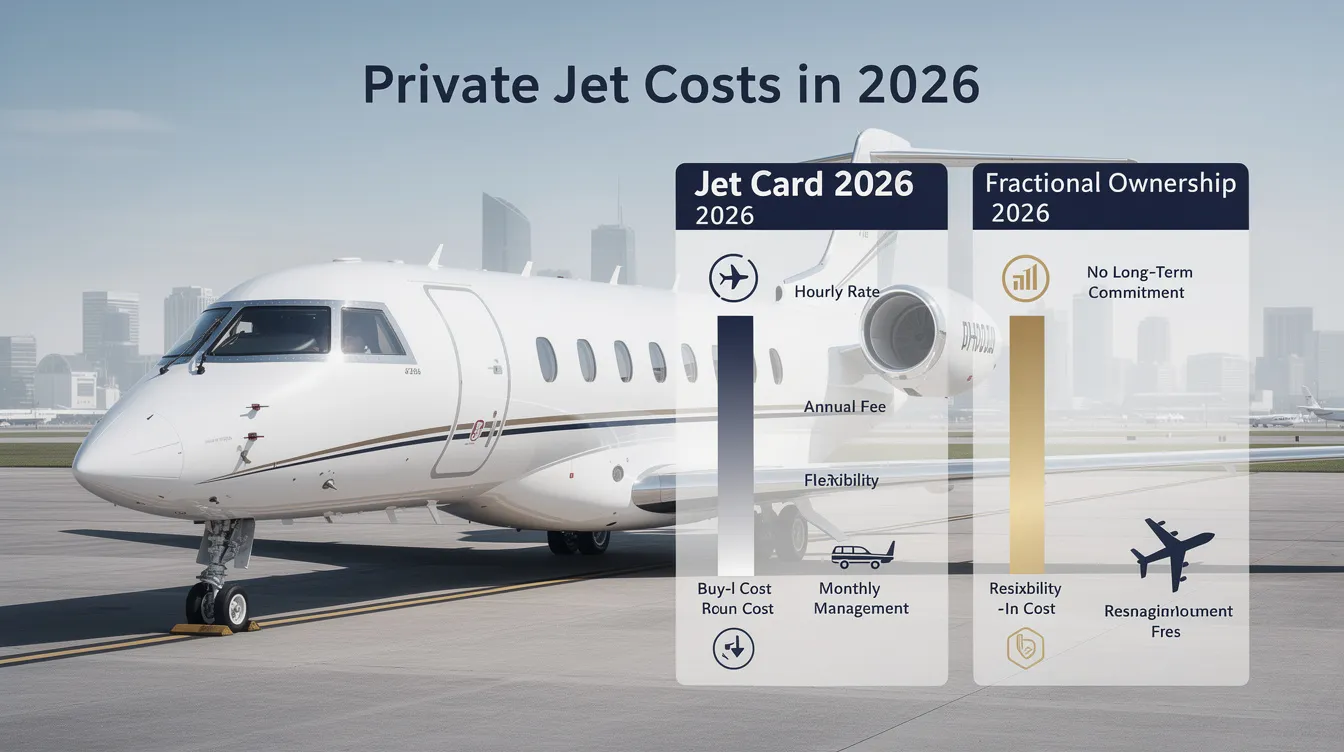
In 2026, private jet access options include jet cards and fractional shares, each with distinct cost structures. Jet cards offer prepaid flight access without ownership, typically involving lower upfront costs and no monthly fees, while fractional shares require significant upfront capital, monthly management fees, and hourly operating charges tied to a multi-year contract. Cost comparisons should consider four key buckets: upfront funds, recurring fees, hourly charges, and contract terms, as well as factors like peak-day surcharges and minimum billing rules. Ultimately, the choice between these options depends on individual flying frequency, budget, and desired flexibility, with Jettly providing a platform for transparent comparisons and bookings.
Jay Franco Serevilla
Jul 9, 2026
|
5
min read


View all
Private jet travel has transitioned from a luxury to a practical option for those valuing time and convenience, allowing passengers to avoid airport crowds and customize their schedules. Hourly rates for private jet rentals range from $2,000 to $20,000, depending on aircraft type and additional services, with various options available from turboprops to ultra-long-range jets. Key factors influencing costs include aircraft size, flight distance, peak travel times, and optional services, which can lead to hidden fees. Understanding these elements and utilizing platforms like Jettly can help travelers make informed decisions and optimize their private jet experience.
Jay Franco Serevilla
Sep 3, 2025
|
5
min read

View all
Private jets offer a luxurious and efficient travel experience, with their weight significantly impacting performance, safety, and operational costs. They are categorized by weight, ranging from Very Light Jets (under 10,000 pounds) to Heavy Jets (over 100,000 pounds), each designed for specific travel needs and passenger capacities. Understanding the maximum take-off weight (MTOW) is crucial for optimizing range, fuel efficiency, and compliance with safety regulations. As the private aviation market continues to evolve, factors such as weight management and environmental impact are increasingly important for both owners and operators.
Jay Franco Serevilla
Sep 3, 2025
|
5
min read

View all
Airplane insurance is essential for private jet owners, providing financial protection against liabilities and damages, and its cost varies based on factors such as aircraft type, pilot experience, and intended use. Smaller, single-engine planes generally have lower premiums compared to larger, multi-engine aircraft, while comprehensive coverage options like liability and hull insurance are crucial for safeguarding investments. To manage costs, owners can increase pilot experience, choose higher deductibles, and shop around for competitive quotes. Regular maintenance and a clean safety record can also lead to reduced premiums, ensuring peace of mind for aircraft owners and operators.
Jay Franco Serevilla
Sep 3, 2025
|
5
min read

View all
Chartering a private jet to Morocco offers a luxurious travel experience characterized by comfort, exclusivity, and personalized service, allowing travelers to bypass the hassles of commercial flights. Morocco's diverse attractions, from the vibrant cities of Marrakech and Casablanca to the serene landscapes of the Sahara, make it an appealing destination for both adventure and relaxation. Private jet services provide seamless access to various Moroccan cities and remote locations, ensuring tailored itineraries and high-end amenities throughout the journey. With a focus on safety and discretion, private aviation in Morocco is supported by well-developed infrastructure and dedicated services for luxury travelers.
Jay Franco Serevilla
Sep 3, 2025
|
5
min read

View all
Plane sharing offers travelers and aviation enthusiasts a cost-effective and flexible alternative to full aircraft ownership, allowing access to premium jets without the associated financial burdens. Participants benefit from reduced predictable costs, access to a diverse fleet of aircraft, and opportunities for networking within a community of like-minded individuals. This model enhances convenience with faster bookings, personalized services, and predictable pricing structures, making private aviation more accessible. Overall, plane sharing bridges the gap between traditional ownership and commercial flying, providing a balanced solution for those interested in private aviation.
Jay Franco Serevilla
Sep 3, 2025
|
5
min read

View all
Privately owned planes, including various categories such as very light jets, light jets, and executive airliners, offer significant advantages over commercial aviation, including enhanced comfort, flexibility, and privacy. These aircraft can be tailored to specific travel needs, accommodating different passenger capacities and ranges, while also allowing for direct access to smaller airports. The growth of private aviation is driven by increasing demand for personalized travel solutions, with options for ownership, chartering, or fractional ownership available to meet diverse requirements. Companies like Jettly facilitate access to private jets, ensuring a seamless travel experience that prioritizes convenience and luxury.
Jay Franco Serevilla
Sep 3, 2025
|
5
min read
Explore our latest articles and updates.

5
min read
How Fractional Jet Ownership Works: The Complete Guide
Fractional jet ownership allows individuals or companies to purchase a share of a specific aircraft, typically ranging from 1/16 to 1/2, granting them a proportional number of flight hours annually and access to equivalent aircraft when their own is unavailable. This model provides the benefits of private jet travel, including professional management and operational ease, while reducing the financial burden compared to full ownership. Owners can expect to fly between 50 to 400 hours per year, depending on their share size, and the management company handles all operational aspects under FAA regulations. While fractional ownership requires a significant initial investment and ongoing fees, it offers equity and flexibility, making it suitable for frequent flyers, whereas those flying less may prefer alternatives like jet cards or charter services.
Read More
5
min read
Fractional Jet Ownership Cost: The Complete Pricing Breakdown
Fractional jet ownership in 2026 typically requires an upfront investment of $500,000 to over $1.5 million for a share, along with monthly management fees ranging from $8,000 to $25,000 and hourly flight costs of $4,000 to $9,000, leading to total five-year costs that can exceed $1 million. The structure includes various fees such as acquisition costs, management fees, fuel surcharges, and depreciation, making it essential for potential buyers to understand the complete financial implications. While fractional ownership offers flexibility and access to aircraft, it may not be cost-effective for those flying under 150 hours annually, where alternatives like jet cards could provide better value. A thorough analysis of all costs and usage patterns is crucial for informed decision-making in private aviation investments.
Read MoreJoin our community and receive the latest blog updates directly in your inbox.
MEMBERSHIPS AND ASSOCIATIONS



Disclaimer: Jettly operates as a charter broker, offering access to a global digital jet charter marketplace. Jettly is not a direct air carrier and does not own or operate aircraft. All advertised flights are conducted by third-party air carriers that are fully licensed and hold the appropriate Part 135 or Part 121 certifications issued by the Federal Aviation Administration (FAA) or equivalent regulatory authorities under U.S. or foreign law. Jettly complies fully with the U.S. Department of Transportation's Part 295 and Part 298 Charter Broker regulations. Jettly does not carry additional liability insurance. Passengers are covered by aircraft operator insurance. TICO: 50023770


