


Login
Get Instant Pricing On 23,000+ Aircraft


Wisconsin Jet Charter with Jettly offers a convenient and flexible alternative to commercial flights, providing access to over 20,000 aircraft for private travel. Whether for business or leisure, travelers can book flights quickly and enjoy a personalized experience without the hassles of crowded airports. With transparent pricing and a variety of aircraft options, Jettly simplifies the private aviation experience in Wisconsin.
Jay Franco Serevilla
Sep 7, 2026
|
5
min read



View all
Most commercial planes fly between 9 to 12 km, while private jets can reach up to 15.5 km. The chosen altitude balances fuel efficiency, safety, and passenger comfort. Understanding these heights helps travelers appreciate the dynamics of air travel and optimize their flight experience.
Jay Franco Serevilla
Sep 12, 2026
|
5
min read

View all
Travel insurance for airfare is crucial for protecting your investment in non-refundable tickets against cancellations and delays. Whether you're flying commercially or chartering a private jet, understanding the nuances of flight insurance can save you from significant financial loss. This guide covers what flight insurance entails, its benefits, and when it's worth purchasing.
Jay Franco Serevilla
Sep 12, 2026
|
5
min read

View all
This article compares Vonlane, a luxury motorcoach service in Texas, with Jettly, a private jet charter platform. While Vonlane offers a comfortable and convenient ground travel experience, Jettly provides flexibility and privacy for air travel. Discover which option suits your travel needs best.
Jay Franco Serevilla
Sep 12, 2026
|
5
min read

View all
Traveling from New York to Miami offers various options including flights, driving, buses, and private jets. The distance is approximately 1,280 miles by road and 1,090 miles by air, with direct flights taking about 3 to 3.5 hours. This guide provides insights on travel times, costs, and the best ways to plan your journey.
Jay Franco Serevilla
Sep 12, 2026
|
5
min read

View all
Traveling from New York to Miami offers various options, including direct flights, driving, and private jet charters. The aerial distance is about 1,090 miles, while driving spans approximately 1,280–1,300 miles. This guide provides insights into travel times, costs, and the best routes for your journey.
Jay Franco Serevilla
Sep 12, 2026
|
5
min read

View all
The flight time from New York to Aruba typically ranges from 4 hours 30 minutes to 5 hours, with an average of about 4 hours 43 minutes. Factors such as departure airport and flight type can significantly affect total travel time, especially when considering connecting flights. For those seeking convenience, private jet charters can offer similar in-air times while reducing overall travel duration.
Jay Franco Serevilla
Sep 12, 2026
|
5
min read
Explore our latest articles and updates.
5
min read
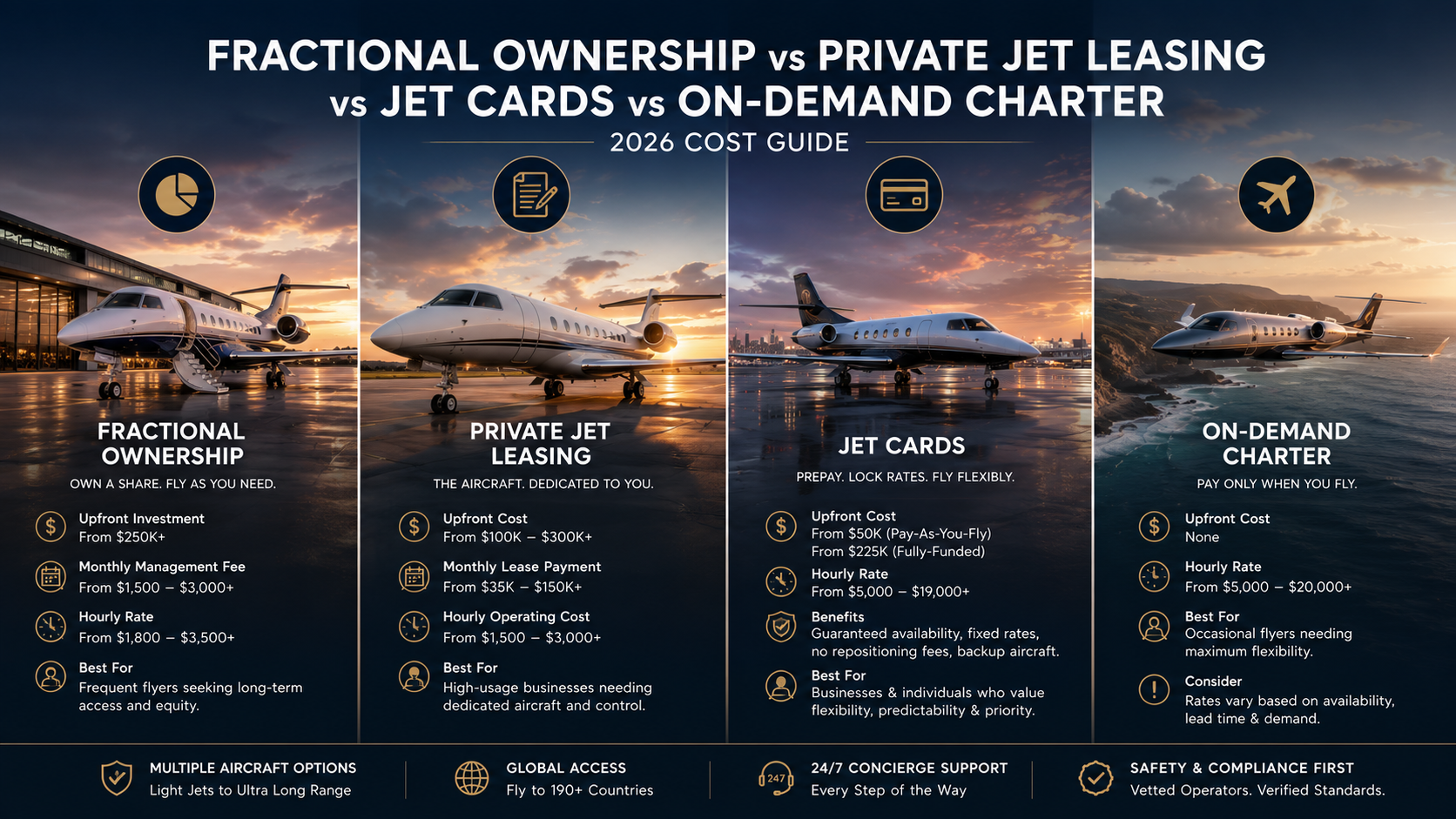
Fractional Ownership vs Private Jet Leasing vs Jet Cards vs On-Demand Charter (2026 Cost Guide)
Navigating private jet access models can be complex, with options like fractional ownership, leasing, jet cards, and on-demand charter each offering unique pricing structures. Understanding these models is crucial for making informed decisions based on your flying habits and financial commitments. This guide breaks down the costs and benefits of each option, helping you choose the best fit for your travel needs.
Read More
5
min read
Guaranteed Availability vs Marketplace Availability (2026): Lead Times, Peak Days, Callout Windows & Backup Aircraft
In private aviation, guaranteed availability offers a contract-backed promise for aircraft access, while marketplace availability provides real-time access to a larger fleet based on supply and demand. Understanding the differences in lead times, peak days, and backup aircraft options is crucial for making informed decisions. This guide breaks down the nuances of both models to help you choose the best fit for your flying needs.
Read MoreJoin our community and receive the latest blog updates directly in your inbox.
MEMBERSHIPS AND ASSOCIATIONS



Disclaimer: Jettly operates as a charter broker, offering access to a global digital jet charter marketplace. Jettly is not a direct air carrier and does not own or operate aircraft. All advertised flights are conducted by third-party air carriers that are fully licensed and hold the appropriate Part 135 or Part 121 certifications issued by the Federal Aviation Administration (FAA) or equivalent regulatory authorities under U.S. or foreign law. Jettly complies fully with the U.S. Department of Transportation's Part 295 and Part 298 Charter Broker regulations. Jettly does not carry additional liability insurance. Passengers are covered by aircraft operator insurance. TICO: 50023770


