


Login
Get Instant Pricing On 23,000+ Aircraft

>
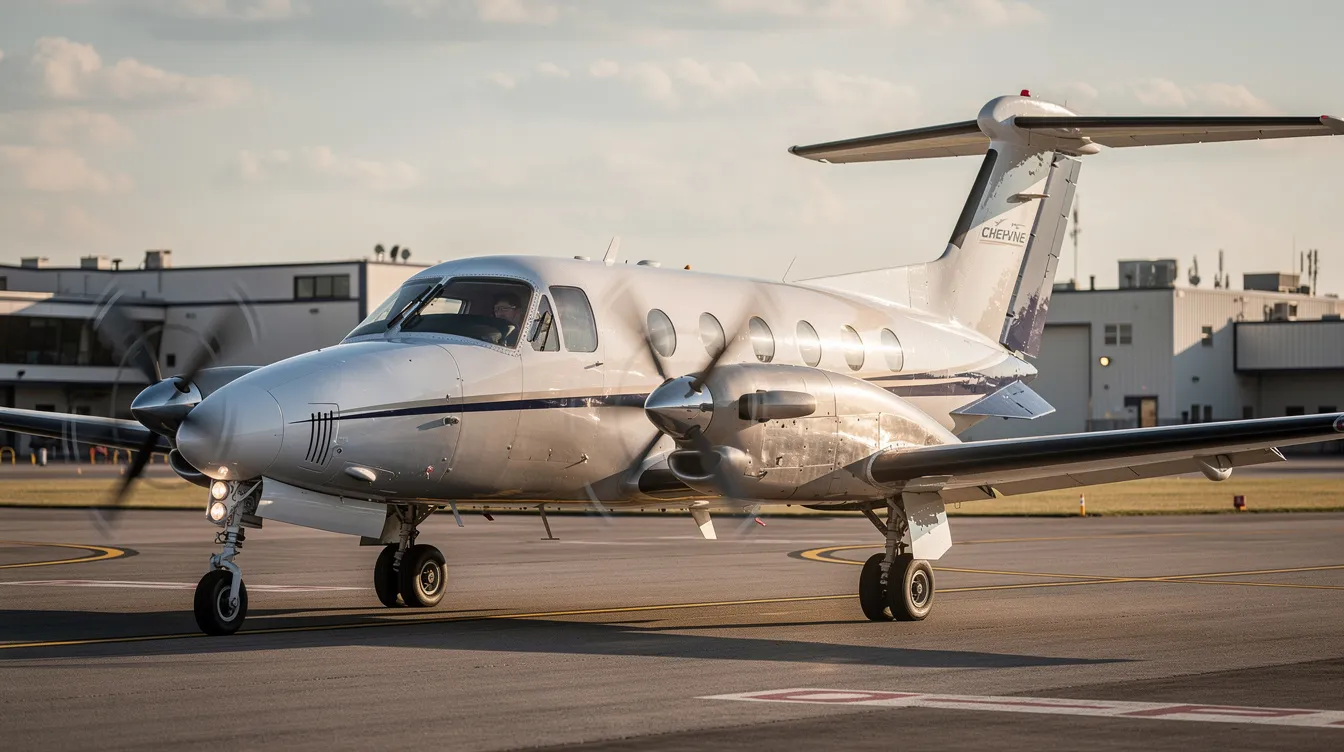
The Piper Cheyenne remains one of the most capable turboprop families available for private charter. Designed as a high-performance, cost-effective alternative to early corporate jets, it continues to serve business travelers, families, and executive charter operators across the USA and beyond. Here's what charter customers should know before booking one through Jettly.
The Piper Cheyenne family spans the PA 31T and PA 42 platforms, covering models from the Cheyenne I through the Cheyenne 400LS, with speeds ranging from 270 knots to 379 mph depending on the variant.
Cheyenne models seat between five and eight passengers in pressurized, club-configured cabins, making them practical for regional business hops and family travel between secondary airports.
Compared to the King Air and many light jets, Cheyennes often deliver competitive cruise speeds at a lower acquisition and charter price, especially on routes under 1,300 nautical miles.
Common use cases include same-day multi-city trips, corporate shuttles, cargo and medevac missions due to the airplane's rugged design, and flights into airports with short runways.
Jettly offers on-demand access to various models of Cheyenne aircraft with instant pricing at https://www.jettly.com.
The Piper Cheyenne is a family of twin-engine turboprops developed by Piper Aircraft, the company behind the Cheyenne family, from the early 1970s through the early 1990s. It was Piper's first turboprop aircraft, following earlier iconic models such as the Piper Cub, and it grew out of the PA-31 Navajo/Chieftain piston twin platform into the PA 31T and PA 42 series, targeting the business aviation and air taxi market.
The primary models, in order of production, are: Cheyenne I (PA 31T), Cheyenne II, Cheyenne IIXL, Cheyenne IA, Cheyenne III (PA 42-720), Cheyenne IIIA, and Cheyenne IV / 400LS (PA 42-1000). These pressurized turboprops typically seat six to eight people in a club arrangement, positioned squarely between piston twins and light jets in the class hierarchy. Many Cheyennes are still operated on charter and corporate fleets and are available through Jettly's global aircraft inventory for on-demand flights.
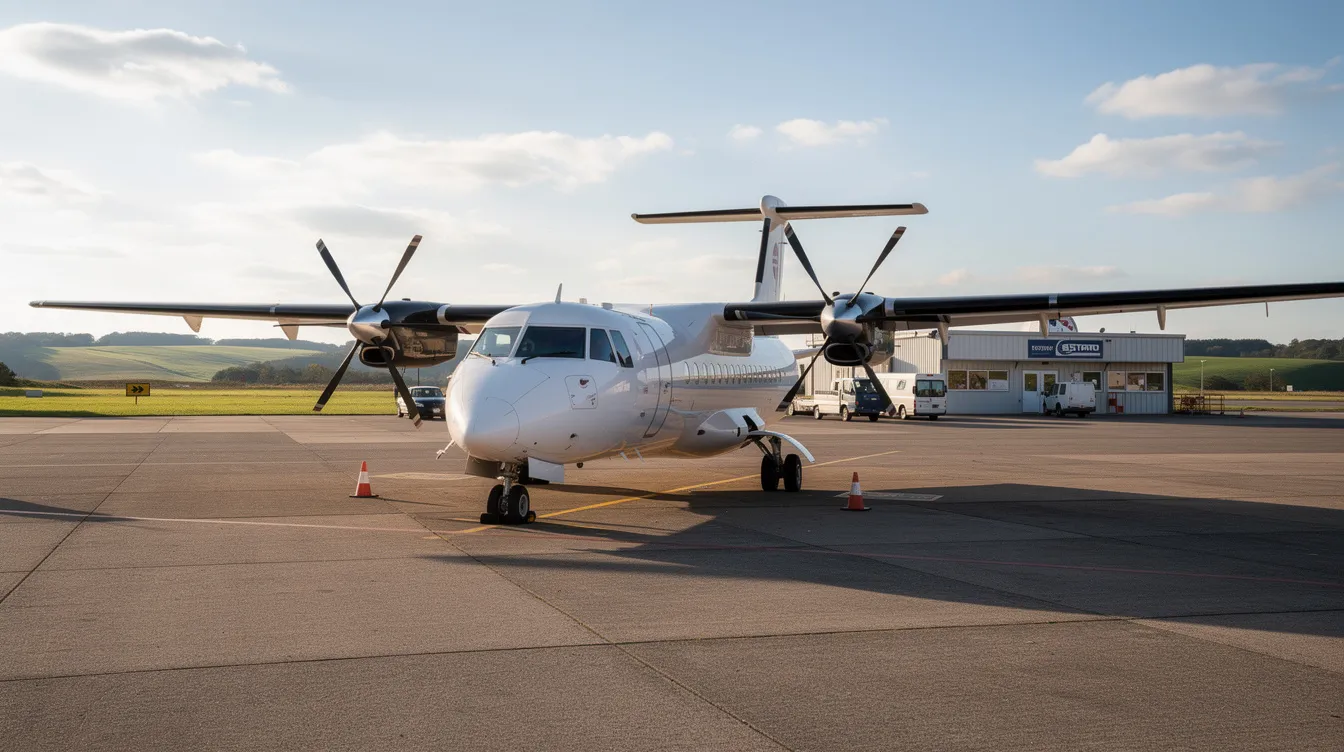
Piper Aircraft's move from piston twins to turboprops in the early 1970s was driven by demand for faster, pressurized business travel and competition from the Beechcraft King Air. Piper introduced the Cheyenne in the mid-1970s. The Cheyenne I, powered by Pratt & Whitney Canada PT6A engines, known industry-wide for their durability, offered a significant change over the Navajo for up to seven passengers.
The Cheyenne II followed with more powerful engine options and performance improvements. The IIXL added a stretched fuselage and higher maximum takeoff weight, increasing payload and cabin comfort. The Cheyenne IA, manufactured from 1983 to 1985, refined engine cowlings and airflow without changing the PT6A powerplants, gaining roughly 10–12 knots in cruise.
In 1979, Piper moved forward with the larger PA 42 fuselage and its distinctive T-tail. The Cheyenne III and later IIIA were longer-range, higher-capacity models. Piper delivered only 149 Cheyenne III and IIIA models from 1980 to 1993. The Cheyenne IV (PA 42-1000), certified in 1984 and later branded the 400LS, used Honeywell TPE331 engines to rival light jets like the Citation in speed and climb performance.
Piper faced bankruptcy and ownership changes during Cheyenne production, which contributed to the line winding down by the early 1990s. Despite this aviation history, the aircraft remain popular in the pre-owned and charter market thanks to strong performance and competitive value.
Below is a quick reference comparing major Cheyenne variants on the factors that matter most for charter customers.
|
Model |
Cruise Speed (knots) |
Max Range (nm) |
Passenger Capacity |
Max Takeoff Weight (lbs) |
Engine Power (shp) |
Cabin Length (ft) |
Notes |
|---|---|---|---|---|---|---|---|
|
Cheyenne I |
260–280 |
~1,000–1,150 |
5–7 |
~11,200 |
PT6A series |
~10.9 |
First turboprop model |
|
Cheyenne IA |
~240 (277 mph) |
~1,070 |
5–6 |
Similar to Cheyenne II |
PT6A with improved cowlings |
10.9 |
Improved airflow, slightly faster |
|
Cheyenne IIXL |
270+ |
~1,150+ |
6–7 |
Higher than I/II |
PT6A series |
Longer than II |
Stretched fuselage, higher MTOW |
|
Cheyenne III |
290 |
1,300 |
Up to 7 |
11,200 |
720 shp PT6A |
Longer fuselage |
Certified for single-pilot ops |
|
Cheyenne IIIA |
Slightly faster |
Similar to III |
Up to 7 |
Similar to III |
Dash 61 engines |
Similar to III |
Higher maintenance costs |
|
Cheyenne 400LS |
329+ |
1,600 |
7–8 |
Higher MTOW |
Honeywell TPE331 |
Largest cabin |
Light jet rival, higher speed |
The Cheyenne I and Cheyenne II (PA 31T) cruise in the 260–280 knot range, with maximum range around 1,000–1,150 nautical miles depending on loading. Cabins are typically configured for five to seven passengers. The Cheyenne IA has a maximum speed of 277 mph and seats five to six in a club-plus-single-seat layout, supporting trips around 1,000 miles.
The Cheyenne IIXL features a stretched fuselage, improved takeoff weight, and better runway performance-ideal for short regional runways and higher payload missions, allowing operators to carry passengers farther with full seats.
The Cheyenne III and IIIA (PA 42-720) cruise at 290 knots at 22,000 feet, with Cheyenne III engines generating 720 shaft horsepower each. The Cheyenne III has a range of 1,300 nautical miles with four passengers, is certified for a maximum takeoff weight of 11,200 pounds, and has a total usable fuel capacity of 578 gallons, with some aircraft also using tip tanks as part of the fuel-capacity and range equation. The Cheyenne III can be equipped for single-pilot operations, and cabin configurations seat up to seven passengers.
The Cheyenne 400LS (PA 42-1000) pushes cruise speeds past 329 knots, rivaling early light jets, with a maximum range reaching 1,600 nautical miles under light loading. The Piper Cheyenne can operate at altitudes up to 35,000 feet across various models, and the Cheyenne III and 400LS variants feature significantly improved cabin altitude and performance. Overall, the range of the Cheyenne typically spans from 1,000 to 1,600 nautical miles across the series. These specs place Cheyenne models between larger King Air variants and entry-level jets, a useful context for customers comparing aircraft on Jettly's platform using tools like Jettly's private jet charter cost estimator.
The Cheyenne's fuselage is narrower than that of the King Air, affecting cabin space, and the model is often characterized by lower-quality interior finishes compared to the King Air in factory-original condition. That said, many chartered Cheyennes today feature upgraded leather interiors, refreshed sidewalls, and modern amenities.
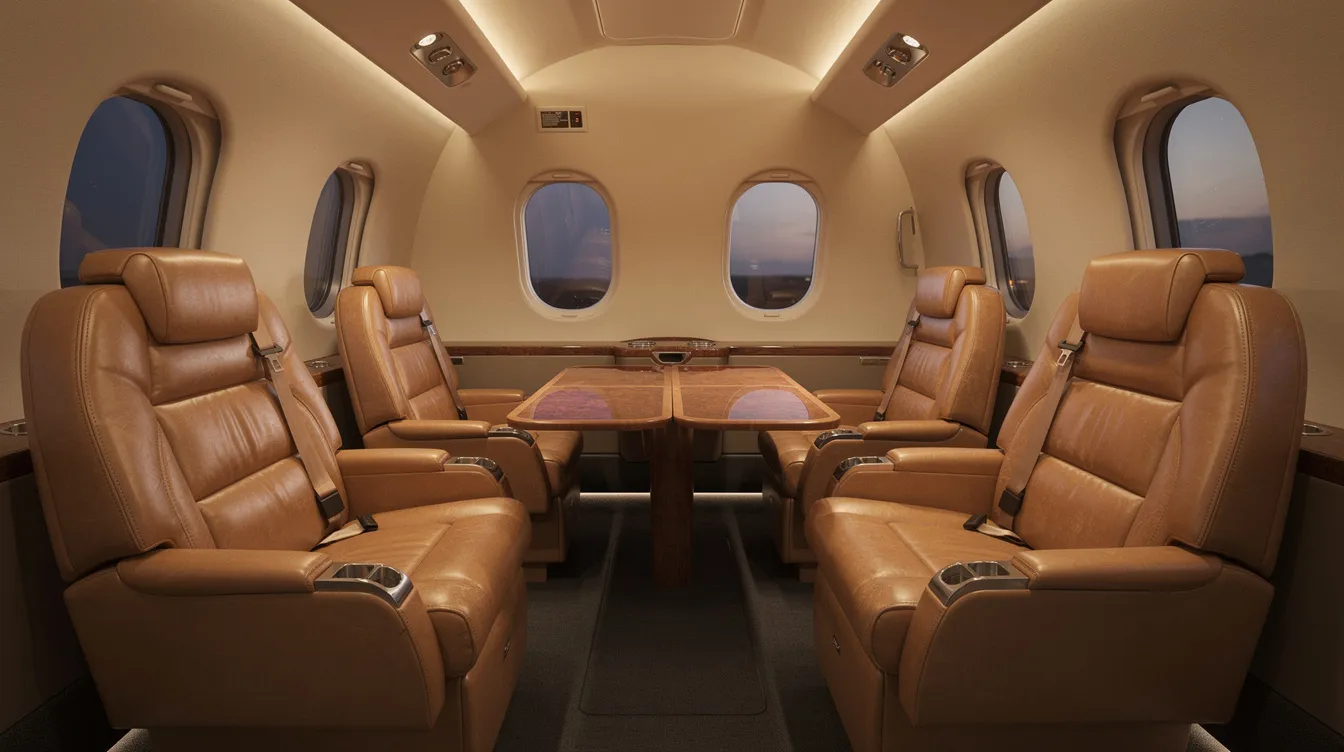
The Cheyenne IA cabin measures 10.9 feet long by 4.2 feet wide. Cheyenne aircraft typically seat six to eight passengers in a club arrangement with facing pairs, fold-out tables, and aft single seats. Passengers can sit upright comfortably, but cannot fully stand as in larger cabin-class aircraft. The Cheyenne series provides turboprop speed and cabin-class comfort at a lower acquisition cost, and pressurization combined with improved soundproofing makes the cabin suitable for laptop work and conversations on typical one-to-three-hour sectors. Jettly coordinates ground transportation and in-flight catering through Jettly Eats to keep the trip seamless, whether you're flying a Cheyenne on a short regional hop or booking private jet charter services to Chennai, Tamil Nadu, for longer international itineraries.
The Cheyenne is known as an airplane with a superior cost-to-performance ratio compared to competitors, making it a strong candidate for price-sensitive charter customers. Cruise speeds in the high-200-knot range (higher for the 400LS) and quick climb performance translate to efficient point-to-point times on routes up to 1,300 nautical miles. Many pilots require recurrent training for high-altitude operations in the Cheyenne, which keeps crew proficiency high.
Turboprop fuel efficiency at typical Cheyenne altitudes often results in lower hourly charter rates and fuel burn compared to small jets on similar stage lengths, a key theme in Jettly's guide to affordable private jet charter costs and pricing factors and its jet card flight cost estimator. Cheyenne III maintenance costs can exceed $200 per hour, but those costs are still $50 to $100 less than King Air maintenance on comparable models. Common upgrades for the Cheyenne cost between $6,200 and $200,000, covering avionics, propellers, engines, and interior refurbishment. For prospective owners, understanding private jet operating costs in detail is essential when comparing Cheyenne ownership to on-demand charter, especially given that most Cheyenne airframes have 3,600 to 6,000 flight hours, and Cheyenne parts availability can delay maintenance by weeks, a reality that makes vetted charter operators, who manage these logistics proactively, a smarter choice than ownership for many travelers.
Many Jettly users cross-shop the Piper Cheyenne with Beechcraft King Air turboprops and entry-level jets like early Citation models. King Air aircraft generally offer a slightly wider and taller cabin and broader parts support, while Cheyennes often deliver higher cruise speeds and lower acquisition prices on the pre-owned market.
Both Cheyenne and King Air 90/200 series typically carry six to eight passengers, but King Air B200 variants provide more headroom and baggage capacity for longer trips. The Cheyenne is popular for charter services, providing a balance of speed and comfort, and it is frequently used for cargo and medevac missions due to its rugged design. For longer or more luxurious itineraries, travelers might instead select a large-cabin jet such as a Gulfstream G-IVSP private jet for rent. The Cheyenne is also often used for corporate transport due to its pressurized cabin.
For Jettly customers: consider Cheyenne models for short-to-medium regional legs with small groups prioritizing cost efficiency, and consider King Air or light jets when more cabin volume or higher cruise altitudes on longer itineraries matter. Jettly's instant pricing tools allow users to compare Cheyenne options alongside King Air and jet alternatives on specific routes, including dedicated services for private jet charter in Kolkata, West Bengal, and other major business hubs.
Jettly functions as a digital private charter marketplace, giving users access to Piper Cheyenne aircraft worldwide and positioning itself as a flexible alternative to fractional ownership providers like NetJets while also offering resources that explain how NetJets works and why it's considered an industry leader. The typical booking flow: enter your route and dates, view instant pricing, filter for turboprops or specific types like the PA 31T or PA 42, then review aircraft profiles-including photos, cabin layouts, and performance data on the spec page-before confirming.
On-demand charter via Jettly lets travelers fly without long-term commitments, jet cards, or fractional ownership contracts, and is well-suited to those comparing different ways to buy just a seat on a private jet rather than chartering an entire aircraft every time. Jettly works with certified operators and vetted crews, ensuring compliance with relevant aviation regulations while also enabling travelers to crowdsource flights and share empty seats on certain routes to reduce per-passenger costs, often by leveraging discounted empty leg flights on Jettly when aircraft reposition without a full payload. Common trip profiles suited to the Cheyenne include corporate shuttles, family trips to secondary airports, and same-day meetings across multiple cities, including routes into busy capitals served by Jettly's private jet charter services in New Delhi. Additional services such as ground transfers, tailored catering, and schedule changes are available to maximize convenience, similar to the support offered when chartering through Dexter Air Taxi's private jet services on Jettly.
Some readers may consider purchasing a Cheyenne, but many business and private individuals can achieve similar benefits through Jettly's on-demand or membership-based access. Ownership costs for a Cheyenne II or PA 42 include acquisition, hangar, crew, insurance, maintenance, upgrades, and fuel. Annual operating costs can exceed seven figures, depending on utilization. A pre-buy inspection for a Cheyenne costs $5,400, including flight test, and maintenance complexity increases with older airframes in areas like pressurization and avionics.
On-demand charter eliminates capital outlay and long-term commitments. Owners who sold their aircraft and switched to charter often cite freedom from depreciation, hangar fees, and parts sourcing headaches. Frequent flyers who value predictable budgeting can explore Jettly's private jet membership options or compare them with fractional jet ownership pros and cons to reduce per-flight costs while avoiding the administrative burden of aircraft ownership.
Turboprops like the Piper Cheyenne generally burn less fuel per mile on short-to-medium routes than comparable jets, reducing overall emissions for similar missions. Using smaller airports closer to final destinations cuts ground transfer times and total trip carbon footprint. Some operators on Jettly's platform offer carbon offset programs, and resources on affordable aircraft rental costs and options, and broader guides to how much a private jet really costs can help travelers choose efficient aircraft types for their missions. Selecting the right size aircraft for the passenger count, such as a Cheyenne rather than a larger jet for a three-to-five person regional trip, is both cost-effective and more efficient from an environmental standpoint.
Most Piper Cheyenne models used for charter seat between five and eight passengers, depending on the variant and interior configuration. The Cheyenne I and II typically accommodate five to seven passengers, while the Cheyenne III and 400LS can seat up to seven or eight passengers in club arrangements. Jettly's aircraft profiles show exact seating layouts so customers can confirm capacity before booking.
Cheyennes are ideal for regional trips of roughly 300–1,000 nautical miles, where cruise speeds in the high-200-knot range and turboprop efficiency keep total travel time and cost attractive, whether booked as shared charter flights or full aircraft charters. They perform particularly well at airports with shorter runways or limited infrastructure where some jets cannot operate, especially when flown by properly vetted Part 135 charter operators. Tools like Jettly's airport locator for private charter flights make it easier to identify these smaller fields, and their wing design also helps support efficient performance on these regional missions.
Cheyennes have a solid safety record comparable to other certified turboprops when operated and maintained correctly. Safety comparisons cited by Robert E. Breiling & Associates generally place them in line with similar turboprop aircraft. Jettly works only with licensed operators that meet local regulatory standards, and many Cheyennes in charter service today are equipped with modern avionics, navigation, and safety upgrades, supported by advanced private jet tracking tools and airport locator services that enhance operational oversight.
Hourly charter rates for Cheyennes are often lower than for comparable King Air models and significantly less than many light jets on short-to-medium routes. Customers can use Jettly's instant pricing tools to compare real-time quotes for Cheyennes, King Airs, and jets on the same itinerary.
Subject to fleet availability, users can filter or request specific aircraft families like the PA 31T Cheyenne II or PA 42 Cheyenne III when submitting a charter request. You can also compare similar Piper types, such as the Piper Aerostar 600 or Piper Matrix, when deciding which aircraft best fits your needs, or consult a broader overview of the best private plane manufacturers for different budgets if you're open to alternatives beyond Piper. Training and maintenance support can vary by operator, including support networks in Florida. Mention preferences such as seating capacity, desired range, or avionics upgrades so Jettly can match you with the most suitable Cheyenne or alternative aircraft.
When requesting a Piper Cheyenne through Jettly, customers can specify preferences such as seating capacity, desired range, or avionics upgrades. This helps the platform match travelers with the most suitable Cheyenne model or suggest alternative aircraft that meet their needs. Whether prioritizing passenger comfort, extended range for longer trips, or modern cockpit technology, Jettly's system provides tailored options to ensure an efficient and comfortable flight experience, similar to the selection process outlined in guides to the best private jet charter companies and how to choose.
The Piper Cheyenne series-spanning the PA 31T and PA 42 platforms, including the Cheyenne I, Cheyenne IA, Cheyenne II, Cheyenne III, and Cheyenne 400LS, offers an attractive mix of speed, range, and cost for regional private travel. In many cases, Cheyennes compete directly with King Airs and light jets, giving travelers more flexibility and value on typical business and leisure routes.
Consider your mission profile, distance, passenger count, baggage, and budget when deciding whether a Cheyenne or another turboprop or jet category fits best.
Ready to experience private travel on your terms? Explore Piper Cheyenne charter availability, compare aircraft types, and request instant pricing at https://www.jettly.com, consider instant-book partners like Zenflight's private jet operator marketplace, or review a broader guide to private and charter airlines if you're still learning how the industry works.
Share this post:
Jay Franco Serevilla
Jun 15, 2026
|
5
min read
Discover tips and trends in the industry.

5
min read
Plane Tickets NYC to Miami: Your Complete Guide (Commercial & Private)
This comprehensive guide covers everything you need to know about booking plane tickets from NYC to Miami, including commercial and private flight options. It highlights key airports, airlines, pricing strategies, and tips for finding the best deals. Whether you're traveling for business or leisure, understanding your options can enhance your travel experience.
Read More
5
min read
Medical Air Insurance: How Air Ambulance Coverage Works and When You Need It
Medical air insurance is essential for covering the high costs of emergency air ambulance transport, which can range from $10,000 to over $100,000. It supplements traditional health insurance, providing coverage in situations where ground transport is inadequate. Understanding the differences between medical air insurance, air ambulance memberships, and travel insurance is crucial for comprehensive protection during medical emergencies.
Read MoreStay updated with our latest insights and tips to elevate your journey with us.
MEMBERSHIPS AND ASSOCIATIONS



Disclaimer: Jettly operates as a charter broker, offering access to a global digital jet charter marketplace. Jettly is not a direct air carrier and does not own or operate aircraft. All advertised flights are conducted by third-party air carriers that are fully licensed and hold the appropriate Part 135 or Part 121 certifications issued by the Federal Aviation Administration (FAA) or equivalent regulatory authorities under U.S. or foreign law. Jettly complies fully with the U.S. Department of Transportation's Part 295 and Part 298 Charter Broker regulations. Jettly does not carry additional liability insurance. Passengers are covered by aircraft operator insurance. TICO: 50023770


