


Login
Get Instant Pricing On 23,000+ Aircraft

>

Do you frequently travel, or are you looking for more privacy and luxury during your flights? Private jets are convenient and comfortable options for travel. Depending on your needs, you can book flights through a private jet card program or have fractional ownership.
Here are some pros and cons of each option to help you make an informed decision.
A jet card program is a membership with a chartering company. You can pre-purchase hours and use them throughout the year to fly within your chartering service area. Many jet cards sell hours in groups of 25. They also often come with discounts, rewards, and other membership perks.
Jet card programs work best for frequent fliers because you are usually required to buy an hourly minimum for each year.
Private jet fractional ownership is when you own a share of a private jet. The share’s fraction equals the fraction of flying hours you can use throughout the year. Most shares are between 1/16 and ½, and you own the share for a contract period of about five years.
For example, if you owned a ¼ share of a jet, you would be allowed 200 of the average 800 flight hours private jets offer each year.
However, when you purchase a share from a jet provider, you often do not own a fraction of a specific jet. Instead, you may end up flying on whichever plane is closest to your location to make your flight more convenient for you.
At the end of your five-year term, you can either sign another contract or allow your provider to repurchase your share back.
Jet card programs aren’t as expensive as private jet fractional ownership. You pay per hour that you are flying, along with a few extra fees like fuel charges and taxes that vary by program. While the cost per hour differs widely from one program to the next and by aircraft type, you can expect to pay on average about $5,000 an hour as a starting rate for a light aircraft.
Jet ownership is more expensive. Initially, you will buy a share at an equal fraction to the plane’s value. For example, if you buy a ½ share, the share will most likely cost close to half of the plane’s worth. After that payment, you will need to pay upkeep, maintenance, and hanger fees each month. Lastly, you will receive bills for your flight time and additional flight fees such as catering, fuel, and maintenance.
Jet card programs are short-term commitments. Your card works while you have hours available. While many cards’ hours expire after 1-3 years, others allow you to carry over the hours and even receive a refund if you don’t use all the hours.
Private jet fractional ownership is a long-term commitment. On average, you will sign a 5-year contract. As a result, it is only the better option if you know your plans over the next few years.
Jet card programs have varying availability, with some programs like Jettly guaranteeing aircraft within hours while others require advance notice.
Private jet fractional ownership has greater availability, so it is better for those who need the extra reliability of knowing there is always an available last-minute flight. You also have more available destinations.
Each option has its place. For example, if you travel often and need reliable availability, you may want to budget for a private jet fractional ownership. However, if you are a frequent flier but have a predictable schedule that you can plan for ahead of time, you can save some money by using a jet card program instead.
Are you still unsure of the right choice for you? Talk with our team of experts to discuss what services Jettly has to meet your needs.
Share this post:
Justin Crabbe
May 7, 2025
|
5 minutes
min read
Discover tips and trends in the industry.
5
min read
Comprehensive Overview of the Cessna 172S Skyhawk
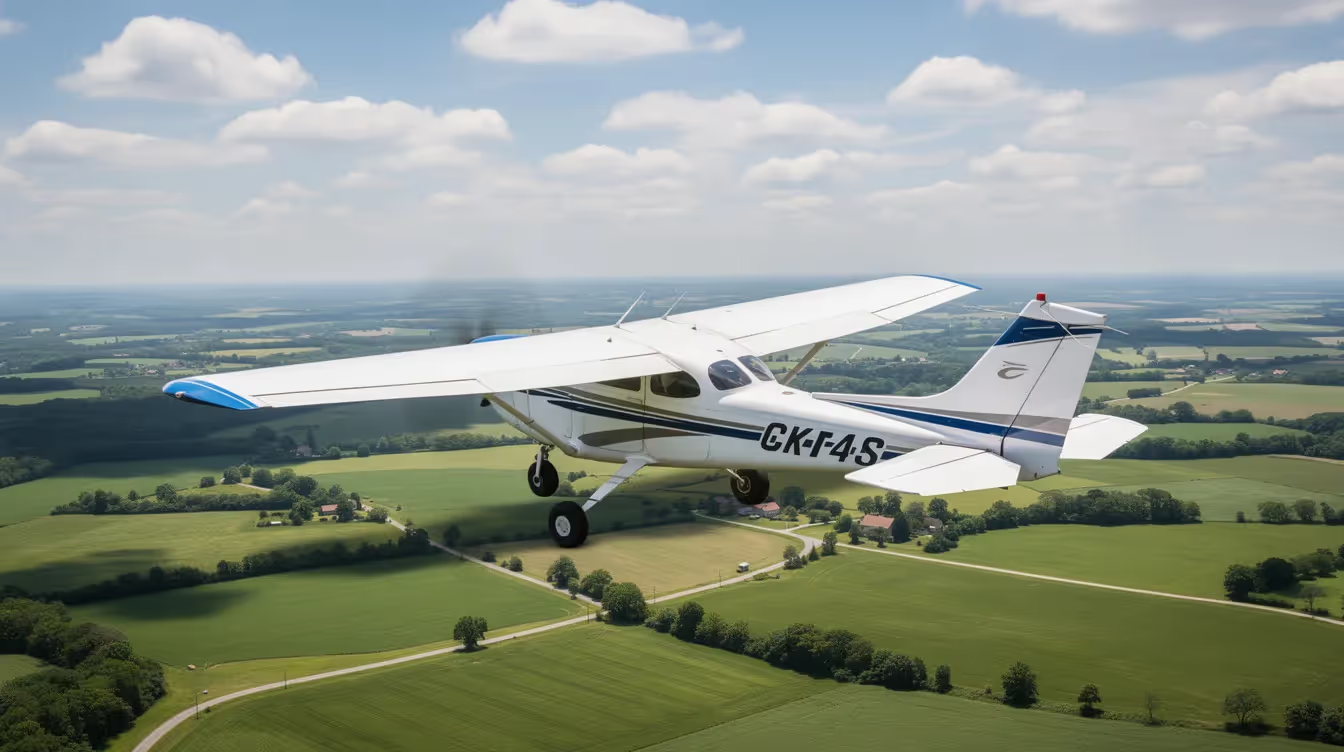
The Cessna 172S Skyhawk is a four-seat, single-engine aircraft known for its reliability and forgiving handling, making it a popular choice for flight training and personal aviation. Introduced in 1998, it features a 180-hp fuel-injected engine and modern Garmin G1000 NXi avionics, enhancing its appeal for both new and experienced pilots. With a cruise speed of 124 knots and a range of approximately 600-680 nautical miles, the 172S is well-suited for training missions and short regional flights. Its extensive production history, with over 44,000 units built, underscores its status as the most produced aircraft in history, ensuring robust support and maintenance availability.
Read More
5
min read
Cessna U206F Stationair Buyer’s Guide & Charter Use Case
The Cessna U206F Stationair is a six-seat, single-engine utility aircraft known for its impressive load capacity and short-field performance, making it ideal for various missions such as air taxi services, medevac, and cargo transport. Produced between 1972 and 1976, it features a high useful load of over 1,500 pounds and a fuel capacity of 92 gallons, with operating costs ranging from approximately $140 to $190 per flight hour. While acquisition costs typically range from $180,000 to $350,000, the U206F remains a popular choice for charter operators due to its rugged capabilities and reliability in demanding environments. Jettly offers a platform for sourcing comparable utility aircraft, facilitating access to the U206F for those needing its unique operational advantages without the commitment of ownership.
Read MoreStay updated with our latest insights and tips to elevate your journey with us.
MEMBERSHIPS AND ASSOCIATIONS



Disclaimer: Jettly operates as a charter broker, offering access to a global digital jet charter marketplace. Jettly is not a direct air carrier and does not own or operate aircraft. All advertised flights are conducted by third-party air carriers that are fully licensed and hold the appropriate Part 135 or Part 121 certifications issued by the Federal Aviation Administration (FAA) or equivalent regulatory authorities under U.S. or foreign law. Jettly complies fully with the U.S. Department of Transportation's Part 295 and Part 298 Charter Broker regulations. Jettly does not carry additional liability insurance. Passengers are covered by aircraft operator insurance. TICO: 50023770


