


Login
Get Instant Pricing On 23,000+ Aircraft

>
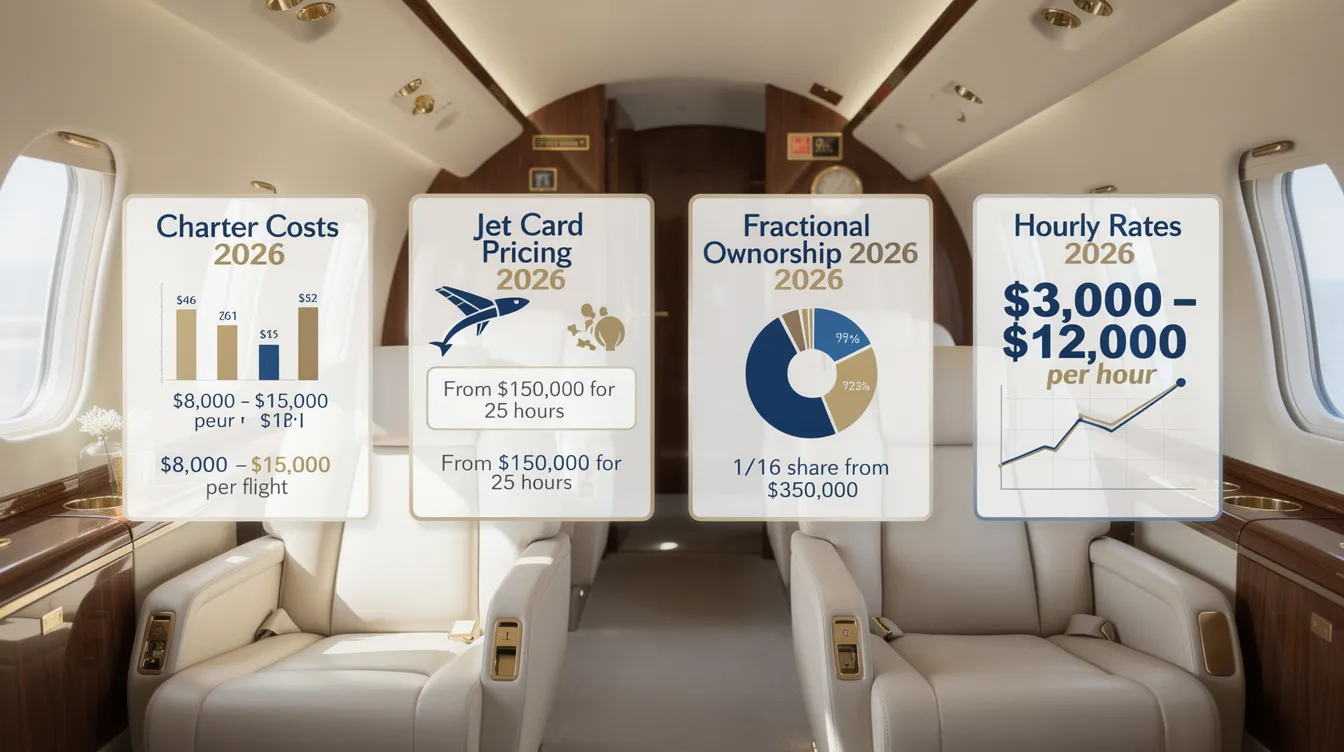
Private jet costs in 2026 split into two simple buckets, what you pay to access aircraft and what you pay per trip. Most pricing pages stop at an hourly rate and leave the rest a mystery. This guide maps every line item to real programs, shows math you can paste into a spreadsheet, and hands you a method to compare two quotes on the same basis. Every number here is anchored to Jettly's published programs, so nothing is hand-waving.
Last updated: July 8, 2026. Written by the Jettly editorial team and reviewed for pricing accuracy by Justin Crabbe, CEO of Jettly.
Here is the fast version, then the detail.
On-demand charter is priced by aircraft category. Jettly's indicative bands run from turboprops at $1,800 to $2,800 per hour up to heavy and ultra-long-range jets at $8,000 to $15,000 and above per hour.
A jet card pre-buys hours at a set hourly model. Jettly's published 25-hour Jet Card is $50,000 plus a one-time $12,997 enrollment fee, with flights billed at an occupied hourly rate starting at $3,528 per hour.
Fractional-style access adds three parts: a license fee, a monthly management fee, and a fixed hourly rate. Jettly Cloud Fraction Light starts at a $325,000 license, $12,000 per month, and $5,250 per hour.
Common per-trip fees include the 7.5% federal excise tax (FET), small per-passenger segment fees, de-icing in winter, overnight crew, and peak-day rules.
Jettly membership programs carry no fuel surcharges and no positioning fees, billed point to point from takeoff to landing.
Two cost layers drive every program. Access costs are fixed: membership dues, enrollment fees, a fractional license, or a monthly management fee. Per-trip costs are variable: billed flight time, taxes and segment fees, and any add-ons. The billing clock matters as much as the rate. Point-to-point billing charges you only for takeoff-to-landing time, where an "all-in including repositioning" model also bills the empty legs flown to reach you. For deeper line-item detail, see our breakdown of private jet operating costs.
The most reliable way to compare private jet costs is to normalize every quote to the same basis: billed flight time, taxes and fees, minimums, and any repositioning or fuel add-ons. All-in pricing means the quote already includes mandatory taxes, fees, and the provider's surcharges, so you can compare providers on equal footing. Industry framing from NBAA treats total cost as a blend of fixed and variable operating economics, the lens this guide uses throughout.
|
Private jet cost components at a glance |
|
|
Fixed (program) costs |
Variable (per-trip) costs |
|---|---|
|
Membership dues or subscription |
Billed flight time (occupied hours) |
|
Enrollment / initiation fee |
Federal excise tax (FET) and segment fees |
|
Fractional license or share cost |
Landing, handling, de-icing |
|
Monthly management fee |
Overnight crew, international handling |
|
Escrowed deposit |
Peak-day surcharges (program dependent) |
Choosing a model is a trade among three things: price predictability, flexibility, and commitment. Fly rarely and on-demand charter keeps you flexible. Fly often and a jet card or fractional-style program trades flexibility for steadier rates and faster access. That trade is what shapes private jet costs across every program below.
On-demand charter means trip-by-trip quotes. Pricing is the most variable because it tracks real-time aircraft availability, route, and date. This suits infrequent flyers or anyone optimizing each mission. Our guide to renting a private jet walks through how a single trip gets quoted.
Flight-based memberships are monthly or annual subscriptions that change your booking fees and access terms. Flights themselves can still be dynamically priced, so your total is the membership cost plus the trip price.
Jet cards pre-purchase hours or deposits for more predictable pricing. Three terms define a card: "hours" (the flight time you bought), "callout" (how much notice you must give), and "expiration" (whether unused hours lapse). Jet cards sit between ad-hoc charter and fractional ownership: you trade some flexibility in terms and policies for more predictable pricing and access.
Fractional ownership, and fractional-style access, layers an ownership-like cost structure on top of flying: a share or license, a monthly management fee, and an occupied hourly fee. Share size sets how many hours you can fly per year, and the term length sets your commitment.
A charter broker arranges flights with certified air carriers that retain operational control; the broker does not operate the aircraft. Jettly is a charter broker marketplace, and every advertised flight is flown by a third-party operator certified under FAA Part 135 or Part 121 (or the foreign equivalent). Jettly complies with U.S. Department of Transportation Part 295 and Part 298 charter broker rules.
|
Four ways to access private aircraft |
||||
|
Model |
Typical commitment |
What's fixed |
What's variable |
Best for |
|---|---|---|---|---|
|
On-demand charter |
None |
Nothing |
Whole trip price |
Infrequent or opportunistic flyers |
|
Flight-based membership |
Monthly/annual, cancelable |
Subscription |
Each trip price |
Regular flyers wanting lower fees |
|
Jet card |
Pre-paid hours/deposit |
Card price + rate |
Hours flown, taxes/fees |
Predictable budgeting, 25 to 75 hrs/yr |
|
Fractional-style |
Multi-year term |
License + management fee |
Occupied hours |
Higher use with guaranteed availability |
If you cannot put a cost into one of these buckets, you cannot compare providers. The blueprint has two sides and a set of distortions that hide in the gap between them, where your private jet costs quietly grow.
These recur whether or not you fly. Membership dues, an initiation or enrollment fee, escrowed deposits, a fractional license or share acquisition, and the monthly management fee all belong here. Spread across a year of flying, they form the fixed layer of your private jet costs.
These move with each mission: billed flight time in occupied hours, taxes and per-segment or per-passenger fees, landing and handling, de-icing, overnight crew, and international permits or handling. The occupied hourly rate is the heart of this layer. Our explainer on the hourly rate for private jets goes deeper on how operators set it.
An occupied hourly rate is the time-based price you pay only while you are on board, typically from takeoff to landing, rather than paying for repositioning flights.
This is where two "identical" rates diverge. Fuel surcharges, repositioning or "ferry" fees, taxi-time billing, daily minimums, peak-day surcharges, and service-area rules can each add real money. A positioning fee is what you pay to move an aircraft from where it is to where your trip begins, and sometimes to send it back afterward. Spotting these hidden fees early separates a clean comparison from a surprise invoice. Fuel volatility is one reason add-ons exist; our primer on jet fuel types explains why prices swing.
"One of the biggest misunderstandings in business aviation is assuming an hourly rate is the final number. The billing clock, minimums, and operational rules often determine the actual cost more than the advertised rate."
- Justin Crabbe, CEO
Three models exist. Point-to-point bills takeoff to landing. Block time bills from pushback to engine shutdown. An "includes repositioning" model bills the empty legs flown to reach you and to return home. To compare two jet card quotes, you must normalize: billed hours plus minimums plus taxes and fees plus peak rules plus any fuel or positioning add-ons.
|
Cost component map |
||
|
Line item |
Who charges it |
Which models it applies to |
|---|---|---|
|
Membership / subscription |
Program provider |
Memberships, jet card |
|
Enrollment / license fee |
Program provider |
Jet card, fractional-style |
|
Monthly management fee |
Program provider |
Fractional-style |
|
Occupied hourly rate |
Operator / program |
All models |
|
FET and segment fees |
Government (collected by provider) |
All models |
|
Fuel surcharge |
Operator |
Charter, some cards |
|
Positioning / ferry fee |
Operator |
Charter, some cards |
|
De-icing, handling, crew |
Operator / FBO |
All models |
Jettly is a charter broker marketplace; flights are operated by certified third-party carriers. That single fact shapes how every quote, contract, and protection works, and it lets Jettly explain private jet costs in plain language rather than marketing.
An instant quote from Jettly is an estimate, not a binding price. The booking flow moves from request to options to selection, then to a signed charter agreement and secured payment, then to departure from the private terminal (FBO). A charter agreement is the contract for a specific flight that lists the aircraft, itinerary, price, and operational terms; the flight is confirmed after it is signed and payment is secured.
What gets vetted matters for both safety and price stability. Jettly works only with operators certified under FAA Part 135 or Part 121 (or foreign equivalents) that hold ARGUS or Wyvern ratings and meet FAA, Transport Canada, or EASA standards, with some also carrying IS-BAO certification. Jettly says it vets every operator, monitors aircraft for compliance, and works with independent safety auditors. If safety drives your decision, read our deep dive on private jet safety.
On insurance, be precise. Jettly does not carry additional liability insurance; passengers are covered by the aircraft operator's insurance. Member deposits for applicable programs sit in an insured secure escrow account, kept separate from operating funds.
With Jettly, each booking is confirmed through a signed charter agreement with the operating carrier; Jettly arranges the flight as a charter broker. The full legal framework lives in the terms of use.
|
Jettly quote vs confirmed flight |
|
|
Estimate stage |
Confirmed stage |
|---|---|
|
Instant route estimate from the quote tool |
Specific tail and operator assigned |
|
Indicative aircraft category and rate |
Final all-in pricing locked in writing |
|
Taxes and fees estimated |
Taxes, segment fees, add-ons itemized |
|
Subject to availability |
Charter agreement signed, payment secured |
Most competitor pages explain only their own program. Here is a unified private jet costs map across Jettly's on-demand charter, flight-based memberships, Jet Card, and Cloud Fraction, with published numbers and clear "what's included" notes.
On-demand charter is best when you want the most flexibility and are willing to price each trip based on real-time aircraft availability. Pricing tracks route, date, aircraft, and supply. Jettly's indicative hourly bands give you a starting frame: turboprops $1,800 to $2,800, very light jets $2,000 to $3,500, light jets $2,800 to $4,500 (a light jet like the Phenom 300, for example), midsize and super-midsize $4,000 to $8,000, and heavy or ultra-long-range jets $8,000 to $15,000 and above. Treat these as ranges, not quotes.
Estimates get built from billable flight time, the 7.5% FET, and small per-passenger segment fees in the range of about $4.50 to $5.20. The Jettly cost calculator returns route-specific numbers from your airports, dates, and passenger count, though results stay estimates until a charter agreement is signed.
Jettly's flight-based memberships reduce per-booking fees, or eliminate them on paid tiers, and flight prices stay trip-specific and market-driven. Four tiers exist:
Free, $0: unlimited bookings at dynamic pricing plus a 10% booking fee.
Personal, $370/mo or $3,552/yr: one booking per month, or 12 per year.
Business, $670/mo or $7,152/yr: three bookings per month, or 36 per year.
Unlimited, $997/mo or $9,997/yr: unlimited bookings.
A booking fee is an added percentage or flat fee charged by the platform on top of the flight price. The Free tier adds 10%; paid tiers drop it to zero. Every tier carries no contract, no initiation fee, and can be canceled online, and annual plans save up to 20%. Your total for any trip is the membership cost plus the trip price plus applicable taxes and fees. Light flyers fit the Free or Personal tier, and high-frequency travelers usually break even fastest on Unlimited.
Jettly's published 25-hour Jet Card is $50,000 plus a one-time $12,997 enrollment fee, and flights are billed at an occupied hourly rate model with a base rate starting at $3,528 per hour. The card tiers are:
25-hour card: $50,000
50-hour card: $95,000
100-hour card: $160,000
200-hour card (contact for current pricing)
Every tier carries the same one-time $12,997 enrollment fee. You pay the occupied hourly rate as you fly, starting at $3,528 per hour, with the effective rate depending on aircraft category and your actual quote. This jet card pricing structure keeps your per-hour math simple. Prefer to prepay? Optional fully funded examples run $225,000 for the 25-hour, $450,000 for the 50-hour, and $900,000 for the 100-hour card.
Member protections are where this jet card earns its keep. Jettly Jet Card hours do not expire, and membership flights are billed point to point, takeoff to landing, without fuel surcharges. There are no blackout dates, the minimum callout is 10 hours, deposits sit in insured escrow, and membership programs charge no positioning fees. That combination is why the jet card pricing here reads cleaner than a typical charter invoice.
"Jet cards became popular because they introduced budgeting predictability without requiring full aircraft ownership. Buyers are often paying for consistency and reduced administrative friction as much as flight access."
- Justin Crabbe, CEO
|
Jettly Jet Card cost components |
|
|
Component |
Detail |
|---|---|
|
Enrollment fee |
One-time $12,997 |
|
Upfront tier price |
$50,000 (25 hr) to $160,000 (100 hr) |
|
Hourly (occupied) rate |
From $3,528/hr, by category |
|
Taxes / fees |
FET 7.5% and segment fees where applicable |
|
Included |
Catering, executive car service, de-icing coverage, no fuel surcharge, no positioning fee |
Cloud Fraction is a fractional-style program that licenses access to an entire aircraft class rather than a single tail number. There is no aircraft title and no tail-number restriction, so you fly any available aircraft in your class. Three tiers run on a 36-month term with 50 annual flight hours:
Light: $325,000 license + $5,250/hr + $12,000/mo management fee
Midsize: $495,000 license + $6,950/hr + $16,500/mo management fee
Super-Mid: $725,000 license + $8,900/hr + $22,000/mo management fee
A monthly management fee is a recurring fixed charge that covers ownership-like fixed costs and program operations, separate from your per-flight occupied hourly charges. In fractional-style programs, your monthly management fee covers fixed ownership-like costs (crew, maintenance planning, insurance administration, scheduling operations), where your occupied hourly rate covers the variable cost of each flight.
Cloud Fraction pricing is a simple three-part formula: license fee plus monthly management fee plus a fixed hourly rate for the time you fly. The same membership mechanics apply as the Jet Card: no fuel surcharges, point-to-point billing, and no positioning fees. Compared with traditional fractional ownership, the licensing model skips the title, so it sidesteps resale and depreciation risk. A fractional cost explainer from Stratos Jets walks through that resale and fixed-cost exposure, exactly the exposure Cloud Fraction avoids. Whichever fractional ownership route you weigh, the math below is what changes your real fractional private jet costs.
|
Cloud Fraction effective hourly cost at 50 hours per year |
||||
|
Tier |
Annual fixed (license/3 + fee×12) |
Fixed per hour (÷50) |
+ Hourly rate |
Effective hourly |
|---|---|---|---|---|
|
Light |
$108,333 + $144,000 = $252,333 |
$5,047 |
$5,250 |
≈ $10,297 |
|
Midsize |
$165,000 + $198,000 = $363,000 |
$7,260 |
$6,950 |
≈ $14,210 |
|
Super-Mid |
$241,667 + $264,000 = $505,667 |
$10,113 |
$8,900 |
≈ $19,013 |
If two programs quote the same hourly rate, they can still differ by 15% to 40% after minimums and add-ons. A normalized comparison removes the marketing and leaves the math. This is how you put NetJets, Flexjet, Wheels Up, VistaJet, and any broker quote side by side without guessing.
Billed-time standard (point-to-point, block, or repositioning-inclusive)
Daily minimums
Taxi-time billing
Repositioning / ferry policy
Fuel surcharges
Peak-day rules
De-icing policy
Catering inclusions
Ground transportation
International handling and permits
Cancellation windows
Deposit protection and escrow
A peak day is a high-demand date where programs may require longer notice or apply higher rates and surcharges. Watch the gap between "all-in" and "plus-tax" pricing. Take a 3-hour midsize trip quoted at $6,000 per hour. Plus-tax: $18,000 + 7.5% FET ($1,350) + segment fees. All-in pricing folds those into one headline number. Same flight, two different first impressions, and that gap is where hidden fees live.
Some programs market "guaranteed availability," yet the contract may define callout windows and peak-day extensions. A fair comparison is a normalized comparison: same aircraft category, same billed-hour rule, same taxes and fees included, and the same peak-day assumptions. Run that test once and jet card pricing stops looking like a guessing game.
Pick one aircraft category and one route for every quote.
Convert all rates to the same billed-time rule (use point-to-point).
Add daily minimums and taxi-time if the program bills them.
Add FET, segment fees, and any fuel or positioning charges to expose hidden fees.
Apply the peak-day rate if your date is a peak day.
Compare the all-in totals, then check deposit protection and cancellation terms.
International trips add their own layer. Handling, permits, and European tax rules shift the total, as our guide on the cost to fly private to Europe details.
Two formulas drive everything here:
Total trip cost = billed hours × rate + taxes/fees + trip add-ons.
Total annual cost = program fixed costs + sum of trip costs.
Point-to-point billing means you are billed only for the time from takeoff to landing, not for repositioning legs. The key ratio: effective hourly cost = (annual fixed costs ÷ annual flight hours) + the occupied hourly rate. This example trip math turns abstract private jet costs into a number you can sign off on.
"Private aviation pricing should be evaluated the same way institutional buyers evaluate infrastructure: separate fixed access costs from variable utilization costs and calculate an effective cost per occupied hour."
- Justin Crabbe, CEO
Scenario A, the 25-hour Jet Card. Card price $50,000, plus the $12,997 enrollment fee, plus 25 hours at the $3,528 base occupied hourly rate. Only $62,997 falls due upfront; the hours are paid as you fly, which fits a roughly $150k upfront budget with room to spare.
Scenario B, Cloud Fraction Light. Effective hourly lands near $10,297 at 50 hours a year. A 2.0-hour leg billed point to point costs 2 × $5,250 = $10,500 in flight charges, and 2 × $10,297 = $20,593 once you allocate the year's fixed costs.
Scenario C, Cloud Fraction Midsize. Effective hourly lands near $14,210. A 3.5-hour leg costs 3.5 × $6,950 = $24,325 in flight charges, and 3.5 × $14,210 = $49,735 with fixed costs allocated. Compare a short hop with a long run like a Bahamas cost estimate and the swing is obvious.
Scenario D, on-demand charter normalization. Take the midsize band midpoint at $6,000/hr for a 3-hour trip: $18,000, plus 7.5% FET ($1,350), plus per-passenger segment fees (four passengers on one segment at about $5 each, roughly $20). Estimated all-in near $19,370, an estimate only until a signed agreement confirms it.
|
Worked example trip math |
||||||
|
Scenario |
Fixed cost allocation |
Billed hrs |
Rate |
Subtotal |
Est. taxes/fees |
Est. total |
|---|---|---|---|---|---|---|
|
A, 25-hr Jet Card (full year) |
$62,997 |
25 |
$3,528 |
$151,197 |
~$6,615 FET + segment |
≈ $157,812 |
|
B, Cloud Fraction Light, 2.0-hr leg |
$10,093 |
2.0 |
$5,250 |
$10,500 flight |
FET + segment |
≈ $20,593 all-in |
|
C, Cloud Fraction Midsize, 3.5-hr leg |
$25,410 |
3.5 |
$6,950 |
$24,325 flight |
FET + segment |
≈ $49,735 all-in |
|
D, On-demand midsize, 3.0-hr trip |
None |
3.0 |
$6,000 |
$18,000 |
~$1,370 |
≈ $19,370 est. |
This example trip math is illustrative, built from published numbers and the assumptions in the methodology note. For a fuller treatment of the fractional side, our fractional costs breakdown extends these same formulas across more tiers and usage levels.
The best program is the one that matches your hours, your scheduling volatility, and your tolerance for variable pricing. Names like NetJets, Flexjet, and Wheels Up dominate the card and share conversation, and the same rules of thumb apply to all of them.
Under ~25 hours a year: on-demand charter usually wins, since you skip fixed commitments.
25 to 75 hours: jet card memberships often hit the sweet spot for predictable budgeting.
50+ hours with predictability needs: fractional-style access can pay off, then verify with the calculator.
Unpredictable schedules push buyers toward guaranteed callout windows. If you fly about 60 hours a year on short notice, a fractional-style program or a larger jet card buys you guaranteed availability that ad-hoc charter cannot promise on a busy peak day. That is the core of how fractional ownership pricing earns its premium.
Overbuying hours hurts when those hours expire. Jettly Jet Card hours do not expire, which removes the year-end "use it or lose it" pressure that some programs apply. For context on how a market leader frames the card-versus-share choice, NetJets publishes its own jet card and share comparison.
"The strongest pricing frameworks treat each flight as two separate decisions: first, how you access aircraft; second, how each mission is billed."
- Justin Crabbe, CEO
If you want predictable budgeting without owning a whole plane, compare programs by (1) callout window, (2) peak-day rules, and (3) whether your deposit is protected. Those three answers settle most decisions, including guaranteed availability when you need it.
These seven items move the decision; everything else is marketing. A 2026 jet card selection guide from BlackJet arrives at a similar shortlist.
Availability and callout window. Jettly's membership programs set a 10-hour minimum callout. Ask how short your guaranteed notice is. Good looks like hours, not days.
Peak-day rules. Surcharge, extended callout, or blackout? Good looks like a published peak-day list.
Rate integrity. Fuel surcharges, taxi-time, minimums. Good looks like no fuel surcharge and point-to-point billing.
Fee transparency. Itemized quotes expose hidden fees before you sign. Good looks like every line visible upfront.
Aircraft category guarantee. What happens at interchange? Good looks like a clear class and a complimentary upgrade path.
Deposit protection. Escrow or operating account, and a verifiable monthly management fee on fractional programs? Good looks like insured escrow, separate from operating funds.
Cancellation and change policy. Especially within 72 hours, where operator terms often govern. Good looks like terms you can read before paying.
Before you wire a deposit, get the provider to confirm in writing: callout window, peak-day list, billing clock, minimums, and where funds are held.
Jet card pricing in 2026 is typically a combination of an upfront purchase or deposit plus a defined hourly billing model, so the real comparison is the all-in cost per billed hour after fees and minimums. Jettly's published 25-hour jet card is $50,000 plus a one-time $12,997 enrollment fee, with hours billed from $3,528. Normalize every quote for FET, daily minimums, taxi time, peak-day surcharges, and positioning rules using the checklist above.
An occupied hourly rate is the hourly price charged only while you are flying, typically measured from takeoff to landing. It contrasts with block time, which starts at pushback, and with repositioning-inclusive billing, which also charges for the empty legs an aircraft flies to reach you.
A monthly management fee is a fixed recurring charge that covers ownership-like fixed costs and program operations, separate from your per-trip hourly flying charges. Convert it into an effective hourly cost by adding it to your other annual fixed costs and dividing by annual flight hours. At Cloud Fraction Light, that math lands near $10,297 per hour at 50 hours a year.
Most private jet charters are priced per aircraft (the whole plane), but some government taxes and segment fees are assessed per passenger. Jettly offers a cost-splitting feature that lets passengers split a flight's cost with separate invoices, a billing convenience rather than per-seat charter pricing.
It depends on the program: some providers add fuel or positioning fees, where others advertise fixed hourly rates that exclude those add-ons. Jettly's membership programs advertise no fuel surcharges and no positioning fees, billed point to point. Confirm this in writing for any provider before you commit.
Notice requirements depend on the program, but many memberships and jet cards define a guaranteed callout window that can be as short as hours rather than days. Jettly's membership programs set a 10-hour minimum callout, and booking earlier generally improves availability and aircraft choice.
Program figures come from Jettly's published pricing as of Jun 23, 2026. Worked examples apply those numbers with stated assumptions: 50 annual flight hours for Cloud Fraction tiers, a 7.5% FET on the flight portion, and per-passenger segment fees of roughly $4.50 to $5.20. Estimates stay illustrative until a signed charter agreement and secured payment confirm a flight. Effective hourly cost spreads annual fixed costs (license amortized over 36 months plus 12 monthly management fees) across the program's annual flight hours, then adds the occupied hourly rate. A downloadable normalization worksheet that implements these formulas is available on request from a coordinator.
Private jet costs stop being mysterious once you separate fixed access from variable trips and normalize every quote to the same basis. A jet card buys predictable budgeting, fractional-style access buys guaranteed capacity at higher use, and on-demand charter keeps you flexible. Jettly's published programs give you concrete anchors plus member protections: no fuel surcharges, point-to-point billing, no positioning fees, escrow-backed deposits, and hours that do not expire.
Get an instant estimate for your route with the Jettly quote tool, or talk to a Personal Flight Coordinator about the best program for your hours and routes. Call +1-866-448-2358 or email departures@jettly.com.
NBAA Business Aviation Insider (Sept/Oct 2024) - industry framing for fixed versus variable operating economics.
BlackJet private jet cost and pricing - competitor benchmark for how predictability is presented.
Share this post:
Jay Franco Serevilla
Jul 9, 2026
|
5
min read
Discover tips and trends in the industry.

5
min read
What Airline Has the Most Crashes 2026 (And What That Really Means for Air Travel Safety)
In 2026, no major airline has been identified as having the most crashes, with serious incidents primarily involving smaller operators. Despite 61 reported crashes resulting in 397 fatalities, commercial flying remains one of the safest modes of transportation due to stringent regulations and advanced safety technologies. Understanding aviation safety statistics is crucial for travelers to make informed decisions about their air travel options.
Read More
5
min read
Survival Rate of Plane Crashes: What the Data Really Shows
The survival rate of plane crashes is significantly higher than commonly believed, with around 90% of accidents being survivable. Factors such as seat location, crew training, and aircraft design play crucial roles in enhancing safety. By choosing regulated operators like Jettly, travelers can further ensure high safety standards in private aviation.
Read MoreStay updated with our latest insights and tips to elevate your journey with us.
MEMBERSHIPS AND ASSOCIATIONS



Disclaimer: Jettly operates as a charter broker, offering access to a global digital jet charter marketplace. Jettly is not a direct air carrier and does not own or operate aircraft. All advertised flights are conducted by third-party air carriers that are fully licensed and hold the appropriate Part 135 or Part 121 certifications issued by the Federal Aviation Administration (FAA) or equivalent regulatory authorities under U.S. or foreign law. Jettly complies fully with the U.S. Department of Transportation's Part 295 and Part 298 Charter Broker regulations. Jettly does not carry additional liability insurance. Passengers are covered by aircraft operator insurance. TICO: 50023770


