


Login
Get Instant Pricing On 23,000+ Aircraft


A helicopter ride in New York offers breathtaking views of iconic landmarks like the Statue of Liberty and Central Park. Tours typically last between 12 to 30 minutes and can be booked as shared sightseeing flights or private charters. Jettly provides a platform for arranging customizable helicopter experiences, making it easy to explore the city from above.
Jay Franco Serevilla
Oct 11, 2026
|
5
min read



View all
Gulfstream aircraft are highly regarded in private aviation for their speed, range, and comfort, making them a preferred choice for executives and discerning travelers. This guide details the features, history, and charter options of Gulfstream jets available through Jettly, emphasizing their reliability for long-distance travel. Models like the G550, G650ER, G700, and G800 offer spacious interiors and advanced technology, catering to various passenger needs. Jettly provides on-demand access to these aircraft with instant pricing and booking, allowing travelers to efficiently plan their journeys without ownership commitments.
Jay Franco Serevilla
May 23, 2026
|
5
min read
View all
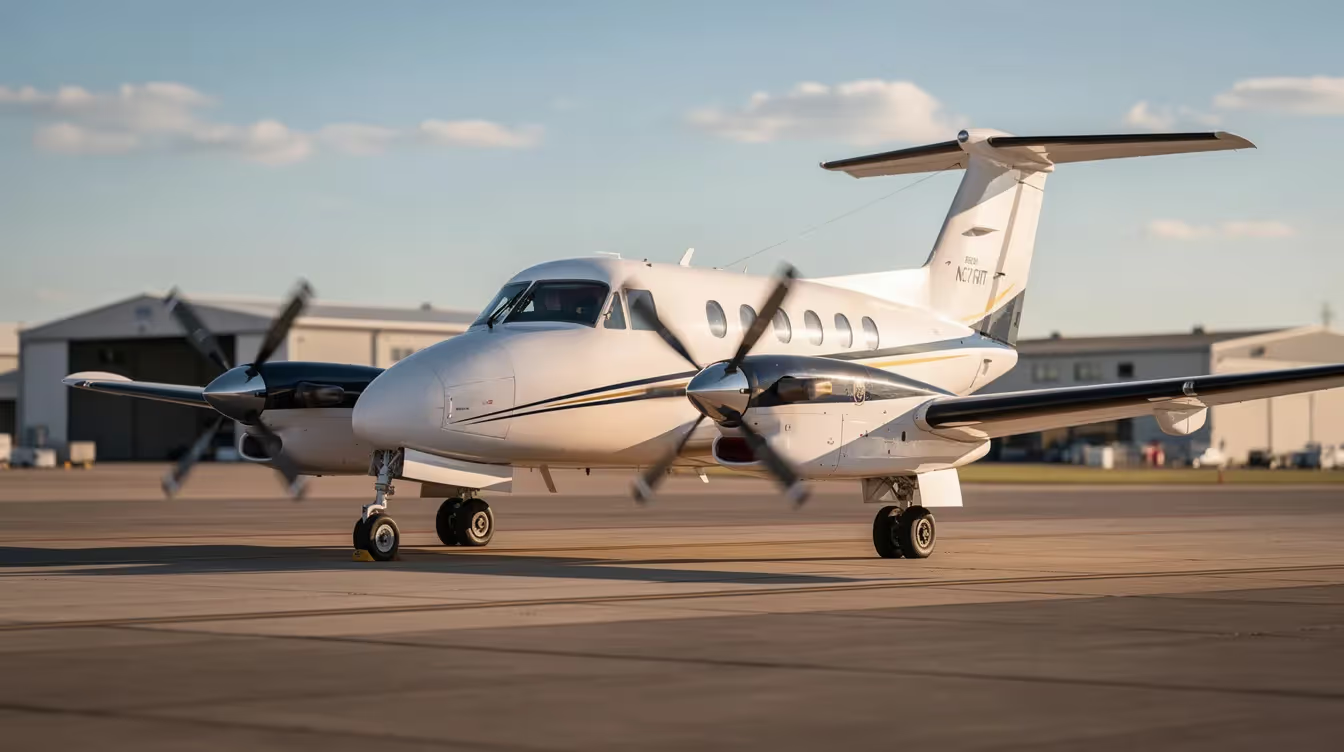
The King Air 350 is a versatile twin-engine turboprop ideal for private charter, offering a spacious cabin for up to 9 passengers and the ability to operate from shorter runways. With a maximum range of 1,806 nautical miles and cruise speeds around 312 knots, it balances performance and efficiency, making it suitable for corporate travel, air ambulance services, and leisure trips. Charter rates typically start in the mid-$2,000s per hour, while ownership costs can exceed $1 million annually. Jettly provides on-demand access to the King Air 350, emphasizing transparent pricing and flexible booking options for travelers.
Jay Franco Serevilla
May 23, 2026
|
5
min read

View all
The Gulfstream G650 is an ultra-long-range business jet known for its speed, comfort, and advanced technology, making it ideal for nonstop travel between major global cities. With a maximum range of 7,000 nautical miles and a spacious cabin designed for productivity, it caters to corporate executives and high-net-worth individuals. Jettly offers seamless charter access to the G650, providing transparent pricing and digital booking options without the costs associated with ownership. This aircraft is particularly suited for business and leisure travel, allowing for efficient, direct flights while ensuring a comfortable in-flight experience.
Jay Franco Serevilla
May 23, 2026
|
5
min read

View all
One-way private jet charters offer flexibility for travelers with uncertain return plans, allowing direct access to destinations without the hassle of crowded terminals. These charters can be paired with discounted empty leg flights, which occur when jets reposition without passengers, providing cost-saving opportunities for flexible travelers. Jettly's platform facilitates easy booking and comparison of over 20,000 aircraft, with transparent pricing that includes all relevant fees. Overall, one-way charters are ideal for business and leisure travelers seeking convenience and efficiency in their travel arrangements.
Jay Franco Serevilla
May 23, 2026
|
5
min read

View all
Chartering a private jet for 15 passengers provides a spacious, comfortable, and flexible travel solution ideal for business groups, families, or special events. This guide outlines the best aircraft options, typical costs ranging from $7,000 to $15,000 per flight hour, and operational considerations, emphasizing the importance of selecting the right jet for privacy and amenities. Jettly simplifies the booking process, offering transparent pricing and access to a global fleet, while also providing insights on comparing costs between single large jets and multiple smaller jets. Overall, private jet travel enhances productivity and convenience, making it a preferred choice for group travel compared to commercial airlines.
Jay Franco Serevilla
May 23, 2026
|
5
min read

View all
This guide outlines the intricate processes involved when a private jet is on the runway at busy airports, such as Chicago Midway. It emphasizes the importance of meticulous flight planning, safety protocols, and air traffic control coordination, which are crucial for ensuring safe operations. The guide also highlights how Jettly, a digital private aviation platform, connects travelers with various aircraft options and pricing, while providing insights into runway rules and the significance of disciplined communication among pilots and air traffic controllers. Overall, it aims to enhance the understanding of private jet operations and improve the travel experience for passengers.
Jay Franco Serevilla
May 23, 2026
|
5
min read
Explore our latest articles and updates.
5
min read
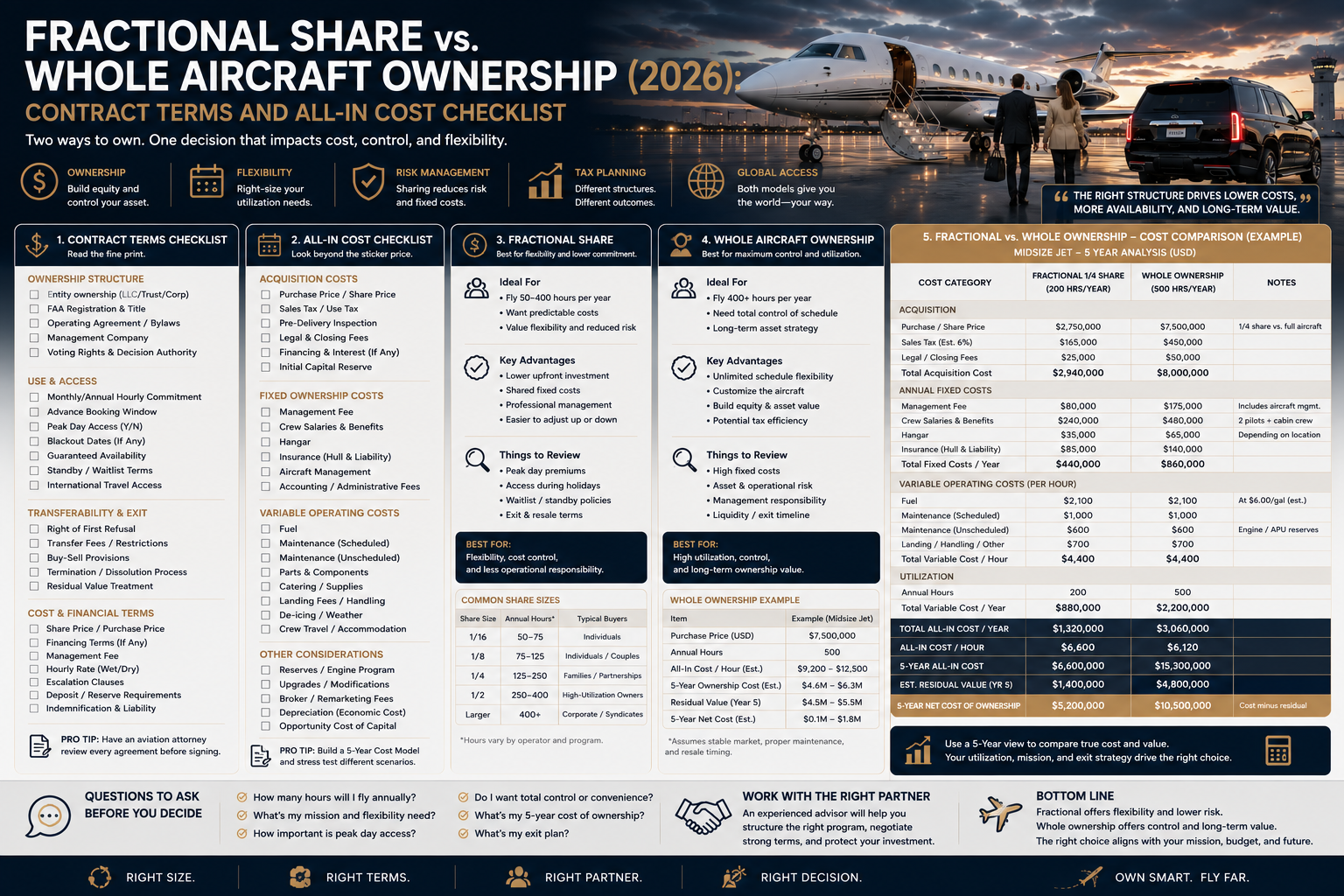
Fractional Share vs Whole Aircraft Ownership (2026): Contract Terms and All-In Cost Checklist
In 2026, buyers of private aviation must weigh fractional share ownership against whole aircraft ownership based on their flying needs, capital commitment, and operational flexibility. This guide provides a comprehensive checklist to evaluate contract terms and all-in costs, emphasizing the importance of understanding effective cost per occupied hour and peak-day reliability. By aligning ownership structures with flight patterns and financial goals, buyers can make informed decisions that suit their unique aviation requirements.
Read More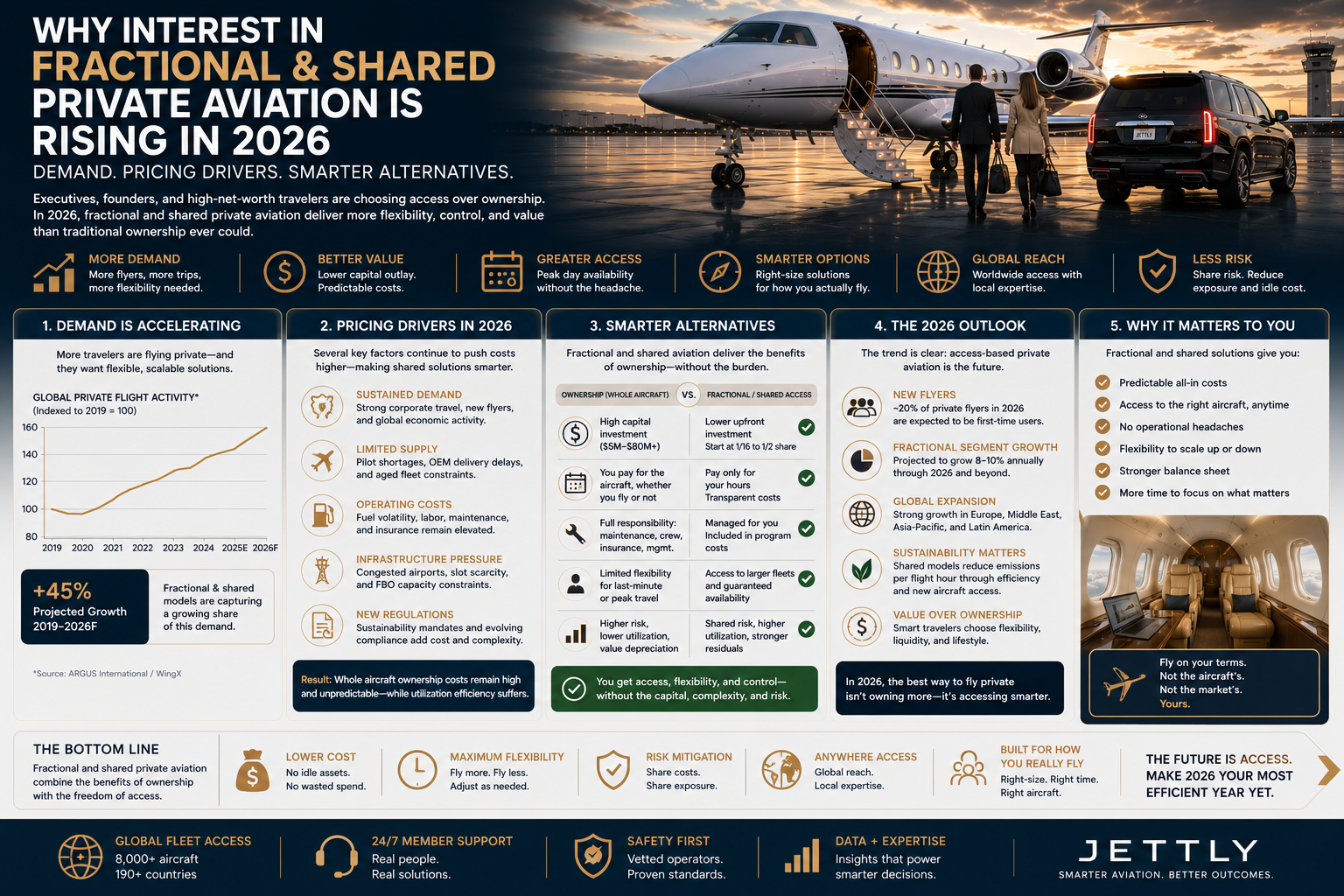
5
min read
Why Interest in Fractional and Shared Private Aviation Is Rising in 2026 (Demand, Pricing Drivers, and Smarter Alternatives)
Interest in fractional and shared private aviation is surging in 2026 due to increased demand and tight availability. Travelers are seeking predictable access and transparent pricing, making fractional ownership and shared flights more appealing alternatives to traditional charter services.
Read MoreJoin our community and receive the latest blog updates directly in your inbox.
MEMBERSHIPS AND ASSOCIATIONS



Disclaimer: Jettly operates as a charter broker, offering access to a global digital jet charter marketplace. Jettly is not a direct air carrier and does not own or operate aircraft. All advertised flights are conducted by third-party air carriers that are fully licensed and hold the appropriate Part 135 or Part 121 certifications issued by the Federal Aviation Administration (FAA) or equivalent regulatory authorities under U.S. or foreign law. Jettly complies fully with the U.S. Department of Transportation's Part 295 and Part 298 Charter Broker regulations. Jettly does not carry additional liability insurance. Passengers are covered by aircraft operator insurance. TICO: 50023770


