



Login
Get Instant Pricing On 23,000+ Aircraft

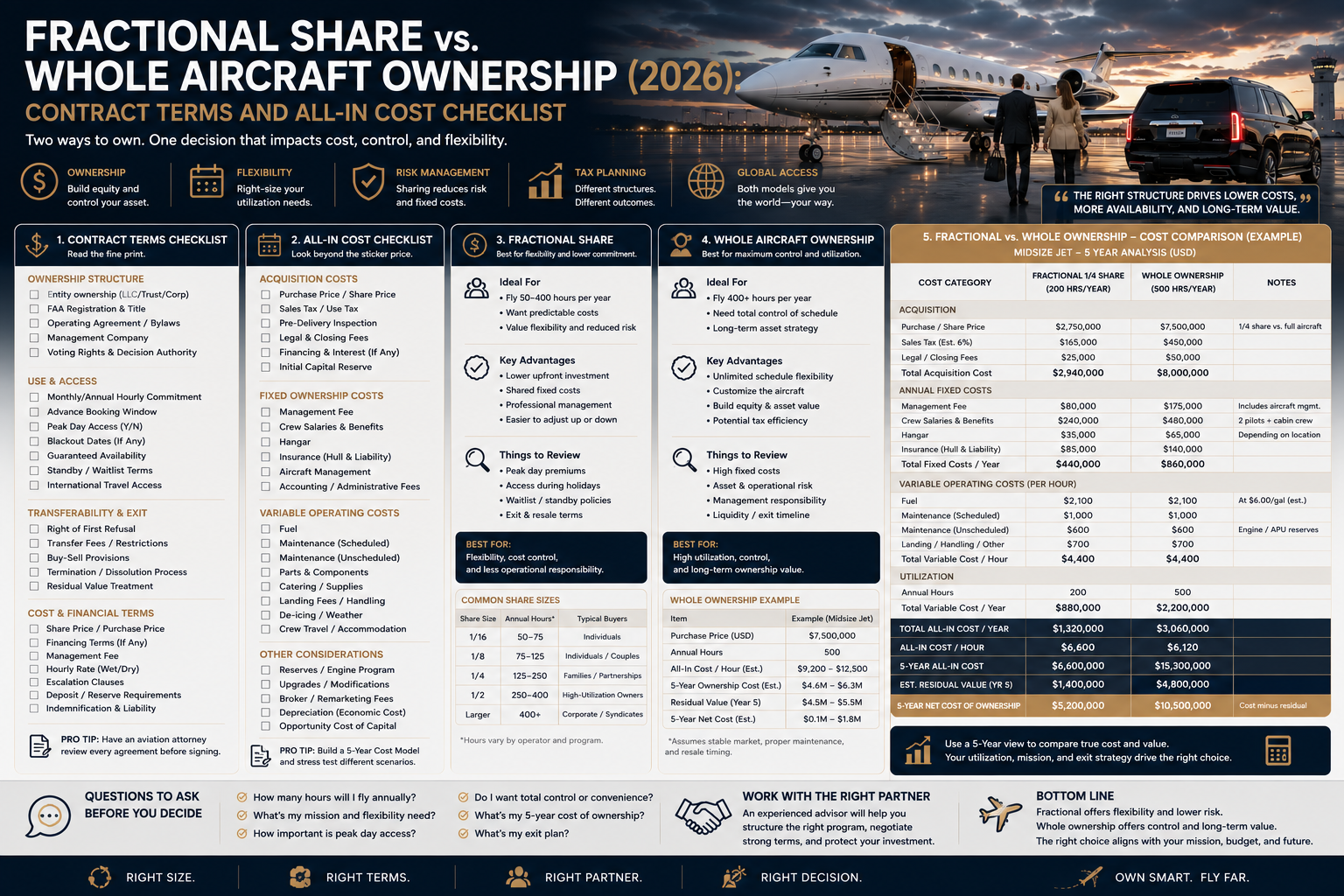
In 2026, buyers of private aviation must weigh fractional share ownership against whole aircraft ownership based on their flying needs, capital commitment, and operational flexibility. This guide provides a comprehensive checklist to evaluate contract terms and all-in costs, emphasizing the importance of understanding effective cost per occupied hour and peak-day reliability. By aligning ownership structures with flight patterns and financial goals, buyers can make informed decisions that suit their unique aviation requirements.
Jay Franco Serevilla
Jul 25, 2026
|
5
min read



View all
Certain aircraft have gained notoriety for their poor safety records, particularly the Fokker F28 and McDonnell Douglas MD-11, which exhibit high hull loss rates. While the Boeing 737 family has the highest total fatalities, this is largely due to its extensive use rather than inherent danger. Understanding these statistics is crucial for travelers assessing aviation safety.
Jeff Ryan Serevilla
Oct 22, 2026
|
5
min read

View all
This guide compares the use of Trivago for cheap flights and hotel deals with booking private jets through Jettly. While Trivago excels at finding budget-friendly options, Jettly offers flexibility and time savings for travelers needing efficient transportation. Understanding both platforms helps travelers make informed decisions based on their specific needs.
Jeff Ryan Serevilla
Oct 22, 2026
|
5
min read

View all
Huntington Municipal Airport (KHHG) in Indiana offers private jet access with a 5,003-foot runway, catering to general aviation and charter services. Ideal for business and leisure travelers, it provides a convenient alternative to larger airports, with Jettly facilitating seamless booking and aircraft selection.
Jeff Ryan Serevilla
Oct 22, 2026
|
5
min read

View all
The Britten-Norman Islander, now known as the British Islander, is a versatile twin-engine aircraft designed for short-haul regional flights. With its ability to operate from unpaved airstrips and rugged airframe, it serves remote communities and island chains effectively. This guide explores its history, design, and charter options, making it an essential read for aviation enthusiasts and travelers alike.
Jeff Ryan Serevilla
Oct 22, 2026
|
5
min read

View all
Jet travel in South Africa offers unparalleled convenience and flexibility, connecting major cities like Johannesburg, Cape Town, and Durban. Jettly's digital platform provides instant access to a vast network of private jets, catering to both business and luxury travel needs. With tailored itineraries and quick airport processing, flying private is an efficient alternative to commercial flights.
Jeff Ryan Serevilla
Oct 22, 2026
|
5
min read

View all
Choosing the right jet method is crucial for optimizing private aviation travel. This guide explores various options, including on-demand charters, memberships, jet cards, fractional ownership, and full ownership, helping travelers find the best fit for their needs.
Jeff Ryan Serevilla
Oct 22, 2026
|
5
min read
Explore our latest articles and updates.

5
min read
Dassault Falcon 20F: Legacy Midsize Jet and Modern Charter Alternatives
The Dassault Falcon 20F is a notable midsize business jet that played a crucial role in defining the charter category from the 1970s to the 1980s. While it offers a rich history and solid performance, modern jets surpass it in efficiency, comfort, and technology. Today, platforms like Jettly provide access to newer alternatives that better meet the needs of private travelers.
Read More
5
min read
Fastest Non-Military Jet: The Ultimate Guide to High-Speed Private Travel
Discover the fastest non-military jet, the Bombardier Global 8000, which reaches speeds of Mach 0.94 and offers an intercontinental range of 8,000 nautical miles. This guide explores the importance of speed in private aviation, comparing top contenders and highlighting how Jettly connects travelers with high-speed jets for efficient travel.
Read MoreJoin our community and receive the latest blog updates directly in your inbox.
MEMBERSHIPS AND ASSOCIATIONS



Disclaimer: Jettly operates as a charter broker, offering access to a global digital jet charter marketplace. Jettly is not a direct air carrier and does not own or operate aircraft. All advertised flights are conducted by third-party air carriers that are fully licensed and hold the appropriate Part 135 or Part 121 certifications issued by the Federal Aviation Administration (FAA) or equivalent regulatory authorities under U.S. or foreign law. Jettly complies fully with the U.S. Department of Transportation's Part 295 and Part 298 Charter Broker regulations. Jettly does not carry additional liability insurance. Passengers are covered by aircraft operator insurance. TICO: 50023770


