



Login
Get Instant Pricing On 23,000+ Aircraft

>
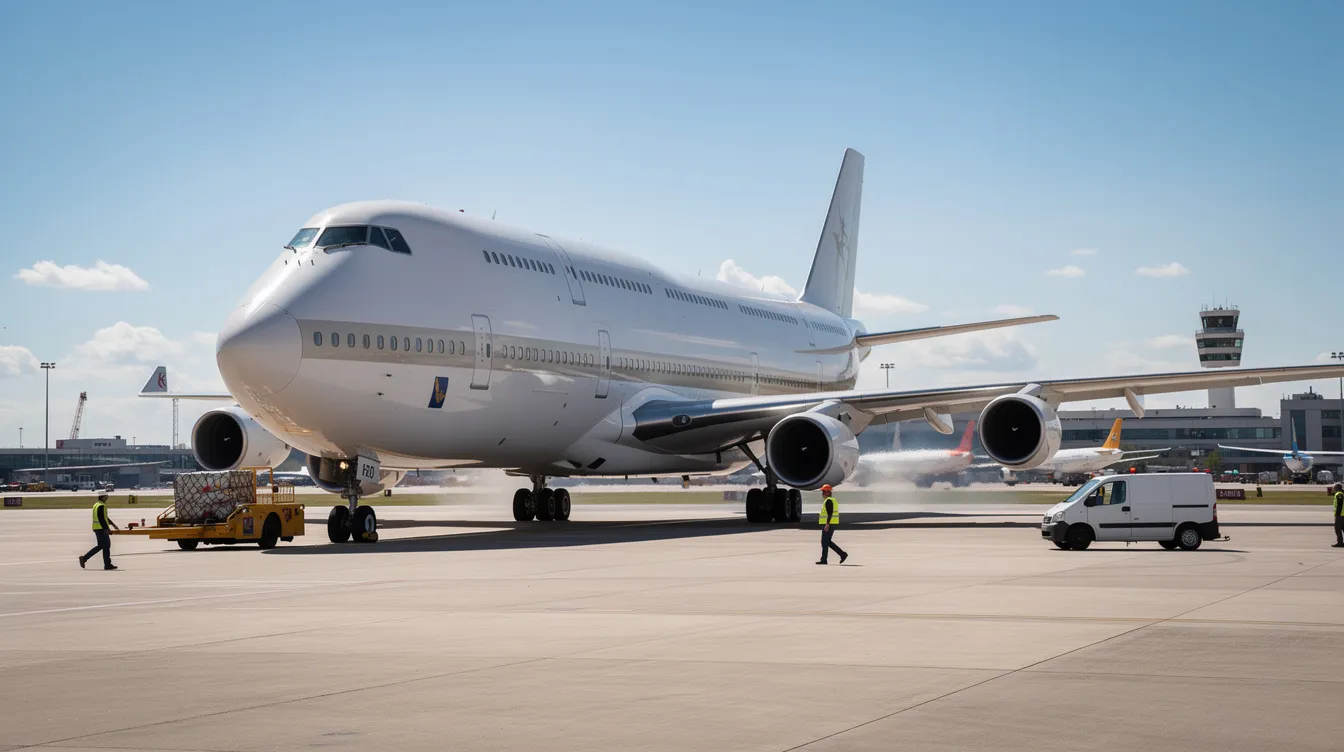
At its core, the Airbus A380 weight story is the story of the aircraft itself. Every design choice, from wing shape to seat count, circles back to one question: how much does this thing weigh, and what does that mean for performance? With a maximum takeoff weight of approximately 575,000 kg, the A380 is the world's largest passenger airliner and the heaviest passenger aircraft in regular commercial service.
Throughout this article, you'll encounter terms like MTOW (maximum takeoff weight), OEW (operating empty weight), MLW (maximum landing weight), and MZFW (maximum zero fuel weight). Each represents a certified limit that governs how the A380 operates, from cargo loading to runway selection.
Weight influences nearly everything: fuel burn on long-haul routes, how many passengers can board, and which airports have runways and pavement strong enough to handle such a large aircraft. While the A380 represents the extreme end of commercial aviation, most travelers who value flexibility and time savings find that lighter, right-sized private jets, like those available through Jettly, offer a different set of advantages.
The Airbus A380 has a maximum takeoff weight of approximately 575,000 kg (1,268,000 lb), making it the heaviest in-service passenger aircraft ever built.
Its operating empty weight sits around 277,000 kg - meaning nearly half of the maximum takeoff weight is the airframe itself before a single passenger boards or a drop of fuel is loaded.
Total weight at departure (airframe, fuel, passengers, cargo) directly drives fuel burn, minimum runway length, and which airports can handle this large aircraft.
Technological innovations like carbon-fiber composites, GLARE panels, and advanced aerodynamics were essential to keeping the A380's mass from spiraling even higher.
While the A380 pushed the limits of large aircraft design, most high-end travelers today benefit from nimble, right-sized private jets, available through platforms like Jettly and promoted via its ULTRA high-ticket affiliate program, that access far more airports with far less weight overhead.
|
Specification |
Value |
|---|---|
|
Maximum takeoff weight (MTOW) |
~575,000 kg (1,268,000 lb) |
|
Operating empty weight (OEW) |
~277,000 kg (611,000 lb) |
|
Maximum landing weight (MLW) |
~394,000 kg (869,000 lb) |
|
Maximum zero fuel weight (MZFW) |
~361,000–369,000 kg (796,000–813,000 lb) |
|
Maximum fuel capacity |
~320,000 liters (~253,900 kg of usable fuel) |
|
Typical maximum payload |
~84,000 kg |
|
Passenger capacity |
Up to 853 passengers in an all-economy configuration, or about 525 in a typical three-class layout |
To put the scale in perspective: the A380's empty weight alone is roughly equivalent to 69 fully loaded pickup trucks. At maximum takeoff weight, it outweighs a Boeing 747-8 (MTOW ~447,000 kg) by more than 125 tonnes.
These figures vary slightly between early- and later-production aircraft and between different airline configurations. But one fact remains constant: the A380 is the heaviest operational passenger aircraft in history.
Understanding the A380 starts with understanding aircraft weight terminology. Here are the key terms, each anchored to real A380 numbers.
Maximum Takeoff Weight (MTOW): The maximum permitted takeoff weight, set by structural, engine, and regulatory limits. For the A380, MTOW ranges from roughly 560 tonnes on early production aircraft to about 575,000 kg on later high-gross-weight variants. No pilot may exceed this figure.
Operating Empty Weight (OEW): This is the weight of the aircraft, including its structure, systems, crew, and standard equipment, but excluding passengers, cargo, and usable fuel. The A380's OEW is approximately 277,000 kg. The A380's OEW is around 277,000 kg. Cabin configurations influence this number; a first-class-heavy fit-out with suites and bars weighs more than a dense economy layout.
Maximum Landing Weight (MLW): The heaviest the aircraft can be at touchdown. For the A380, MLW sits at approximately 394,000 kg. This limit protects the landing gear, brakes, and structure from excessive stress on impact.
Maximum Zero Fuel Weight (MZFW): The maximum weight of the aircraft without usable fuel - essentially OEW plus all payload. For the A380, MZFW ranges from about 361,000 to 369,000 kg depending on the variant. Exceeding MZFW would overstress the wing root during maneuvers.
Payload: The weight available for passengers, baggage, and cargo after accounting for OEW. On the A380, maximum payload sits around 84,000 kg, though actual figures depend on route, fuel, and configuration.
Regulators such as EASA and the FAA certify these limits through rigorous flight testing, structural analysis, and safety margin verification. Compliance is non-negotiable - whether for a 575-tonne airliner or a light jet booked through a digital platform like Jettly.
Airbus publishes multiple certified weight variants for the A380-800, letting airlines choose combinations of MTOW, MLW, and MZFW that suit their route networks. Here is how the main certified options break down:
Early production MTOW: ~560,000 kg
Mid-life enhanced MTOW: ~569,000–573,000 kg
Highest certified MTOW (variants WV008, WV011): ~575,000 kg
Lower-weight variants (e.g., WV010): ~480,000 kg MTOW for shorter routes or lower airport fee structures
OEW: ~277,000 kg (varies by airline interior fit)
Maximum fuel capacity: ~320,000 liters (~253,900 kg)
Maximum structural payload: ~84,000 kg
Airlines like Emirates and Singapore Airlines often selected the highest weight variants to maximize range on ultra-long-haul flights. Korean Air and other carriers operating shorter sectors sometimes opted for lower-weight certifications to reduce landing fees.
Cabin layout matters more than most people realize. An aircraft fitted with premium cabins, spacious first-class suites and business-class seats, may carry heavier interior components than one configured in an all-economy layout, shifting the OEW upward and reducing available payload.
These high weight limits were required because the A380 was designed to combine very long range (up to ~15,200 km) with very high passenger capacity - a combination that demands enough space for both fuel weight and passenger load.
Here is how an A380 goes from empty weight to the total weight seen at takeoff, using a realistic long-haul scenario.
Step 1 - Start with OEW: ~277,000 kg. This includes the airframe, systems, crew, crew baggage, and standard equipment.
Step 2 - Add passengers and baggage: The A380's typical three-class layout accommodates about 525 passengers. At roughly 100 kg per person (including checked and carry-on baggage), that adds ~52,500 kg.
Step 3 - Add cargo and catering: Belly cargo and in-flight catering can add 15,000–25,000 kg depending on route and demand. Call it 20,000 kg.
Step 4 - Add fuel: For a near-maximum-range flight, the A380 can carry up to ~253,900 kg of usable fuel. That is by far the single largest variable.
Running total: 277,000 + 52,500 + 20,000 + 253,900 = ~603,400 kg - which exceeds the maximum takeoff weight of approximately 575,000 kg.
This is exactly the trade-off airlines face on every flight. Fuel and payload affect the A380's takeoff weight calculation. On very long routes, maximum fuel means less cargo or fewer passengers. On shorter routes, less fuel frees up room for more passengers and freight. Dispatchers and pilots use flight-planning tools to balance these factors without breaching weight limits, just as private aviation clients may rely on structured jet card programs to manage predictable flight costs across varying mission profiles.
This payload-range logic applies to private jets too, just at a smaller scale. Platforms like Jettly and its private jet charter cost estimator factor this into instant pricing and planning, matching each trip to an aircraft that comfortably handles the distance, passenger count, and luggage.
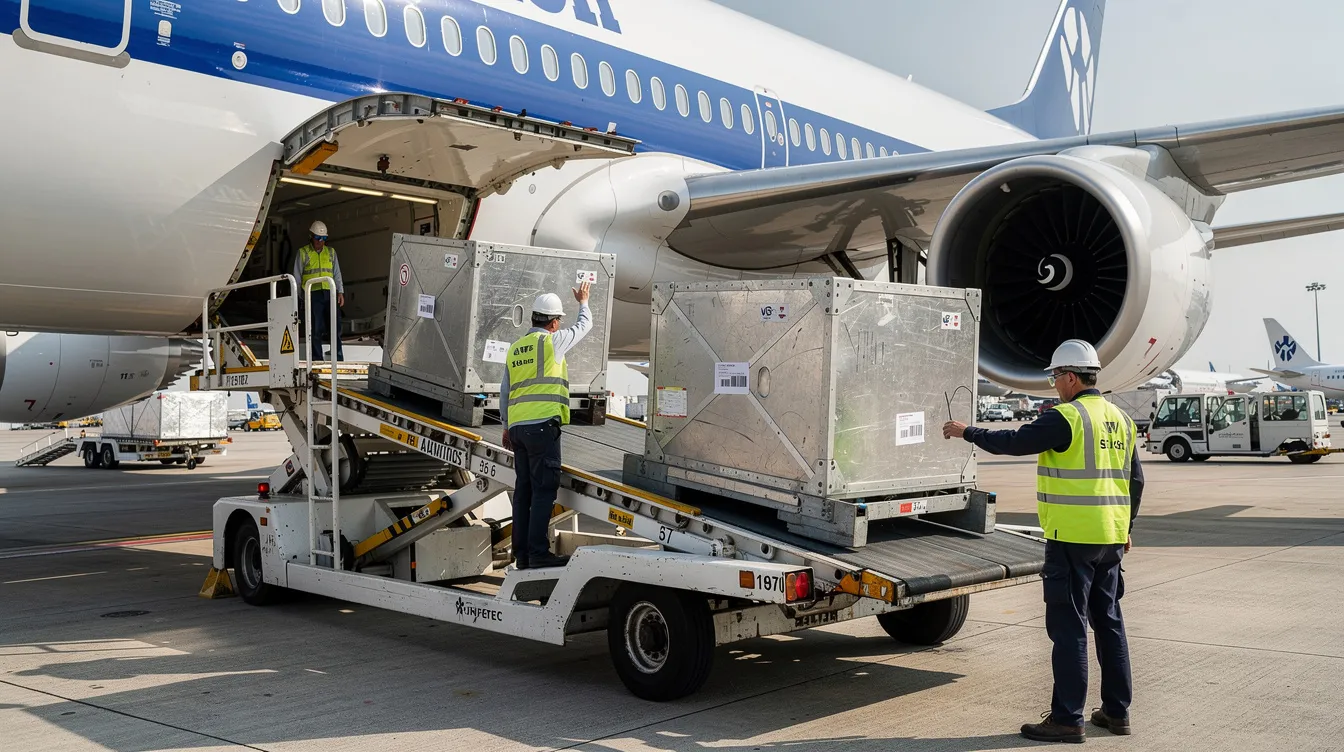
When Airbus engineers began serious design work on what would become the A380 in the late 1990s, they faced a straightforward challenge: build a double-deck passenger aircraft that could carry more passengers than the Boeing 747-400 over similar distances, while keeping per-seat operating costs competitive.
The only aircraft of comparable ambition was the 747 itself, which had dominated the very-large-aircraft segment for three decades. Beating it meant a bigger cabin, more seats, and longer range, all of which pushed total weight up.
Yet despite its very-large-aircraft size, the design team could not let empty weight grow unchecked. Every extra tonne of structure requires more fuel to carry it, which demands bigger fuel tanks, which adds more weight, which requires stronger wings - the classic "snowball effect" in aerospace engineering.
Design work began years before the A380's maiden flight on 27 April 2005, with weight projections refined continuously as wind-tunnel data, material test results, and prototype assembly revealed real numbers. The complexity of scaling up to two full-length decks while controlling empty weight drove many of the program's most important technological innovations.
Those challenges shaped not just the A380, but later widebody projects and even modern long-range business jets that Jettly customers might fly today.
Several new technologies were deployed specifically to reduce weight and manage the A380's mass:
Composite materials: The A380 uses carbon-fiber reinforced plastic extensively - in the central wing box, rear fuselage sections, tail sections, and flight control surfaces. Composites account for more than 20% of the airframe by weight, saving thousands of kilograms versus all-metal alternatives.
GLARE (Glass Fiber Reinforced Aluminum Laminate): Used across roughly 485 square meters of upper fuselage skin and stabilizer leading edges, GLARE reduces weight and improves corrosion resistance while boosting fatigue life.
Integrated modular avionics (IMA): By consolidating avionics functions into shared computing modules, the A380 reduced wiring runs and equipment duplication compared to previous-generation airliners. Less wiring means less weight - a meaningful saving when the aircraft's total harness stretches hundreds of kilometers.
Advanced aerodynamics: The A380's wings incorporate wingtip fences to reduce induced drag and improve fuel efficiency, allowing the aircraft to carry heavy loads with lower fuel burn than a clean-wing design of the same span.
Digital design tools: Full 3D digital mock-ups enabled engineers to route hydraulic lines, wiring, and ducting more efficiently, avoiding unnecessary brackets, supports, and structural reinforcement.
These technological innovations were practical responses to an engineering problem, not marketing features. Every kilogram saved in structure or systems translated directly into either more payload, more fuel (and therefore range), or lower fuel burn.
The A380's operating empty weight of around 277,000 kg is distributed across several major structural groups:
Fuselage: The double-deck pressurized hull is the single heaviest structural component. Upper fuselage skin panels use GLARE, which saves an estimated 700–800 kg directly, plus additional "snowball" savings from lighter supporting structure.
Wings: The wing structure, including the central wing box, is a major mass contributor. More than 50% of the central wing box is CFRP, significantly reducing weight in this critical load path.
Tail: Horizontal and vertical stabilizers use composite construction to reduce weight while maintaining the stiffness needed to control a 575-tonne aircraft.
Landing gear: The main gear alone, with 20 wheels on the main assemblies, is one of the heaviest single systems. It must absorb the energy of landing a 394,000 kg aircraft.
Interior fittings, seats, galleys, lavatories, overhead bins, and in-flight entertainment systems add tens of thousands of kilograms. Airlines operating premium cabins with wider seats and bars add more interior mass than those flying dense layouts, just as private jet operators factor in amenities like in-flight catering for private jets when balancing comfort and weight.
The A380 uses laser beam welding to reduce structural weight at fuselage panel joints, replacing thousands of rivets with continuous welds that are lighter and aerodynamically smoother.
Even the paint layer contributes a non-trivial amount: the full exterior coating on an A380 weighs roughly 650 kg. When total weight is already measured in hundreds of tonnes, every design decision, down to paint thickness, counts.
The A380's wing was originally designed with enough space for potential MTOW values above 600,000 kg. However, a major constraint intervened: the 80-meter box limit imposed by ICAO Code F airport infrastructure.
The final wing span of 79.75 meters is enormous but slightly shorter than an unconstrained aerodynamic optimum would have been. This compromise adds some structural weight (a shorter, thicker wing must be stronger per unit span) and slightly reduces aerodynamic efficiency compared with a longer, more slender wing. The 845-square-meter wing area provides the lift needed for a maximum design load well beyond normal operations.
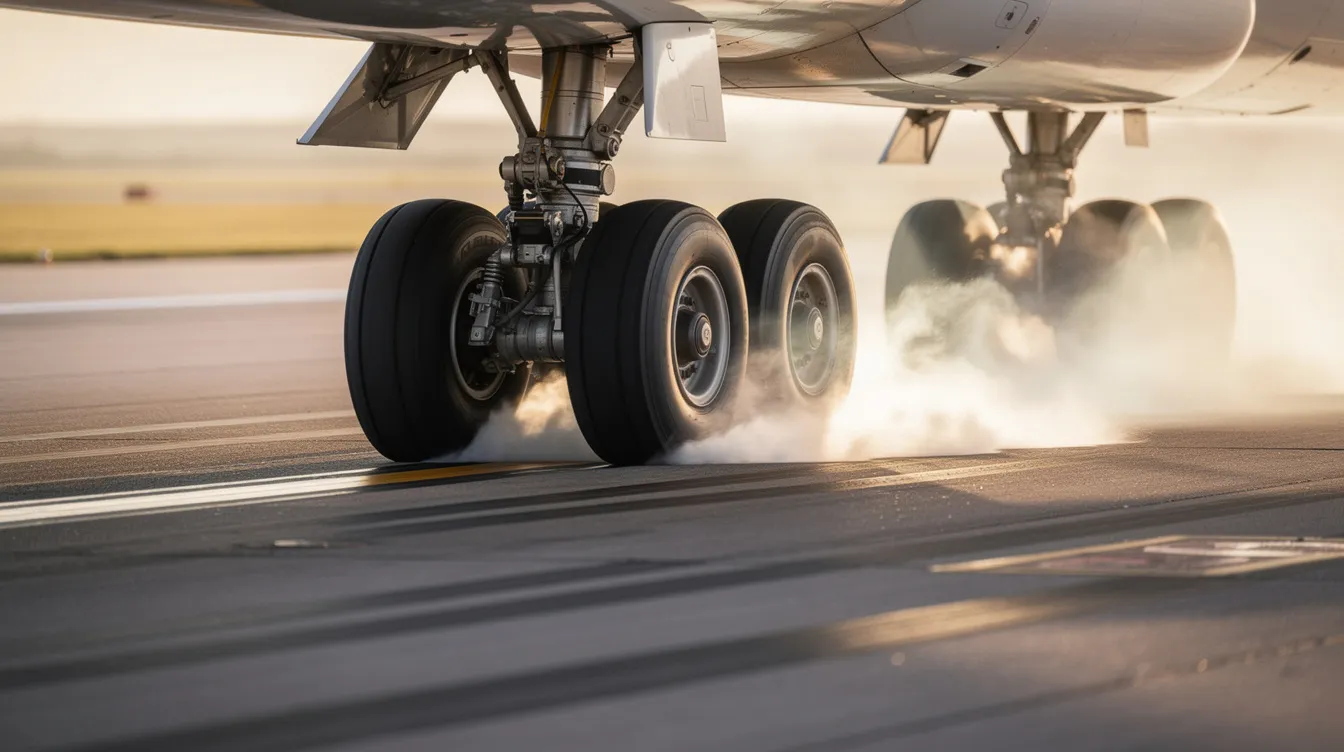
The landing gear tells its own weight story. The A380's main gear uses 20 wheels spread across four main gear legs, plus a two-wheel nose gear. This arrangement spreads the aircraft's mass over a wide contact area, protecting runway and taxiway surfaces from damage.
Before certification authorities approved the structure, the A380's wings underwent static tests at up to 150% of the maximum expected loads. During the famous wing-bend test, the wings deflected dramatically before finally failing just beyond the required margin - proving the design met structural safety standards.
These infrastructure and certification constraints defined how big and heavy Airbus could make the A380. Gate size, pavement strength, and taxiway width all played a role in setting the final dimensions and weight of this large aircraft.
Jet fuel is one of the largest single contributors to total A380 weight. With a fuel capacity of roughly 320,000 liters (~253,900 kg), fuel alone can represent over 44% of the aircraft's maximum takeoff weight.
Fuel burn follows a straightforward principle: more weight at takeoff requires more thrust, which burns more fuel. As fuel is consumed in flight, the aircraft becomes lighter, and efficiency improves. This is why the final hours of a long-haul flight are significantly more fuel-efficient per kilometer than the first hours.
The A380's fuel consumption is about 3.1 liters per 100 passenger-kilometers when operated at high load factors - a figure that was competitive with other aircraft of its era, though newer twin-engine widebodies like the A350 and 787 have since improved on it.
Flight planning must respect both MTOW and MLW simultaneously. On routes where an A380 departs near maximum weight, pilots may need to burn down fuel before landing to stay within the maximum landing weight of approximately 394,000 kg. On hot days or at high-altitude airports, takeoff weight may need to be further restricted.
Long-range business jets operate on the same physics, just with far less fuel. A Bombardier Global 7500, for example, carries about 20,000 kg of fuel - roughly 8% of the A380's capacity - yet can fly nearly as far with a handful of passengers.
The Airbus A380 completed its maiden flight on 27 April 2005 from Toulouse, France. Early test aircraft operated across a broad spectrum of weights to confirm performance, handling, and structural integrity before the type entered commercial service with Singapore Airlines in October 2007.Early test aircraft operated across a wide range of weights to validate performance, handling, and structural integrity before the type entered commercial service with Singapore Airlines in October 2007.
Early production A380s were certified at an MTOW of approximately 560,000 kg. Around 2012–2013, Airbus introduced a performance enhancement package that increased MTOW by about 6 tonnes and MZFW by roughly 3 tonnes, raising the ceiling to ~569,000 kg and later to the current maximum of approximately 575,000 kg.
These gains came not from a major redesign but from exploiting existing structural margins. Engineers optimized stringer radii, adjusted skin thicknesses, and added a Load Alleviation Function using enhanced gust sensors to reduce dynamic wing loads - a classic example of weight reduction through smarter engineering rather than new hardware.
Airlines operating the A380 - including Emirates, British Airways, Qatar Airways, and Nippon Airways (ANA) - selected weight variants that best matched their route profiles. Airbus delivered aircraft with the flexibility to switch between weight variants, letting airlines operating the type adapt to changing network needs.
Airbus also proposed the A380plus concept with larger winglets, higher MTOW, and denser cabin options, but it never progressed beyond the concept stage. Production ended in 2021, with Airbus having continuously refined weight and performance across the program's lifetime.
The A380 requires specialized airport infrastructure due to its weight. At or near maximum takeoff weight, the A380 requires runways of approximately 3,000 meters or longer for safe departure on long-haul routes.
But runway length is only part of the story:
Pavement strength: Taxiways and aprons must carry the full weight of the aircraft during ground maneuvers. Despite the 20-wheel main gear spreading the load, many airports needed pavement upgrades to handle the A380.
Gate and terminal infrastructure: Dual or triple jet bridges, widened taxiways, and reinforced ramp surfaces are required. Not every hub invested in these modifications.
Turning radii: The aircraft's sheer size demands wider turns, which some taxiway intersections cannot accommodate without modification.
Only a limited number of major international hubs were upgraded for A380 operations. This constrained route flexibility - airlines operating the A380 could only deploy it between airports that had invested in the necessary ground infrastructure, a limitation that helped spur growth in more flexible charter airlines and private operators.
This is one of the clearest contrasts with private aviation. Lighter aircraft used in platforms like Jettly can access thousands of airports worldwide, including regional and secondary fields that are often closer to passengers' final destinations. Travelers can use tools like Jettly's airport locator tool to identify convenient departure and arrival points. No pavement upgrades, no special gates, no infrastructure bottlenecks.
The A380 is classified in the wake turbulence category "Super" - a designation created specifically for this aircraft and sitting above the standard "Heavy" classification used for other large aircraft like the 747 and 777.
Higher weight and a massive wingspan generate stronger wake vortices behind the aircraft. These invisible rotating air columns can be hazardous to following traffic, especially smaller planes.
The operational consequences are real:
Greater separation distances are required behind an A380 on approach and departure.
Runway throughput decreases when A380 movements are mixed with lighter traffic.
Air traffic controllers must apply special spacing rules, which can slow down busy hub operations.
Wake-related restrictions, combined with the aircraft's physical size, make it harder to integrate the A380 into high-frequency schedules at congested airports. Smaller jets - both commercial and private - can be scheduled more flexibly because their weight and wake profiles are far less demanding, and charter platforms can route a variety of private charter aircraft through airports that could never handle an A380.
The A380 is significantly heavier than the Boeing 747-8 and Boeing 777-300ER, the two other aircraft most commonly mentioned alongside it. Here is how they compare:
|
Aircraft |
MTOW (approx.) |
Typical Passenger Capacity |
Engines |
|---|---|---|---|
|
Airbus A380-800 |
575,000 kg |
~525 (3-class) / 853 (max) |
4 |
|
Boeing 747-8 |
447,000 kg |
~410 (3-class) |
4 |
|
Boeing 777-300ER |
352,000 kg |
~365 (3-class) |
2 |
|
Airbus A350-1000 |
316,000 kg |
~350 (3-class) |
2 |
While some military and cargo aircraft (the An-124 and the now-destroyed An-225) approach or exceed A380 weights, the A380 remains the heaviest regular passenger aircraft in history.
Per-seat weight and per-seat fuel burn differ meaningfully between the A380 and newer twin-engine widebodies. The A350 and 787 families, designed a decade later with more advanced composites and two powerful engines instead of four engines, typically achieve better fuel efficiency per seat on most routes.
Market preferences shifted accordingly. Airlines increasingly chose lighter, more flexible twin-engine jets that could serve more passengers on more routes point-to-point, rather than relying on large planes built to concentrate huge volumes on a few hub pairs - the operating model the A380 was built for. In private aviation, similar preferences drive travelers toward NetJets alternatives like Jettly that emphasize flexibility over sheer size.
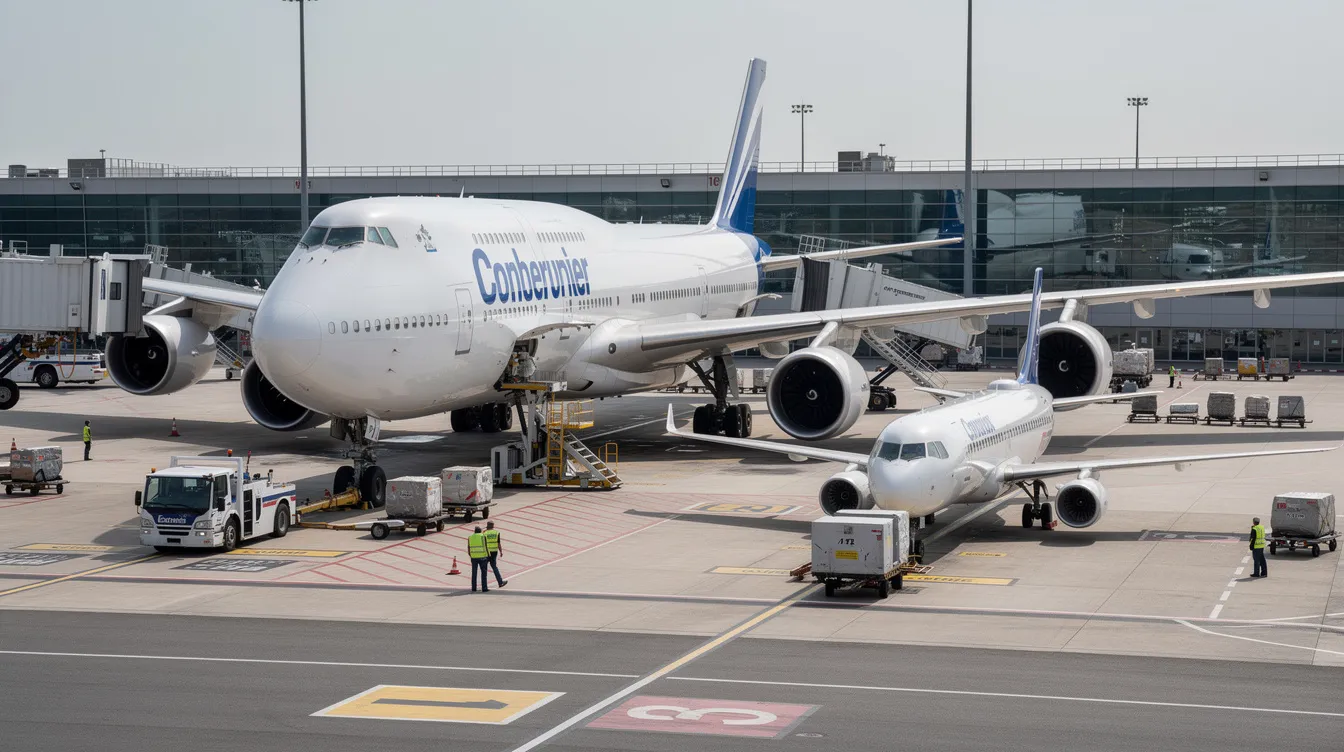
The contrast between the A380 and a typical private jet is dramatic. The A380's maximum takeoff weight of approximately 575,000 kg is roughly 10 to 12 times the MTOW of a large-cabin ultra-long-range business jet.
For context:
Gulfstream G700: MTOW ~48,000 kg
Bombardier Global 7500: MTOW ~49,000 kg
Dassault Falcon 8X: MTOW ~33,000 kg
Very light jets (e.g., HondaJet): MTOW ~4,800 kg - the A380 outweighs a VLJ by more than 100 to 1.
This weight gap drives every practical difference between the two categories of aircraft, which is why families comparing the A380 experience with the best private planes for family travel often focus less on seat count and more on flexibility and comfort:
Runway needs: Business jets routinely operate from runways under 2,000 meters. The A380 needs 3,000 meters or more.
Airport access: Private jets can reach thousands of smaller airports globally. The A380 is limited to perhaps 100–150 equipped hubs.
Fuel consumption: Lower weight means far less fuel burn per flight, though also far fewer seats.
Ground infrastructure: No special gates, bridges, or pavement upgrades required for private jets.
Private jets prioritize bespoke routing, schedule control, and time savings over sheer seat capacity. That aligns more closely with the travel needs of executives and families who use Jettly's digital platform and its flexible private jet memberships to select right-sized aircraft for each mission.
The A380's high structural weight and four-engine design increase direct operating costs in several ways:
Fuel burn: Four engines consuming fuel at weights approaching 575 tonnes means high absolute fuel costs per flight.
Maintenance: Four engines require more maintenance hours and parts than two. Heavy landing gear and large composite structures add inspection complexity.
Landing and navigation fees: Many airports base fees on MTOW. The A380 pays premium fees at every stop.
Airport charges: Specialized gate and handling requirements add further costs.
When very full, the A380 can achieve competitive per-seat costs. The A380's design allows for lower operating costs per passenger than the 747-400 - but only when load factors are consistently high. On routes where demand fluctuates, the inability to downscale a 500+ seat aircraft hurts profitability.
These airline economics ultimately contributed to Airbus ending A380 production. Airlines increasingly favored lighter, more flexible widebodies that could profitably serve thinner routes without needing to fill 500 seats on every departure, while private travelers turned to agile marketplaces such as instant-book private jet operators like Zenflight.
In private jet economics, customers focus on time and convenience per trip rather than per-seat cost. Platforms like Jettly make it possible to choose aircraft that match the mission from a broad range of private charter aircraft - without paying for unused capacity that comes with larger planes.
There is an upside to all that weight. The A380's mass and large wing area deliver a noticeably smoother ride. Heavier aircraft are less susceptible to turbulence-induced pitching and rolling, and the A380's advanced aerodynamics further dampen the effects of rough air.
The A380 cabin has 550 square meters of usable floor space spread across two passenger decks - roughly equal to three tennis courts. This gives airlines enough space to install lounges, onboard bars, and private suites without immediately hitting weight or volume limits.
Additional comfort features tied to the aircraft's design:
The A380 produces 50% less cabin noise than previous-generation widebodies, earning it half the noise reputation that made it a passenger favorite.
The cabin is pressurized to 1,520 meters altitude equivalent - lower than the 2,400-meter cabin altitude common on older jets - which reduces fatigue and jet lag.
A380 economy seats can be up to 48 cm wide, offering wider seats and more personal space than most other passenger aircraft.
The A380 features LED mood lighting for passenger comfort, adjustable through different phases of flight.
The upper deck and lower main deck together create enough space that airlines can offer genuinely different cabin products without compromising on passenger comfort.
Yet for travelers who value privacy, tailored service, and the ability to depart on their own schedule, private jets offer a different kind of comfort - one not measured in cabin length or usable floor space, but in time saved and hassle eliminated, especially on the best private planes for families where cabin layouts are optimized for comfort and care.
The A380 structure is designed with conservative safety margins well above normal operating loads. Certification regulations require that the structure withstand at least 150% of the maximum design load without catastrophic failure.
Key elements of the A380's safety architecture include:
Redundant hydraulic systems: The A380 uses a 350-bar (5,000 psi) hydraulic system - higher pressure than older airliners - to keep actuator size and weight manageable despite the aircraft's mass. Three independent hydraulic circuits plus two backup electrical systems ensure continued controllability even with multiple failures.
Redundant flight controls: Each control surface has multiple actuators fed by independent power sources. No single failure can cause loss of control.
Structural monitoring: Sensors throughout the airframe track loads in real time, feeding data into maintenance systems.
The A380 has had no hull loss accidents as of mid-2026, an impressive safety record for a fleet that has accumulated millions of flight hours. This record reflects how carefully weight, structure, and systems were engineered.
The same principles of conservative design and regulatory oversight apply across the aviation spectrum, including the charter aircraft available through Jettly. Every aircraft in commercial service - from a very light jet to the A380 - must meet rigorous structural and systems standards.
The A380 program demonstrated both the possibilities and the practical limits of building extremely heavy passenger aircraft. It proved that a 575-tonne, 853-seat airliner could be designed, certified, and operated safely. It also showed that filling such a large aircraft consistently enough to justify its operating costs was the harder problem.
Key lessons from the program:
Accurate demand forecasting matters enormously for very large aircraft. Hub-and-spoke strategies that justified the A380 in the early 2000s gave way to point-to-point twin-engine operations.
Infrastructure constraints - runways, gates, taxiways - impose hard limits on how big and heavy a commercial airliner can practically be.
The technological innovations used to control A380 weight, including advanced composites and digital design tools, now appear in newer widebodies and in modern long-range business jets from leading private plane manufacturers for every budget and need.
The market shifted toward smaller, more efficient large aircraft with lower MTOW but greater route flexibility. The A380 was the only aircraft of its kind to enter commercial service at that scale, and it may remain so for decades.
This lesson connects directly to the principle of "right-sizing" aircraft for specific missions - a philosophy that underpins Jettly's approach to matching travelers with suitable private jet models based on factors like how many passengers a private jet can carry.
Jettly does not charter A380S. But the platform relies on the same categories of weight and performance data - MTOW, runway requirements, range, and payload limits - for the 20,000+ smaller aircraft in its global inventory.
Here is how that data works in practice:
Aircraft selection: When a customer requests a trip, Jettly's systems evaluate which aircraft can handle the distance, passenger count, luggage volume, and airport constraints - all of which trace back to weight.
Instant pricing: Fuel burn is one of the largest cost drivers in any charter quote. Fuel burn scales with aircraft weight. So the price a customer sees is directly influenced by how heavy the right aircraft is for their mission.
Airport access: Lighter aircraft open up more airports. Jettly's platform can suggest departures from secondary or regional fields that heavier commercial aircraft - let alone the A380 - could never reach.
Airbus support and industry data: Jettly's team stays current on aircraft specifications, performance updates, and new technologies across the global aviation landscape.
Understanding aircraft weight is not just academic. It directly influences routing options, time savings, and overall trip cost for every private charter customer, whether they are using Jettly's affordable private jet charter options or planning flights through its jet card flight cost estimator. Explore how Jettly translates complex performance numbers into simple, clear flight options at jettly.com.

The following questions address topics not fully covered in the main article. All values are approximate and based on publicly available data. While the A380 is not a typical charter aircraft, understanding its weight helps put smaller private jets into useful perspective.
The A380's MTOW is roughly 575,000 kg. A long-range private jet such as a Gulfstream G700 or Global 7500 typically weighs under 50,000 kg at MTOW - about one-tenth to one-twelfth of the A380.
At the other end of the spectrum, a very light jet like the HondaJet has an MTOW of roughly 4,800 kg. The A380 outweighs it by a factor of more than 100. This massive difference translates directly into practical gaps: runway length requirements, airport availability, fuel needs, and ground infrastructure are all driven by weight. Private jets can use thousands of airports that the A380 could never reach.
No. Airlines only approach MTOW on the longest routes with full passenger loads and maximum cargo. On shorter sectors or when demand is low, aircraft depart well below the limit.
Factors that cause daily variation include route length, expected headwinds, required fuel reserves, actual passenger bookings, and cargo demand. Operating below MTOW shortens the required takeoff distance and improves climb performance - a useful advantage at hot-and-high airports or where runway length is limited. How many passengers board and how much cargo is loaded are decisions made flight by flight.
Performance planners use charts based on weight, ambient temperature, wind, and runway surface condition to calculate the minimum runway length for safe takeoff and landing. At or near MTOW, the A380 needs some of the longest runways available - around 3,000 meters at sea level under standard conditions.
This restricts operations to major international hubs. Many regional airports simply lack the pavement classification, runway length, or gate infrastructure to support the aircraft. Business jets, by contrast, are optimized to operate from shorter runways, opening up access to secondary airports closer to city centers and resorts.
Airbus offered different certified weight options within the A380-800 family. Early models had an MTOW around 560 tonnes; later enhancements pushed this to approximately 575 tonnes. Lower-weight variants with MTOWs as low as 480 tonnes were also available for airlines that did not need maximum range.
Proposed variants like the A380F freighter and the stretched A380-900 would have had even higher MTOW values, but neither was brought to market. Airlines could select weight options that balanced range, maximum payload, and landing fees for their specific route networks, and Airbus allowed switching between certified variants over the life of the aircraft.
The core lesson is that bigger and heavier is not always better. It depends on travel goals, routes, and group size. The A380 excels at moving 500+ passengers between major hubs, but it requires massive infrastructure and offers no schedule flexibility to individual travelers.
For individuals, families, and small teams, right-sized private jets deliver better overall value in time saved, airport access, and schedule control. Platforms like Jettly use aircraft performance data - including weight-related factors - to match travelers with options suited to business trips, vacations, or urgent travel, whether they want to charter an entire aircraft or simply buy a seat on a private jet. Explore how at https://www.jettly.com.
The Airbus A380's maximum takeoff weight of approximately 575,000 kg represents the high-water mark of commercial airliner design. From its operating empty weight of 277,000 kg, the buildup of fuel, passengers, and cargo to reach that limit involves careful trade-offs that dispatchers and pilots manage on every flight.
Technological innovations in materials, integrated modular avionics, and advanced aerodynamics were essential to keeping this aircraft's weight under control. Without CFRP, GLARE, and digital design tools, the A380 could not have met its range and payload targets.
Yet the program also underlined a shift in global aviation: the market increasingly values efficient, right-sized aircraft - both for airlines and for private travelers. Fewer seats, less weight, more airports, and better flexibility now define the winning formula.
That is exactly Jettly's approach. By connecting travelers with a wide range of lighter aircraft through a transparent digital platform, Jettly delivers flexible, time-saving private flights without the constraints that come with the world's heaviest passenger jet.
Ready to experience private travel on your terms? Explore flight options or request a quote at https://www.jettly.com.
Share this post:
Jay Franco Serevilla
Oct 20, 2026
|
5
min read
Discover tips and trends in the industry.
5
min read
Passenger Airline Crashes: History, Safety, and What Modern Travelers Should Know
Passenger airline crashes are rare, with commercial aviation being the safest mode of mass transportation today. In 2023, there were zero fatal accidents involving passenger jets, highlighting the effectiveness of safety regulations and advancements in technology. This article explores the history of airline crashes, safety measures, and what travelers should know about aviation safety.
Read More
5
min read
Worldwide Jet Charter: A Practical Guide to Global Private Flights with Jettly
Worldwide jet charter has transformed private air travel into a practical solution for executives, families, and urgent travelers. With access to over 20,000 aircraft globally, Jettly offers flexible, efficient, and direct flights that save time and enhance the travel experience. This guide outlines how jet charter works, its benefits, and how to navigate the booking process seamlessly.
Read MoreStay updated with our latest insights and tips to elevate your journey with us.
MEMBERSHIPS AND ASSOCIATIONS



Disclaimer: Jettly operates as a charter broker, offering access to a global digital jet charter marketplace. Jettly is not a direct air carrier and does not own or operate aircraft. All advertised flights are conducted by third-party air carriers that are fully licensed and hold the appropriate Part 135 or Part 121 certifications issued by the Federal Aviation Administration (FAA) or equivalent regulatory authorities under U.S. or foreign law. Jettly complies fully with the U.S. Department of Transportation's Part 295 and Part 298 Charter Broker regulations. Jettly does not carry additional liability insurance. Passengers are covered by aircraft operator insurance. TICO: 50023770


