


Login
Get Instant Pricing On 23,000+ Aircraft

>
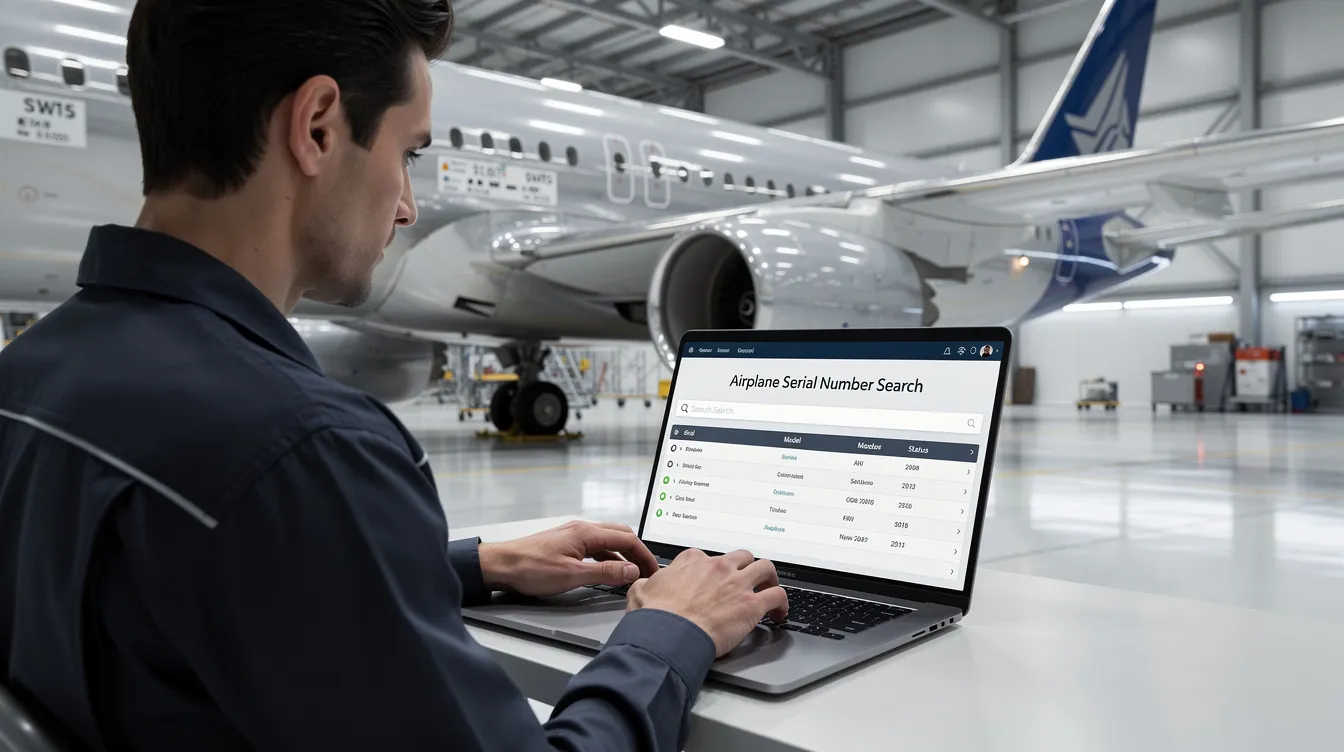
Running an airplane serial number search is one of the most practical steps a buyer, broker, or charter traveler can take to verify an aircraft's identity and history. This guide is intended for aircraft buyers, brokers, and charter travelers seeking to verify aircraft identity and history. Understanding how to search by serial number is crucial for ensuring safety, regulatory compliance, and informed decision-making in private aviation. Every airframe carries a manufacturer-assigned serial number that stays with it for life, regardless of where it flies or who owns it. Here is how the system works and why it matters for private aviation, especially when searching for aircraft present in the USA and beyond.
An aircraft's serial number is assigned by the manufacturer and never changes, while registration marks (like a U.S. N-number) can be reassigned when the aircraft is sold or exported to another country.
Serial number searches can reveal aircraft age, ownership history, accident records, and maintenance status—all critical for safety and valuation.
The FAA N-Number Inquiry database is the primary free tool for U.S. civil aircraft lookups. Other countries maintain their own national registries in accordance with ICAO standards.
Charter platforms like Jettly rely on verified operator registration data and airworthiness documentation behind the scenes to help maintain safety and regulatory compliance for every private flight.

A serial number is assigned by the manufacturer at the time of production and stamped on a fireproof data plate attached to the airframe. Finding the serial number often involves looking on the manufacturer's data plate. For example, a Gulfstream G550 built in 2016 might carry serial number 5546 and U.S. registration N550GX. The serial number is a more permanent identifier used to trace the full history of the airframe, even if the registration changes.
N-numbers in the USA start with the letter N, followed by one to five characters. Aircraft registration numbers can have one to five characters, and N-numbers in the USA must start with a digit other than zero. Letters I and O are excluded to avoid confusion with numerals 1 and 0. The USA has 915,399 possible aircraft registration numbers under current format rules.
Other countries use different nationality prefixes, and many registrations take the form of a nationality prefix and suffix separated by a dash on the aircraft. British aircraft carry a G- prefix, Canadian aircraft use C-, and Australian aircraft display VH-. Aircraft registration formats vary by country and type, but the core idea is the same: a unique registration identifies every commercial aircraft throughout its operational life, and no two active aircraft in the same country can share the same registration.
Aircraft registration began with radio callsigns in 1913, and the ICAO has managed aircraft registration standards since 1947. The Chicago Convention requires aircraft to display nationality marks. When an airplane moves between registries—say from G-XXXX to N123AB after a sale—the registration changes, but the serial number stays the same. In business aviation, serial numbers are key for confirming configuration, checking whether specific upgrade packages apply, and establishing resale values through production-year examples.
|
Country |
Nationality Prefix |
Registration Format Example |
Notes |
|---|---|---|---|
|
United States |
N |
N123AB |
N-number starts with digit (not zero), excludes I and O |
|
United Kingdom |
G |
G-ABCD |
Dash separates prefix and suffix |
|
Canada |
C |
C-FABC |
Includes dash and alphanumeric suffix |
|
Australia |
VH |
VH-ABC |
Dash-separated prefix and suffix |
|
Germany |
D |
D-ABCD |
Uses letter suffixes for powered aircraft |
|
Switzerland |
HB |
HB-ABC |
Uses numbers for unpowered gliders |

Searching for airplane history using a serial number requires official aviation databases. National aviation authorities maintain aircraft registration information accessible through databases, and you can search for airplane information using its serial number through these systems.
U.S. FAA tools:
The FAA's Aircraft Registration Inquiry allows searching by serial number to find owner information. The FAA offers a dedicated search tool that allows searching specifically by serial number.
Enter an N number (e.g., N729QS) into the search fields. The system returns the registrant name, address, serial number, year manufactured, airworthiness category, manufacturer, and model. For a deeper dive, see Jettly's guide on tail number lookup.
Other national registries:
UK aircraft records can be searched by serial number through the CAA G-INFO register. Transport Canada and EASA member-state databases provide similar functionality.
Search by serial number is available in multiple databases across these registries, though data fields and update frequency vary by state.
Third-party aggregators:
Commercial databases often aggregate public records to provide user-friendly overviews of aircraft history, cross-referencing serial numbers, registration marks, Mode-S hex codes, and operator data on a subscription basis.
Practical steps:
Identify the registration painted on the aircraft tail.
Enter it into the relevant registry page.
Confirm the matching serial number and model.
Use that serial number to cross-check in additional tools such as accident databases or OEM portals.
Limitations to keep in mind: In some cases, corporate ownership is masked via trusts or LLCs in the registered records. Not all maintenance or utilization data is publicly accessible. Serious buyers often commission a pre-purchase inspection where technicians verify the airframe serial number against logbooks, service bulletins, and provided registration documents to ensure authenticity.
A thorough airplane serial number search goes well beyond simple identification. It provides insight into safety, value, and suitability for charter or purchase.
Manufacture and configuration details:
The serial number can indicate the production year and delivery history of an aircraft. It may also reveal the production block, engine model, and avionics generation—such as whether a midsize jet carries Pro Line 21 or Pro Line Fusion avionics.
Accident and incident history:
You can check accident and incident databases for aircraft that have been involved in notable occurrences. The NTSB database links events to serial numbers and registration marks, so a past incident follows the airframe even after re-registration. For related safety data, see Jettly's overview on private jet safety.
Maintenance and airworthiness:
Aircraft registration records include ownership history and certification documents. Tracking systems like CAMP and Traxxall organize airworthiness directives and component life limits by serial number, helping confirm each airframe meets regulatory requirements at any given time.
Valuation and financing:
Lenders and insurers review serial number–based histories to assess residual value, prior damage, and compliance. These factors influence financing terms, insurance rates, and hull coverage limits.
Registry change patterns:
Frequent moves between registries (N- to OE- to VP- prefix changes over a decade, for example) may prompt questions about operating structure, import and export status, or underlying ownership changes.
Use case in addition to the above: A corporate flight department verifying that a 2019 Bombardier Challenger 350 with a specific serial number has the latest avionics software, or an individual buyer confirming a pre-owned Cessna Citation XLS+ has not been reserved as a major structural repair case.
Most charter passengers will never need to run a serial number search themselves. But they benefit directly from operators and platforms that do.
Charter platforms like Jettly work with licensed operators whose aircraft are registered with national authorities. Operator documentation includes serial numbers, registration marks, and airworthiness certificates for each aircraft in the fleet. Learn more about how operators are structured with Jettly's guide on charter operators.
When a traveler books a private flight—such as a Toronto–Vancouver business trip on a midsize jet or a New York–Miami weekend on a light jet—selecting convenient departure and arrival airports is paired with an underlying aircraft selection that has already been filtered for regulatory compliance, registration status, and known safety history.
Consistent identification via serial numbers and N numbers helps platforms manage a large global inventory (over 20,000 unique aircraft across categories including turboprops, light jets, midsize jets, heavy jets, and helicopters), avoiding duplicate listings and enabling accurate aircraft-specific pricing.
Consumers can always request aircraft details—type, registration, operator certificate—in advance if transparency and due diligence are priorities, and then choose from a wide selection of private charter aircraft that meet their needs. Learn more about Jettly's charter options at https://www.jettly.com.
Below are common questions about airplane serial numbers, N numbers, and how they apply to travelers and buyers.
Passengers are usually provided with the aircraft type and registration mark (e.g., Gulfstream G450, N88GX). The serial number appears on official documents and the data plate rather than on the exterior. Travelers can ask the charter broker or operator for the aircraft's serial number in advance to check build year or configuration, and professional operators will typically share it on request.
Many national registries, such as the FAA N-Number Inquiry and UK G-INFO, are free to use for basic ownership and registration checks. Just enter the tail number on the relevant page. Deeper analytics—global fleet histories, utilization data, detailed valuations—are usually offered by paid data providers that aggregate information across multiple sources.
Registry searches only return static registration and ownership details. They do not display live flight position or routing. Real-time tracking is provided by ADS-B and radar-based platforms, which may show current location, altitude, and route. However, some private aircraft opt out of public tracking programs for privacy reasons.
Registries are typically updated when an aircraft changes ownership, changes country of registration, or goes through significant status changes such as export or deregistration. There can be a delay between a sale or export event and the database update, so users should treat the data as authoritative but not always real-time.
Changing an N number or registration mark is an administrative process. It does not reset the aircraft's maintenance history or accident record, which continue to follow the same serial number. Regulators, investigators, lenders, and insurers rely primarily on the manufacturer's serial number for long-term traceability, so re-registration does not erase an aircraft's past.
Ready to experience private travel on your terms? Explore flight options or request a quote at https://www.jettly.com.

An airplane serial number search is an essential tool for anyone involved in private aviation, whether buying, brokering, or chartering a flight. It provides a permanent, manufacturer-assigned identifier that unlocks valuable information about an aircraft’s history, configuration, and safety record—information that registration numbers alone cannot fully reveal. Leveraging official databases like the FAA’s Aircraft Registration Inquiry and international registries ensures accurate verification and informed decision-making.
For travelers and operators alike, platforms such as Jettly integrate these verification processes behind the scenes, offering access to a vast global inventory of private jets with transparent, instant pricing and regulatory compliance. This approach enhances safety, convenience, and confidence in private air travel. Learn more about how Jettly ensures regulatory compliance and safety by visiting our charter operator guide.
Ready to experience private travel on your terms? Explore flight options or request a quote at https://jettly.com.
Share this post:
Jay Franco Serevilla
Jul 22, 2026
|
5
min read
Discover tips and trends in the industry.

5
min read
TSA Privatization: What It Means for Airport Security, Travelers, and Private Flyers
The debate over TSA privatization is intensifying as the government considers expanding contractor-run checkpoints at airports. This shift could significantly impact travelers, TSA employees, and the overall security landscape, raising questions about efficiency, accountability, and labor conditions. Understanding the implications of privatization is essential for anyone navigating the evolving airport security environment.
Read More
5
min read
Nairobi to Isiolo: Travel Options, Driving Distance, and Private Jet Charter
Traveling from Nairobi to Isiolo offers various options, including driving, bus, and private jet charter. The distance is approximately 260 to 280 kilometers by road, taking around 4 to 5 hours by car, while a private flight can reduce travel time to under 2 hours. Jettly provides a convenient platform for booking private flights, making it an ideal choice for those seeking speed and flexibility.
Read MoreStay updated with our latest insights and tips to elevate your journey with us.
MEMBERSHIPS AND ASSOCIATIONS



Disclaimer: Jettly operates as a charter broker, offering access to a global digital jet charter marketplace. Jettly is not a direct air carrier and does not own or operate aircraft. All advertised flights are conducted by third-party air carriers that are fully licensed and hold the appropriate Part 135 or Part 121 certifications issued by the Federal Aviation Administration (FAA) or equivalent regulatory authorities under U.S. or foreign law. Jettly complies fully with the U.S. Department of Transportation's Part 295 and Part 298 Charter Broker regulations. Jettly does not carry additional liability insurance. Passengers are covered by aircraft operator insurance. TICO: 50023770


