


Login
Get Instant Pricing On 23,000+ Aircraft

>

An airport locator is one of the most practical tools available to private jet travelers. Instead of defaulting to the nearest major hub, it helps you find airports that are closer to where you actually need to be - saving time on the ground and simplifying the entire trip. This guide covers how airport locators work, what data matters most, and how Jettly uses this information to connect travelers with the right aircraft at the right airport.
An airport locator is a digital tool that lets travelers search for airports by city, route, ICAO/IATA code, or current location, displaying key details like distance, runway length, and available services.
Choosing the right airport - a regional executive field instead of a congested international hub - can cut total door-to-door trip time by hours on routes like New York to Miami or Toronto to Vancouver.
Airport locators typically filter results by runway specifications, customs availability, fuel types, and instrument approaches, all of which determine whether a given aircraft can safely operate there.
Jettly's digital platform applies airport locator logic to match travelers with suitable aircraft across more than 5,000 public-use airports, far more than scheduled airlines use.
Over 20,000 unique aircraft are available for on-demand private jet rental through platforms like Jettly, and airport locator data ensures each one is paired with a compatible airfield.
An airport locator is a digital tool or database that helps travelers and operators identify airports based on location, code, or route. Think of it as a specialized search engine - but instead of web pages, it returns airfields ranked by distance, capability, and service level.
Commercial airlines operate through a limited network of large hubs. Private aviation works differently. With airport locator tools, charter travelers can access thousands of smaller airports that sit closer to their true origin and destination.
Here is a concrete example: a traveler departing from Midtown Manhattan has commercial options at JFK or Newark, both requiring significant ground transfers. An airport locator quickly surfaces Teterboro (KTEB), just 12 miles from the city center, with a 5,000-foot runway suitable for most business jets. That single change can save 60–90 minutes of driving and check-in time each way. For more on airports serving the New York area, see Jettly's guide to Private Airport New York City.
Jettly is a private jet charter platform that relies on accurate global airport data to provide instant route options and pricing. The rest of this article will walk through how to use an airport locator, what data to evaluate, and how this information connects directly with private jet charter decisions.
Most airport locator tools aggregate official data from sources like the ICAO, IATA, the FAA, EASA, and Nav Canada. They compile this data into a searchable interface that anyone can use - from a first-time charter traveler to a seasoned flight dispatcher.
There are several ways to find an airport through these tools:
By city or region - Enter a city name like "London" or "Dallas," and the tool returns all airports within a set radius.
By ICAO code - Use a four-letter code like EGLL (Heathrow) or KTEB (Teterboro) for a direct lookup.
By IATA code - Three-letter codes like LHR or MIA, commonly seen on boarding passes and tickets.
By GPS coordinates - Useful for remote destinations or offshore locations.
By device location - Several apps are available for finding nearby airports using location services, and mapping platforms can help locate airports near a current position.
A typical airport locator result displays:
Airport name and city
Distance from the search point
Runway lengths, widths, and surface types
Elevation and approach types
Available services (fuel, FBOs, customs)
Advanced locators include filters for minimum runway length, lighting, instrument approaches, customs availability, and noise restrictions. Real-time situational awareness tools exist for over 40 airports in the U.S., providing updated information on runway conditions and temporary restrictions.
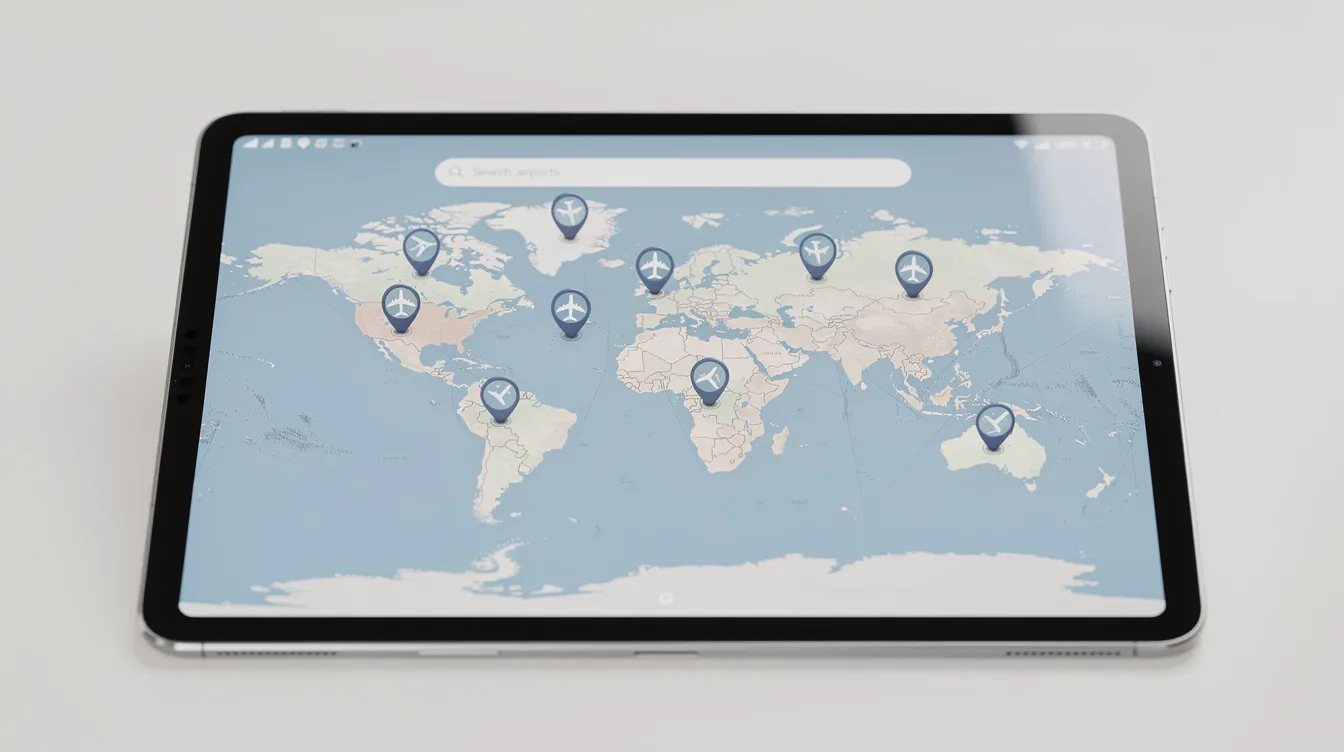
Jettly's platform uses similar locator logic in the background. When a user enters only city pairs - such as "New York to Miami" or "Paris to Geneva" - the system automatically identifies viable departure and arrival airports and presents them alongside matching aircraft and pricing.
Not every airport that appears in a locator result will work for every aircraft or every trip. Aviation databases can provide technical details about airfields, but knowing which details matter most is what separates a smooth flight from a logistical headache.
|
Data Point |
Why It Matters |
|---|---|
|
Runway length |
Determines which aircraft categories can operate safely |
|
Runway surface |
Paved runways are typically made of asphalt or concrete; grass strips are often used for smaller aircraft operations |
|
Airport category |
International, regional, or executive - affects available services |
|
Opening hours |
Some airports close at night or have restricted weekend operations |
|
Navigation aids |
ILS, RNAV, VOR approaches affect access in bad weather |
|
ICAO/IATA codes |
Standard identifiers used in flight planning and booking |
|
Towered vs. non-towered |
Affects traffic management and communication requirements |
Minimum runway length varies based on aircraft type and weight. Here is a general guide:
Light jets and turboprops - Often operate from runways around 3,500–4,000 ft (~1,100–1,200 m). Learn more about light aircraft in the Small Aircraft Guide.
Midsize jets - Typically require 4,500–5,500 ft (~1,400–1,700 m), with more margin needed at high-elevation airports.
Large-cabin and heavy jets - Often need 6,000–8,000 ft or more depending on payload and temperature. For a broader overview of aircraft categories, see the Types of Planes Guide.
Runway specifications include width, length, and surface type. Width matters for wingspan clearance - FAA and ICAO standards tie minimum widths to airplane design groups, typically 75–100 ft for business jets.
Terrain and weather also play a role. An airport like Aspen–Pitkin County (KASE) sits at 7,820 ft elevation in a mountain valley, which significantly increases required takeoff distances and limits access in poor visibility compared to Denver International (KDEN), located on flat terrain at 5,431 ft.
An airport locator helps travelers and brokers quickly check whether a chosen airport can handle a specific aircraft category, from turboprops to heavy jets.
A traveler planning a trip from Los Angeles to Las Vegas or Toronto to Vancouver can start by using an airport locator to decide on the most convenient departure and arrival airports, drawing on insights about where private jets typically land. Flight tools can help compare travel distances and flight options across multiple airfields near each city.

Take Los Angeles as an example. A locator will surface at least three relevant options:
|
Airport |
ICAO |
Distance from Downtown LA |
Longest Runway |
Best For |
|---|---|---|---|---|
|
Los Angeles International (LAX) |
KLAX |
~17 miles |
12,091 ft |
Heavy jets, international flights |
|
Van Nuys (VNY) |
KVNY |
~15 miles |
8,001 ft |
Midsize to heavy jets, executive travel |
|
Hollywood Burbank (BUR) |
KBUR |
~12 miles |
6,886 ft |
Light to midsize jets, less congestion |
For a private jet traveler living on the Westside, Van Nuys is likely the better departure point. It has dedicated FBOs, shorter taxi times, and far less congestion than LAX.
The same logic applies at the arrival end. A family heading to southwest Florida for vacation might instinctively book into Miami International (KMIA). But an airport locator reveals Naples Municipal (KAPF) with a 5,050-foot runway - sufficient for most light and midsize jets - and a ground transfer time to many Gulf Coast resorts of under 20 minutes versus 90+ minutes from Miami.
This process connects directly to how Jettly works. Users enter their route, and the platform suggests optimal airports identified from locator data, then presents matching aircraft and pricing. For step-by-step booking guidance, see How to Book a Private Jet.
Airport locator tools are especially useful for operators, brokers, and frequent flyers who want to understand operational constraints before booking and to compare different private and charter airline options. Here are the details that matter most.
Jet-A - The standard fuel for turbine and jet engines. Available at most airports with FBO services.
100LL (Avgas) - Used for piston aircraft. Less common at larger executive airports.
Fuel prices vary widely by airport and region. A smaller regional field may charge significantly more per gallon than a high-volume hub, which can affect total trip cost.
Paved runways, typically made of asphalt or concrete, are required for most jet operations.
Grass strips are often used for smaller aircraft operations, such as piston singles or light turboprops, but are generally unsuitable for jets.
Single-runway airports may have limited capacity during peak times or crosswind conditions.
|
Approach Type |
Precision Level |
Weather Access |
|---|---|---|
|
ILS (Instrument Landing System) |
High |
Best access in low visibility |
|
RNAV/GPS |
Moderate to high |
Good in most conditions |
|
VOR/NDB |
Low |
Limited in poor weather |
|
Visual only |
None |
Fair weather only |
Airports with precision approaches like ILS provide better access in poor weather, reducing the chance of diversions and delays. This matters significantly for time-sensitive travelers.
Airport locator data often includes available amenities that influence comfort and convenience:
FBO lounges - Private terminals with waiting areas, Wi-Fi, and conference rooms.
Hangars and de-icing - Critical in winter or for overnight aircraft storage.
Customs services - Available at select airports, sometimes by prior arrangement only.
Catering and crew rest - Some FBOs coordinate in-flight catering and crew accommodations.
Ground transportation - Rental car services are commonly available at airports, and some airports provide courtesy cars for passengers.
Dining - Many airports offer on-site restaurants for travelers during layovers or while waiting for departures.
Safety and compliance are non-negotiable in airport selection for private jets. An airport locator that pulls from official regulatory sources helps ensure that the airfield meets applicable standards.
In the United States, the FAA certifies airports under Part 139 for operations involving air carriers. Approximately 520 airports hold Part 139 certification, which mandates standards for:
Aircraft rescue and firefighting (ARFF)
Pavement condition and maintenance
Signage, marking, and lighting
Wildlife hazard management
Emergency response planning
Smaller general aviation fields may not carry Part 139 certification. Their safety infrastructure varies, and the FAA classifies them differently based on usage and public access. When booking through Jettly, travelers can trust that partner operators verify each airport's regulatory status before confirming operations.
Choosing a closer regional airport can reduce total fuel burn and ground-transfer mileage. Fewer taxiing minutes and shorter ground drives translate to lower overall emissions.
Many airports also enforce noise-abatement procedures, curfews, and flight-path restrictions that are reflected in locator data. These constraints may limit operating hours for certain jet types - something worth checking before finalizing a booking.
Jettly prioritizes safety by working only with licensed operators and vetted air carriers. The platform may also reference carbon-offset or efficiency-conscious practices for travelers interested in reducing their environmental footprint, and its jet card programs give frequent flyers predictable access to aircraft that meet rigorous safety and service standards.
Jettly integrates airport and route data within its digital platform to streamline the entire booking process for private flights, while its extensive inventory of private charter aircraft ensures the right jet is matched to each route. Rather than asking travelers to research airports on their own, the platform handles that step automatically.
A traveler enters origin and destination cities on the Jettly platform.
The system surfaces multiple airport options, including major hubs and nearby executive airports.
Jettly matches those airport options with a global inventory of over 20,000 aircraft, checking runway lengths, performance limits, and operating hours automatically.
The platform presents instant pricing and availability, helping users compare options - like a light jet into a smaller regional airport versus a midsize jet into a larger international airport.
This approach lets travelers see meaningful differences at a glance. A flight into Van Nuys might cost less in landing fees and save 45 minutes of ground time compared to LAX, while a midsize jet into a longer runway at a different field might offer better value for a larger group, particularly for members using Jettly's private jet memberships to access wholesale charter rates.
To explore charter options and see how route planning works in practice, visit https://www.jettly.com. You can also estimate costs using Jettly's Private Jet Cost Calculator.
The best way to understand the value of an airport locator is through practical examples. Here are three scenarios that show how airport choice shapes the travel experience.

A corporate executive needs to fly from Manhattan to a meeting in Coral Gables, Florida. The airport locator presents these options:
|
Route Segment |
Option A (Commercial Hubs) |
Option B (Executive Airports) |
|---|---|---|
|
Departure |
JFK (KJFK) - 60+ min drive from Midtown |
Teterboro (KTEB) - 20 min from Midtown |
|
Arrival |
Miami International (KMIA) - 25 min to Coral Gables |
Opa-locka Executive (KOPF) - 15 min to Coral Gables |
|
Estimated ground time saved |
- |
~50 minutes each way |
By selecting executive airports at both ends, the traveler gains roughly 100 minutes of productive time over the round trip. For more on managing private jet charter costs, including how airport choice affects pricing, Jettly provides transparent breakdowns and a dedicated jet card flight cost estimator for members comparing program options
A family of four wants to reach Whistler for a ski vacation. The locator shows that flying from Buttonville Municipal (CYKZ), closer to their suburban Toronto home, avoids the congestion of Pearson International (CYYZ). On the arrival side, Abbotsford (CYXX) or Squamish may offer shorter drives to the resort than Vancouver International (CYVR). For similar mountain-destination planning, see Private Flights to Lake Tahoe.
In an emergency, time is everything. A dispatcher or traveler can use an airport locator to quickly identify the nearest suitable airport, check that the runway accommodates the available aircraft, and confirm fuel and ground services. The ability to find the right airfield in minutes - rather than hours - makes a measurable difference in total response time. Jettly's platform handles this locator logic behind the scenes, presenting a clear selection of routing and aircraft options even under time pressure, and its crowdsourced private jet flights and seat-sharing can sometimes unlock more flexible or affordable options at short notice. To check empty leg flights that might provide faster availability, travelers can search Jettly's current inventory.
These questions address common concerns about airport locators and private jet charter that were not fully covered in the sections above.
Airport choice can change total cost through landing fees, handling charges, fuel prices, and repositioning distance for the aircraft. Smaller executive airports sometimes have lower landing fees but may charge more for fuel, while major hubs often have higher facility fees but more aircraft positioned nearby. Jettly's instant pricing and private jet charter cost estimator let travelers compare costs across nearby airports before confirming a flight, so there are no surprises.
Yes. Many airport locator tools allow filtering by customs availability or indicate whether an airport supports international arrivals and departures. However, customs services are available at select airports, and hours of operation vary - some smaller fields only offer clearance at specific times or by prior arrangement. Jettly and its partner operators routinely verify customs and border requirements when planning international private jet charter flights.
No. Not all airports in a locator are appropriate for every type of aircraft. Limitations include runway length, surface condition, terrain, and local operating restrictions. Lighter aircraft like turboprops or very light jets may use shorter runways that are not suitable for large-cabin jets. Jettly and professional operators assess each airport's technical data - including runway specifications, elevation, and approach types - before confirming that a specific aircraft can safely operate there.
Most comprehensive locators include both major international hubs and thousands of regional, municipal, and remote airfields. In the U.S. alone, the FAA tracks roughly 5,000 public-use airports and approximately 14,400 private-use fields. Coverage and data depth can vary by country, but official sources like the FAA, Nav Canada, and Eurocontrol provide broad, regularly updated information. Jettly often uses these smaller airports to get travelers closer to resorts, islands, and remote destinations not served by commercial airlines.
Travelers can either research airports in a standalone locator first or simply enter city pairs into Jettly, which automatically recommends suitable airports. Frequent flyers or corporate travel planners may benefit from checking specific airport details - runway lengths, hours, customs - in a locator tool like OpenNav, then using that information when requesting quotes on Jettly or planning routes to specific markets such as private jet charter in Atlanta, Georgia.
An airport locator is an essential tool for private jet travelers seeking efficiency, convenience, and cost savings. By identifying the best airports based on runway specifications, services, and location, travelers can significantly reduce ground time and streamline their journeys. Jettly leverages comprehensive airport data and a vast global aircraft inventory to match travelers with optimal routes and aircraft instantly. Whether for business, leisure, or urgent travel, using an airport locator through platforms like Jettly ensures a seamless, tailored private flight experience.
Ready to find the right airport and aircraft for your next trip? Explore flight options or request a quote at https://www.jettly.com.
Share this post:
Jay Franco Serevilla
Jun 29, 2026
|
5
min read
Discover tips and trends in the industry.

5
min read
White Cloud Aviation & Private Charter Around Lake Havasu
White Cloud Aviation in Lake Havasu City offers specialized flight training and private jet charter services, making it an ideal destination for pilots and leisure travelers. With year-round flying conditions and a focus on cloud aviation skills, students can enhance their training while enjoying seamless travel through platforms like Jettly.
Read More
5
min read
BAJ Jets: How Digital Platforms Like Jettly Are Changing Private Jet Travel
BAJ jets, or Book-A-Jet platforms, are revolutionizing private aviation by providing digital access to over 20,000 aircraft worldwide. Platforms like Jettly offer live pricing, transparent quotes, and flexible booking options, making private jet travel more accessible than ever. This article explores how these platforms work, their pricing models, and the overall booking experience.
Read MoreStay updated with our latest insights and tips to elevate your journey with us.
MEMBERSHIPS AND ASSOCIATIONS



Disclaimer: Jettly operates as a charter broker, offering access to a global digital jet charter marketplace. Jettly is not a direct air carrier and does not own or operate aircraft. All advertised flights are conducted by third-party air carriers that are fully licensed and hold the appropriate Part 135 or Part 121 certifications issued by the Federal Aviation Administration (FAA) or equivalent regulatory authorities under U.S. or foreign law. Jettly complies fully with the U.S. Department of Transportation's Part 295 and Part 298 Charter Broker regulations. Jettly does not carry additional liability insurance. Passengers are covered by aircraft operator insurance. TICO: 50023770


