


Login
Get Instant Pricing On 23,000+ Aircraft

>
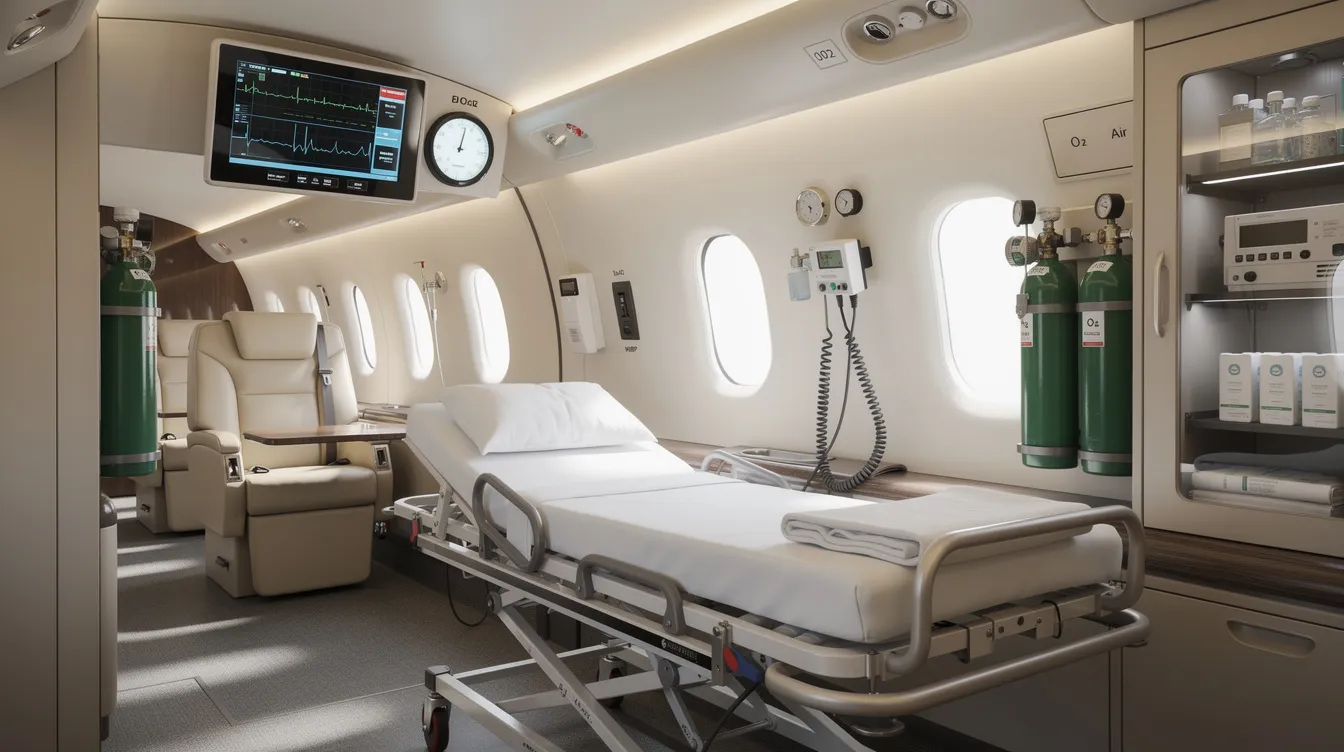
When a medical crisis strikes far from home, commercial airlines rarely offer the speed, equipment, or clinical support a patient needs. An ambulance jet fills that gap. These specially configured aircraft function as flying intensive care units, carrying critically ill or injured patients across domestic and international routes with hospital-grade monitoring and dedicated medical teams on board. This guide covers how ambulance jets work, who needs them, what they cost, and how to arrange one quickly through a platform like Jettly.
An ambulance jet is a fixed-wing air ambulance, typically a private jet outfitted with icu level medical equipment, ventilators, defibrillators, and continuous monitoring systems. It carries certified medical staff capable of providing intensive medical care throughout the flight.
These aircraft handle both domestic and international flights, covering distances between 1,000 and 3,500 nautical miles depending on aircraft category. With coordinated fuel stops, global coverage is achievable.
Ambulance jets serve patients facing time-sensitive conditions such as stroke, major trauma, cardiac events, spinal injury, or complex chronic illness requiring specialist treatment abroad.
Jettly's digital platform connects patients and family members with suitable ambulance jets, turboprops like the King Air, and medically configured private jets on demand, offering transparent pricing and access to over 20,000 aircraft worldwide.
Air ambulance services can be arranged with just four hours' notice in urgent scenarios, with most non-emergency missions planned 24–48 hours ahead.
For answers to common questions, scroll to the FAQ section at the bottom, or explore Jettly's air ambulance services to request a medical flight quote.
An ambulance jet is a fixed-wing aircraft, usually a light, mid-size, or heavy private jet, converted into a mobile intensive care unit for patient transport. Fixed-wing air ambulances are used for long-distance transport where ground ambulances or helicopters cannot practically reach, or where the patient's condition demands faster transit and continuous clinical monitoring.
A regular private jet offers comfort, speed, and privacy, but a medical configuration adds clear benefits through enhanced in-flight care, remote-area accessibility, and faster transport for critical patients. An ambulance jet goes further. It integrates:
Stretcher systems secured with aviation-certified mounts
Mechanical ventilators (battery-powered, flight-certified)
Multi-parameter monitors tracking ECG, blood pressure, SpO₂, capnography, and temperature
Defibrillators with pacing capability
Infusion and syringe pumps for continuous medication delivery
Oxygen supply (compressed gas or liquid oxygen) sized for the full flight plus reserves
Emergency drug kits and airway management tools
Medical private jets have ICU-level medical equipment onboard, replicating or exceeding what a hospital ward can provide during transit. The aircraft cabin effectively becomes a clinical environment from the moment the patient boards until they arrive at the receiving hospital.
Ambulance jets operate within a broader medical transport ecosystem that includes coordinated ground transportation. A typical mission involves coordination between the sending hospital, the receiving facility, ground ambulance services at both ends, insurers or medical assistance companies, and aviation authorities for overflight and landing permits, especially on international flights.
Ambulance jets include Learjet and Bombardier Challenger models, among others. Frequently used aircraft types for air ambulance charter missions include:
Learjet 35/45 – light jets with ranges around 1,800–2,160 nautical miles, commonly used for regional and shorter international missions
Cessna Citation models (such as Citation Bravo and Citation CJ3) – versatile light-to-midsize jets with good short-field performance
Learjet 60/60XR – mid-size jets offering stand-up cabins, onboard lavatories, and non-stop range up to approximately 2,050 nautical miles
Bombardier Challenger 604/605 – large-cabin, long-range jets capable of over 4,000 miles, ideal for intercontinental repatriation
Through Jettly's marketplace, patients and caregivers can access both dedicated air ambulance jets and medically configured private charter aircraft as part of a broader fleet available through the platform, filtered by clinical need, cabin size, range, and budget.
The term "air ambulance" covers a broad category of aircraft types-from turbine-powered turboprops to high-speed jets. Each suits different distances, budgets, and runway conditions. Understanding the differences helps coordinators and families choose the best option for a given mission.
Turboprop planes are slower than ambulance jets, cruising at roughly 250–350 mph compared to 450–600+ mph for jets. However, they carry distinct advantages. Examples of turboprop planes include King Air 90 and Piper Cheyenne, along with larger variants like the King Air 200/250 and King Air 360.
Key strengths of turboprops:
Short runway performance – they can land closer to rural or remote communities, using airstrips that jets cannot access
Regional airfield access – ideal for pickups and deliveries at smaller airports
Cost efficiency – more economical on routes under approximately 600–800 nautical miles
Patient safety – turboprop planes are equipped for safe patient transfers, carrying the same categories of monitoring and life-support gear as jets
Air ambulance services can access more airports than commercial operators, and turboprops extend that advantage further by operating from runways as short as 3,000 feet, often identified in advance using an airport locator tool to find suitable regional airfields.
Ambulance jets are preferred for long-distance medical transfers. Aircraft like the Learjet 35A, Cessna Citation CJ3, and Challenger 604 bring:
Higher cruise speeds – reaching destinations in significantly less time, critical when the patient's condition is deteriorating
Pressurized cabins – smoother, more stable cabin environments at altitude
Longer range – 1,500 to 4,000+ nautical miles non-stop, depending on the model
Comfort on long-distance flights – stand-up cabins, lavatories, and space for family members on larger jets
Jets provide smoother transportation for patients with fragile conditions such as spinal injuries, recent surgery, or severe burns, where vibration and turbulence need to be minimized.
Jettly's platform lets coordinators compare turboprops and jets side by side for a given medical charter plane scenario, factoring in coverage, enabling in distance, weather, airport access, and patient stability. A 2,500-mile repatriation will almost certainly require a jet, while a 400-mile transfer between regional hospitals may be better served by a King Air at a lower cost.
Ambulance jets are used when a patient is too sick, fragile, or immobile to safely fly on a standard commercial aircraft, even with basic medical assistance. Medical jets can bypass traffic and geographic barriers, reaching specialist hospitals that ground transport or commercial airlines simply cannot serve in time.
Major trauma – accidents abroad requiring transfer to a Level I trauma center, where the golden hour is critical in medical emergencies
Stroke or heart attack – transfer to a facility with interventional cardiology or neurosurgery capabilities
Advanced cancer – patients seeking specialized treatment (proton therapy, clinical trials) in another country
Spinal cord injuries – requiring immobilization and continuous monitoring throughout a medical flight
ICU patients – ventilator-dependent individuals who cannot be disconnected during transit
Pediatric or neonatal transport – requiring specialized equipment and clinical expertise
Research indicates air transport improves survival rates for severely injured patients, particularly when time to definitive care is a decisive factor.
A common use case involves transferring patients back home from destinations such as Europe to North America, the Caribbean to the U.S., or between Canadian cities when road transfer is impractical. For example, a family arranging transport from Miami to Toronto for cardiac care would typically coordinate an ambulance jet with ICU capability, ground teams to collect the patient at one end and complete the airport-to-hospital handoff at the other, and a receiving cardiologist on standby.
Not every patient is in a medical crisis. Jettly's network also accommodates stable but mobility-limited passengers-elderly individuals, post-surgery patients, or those with severe mobility impairment-who still require stretcher transport, monitoring, and professional oversight during the journey. That support can also make the trip feel more manageable during recovery.

The range of an ambulance jet depends on aircraft category, payload, fuel reserves, and weather conditions. Medical private jets can travel between 1,000 and 3,500 nautical miles, covering everything from regional transfers to intercontinental repatriations.
|
Aircraft Category |
Typical Models |
Approximate Non-Stop Range |
|---|---|---|
|
Light jet |
Learjet 35, Citation CJ3 |
1,000–2,000 NM |
|
Mid-size jet |
Learjet 60XR, Falcon 50, Hawker 900 |
2,000–3,200 NM |
|
Heavy/long-range jet |
Challenger 604/605, Global series |
3,500–4,500+ NM |
For missions that exceed a single aircraft's non-stop range, quick refueling can extend the range of medical private jets. With coordinated fuel stops and the right overflight permits, there is practically no limit to global coverage, enabling routes like New York to London, Dubai to Frankfurt, or São Paulo to Lisbon.
Longer range missions usually prioritize larger cabins (Challenger or Global series) to accommodate extra medical equipment, staff, and one or two accompanying family members, mirroring many of the same cabin-comfort considerations covered in guides to the best private planes for families and caregivers.
Flight time is only one piece of the puzzle. Medical flight planning also accounts for:
Cabin altitude – pressurization settings adjusted for patients sensitive to altitude changes
Weather and airspace constraints – routing adjusted to avoid turbulence or restricted zones
Positioning legs – time for the aircraft to fly to the patient's location before the medical leg begins
Ground segments – ambulance connections at origin and destination airports
Jettly's platform helps planners match range requirements with suitable aircraft and schedule efficient routing that minimizes time on the ground. Clients can filter by distance, speed, cabin size, and availability to identify the right jet for their route.
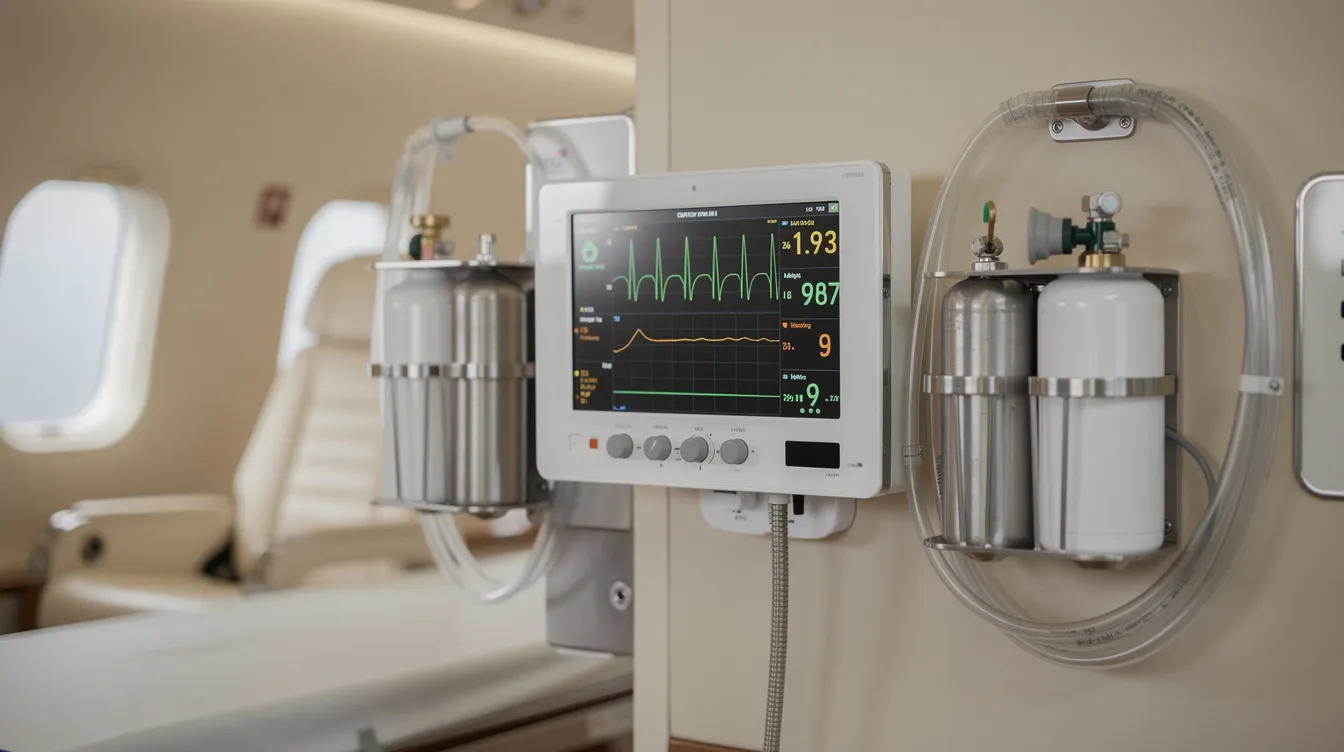
A true ambulance jet replicates an intensive care environment, allowing patients to receive hospital-level medical assistance during all phases of flight-taxi, takeoff, cruise, descent, and landing. Air ambulances provide life-saving technology during transport, and advanced equipment is included in air ambulances for severe conditions ranging from respiratory failure to cardiac arrest.
Air ambulances are equipped with ICU-level medical equipment, typically including:
Multi-parameter patient monitors (ECG, blood pressure, SpO₂, capnography, temperature)
Flight-certified mechanical ventilators
Defibrillator with external pacing
Infusion and syringe pumps for vasopressors, sedatives, and other critical medications
Portable suction units
Oxygen supply (gas cylinders or liquid oxygen) with capacity for the full flight plus reserves
Emergency drug kit and airway management tools
Specialized equipment as needed: portable ultrasound, neonatal incubator, ECMO brackets
Patients receive care from certified medical professionals during flights. Medical teams in air ambulances include flight paramedics and emergency nurses, with onboard physicians added for higher-acuity cases. Typical staffing includes:
Critical care flight nurses – usually with 5+ years of ICU or ER experience
Flight paramedics – certified in advanced pre-hospital and aeromedical care
Physicians – anesthesiologists, emergency medicine doctors, or intensivists for ventilator-dependent patients, recent post-operative cases, or unstable conditions
Specialist roles – neonatal nurses, respiratory therapists, or pediatric specialists when the patient's age or condition requires it
Before any mission, the medical staff reviews the patient's records, discharge summaries, imaging, doctor's notes-to determine staffing levels, ventilator settings, medication plans, and any special requirements. Coordination with both the sending and receiving hospitals ensures continuity of care throughout the trip.
When arranging a mission via Jettly, the operating medical provider works directly with families and clinicians to define these requirements, including any need for pediatric equipment or infectious disease isolation.
Most ambulance jets allow at least one, and sometimes two, family members or close companions to travel with the patient. Larger-cabin jets like the Learjet 60 or Challenger 604 provide stand-up space, onboard lavatories, and dedicated companion seating, making longer flights more manageable for families.
Medical private jets provide comfort and peace of mind for patients and their families. Unlike a busy commercial cabin with hundreds of strangers, a medical flight is a private, controlled environment. This matters for patients dealing with high pain levels, confusion, anxiety, or the emotional weight of a serious diagnosis.
Noise and vibration – jets are generally quieter and smoother at cruise altitude than turboprops
Pressurization – quality jets maintain cabin altitude equivalent to lower elevations, reducing physiological stress
Seat configuration – companion seats may recline or convert for rest on overnight sectors
Catering – soft meals or dietary-specific food can be arranged for longer flights
Luggage space – modest personal luggage for the patient and companions is usually accommodated
Jettly's booking process can take into account specific comfort requests-extra seating for caregivers, in-flight catering preferences, or direct ground transfers to the hospital-so families can focus on their loved one rather than logistics. Emotional support and clear communication with family members are standard parts of any well-run medical transport mission.
Jettly acts as a digital charter broker, connecting clients with vetted air ambulance operators around the world. Its platform provides access to over 20,000 unique aircraft, including dedicated ambulance jets and aircraft that can be medically outfitted for specific missions, similar to how it connects travelers with operators like Dexter Air Taxi through its global charter platform.
Initial inquiry – contact Jettly by phone or online with origin, destination, patient condition, and desired timing
Medical report submission – share diagnosis details, mobility status, ventilator or infusion needs, and number of accompanying family members
Clinical and aviation review – the medical and flight team assesses staffing requirements, equipment, and aircraft suitability
Aircraft selection – options are matched by range, cabin size, runway requirements, and budget
Routing and regulatory clearance – flight plan filed, overflight and landing permits secured, ground ambulance integration arranged
Price and schedule confirmation – transparent quote provided, including aircraft type, crew, and estimated timing
Air ambulance services can be arranged with four hours' notice in urgent situations, and operators can respond quickly when medical documentation, crew availability, and payment or insurance authorization are in place. Air ambulances are often available 24/7 for emergencies, and Jettly's operator network includes providers prepared for short-notice mobilization. For non-emergency cases, 24–48 hours of planning allows for better aircraft selection and cost optimization.
Jettly offers transparent pricing with instant or rapid quotes on many routes, helping families understand cost implications of different aircraft types-turboprop versus light jet versus mid-size jet-and how these compare with affordable private jet charter options for non-medical or lower-acuity travel, drawing on the same principles that govern private jet flight pricing and one-off trip costs and broader private jet ownership and operating costs.
Learn more about how booking works and request a medical flight quote at jettly.com.
Ambulance jet pricing depends on several factors: distance flown, aircraft category, medical crew requirements, airport and handling fees, and mission urgency. Day versus night operations, short-notice dispatch, and weekend or holiday scheduling all carry cost implications.
|
Mission Type |
Approximate Cost Range (USD) |
|---|---|
|
Short-haul regional (a few hundred miles) |
Low tens of thousands |
|
Mid-range continental |
Mid tens of thousands to low six figures |
|
Intercontinental repatriation (full ICU jet) |
Mid to high six-figure |
These ranges vary based on aircraft type, medical crew complexity, and routing. A charter cost estimator or dedicated jet card flight cost estimator can help narrow expectations for specific routes.
Insurers, travel insurance companies, and assistance organizations sometimes reimburse or pre-approve medical transport when it is medically necessary and pre-authorized. Key steps include:
Confirming that the policy covers "air ambulance," "medical evacuation," or "medical repatriation"
Obtaining prior authorization from the insurer or assistance provider
Documenting medical necessity with physician reports and discharge summaries
Submitting detailed invoices from the operator
Clients should check their policy wording before travel, particularly for international trips. Some policies have per-incident limits, pandemic exclusions, or requirements for using specific assistance networks.
Jettly's support team and partner operators can provide documentation, medical reports, and invoices needed for reimbursement discussions with insurers, while resources on jet card costs and pricing structures and broader comparisons of leading jet card programs can help frequent travelers evaluate longer-term budget strategies for private flights.
Ambulance jets must meet both aviation safety regulations and medical quality benchmarks for in-flight care. This dual layer of oversight protects patients during what is often one of the most vulnerable moments of their lives.
Reputable operators fly under strict frameworks-FAR Part 135 in the United States, equivalent EASA rules in Europe, or Transport Canada standards. These regulations govern aircraft maintenance schedules, pilot qualifications, crew duty limits, and operating procedures. Pilots on medical missions typically hold Airline Transport Pilot (ATP) certificates with recurrent simulator training.
Beyond aviation compliance, industry bodies set standards specifically for medical transport:
CAMTS (Commission on Accreditation of Medical Transport Systems) – U.S.-based accreditation covering training, crew qualifications, equipment, and safety audits for fixed-wing and rotor-wing programs
EURAMI (European Aero-Medical Institute) – European accreditation requiring certified stretcher systems, climate-controlled cabins, medical cold chain maintenance, and clear separation of medical and aviation responsibilities
These marks matter because they signal that an operator has been independently audited for both clinical competence and flight safety.
Medical and flight crews jointly assess weather, airspace constraints, and patient fitness before every mission. Planning includes alternate airports for diversions, fuel contingencies, and clinical decision-making about cabin altitude settings that could affect specific conditions. Through its marketplace, Jettly works with licensed operators and encourages clients to prioritize medically accredited providers for higher-acuity cases, while corporate travelers may separately benefit from structured jet card programs and detailed guides on how jet cards work, their costs, and benefits for their non-medical private flying needs.
Not every patient requires a full air ambulance. Some can safely travel on commercial flights with medical escorts, or on standard private jets with light medical support. The key is matching the level of care to the patient's actual clinical risk.
For stable patients, a nurse or paramedic can accompany them on a regular airline flight. This option is significantly cheaper, often a fraction of the cost of a dedicated ambulance jet. However, it comes with limitations: less privacy, minimal emergency equipment, potential delays from airline scheduling, and limited ability to intervene if the patient's condition changes mid-flight. Most patients in this category are mobile or semi-mobile, medically stable, and not dependent on continuous infusions or ventilator support.
Helicopter air ambulances are used for emergency scene responses, accident sites, remote area evacuations, or short-distance hospital-to-hospital transfers. They are critical when the golden hour demands rapid extraction. However, helicopters have limited range (typically under 200 miles), lower cruise speeds, and higher cost per mile than fixed-wing aircraft. For a deeper look at rotary-wing options and what they cost, see Jettly's guide to helicopter ambulance costs.
For short distances between hospitals, particularly within the same city or region, ground ambulance or critical care transport remains the default. Air ambulances coordinate ground ambulance connections for patient transfers at both origin and destination, so ground and air transport often work together rather than as substitutes.
Jettly's advisors can help compare these options from both medical and budget perspectives, ensuring the chosen transport mode is proportionate to the patient's condition, and in some cases, suggest crowdsourced private jet flights and shared seats or other ways to buy a single seat on a private jet for accompanying family members or non-critical travel needs. Safety and clinical stability should always take precedence over cost when deciding between an ambulance jet and a less-equipped alternative. An emergency private jet charter may also suit patients who need speed and privacy but not full ICU-level support.
Ambulance jets, like all aircraft, carry an environmental footprint. But the context matters: these are life-saving missions where hours-sometimes minutes-determine outcomes. The trade-off between carbon output and patient survival is one that most families, providers, and insurers accept without hesitation.
That said, responsible planning can reduce unnecessary impact:
Efficient routing – avoiding circuitous paths and minimizing positioning legs
Right-sized aircraft – choosing a turboprop or light jet when a heavy jet is not clinically required, avoiding excess fuel burn
Carbon offset programs – some operators and platforms offer offset options for medical flights
Modern fleets – newer aircraft burn less fuel per nautical mile and produce lower emissions
Jettly's broad aircraft inventory allows planners to choose the most operationally efficient aircraft type for each route. Operational efficiency translates into cost savings for patients and insurers as well. Smaller aircraft, shorter ground times, and direct routing all reduce the total bill, particularly when combined with flexible private jet memberships or a NetJets alternative like Jettly's on-demand and membership model that offers wholesale rates for additional non-medical flights.
In many regions, an air ambulance jet can be dispatched within a few hours once medical details, documentation, and payment or insurance guarantees are in place. Air ambulance services can be arranged with four hours' notice in urgent cases. Timing depends on aircraft availability, crew duty limits, airport operating hours, and, for international routes, overflight and landing permits. Contact Jettly or a medical assistance provider as early as possible to speed up coordination and clinical review.
Smaller turboprops like King Air 90 and King Air 200 variants are well-suited to shorter or unpaved runways, making them ideal for remote or regional pickups. Jet operations typically require longer paved runways, so sometimes a combination of ground ambulance and air ambulance is used. Ground transport moves the patient to the nearest suitable airfield, where the ambulance jet is waiting. Jettly's route planning tools and operator network help identify the closest safe departure and arrival airports for each mission.
To receive a precise quote, be prepared to share:
Patient's current location and destination hospital
Diagnosis and medical history
Mobility level (can the patient sit, or is a stretcher required?)
Need for ICU, ventilator, or continuous infusion support
Preferred travel date and time
Number of family members planning to accompany the patient
Recent medical reports-discharge summaries, imaging, doctor's notes
With this information, Jettly can present accurate aircraft options, timing expectations, and route planning suited to the case.
Priority is always given to medical equipment, medical staff, and the patient's safety. Space for pets or additional baggage is assessed on a case-by-case basis. For most ICU-level missions, non-service animals are discouraged or restricted, while modest luggage for the patient and accompanying family is usually acceptable. Any special requests should be shared early in the planning process so operators can determine feasibility based on cabin size and the equipment already on board.
Standard practice is to coordinate a ground ambulance or medical transport service to meet the aircraft on arrival and transfer the patient directly to the receiving hospital. The medical staff on the flight typically briefs the receiving team, hands over documentation, and confirms that ongoing treatment needs are understood. This bed-to-bed coordination, from the sending hospital through the flight to the destination facility, is a core part of well-run air ambulance operations. Jettly's partner operators can integrate these logistics so families do not need to organize each step themselves.
An ambulance jet bridges the distance between a medical crisis and the specialized hospital care a patient needs. Whether the mission is a 500-mile domestic transfer or a 4,000-mile intercontinental repatriation, the core principles remain the same: match the aircraft to the patient's clinical needs, ensure the medical team has the right training and equipment, and move fast without compromising safety.
Choosing the right aircraft depends on distance and urgency-a turboprop may handle a regional pickup from a short runway, while a mid-size or heavy jet covers a transatlantic mission with room for family, staff, and full ICU-level equipment, much as individuals weighing ownership might compare affordable planes and budget-friendly aircraft choices or other low-cost private aircraft options across categories to match capability with cost. Air ambulances can land at more airports than commercial flights, giving patients and coordinators flexibility that scheduled airlines cannot offer.
Jettly's technology-driven platform simplifies access to a global network of ambulance jets and medically configured aircraft, with transparent pricing and rapid response times. For families navigating an unfamiliar and stressful process, that clarity makes a real difference.
Ready to explore medical flight options or need to arrange urgent patient transport? Request a quote at https://www.jettly.com.
Share this post:
Jay Franco Serevilla
Jun 24, 2026
|
5
min read
Discover tips and trends in the industry.

5
min read
Business Aviation: How Modern Private Air Travel Powers Business Growth
Business aviation revolutionizes corporate travel by providing unmatched flexibility, privacy, and efficiency. With access to over 5,000 airports and the ability to book on-demand, it enhances productivity and reduces travel time significantly. Platforms like Jettly simplify the process, making private jet travel accessible and cost-effective for businesses.
Read More
5
min read
Private Jet from Chicago to Las Vegas: Flight Time, Cost & Best Charter Options
Chartering a private jet from Chicago to Las Vegas offers a swift and convenient travel option, covering approximately 1,500 miles in about 3.5 hours. With various aircraft options available, travelers can enjoy significant time savings and avoid crowded commercial airports. Jettly's platform provides transparent pricing and access to over 20,000 private jets, making it easy to find the right charter for your needs.
Read MoreStay updated with our latest insights and tips to elevate your journey with us.
MEMBERSHIPS AND ASSOCIATIONS



Disclaimer: Jettly operates as a charter broker, offering access to a global digital jet charter marketplace. Jettly is not a direct air carrier and does not own or operate aircraft. All advertised flights are conducted by third-party air carriers that are fully licensed and hold the appropriate Part 135 or Part 121 certifications issued by the Federal Aviation Administration (FAA) or equivalent regulatory authorities under U.S. or foreign law. Jettly complies fully with the U.S. Department of Transportation's Part 295 and Part 298 Charter Broker regulations. Jettly does not carry additional liability insurance. Passengers are covered by aircraft operator insurance. TICO: 50023770


