


Login
Get Instant Pricing On 23,000+ Aircraft

>
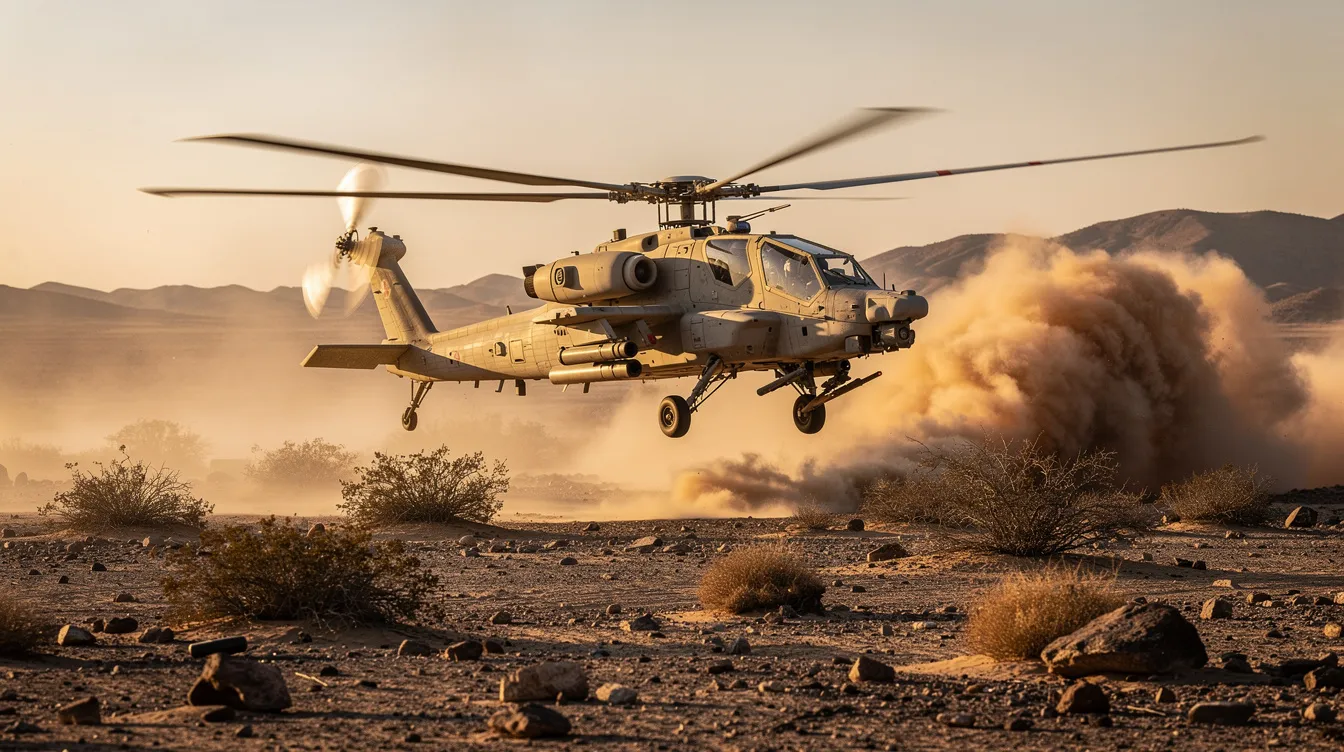
The AH-64 Apache is a twin-engine attack helicopter with a fuselage length of roughly 58 ft 3 in, a 48 ft main rotor span, and an overall height of about 12–15 ft depending on whether the Longbow radar dome is fitted.
Mission weight typically sits between 16,000 and 18,000 lb, with the maximum takeoff weight for the AH-64D and AH-64E near 23,000 lb. These figures directly affect range, payload, and hot-and-high performance.
The mast-mounted radar on the AH-64D Apache Longbow adds roughly 2–3 ft of height but does not change fuselage length or main rotor diameter, keeping the basic footprint consistent across variants.
Apache dimensions matter because they determine hangar clearance, deck compatibility, forward base requirements, and how the helicopter operates in combat. Dimensions are categorical attributes that provide context to quantitative measurements like speed, range, and weapons load.
Note: In data analytics, dimensions are categorical or descriptive attributes (such as variant, configuration, or environment) that provide context to measurable facts (like weight or speed). In this article, Apache dimensions refer to the physical attributes—length, rotor diameter, height, and weight—that define the helicopter’s operational context.
Unlike private jets or civil helicopters chartered through platforms like Jettly, the Apache is a purpose-built military platform optimized around armor, sensors, and firepower rather than passenger comfort.
Apache dimensions, in practical terms, are about 58 ft 3 in (17.76 m) in fuselage length, a 48 ft (14.63 m) main rotor diameter, and roughly 12 to 15 ft in overall height, depending on the variant and whether the Longbow radar dome is fitted. Those measurements are more than a list of specs: they define what the AH-64 can do on the battlefield, where it can operate, how crews plan each mission, and what it takes to base, transport, and support the aircraft.
The AH-64 Apache has served as the United States Army's primary attack helicopter since the mid-1980s. More than 2,400 airframes have been built across multiple variants, from the original AH-64A to the AH-64D Apache Longbow and today's AH-64E Guardian. By 2023, U.S. Apaches had flown over 1.3 million combat hours, making the type one of the most operationally proven rotorcraft in history.
The Apache first saw combat in 1989 during Operation Just Cause. In Operation Desert Storm, Apaches destroyed 278 tanks and 500 vehicles, demonstrating their effectiveness in armored warfare. During the 2003 Iraq invasion, one Apache was shot down, highlighting both the helicopter's combat role and its vulnerabilities. The AH-64E Apache, the latest variant, was first deployed in combat in 2014 and features advanced capabilities, including control of unmanned aerial vehicles for scouting.
For military aviation enthusiasts, defense professionals, data-minded readers comparing aircraft specifications, and anyone curious how the Apache's size stacks up against civil helicopters and charter aircraft, this article stays focused on the numbers that matter: length, rotor diameter, height, weight, and how those dimensions affect performance, mission planning, battlefield roles, and side-by-side comparisons with aircraft seen through Jettly's charter marketplace. Understanding those dimensions gives readers a clearer way to judge the Apache's operational reach and logistics while putting a military rotorcraft in context against civilian aircraft built for very different missions.
The Apache family traces its roots to the US Army's Advanced Attack Helicopter program, which selected Hughes Helicopters' YAH-64 prototype in 1976. The army needed a replacement for the aging AH-1 Cobra, and the new design had to carry anti-tank missiles, survive hits from heavy ground fire, and operate at night and in bad weather.
Key milestones include:
1976: Hughes Helicopters wins the AAH competition. The aircraft featured revolutionary features including a tandem cockpit, integrated helmet and display sighting system, and steel composite rotors.
1984: McDonnell Douglas (which acquired Hughes Helicopters) delivers the first production AH-64A Apache to the Army. Boeing AH-64 production later moved to Boeing's Mesa, Arizona facility after the Boeing Company acquired McDonnell Douglas.
1986: The AH-64A Apache enters army service with the US Army.
1989: The Apache first saw combat during Operation Just Cause in Panama, becoming the first helicopter to fire in that conflict.
1991: In Operation Desert Storm, Apaches destroyed 278 tanks and 500 vehicles during the Gulf War, cementing the type's reputation as a premier close-combat support platform.
1997–2003: The AH-64D Apache Longbow enters full-scale production with the AN/APG-78 Longbow radar, upgraded avionics, and improved survivability.
2010s–present: The AH-64E Guardian (E model) begins deliveries. The AH-64E Apache was first deployed in combat in 2014.
Despite generational upgrades, core airframe dimensions have remained broadly similar across variants. Fuselage length, main rotor diameter, and basic structural layout stayed consistent, which simplifies logistics, spare parts supply, and infrastructure planning. Today, Boeing's Mesa, Arizona, facility continues producing Apaches for the US Army and international customers, including Poland, Morocco, and India.
Fuselage length and rotor diameter together define how much space an Apache requires on the ground, on ship decks, or at forward arming and refueling points.
The Apache's fuselage length is about 58 feet 3 inches (17.76 m) for AH-64A, AH-64D, and AH-64E variants. This figure includes sensors and antennae at the nose and tail, though references may vary by a few inches depending on specific equipment fits.
It is important to distinguish between the Apache's fuselage length and its overall footprint when the main rotor disk is spinning. With a 48 ft rotor, the total swept area extends well beyond the fuselage envelope in every direction.
The relatively compact fuselage compared with fixed-wing ground-attack aircraft allows Apaches to operate from smaller improvised sites near the front line.
Ground units and support crews must still account for the rotor disk when positioning the helicopter in tight landing zones.
Planning for revetments, ship decks, and maintenance pads requires factoring in both the 58 ft body and the rotor overhang.
While Jettly's charter helicopters, such as civil medium twins, may have comparable overall lengths, military Apaches dedicate that space to armor, weapons, and sensors rather than a passenger cabin.
Rotor diameter determines lift generation, hover performance, and the size of the rotor wash zone that ground crews and supporting vehicles must respect.
The AH-64's four-blade main rotor has a diameter of approximately 48 ft (14.63 m). This main rotor span remains constant across AH-64A, AH-64D, and AH-64E variants. Each rotor blade is designed to survive hits from 23 mm rounds, a specification that adds weight and structural complexity but dramatically improves battlefield survivability. Rotor blade life is a key maintenance metric, with regular inspections tracking wear, ballistic damage, and fatigue.
The tail rotor, while smaller, contributes to the overall lateral span and affects parking width requirements. Combined with stub wings carrying weapons, the helicopter's effective lateral footprint can reach approximately 16 ft 4 in when stores are attached.
Rotor size balances agility with the ability to carry weapons and armor.
Lighter attack helicopters may opt for smaller rotors but accept lower payloads.
Deck compatibility on naval ships and crowded forward arming points depend heavily on the 48 ft rotor diameter, making Apache dimensions a key factor in deployment planning.
For a broader look at how rotor diameter affects different helicopter types, readers can explore Jettly's helicopter specs guide.
Height is a critical dimension for hangar clearance, shelter planning, and tactical concealment. The radar dome on the AH-64D Apache Longbow is the main factor that changes the Apache's vertical profile.
Here are the concrete figures:
AH-64A (no Longbow): Height to rotor hub is roughly 12 ft 8 in (3.87 m).
AH-64D Apache Longbow (with radar dome): Overall height reaches approximately 15 ft 3 in (4.65 m) to the top of the AN/APG-78 radar dome.
The AN/APG-78 radar is mounted above the rotor for better visibility, sitting on a mast that extends above the rotor plane. This mast-mounted radar design gives the Apache Longbow its distinctive profile and allows terrain masking: crew members can hide the helicopter behind a ridgeline or tree line, exposing only the Longbow radar dome to scan for armored threats.
The Longbow radar can track up to 256 targets simultaneously, and the system can engage up to 16 targets at once. It allows targeting beyond the pilot's line of sight, and Longbow-equipped Apaches can initiate attacks within 30 seconds of targets detected by the radar. These capabilities illustrate how the radar dome is not just a dimensional feature but a tactical game-changer.
Not all AH-64D aircraft carry the radar dome on every mission. When removed, height drops back near AH-64A levels. Civil helicopters chartered via platforms like Jettly normally lack large mast-mounted radars, so their hangar requirements are considerably simpler.
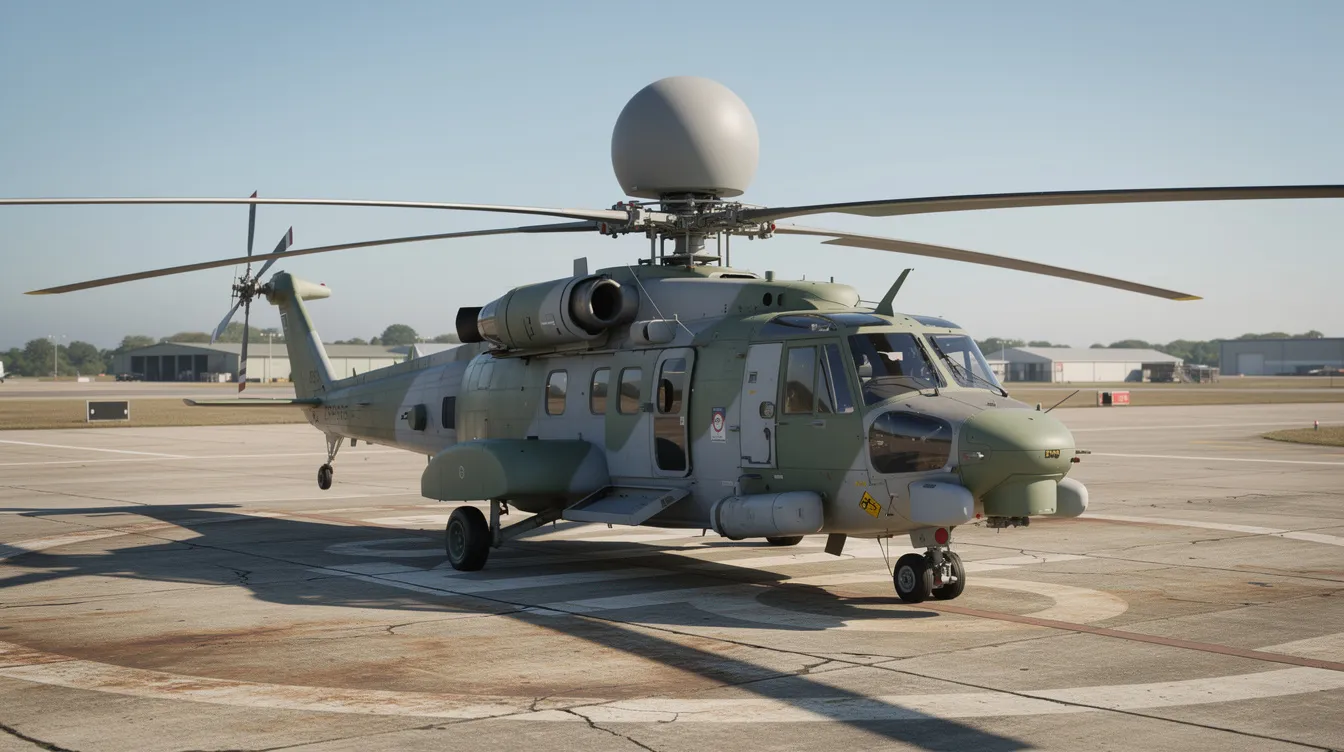
Weight is as important as length and height when evaluating performance, payload, and range for any aircraft. For a deeper look at how rotorcraft weight affects operations, see Jettly's guide on how much a helicopter weighs.
Here are the typical published figures:
|
Weight Category |
AH-64A |
AH-64D / AH-64E |
|---|---|---|
|
Empty weight |
~11,000 lb (4,990 kg) |
~11,387 lb (5,165 kg) |
|
Primary mission gross weight |
~15,000–16,000 lb |
~16,000–18,000 lb |
|
Maximum takeoff weight |
~21,000 lb |
~23,000 lb (10,432 kg) |
The AH-64A Apache was slightly lighter due to earlier avionics and fewer armor and sensor additions. The AH-64E balances extra weight from advanced systems with more powerful engines.
Fuel, 30 mm ammunition, and Hellfire anti-tank missile loads quickly push the helicopter toward its maximum takeoff weight, forcing trade-offs between endurance and firepower. A fully loaded Apache carrying 16 AGM-114 Hellfire missiles, full ammunition for the 30 mm chain gun, and maximum internal fuel will approach the 23,000 lb ceiling.
In the data analytics world, facts represent quantitative values that can be measured or aggregated. Weight figures like empty weight, gross weight, and maximum takeoff weight serve the same role for Apache performance analysis: they are the measurable facts against which mission planning decisions are made.
Civilian charter helicopters and private jets focus their payload on passengers and luggage. Readers interested in how these trade-offs affect charter pricing can review Jettly's guide to affordable aircraft rental options to see how cabin space, range, and payload influence costs. Jettly customers typically care about cabin capacity and baggage limits rather than missiles and armor.
Much of the Apache's weight and bulk comes from its armor and crashworthy structure, not just the airframe and engines.
The crew compartment and critical systems are protected by approximately 2,500 lb (1,100 kg) of armor plating. This armor allows the aircraft and crew members to survive hits from 23 mm rounds, a standard set during the Cold War when Soviet anti-aircraft guns posed a persistent threat. Both the pilot and co-pilot/gunner sit in a tandem cockpit separated by a blast shield, so that either the pilot or the gunner can continue flying if the other is incapacitated.
Key protection features include:
Crew seats and fuselage are designed to meet MIL-STD-1290 crashworthiness standards, influencing floor height and landing gear stroke.
Self-sealing fuel tanks that prevent catastrophic leaks after ballistic damage.
Redundant hydraulic and flight control systems, so the Apache can continue flying after taking fire.
These systems explain why the Apache appears bulkier than lighter attack helicopters like the European Tiger. The added volume and weight represent a deliberate trade-off: battlefield survivability over speed and compactness.
Civil rotorcraft used for charter prioritize cabin comfort and efficiency over this level of protection. For readers comparing the Apache's mission-driven design with civil operations, Jettly's comprehensive guide to helicopter rental costs explains how aircraft type, route, and payload drive pricing. For details on comfortable charter options, explore Jettly's helicopter charter page.
While engines do not dramatically alter external dimensions, their size and power output shape climb rate, speed, and hot-and-high performance.
Engine types across variants:
AH-64A: General Electric T700-GE-701 or 701C turboshafts, approximately 1,690–1,890 shp each.
AH-64D: T700-GE-701C, later upgraded.
AH-64E: T700-GE-701D engines producing close to 2,000 shp each. The AH-64E model produces 2,000 shp per engine, a meaningful upgrade over earlier powerplants.
These engines drive specific performance numbers:
Maximum speed: The AH-64 Apache has a maximum speed of 188.7 mph (roughly 158 knots / 293 km/h).
Cruise speed: Approximately 143 knots (165 mph / 265 km/h).
Service ceiling: It has a service ceiling of 21,000 feet.
Climb rate: The helicopter can climb at a rate of 1,775 feet per minute under standard conditions.
More powerful engines on the AH-64E compensate for added sensors, upgraded avionics, and digital connectivity systems while preserving hover performance at high gross weight and warm temperatures. High-performance data stores use dimensions for filtering and aggregation, and in the same way, comparing engine output against weight and altitude conditions filters the Apache's usable performance envelope.
Power-to-weight ratio influences takeoff distance, climb performance, and the ability to carry full weapons loads. For readers comparing these figures to civil helicopter specs, examining a modern light utility helicopter such as the Eurocopter EC30 specs and charter profile highlights how civil designs balance power, payload, and passenger comfort. The Apache prioritizes power margin for combat maneuvers over fuel efficiency.
Internal volume on the Apache is split between fuel tanks, avionics bays, and armor, unlike passenger-oriented aircraft where interior space is optimized for seating.
Internal fuel capacity for a typical AH-64D is about 376 US gallons (1,423 liters). This gives a combat radius of around 260 nautical miles (roughly 300 miles / 480 km) with standard loads, supporting the aircraft's primary mission profile of close combat support and anti-armor operations.
The Apache can carry wing fuel tanks on its stub wings pylons, extending ferry range to roughly 1,180 miles (1,900 km) at the cost of weapons carriage. This ferry range figure applies when carrying minimal stores and auxiliary fuel tanks.
Fuel volume and tank placement affect the center of gravity and usable load.
Self-sealing fuel tanks add weight but prevent catastrophic fuel loss after hits.
Mission planners constantly trade fuel load against weapons to stay within safe operating weight.
Compared to the Apache's relatively short combat radius, midsize and heavy private jets available via Jettly can cover thousands of miles nonstop. Jettly's private charter aircraft catalog shows how different jet classes trade wingspan, cabin volume, and fuel capacity to achieve this range. This reinforces how mission shapes aircraft design: the Apache needs to loiter and fight within a defined radius, while charter aircraft need to cover distance efficiently.
The Apache's stub wings and weapons pylons materially increase its effective width and clearance requirements when fully armed.
The basic layout consists of two short wings with two hardpoints each, for a total of four pylons. These can carry:
AGM-114 Hellfire missiles: The Apache carries up to 16 AGM-114 Hellfire missiles. The Hellfire missile can engage targets up to 6,500 meters away, making it the helicopter's primary anti-armor missile. It is a helicopter-launched precision weapon used against armored threats, vehicles, and fortifications.
Hydra 70 rockets: The Apache can carry Hydra 70 rockets on its stub wings, typically in rocket pods holding up to 76 rounds total.
External fuel tanks: Wing fuel tanks can replace weapons pylons for extended ferry range.
The 30 mm M230 chain gun is mounted in a chin turret under the nose. It is equipped with a 30 mm M230 chain gun that carries 1,200 rounds and can track head movements through the integrated helmet and display sighting system. This allows either the pilot or the co-pilot/gunner to aim simply by looking at the target.
A fully loaded Apache with 16 Hellfire anti-tank missile rounds and full rocket pods represents a substantial lateral footprint increase over a "clean" configuration. Ground crews need extra spacing in revetments, and ship deck officers must account for the additional width when parking multiple aircraft.
For a complete breakdown of Apache procurement and incremental or flyaway cost, see Jettly's article on the price of the Apache helicopter, and contrast those figures with Jettly's guide to affordable private jet charter pricing to understand how civil charter costs scale with aircraft size and capability.
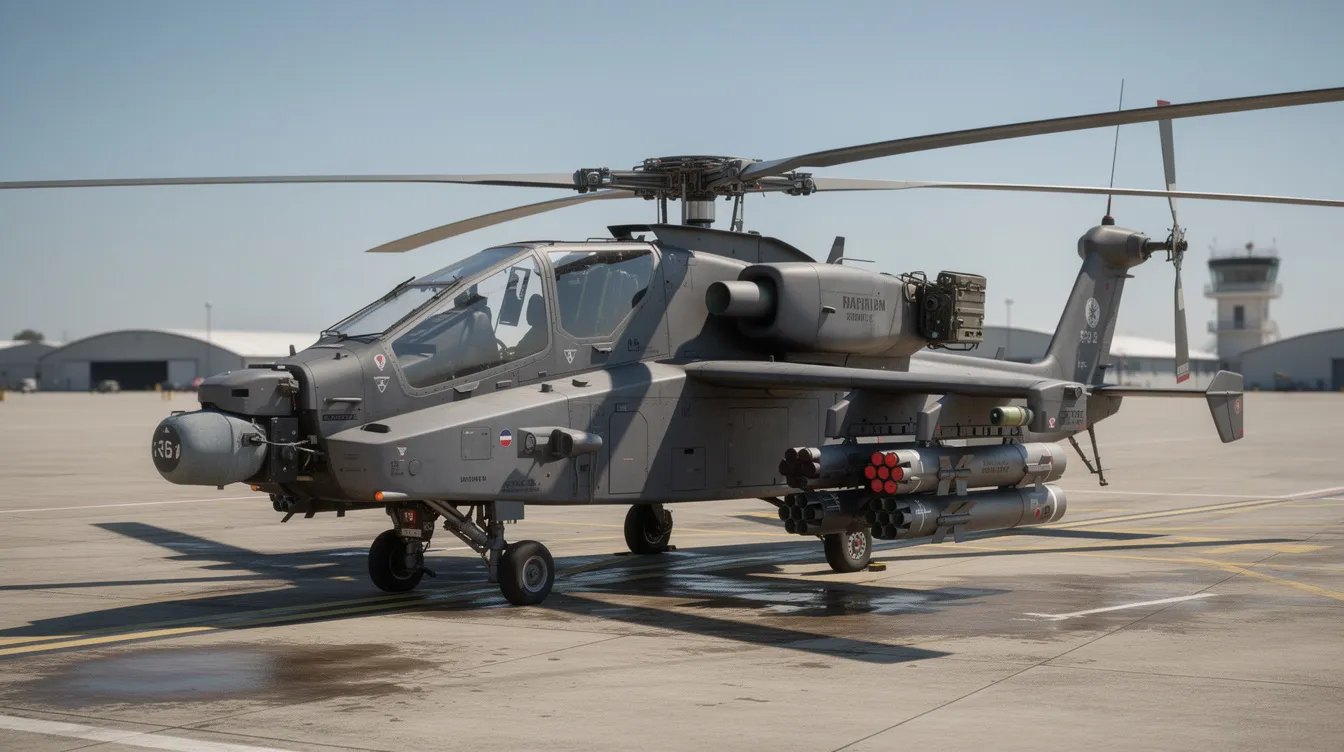
While all Apache variants share a common airframe, subtle changes in height, weight, and equipment fit distinguish the AH-64A, AH-64D Apache Longbow, and AH-64E Guardian. In data analytics, dimensions are descriptive attributes used to filter, group, and slice facts. The same principle applies here: variant designation is the dimension that filters performance data.
Fuselage length and rotor diameter remain essentially the same across variants, keeping the basic footprint consistent for logistics planning. Where variants diverge is in height (Longbow radar dome), weight (added sensors and armor), and internal systems.
|
Specification |
AH-64A Apache |
AH-64D Apache Longbow |
AH-64E Guardian |
|---|---|---|---|
|
Fuselage length |
58 ft 3 in (17.76 m) |
58 ft 3 in (17.76 m) |
58 ft 3 in (17.76 m) |
|
Main rotor diameter |
48 ft (14.63 m) |
48 ft (14.63 m) |
48 ft (14.63 m) |
|
Height (no radar) |
~12 ft 8 in (3.87 m) |
~13 ft 4 in (4.06 m) |
~12 ft 8 in (3.87 m) |
|
Height (with Longbow) |
N/A |
~15 ft 3 in (4.65 m) |
~15 ft 3 in (4.65 m) |
|
Empty weight |
~11,000 lb |
~11,387 lb |
~11,400+ lb |
|
Max takeoff weight |
~21,000 lb |
~23,000 lb |
~23,000 lb |
|
Engine |
T700-GE-701/701C |
T700-GE-701C |
T700-GE-701D |
In data warehousing, slowly changing dimensions manage attributes that shift over time. The Apache's variant evolution is a real-world parallel: engine type, radar configuration, and weight have shifted incrementally from AH-64A through AH-64D to AH-64E, while core airframe dimensions remain fixed. This approach allowed the army to avoid rebuilding infrastructure for each new variant.
Filtering and slicing allow users to isolate specific subsets of data, and the variant table above lets readers do exactly that for Apache specifications. The army announced each upgrade cycle with specific performance targets, and Boeing delivered improvements that fit within the existing dimensional envelope.
Additionally, the AH-64E can control unmanned aerial vehicles for scouting, adding a capability that earlier AH-64As could not have imagined. This digital connectivity does not change the airframe's physical size but dramatically extends its battlefield awareness.
Size and shape directly influence how the Apache is used in combat, from nap-of-the-earth flight to pop-up attacks against multiple targets.
The relatively low height and narrow fuselage allow the AH-64D Apache Longbow to hide behind ridgelines, trees, or man-made structures. Crew members can expose only the Longbow radar dome above cover, scan for targets detected by the AN/APG-78 radar, and fire without revealing the full airframe. Dimension attributes answer the "who," "what," "where," or "why" behind events, and in combat, the Apache's dimensions answer why it can perform terrain masking that taller or wider aircraft cannot.
Categorizing data by dimensions allows systems to organize vast streams of events. In a similar way, military planners categorize Apache operations by terrain type, threat density, and available cover, all influenced by the helicopter's physical dimensions.
The Apache's combat record reinforces these tactical advantages:
During the Gulf War and Operation Desert Storm, AH-64As flew deep-strike missions against radar sites and armored formations.
In 2003, one Apache was shot down during the Iraq invasion, but most other Apaches in the same engagement survived significant ground fire and returned to base.
AH-64 crews have operated in Afghanistan's mountain valleys, where the 48 ft rotor and compact fuselage allowed operation in confined terrain.
Armor and weight mean the Apache is not the fastest helicopter, but its robust structure allows it to survive hits and continue flying. The aircraft was designed to absorb punishment that would destroy lighter platforms, a direct consequence of its dimensional and weight choices.
Comparing Apache dimensions to other attack helicopters helps frame its design choices and battlefield role. Data frameworks allow users to filter and aggregate data along specified dimensions, and the table below filters key metrics across several competing platforms. Grouping defines the granularity of reports or queries in data analytics, and grouping by airframe type reveals where the Apache sits in the global attack helicopter landscape.
|
Aircraft |
Approx. Length |
Rotor Diameter |
Max Takeoff Weight |
|---|---|---|---|
|
AH-64E Apache |
58 ft 3 in |
48 ft |
~23,000 lb |
|
Ka-52 Alligator |
~52 ft |
~47 ft 7 in |
~24,000 lb |
|
Mi-28N Havoc |
~56 ft |
~56 ft |
~25,800 lb |
|
Tiger (Eurocopter) |
~46 ft |
~43 ft |
~13,200 lb |
The AH-64 Apache sits at the heavier end of the attack helicopter spectrum. It trades compactness for armor, advanced sensors, and substantial weapons loads. The European Tiger is lighter and more agile but carries less armor and fewer weapons. Russian designs like the Ka-52 use coaxial rotors, which eliminate the tail rotor and alter the overall height and deck footprint.
Dimension tables in data warehouses facilitate star-schema joins for analysis, and in a similar fashion, comparing these platforms along standardized dimensions (length, weight, rotor span) enables meaningful cross-platform analysis.
Despite similar or smaller dimensions on paper, few rivals match the Apache's documented combat hours and survivability record. The aircraft remains one of the best military platforms in its class, just as Jettly positions itself as a flexible NetJets alternative for private flyers within the civil aviation space.
Apache dimensions matter in peacetime settings as well. At airshows, museums, and training environments, the 48 ft main rotor disk and 58 ft fuselage length require careful crowd control and safety perimeters.
Static displays at major events in the UK, US, and Middle East routinely feature the AH-64. Organizers plan the layout around the aircraft's footprint, accounting for the rotor overhang and weapons clearance zones. The Apache's fuselage and tail boom dominate display lines, giving spectators a visceral sense of the machine's scale compared with cars or light aircraft parked nearby, much as Jettly's guide to charter airlines and private operators helps readers visualize how different private aircraft compare in size and role.
For transport to display locations, blades can be removed to reduce width, though the underlying fuselage length remains the same. Large-scale models (1:24 and similar) replicate key dimensions and proportions, helping enthusiasts appreciate the size of the AH-64 Apache outside of military settings.
Dimensions drive infrastructure planning for every AH-64 unit: hangar door height, pad spacing, and taxiway clearances all depend on the Apache's physical footprint.
Typical Army or allied hangar complexes handle 4–8 Apaches per facility. Rotor overlap and tail clearances dictate minimum spacing between parking spots. With a 48 ft rotor diameter, even slight positioning errors can create dangerous blade conflicts during startup or shutdown.
Key ground operation factors include:
Blade tie-downs and rotor positioning must account for wind loads on the full rotor disk.
Towing vehicles and ground units need extra clearance when weapons or wing fuel tanks are attached.
Hangar doors must clear at a minimum of 15 ft 4 in to accommodate Longbow-equipped aircraft with the radar dome installed.
Index structures like dictionaries are used for fast lookups of dimensions in data management, and maintenance databases similarly index Apache serial numbers against configuration dimensions to track which aircraft carry Longbow radar, specific sensor packages, or armament configurations.
These requirements differ substantially from those of private jet and charter helicopter facilities. Jettly's partner operators maintain hangars optimized around wingspans and cabin access rather than stub wings and chin guns. Travelers interested in recurring access to such facilities and aircraft can review Jettly's private jet membership programs for details on how membership structures relate to aircraft availability and size. For an overview of charter-ready rotorcraft and their passenger capacity, readers can explore Jettly's fleet guides.
The Apache's dimensions and configuration have influenced several decades of attack helicopter design. The US Army's Advanced Attack Helicopter program in the 1970s set size and weight expectations for a next-generation platform that could carry anti-armor missile systems like the AGM-114 Hellfire while operating from austere forward bases.
Subsequent designs, including Russia's later attack helicopters and various Western prototypes, often use similar length and weight envelopes. This reflects a shared engineering conclusion: roughly 50–60 ft of fuselage, 45–50 ft of rotor, and 20,000–25,000 lb of maximum takeoff weight represent an effective balance between survivability and deployability.
Boeing is currently pushing the Modernized Apache concept with open systems architecture, enhanced sensors, and autonomous teaming with UAVs. Data cubes utilize dimensions to pre-aggregate metrics for faster querying, and modern Apache systems apply similar logic, pre-processing sensor data so that crew members can act on threats faster. Join optimization efficiency improves when dimensions are appropriately managed, and the same principle applies to Apache mission systems that fuse radar, infrared, and networked data streams.
Full production of new-build AH-64Es continues for international customers through 2026 and beyond. The type's first flight was decades ago, but the platform remains the benchmark for attack helicopter size, sensors, and weapon capacity. For civilians, understanding acquisition and operating expenses for personal or business aircraft starts with resources like Jettly's guide to affordable aircraft rental options and its breakdown of the cheapest private aircraft options by category. The flyaway cost and average unit cost remain subjects of active discussion in defense procurement, with the incremental or flyaway cost varying by customer and configuration.
Understanding the Apache's size and weight can help readers intuitively grasp how civil helicopters and jets compare, even though the missions differ entirely.
Simple comparisons make the Apache's scale tangible:
The Apache's 48 ft rotor disk is similar in span to some light business jets' wings.
Its 58 ft fuselage length is comparable to certain turboprops used on regional charter routes.
Analytical frameworks use dimensions to transform raw metrics into insights, and comparing military rotor diameter to civilian wingspan gives readers an intuitive reference point.
Charter clients using a digital platform like Jettly focus on cabin height, legroom, and baggage volume, while Apache engineers prioritize rotor clearance, armor thickness, and ammunition storage within similar spatial constraints. Tools such as Jettly's jet card flight cost estimator help these clients translate aircraft size and performance into practical trip pricing. Any aircraft, whether an AH-64D Apache Longbow or a light jet, must balance dimensions against performance, range, and operating costs.
Dimensions provide structural context for analytical queries in data management, and the same applies to aircraft selection: understanding physical dimensions is the structural context needed to compare performance across platforms.
Interested readers can view cabin dimensions and performance data for charterable jets and helicopters using Jettly's charter cost estimator or explore Jettly's jet card membership programs for fixed-rate access to various aircraft sizes and configurations.
The AH-64 Apache's capabilities are defined by a core set of quantitative features: a fuselage length of 58 ft 3 in, a 48 ft main rotor, a height of roughly 15 ft with Longbow radar fitted, and an operating gross weight between 16,000 and 20,000 lb depending on mission configuration.
These Apache dimensions support the type's role as one of the world's most capable attack helicopters. The platform can operate from forward bases, survive hits from heavy-caliber fire, and deliver precision firepower against multiple targets at ranges exceeding 6 km. Native American tribes, including the Apache people, lent their name to a helicopter that has become synonymous with battlefield dominance.
Contextual queries rely on dimensions to give meaning to numerical metrics, and every number in this article—speed, weight, rotor span, weapons load—gains meaning only when placed in the context of the Apache's mission. Broadcast joins are efficient for joining large fact and small dimension tables, and the same efficiency applies when combining Apache performance facts with the dimensional context of variant, configuration, and environment.
Purpose-built attack helicopters and passenger-oriented aircraft occupy opposite ends of the aviation spectrum. Private jets and civil helicopters available through Jettly's charter marketplace prioritize comfort, range, and efficiency for travelers, while the Apache prioritizes firepower, armor, and tactical agility for combat crews.
Ready to explore aircraft built for comfort rather than combat? Request a quote or browse charter options at https://www.jettly.com.
The AH-64 Apache's fuselage length is about 58 ft 3 in (17.76 m), with a main rotor diameter of 48 ft (14.63 m). This gives the aircraft a sizable on-ground footprint that requires dedicated planning for parking, hangars, and landing zones. Overall height depends on variant: a basic AH-64A is roughly 12–13 ft tall, while an AH-64D Apache Longbow with the AN/APG-78 radar dome reaches approximately 15 ft 3 in (4.65 m). These figures can vary slightly with antennae and sensor fits but stay within a narrow range significant for hangar and deck clearances. Dimensions are used in star schema data modeling in data warehousing, and similarly, these dimensional specifications form the structural basis for all Apache logistics planning.
The Longbow radar adds height rather than length or rotor diameter. Installing the AN/APG-78 dome increases overall height by roughly 2–3 ft compared with an Apache without it. This higher profile affects hangar door requirements and some shipboard operations but does not change the 58 ft fuselage length or 48 ft main rotor span. Some AH-64D aircraft fly without the radar dome depending on mission requirements and configuration, reducing their height back near AH-64A levels. The radar dome sits on a mast above the rotor plane specifically so the helicopter can hide behind terrain and scan with only the dome exposed.
An Apache's empty weight is around 11,000–12,000 lb, but a typical combat-ready configuration with fuel, crew, 30 mm ammunition, and anti-tank missiles often brings it into the 16,000–18,000 lb range. Maximum takeoff weight is close to 23,000 lb for AH-64D and AH-64E variants, but operating at that limit usually involves trade-offs between range, weapons load, and hot-and-high performance at sea level and above. Exact mission weight depends on fuel load, number of Hellfire missiles, rocket pods, and any external tanks carried.
Many twin-engine civil utility or offshore helicopters have similar overall lengths and rotor diameters to the Apache but devote internal space to passenger cabins rather than armor and ammunition. A medium civil helicopter used for charter flights via Jettly might match the Apache's rotor span yet offer a standing-height cabin for 8–12 passengers. Sizes are comparable on paper, but mission equipment, interior layout, and regulatory requirements create very different experiences. For details on the largest passenger helicopters available for charter, readers can explore Jettly's fleet guides.
Attack helicopters like the AH-64 Apache, AH-64D Apache Longbow, or other advanced attack helicopters are military assets and are not offered for civilian charter. The AH-64As, other Apaches, and similar platforms operate exclusively under military authority. Private travelers instead use certified civil helicopters and jets configured with comfortable passenger cabins and meeting all civil aviation regulations, and some may even offset costs by using Jettly's platform to crowdsource private jet flights and share empty seats. Interested readers can explore Jettly's selection of charterable helicopters and fixed-wing aircraft and request instant pricing at https://www.jettly.com.
The AH-64 Apache's dimensions are more than mere numbers; they are integral to the helicopter's battlefield effectiveness, operational flexibility, and logistical planning. With a fuselage length of approximately 58 feet 3 inches, a 48-foot main rotor diameter, and a variable height that reaches about 15 feet with the Longbow radar dome, the Apache balances compactness with the capacity to carry advanced sensors, armor, and weaponry.
These dimensions enable the Apache to operate from austere forward locations, fit within existing infrastructure, and execute complex missions involving terrain masking and multi-target engagement. The consistent airframe size across variants simplifies maintenance and deployment while allowing incremental upgrades in avionics and powerplants that enhance performance without altering the helicopter’s footprint.
Understanding Apache dimensions also offers a valuable perspective when comparing military rotorcraft with civilian aircraft chartered through platforms like Jettly. While private jets and civil helicopters prioritize passenger comfort and range, the Apache prioritizes survivability, firepower, and tactical agility. Learn more about Jettly's helicopter charter options and how they differ from military aircraft.
In sum, the AH-64 Apache’s size and configuration reflect a deliberate design optimized for combat effectiveness and mission versatility. These dimensional attributes continue to influence attack helicopter development worldwide and underscore why the Apache remains a cornerstone of modern military aviation. For insights on private jet charter pricing and aircraft size comparisons, explore Jettly's resources.
Ready to explore aircraft built for comfort rather than combat? Request a quote or browse charter options at https://www.jettly.com. Also, check out our guides on helicopter passenger capacity and affordable aircraft rental options to better understand the civil aviation side of the industry.
Ready to explore aircraft built for comfort rather than combat? Request a quote or browse charter options at https://www.jettly.com.
Share this post:
Jay Franco Serevilla
Aug 15, 2026
|
5
min read
Discover tips and trends in the industry.
5
min read
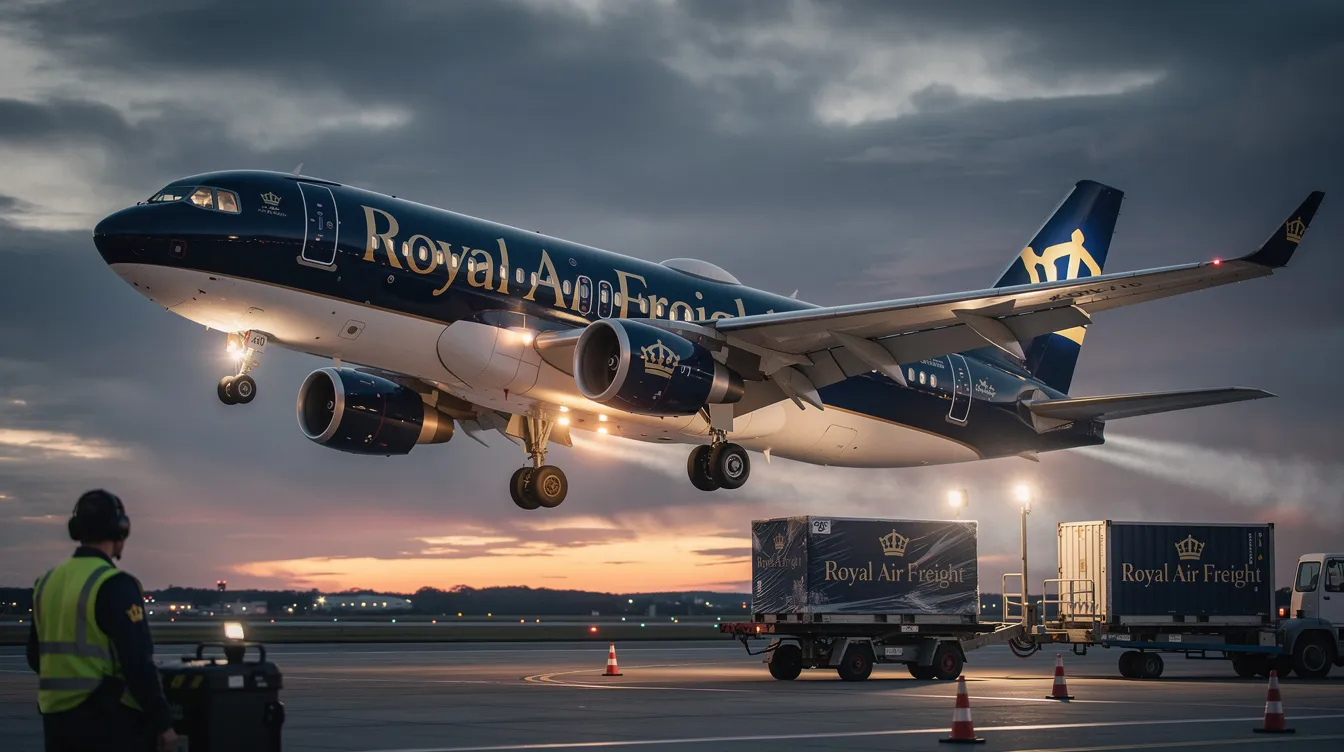
Royal Air Freight Inc: Chartering Alternatives with Jettly
Royal Air Freight Inc. has been a trusted name in charter and air freight services since 1961, specializing in expedited cargo and passenger flights across North America. Jettly, a digital charter broker, offers a broader marketplace for comparing private jet and cargo flight options, providing travelers with greater flexibility and instant pricing.
Read More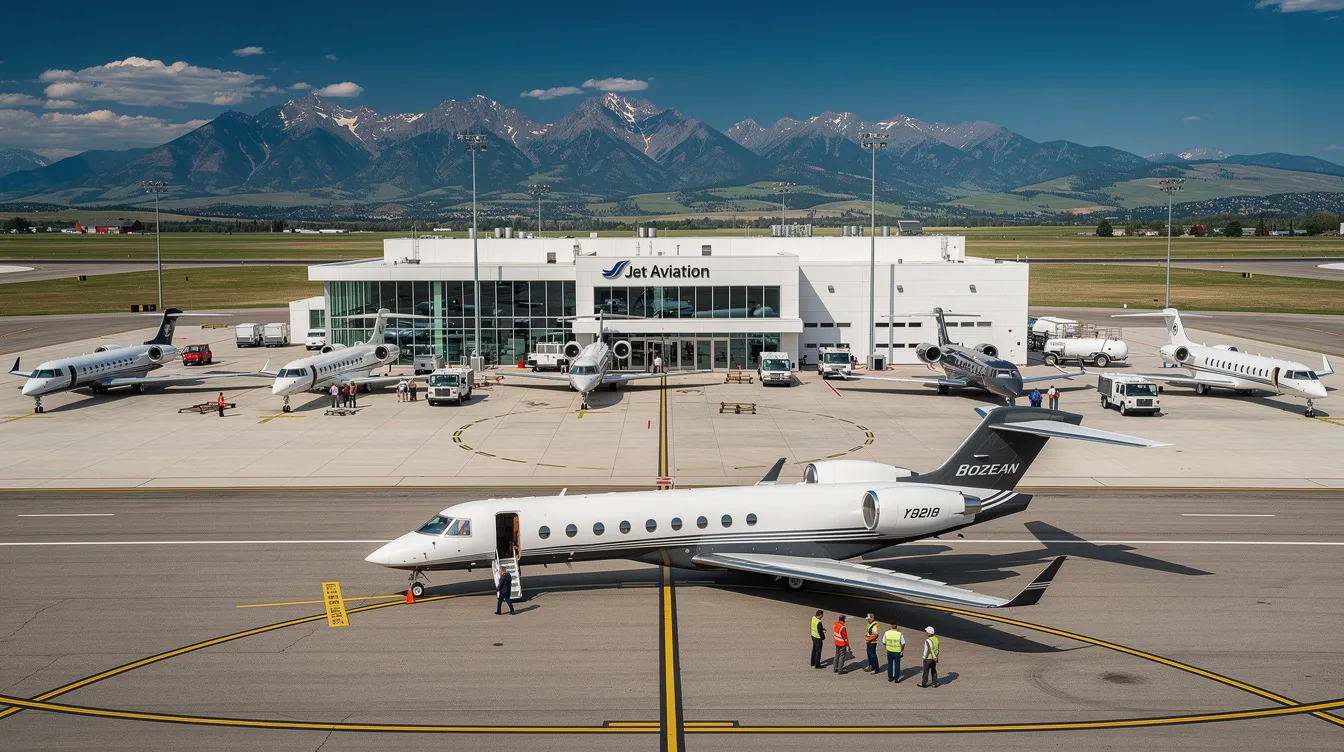
5
min read
Jet Aviation Bozeman: Private Jet Access to Big Sky Country with Jettly
Jet Aviation Bozeman provides private jet access to the stunning landscapes of Big Sky Country, located at Bozeman Yellowstone International Airport. With a full-service FBO and Jettly's digital charter marketplace, travelers can easily book flights and enjoy seamless ground transportation to popular destinations like Big Sky Resort and Yellowstone National Park.
Read MoreStay updated with our latest insights and tips to elevate your journey with us.
MEMBERSHIPS AND ASSOCIATIONS



Disclaimer: Jettly operates as a charter broker, offering access to a global digital jet charter marketplace. Jettly is not a direct air carrier and does not own or operate aircraft. All advertised flights are conducted by third-party air carriers that are fully licensed and hold the appropriate Part 135 or Part 121 certifications issued by the Federal Aviation Administration (FAA) or equivalent regulatory authorities under U.S. or foreign law. Jettly complies fully with the U.S. Department of Transportation's Part 295 and Part 298 Charter Broker regulations. Jettly does not carry additional liability insurance. Passengers are covered by aircraft operator insurance. TICO: 50023770


