


Login
Get Instant Pricing On 23,000+ Aircraft

>
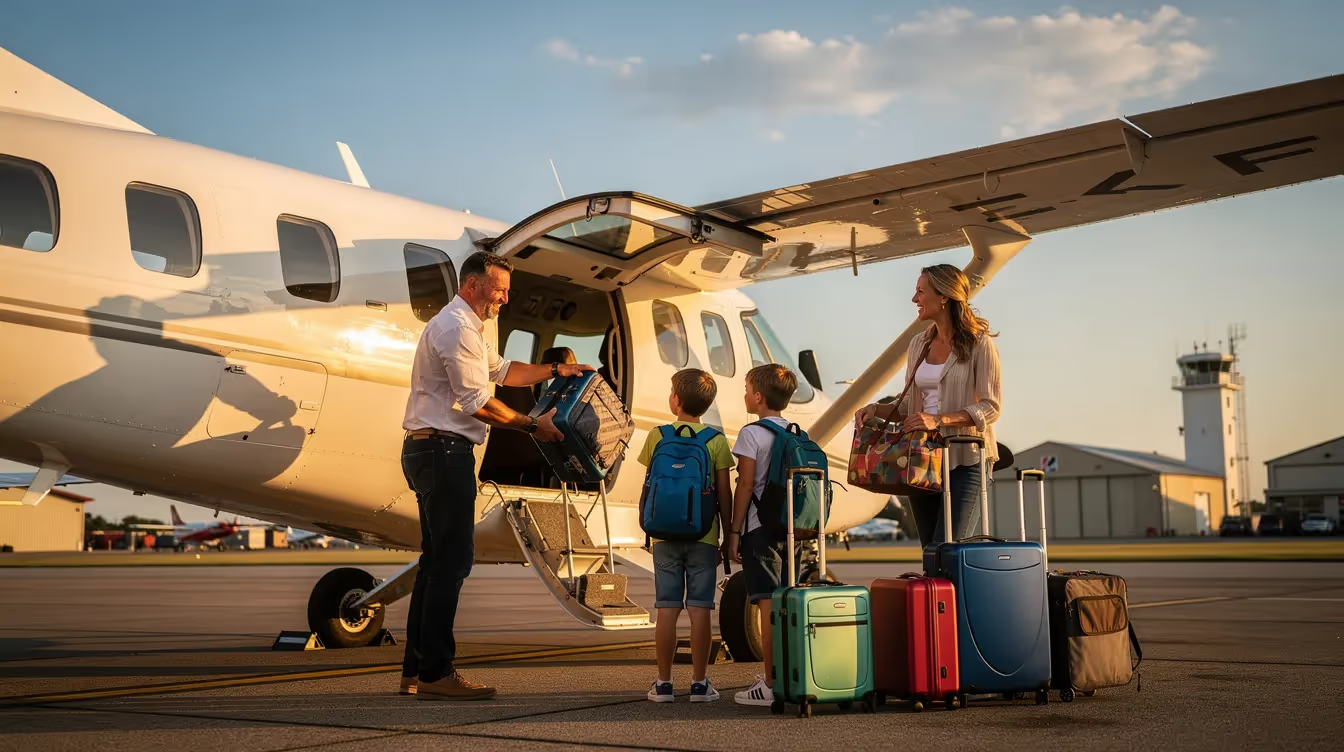
Choosing the best plane for a family of four involves balancing comfort, safety, performance, and cost. Whether for weekend getaways, cross-country vacations, or regular regional travel, families need aircraft that offer enough cabin space, reliable handling, and practical baggage capacity. With many options available—from piston singles to turboprops and light jets—understanding the key features and trade-offs is essential to making the right choice. This guide explores top family-appropriate aircraft, ownership costs, and smarter alternatives like chartering to help families fly with ease and confidence.
The best plane for a family of 4 depends on mission profile: short weekend trips favor economical pistons like the Cessna 182 Skylane, while cross-country adventures suit faster options like the Cirrus SR22 or Beechcraft Bonanza A36.
Popular family aircraft include the Cessna 182, Cirrus SR22, Piper PA-28/PA-32 series, and Beechcraft Bonanza—each excelling in different scenarios.
Total cost of aircraft ownership (purchase price plus maintenance, hangar space, and insurance) typically runs 1.5–2x the acquisition cost over 5–10 years.
Chartering via Jettly offers flexibility and often proves more cost-effective for families flying under 150–200 hours annually.
Many families overestimate how much they’ll fly their own plane—testing routes through charter first helps avoid costly ownership mistakes.
Finding the best family planes isn’t simply about counting four seats. The right family airplane depends on your typical routes, budget constraints, and the airports you’ll use most often.
A typical family of four means two adults and two children—but this profile shifts dramatically as kids grow. Young children weighing 50–80 lbs require far less useful load than teenagers approaching adult weight. Your flight plan today may not match your needs in five years.
The key trade-off triangle involves speed, range, and cabin size. A 400–600 nm weekend trip to a lake cabin demands different performance than a 1,000+ nm family vacation. Typical cruise speeds that work well for family pilots range from 130–170 knots, with ranges of 600–900 nm including reserves. Many families don’t need full ownership—charter or private jet membership models provide access without the capital commitment.
Before evaluating specific aircraft models, consider this checklist of what makes a safe and enjoyable family flying experience.
Cabin Size and Comfort: Look for significant cabin space with adequate headroom and shoulder room. A wide cabin allows easier supervision, while club seating configurations facilitate family interaction during longer family trips. Many family-friendly aircraft seat up to six passengers but fly comfortably with four, providing extra flexibility.
Useful Load and Baggage Capacity: Target 800–1,200 lbs useful load to accommodate four people (roughly 600–700 lbs total), fuel for 500 nm (180–240 lbs), and sufficient cargo space for vacation gear. Family aircraft often include generous baggage compartments or fold-down rear seats to add flexibility.
Range and Speed: Should match your missions. A 135-knot cruiser handles 300 nm weekend trips efficiently, while 170-knot aircraft like the Beechcraft A36 Bonanza excel on 600–800 nm legs with cruise speeds around 170 knots and ranges exceeding 800 nautical miles.
Runway Performance: Matters for families seeking access to smaller airports near lakes, mountains, or remote destinations.
Modern Safety Features: Autopilot, GPS, ADS-B, angle-of-attack indicators, and whole-airframe parachute systems (such as the Cirrus Airframe Parachute System, CAPS) provide built-in safety that reduces pilot workload and enhances family comfort. Safety features like TKS ice protection or FIKI capability are important for reliable travel in varying weather.
Operational Costs: Vary dramatically: piston singles cost far less per hour than turboprops or light jets, making them accessible for many families. Routine maintenance typically costs between $2,000 and $5,000+ annually, depending on aircraft type, with used single-engine planes averaging $3,000 to $7,000 per year. Hangar space adds $250 to $1,000+ monthly, depending on location. Full ownership costs also include liability and hull insurance, financing rates, and down payments, often ranging from 15–30%.
Parts Availability: Through mainstream manufacturers like Cessna, Piper, Beechcraft, and Cirrus, routine maintenance doesn’t ground your family airplane unexpectedly.
Four-seat and six-seat piston singles represent the most common first family aircraft for owner-pilots. Understanding the difference between strictly four-seat platforms (more efficient, lighter) and six-seat aircraft operated with four people (more space and useful load) helps narrow your search.
The best family planes in this category cruise between 130–170 knots and can comfortably cover 400–700 nm stages—sufficient for most family aviation needs.
The Cessna 182 Skylane consistently tops “best plane for family of 4” recommendations across North America. With cruise speed around 135–145 knots, range of 500–700 nm with reserves, and useful load often exceeding 1,000 lbs, it handles most family missions capably.
The high-wing design provides excellent downward visibility—kids love watching the landscape below. Easier loading, good headroom, and stable handling make it ideal for experienced pilots stepping up from the Cessna 172. Fixed gear and a strong safety history support backcountry flying to lake cabins and mountain strips.
Used market prices range from USD $150k–$300k, depending on year, avionics, and engine time. Fuel costs remain reasonable with better fuel burn rates than faster, complex aircraft. Typical use cases: 300–600 nm trips, ski weekends, and regional vacations with moderate baggage.
While not traditionally viewed as a family plane, the Cirrus SR22 has become popular among families for its spacious cabin, advanced safety features, and high cruise speeds. The Cirrus Airframe Parachute System (CAPS) significantly boosts passenger confidence, and models like the SR22T emphasize ballistic parachutes and modern avionics that enhance safety during travel.
Performance figures impress: cruise 170–185 knots, range up to 1,000 nm at economy settings, and useful load of 1,000+ lbs in many configurations. The spacious cabin features side-yoke controls, good legroom for at least four adults, contemporary interiors, and strong soundproofing compared with older designs—important for enjoyable family flying on longer legs.
Purchase price ranges from mid-$300k for used mid-2000s models to $1M+ for new G6 versions. Ideal missions include faster cross-country adventure routes like New York–Chicago or Los Angeles–Denver, where time savings matter for school and work schedules.
The Piper Cherokee remains one of the most accessible family aircraft for budget-conscious buyers. PA-28 Archer and Dakota models offer four seats, while the Piper Cherokee Six and Saratoga (PA-32 line) provide up to six passenger capacity—functioning as great family hauler platforms with room to spare.
Sample performance: Archer/Dakota cruise 120–135 knots; Cherokee Six/Saratoga reach 145–160 knots with large, roomy cabin space and big baggage doors perfect for loading strollers, car seats, and bulky gear.
Club seating in some PA-32 models enhances family interaction. Strong, useful load, simple systems on fixed-gear variants, and excellent parts availability make these practical family platforms.
Used pricing brackets: PA-28 models start around $80k–$180k; PA-32s run $150k–$350k. Use cases: families wanting extra room for growth, gear-heavy trips, and potentially shared ownership between two families through aviation co-ops.
The Beechcraft A36 Bonanza is known for its speed and refined feel, making it a solid pick for families looking for a reliable aircraft that efficiently covers long distances. It cruises around 170 knots with a maximum range exceeding 800 nautical miles, suitable for long-distance family trips.
The A36 features a spacious cabin with club seating options, providing comfort and interaction during flights. While some A36 models seat six, many families of four use the rear seats for cargo flexibility. Acquisition costs run higher than comparable Cessnas or Pipers, but blue-chip resale values reward well-maintained aircraft.
The V35B Bonanza offers a four-seat configuration with similar performance and style, appealing to families prioritizing speed and quality.
Mooney M20: Delivers efficient, fast four-seater performance: cruise near 160–170 knots with excellent fuel efficiency but tighter rear seats for taller passengers.
Rockwell Commander 114: Trades some speed for wide-body aircraft comfort and smooth handling—appealing for families prioritizing the experience over pure speed. It features a spacious cabin and a strong safety record, making it a favorite among family flyers.
Grumman Tiger: Works well for small families with younger kids: decent cruise speed around 135 knots, good visibility, and relatively affordable acquisition at half the price of premium options.
Each fills a niche: Mooney for speed-conscious family pilots, Commander for families seeking comfort, and Tiger for shorter trips and smaller budgets.
|
Model |
Cruise Speed (knots) |
Range (nm) |
Useful Load (lbs) |
|---|---|---|---|
|
Cessna 182 Skylane |
135–145 |
500–700 |
1,000+ |
|
Cirrus SR22 |
170–185 |
Up to 1,000 |
1,000+ |
|
Piper PA-28 Archer/Dakota |
120–135 |
500–700 |
900–1,100 |
|
Piper Cherokee Six/Saratoga |
145–160 |
700–900 |
1,200+ |
|
Beechcraft Bonanza A36/V35B |
170 |
800+ |
1,100+ |
|
Mooney M20 |
160–170 |
700–1,000 |
900–1,000 |
|
Rockwell Commander 114 |
135–140 |
600–800 |
1,100+ |
|
Grumman Tiger |
135 |
500–600 |
900 |
Turboprops and light jets rarely serve as the first aircraft for new owner-pilots, but families flying frequently who value time savings eventually consider them. For families of four, chartering these aircraft allows them to avoid airport hassles such as long lines and security delays, making travel far more convenient and comfortable compared to commercial flights. Most families of four who regularly need this performance access it via charter rather than outright ownership.
Performance contrasts tell the story: turboprops cruise 250–330 knots with 1,200–1,500+ nm range; very light jets and light jets reach 350–450 knots with similar or greater range. Popular examples include the Daher TBM 910/960, Piper M600, and Pilatus PC-12 on the turboprop side; Embraer Phenom 100/300 and Cessna Citation CJ series for jets.
Use cases include coast-to-coast trips, international vacations, and tight schedules requiring same-day out-and-back family travel. Jettly’s marketplace frequently sources these aircraft types for families on routes like New York–Miami, Toronto–Vancouver, and London–Nice.
Pressurized turboprops fly in the mid-20s to low-30s flight levels, avoiding much of the weather that affects piston flights—a key factor for reliable family vacation scheduling.
Typical cruise statistics: TBM series exceeds 300 knots, PC-12 cruises 260–280 knots, with ranges often exceeding 1,400 nm. Cabin advantages for families include club seating, large luggage volume, and often a private lavatory on aircraft like the PC-12.
Acquisition costs run $2–4M+ new, making charter through Jettly attractive versus ownership for most families, especially once you understand typical private jet rental costs. Ideal missions: ski trips from Los Angeles to Aspen, Toronto to Florida without multiple passengers enduring fuel stops, or European city-pair hops.
VLJs and light jets like Embraer Phenom 100/300, Citation CJ1/CJ3, and Hondajet represent popular family-friendly planes for charter.
Performance numbers: cruise speeds near 380–450 knots with typical ranges of 1,000–2,000 nm. Pressurized, quiet cabins; private lav options; in-flight Wi-Fi and entertainment keep children and teens comfortable on longer legs.
Families rarely purchase these outright unless flying 200–300+ hours annually. Hourly charter costs range from USD $3,000–$5,000+, depending on region and aircraft. Trip examples: New York–Miami in under 3 hours, London–Mallorca non-stop for school breaks.
Jettly’s platform shows instant pricing for these aircraft, letting families compare turboprops and jets for identical routes—enabling an efficient private travel experience without ownership commitment.

Families often overestimate how much they’ll fly their own plane. The gap between imagined annual hours and actual flight logs leads to expensive surprises.
A rule of thumb: aircraft ownership begins making financial sense around 150–200 flight hours per year. Below that threshold, on-demand charter through platforms like Jettly is often more cost-effective; understanding how much a private jet costs overall helps clarify the trade-offs.
Major cost categories for owners include acquisition, routine maintenance, hangar space or tie-down fees, insurance, training, avionics upgrades, and engine overhauls. Compare this to pay-per-trip chartering, where the family pays only for actual flight time—no capital risk, no downtime waiting for parts.
Jettly operates as a B2C charter marketplace, providing access to 20,000+ aircraft globally without ownership or fractional commitments. For families flying 60–80 hours annually, chartering similar missions often costs less than owning a Cessna 182 once all expenses are calculated.
Typical market purchase price ranges (2024–2026 context):
Cessna 182: $150k–$300k
Cirrus SR22: $300k–$1M+
Piper PA-32: $150k–$350k
Beechcraft Bonanza A36: $200k–$600k+
Annual fixed costs add up quickly: insurance, hangar ($250–$1,000+ per month), subscriptions, and required inspections. Variable per-hour costs include fuel burn, oil, engine reserves, and routine maintenance.
The total 5–10 year cost of ownership often equals 1.5–2x the initial purchase price due to overhauls, avionics updates, paint, and interior refresh. Today’s small planes require contingency funds for unexpected maintenance, avoiding becoming grounded during the peak family vacation season.
For many families taking 3–8 longer trips per year, on-demand charter proves financially smarter and administratively simpler than ownership, especially when using a private jet charter cost estimator to model real routes.
Jettly’s model offers a digital marketplace with instant pricing, access to 20,000+ aircraft globally, and transparent pay-per-flight costs. Charter eliminates concerns about hangars, insurance, maintenance, fuel costs, and resale—providing flexibility to pick the ideal aircraft for each trip.
Examples: use a light jet from a broad private charter aircraft fleet for a Toronto–Vancouver family vacation, a turboprop for Denver–Jackson Hole ski trips, or a piston charter for shorter 200–300 nm flights. Families wanting private-aviation benefits while flying fewer than 100–150 hours annually often find Jettly the optimal solution.
“Mission first, aircraft second” remains the most reliable approach for choosing the best plane for a family of 4 scenarios.
Define core missions: typical trip length (in nm or hours), number of legs per year, preferred airports, and runway requirements. Consider growth factors: children getting older and heavier, sports equipment, larger suitcases, and occasionally bringing a family member, like grandparents.
Build 2–3 realistic example trips (400 nm beach run, 800 nm holiday visit, 200 nm lake weekend) to evaluate which aircraft categories qualify. Flight planning apps help visualize routes and fuel requirements.
Test legs via charter or rental to assess comfort levels before committing to ownership. Guides to affordable airplane rental costs and options can also help frame expectations. Jettly’s platform can help match mission profiles to aircraft types during trip planning.
Regional hops—Boston to Bar Harbor, Dallas to Santa Fe, Toronto to Muskoka—define this category. Four-seat pistons like Cessna 172/182, Piper Archer, and Grumman Tiger handle these missions well when kids are younger, and baggage is moderate.
Benefits include lower hourly operating costs, simpler systems, and easier step-up paths for new pilots. Commercial flights can’t match the convenience of avoiding airport hassles and flying direct to smaller destinations.
Multi-state hops like New York–Nashville, Chicago–Denver, or Paris–Mallorca represent typical family vacation distances. Mid-performance pistons (SR22, Bonanza, PA-32, Commander 114) shine here with cruise speeds of 140–180 knots.
Trade-offs emerge: slower but cheaper pistons versus faster turboprops or light jets that burn less fuel per mile but cost more per hour. Many of the same factors covered when choosing the best cross-country plane for long trips apply here. Families prioritizing schedule reliability may lean toward chartering turboprops via Jettly for these routes—especially avoiding the significant compromise of arriving exhausted.
Beyond 800–1,000 nm, fuel stops and weather routing make piston trips slower and more tiring for children. Pressurized turboprops (TBM, PC-12, M600) or light jets (Phenom 300, Citation CJ3) excel here as some of the best private planes for families, often accessed via charter.
Routes like New York–Miami, Los Angeles–Seattle, Toronto–Bahamas, or London–Athens clearly benefit from jet/turboprop speed. Jettly’s instant pricing lets families compare one-stop piston itineraries versus non-stop jet options before choosing—your last plane decision shouldn’t be a rushed one.
Bringing family on board should influence training standards, equipment choices, and how every flight is planned. Today's small planes are equipped with advanced technology and safety equipment, enhancing passenger safety and supporting emergency procedures for family flights.
Pilot training matters: recurrent proficiency checks, instrument rating for variable weather, and scenario-based training for emergency procedures build confidence. Many instructors suggest 100–200 hours total time before flying frequent family cross-countries.
Modern safety equipment reduces risk: whole-airframe parachutes like the Cirrus CAPS, angle-of-attack indicators, traffic and terrain warning systems, and additional safety gear like de-icing, where appropriate.
The Diamond DA40 Star is noted for exceptional safety with one of the lowest fatal accident rates in general aviation, exemplifying the importance of selecting aircraft with strong safety records.
Families should evaluate the safety record of their chosen aircraft, as some models are known for their reliability and strong safety history. Built-in safety features like shoulder harnesses and crashworthy seats help protect everyone on board.
Modern private jets surpass commercial aviation safety standards through stringent certification processes and advanced technologies, providing families with additional peace of mind when flying with vetted Part 135 charter companies.
Child comfort requires attention: headsets sized for kids, FAA-approved child restraints, snacks, cabin temperature management, and entertainment options. Conservative go/no-go decisions around kids’ sleep schedules and school days ensure enjoyable trips.
When flying via Jettly, families can prioritize operators with strong safety record certifications, Part 135 certification, and audited ratings (ARGUS, Wyvern).
Many families are increasingly conscious of emissions and efficiency when choosing personal aircraft.
Smaller, fuel-efficient pistons (Mooney M20 or late-model injected engines) burn less fuel per hour, reducing per-seat emissions compared to commercial flying on partially-filled jets.
Modern turboprops often offer better fuel burn per passenger-mile than older jets, especially on 300–700 nm routes where jets don’t reach optimal efficiency.
Carbon-offset programs are available through platforms like Jettly and partner operators, and some providers specialize in affordable private jet charter while still offering offset options. Choosing the smallest aircraft that safely and comfortably fits the mission—rather than automatically selecting larger jets—represents both environmental responsibility and cost efficiency.

These questions address practical concerns not fully covered above.
Older Cessna 172s and Piper Cherokees represent the most affordable entry-level four-seat aircraft for families with young children. Airworthy examples range from USD $80k–$180k depending on year, avionics, and engine time.
While slower with less useful load than a 182 or PA-32, they handle 200–300 nm regional trips with modest baggage effectively. Families uncertain about ownership can book similar aircraft through Jettly to test comfort and performance before purchase.
Regulatory minimums (private pilot certificate) are just starting points. Many instructors recommend 100–200 hours total time before frequent family cross-countries, with an instrument rating if flying in variable weather or busy airspace.
Ongoing proficiency training—annual check rides, simulator sessions, and scenario-based emergency procedures practice—maintains skills. Families preferring not to rely on a single pilot can use professional crews via Jettly charters for complex routes.
While many piston singles have the range for 4–5 hour legs, comfort depends heavily on seat quality, cabin noise, turbulence, and children’s tolerance. Start with 1.5–2.5 hour segments and build up gradually.
Faster aircraft like Cirrus SR22 or Bonanza can turn a 5-hour trip into a 3–3.5-hour leg. For very long legs, chartering a turboprop or light jet via Jettly significantly improves comfort for children.
Economics depend on annual use. Families flying under 100–150 hours yearly often find on-demand charter cheaper once all ownership costs—private aircraft loans, hangar, insurance, maintenance, fuel—are included.
Charter also eliminates capital risk, resale uncertainty, and downtime from maintenance. Request instant quotes at Jettly to compare projected ownership budgets with real-world charter pricing for your specific routes.
Jettly’s platform allows users to enter routes and dates, then see pricing and aircraft options ranging from pistons to jets for identical trips. Families can filter for specific features: lavatory, club seating, extra baggage space, Wi-Fi, or pet-friendly cabins.
Jettly’s support team helps interpret options, comparing flight time, cost, and comfort for multiple passengers. Test a few real trips you plan to take in the next 12–24 months through Jettly’s search to see which aircraft types match your needs before committing to ownership.
There is no single best plane for a family of 4—but several proven platforms consistently top shortlists. The Cessna 182, Cirrus SR22, Piper PA-28/PA-32, and Beechcraft Bonanza A36 each excel for different mission profiles and budgets.
Your mission profile, safety expectations, budget constraints, and actual flight frequency should drive the decision—not brand prestige or aesthetics. Ownership carries high fixed costs and responsibilities, while on-demand charter via Jettly offers flexibility and pay-per-trip simplicity, whether through shared charter flights or full private charters.
For families seeking private aircraft benefits without ownership complexity, testing routes through charter provides real-world data before committing capital. Ready to experience private travel on your terms? Explore flight options or request instant pricing at https://www.jettly.com
Share this post:
Jay Franco Serevilla
Apr 18, 2026
|
5
min read
Discover tips and trends in the industry.
5
min read
Ameristar Jet Charter: Passenger, Cargo, and How Jettly Helps You Compare Options
Ameristar Jet Charter is a seasoned U.S. air carrier specializing in both passenger and cargo charter services. With a diverse fleet and a focus on safety, it offers flexible, on-demand flights across the Americas and the Caribbean. Digital platforms like Jettly enhance the booking experience by allowing users to compare options and access a wide range of aircraft.
Read More
5
min read
FlightAware: How Modern Flight Tracking Powers Smarter Private Travel
FlightAware revolutionizes air travel by providing real-time flight tracking data that enhances the travel experience for both commercial and private aviation. With a global network of ADS-B ground receivers and satellite technology, it offers accurate flight status updates, enabling smarter planning and smoother journeys. This guide explores how FlightAware's technology impacts travelers and operators alike, ensuring timely information and efficient operations.
Read MoreStay updated with our latest insights and tips to elevate your journey with us.
MEMBERSHIPS AND ASSOCIATIONS



Disclaimer: Jettly operates as a charter broker, offering access to a global digital jet charter marketplace. Jettly is not a direct air carrier and does not own or operate aircraft. All advertised flights are conducted by third-party air carriers that are fully licensed and hold the appropriate Part 135 or Part 121 certifications issued by the Federal Aviation Administration (FAA) or equivalent regulatory authorities under U.S. or foreign law. Jettly complies fully with the U.S. Department of Transportation's Part 295 and Part 298 Charter Broker regulations. Jettly does not carry additional liability insurance. Passengers are covered by aircraft operator insurance. TICO: 50023770


