


Login
Get Instant Pricing On 23,000+ Aircraft

>

The best private jet for business travel depends entirely on your mission profile. A CEO making weekly regional hops between New York and Chicago has vastly different needs than an executive requiring monthly nonstop flights from London to Singapore. In 2025–2026, the leading choices for business travelers include the Bombardier Global 7500, Gulfstream G700, Bombardier Challenger 3500, Embraer Phenom 300E, and Cessna Citation Longitude—each optimized for specific business requirements.
Private aviation has shifted dramatically in the past few years. Rising demand for time-efficient executive travel, increasing focus on fuel efficient engines and sustainable aviation fuels, and the non-negotiable requirement for high-speed connectivity have reshaped what business leaders expect from private jets. Commercial airlines simply cannot match the flexibility, privacy, and productivity that private jet travel offers for time-sensitive business operations.
This guide will help decision-makers choose the right aircraft by comparing range capabilities, cabin productivity features, passenger capacity, and operating economics across each category—from very light jets to the world’s largest private jet configurations.
Ultra long range jets like the Bombardier Global 7500 (7,700 nm) and Gulfstream G700 (7,500 nm) are the best private jets for global board-level travel, enabling nonstop routes such as New York–Hong Kong or London–Buenos Aires.
Super midsize jets including the Cessna Citation Longitude and Bombardier Challenger 3500 offer the sweet spot for coast-to-coast North American travel and intra-European missions with 8–12 passengers.
Light jets like the Embraer Phenom 300E deliver exceptional value for teams of 4–6 doing frequent 2–4 hour hops between business hubs at significantly lower charter rates.
The three evaluation pillars for any business jet selection are: range and performance (can it fly your routes nonstop?), cabin productivity (conference room capability, connectivity, quiet zones), and operating economics (ownership cost, charter rates, fuel efficiency).
For frequent flyers logging 300+ hours annually, private jet ownership or fractional ownership makes financial sense; for occasional trips, charter services and jet cards offer guaranteed availability without capital commitment.
Selecting the right aircraft requires mapping your typical routes, passenger counts, and whether you plan to charter, join a fractional program, or pursue full ownership. The most expensive private jets are rarely the “best” choice—the best aircraft is the one that matches your actual travel patterns.
Here’s what to evaluate, especially since business jets offer flexible scheduling and access to regional airports that help travelers avoid commercial airline congestion:
Range requirements by mission type: Light jets cover routes up to 2,000 nm (New York–Denver, London–Athens). Super midsize jets handle 3,000–4,000 nm (New York–Los Angeles, London–Dubai). Long range private jets at 7,500+ nm enable true intercontinental nonstop flights.
Passenger capacity needs: C-suite travel with 4–6 executives fits light jets perfectly. Full project teams of 10–14+ passengers require large cabin jets or super mid size jets with expanded seating configurations.
Cabin layout priorities: Conference room with seating for working meetings, quiet zones for focused work, lie-flat seating for overnight sectors, and secure storage for devices and documents.
Connectivity infrastructure: Ka-band or Ku-band Wi-Fi with VPN capability, 4K displays for presentations, and USB-C power at every seat are now baseline requirements for business jets.
Airport access flexibility: Ability to use short runway performance airports like London City, Aspen, or Teterboro expands your destination options significantly and reduces ground transportation time.
Budget parameters: New light jets start around $10–15 million; super-midsize jets run $30–50 million; ultra long range aircraft exceed $70 million. The purchase price is only one part of ownership, alongside operating expenses, maintenance, and insurance costs. Charter rates scale accordingly, from low five figures per hour for light jets to six figures for flagship models.
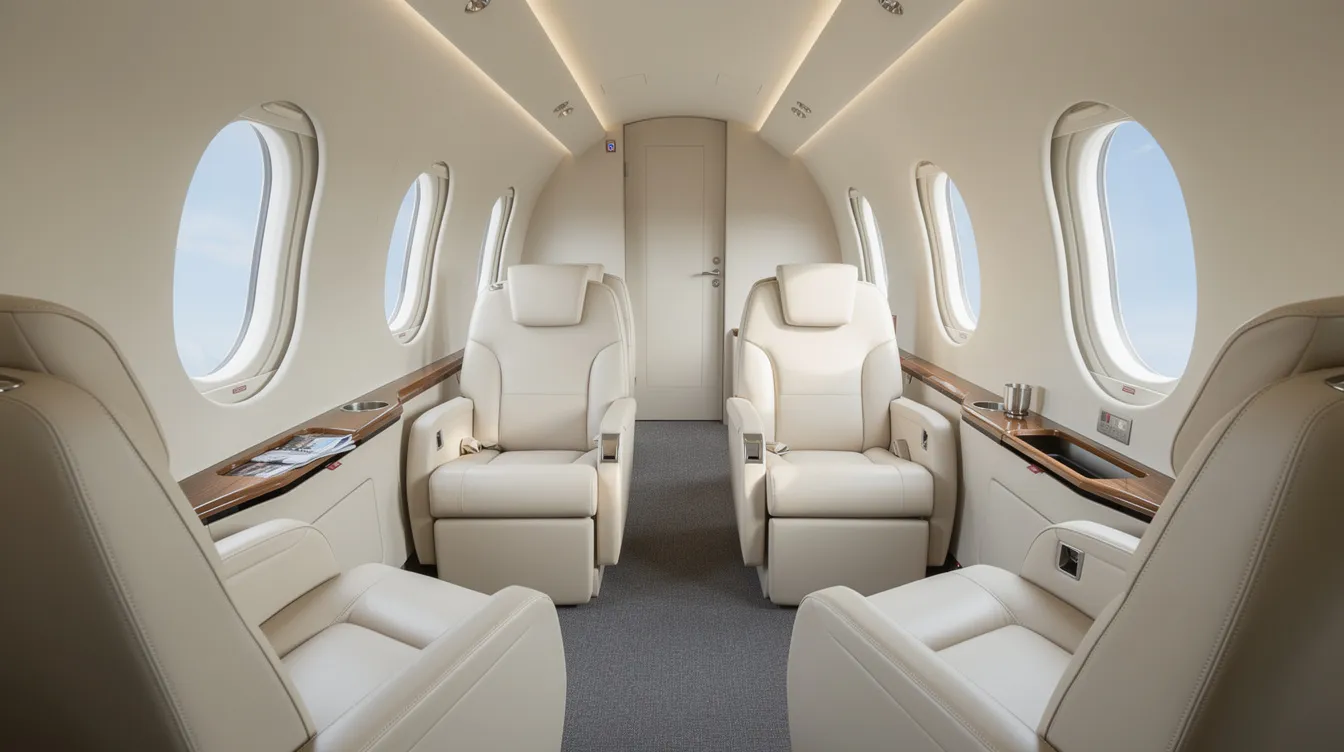
The Embraer Phenom 300E has earned its position as the most requested jet of 2025 and has held best-seller status in its category for over a decade. For regional business travel, no light jet delivers a better combination of speed, cabin space, and operating economics.
Performance specifications:
Range of approximately 2,000 nm covers routes like Los Angeles–Dallas, London–Athens, and New York–Denver without refueling
Cruise speed around 450 knots delivers flight time advantages on 2–3 hour missions
Ideal for same-day out-and-back executive trips
Business-oriented cabin features:
Seating for 6–8 passengers in club configuration that converts into a small meeting space
Whisper quiet cabin design with natural light from large windows
Generous baggage compartment for roadshow materials and carry-on luggage
Wi-Fi options supporting video calls and continuous email access
Safety and technology:
Advanced avionics suite with single-pilot certification for private jet owners who fly themselves
Runway overrun awareness systems and modern navigation equipment
The updated 300E version delivers refined cabin noise levels and improved ergonomics over earlier models
The Phenom 300E excels for regional European or US business routes—think New York–Chicago, Paris–Berlin, or San Francisco–Los Angeles. It offers a cost-efficient alternative to midsize jets for teams of 4–6 who prioritize speed and lower hourly charter costs over extended range.
The Cessna Citation Longitude stands as the 2025–2026 super-midsize favorite for coast-to-coast executives who need transcontinental capability without the complexity of ultra long range aircraft. The Citation series has built its reputation on reliability—one takes off or lands every two minutes globally.
Performance and range:
Typical range near 3,500 nm enables nonstop flights including New York–Los Angeles, London–Dubai (with payload considerations), and São Paulo–Miami
Cruise speed in the Mach 0.80–0.84 range delivers time-efficient business schedules, with private jets in this class commonly cruising around Mach 0.78 to Mach 0.81 for efficient long-distance business travel
Extended range capability covers most domestic and regional international travel
Cabin advantages for productivity:
Stand-up flat-floor cabin with seating for 8–12 in club seats and divan configuration
Fully equipped galley for catering on long haul flights, where greater comfort matters on long flights
Remarkably low cabin altitude reduces fatigue and helps combat jet lag
High-speed internet, individual monitors, and tables large enough for laptops and documents
Cockpit and safety technology:
Garmin G5000-based flight deck with optional emergency autoland
Modern navigation and safety suites meeting 2025 standards
Predictable operating economics compared to larger long range aircraft
The Citation Longitude fits companies wanting long legs and a premium spacious cabin without moving into ultra long range pricing. It handles regular coast-to-coast North American trips, intra-Europe flights with 8–10 passengers, and regional Asia-Pacific routes with ease.
The Bombardier Challenger 3500 represents Bombardier’s updated super-midsize/long range jet workhorse, launched as an evolution of the popular Challenger 350. It offers a refined blend of transcontinental performance and manageable operating costs.
Core specifications:
Range around 3,400 nm enables missions like New York–London (under favorable conditions), Los Angeles–Hawaii, or Dubai–London
Seating for approximately 9 passengers, with the cabin configured for team travel and other tailored layouts; super midsize jets like the Bombardier Challenger 350 are well suited to 6–7 hour flights
Top speed competitive with larger aircraft in its segment
Productivity and passenger comfort:
Widest cabin in its class with flat floor and a sense of spaciousness in the stand-up interior
Nuage seating specifically designed to reduce pressure points and fatigue on 5–7 hour flights
Very low cabin noise and advanced technology air management systems for better wellness upon arrival
Luxurious interiors without compromising functionality
Technology for business travelers:
High-speed Ka-band connectivity with 4K monitors for presentations; high-speed satellite Wi‑Fi is essential for video calls on oceanic sectors
Wireless device charging and integrated cabin management systems
Bombardier Vision Flight Deck with advanced vision and navigation systems
The Challenger 3500 delivers balanced operating economics versus cabin size and range, making it a favorite for corporate departments and charter fleets alike. It’s ideal for multi-city roadshows—a New York–Chicago–Dallas–Los Angeles itinerary in one trip becomes practical due to fast turnaround times and robust performance, and its place as a reliable favorite on domestic routes reflects the Challenger 350’s high operational reliability and refined interior.
For international travel requiring nonstop intercontinental capability, the Bombardier Global 7500 and Gulfstream G700 represent the pinnacle of business aviation in 2025–2026. Both aircraft function as genuine flying headquarters for business leaders managing global operations.
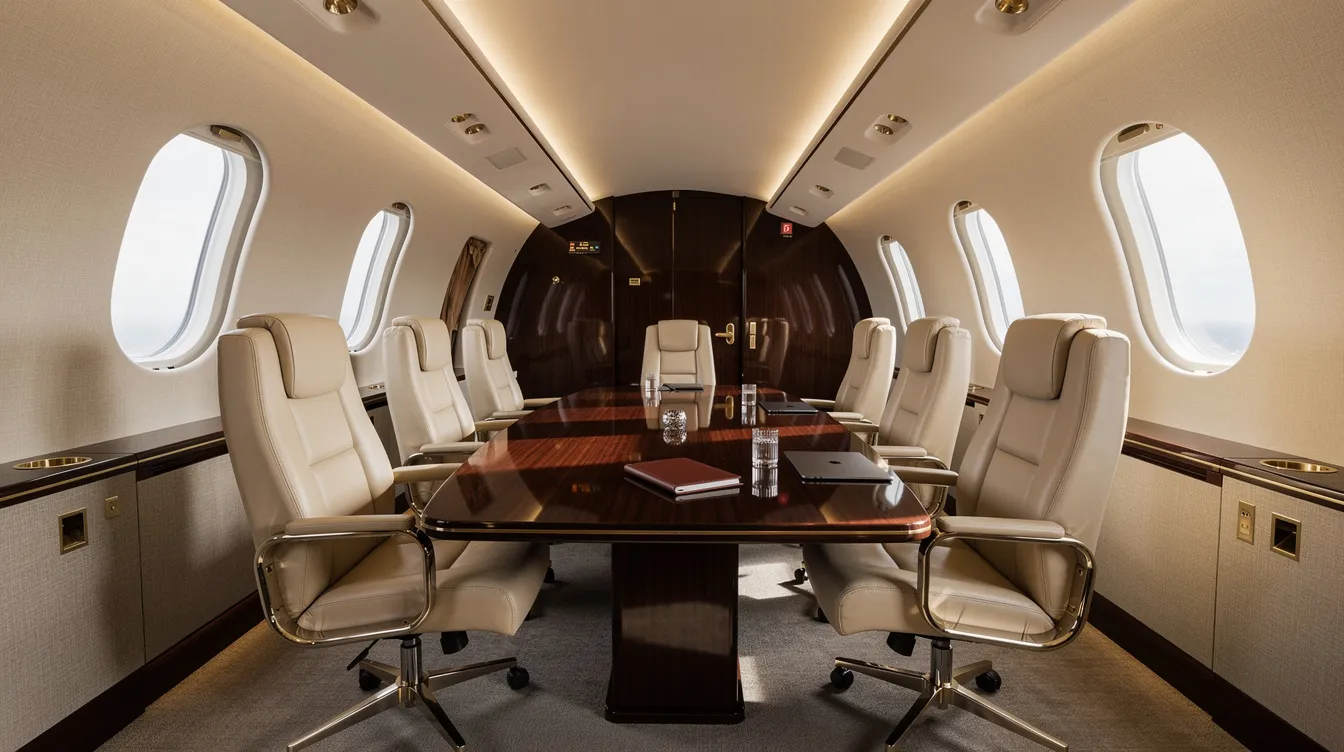
The Global 7500 offers exceptional range at 7,700 nm with up to 16 hours endurance, enabling nonstop routes like, for example, New York–Hong Kong, Los Angeles–Sydney, and London–Singapore, and all this helps it maintain a leading position for ultra-long-range business missions. This is the fastest business jet capable of such range.
Four zone cabin: Dedicated conference room doubling as dining room, lounge with entertainment rooms capability, private suites with full sized master bedrooms options, and a full size lavatory styled more like boutique-hotel bathrooms than typical aircraft facilities
Low cabin altitude and advanced wing design for smoother ride
Steep-approach certification enables access to challenging airports like London City
Bespoke amenities configurable for work or rest, with personalization shaped around owner preferences
Owners can configure amenities in remarkable detail to support family travel, including entertainment or wellness spaces, plus a full size kitchen, full-service bar, or even a gym.
The G700 matches with approximately 7,500 nm range and Mach 0.925 top speed, positioning it alongside the Global 7500 for ultra-long missions.
Five living areas: Panoramic oval windows flood the cabin with natural light, enhancing cabin aesthetics and showcasing premium materials
Options for master suite with shower for truly long haul flights, with some interiors using unique finishes such as cashmere, crystal, or gold accents to elevate the atmosphere
Ultralow cabin altitude and whisper quiet cabin reduce jet lag significantly
State-of-the-art Symmetry Flight Deck with advanced technology and touch-based controls
Both aircraft are optimized as flying palace configurations with boardroom-ready conference tables, high-bandwidth connectivity, and multiple quiet zones for confidential meetings. Buyers also compare the Gulfstream G550, with a 6,750-nautical-mile (12,500 km) range suited to transcontinental travel, and the Dassault Falcon 8X, favored by European executives for its advanced technology, efficiency, 6,450-nautical-mile range, and Mach 0.90 maximum speed. Selection often comes down to cabin design preferences, brand loyalty, service network coverage, resale value considerations, and the specific mix of speed, cabin design, and operating philosophy buyers find most compelling.
Upcoming models like the Bombardier Global 8000 and Gulfstream G800 will push boundaries further by 2026—the Global 8000 promises 8,000 nm range at Mach 0.94, making it the fastest civilian aircraft since Concorde. However, the Global 7500 and G700 remain the proven references for current purchasing decisions.
When passenger capacity requirements exceed what even large cabin jets can accommodate, executive airliners—or “bizliners”—become the logical choice. These include Airbus Corporate Jets (ACJ319neo, ACJ350) and Boeing Business Jets (BBJ 787), commercial platforms reconfigured for corporate use. If a company is moving a smaller group on short regional sectors, turboprops such as the King Air 350i can be a more cost-effective choice than stepping up to an executive airliner.
When bizliners are “best”:
Multinational roadshows, product launches, or annual meetings involving 20–60+ executives and staff
Global companies needing true flying headquarters with boardroom, breakout rooms, and multiple private suites
Travel for heads of state requiring personalized service at scale
Representative configurations:
Airbus ACJ319neo: Approximately 6,700+ nm range with 800+ square feet of configurable space—offices, lounges, entertainment rooms, and bedrooms
BBJ 787: Up to 9,900 nm range with fully bespoke interiors, often exceeding $100 million in fit-out costs alone
Trade-offs to consider:
Significantly higher acquisition and operating costs than heavy jet alternatives
Larger flight crews and more complex ground handling requirements
More restrictive airport access due to runway length requirements
Longer turnaround times between flights
For most corporate travel, a modern fleet of smaller private jets provides better flexibility. Bizliners make sense primarily for specific high-profile events where luxurious amenities and sheer cabin space justify the premium, mainly appealing to high-net-worth individuals, governments, and major corporations needing exceptional scale.
Understanding that “best for business” means balancing capital outlay, annual usage hours, and flexibility is essential. The right ownership model depends on how often and how far you fly, and the right fit can turn travel into a more efficient business process when usage patterns justify it.

Ownership paths:
Full ownership: Makes sense for companies flying 300–400+ hours annually. Acquisition costs range from under $15 million for smaller private jets to $75–80 million+ for new ultra long range jets, but the purchase price is only the starting point, with ongoing costs such as fuel, crew salaries, hangar fees, insurance, and catering.
Fractional ownership: Shares (1/16 to 1/4) suit 50–200 annual hours, providing predictable access to fleets including Global 7500s and G700s without full capital commitment.
Charter and membership models:
On-demand charter: Ideal for occasional trips, allowing selection from light to ultra long range jets per mission based on specific needs; prioritize operators with ARGUS Platinum or IS-BAO certifications.
Jet cards and subscription programs: Offer fixed hourly rates, guaranteed availability, and sometimes carbon-offset operations. Particularly valuable for direct air carrier access without ownership complexity.
Cost considerations:
Light jets charter in the low-to-mid five figures per hour
Ultra long range aircraft command significantly higher rates, often exceeding $15,000–25,000+ per hour
Additional costs include de-icing, overnight crew fees, and positioning legs that business planners often overlook
Decision framework:
Evaluate your last 12–24 months of executive travel data—routes, passengers, frequency—before committing to purchase versus charter if you're interested in ownership versus chartering
Many firms use a hybrid approach: owning a super-midsize jet (Challenger 3500 or Citation Longitude) for regular travel while chartering a Global 7500 or G700 when ultra-long-haul trips arise, which can help you learn which model best fits your usage
These are the questions executives most frequently ask when choosing or chartering jets for business use.
Which private jet is best overall for long-distance business travel in 2025?
For nonstop intercontinental corporate missions, the Bombardier Global 7500 and Gulfstream G700 stand out as the best private jets available. Their 7,500–7,700 nm range enables routes like New York–Hong Kong or Los Angeles–Sydney without refueling. Multi-zone cabins with conference room configurations, advanced connectivity, and low cabin altitude make them genuine productivity tools for business travelers operating globally, and the best options also pair faster cruise performance with the ability to fly non-stop when the mission requires it.
What is the most cost-effective jet for regional business trips?
Light jets like the Embraer Phenom 300E deliver the best value for 2–3 hour flights with 4–6 passengers. They balance speed, passenger comfort, and significantly lower operating costs compared to midsize jets. For frequent regional travel between business hubs—New York to Boston, San Francisco to Los Angeles—the Phenom 300E’s combination of availability, performance, and economics makes it the practical choice.
How important is Wi-Fi and onboard tech for business jet selection?
High-bandwidth, reliable connectivity is now critical for business jet selection—not a luxury feature. Modern executives expect video conferencing capability, secure email access, and cloud connectivity throughout flights. Most new business jets from Phenom 300E to Global 7500 offer advanced technology internet and cabin control systems, and on longer trips advanced cabin air systems and filters can help reduce allergens, but buyers should confirm actual bandwidth and coverage on their typical routes. A 12-hour flight without reliable connectivity negates the productivity advantage of private travel.
Should a company buy, go fractional, or just charter for business travel?
Annual flight hours drive this decision. Charter services work best for occasional trips under 50 hours yearly. Fractional ownership suits moderate use at 50–200 hours annually. Full private jet ownership makes financial sense at 300+ hours with predictable patterns. Private ownership is one thing, but total cost also includes operating and maintenance obligations. Companies should analyze actual travel data rather than aspirational usage when making this decision. Many organizations combine models—owning a super-midsize jet while chartering luxury private jets for occasional intercontinental trips.
What is the safest private jet for executives?
Modern business jets from major manufacturers—Bombardier, Gulfstream, Dassault, Embraer, Cessna—all meet rigorous certification standards. Rather than focusing on specific models, evaluate operator quality, pilot training programs, and maintenance practices. Charter safety evaluation should also include operator certifications such as ARGUS Platinum or IS-BAO. Safety systems like Enhanced Flight Vision Systems, Terrain Awareness Warning Systems, and modern autopilots are standard on current-generation aircraft. The Air Force uses similar technology principles in their VIP transport fleet, demonstrating the maturity of these safety systems.
There is no single “best private jet for business travel”—only best-in-class options for specific mission profiles. The Embraer Phenom 300E and Cessna Citation Longitude efficiently cover regional and coast-to-coast needs for small teams. The Bombardier Challenger 3500 bridges long range capability with manageable economics for mid-market corporations. Some operators may favor the Pilatus PC-24 when access to short or unpaved runways matters more than maximum cabin size, since it can use smaller airports.
For global C-suite travel requiring nonstop intercontinental access, the Bombardier Global 7500 and Gulfstream G700 set the 2025–2026 standard. These aircraft deliver the cabin space, connectivity, and range that transform flight time into productive work time—whether you need to fly nonstop from New York to Hong Kong or conduct confidential board meetings above the Atlantic.
Decision-makers should map actual travel patterns against each jet category’s capabilities and costs before committing. Upcoming models like the Bombardier Global 8000 and Gulfstream G800 will push range and speed further by 2026, giving businesses even more strategic options. But the fundamental question remains the same: which aircraft transforms your travel requirements into a competitive advantage? If you need help narrowing the list, focus on the option that gets executives from office to wheels-up quickly.
Share this post:
Jeff Ryan Serevilla
Sep 17, 2026
|
5
min read
Discover tips and trends in the industry.
5
min read
Private Jet Billing Models Compared for 60-Hour Flyers: Days-Based vs. Hours-Based vs. Occupied-Hour
Choosing the right billing model for private jet travel can save you thousands. For approximately 60 hours of flying annually, hours-based or occupied-hour billing typically offers the best value, providing predictable costs without the burden of fixed fees. This guide breaks down the differences between days-based, hours-based, and occupied-hour billing to help you make an informed decision.
Read More5
min read
Best Private Jet for Business Travel in 2026
Choosing the best private jet for business travel in 2025 and 2026 depends on specific mission profiles, passenger needs, and budget considerations. Top contenders include the Bombardier Global 7500 and Gulfstream G700 for ultra-long-range travel, while the Embraer Phenom 300E excels for regional trips. This guide helps decision-makers evaluate jets based on range, cabin productivity, and operating economics to find the ideal fit for their travel requirements.
Read MoreStay updated with our latest insights and tips to elevate your journey with us.
MEMBERSHIPS AND ASSOCIATIONS



Disclaimer: Jettly operates as a charter broker, offering access to a global digital jet charter marketplace. Jettly is not a direct air carrier and does not own or operate aircraft. All advertised flights are conducted by third-party air carriers that are fully licensed and hold the appropriate Part 135 or Part 121 certifications issued by the Federal Aviation Administration (FAA) or equivalent regulatory authorities under U.S. or foreign law. Jettly complies fully with the U.S. Department of Transportation's Part 295 and Part 298 Charter Broker regulations. Jettly does not carry additional liability insurance. Passengers are covered by aircraft operator insurance. TICO: 50023770


