


Login
Get Instant Pricing On 23,000+ Aircraft

>

Choosing the best twin engine plane depends on what matters most: raw speed, cabin comfort, fuel efficiency, or overall mission flexibility. This guide ranks the top twin-engine piston aircraft for private owners and charter users, breaking down real specs, trade-offs, and how each model stacks up for different types of flying.
Piper Aerostar leads the pack in speed, with cruise speeds reaching 230–260+ knots and the ability to reach up to 300 knots in certain configurations.
Beechcraft Baron G58 is the benchmark all-rounder piston twin, with over 8,000 units built since 1961 and strong support from Textron. It comfortably seats up to six passengers.
Piper Seneca V remains a popular, accessible choice for family and business travel from smaller airports, featuring a large and spacious cabin for six people.
Diamond DA62 offers modern diesel power and exceptional fuel efficiency, accommodating up to seven occupants, making it ideal for family trips and longer journeys.
Cessna 340 provides a pressurized cabin for up to six passengers, enhancing comfort on higher altitude flights.
Twin turboprops such as the King Air excel in long-distance travel and high-capacity missions, offering superior reliability and operational efficiency.
Twin-engine piston aircraft provide critical redundancy with two engines, offering enhanced safety compared to single-engine planes. They also offer higher travel speeds, improved climb performance, and higher payload capacities.
Although twin-engine aircraft typically have higher purchase and maintenance costs than single-engine planes, they can access shorter runways and more airports than larger jets.
Flying a twin-engine requires more training than a single-engine, but the added horsepower and redundancy improve overall mission flexibility and safety.
Piston twins are well-suited for private travel and shorter business flights, balancing operating costs and performance.
Operational costs increase significantly from piston twins to turboprops and then to jets, but modern turboprop engines are widely regarded for their exceptional reliability and long service lives.
A twin engine piston aircraft uses two piston engines to power its propellers, offering redundancy that single engine piston aircraft cannot match, and many current models are equipped with modern avionics and safety systems. Despite the growth of turboprops and light jets, pilots still value piston twins in general aviation for their lower acquisition cost, ability to use smaller airports, and competitive operating costs on regional routes.
This article evaluates models across five criteria, similar to broader guides on finding the best cross-country plane for your travel journey:
Safety - engine redundancy, handling on one engine, and built-in safety features
Performance - cruise speed, climb rate, range, and service ceilings
Cabin comfort - seating layout, noise, pressurization, and spacious cabins
Operating costs - fuel burn, maintenance, insurance, and training
Support - parts availability, resale value, and active owner communities
Flying a twin engine requires more training than a single engine, including a multi-engine rating and the added complexity of managing two engines. Charter operators prefer experienced multi-engine aircraft pilots who maintain recurrent proficiency. While Jettly primarily brokers turbine and jet aircraft, understanding what piston and propeller-driven aircraft can deliver helps travelers compare chartered twins versus light jets or turboprops on similar regional routes.
A high-performance single-engine piston aircraft like a Cirrus SR22 or Cessna 210 offers simplicity, lower fuel burn, and easier maintenance. But it lacks one critical thing: a second engine.
Twin-engine aircraft offer higher travel speeds than single-engine planes, higher payload capacity, and improved climb performance. The core safety advantage is continued flight after an engine failure. Twin-engine planes can continue flying if one engine fails, which matters most over water, mountains, or at night. However, engine failures in light twin aircraft require prompt and correct pilot actions, emphasizing the need for recurrent training. Asymmetric thrust and higher approach speeds introduce risks for under-trained pilots.
Missions where a twin-engine aircraft is clearly preferable include:
Night IFR over mountainous terrain
Long over-water segments with limited alternates
Multi-passenger business trips from secondary airports with shorter runways
Demanding weather environments requiring reliable climb performance
Twin engine aircraft typically have higher purchase and maintenance costs than singles, plus greater training demands. For time-sensitive business travel, private charter aircraft such as chartered turbine twins and light jets through Jettly often provide similar redundancy with higher speed and altitude capability.
The Piper Aerostar remains one of the fastest piston twin-engine aircraft ever produced. The Piper Aerostar can reach speeds up to 300 knots in its most powerful configurations, with typical cruise speeds in the 230–260+ knot range depending on variant. For aviation enthusiasts who dream of jet-like performance from a piston aircraft, this is the plane that delivers.
Designed by Ted Smith, the Aerostar 600/601 debuted around 1969. Later pressurized models - the 601P, 602P, and 700P - arrived through the late 1970s and early 1980s, with production ending in 1984. Learn more about Piper Aerostar speed and performance or explore Piper Aerostar 600 specs, range, and charter rates.
The Aerostar seats up to six passengers in a sleek design. Lycoming IO-540 series engines produce up to about 350 horsepower each, delivering ranges of 900–1,200 nm with reserves and service ceilings around FL250–FL280 depending on the model. The pressurized cabin on later variants allows comfortable high-altitude flight for better weather avoidance.
Strengths: Exceptional speed for a piston aircraft, strong climb, pressurization on many models, and an active owner support community incorporating advancements through aftermarket STCs.
Limitations: Demanding maintenance due to tight engine packaging, higher fuel burn than slower twins, and a cockpit that rewards experienced pilots. This is a pilot's airplane, not an entry-level twin. The empty weight of heavier variants (~4,600 lb) limits useful load when fuel tanks are full.
For niche charter or owner-flown business missions, the Aerostar is compelling. But many charter flights on platforms like Jettly route similar trips on turboprops or light jets for greater payload and altitude.
The Beechcraft Baron - especially the modern G58 - is the archetypal piston twin. Over 8,000 Beechcraft Barons have been manufactured since 1961, backed by continuous production and strong support from Textron. For pilots who want a twin bonanza of performance and reliability, the Baron delivers.
The Beechcraft Baron G58 seats up to six passengers. Twin Continental IO-550-C engines produce approximately 300 horsepower each, cruising around 200–202 knots with a useful load north of 1,500 lb. That translates to four adults plus baggage and fuel for 700–900 nm missions. The AOPA aircraft guide confirms takeoff distances of roughly 2,300–2,500 ft over a 50-ft obstacle.
Pilots value the Baron for predictable handling, well-documented systems, and good single-engine performance. Training material and simulator support are widely available, making it well suited for owners stepping up from simpler aircraft.
The roomy cabin offers club seating in later models, with comfortable seating, business-friendly interior options, and modern avionics packages like the Garmin G1000 NXi. Direct operating costs run approximately $280/hr, with charter rates around $600/hr.
Some regional charter operators still use Barons for short-haul hops into smaller airports. But customers searching Jettly will more often see turboprops like the King Air or light jets covering similar business routes with more room, seats, and higher cruise altitudes.
The Piper Seneca series (PA-34) is a popular entry-level cabin class twin, widely used for private ownership, training, and light charter since the early 1970s. The original Seneca I gave way to the turbocharged Seneca II and III, culminating in the modern Seneca V with Continental TSIO-360-RB engines producing 220 horsepower each and counter-rotating props.
The Piper Seneca V features a spacious cabin for family trips, with a typical six-seat layout, cruise speeds around 190–200 knots, and range of 800–830 nm with reserves. Service ceiling reaches 25,000 ft, with a single-engine ceiling around 16,500 ft. Takeoff distances are modest (~1,700 ft over a 50-ft obstacle), making the Seneca attractive for operations from shorter runways.
Key strengths:
Relatively forgiving handling for a twin comanche-class airplane, making it accessible for newer multi engine pilots
Good load-carrying capability for a family plus luggage
Large installed base keeping training, support, and parts readily available
Typical use cases include multi-leg family trips, owner-flown business travel between secondary cities, and advanced multi-engine training. Prospective owners weighing acquisition budgets can benefit from understanding affordable planes and budget-friendly aircraft choices. Learn more in Jettly's guide to the Piper Seneca 1 (PA-34-200).
While a piston twin may have lower direct fuel cost, turboprops and light jets booked through Jettly can dramatically reduce travel time on longer routes, offering better high-altitude weather avoidance and cabin comfort.
Beyond the Aerostar, Baron, and Seneca, several other models stand out depending on the mission: training, family travel, small-group charter, or cargo.
Diamond DA62 - A modern, diesel-powered twin engine aircraft that seats up to seven passengers. The Diamond DA62 can accommodate up to seven occupants using Austro AE330 engines burning Jet-A fuel. Cruise sits around 192 knots with total fuel burn of just ~11.8 US gal/hr at 60% power, delivering outstanding fuel efficiency and a range of ~1,288 nm. Modern Garmin G1000 NXi avionics come standard. Twin engines improve climb performance significantly even with moderate horsepower, and Jet-A availability in remote areas is a real advantage. Pilots comparing models should also understand affordable aeroplane rent costs and options when deciding between renting and owning.
Cessna 340 - A pressurized, six-seat cabin class twin with turbocharged Continental engines. The Cessna 340 specs, range, and charter rates highlight its pressurized cabin for comfort, allowing a cabin altitude of ~8,000 ft at FL200. Service ceiling reaches ~29,800 ft, making it well suited for IFR business travel through weather. Produced from 1972–1984, it remains popular on the used market.
Piper Navajo/Chieftain - A larger cabin class twin piston aircraft seating 6–8 passengers, widely used in commuter and charter roles. Large bodies and generous payload made the Navajo a workhorse. Learn more in Jettly's Piper PA-31 Navajo guide.
Other notable models: The Cessna 310 offers sleek design and crisp handling. The Cessna 421 Golden Eagle has a pressurized cabin for comfort on longer legs. The Beechcraft Duke delivers premium cabin and performance but demands high maintenance. The Tecnam P2006T seats up to four passengers as a modern light twin trainer. And the Beechcraft Model 18 holds iconic, historical status among aviation enthusiasts.
Travelers using Jettly may not book these piston models on every route, but understanding their strengths helps compare them to more common charter categories like turboprops and very light jets.
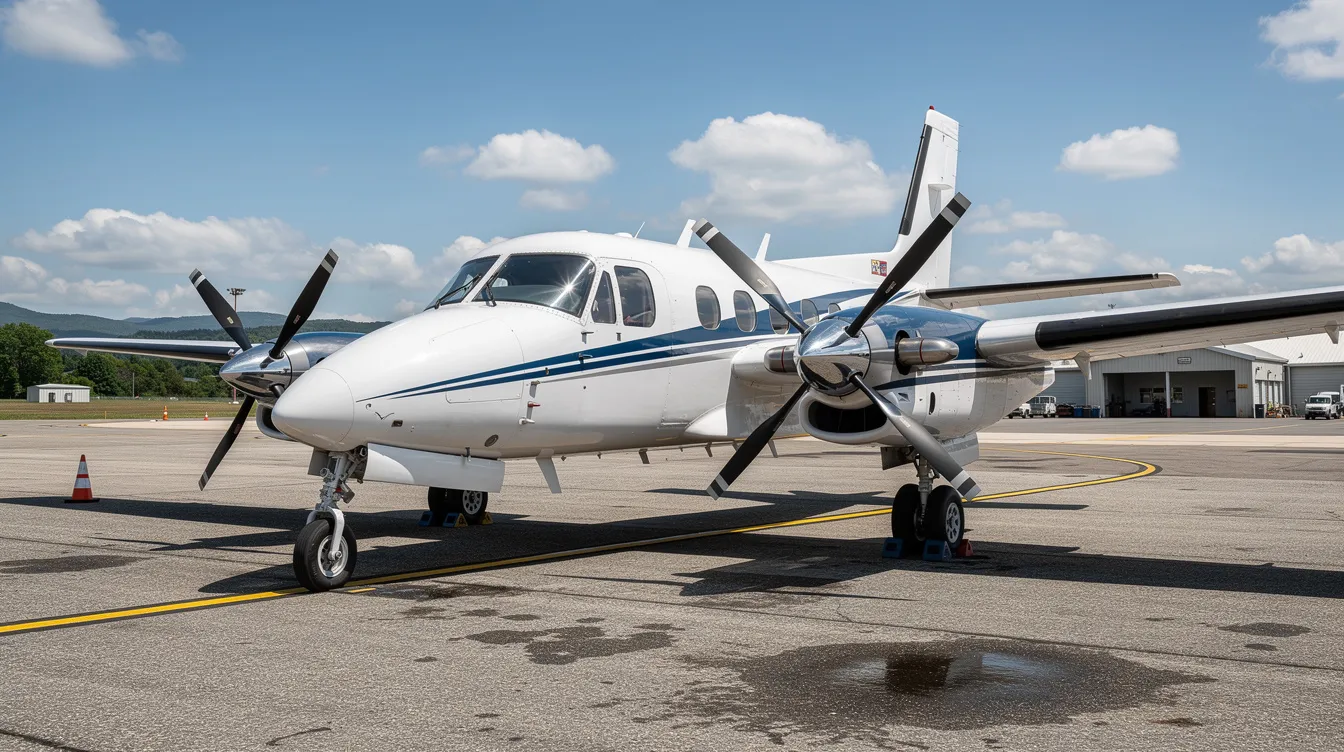
The "best" twin engine plane depends entirely on the mission: distance, speed, passenger count, typical airfields, budget, and whether the aircraft is owner-flown or crewed for charter. Piston twins are considered good for private travel and shorter business flights, where their economics and airfield flexibility shine.
Match aircraft to mission type:
Short regional hops from small airports - Seneca, Baron, Cessna 310
High-speed business travel - Piper Aerostar, Cessna 340
Modern, fuel-efficient touring - Diamond DA62
Higher-capacity commuter or charter work - Piper Navajo and similar cabin class twins
Twin engine aircraft typically have higher purchase and maintenance costs than singles. Budget for fuel burn (roughly 20–30+ gal/hr for most piston twins), annual maintenance, hangar, insurance, and recurrent training. If cost is a primary constraint, explore the cheapest private aircraft options for every budget. Newer designs like the DA62 cost more upfront but may save on fuel and maintain stronger resale.
Mainstream models from Piper, Beechcraft, Cessna, and Diamond offer smoother long-term ownership than rare or heavily customized airplanes thanks to parts availability and active operators communities, and they feature prominently among the best private plane manufacturers for every budget and need.
For many travelers, chartering a turboprop or light jet through Jettly delivers twin engine redundancy and strong performance without the capital commitment and ongoing upkeep of owning a piston twin.
Mission profiles that once belonged almost exclusively to piston twins - regional business trips with up to six passengers - are now often flown by turboprops and light jets in the charter market. Platforms specializing in private jet rental and charter with jet cards make it easy to match aircraft type to each mission. Modern turboprop engines are widely regarded for their exceptional reliability and long service lives, giving charter clients confidence on every flight.
Key performance differences are significant. A piston twin cruises at 170–210 knots, a turboprop at 250–320 knots, and a light jet at 350–450+ knots. That speed gap translates to real time savings on routes like New York–Boston or Los Angeles–Las Vegas. Turbine aircraft also fly higher, above weather, with lower cabin noise and full pressurization.
Operational costs increase significantly from piston twins to turboprops and then to jets. But charter customers avoid capital costs, maintenance, training, and downtime - paying only for actual flight time. Twin turboprops such as the King Air excel in long-distance travel and high-capacity missions.
Jettly's digital platform gives instant access to a wide inventory - turboprops, light jets, midsize and heavy jets - with transparent pricing. Readers can apply what they know about piston twins to select equivalent or better-performing charter options for specific missions, such as swapping a Baron-class route for a King Air or very light jet charter.
These questions address common topics that go beyond the main comparisons above. Whether you're considering ownership or simply want to understand your options before booking a charter flight, these answers provide practical guidance, and Jettly's private jet memberships can be part of that decision set for frequent flyers.
Twin-engine planes provide critical redundancy in case of engine failure, and enhanced safety through engine redundancy is a real advantage - especially over water or mountains. However, complexity, higher approach speeds, and asymmetric thrust can introduce new risks for under-trained pilots. Safety ultimately depends on training, maintenance, and how the aircraft is flown.
Expect around 700–900 nautical miles with reserves for aircraft like the Beechcraft Baron G58 and Piper Seneca V, depending on payload and power settings. High-performance models like the Piper Aerostar or Cessna 340 can stretch this further, making them suitable for longer regional business routes without fuel stops, especially when chosen as cross-country planes optimized for range and speed.
While Jettly's global marketplace focuses mainly on turboprops and jets for charter flights, some operators in the network do offer twin-engine piston aircraft on select regional routes. Jettly's private charter aircraft listings, combined with its search and instant pricing tools, let you see which aircraft types are available for your desired route and passenger count, then compare cost and flight times side by side.
Owning a piston twin involves direct costs - fuel, maintenance, engine reserves, insurance, hangar - plus training and capital. Readers comparing options may want a deeper breakdown of how much a private jet costs, including ownership and charter. Charter clients on Jettly pay only for flight time and optional services. For low to moderate annual flight hours, chartering turboprops or light jets can be more cost-effective and simpler than full ownership of a twin-engine piston aircraft.
Define the mission first: distance, passenger count, luggage, runway length, timing, and budget. Then compare performance, cabin comfort, and price for each category. If you decide to charter instead of own, it helps to understand affordable private jet charter pricing and cost factors. Use Jettly's platform to run instant quotes across multiple aircraft types for the same route, allowing a practical, data-driven choice between piston twins, turboprops, and jets.
Choosing the best twin-engine plane involves balancing safety, performance, cabin comfort, and operating costs against your specific mission needs. Piston twins like the Beechcraft Baron, Piper Seneca, and Diamond DA62 offer reliable, efficient options for private owners and charter users who value access to smaller airports and moderate travel distances. While turboprops and light jets provide faster speeds, higher altitudes, and greater cabin comfort, piston twins remain a practical choice for shorter regional trips and family travel.
For those seeking flexibility without ownership burdens, Jettly’s private jet charter platform offers instant access to a wide range of twin-engine aircraft, turboprops, and jets with transparent pricing. Whether you prioritize speed, fuel efficiency, or passenger capacity, understanding the strengths of piston twins helps you make informed decisions for your next flight.
Experience the convenience of private travel tailored to your needs. Discover available flights or get a personalized quote at https://www.jettly.com.
Share this post:
Jay Franco Serevilla
Jul 29, 2026
|
5
min read
Discover tips and trends in the industry.

5
min read
Private Jet LA to Miami: Charter Guide, Costs, and Best Airports
Traveling from New York to Miami offers various options including flights, driving, buses, and private jets. The distance is approximately 1,280 miles by road and 1,090 miles by air, with direct flights taking about 3 to 3.5 hours. This guide provides insights on travel times, costs, and the best ways to plan your journey.
Read More
5
min read
New York to Miami Distance: Routes, Flight Times, and Private Jet Options
Traveling from New York to Miami offers various options, including direct flights, driving, and private jet charters. The aerial distance is about 1,090 miles, while driving spans approximately 1,280–1,300 miles. This guide provides insights into travel times, costs, and the best routes for your journey.
Read MoreStay updated with our latest insights and tips to elevate your journey with us.
MEMBERSHIPS AND ASSOCIATIONS



Disclaimer: Jettly operates as a charter broker, offering access to a global digital jet charter marketplace. Jettly is not a direct air carrier and does not own or operate aircraft. All advertised flights are conducted by third-party air carriers that are fully licensed and hold the appropriate Part 135 or Part 121 certifications issued by the Federal Aviation Administration (FAA) or equivalent regulatory authorities under U.S. or foreign law. Jettly complies fully with the U.S. Department of Transportation's Part 295 and Part 298 Charter Broker regulations. Jettly does not carry additional liability insurance. Passengers are covered by aircraft operator insurance. TICO: 50023770


