



Login
Get Instant Pricing On 23,000+ Aircraft

>
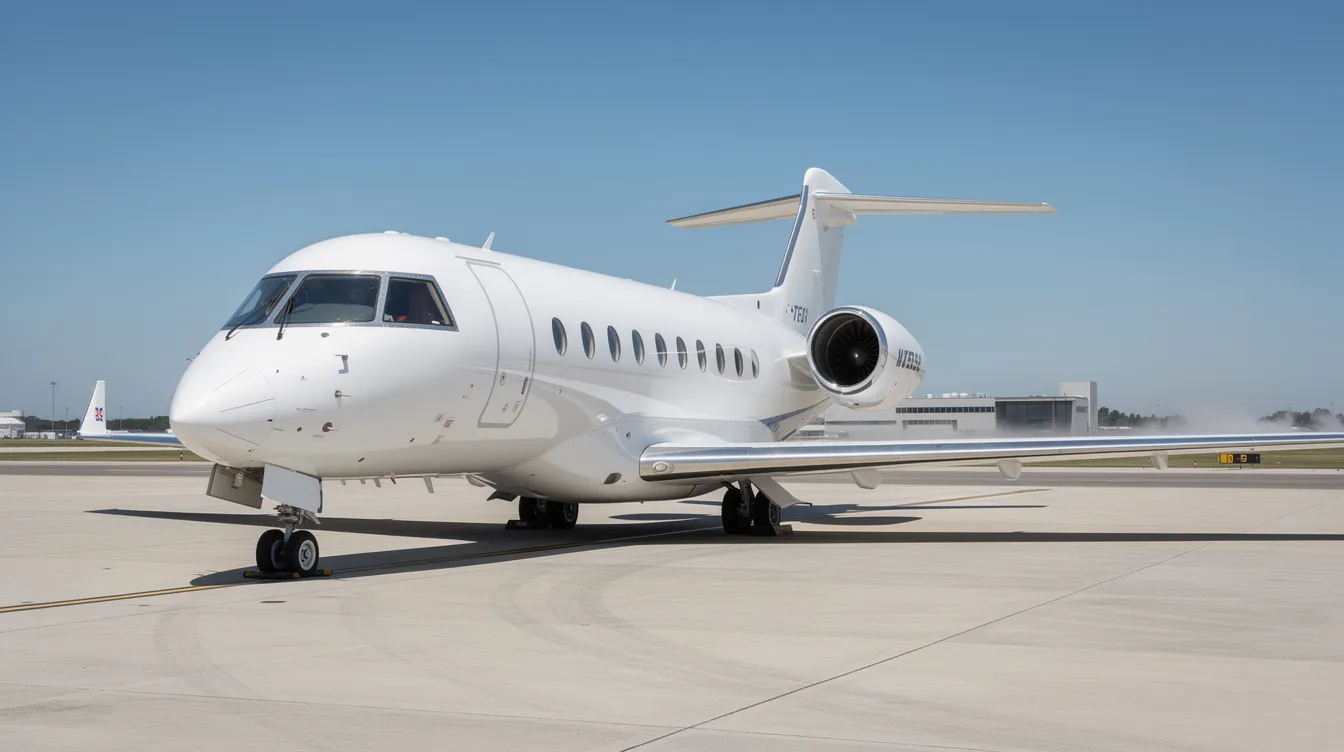
The Bombardier Challenger 650 is one of the most requested large-cabin business jet types on the charter market. With a range that covers transatlantic routes, a cabin wider than anything else in its class, and the ability to fly into constrained airports, it sits in a productive sweet spot for both corporate and leisure travellers. Here is a practical breakdown of Bombardier Challenger 650 specs, what they mean in real-world charter scenarios, and how to book one through Jettly's platform.
The Bombardier Challenger 650 is a long-range business jet with a 4,011 nautical mile range, steep approach certification for airports like London City, and the widest flat floor cabin in its class. It is one of the most frequently chartered large-cabin aircraft available through Jettly.
The Challenger 650 has a range of 4,011 nautical miles, a cruise speed near Mach 0.80, and seats up to 12 passengers - enough for nonstop flights between New York and London or Dubai and Paris.
Its cabin volume of 1,146 cubic feet, stand-up height, and in-flight baggage compartment access make it a strong fit for groups needing space and comfort.
Bombardier Challenger 650 specs translate directly into charter value: lower direct operating costs than competitors in the same class, access to more challenging airports, and the flexibility to book on-demand through Jettly without ownership commitments.
The Challenger 650 was launched in 2014 and entered service the following year as the latest evolution of the bombardier challenger 600 series. The first Challenger model, the CL-600, entered service in 1980. Since then, the Challenger 604 was introduced in 1995 as an upgrade, and the line continued through the 605 before arriving at the 650, alongside earlier variants like the Bombardier Challenger 601 available for charter. Over 1,000 Challenger aircraft have been delivered to date, with the 1000th Challenger aircraft delivered in December 2015.
The 650 retains the proven airframe but refines its engines, avionics suite, and cabin design. It typically seats 10 to 12 passengers across two cabin zones and is positioned as a transcontinental and intercontinental corporate jet within the broader Bombardier Challenger series.
Category: Large cabin business jet
Common charter missions: New York–London, Dubai–Paris, Singapore–Tokyo
Dispatch reliability: Above 99.9% across the Challenger series fleet
Charter availability: Many Challenger 650s on Jettly are operated by leading charter operators with high safety ratings and global coverage
This section provides a quick-reference spec snapshot for charter clients comparing aircraft on Jettly. For the full breakdown, visit the Challenger 650 specs, range, and charter rates page.
Range: The Challenger 650 has a range of 4,011 nautical miles (approximately 7,408 km) under NBAA IFR reserves with four to five passengers and two crew. With a full cabin, effective range decreases but still covers most transatlantic city pairs.
Cruise speed: Typical high-speed cruise near 488 ktas (about Mach 0.80), supporting 7–8 hour nonstop sectors. Maximum cruise speed reaches approximately Mach 0.85.
Service ceiling: About 41,000 ft (12,497 m), high enough to fly above most airline traffic and weather systems on longer routes.
Max takeoff weight: Approximately 48,200 lb (21,863 kg). Wing span measures about 64 ft 4 in.
Runway performance: Takeoff distance around 5,640 ft (1,719 m) under ISA conditions at sea level, and landing distance around 2,400 ft (732 m), giving the aircraft access to many mid-size business aviation airports.
Passenger capacity: Usually 10 passengers in standard layouts. The cabin can accommodate up to 12 passengers in denser charter configurations.
Maximum payload: 4,750 lbs (2,155 kg)
The Challenger 650 pairs proven powerplants with a modern flight deck - two factors that matter to safety-conscious charter clients and corporate flight departments alike.
Engines: The aircraft is equipped with two General Electric CF34-3B turbofan engines (specifically the General Electric CF34-3B MTO variant).). Each engine provides 8,729 pounds of takeoff thrust, delivering more powerful engines compared to the predecessor 605. The General Electric CF34 family has logged over 65 million flight hours across business and regional jet fleets.
Combined fuel burn at cruise: approximately 227 gallons per hour, though exact figures vary by weight and altitude.
Scheduled maintenance occurs every 200 hours or six months, and major inspections for the Challenger 650 are every 96 months - intervals that support high fleet utilisation on charter schedules.
Avionics and Flight Deck: The Bombardier Vision Flight Deck uses the Rockwell Collins Pro Line 21 Advanced system (sometimes with Fusion components), featuring four large displays, synthetic vision, and MultiScan weather radar. These features give pilots better situational awareness and support operations into challenging airports during low-visibility conditions. Many 650s hold steep approach certification and advanced navigation approvals, supporting access to airports like London City.
The Challenger 650 features the widest cabin in its class - a key reason it leads Jettly's large-cabin charter requests.
Cabin height: approximately 6 ft (1.83 m) of stand-up space
Width: 8 ft 2 in (2.49 m)
Length: 25 ft 7 in (7.8 m) in the main seating area, with two distinct cabin zones
Cabin volume: 1,146 cubic feet - the largest percentage of usable space among competitors in this category
Typical charter layouts include a front club group of four seats, a mid-cabin conference section with four seats around a table, and an aft divan or additional club seats. Some aircraft are configured for 9 passengers, others stretch to 12, and larger derivatives like the Challenger 850 private jet for rent can seat even more while retaining similar comfort features.
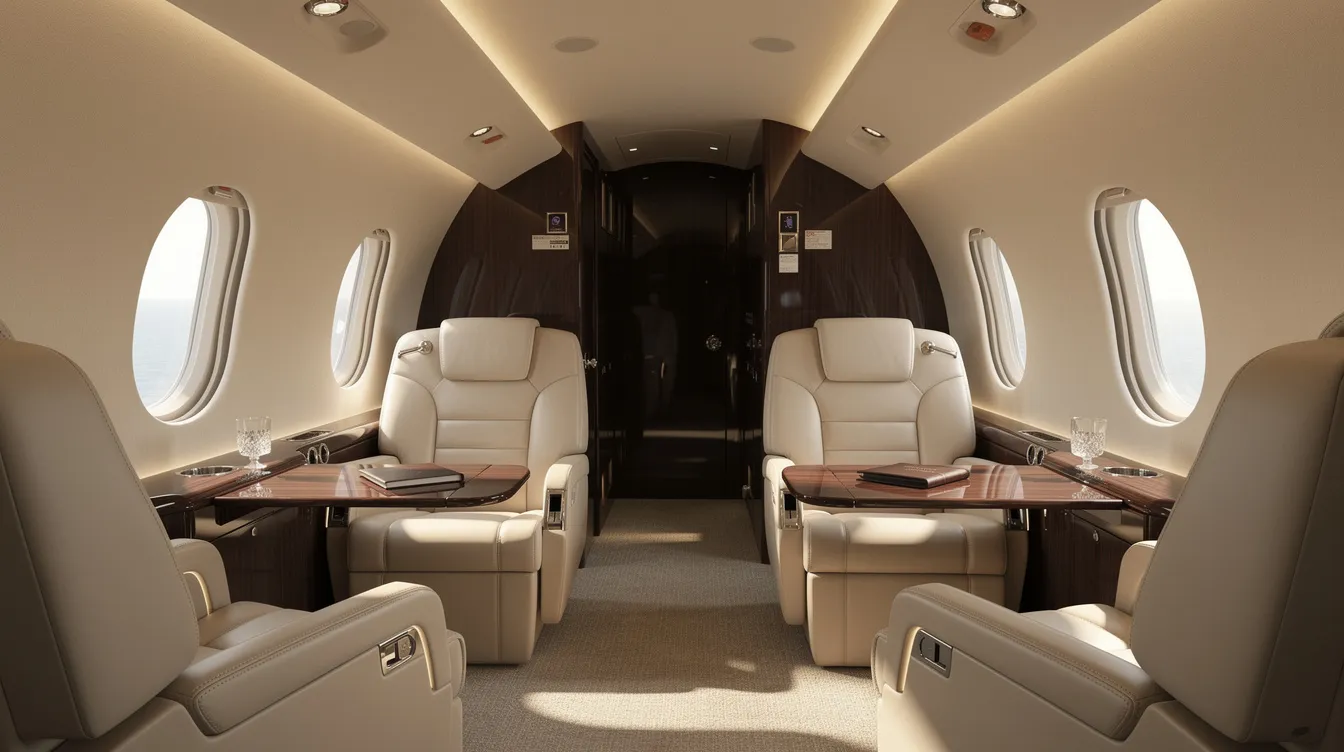
Sleeping: Many configurations convert seats and divans into 4–6 lie-flat beds, making the aircraft suitable for overnight flights such as New York to London.
Comfort and tech details:
The carefully designed cabin includes wider seats than earlier Challenger models, large windows for natural light, and customizable veneers
Angled touch screens for cabin management, universal HDMI inputs for presentations or entertainment, USB ports, and individual power outlets
Ka-band or similar high-speed internet on many aircraft (varies by operator)
A faster meal preparation galley forward and a full lavatory aft
Passengers can access the baggage compartment at all times in most configurations, with space for about 8–10 standard suitcases plus personal items (approximately 115 cu ft / 3.25 m³)
The flat floor cabin and an ultra-smooth ride at altitude make longer flights noticeably more comfortable than most super-midsize alternatives.
How do these specs translate to actual charter missions?
The Challenger 650 has a range of 4,011 nautical miles - enough for 4,000 nm class sectors under standard charter conditions. Real range depends on passenger count, baggage weight, routing, and headwinds. With full fuel and a lighter load, the aircraft can push toward the upper limit. With 10–12 passengers and heavy luggage, plan for slightly shorter nonstop legs.
Nonstop route examples within the 4,000 nm band:
London–New York
Dubai–London
Los Angeles–Honolulu on private jets or high-capacity narrowbodies like the Boeing 737-800
Singapore–Sydney on aircraft like the Challenger 650 or widebody options such as the Airbus A330-300
Toronto–Reykjavik
Pilots can fly at long-range cruise (Mach 0.78–0.80) for fuel efficiency on longer sectors or select a higher cruise speed on shorter segments like New York–Miami or Paris–Marrakech. The 41,000 ft ceiling helps avoid turbulence and congested airspace.
The aircraft's landing distance of approximately 2,400 ft means it can operate comfortably from dedicated business aviation fields - Teterboro instead of JFK, Le Bourget instead of CDG, Farnborough instead of Heathrow. Jettly's platform lets users filter by range and performance or use its airport locator tool to see whether a Challenger 650 covers their specific city pairs.
One standout feature of the Challenger 650 is its steep approach certification, opening up constrained airports that many large jets cannot use.
London City Airport (EGLC) requires a steep 5.5-degree approach angle, a short runway, and strict noise requirements. The Challenger 650 is certified for these operations when the specific aircraft carries the necessary service bulletins and the crew holds current training, as evaluated by Transport Canada and the FAA. For time-sensitive travellers heading into central London, this means a new tail cone design and new undercarriage components help support operation at more challenging airports.
Other examples include Aspen (Colorado) under suitable conditions and certain alpine fields in Switzerland. The Challenger 650 can operate from shorter runways than many large-cabin competitors, though exact access always depends on operator approvals, weight, and weather.
Through Jettly's London City charter page, users can specify their preferred airport, compare capable aircraft, and see availability across multiple operators.

Charter clients don't pay operating costs directly - they see them reflected in hourly charter rates. But understanding the cost structure helps explain why the Challenger 650 is competitively priced in the large-cabin category.
Annual operating cost: Approximately $2,682,250 for a typical Challenger 650 operation, covering crew, insurance, hangar, training, fuel, and maintenance
Variable costs: Often estimated around USD 3,500–4,500 per flight hour (fuel plus maintenance)
Fuel consumption: The Challenger 650 engines consume 227 gallons per hour combined at cruise
Charter hourly rates: Substantially higher than variable costs alone, reflecting operator overhead and margin; European operators list rates in the range of €10,000–€12,000 per hour
The Challenger 650 has the lowest direct operating costs in its class, which makes it attractive to corporate flight departments and charter operators - and helps keep charter pricing competitive against similar large-cabin private jets. Readers interested in a deeper breakdown of private jet operating costs can better understand how these savings are achieved.
For charter customers, Jettly's cost calculator and jet card flight cost estimator draw on aircraft category, route length, positioning requirements, and current fuel prices to generate live estimates. On-demand charter avoids the capital outlay and depreciation of ownership entirely, and Jettly also outlines how private jet charter pricing works for travellers comparing costs.
The Challenger 650 is a versatile option for both corporate and leisure itineraries where passengers value space and nonstop reach, fitting well among the top private jet charter companies and offerings that emphasise safety and service.
Corporate missions:
Multi-city European roadshows (London–Berlin–Rome) where teams need to work in a quiet, connected cabin with structural improvements over earlier models, similar in planning complexity to private jet charter operations in Kolkata, West Bengal
Transatlantic board meetings (New York–London) with lie-flat beds for overnight productivity, or long-haul trips connecting with hubs like New Delhi via private jet charter
Intra-Middle East or intra-Asia hops for executive teams of 8–10, or regional itineraries such as private jet charter to Jaipur, Rajasthan
Leisure travel:
Family trips like Los Angeles–Maui or Dubai–Maldives, where extra baggage for sports equipment benefits from the Challenger's generous baggage compartment
Group getaways (London–Canary Islands) with up to 12 passengers sharing costs, similar to trips often flown on the Challenger 850 charter aircraft
When passenger numbers or luggage volume increase, the Challenger 650 often becomes the more practical choice over smaller super-midsize jets - even at a higher per hour rate - because of its cabin width and range, particularly when viewed within the broader charter airlines and private flight ecosystem.
Jettly's platform lets users filter by aircraft size, range, and amenities (Wi-Fi, pet-friendly, special catering) or tap into its crowdsourced private jet flights and shared empty seats. Empty leg flights on repositioning Challenger 650s sometimes appear at reduced rates, giving flexible travellers large-cabin comfort for less on specific routes.
Many Jettly users compare the Challenger 650 with other large-cabin or super-midsize jets. Here is a simple framework:
Choose the Challenger 650 when:
Your nonstop distance approaches 4,000 nm
Your group is 8–12 passengers needing a wide, stand-up cabin
You want to operate into airports like London City (when equipped and approved)
You prioritise low direct operating costs in the large-cabin class
Consider a smaller jet when:
You have 3–5 passengers on a short regional hop under 1,000 nm
The departure or arrival airport has very restrictive runway limits, where a light twin like the Cessna 340 might be more appropriate
Budget is the primary driver and a light or midsize jet easily meets the mission
Move up to ultra-long-range when:
Nonstop distance significantly exceeds 4,000 nm (e.g., New York–Hong Kong)
You need three or more cabin zones, a dedicated crew rest area, or a sale of additional onboard amenities
Jettly's comparison features let users match aircraft types side by side by range, cabin dimensions, and estimated price for a given route, with the Challenger 650 as a strong benchmark in the heavy jets category within Jettly's broader private charter aircraft marketplace. Understanding the core specs - range, capacity, airport access - helps travellers select the right jet faster and avoid over- or under-sizing their aircraft.
These FAQs address common Challenger 650 questions that go beyond the main spec summary, aimed at Jettly charter users.
With a range around 4,000 nm, the Challenger 650 typically flies about 7–8 hours nonstop under standard charter conditions, depending on winds and payload. Missions approaching the upper limit may require a fuel stop, which Jettly or the operator will plan into the itinerary.
The Challenger 650 can absolutely operate short segments under 1,000 nm, but it is most cost-effective when the cabin is well utilised or when passengers specifically want a wide, stand-up cabin. For 2–4 passengers on very short trips, smaller jets on Jettly may offer better value.
The Challenger 650 type has steep approach capability, but individual aircraft and operators must hold the necessary approvals from Transport Canada and the FAA. Conditions such as weight, wind, and noise restrictions still apply. Specify London City in your Jettly request so the platform can confirm whether a particular aircraft is equipped and capable for that airport.
Many Challenger 650s are equipped with high-speed Ka-band or similar broadband systems, supporting email, VPN, and streaming for multiple devices. Equipment varies by operator and tail number, so check Wi-Fi availability in the flight request details on Jettly.
Charter rates for the Challenger 650 are generally lower than those for larger ultra-long-range jets, while still offering a spacious cabin and intercontinental range. Travellers flying within the 4,000 nm band can often save significantly by choosing a Challenger 650 without sacrificing comfort. Jettly's instant pricing tools make this comparison transparent.
Ready to experience private travel on your terms? Explore Challenger 650 flight options or request a quote at https://www.jettly.com.
The Bombardier Challenger 650 stands out as a versatile and efficient large-cabin business jet, powered by two General Electric CF34-3B engines that deliver strong performance and reliability. Its combination of transcontinental range, spacious cabin, and access to challenging airports like London City makes it a top choice for both corporate and leisure travellers. With competitive operating costs and flexible booking options through Jettly, the Challenger 650 offers a compelling balance of comfort, capability, and value in the private jet charter market. For travellers seeking a private jet that meets demanding mission profiles without compromising on passenger experience, the Challenger 650 remains a leading option.
Ready to experience private travel on your terms? Explore Challenger 650 flight options or request a quote at https://www.jettly.com.
Share this post:
Jay Franco Serevilla
Jul 20, 2026
|
5
min read
Discover tips and trends in the industry.

5
min read
Private Jet Membership: How to Choose the Right Membership for the Way You Fly
Choosing the right private jet membership is crucial for maximizing value and flexibility in private aviation. This guide outlines the different membership structures, including jet cards, fixed-fee subscriptions, and deposit-based programs, helping travelers make informed decisions based on their flying habits. Jettly's on-demand charter service offers a compelling alternative, allowing users to avoid large upfront commitments while enjoying transparent pricing.
Read More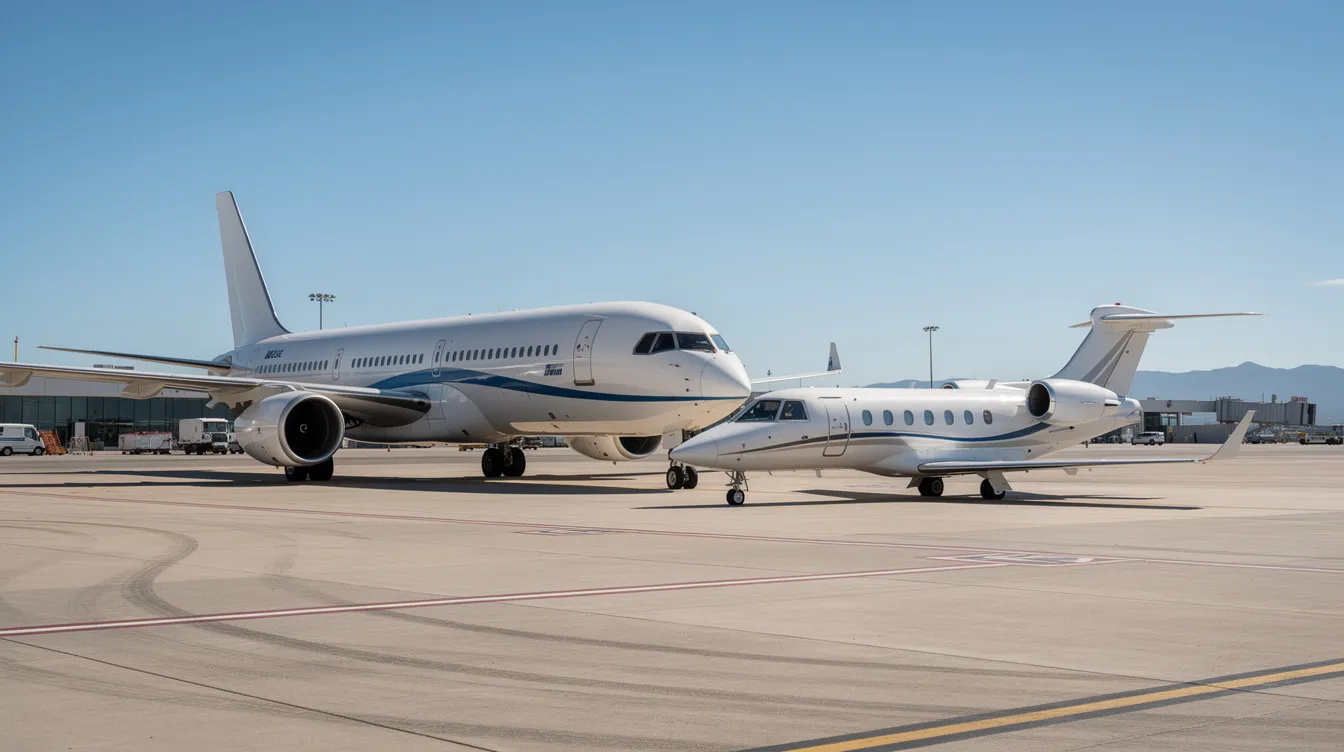
5
min read
Types of Planes in Civil Aviation: From Commercial Airliners to Private Jets
Civil aviation encompasses a diverse range of aircraft types, from commercial airliners to private jets. Understanding these categories helps travelers and aviation enthusiasts make informed decisions about their flying needs. This guide details the various aircraft types, their missions, and how to choose the right plane for specific travel requirements.
Read MoreStay updated with our latest insights and tips to elevate your journey with us.
MEMBERSHIPS AND ASSOCIATIONS



Disclaimer: Jettly operates as a charter broker, offering access to a global digital jet charter marketplace. Jettly is not a direct air carrier and does not own or operate aircraft. All advertised flights are conducted by third-party air carriers that are fully licensed and hold the appropriate Part 135 or Part 121 certifications issued by the Federal Aviation Administration (FAA) or equivalent regulatory authorities under U.S. or foreign law. Jettly complies fully with the U.S. Department of Transportation's Part 295 and Part 298 Charter Broker regulations. Jettly does not carry additional liability insurance. Passengers are covered by aircraft operator insurance. TICO: 50023770


