


Login
Get Instant Pricing On 23,000+ Aircraft

>
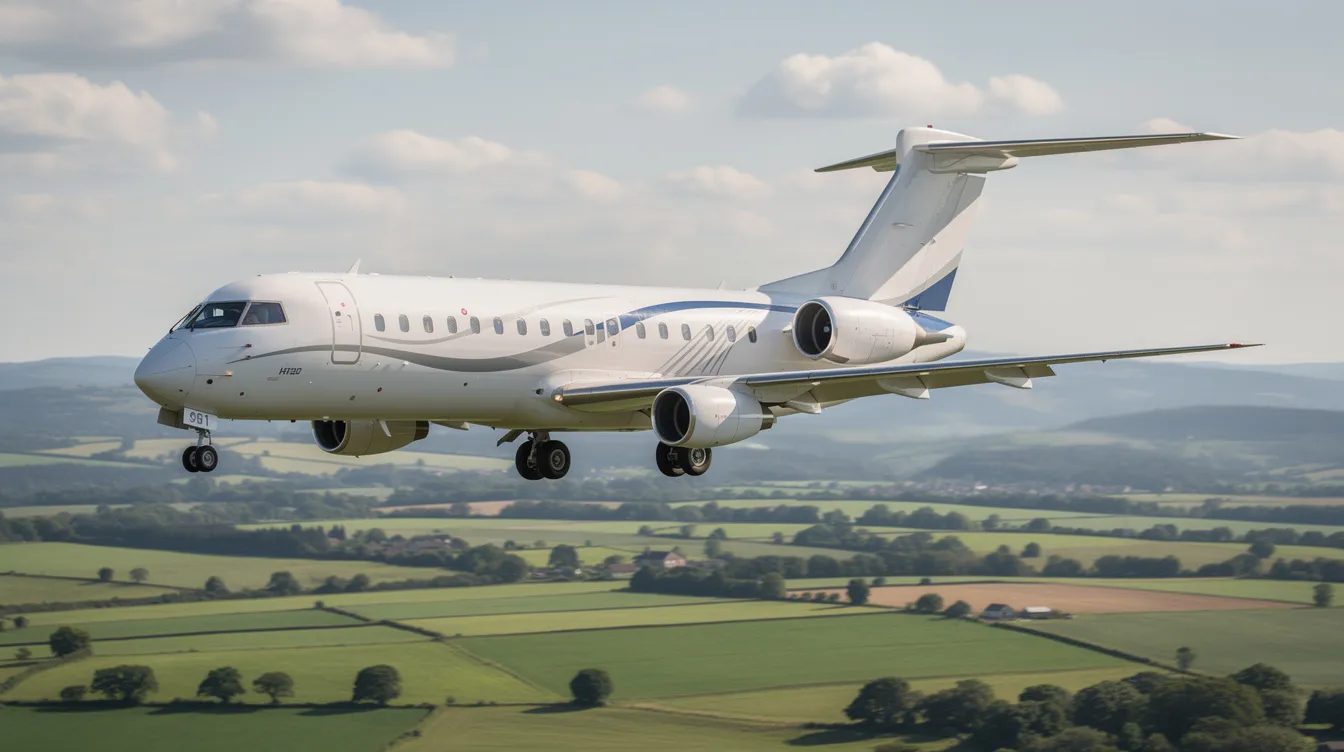
The British Aerospace BAe 146 is a four-engine short-haul regional jet airliner built to do what most other jets could not: operate reliably from short runways, noise-restricted airports, and constrained city-centre airfields. Known widely as the "Whisperjet," this British-designed plane earned its reputation through quiet operation, steep-approach capability, and the flexibility to serve passengers, freight, and specialised missions across six continents.
This guide is intended for charter travellers, aviation enthusiasts, and operators seeking a comprehensive overview of the BAe 146’s history, design, operational roles, and charter options. Here, you'll find detailed information on the aircraft's development, technical features, main variants, and how it continues to serve in both scheduled and charter operations worldwide.
The British Aerospace BAe 146 and its Avro RJ and Avro RJX developments were purpose-built for short runways, noise-sensitive airports, and flexible passenger and freight missions. A total of 387 BAe 146 aircraft were produced between 1983 and 2002, and the type sees wide usage across a range of roles to this day.
The typical passenger capacity ranges from about 70 to 112 across three main fuselage lengths (BAe 146-100, -200, and -300), with sub-variants including the Quiet Trader freighter version and Quick Change combi layouts. The aircraft is notable for its exceptional short-field performance, accessing airports that most other jets cannot reach.
Many airframes now serve in specialist roles — cargo, aerial firefighting, atmospheric research — while a smaller number remain active on regional passenger routes and charter operations. As of July 2020, 54 BAe 146 aircraft were still in service globally, though that number has continued to decline.
For charter travellers moving larger groups into challenging airports, platforms like Jettly can source BAe 146 and Avro RJ aircraft through vetted operators, providing a practical solution when runway length or noise limits rule out conventional narrowbody jets.
The British Aerospace BAe 146 stands as one of the most commercially successful civil aircraft programmes in UK aviation history by units delivered. This regional airliner family was developed to fill a specific gap: connecting cities with short-haul routes that turboprops served too slowly and larger jets could not physically access.
The programme originated under Hawker Siddeley in the early 1970s as the HS.146 concept. Following UK aerospace industry consolidation in 1977, British Aerospace inherited the project. It later fell under BAE Systems after further corporate restructuring. Production ran from 1983 through the early 2000s, and in that span the assembly line delivered 387 production aircraft. The BAe 146 served airlines across Europe, North America, and Asia in scheduled, charter, and freight operations.
The aircraft family includes three principal fuselage lengths - BAe 146 100, BAe 146-200, and BAe 146-300 - plus the later Avro RJ series (RJ70, RJ85, RJ100), together covering passenger variants, freight carrying versions, VIP transport, and special mission roles.
British Aerospace pursued the BAe 146 to fill a gap between turboprop commuters and larger single-aisle jets on short-haul routes. The aircraft's operational design focuses on accessing constrained airports rather than maximizing cruise efficiency - a deliberate trade-off that shaped every aspect of development.
The initial HS.146 concept took shape in the early 1970s, was shelved during the oil crisis, and revived later in the decade as regional air travel demand recovered. Design emphasis centred on short runways, quiet operation, and steep approach capability, enabling use of airports with runway lengths around 1,200–1,500 m and strict noise curfews. The aircraft is designed for short takeoff and landing operations and is capable of operating from noise-sensitive airports.
Final assembly took place at Hatfield, with wing production at Chadderton and Woodford and various systems sourced from British and European partners. Certification testing focused heavily on low-speed handling, flap systems, rejected takeoff performance, and noise footprint.
The BAe 146's silhouette is unmistakable among regional aircraft: a high-mounted wing, T-tail, four compact turbofan engines, and relatively tall landing gear give it a profile that stands apart from other jets in its class. The four-engine configuration was chosen specifically for redundancy, noise distribution, and balanced thrust during short-field operations.
Key aerodynamic features include:
High wing design - provides ground clearance for engines, reduces foreign object ingestion, and enables operations from unimproved or gravel strips
Full-span high-lift devices - advanced high-lift devices including multi-segment trailing-edge flaps and leading-edge slats generate high lift at low speeds
T-tail - delivers clean airflow over the horizontal stabiliser during steep approaches and turbulent conditions at mountainous or coastal airports
Robust landing gear - engineered for high cycle counts, frequent pressurisation, and uneven surfaces, with strong braking for short-field stops
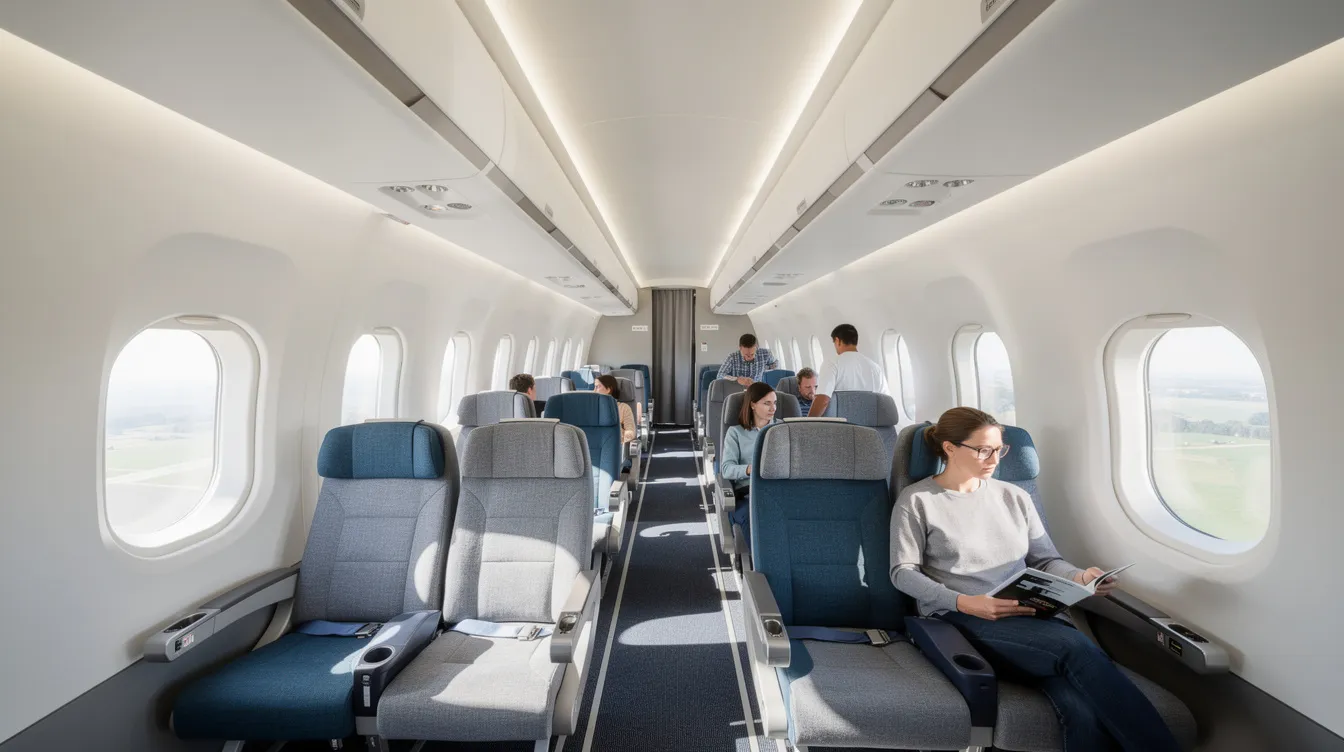
The BAe 146's cabin is wider than most regional jets, allowing for five-abreast seating in a 2+3 layout. The cockpit evolved from analogue instrumentation on early models to more advanced digital avionics on the Avro RJ version, improving situational awareness for crews flying demanding short-haul airliner operations.
The four-engine configuration is central to the BAe 146 concept. Four small turbofan engines provide improved engine-out performance compared with twin-engine designs, while distributing thrust across the wing for balanced handling during takeoff from short runways.
Early BAe 146 variants used Textron Lycoming ALF 502R turbofans. Later Avro RJ aircraft adopted Honeywell LF 507 new engines with FADEC, offering better reliability and fuel efficiency. The aircraft has a service ceiling of about 35,000 feet.
The aircraft is marketed as the "Whisperjet" due to its low noise levels. The smaller turbofans, acoustic treatment, and reduced thrust settings on departure all contribute to notably quiet operation - a primary reason the type gained access to airports with strict night curfews.
The maximum range of the BAe 146 can vary from approximately 1,800 to 2,090 nautical miles depending on variant and payload. Cruise speeds typically sit around 760–790 km/h, with the BAe 146-300 reaching a maximum operating speed of Mach 0.73. The type delivers strong climb performance in multi-stop networks and is suitable for steep approaches such as London City's 5.5° profile.
The BAe 146 evolved through three fuselage stretches, each addressing different capacity and range needs on regional routes.
|
Specification |
BAe 146-100 |
BAe 146-200 |
BAe 146-300 |
|---|---|---|---|
|
First flight |
3 September 1981 |
August 1982 |
1987 |
|
Typical seating |
70–82 |
85–100 |
100–112 (max 128) |
|
Max takeoff weight |
~38,100 kg |
~42,200 kg |
~44,225 kg |
|
Cruising speed |
767 km/h |
~760 km/h |
~760 km/h |
|
Range |
~2,600 km |
2,910 km |
~2,800 km |
|
Max payload |
~8,300 kg |
10,039 kg |
~11,500 kg |
|
Takeoff run (SL) |
~1,195 m |
~1,390 m |
~1,535 m |
The BAe 146-100 had its first flight on September 3, 1981, and entered service as a prototype-validated design suited to thinner regional routes and VIP shuttle missions. The BAe 146-200 added a fuselage extension of 2.41 metres, increasing both passenger count and cargo volume. The BAe 146-300 can carry up to 128 passengers in high-density configuration, serving higher-demand short-haul routes.
Key sub-variants include:
Quick Change (QC) combi layouts
Quiet Trader (QT) freighters
BAe 146-100QT: a freighter version of the -100
BAe 146-200QT and -300QT: workhorses of European night freight networks, featuring large side cargo doors and strengthened floors
In the early 1990s, British Aerospace rebranded and upgraded the BAe 146 as the Avro RJ family - an improved version with better engines, modern cockpit systems, and refined cabins. The Avro RJ version began production as a direct evolution of the original airframe.
Avro RJ70 - successor to the BAe 146-100 with Honeywell LF 507 engines, FADEC, updated digital avionics, and seating around 70–94 passengers
Avro RJ85 - replaced the BAe 146-200, offering seating capacity where the Avro RJ85 seats up to 112 passengers, enhanced systems, and better fuel economy; popular with European regional airlines
Avro RJ100 - successor to the BAe 146-300, optimised for high-frequency short-haul operations with configurations developed for steep-approach airports
The Avro RJ series represents the later part of the aircraft family's commercial life, with deliveries commencing in the early 1990s and first deliveries going to European carriers.
The Avro RJX programme attempted a further improved version with AlliedSignal/Honeywell AS977 engines. However, only two prototypes and one production aircraft were built before the programme's cancellation in November 2001. Production ceased entirely, ending the civil jet airliner line that British Aerospace had developed over two decades. The production figures for the entire family reached 394 airframes, including the Avro RJ series.

The BAe 146 and Avro RJ family saw broad adoption across continents. The plane served as a primary regional workhorse from the early 1980s through the 2010s, manufactured for airlines, governments, and specialist operators alike.
Regional airline service: Dan-Air launched BAe 146 services in May 1983, marking the type's first commercial passenger operations. Other major operators included Pacific Southwest Airlines, Air Wisconsin, Ansett Australia, Crossair, and Swiss. National Jet Express operated 33 BAe 146 aircraft until June 2022, illustrating the type's longevity in Australian regional jet operations. The BAe 146 also made the first commercial flight to Saint Helena in 2017.
VIP and governmental use: The Royal Air Force operated BAe 146-100 CC2 and C3 aircraft for VIP transport from 1986 until 2022, flying the British Royal Family and senior government officials. The BAe 146M program was also announced in 2009 for military use, underscoring the type's appeal as a civil aircraft adapted for defence transport.
Freight and night cargo: In 2012, the BAe 146 QT was the most numerous type in TNT Airways' fleet, with the BAe 146 used for cargo operations by TNT Airways across European express networks. Other operators such as ASL Airlines also bae employed Quiet Trader variants for overnight parcel services.
Modern operators: Pionair Australia operates BAe 146 aircraft for freight and passenger services today. Only about 21 airframes remain in scheduled passenger airline service globally, many concentrated in Latin America and Iran.
As passenger fleets have shrunk, many BAe 146 and Avro RJ airframes have found second lives in specialised missions. The aircraft has gained recognition for its versatility, including cargo and firefighting roles.
Aerial firefighting: Companies such as Conair, Neptune Aviation, and Air Spray have converted BAe 146-200 and RJ85 airframes into firefighting air tankers. Neptune Aviation currently operates nine converted BAe 146s in the United States. These conversions exploit the type's low approach speeds, strong climb performance, and robust structure for retardant drops.
Atmospheric research: The UK FAAM Airborne Laboratory operates a converted BAe 146-301 for atmospheric science campaigns worldwide, fitted with sensor pylons, probes, and instrument racks.
Charter and group transport: Some airframes have been converted into corporate shuttle or group charter layouts for sports teams, concert tours, and corporate roadshows - making them available through platforms such as Jettly when runway constraints align with mission profiles.

The BAe 146 and Avro RJ series feature a single-aisle 2+3 cabin layout that is wider than many competing regional aircraft. Engines mounted on pylons below the high wing keep cabin noise levels comparatively low, contributing to a more comfortable flying experience on short sectors.
Seating capacities across variants:
BAe 146-100 / Avro RJ70: approximately 70–82 seats
BAe 146-200 / Avro RJ85: roughly 85–100 seats
BAe 146-300 / Avro RJ100: approximately 100–112 seats (up to 128 in high density)
While the cabin design dates from the 1980s, many surviving charter-configured examples have been refurbished with modern LED lighting, updated seats, Wi-Fi, and in-seat power. Cabin height and overhead bin space are adequate for short-haul sectors.
Charter use cases relevant to private aviation include corporate roadshows, sports team travel, music tours, incentive trips, and shuttles to remote project sites where small airport access is essential. Using Jettly's airport locator tool, travellers can quickly identify suitable runways and, through the global charter marketplace, match with BAe 146 or Avro RJ operators when they need a 30-plus-passenger plane capable of operating into airports that larger narrowbodies cannot reach.
A short runway — typically under 1,500 metres — presents real operational challenges. Airports like London City, Florence Peretola, and remote strips serving mining or tourism operations combine limited runway length with noise limits and sometimes steep terrain gradients.
The BAe 146's combination of a high-lift wing, four-engine thrust distribution, and robust brakes delivers reliable performance on these strips. Where a Boeing 737 needs significantly more runway, the BAe 146-100 can operate from as little as 1,195 metres at sea level.
The noise-abatement advantages earned the aircraft its "Whisperjet" nickname, reducing community impact and enabling access to airports with strict night curfews. For charter customers, this means a 90-person delegation can fly directly into a regional hub with limited runway length rather than routing through a distant major airport and transferring by ground, especially when leveraging Jettly's extensive private charter aircraft network to find an operator using the BAe 146 or similar regional jets.
Compared with modern twin-engine regional jets and turboprops, the BAe 146 trades higher fuel burn for unmatched access. When the destination airport rules out other jets, this trade-off becomes a clear advantage.
The BAe 146 and Avro RJ family has accumulated millions of flight hours since the early 1980s. Its safety record is generally in line with other regional jet types of similar vintage, with a limited number of hull-loss events attributable primarily to operational factors rather than inherent design flaws.
Environmental considerations include higher per-seat fuel consumption compared with modern two-engine regional jets. However, the type's continued use in specialised roles - where few alternatives exist - can be partially offset through efficient dispatch and carbon-offsetting programmes.
Fleet sustainability is supported by specialist MRO providers maintaining parts availability and running life-extension programmes for converted freighters, firefighting tankers, and research platforms.
For charter customers, Jettly works exclusively with licensed, safety-audited Part 135 charter companies and equivalent regulatory frameworks worldwide. Any BAe 146 or Avro RJ flights offered on the platform comply with applicable regulatory and maintenance standards.
The technical strengths of the British Aerospace BAe 146 translate directly into practical charter value. On-demand charter platforms have extended this aircraft's relevance well beyond scheduled airline service.
Typical charter scenarios include, whether booked as a full aircraft or through shared charter flights:
Short-haul group travel within Europe or Australia, where Jettly's platform can help crowdsource flights and share empty seats on private jets
Corporate shuttles between industrial hubs with limited runway infrastructure
Event logistics where dozens of passengers must arrive together at a regional airport, a scenario where guides on how to get a seat on a private jet and coordinate group travel become especially useful
Access to destinations where private jets land at airports too short for conventional airliners
Jettly's digital platform, with access to thousands of aircraft worldwide, can source BAe 146 and Avro RJ aircraft through vetted operators when clients request a regional jet with specific capacity and airport performance criteria. Key benefits include instant pricing estimates, transparent comparison with alternative aircraft types such as other regional jets like the CRJ 200 or turboprops like the Embraer ERJ 145, and the ability to tailor schedules around short runway performance.
Ready to explore group charter options for your next trip? Request a tailored quote at https://www.jettly.com.
The following questions cover common topics about the British Aerospace BAe 146, its variants, and how it fits into modern charter and regional aviation.
While many BAe 146 and Avro RJ aircraft have left frontline airline fleets, a number remain in service with regional carriers and charter operators in Latin America, the Middle East, and Australia. As of early 2026, roughly 21 airframes still operate scheduled passenger routes globally, forming part of the broader ecosystem of charter airlines and private operators that connect secondary and remote airports.
Continued airworthiness support and cabin refurbishments keep selected airframes viable for charter missions, especially where short-runway capabilities offer advantages that newer types cannot match.
Turboprops typically offer lower fuel burn and operating costs on very short sectors, while the BAe 146 provides jet-speed cruise, a quieter cabin experience, and higher passenger capacities — at the expense of higher fuel consumption. The choice often depends on passenger count, runway length, and budget, which can be evaluated with Jettly's private jet charter cost estimator. How to charter a plane through Jettly involves reviewing side-by-side options and pricing for both aircraft categories.
Under typical charter payloads, the BAe 146-100 covers around 2,400–2,600 km, the BAe 146-200 reaches about 2,910 km, and longer-range Avro RJ variants can extend to roughly 2,900 km or more depending on configuration. Actual range depends on passenger load, baggage, weather, and airport elevation. Jettly or the operating carrier will calculate precise routing and fuel planning when preparing a tailored charter quote, while tools that explain affordable private jet charter costs help travellers understand how distance and aircraft type affect pricing.
Some BAe 146 and Avro RJ aircraft have been reconfigured with club seating, meeting areas, and enhanced catering facilities to support corporate, government, or sports team missions, often paired with dedicated services like Jettly Eats in-flight catering. For smaller groups prioritising ultra-premium interiors, large-cabin business jets may be preferable, but the BAe 146 is well suited for cost-effective VIP transport when moving 50–100 passengers as a single group.
Submit trip details — dates, routes, passenger count — via Jettly's online platform. Review instant or rapid pricing options and specify preference for regional jets or BAe 146 / Avro RJ types when relevant. Travellers who fly frequently may also benefit from Jettly's private jet memberships, which can simplify repeat bookings and access. Explore available aircraft and request a quote at https://www.jettly.com, where you can compare the BAe 146 with other regional jet and turboprop options for short-haul missions.
The British Aerospace BAe 146 remains a distinctive regional jet with unmatched capabilities for short runways and noise-sensitive airports. Its four-engine design, quiet operation, and robust structure have enabled it to serve diverse roles from passenger transport to firefighting and research. While newer aircraft have largely replaced it in mainstream airline fleets, the BAe 146's unique performance characteristics continue to provide value in specialised missions and charter operations.
For travellers and groups needing access to constrained airports where conventional jets cannot operate, the BAe 146 offers a practical and reliable solution. Platforms like Jettly make it easy to source these aircraft through trusted operators, combining the BAe 146’s operational strengths with the convenience of modern digital booking and positioning Jettly as a compelling NetJets alternative for private flying.
Ready to experience private travel on your terms? Frequent flyers can consider structured solutions like Jettly's jet card programs or broader private jet memberships, while newcomers may want to review guides on top private jet charter companies and how to buy a seat on a private jet before booking. For longer routes, aircraft such as the Airbus A330-300 or Boeing 737-800 may complement regional jets like the BAe 146, and Jettly can also arrange private jet charters in Kolkata, West Bengal and other global hubs. Explore flight options or request a quote at https://www.jettly.com.
Share this post:
Jay Franco Serevilla
Sep 26, 2026
|
5
min read
Discover tips and trends in the industry.

5
min read
Hawker Beechcraft: Aircraft Family, History, and Charter Insights
Hawker Beechcraft, a prominent name in private aviation, combined the legacies of Beechcraft and Hawker to produce a diverse fleet of business jets and turboprops. Although the company no longer exists, its aircraft continue to operate globally, supported by Textron Aviation. This guide explores the history, aircraft families, and charter options available through platforms like Jettly.
Read More5
min read
British Aerospace BAe 146: Overview and Charter Guide
The British Aerospace BAe 146, known as the 'Whisperjet,' is a versatile regional jet designed for short runways and noise-sensitive airports. With a capacity ranging from 70 to 112 passengers, it serves various roles including passenger transport, cargo, and specialized missions. This guide provides insights into the BAe 146's history, design, operational capabilities, and charter options for travelers seeking access to challenging airports.
Read MoreStay updated with our latest insights and tips to elevate your journey with us.
MEMBERSHIPS AND ASSOCIATIONS



Disclaimer: Jettly operates as a charter broker, offering access to a global digital jet charter marketplace. Jettly is not a direct air carrier and does not own or operate aircraft. All advertised flights are conducted by third-party air carriers that are fully licensed and hold the appropriate Part 135 or Part 121 certifications issued by the Federal Aviation Administration (FAA) or equivalent regulatory authorities under U.S. or foreign law. Jettly complies fully with the U.S. Department of Transportation's Part 295 and Part 298 Charter Broker regulations. Jettly does not carry additional liability insurance. Passengers are covered by aircraft operator insurance. TICO: 50023770


