


Login
Get Instant Pricing On 23,000+ Aircraft

>

Data from Honeywell Aerospace shows that North America and Europe dominate global private aviation demand, with the two regions slated to receive roughly 84% of all new business jet deliveries over the next three years.
In the U.S. and Europe, the late August to early September (aka back-to-school season) marks a transition period. The end of summer vacation, the start of the school year, and the beginning of business travel season have people moving around, trying to catch a flight to their destinations.
For charter flight operators, this time of year brings a predictable surge that includes congestion at airports and scheduling of crews. Those who can prepare in advance for this increase in business will position themselves to improve customer satisfaction and pull in new flyers looking for comfort and flexibility, Jettly reports.
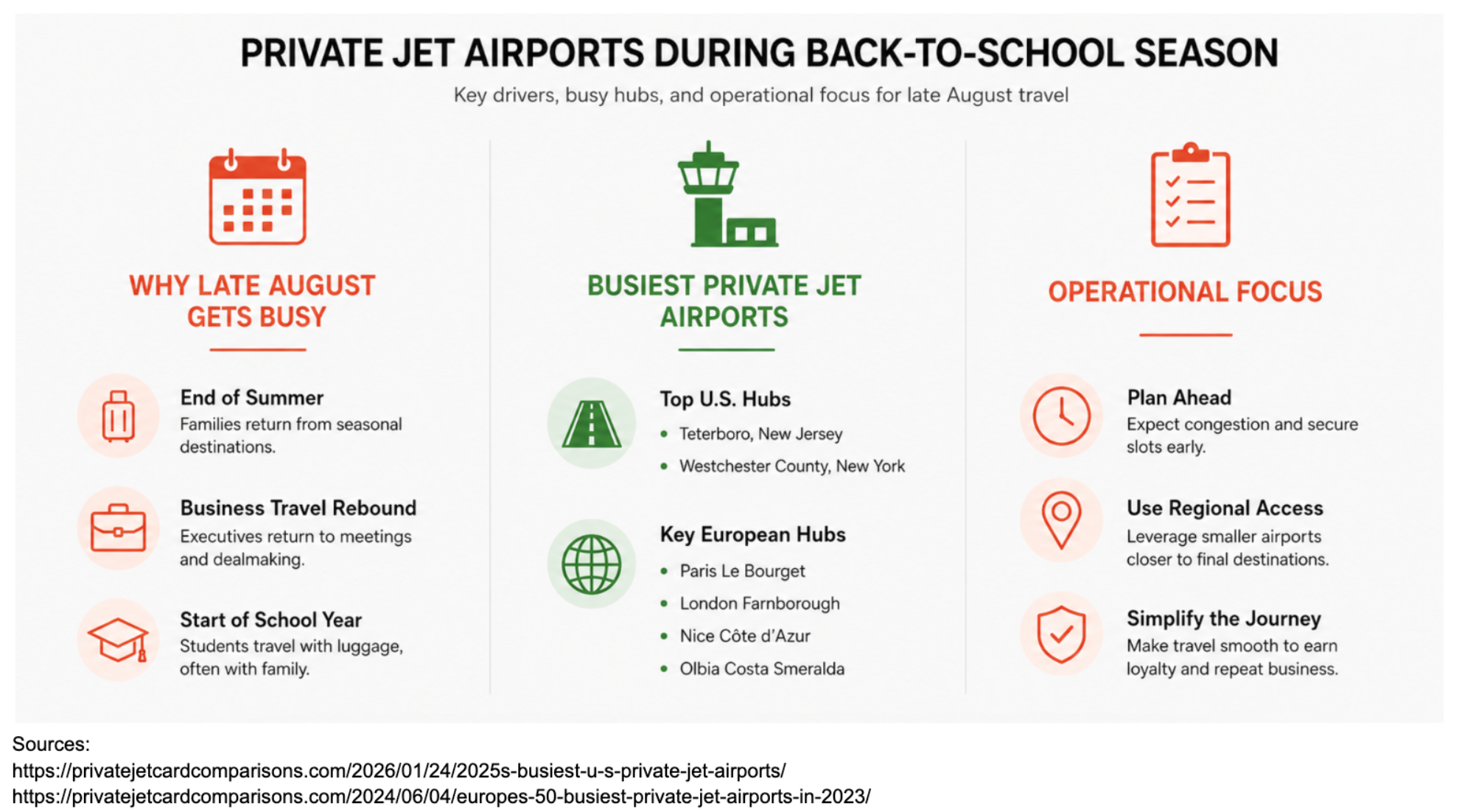
The late-august surge might seem counterintuitive given that the heat of summer has died down and the holiday season hasn’t started yet, but there are three primary factors that fuel the rise in private jet usage.
1. The End of Summer
The end of August is the mandatory hard stop for summer leisure travel. This means that families spending their summer in second-home destinations (Aspen, Nantucket, Martha’s Vineyard, the Hamptons, or in Europe) are returning to their main residence in big cities en masse.
2. The Start of Business Travel Season
June, July, and parts of August tend to be slower for private business flying. But this doesn’t mean that private flight operators are left in the dust, planes grounded, and crew unemployed. It just means that the demand is headed elsewhere.
Digital marketplaces see a surge in charter requests from families and holidaymakers heading to summer destinations, making mid-summer one of the busiest times of the year for private jet activity.
Come late August/early September, the demand shifts back to business travel as C-suite executives and business owners hurry back into meetings and talks about mergers and acquisitions.
3. The Start of the School Year
The back-to-school season means that many students will head to school. When flyers have a lot of luggage to carry around (typical for the beginning of a new school year), they may not want to navigate airport crowds in addition to trying to find their way to their dorm or accommodation from a major air hub.
As a result, many students coming from wealthy families will take the private aviation route. Some may even be accompanied by family members who want to usher them into the new year.
One major advantage operators can market to potential flyers (besides the added comfort and increased luggage allowance) is that a private aircraft can land directly at small regional fields. For instance, for a flyer going to Ohio University, operators can take flyers to the Gordon K. Bush Ohio University Airport (KUNI), located about 10–12 miles southwest of the main campus.
As a general rule, the private jet airports that tend to get busy when there’s a spike in air traffic (like during holidays or at the start of summer) will also be crowded when the new school year starts. However, the ones located (and serving) one or more major universities will be the most troublesome.
Teterboro, KTEB, NJ
Consistently ranked as one of the busiest private jet airports in the U.S. and the world, KTEB is the primary private aviation hub for the New York tri-state area. As such, it serves as the primary hub for families returning from summer estates or moving students into Ivy League and Northeast universities.
Dallas Love Field, KDAL, Dallas, TX Handling over 77,000 annual operations, Dallas Love Field ranks as the second-busiest business aviation hub in the United States. Its central geographic location and dedicated private terminals make it a vital crossroads for corporate and regional charter flights.
Besides the annoyance of finding a convenient slot and strict landing and parking mandates, the busy season also brings higher prices. When planning for vacation, it’s always good practice to plan for the return as well. The back-to-school season is chaotic, and this extends to private air travel.
This story was produced by Jettly and reviewed and distributed by Stacker.
Share this post:
Roz C
Sep 4, 2026
|
5
min read
Discover tips and trends in the industry.
5
min read
When Was Smoking on Airplanes Banned? A Timeline for Commercial and Private Flights
Smoking on U.S. airplanes was gradually banned, starting with domestic flights under two hours in 1988 and culminating in a complete federal ban on June 4, 2000. This movement was driven by health and safety concerns, particularly regarding secondhand smoke and fire risks, despite resistance from the tobacco industry. By the early 2000s, most commercial airlines worldwide had adopted similar smoking bans, leading to a universal expectation of smoke-free flights. Today, smoking and vaping are prohibited on nearly all commercial and private flights, reflecting a commitment to passenger safety and comfort.
Read More
5
min read
Cruise Speed of Aircraft: How Fast Airplanes Really Fly and Why It Matters for Private Jet Charter
The cruise speed of an aircraft is a critical factor in private jet charter, representing a balance between speed, fuel efficiency, and passenger comfort rather than the maximum speed the aircraft can achieve. Typical cruise speeds vary by aircraft type, with commercial airliners cruising at Mach 0.78–0.85 and private jets ranging from Mach 0.76 to Mach 0.90. Understanding cruise speed helps travelers avoid overpaying for unnecessary speed and select the right aircraft for their specific route and budget. Platforms like Jettly facilitate this process by allowing users to compare aircraft based on cruise speed, range, and cost, ensuring optimal travel efficiency.
Read MoreStay updated with our latest insights and tips to elevate your journey with us.
MEMBERSHIPS AND ASSOCIATIONS



Disclaimer: Jettly operates as a charter broker, offering access to a global digital jet charter marketplace. Jettly is not a direct air carrier and does not own or operate aircraft. All advertised flights are conducted by third-party air carriers that are fully licensed and hold the appropriate Part 135 or Part 121 certifications issued by the Federal Aviation Administration (FAA) or equivalent regulatory authorities under U.S. or foreign law. Jettly complies fully with the U.S. Department of Transportation's Part 295 and Part 298 Charter Broker regulations. Jettly does not carry additional liability insurance. Passengers are covered by aircraft operator insurance. TICO: 50023770


