


Login
Get Instant Pricing On 23,000+ Aircraft

>
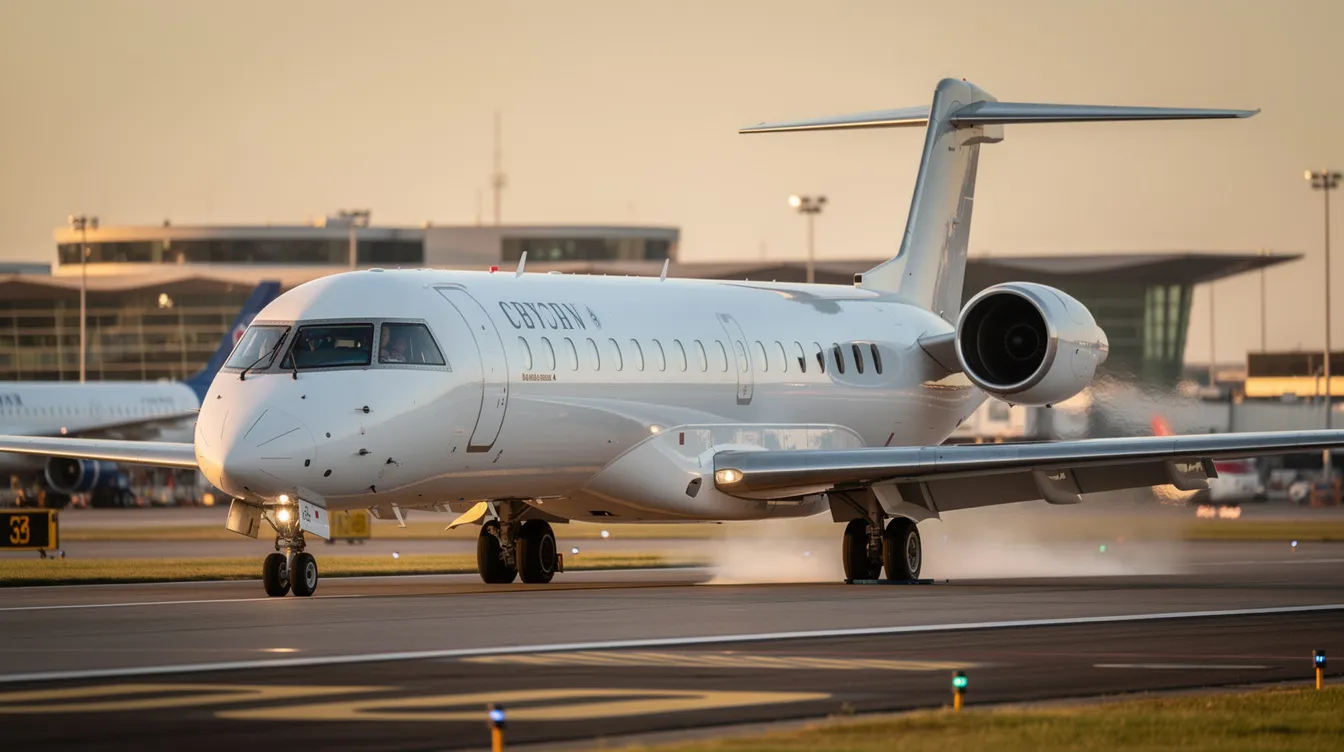
The Bombardier CRJ 900 is a regional jet that has quietly become one of the most important aircraft in short-haul aviation. Since its first flight in 2001, this plane has connected thousands of city pairs across North America and Europe, filling the gap between smaller regional jets and full-size narrow-body airliners. For travelers and organizations looking to move groups of 60 to 90 people efficiently, the CRJ 900 also serves as a practical charter option through platforms like Jettly.
This guide is intended for travelers, aviation enthusiasts, and organizations considering group charter options.
This guide covers everything worth knowing about the aircraft: its development history, technical specifications, cabin layout, airline operations, and how it fits into private charter for corporate teams, sports organizations, and large travel groups. Understanding the CRJ 900's capabilities helps travelers and organizations make informed decisions about efficient group travel and charter options.
|
Feature |
Details |
|---|---|
|
Aircraft Type |
The Bombardier CRJ 900 is a stretched regional jet in the Bombardier CRJ family, designed for short-to-medium-haul operations. Its first flight occurred on February 21, 2001, and it entered airline service in 2003. The aircraft remains widely used across North America and Europe in 2025–2026. (A regional jet is a small to mid-sized airliner designed for short-to-medium-haul flights, typically seating fewer than 100 passengers.) |
|
Cruise Speed |
The CRJ 900 cruises at approximately Mach 0.78–0.82, which translates to roughly 830–870 km/h depending on conditions and configuration. Its max operating speed sits at Mach 0.82. |
|
Passenger Capacity & Range |
Typical seating ranges from 76 to 90 passengers, depending on layout. Range sits around 1,784 miles (~2,870 km) for standard variants, with LR versions extending that figure further. |
|
Engines |
The aircraft is powered by two General Electric CF34-8C5 turbofan engines, each producing approximately 62–64 kN of thrust. Engine chevrons reduce noise, supporting quieter operations at airports. |
|
Charter Availability |
Jettly can arrange CRJ 900 charter for large groups, corporate shuttles, or sports teams, with instant pricing and on-demand access through its digital platform. |
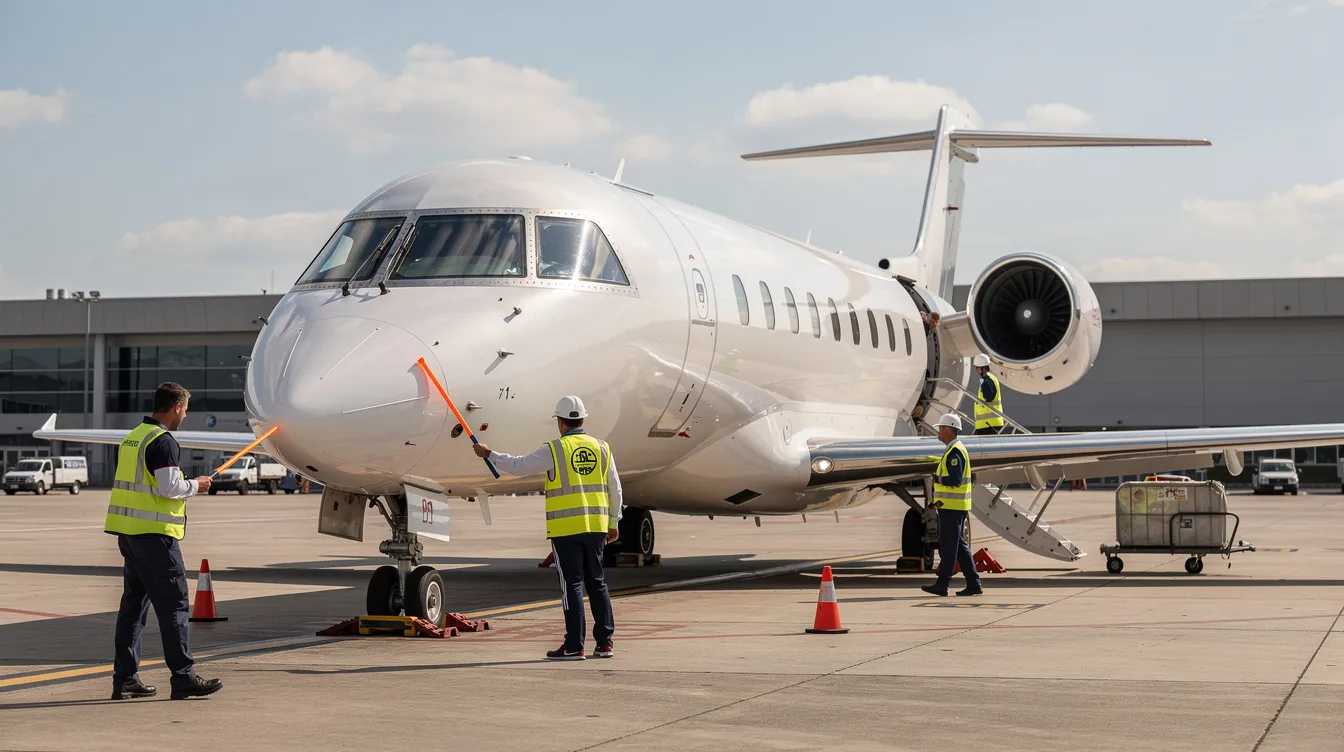
The CRJ 900 is a mid-to-large regional jet in the Bombardier CRJ (Canadair Regional Jet) series. (A regional jet is a small to mid-sized airliner designed for short-to-medium-haul flights, typically seating fewer than 100 passengers.) It sits between smaller CRJ series aircraft like the Canadair CRJ-200 and CRJ-700 and larger narrow-body planes such as the Boeing 737 or Airbus A320. The aircraft is smaller than mainline narrow-body jets like the Boeing 737, making it well-suited for routes that don't need full-size equipment.
The aircraft is commonly referred to as the Bombardier CRJ-900, though several sub-variants exist: the standard CRJ 900, the CRJ 900ER (Extended Range), the CRJ 900LR (Long Range), and later models featuring the refreshed "Atmosphere" cabin. Each variant shares the same fundamental airframe but differs in fuel capacity, max takeoff weight, or interior finish.
Airlines typically deploy the CRJ 900 on regional routes of one to three hours, linking secondary cities to major hubs. (Hub-and-spoke operations refer to a system where flights from smaller airports (spokes) are routed through a central airport (hub) to connect to other destinations.) Carriers like Delta Connection, American Eagle, and Lufthansa CityLine use the type to feed passengers into their hub airports. The aircraft is designed for efficient short-to-medium-haul operations, offering improved economics compared to smaller CRJ models while keeping operating costs well below those of mainline jets.
Although primarily an airline workhorse across the world, the CRJ 900 can be configured for high-density economy cabins, two-class layouts, or even semi-private shuttle-style interiors. For private charter, Jettly lists the CRJ 900 and similar regional jets for group charter, sports teams, corporate roadshows, and incentive travel.
The CRJ 900 was developed as a stretched derivative of the CRJ-700, continuing the company's regional jet evolution that began with the CRJ-100 in the early 1990s. Bombardier announced the program in 1999 with the goal of offering airlines more seats while retaining the operational flexibility and cockpit commonality of the existing CRJ family. Because both types share a common type rating, airlines can train pilots on the CRJ-700 and transition them to the CRJ 900 with minimal additional training.
The CRJ 900 first flew on February 21, 2001, from Bombardier's Montreal-Mirabel facility. Production began that year, and the aircraft received certification shortly after. The first delivery was in February 2003 to Mesa Airlines. A total of 487 CRJ 900 aircraft orders were placed over the production run, manufactured at Bombardier's Canadian facilities until the program's end.
Key design changes from the CRJ-700 included two fuselage plugs—one forward and one aft of the wing—to stretch the overall length. Engineers strengthened the structure, revised the landing gear to handle higher weights, and increased baggage hold volume. Wings received improved leading-edge devices and winglets around 2005 for better low-speed handling and fuel efficiency.
Over the years, Bombardier introduced extended-range variants (ER and LR) with higher max takeoff weights and additional fuel capacity. Later "NextGen" models, starting around 2007, delivered approximately 5–6% better fuel burn, larger passenger windows, and LED cabin lighting. ("NextGen" refers to Bombardier's upgraded CRJ models featuring improved fuel efficiency, larger windows, and enhanced cabin amenities.) By April 2019, Bombardier agreed to sell the CRJ program to Mitsubishi Heavy Industries (MHI RJ). Production ended in December 2020, but hundreds of CRJ 900 aircraft continue to fly worldwide, expected to remain active well into the late 2020s and beyond.
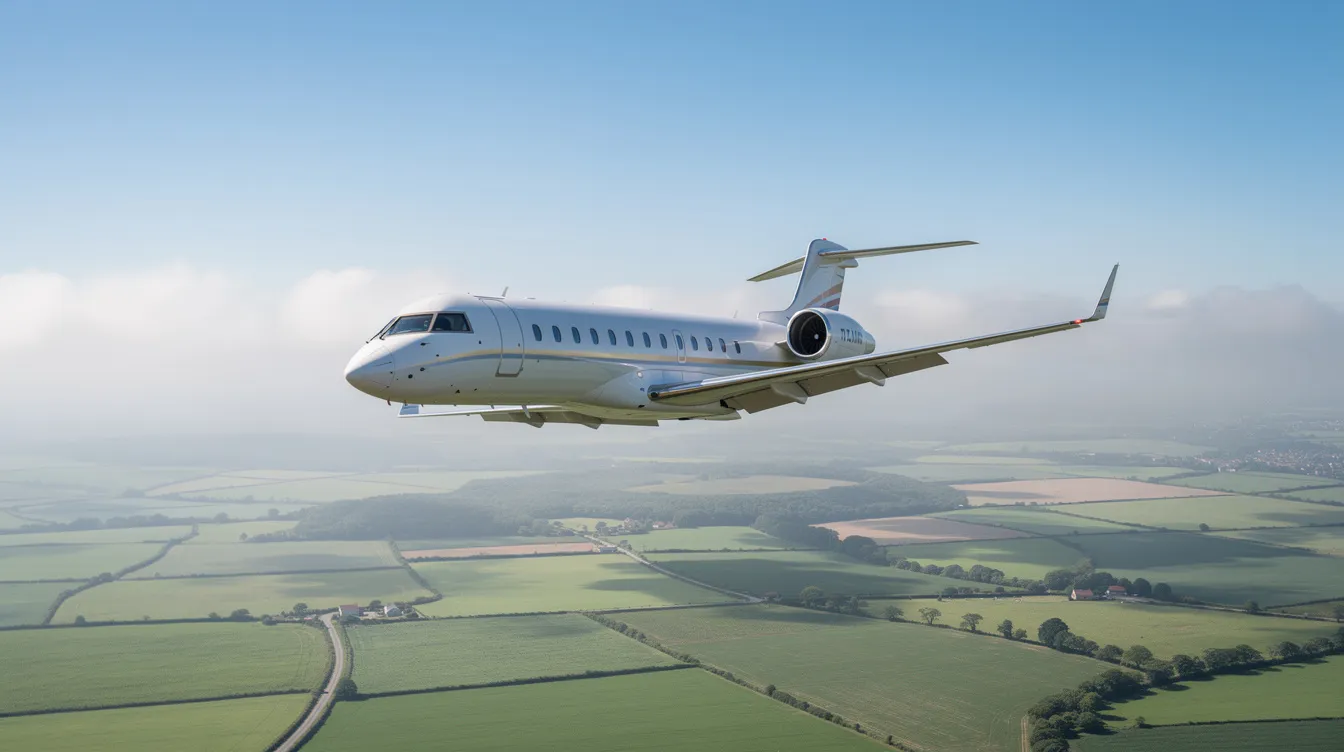
Below is a summary of key specifications for the Bombardier CRJ 900. These figures represent typical values and may vary slightly by sub-variant and operating conditions.
The aircraft is powered by two General Electric CF34-8C5 (or CF34-8C5A1) turbofan engines. Each produces roughly 62–64 kN (approximately 13,360–14,510 lbf) of thrust. Engine chevrons reduce noise, supporting compliance with airport restrictions.
|
Parameter |
Value |
|---|---|
|
Normal cruise speed |
Mach 0.78–0.80 (~830–855 km/h) |
|
Max operating speed |
Mach 0.82 (~870 km/h) |
|
Typical cruising altitude |
~31,000 ft |
|
Service ceiling |
41,000 ft (FL410) |
The CRJ 900 typically cruises around 31,000 ft but can climb to FL410 when conditions allow.
|
Variant |
Approximate Range |
|---|---|
|
Standard CRJ 900 |
~1,350 nmi (~2,500 km / ~1,784 miles) |
|
CRJ 900ER |
~1,593 nmi (~2,950 km) |
|
CRJ 900LR |
~1,828 nmi (~3,385 km) |
Max takeoff weight is around 38 metric tonnes (~84,500 lb), with minor differences by sub-variant. Fuel capacity is approximately 8,888 kg (~19,595 lb).
Wingspan is approximately 24.85 meters, length about 36.4 meters, and height roughly 7.5 meters. Takeoff field length at max takeoff weight is approximately 6,360 ft (~1,940 m), while landing distance at max landing weight is around 5,320–5,400 ft (~1,620–1,630 m).
The aircraft features a Rockwell Collins Pro Line 4 six-tube EFIS (Electronic Flight Instrument System), including a head-up display and guidance system for enhanced situational awareness during approach and landing in low-visibility conditions.
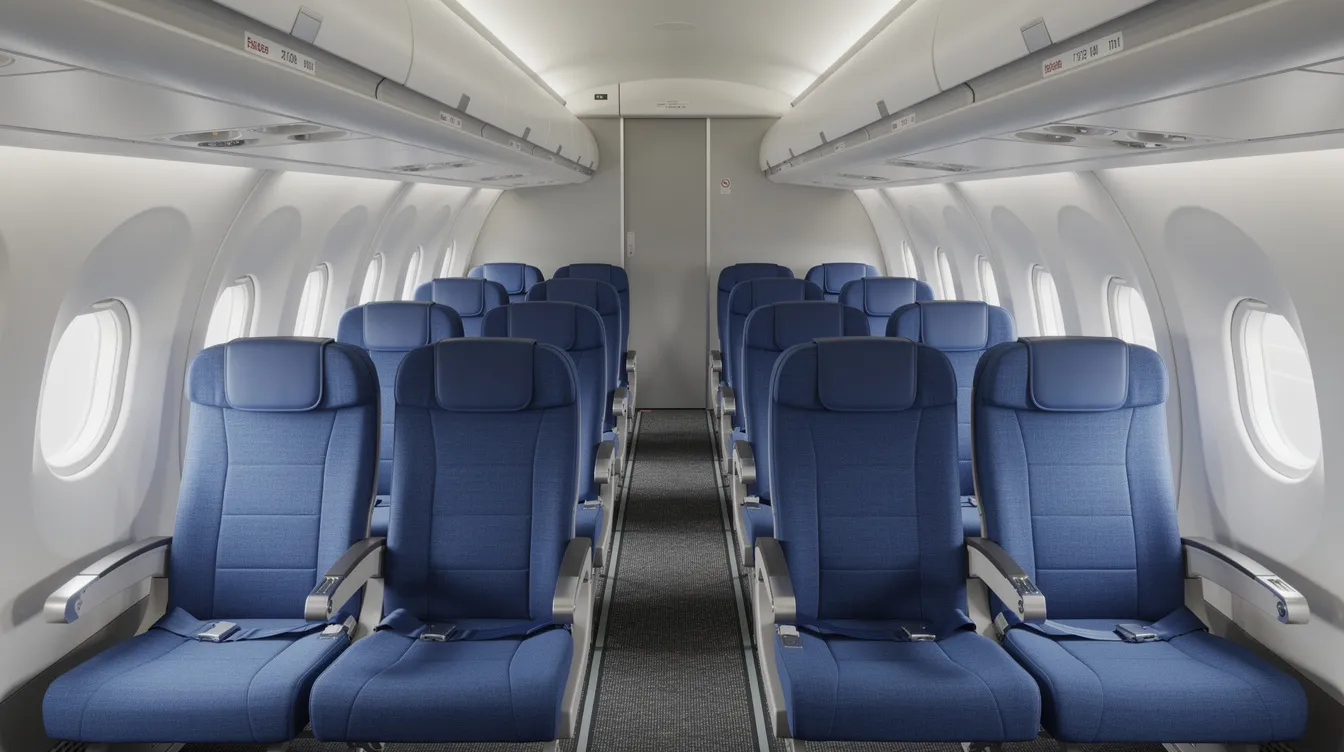
The CRJ 900 seats 76–90 passengers, depending on layout. Airline configurations range from all-economy (90 seats) to two-class (approximately 76 seats with first or business class up front).
The CRJ 900 cabin balances regional efficiency with modern comfort. Passenger experience varies by operator and aircraft interior.
The CRJ 900 features a 2-2 seating configuration with two seats on each side of a single aisle. Some carriers offer premium sections with a 1-2 layout for more personal space. Economy seat width typically measures 17–18 inches, competitive with other regional jets but narrower than mainline aircraft. Passengers often note smaller seats and limited overhead storage on older interiors.
"Atmosphere" cabin or NextGen interior upgrades include:
Larger overhead bins accommodating standard carry-on bags
Improved LED lighting with adjustable color temperature
Redesigned sidewalls and window reveals
Quieter cabin acoustics through improved insulation
Cabin height is approximately 6 ft 2 in (~1.89 m), width about 8 ft 4 in (~2.55 m), allowing comfortable aisle movement.
Amenities vary by operator and may include Wi-Fi, in-seat power or USB ports, and streaming or seatback entertainment. For private charter via Jettly, tailored catering, branded headrests, or customized seating layouts are possible, with services such as Jettly Eats in-flight catering supporting fully customized menus. Groups chartering the entire aircraft can block middle rows for extra legroom or create dedicated team sections with gear storage.
The Bombardier CRJ 900 is a staple of regional fleets in North America and Europe, operating thousands of flights weekly with stage lengths of roughly 300 to 1,000 nautical miles.
Key operators include Air Canada Express and Delta (via Endeavor Air and SkyWest Airlines). American Eagle also flies the type extensively. In Europe, several regional carriers operate the CRJ 900 on intra-regional services. It is heavily used in hub-and-spoke operations, feeding passengers from smaller markets into major hubs where larger narrow-body aircraft such as the Boeing 737-800 take over longer sectors.
Examples illustrating the CRJ 900’s range and efficiency:
Atlanta to Midwestern cities (e.g., Indianapolis, Louisville) – 400–500 nmi, a region where dedicated private jet charter services in Atlanta are also widely used
Dallas to regional business centers (e.g., Tulsa, Little Rock) – 200–350 nmi
Frankfurt to smaller German or neighboring European airports – 200–400 nmi, similar in stage length to many routes served by private jet charter in Kolkata, West Bengal
The CRJ 900’s field performance allows operations from shorter runways than larger jets, granting access to secondary airports often closer to city centers or industrial zones. This reduces ground transfer times, a significant advantage for charter clients.
Jettly can arrange CRJ 900 charters for consistent shuttle services—such as weekly Toronto–Chicago or New York–Montreal corporate runs—on schedules tailored to clients rather than published airline timetables, and tools like its airport locator help identify suitable secondary fields near your destinations. Crew transport charters for remote site access offer similar flexibility.
The CRJ 900 offers a practical middle ground for charter: more capacity than super-midsize business jets and lower operating costs than full-size airliners. For groups of 60 to 90 passengers, it offers an unmatched balance within the broader charter airline and private aviation landscape.
Professional sports teams are moving 70+ players, coaches, and staff with equipment
Music and entertainment tours requiring multi-city itineraries and gear storage
Corporate roadshows with executive teams visiting multiple sites in days
Incentive travel groups reward top-performing employees
Large family events or wedding parties traveling together
Jettly’s digital platform displays available CRJ 900 or other private charter aircraft with instant pricing and on-demand booking. Customers can search one-way, round-trip, or multi-leg itineraries and receive quotes quickly, avoiding traditional broker delays.
Compared to buying scheduled tickets, chartering a CRJ 900 through Jettly simplifies logistics with a single check-in, synchronized arrivals, custom schedules, and no missed connections. Time savings on layovers and ground transfers can be significant.
Clients enjoy flexibility:
Departure times chosen by the group
Airport selection prioritizing secondary airports to reduce ground travel
Ground transportation coordinated via Jettly’s network
Catering tailored to preferences and dietary needs
Interior configurations from standard economy to customized layouts
Explore CRJ 900 charter availability and Jettly’s private jet options at jettly.com.

When evaluating group travel, the CRJ 900 compares as follows, particularly against options highlighted in broader guides to top private jet charter companies:
|
Feature |
CRJ 900 |
CRJ-700 / Embraer E170 |
|---|---|---|
|
Passenger Capacity |
76–90 |
66–78 (CRJ-700), 70–78 (E170) |
|
Cruise Speed |
~830+ km/h |
~830+ km/h |
|
Operating Costs |
Higher overall, better per seat |
Lower overall, higher per seat |
|
Best For |
Groups over 70 |
Smaller groups |
|
Feature |
CRJ 900 |
Embraer E175-E2 / Airbus A220-100 |
|---|---|---|
|
Fuel Efficiency |
Good, but not the latest generation |
Superior, latest technology |
|
Cabin Width |
Standard for regional jets |
Wider, more spacious |
|
Interior |
NextGen/Atmosphere upgrades |
Modern, advanced |
|
Charter Availability |
Widespread |
Less common |
|
Factor |
CRJ 900 Charter |
Large Cabin Business Jet |
|---|---|---|
|
Passenger Capacity |
76–90 |
10–19 |
|
Per-Person Cost |
Lower for large groups |
Significantly higher |
|
Individual Space |
Limited (economy-style) |
Generous (club/lie-flat) |
|
Range |
~1,784 miles (standard) |
Often 3,000+ miles |
|
Best For |
Cost-effective group movement |
Ultra-personal luxury |
The CRJ 900 prioritizes affordable group travel on custom schedules rather than ultra-luxury or ultra-long range.
Ideal for groups of 60–90 passengers on one to three-hour routes, especially when schedule control and airport choice outweigh lie-flat seats or long-range capability. Jettly’s private jet charter cost estimator helps compare options with transparent pricing.
Booking a CRJ 900 charter through Jettly involves:
Entering trip details (route, dates, airports, passenger count)
Filtering by aircraft type or searching specifically for the CRJ 900
Reviewing instant pricing for one-way, round-trip, or multi-leg trips
Confirming extras like catering and ground transport
Booking, with Jettly managing operator coordination and logistics
Final costs depend on:
Flight distance and duration
Positioning the legs if the aircraft must reposition
Airport fees and navigation charges
Onboard services (catering, Wi-Fi, entertainment)
Crew costs and overnight stays for multi-day trips
Trip type (one-way, round-trip, multi-city)
Industry estimates place CRJ 900 charter rates at approximately USD $15,000–$20,000 per flight hour for one-way trips, with round-trip rates often $12,000–$17,000 per hour, though broader guides to affordable private jet charter pricing can help contextualize these figures.
For 70–90 passengers, a CRJ 900 charter compares favorably with flexible business-class airline tickets when factoring in time saved, fewer layovers, and reduced hotel stays. Regular charterers can explore Jettly's private jet membership options, offering transparent pricing without long-term commitments.
For cheap private jet charter prices and group travel quotes, or to consider shared private jet flights and empty-seat options, and whether shared charters or full charters fit your trip best, request a tailored quote at jettly.com.
The CRJ 900 typically cruises at Mach 0.78–0.80 (~830–855 km/h). Its maximum operating speed is Mach 0.82 (~870 km/h), though operators cruise slightly below for fuel efficiency. Actual ground speed varies with wind and routing.
All share the same airframe, cockpit, and engines. ER and LR versions have higher max takeoff weights and more fuel capacity, enabling longer routes. From a passenger's view, cabins are similar. LR variants handle legs up to ~1,828 nmi (~3,385 km).
Most CRJ 900s have airline-style seating, but some have been converted into VIP or corporate shuttles. VIP conversions by companies like MHI RJ can include club seating, conference tables, divans, and reduced seat counts (as few as 13–16 passengers) for more space. Jettly can assist with both standard and VIP charter options, including structured jet card programs for frequent flyers who value predictable hourly rates.
Designed for regional operations, the CRJ 900 can use many medium and smaller commercial airports. It typically requires less runway than Boeing 737 or Airbus A320 jets—about 6,360 ft for takeoff and 5,300 ft for landing under standard conditions. Airport eligibility depends on runway length, elevation, temperature, and performance rules. Jettly’s partners can advise on suitable airports to minimize ground transfers.
The CRJ 900 is optimized for routes up to about 1,500 nautical miles (~2,800–3,000 km). It is not built for intercontinental or very long transcontinental flights. For longer legs, Jettly recommends larger long-range business jets or narrow-body airliners, potentially evaluated using its jet card flight cost estimator. For multi-leg tours within a continent, the CRJ 900 remains an excellent choice when flights are planned as shorter sectors.
Ready to move your group on your own schedule? Explore CRJ 900 charter options, compare aircraft, or request a tailored quote at jettly.com, or review a detailed guide on how to buy a seat on a private jet if you’re comparing shared and individual-seat options.
The Bombardier CRJ 900 remains a versatile and efficient choice for regional travel and group charters. Its balance of passenger capacity, range, and operational flexibility makes it ideal for organizations, sports teams, and corporate groups seeking cost-effective and convenient air travel. Through platforms like Jettly, travelers can easily learn about and book CRJ 900 charters with transparent pricing and tailored services, ensuring a seamless private aviation experience.
Ready to experience private travel on your terms? Explore CRJ 900 flight options or request a personalized quote at https://jettly.com/.
Share this post:
Jay Franco Serevilla
Jun 25, 2026
|
5
min read
Discover tips and trends in the industry.
5
min read
Gulfstream G100 Guide: Charter Costs, Performance & Use Cases
The Gulfstream G100 is a versatile midsize business jet known for its speed, range, and cost-effectiveness. With a maximum range of 2,790 nautical miles and seating for up to 8 passengers, it is ideal for both business and leisure travel. This guide provides insights into its performance, charter costs, and how to book through Jettly's platform.
Read More
5
min read
Gulfstream GV Range: Ultra Long Range Performance, Cabin Dimensions, and Charter Options
The Gulfstream GV is a pioneering ultra-long-range business jet, offering a maximum range of approximately 6,500 nautical miles. With its spacious cabin designed for comfort and productivity, it accommodates up to 18 passengers and is ideal for intercontinental flights. Charter options through Jettly provide flexible access without the costs of ownership.
Read MoreStay updated with our latest insights and tips to elevate your journey with us.
MEMBERSHIPS AND ASSOCIATIONS



Disclaimer: Jettly operates as a charter broker, offering access to a global digital jet charter marketplace. Jettly is not a direct air carrier and does not own or operate aircraft. All advertised flights are conducted by third-party air carriers that are fully licensed and hold the appropriate Part 135 or Part 121 certifications issued by the Federal Aviation Administration (FAA) or equivalent regulatory authorities under U.S. or foreign law. Jettly complies fully with the U.S. Department of Transportation's Part 295 and Part 298 Charter Broker regulations. Jettly does not carry additional liability insurance. Passengers are covered by aircraft operator insurance. TICO: 50023770


