


Login
Get Instant Pricing On 23,000+ Aircraft

>
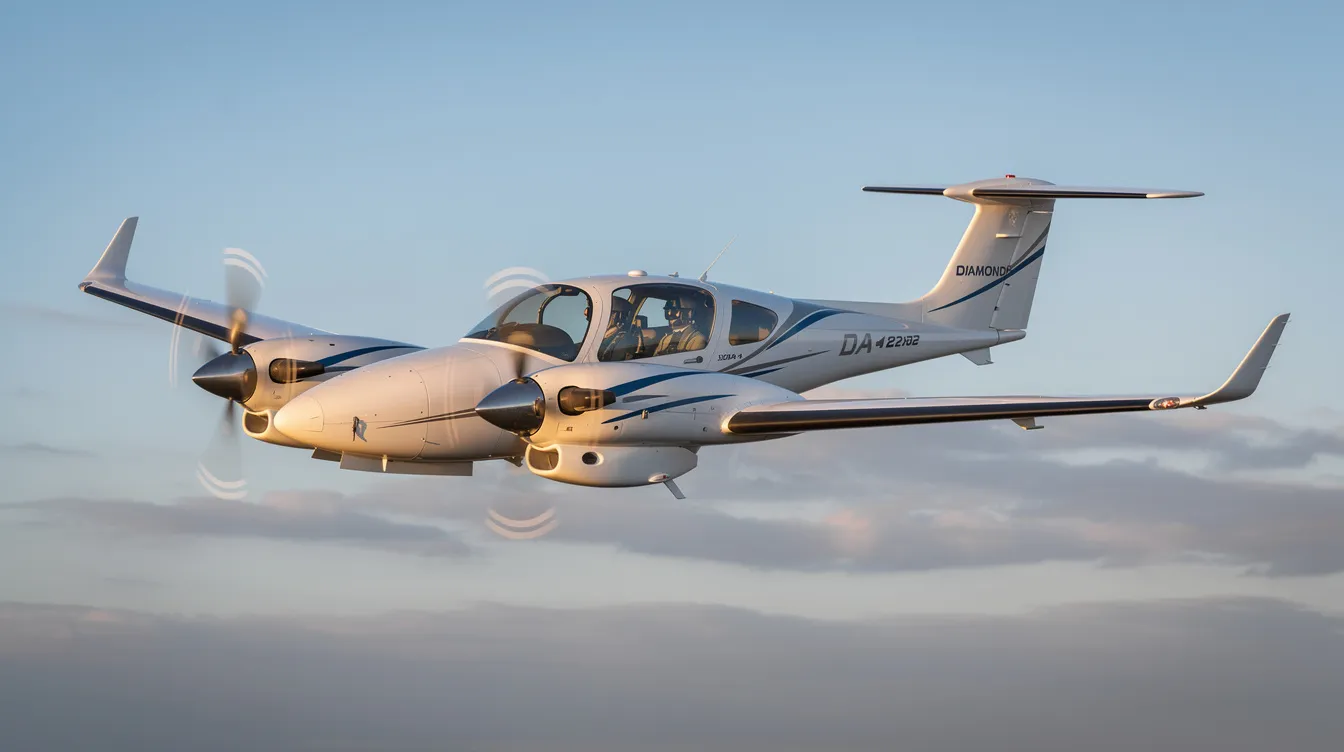
The Diamond Star DA42 is a modern four-seat twin-engine aircraft and one of general aviation’s most recognisable modern twins—a carbon composite airframe powered by turbo-diesel engines that sip jet fuel instead of leaded avgas. For student and professional pilots considering multi-engine training, aviation enthusiasts comparing general aviation aircraft, and travellers or charter customers curious about aeroplanes used in private and training aviation, it is a useful aircraft to understand because it combines efficient performance, strong safety features, and real-world use in training, surveillance, and light mission roles.
Whether you’re evaluating the step up from a single-engine trainer, researching an aircraft that sits between basic trainers and business jets, or simply want a clearer sense of what you may encounter in private aviation, this guide covers the DA42’s performance, safety systems, variants, design, powerplants, avionics, operating history, ownership considerations, and charter relevance.
The DA42 Twin Star is a four-seat twin-engine aircraft with a carbon composite airframe that cruises at over 180 knots and burns roughly 10.4 US gallons per hour of jet A fuel at 60% power.
Pilots, flight schools, and surveillance operators choose the Diamond DA42 for its low accident rate since 2011, Garmin G1000 NXi avionics, and the ability to maintain climb on a single engine.
Three main variants exist: the DA42 TDI (Thielert diesels, ~135 hp each), the DA42 NG (Austro Engine AE 300, ~168 hp, delivered from 2009), and the DA42-VI (aerodynamic refinements, up to 197 knots max speed).
Jettly customers may encounter the DA42 in training, light mission, or repositioning contexts. For broader private charter aircraft options-light jets, midsize, heavy, turboprops, and helicopters- travellers can explore instant pricing on the platform.
The Diamond Star DA42, officially the DA42 Twin Star, is a light twin-engine aircraft built by Diamond Aircraft Industries in Austria. Its first flight took place in December 2002, and it earned EASA certification for IFR operations in late 2004. Over 900 DA42 aircraft have been produced since then, serving as advanced trainers, private tourers, and special mission platforms that bridge the gap between single-engine pistons and larger turbine-powered aircraft.
Headline numbers worth noting:
|
Specification |
Value |
|---|---|
|
Cruise speed |
176–197 knots TAS |
|
Maximum range |
Up to 1,215 nautical miles |
|
Fuel consumption |
Approximately 10.4 US gal/h at 60% power |
|
Service ceiling |
18,000 ft |
|
Maximum takeoff weight |
3,935 pounds |
|
Useful load |
1,299 pounds |
|
Seating capacity |
4 persons |
|
Engines |
Austro AE 300 turbo-diesel (168 hp each) |
|
Avionics |
Garmin G1000 NXi |
The aircraft's all-carbon composite airframe, retractable tricycle landing gear, T-tail, and Garmin G1000 NXi glass cockpit form its core design pillars. It's frequently discussed in aero news network coverage for good reason: diesel and jet fuel engines, a strong safety record, and early adoption of FADEC and synthetic vision made it a standout from day one.
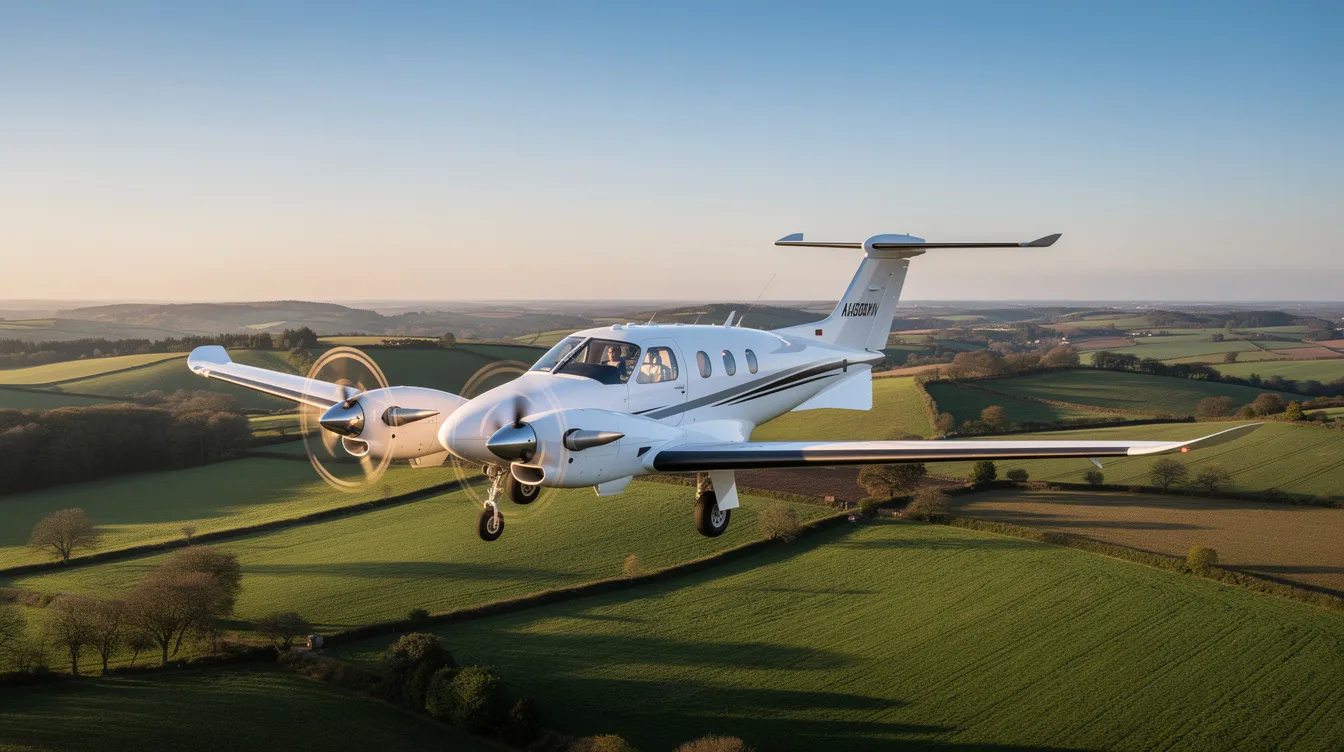
Diamond Aircraft built the DA42 around a composite design philosophy that was ahead of its time. The airframe of the Diamond DA42 is built using carbon fibre and glass fibre, making it one of the first twin-engine design platforms to use a full carbon composite airframe in series production. This composite construction enhances performance and reduces maintenance related to corrosion—a significant advantage over traditional aluminium airframes that are less easily maintained over decades.
The low-wing configuration, T-tail, and sleek aerodynamic profile contribute to lower drag, better fuel efficiency, and stable handling in turbulence. Structurally, the aircraft is designed for crashworthiness: an energy-absorbing fuselage, energy-absorbing seats, and integral aluminium fuel tanks placed between twin wing spars limit fuel leakage in hard landings. These passive safety features work quietly in the background.
The cabin accommodates four people in two rows of seating. Pilots and copilot sit up front with fighter-style central control sticks, while access to rear seats is through a large rear door. Generous nose compartments and a rear-fuselage baggage area accommodate luggage. The cockpit design offers excellent visibility through a large canopy and wrap-around windshield, which aids situational awareness during training and sightseeing alike.
Seats feature adjustable backrests and variable lumbar support, and the cabin includes luxurious hand-finished upholstery options. The interior is clean, modern, and functional—built for long flights rather than flash.
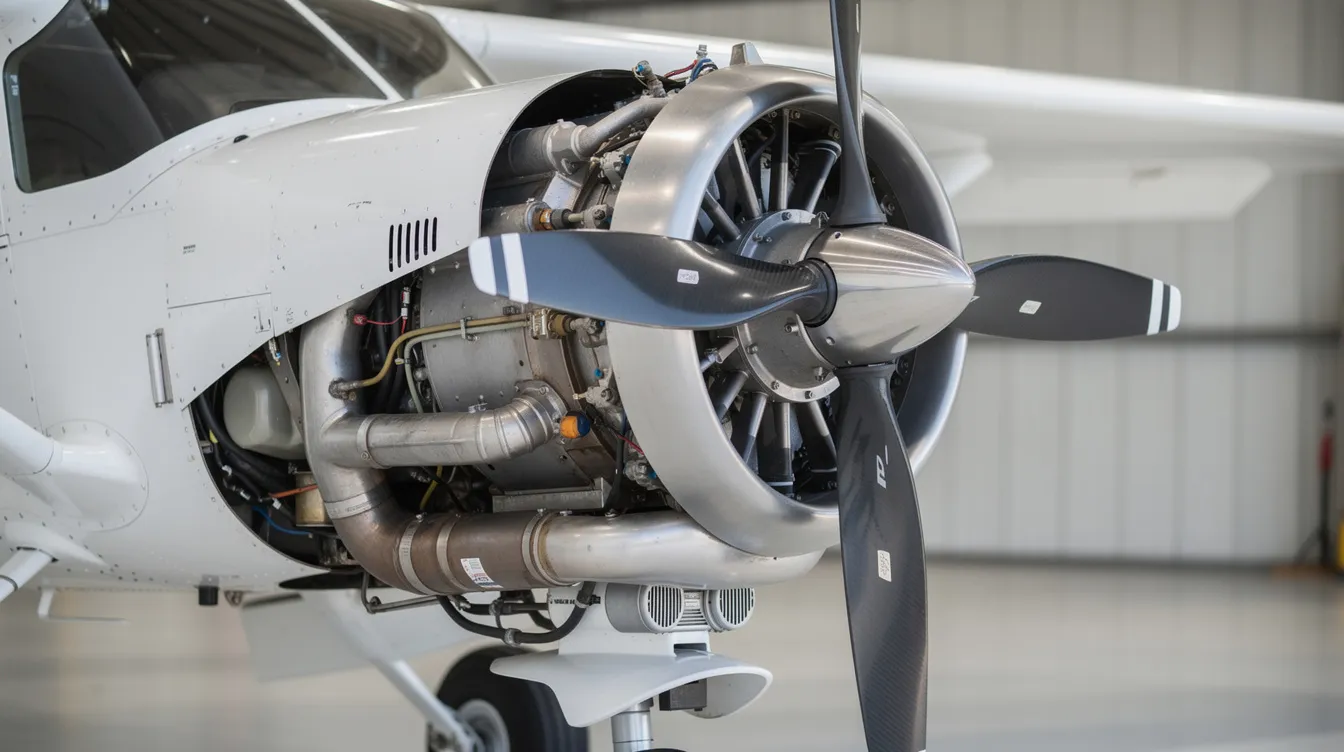
Early DA42s used Thielert TAE 125 diesel engines, but modern DA42 NG and DA42-VI models run the Austro Engine AE 300 turbocharged common rail injected 2.0 liter diesel engine. Each AE 300 turbocharged common rail injected powerplant produces around 168 hp (125 kW), derived partly from Mercedes-Benz automotive technology. The engine's digital engine control system—full authority digital engine controls (FADEC)—reduces pilot workload to a single lever for each engine, covering throttle, prop, and mixture in one automatically controlled input via a single switch interface.
Each engine drives a 3-blade constant-speed MT hydraulic propeller. These propellers feature advanced blade geometry optimised for efficient performance and low noise, which matters for training environments and communities under flight paths.
Compatible fuels include Jet A, Jet A-1, and JP-8. For operators in regions where 100LL avgas is scarce, expensive, or being phased out, this is a significant advantage. Compared to typical avgas piston engines, the common rail-injected 2.0-litre powerplant offers better specific fuel consumption, lower emissions, and competitive times between overhauls. The plane's aerodynamic efficiency contributes to its low fuel burn during flight, making the DA42 one of the most economical twins to operate.
Modern DA42 models come standard with the Garmin G1000 NXi avionics system, replacing analogue gauges with large primary flight and multifunction displays. The DA42 features a Garmin G1000 glass cockpit for user-friendly controls that consolidate navigation, engine monitoring, and situational awareness into one interface.
Key integrated systems include:
GPS navigation with moving map
Engine parameter monitoring
Traffic and terrain awareness (TAWS)
Optional integrated weather radar (e.g., GWX 70)
Garmin's synthetic vision technology for 3D terrain representation on the PFD
The GFC 700 autopilot reduces pilot workload during instrument flight, holding altitude, heading, and approach profiles accurately. This is critical for multi-engine training in busy airspace and during visual flight rules or IFR operations alike.
FADEC contributes directly to active safety features: automatic engine management, optimised fuel flow, and automated propeller feathering in case of engine failure. Stall conditions are warned by a warning horn at 5 to 7 knots above stall speed, and design characteristics providing turbulence righting stability make inadvertent stall conditions rare and recoveries predictable.
The DA42 features a proven TKS ice protection system on the DA42 VI variant, distributing TKS fluid over wings, tail, propellers, and windshield. The aircraft is certified for flight into known icing conditions with this TKS de-icing system. Combined with a low accident record since 2011 and a high degree of built-in redundancy, these systems give the DA42 one of the strongest safety profiles in general aviation.
From a pilot's perspective, the DA42 flies with responsive but forgiving handling. Central control sticks and relatively low control forces make it approachable for pilots transitioning from single-engine trainers, while its twin-engine design provides genuine redundancy.
The DA42 cruises at over 180 knots in typical configurations. Maximum speed reaches about 197 knots TAS for the DA42 VI at 16,000 ft. At ISA SL conditions, the climb rate reaches 1,550 feet per minute—strong for a piston twin. The aircraft can maintain a positive rate of climb on a single engine (roughly 270 ft/min at sea level), which is central to its reputation for providing excellent single-engine handling characteristics for flight training.
Range and endurance options:
60% power cruise: approximately 10.4 US gal/h, range up to 1,215 nautical miles with auxiliary tanks
75% power cruise at 16,000 ft: about 175 KTAS, with somewhat higher fuel burn but still economical compared to many twin-engine aircraft
Maximum takeoff weight of 3,935 pounds with a 1,299 lbs useful load
Stall speed in landing configuration sits in the low 60-knot range (approximately 62 knots CAS), and typical landing ground roll is near 1,100 ft. These numbers make the DA42 practical for shorter regional airports where speed (in km/h or knots) and short-field capability both matter.
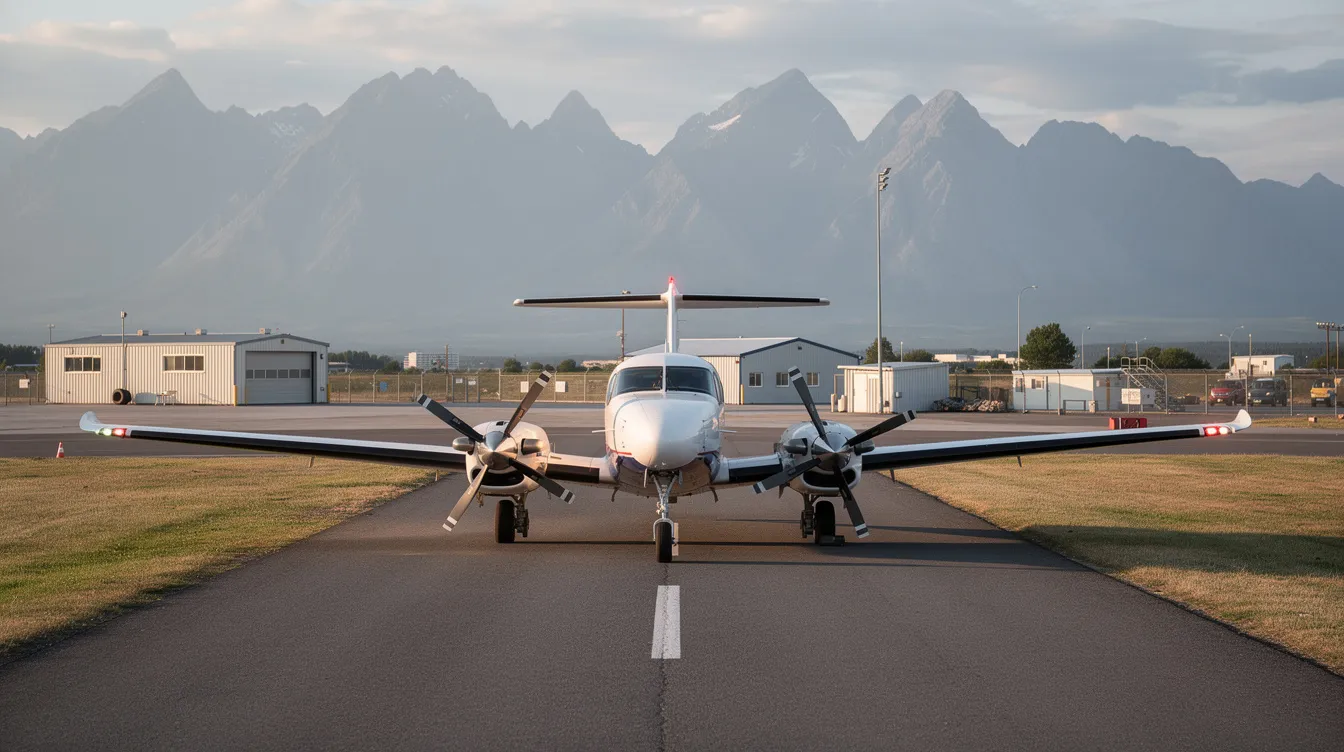
The DA42 family has evolved steadily since the original prototype's first twin-engine flight in 2002. DA42 models include the DA42 M, DA42 L360, and DA42 NG among others, each targeting different operational needs.
The DA42 TDI was powered by Thielert TAE 125-01 and later TAE 125-02-99 engines (~135 hp each). Widely adopted by flight schools, production was temporarily affected when the engine supplier entered insolvency in 2008.
The DA42 NG (Next Generation) arrived after EASA certification of the Austro Engine AE 300 in March 2009. The DA42 NG was delivered to customers starting in 2009, offering about 20% more power, roughly 46% better fuel efficiency, and meaningful improvements in climb and cruise performance.
The DA42 VI is the current premium iteration, unveiled around 2012. Aerodynamic refinements—smoother surfaces, drag-reduced cowls—push cruise speeds approaching 197 knots TAS. Improved climb rates, updated avionics options, and a lighter empty weight make it the most capable variant.
Mission-specific derivatives include the DA42 MPP (Multi Purpose Platform), adapted for surveillance and special missions due to its endurance and equipment capacity. Military and government trainer versions round out the lineup, showing how the DA42 platform perfectly suits diverse operational needs.
The DA42 entered a market where light piston twins were declining. Yet it quickly captured a dominant share—industry analyses in the late 2000s often cited Diamond as holding the majority of new piston twin deliveries.
A defining milestone: the DA42 Twin Star completed the first non-stop crossing of the North Atlantic by a diesel-powered fixed-wing aircraft, proving its range and reliability on long-distance flights.
Adoption by flight schools has been strong. Lufthansa Aviation Training operates roughly 14 DA42s, while Embry-Riddle Aeronautical University fields 31 airframes. The Diamond DA42 is popular for flight training due to its twin-engine safety features and lower operating costs. It provides a smooth transition from single-engine to multi-engine flying for training purposes, helping pilots build the skills needed to eventually fly turboprops and jets.
Government and special mission roles are growing too. DA42 MPP aircraft have supported border surveillance, maritime patrol, and intelligence operations. Meanwhile, Air India ordered DA42 NG aircraft for its Flying Training Organisation, with deliveries beginning in 2025—proof the platform remains current and in production.
The DA42 is not a typical private charter aircraft. It's a piston twin serving a different niche than the light, midsize, or heavy jets available through platforms like Jettly. Still, it plays an important role in the aviation ecosystem.
Compared to common single-engine trainers like the Cessna 172 or Diamond DA40, the DA42 represents a meaningful step up in systems complexity and performance, especially for pilots evaluating the best cross-country plane for longer trips. This step prepares pilots for turbine twins and business jets—the same aircraft types that carry Jettly's charter passengers.
The DA42 is widely used for both personal and business travel, especially in the DA42-VI configuration, as well as aerial survey, photography, and environmental monitoring. For owners focused on choosing the best personal plane for their needs, these are contexts where jet speed isn't essential but twin-engine redundancy and endurance are valued.
For travellers exploring private charter options, understanding aircraft like the DA42 builds appreciation for training standards and the technology pipeline feeding modern business aviation. Learn more about Jettly's charter options at jettly.com.
While many readers access private aircraft through charter, some pilots and operators consider owning a DA42 for training or light commercial operation, weighing it against other affordable planes and budget-friendly aircraft choices.
A new Diamond DA42 costs approximately $1,300,000 depending on year and avionics configuration, which fits into the broader landscape of how much a private jet or aircraft costs overall. Pre-owned prices vary significantly with airframe hours, engine time, and equipped avionics.
Main operating cost drivers include:
Fuel: efficient diesel burn of roughly 9–11 gallons per hour in cruise
Engine and propeller maintenance: Austro engines are designed to be easily maintained, but common-rail diesel overhauls carry specific costs
Insurance: underwriters typically require multi-engine rating, IFR experience, and minimum total hours in type, with premiums quoted as a percentage of hull value
Hangar and periodic avionics updates
All-in direct operating costs (excluding capital) run roughly $300–$350 per flight hour under moderate usage, a useful reference alongside broader private jet operating cost breakdowns and calculators.
For those who'd rather avoid capital expenditure, maintenance obligations, and insurance complexity, chartering through platforms like Jettly provides access to suitable aircraft classes without long-term commitments. Jettly's private jet charter cost estimator can help compare options quickly.
Below are answers to common questions not fully addressed above.
Most students start on simpler single-engine aircraft—like the Diamond DA40 or Cessna 172—before transitioning to the DA42 for multi-engine and advanced instrument training, typically after earning at least a private pilot license. Many compare these trainers with the cheapest private aircraft options across categories. Some integrated programs introduce it earlier, but it remains a step-up aircraft due to systems complexity. Pilots need to learn to avoid accidents through proper multi-engine procedures before handling a twin.
For a broader sense of the private aviation landscape, including major operators and service models, you can explore a comprehensive list of charter airlines and private flight options.
The DA42 is a piston-powered twin with cruise speeds around 180–197 knots and a four-seat cabin. Light jets commonly available on Jettly cruise at 400+ knots with stand-up cabins and larger seating capacities. Jettly focuses on jets, turboprops, and helicopters for passenger charter, while the DA42 fills training and special mission roles, whereas larger missions often rely on aircraft from the best private plane manufacturers across budgets and needs.
Yes. The DA42 is specifically designed to remain controllable with one engine inoperative, maintaining a positive climb rate at low altitudes under typical weight and weather conditions. FADEC and propeller auto-feathering improve handling during engine-out scenarios, and all multi-engine pilots receive dedicated training in these procedures.
Both use the Austro AE 300 engines, but the DA42 VI adds aerodynamic refinements, weight reductions, and updated systems that deliver higher cruise speed (approaching 197 knots), better climb performance, and improved fuel efficiency. The VI is positioned as the premium, most modern variant in the DA42 family.
Capacity is often the starting point, and guides on how many passengers different private jet types can carry help frame the decision alongside range and budget.
Consider distance, passenger count, baggage, runway length, and budget when deciding between turboprops, light jets, midsize, or heavy jets. For instant pricing, airport locator tools, and aircraft comparisons, explore flights or request a personalised quote at jettly.com.
Ready to experience private travel on your terms? Travellers with recurring needs might consider jet card programs with fixed hourly rates and added benefits alongside on-demand options. Explore flight options
The Diamond Star DA42 stands out as a versatile and efficient twin-engine aircraft, combining advanced technology, strong safety features, and economical performance. Its composite airframe, modern Austro AE 300 engines, and Garmin G1000 NXi avionics make it a preferred choice for flight training, surveillance, and light mission roles. While not a typical private charter aircraft, the DA42’s capabilities provide valuable insight into the progression from single-engine trainers to more complex multi-engine aircraft.
For travellers seeking private aviation options beyond training aircraft, platforms like Jettly offer instant access to a wide range of aircraft, including light jets, midsize jets, heavy jets, turboprops, and helicopters. Jettly’s transparent pricing, extensive global network, and digital booking tools make private jet charter simple and convenient.
Ready to experience private travel on your terms? Explore flight options or request a quote at https://jettly.com.
Share this post:
Jay Franco Serevilla
Jul 22, 2026
|
5
min read
Discover tips and trends in the industry.
5
min read
How Much Does a 25 Hour NetJets Card Cost in 2026?
In 2026, a 25-hour NetJets card for a light jet like the Phenom 300 starts at approximately $215,000, with total costs reaching between $247,000 and $262,000 after additional fees. This guide provides a comprehensive breakdown of costs, comparisons with fractional ownership, and insights into whether prepaying for flight hours is the best option for travelers. Understanding these details helps buyers make informed decisions about private aviation solutions.
Read More
5
min read
NetJets App: How It Compares to Modern Digital Private Aviation Platforms
The NetJets app offers fractional owners and jet card holders seamless access to a vast private aviation fleet, allowing for easy flight requests and trip management. However, alternatives like Jettly provide a more flexible, app-first experience without long-term commitments, catering to occasional travelers seeking instant pricing and diverse aircraft options. This article compares the features of both platforms to help travelers choose the best fit for their needs.
Read MoreStay updated with our latest insights and tips to elevate your journey with us.
MEMBERSHIPS AND ASSOCIATIONS



Disclaimer: Jettly operates as a charter broker, offering access to a global digital jet charter marketplace. Jettly is not a direct air carrier and does not own or operate aircraft. All advertised flights are conducted by third-party air carriers that are fully licensed and hold the appropriate Part 135 or Part 121 certifications issued by the Federal Aviation Administration (FAA) or equivalent regulatory authorities under U.S. or foreign law. Jettly complies fully with the U.S. Department of Transportation's Part 295 and Part 298 Charter Broker regulations. Jettly does not carry additional liability insurance. Passengers are covered by aircraft operator insurance. TICO: 50023770


