


Login
Get Instant Pricing On 23,000+ Aircraft

>

The Embraer ERJ 145 is one of the most widely produced regional jets in aviation history, and understanding its cabin configuration matters whether a traveler is boarding a commercial feeder flight or chartering the aircraft for a group trip. This guide breaks down every detail of the Embraer 145 seating capacity, from standard airline layouts to VIP private charter configurations, so readers can make informed decisions about comfort, baggage, and booking.
The Embraer ERJ 145 is a 50-seat Embraer regional jet designed for short to medium routes. It remains a popular choice for both scheduled commercial service and private charter missions. Here are the essentials:
The standard Embraer ERJ 145 seating capacity is 50 passengers arranged in a 2-1 configuration—two seats on the right side and one seat on the left—with a single aisle and no middle seat.
Typical seat pitch is about 31 inches and seat width is approximately 17 inches, providing functional comfort for regional flights under two hours.
Private charter operators often reconfigure the cabin to fewer seats—commonly 16 to 28 passengers in premium layouts, or 30 to 40 in business-style arrangements—for significantly more personal space.
Overhead bin space is limited, so larger carry-on bags are frequently gate-checked on commercial flights. Private charters allow groups to plan baggage handling in advance.
Jettly uses the ERJ 145 seating capacity to rightsize private charter missions, matching groups of roughly 25 to 50 travelers with an aircraft that balances cost efficiency and cabin comfort.
The Embraer ERJ 145 is a narrow-fuselage regional jet built by the Brazilian aerospace company Embraer. It was introduced in the mid-1990s to serve short and medium regional routes, carrying around 50 passengers in a single-class cabin.
The ERJ 145 belongs to the broader Embraer ERJ family, which also includes the smaller ERJ 135 and ERJ 140. Among these siblings, the ERJ 145 holds the largest seating capacity. Over 890 ERJ 145 aircraft were delivered by the mid-2000s, making it one of the most successful regional jets ever produced.
Key specifications relevant to this aircraft overview include:
|
Specification |
Value |
|---|---|
|
Typical seating capacity |
50 passengers |
|
Cabin height |
Approximately 6 feet |
|
Cabin length |
~16.5 metres (54 ft) |
|
Wing span |
~20.04 metres (65.7 ft) |
|
Maximum cruise speed |
Mach 0.78 |
|
Maximum range |
~1,550 nautical miles (LR variant) |
|
Service ceiling |
37,000 feet |
|
Engines |
Two Rolls-Royce AE 3007 turbofans |
|
Maximum takeoff weight |
36,375 pounds |
|
Rear fuselage-mounted engines |
Yes |
Embraer estimated the aircraft would fill a gap between turboprops and larger narrowbodies, and the market proved them right. American Airlines and other major airlines used the ERJ 145 heavily through the 2000s and 2010s as a feeder aircraft connecting hubs with multiple cities across the Americas.
In the 2020s, many of these aircraft have transitioned from scheduled airline service to private charter, corporate shuttle, and special-mission roles, giving the platform a second life in passenger transport and VIP operations.
The standard certified seating capacity of the ERJ 145 is 50 economy-class seats arranged in a single main cabin. The Embraer ERJ 145 typically features a single-class seating layout with no business or first-class section on commercial flights.
The cabin uses a 2-1 seating configuration: two seats on the right side of the aisle (labeled B and C) and one seat on the left (labeled A). This layout means there are no middle seats on the Embraer ERJ 145, giving every passenger either a window or an aisle seat. Its 2-1 seating configuration offers more personal space than competitors using 2-2 arrangements in similar-sized fuselages.
Standard dimensions that define the onboard experience:
Seat pitch: approximately 31 inches (78–79 cm)
Seat width: approximately 17 inches (43 cm)
Recline: modest, roughly 3 inches in most rows
Emergency exit rows, typically located around mid-cabin, can offer greater effective legroom without changing the official seat pitch. Exact row numbers vary by airline.
While 50 seats is the standard for commercial service, private charter operators sometimes reconfigure the cabin to fewer seats for more generous personal space. The Embraer ERJ 145 typically accommodates up to 60 seats depending on theoretical high-density configurations, though 50 remains the practical commercial standard worldwide.
The cabin zones on a typical ERJ 145 flow from front to back: flight deck (cockpit), a small forward galley or service position, a single main cabin holding all passenger seats, and a rear lavatory and service area.
Seats are numbered from row 1 at the front to approximately row 18 at the back. A seats sit alone on the left side, while B and C seats pair up on the right. For a detailed visual breakdown, see Jettly's Embraer RJ145 seating chart guide.
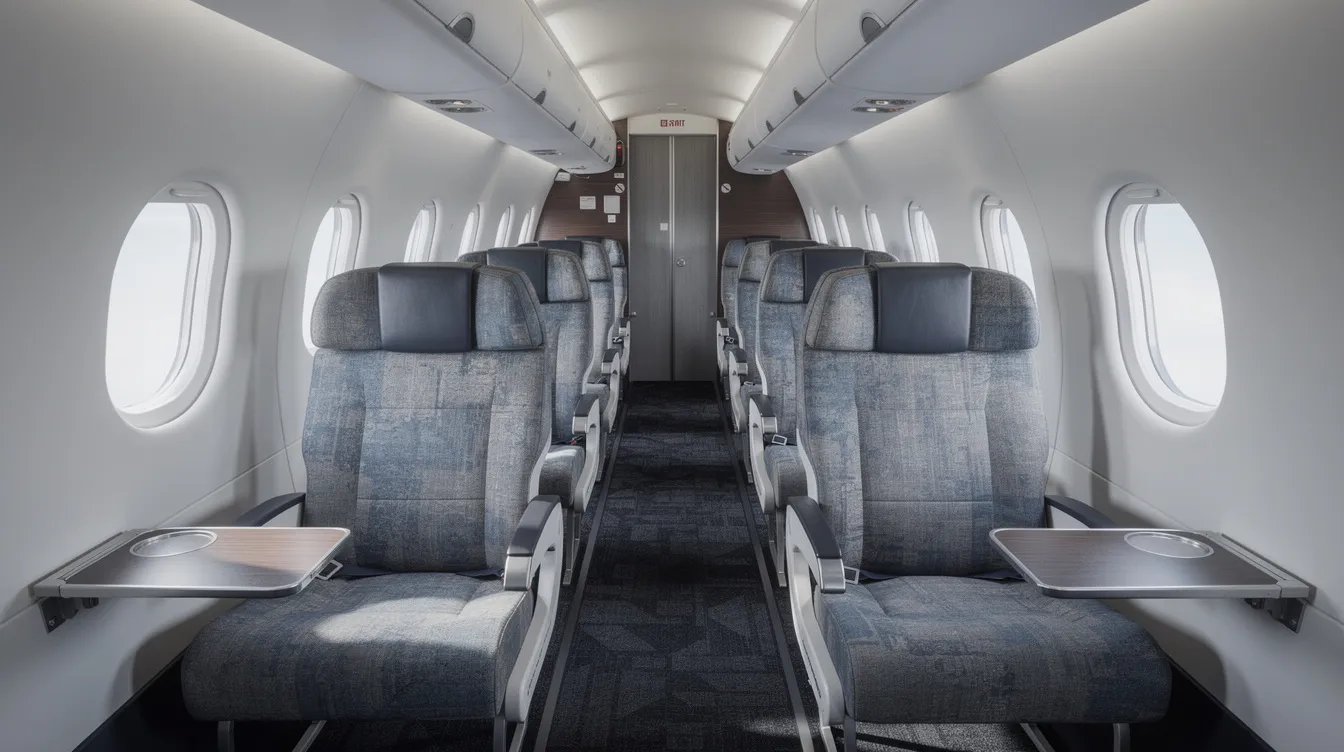
Key areas that affect the seating experience include:
Bulkhead row (front): Extra legroom but may have under-seat storage limitations.
Over-wing rows: Slightly reduced window visibility; structurally reinforced floor.
Exit rows (mid-cabin): Often the most legroom, sometimes labeled "Main Cabin Extra" on carriers like American Airlines.
Seat maps differ slightly between airlines and private charter operators, so travelers should verify specific layouts for their flight. Some aircraft include overhead stowage compartments with space-saving retractable panels to maximize the narrow cabin's usable volume, though these do not change the nominal 50-seat capacity. The narrow aisles-a hallmark of the ERJ 145's compact cross-section—influence boarding flow and storage logistics but keep the cabin efficient for its intended purpose.
Seating capacity numbers only tell part of the story. What matters to passengers on a 90-minute flight is how the cabin actually feels—and that comes down to seat pitch, width, recline, and noise levels.
The standard seat pitch of 31 inches and seat width of approximately 17 inches are typical for the regional jet category. Recline is modest at roughly 3 inches, and some rear rows may have limited or no recline depending on the operator's fit.
The cabin height of approximately 6 feet means passengers above that height may feel cramped when standing or stretching, particularly in mid-cabin sections where fuselage curvature reduces headroom. On flights longer than 90 minutes, seat choice and legroom become noticeably more important.
Many commercial ERJ 145s were delivered with basic interiors—limited in-flight entertainment, no personal screens, and minimal connectivity. This shapes passenger expectations more than the seating capacity itself. Noise can also be more prominent in the aft cabin near those rear fuselage-mounted engines.
On private charter ERJ 145s, the experience is often different, especially when operators add tailored services like premium in-flight catering through Jettly Eats:
Refurbished cabins may include leather seating and Wi-Fi
Some operators add enhanced noise insulation and upgraded lighting
Seat counts drop to 30–40 for a more spacious, business-class-style layout
Power outlets and USB ports become standard in premium conversions
The cabin's narrow cross-section and small overhead bins are the main practical constraints tied to the Embraer 145 seating capacity. Overhead bin space is limited, particularly above the A-side (single seat) where bins are either very small or absent entirely.
Standard 22-inch hard-shell rollaboards often do not fit in these bins, especially above A-side seats. On commercial flights, this leads to frequent gate-checking—a routine inconvenience that passengers on regional jets learn to expect. Larger carry-on bags almost always need to go below.
Practical tips for managing carry-on luggage on the ERJ 145:
Use small soft bags or backpacks as primary cabin items
Plan for gate-checking if the flight is fully loaded to 50 passengers
Check with the airline or operator for specific size limits
While the certified seating capacity is 50, operational practices like voluntary bag-check programs help manage bin space when every seat is occupied. The total overhead bin volume on a standard ERJ 145 is about 67 cubic feet—functional, but not generous.
On private charters arranged through Jettly, the entire aircraft is reserved for one group. This allows baggage planning in advance, balancing passenger count, comfort, and luggage volume without competing for overhead space, and can be coordinated alongside airport locator and booking tools that streamline departure and arrival planning.
There is a clear divide between older commercial ERJ 145 interiors and modern refurbished or private charter cabins when it comes to onboard aircraft features.
Many legacy airline-configured ERJ 145s were delivered without in-seat power outlets or Wi-Fi. Passengers on these older fleets should expect limited connectivity and plan accordingly—bring a fully charged device and download entertainment beforehand.
Some upgraded aircraft now include USB ports, basic Wi-Fi, and refreshed LED lighting, but availability varies widely by operator and route. The upgrades are typically operator-specific rather than standard across the fleet.
Private charter operators using ERJ 145 conversions often add:
AC power outlets at every seat
Business-jet style seating with enhanced galleys
In-cabin connectivity packages
Improved climate control systems
For travelers who plan to work in flight, confirming specific connectivity and power availability is important when requesting a private charter quote. These details can vary significantly even within the same operator's mixed fleet.
The ERJ 145's operational history spans nearly three decades. The aircraft completed its first training flight in August 1995 and entered commercial service shortly after. The first ERJ 145 was delivered in December 1996, with Continental Express among the earliest customers, joining other leading private and commercial aircraft manufacturers in shaping the modern aviation landscape.
Throughout the 2000s and 2010s, the type became a workhorse on high-demand regional routes across the Americas. American Airlines operated it extensively through its regional jet subsidiary partners like American Eagle Airlines, connecting major hubs to small and mid-sized cities. ExpressJet Airlines was also a prominent operator during this era. The aircraft was popular on high-demand regional routes in the Americas, where its 50-seat capacity matched scope clause limitations at many major airlines.
Belgium operated two ERJ 145s for VIP transport from 2001 to 2020, demonstrating the platform's versatility beyond scheduled passenger transport. CommuteAir operates the largest ERJ 145 fleet with 165 aircraft, making it the largest operator of the type today, alongside other specialized private jet operators that use similar regional platforms for bespoke missions.

The ERJ 145 accumulated tens of millions of flight hours in scheduled service, building a reputation for reliability. As airline fleets up-gauged to larger regional jets and mainline aircraft, many ERJ 145s were converted into corporate shuttles, VIP transports, medical aircraft, and military models. Several air forces acquired military aircraft variants for surveillance and reconnaissance, while other operators adapted the platform for government passenger transport through a regional division of their operations.
Some of these transitions involved a joint venture between Embraer and defense organizations, while others were purely commercial conversions. The logistical difficulties of maintaining an aging fleet on scheduled routes actually accelerated the shift toward charter and special-mission roles, where the aircraft's proven 50-seat platform could be easily adapted to 20–40-seat private layouts with enhanced comfort, especially as demand grew for top-tier private jet charter companies offering regional jet cabins for groups.
The Embraer ERJ family includes the ERJ 135, ERJ 140, and ERJ 145, all sharing a similar cockpit, systems architecture, and a single pilot pool for crew qualification. These ERJ aircraft differ primarily in seating capacity and fuselage length.
|
Variant |
Typical Seats |
Difference from ERJ 145 |
|---|---|---|
|
ERJ 135 |
~37 |
Seating thirteen fewer passengers than the ERJ 145 |
|
ERJ 140 |
~44 |
Six fewer passengers than the ERJ 145 |
|
ERJ 145 |
50 |
Largest in the family |
Variations of the Embraer ERJ family include models seating 37 to 44 passengers, giving operators flexibility to match demand. The ERJ 140, with thirteen fewer passengers than the ERJ 145 in practice, was developed to serve thinner routes while maintaining commonality.
Performance variants of the ERJ 145 include the ERJ 145ER (extended range), the ERJ 145LR (long range), and the ERJ 145XR (extra-long range). The extended range version adds increased fuel capacity—using the same tanks but with higher fill limits—to stretch the aircraft's reach. These variants feature upgraded engines and numerous aerodynamic improvements that provide improved climb characteristics and lower cruise configuration drag for improved cruise performance.
According to the company's internal documents, the only significant changes between some sub-variants were not only new software for the crew alerting system and engine indication displays but also significantly upgraded mechanical components, including the physical engines and mechanical components in the high-performance engines themselves. These updates gave the extended range version increased weight capacity without altering the fundamental airframe design. The same fuel capacity across some sub-variants was achieved using the same tanks with different fuel management protocols.
A business jet variant based on the ERJ 145 platform, known as the Legacy 600, took the design in a different executive direction. This variant reached the European market and other international customers.
Private charter and corporate shuttle operators sometimes select among these variants based on mission length and passenger load. A group of 35, for instance, might charter an ERJ 140 with fewer passengers aboard, or an ERJ 145 for more room. Travelers planning regular group trips can work with Jettly to match specific ERJ family variants to typical passenger counts and route profiles using its extensive private charter aircraft network.
The difference between a commercial ERJ 145 flight and a private charter on the same airframe comes down to one thing: who controls the cabin.
Commercial Embraer ERJ 145 flights typically offer all-economy seating at standard 31-inch pitch, minimal variation between rows, and no ability to leave seats empty when demand fills the flight. Every aisle seat and window seat is sold. The estimated cost per seat may be low, but so is the flexibility.
Private charter configurations flip this equation. Operators may reduce seating capacity to 30–40 seats, create VIP zones with club seating, or increase pitch to business-class spacing while using the same basic airframe. The ERJ 145 can be configured for 16 to 28 passengers in premium layouts, trading fewer passengers for dramatically improved comfort. Chartering provides flexible scheduling and custom cabin use that commercial flights simply cannot match.
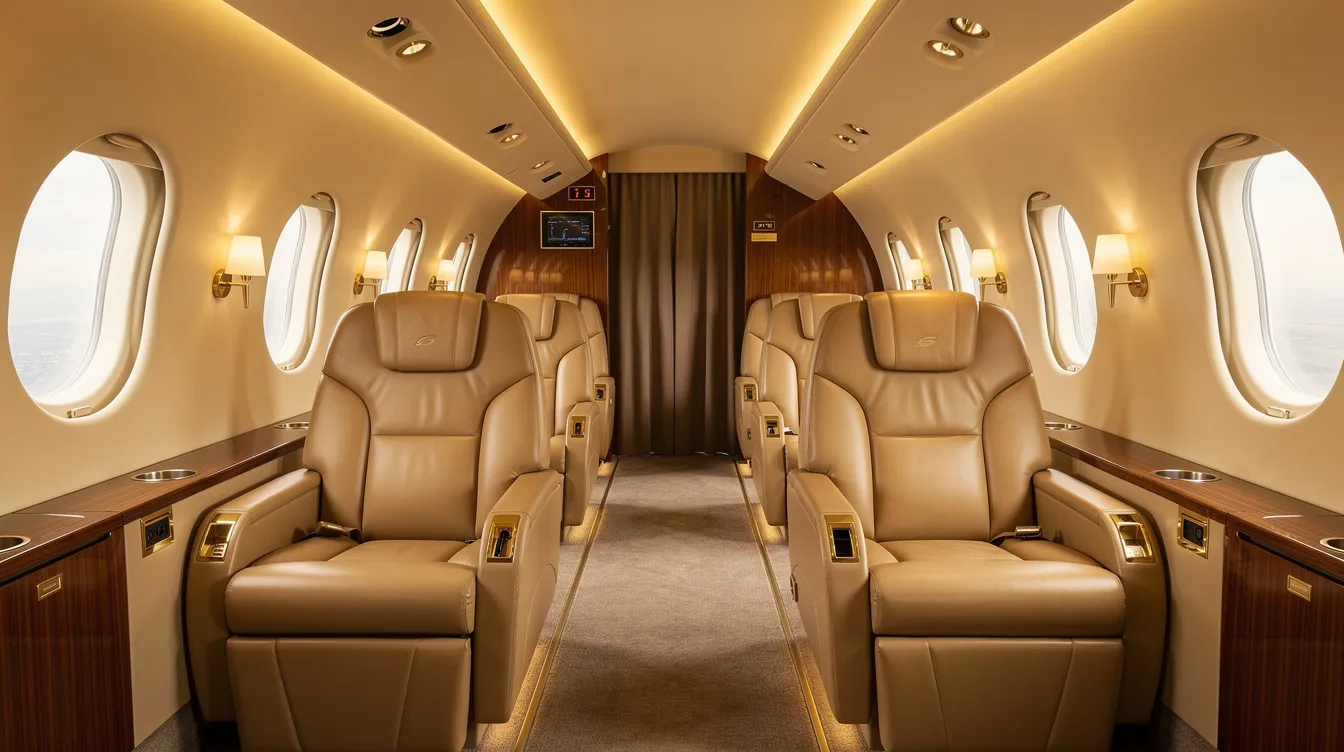
Through Jettly's group charter service, a group can control how the cabin is used: spreading passengers out, designating quiet rows, or grouping teams and families together. While the aircraft is certified for 50 passengers, operating below maximum capacity on a charter often improves comfort, boarding speed, and baggage flexibility.
The ERJ 145 can accommodate 30-50 passengers comfortably depending on the configuration chosen. For travelers weighing these options, understanding how private jet charter costs compare to booking commercial seats in bulk helps clarify the value proposition, especially when paired with strategies for getting a seat on a private jet easily through memberships, shared flights, or last-minute deals.
The ERJ 145 hits a sweet spot for groups too large for a heavy private jet but too small—or too cost-conscious—to justify a full narrowbody airliner. Its seating capacity of 30 to 50 passengers, depending on configuration, aligns well with several real-world scenarios.
High-value use cases include scenarios where travelers may weigh shared charter options versus full charter:
Corporate roadshows connecting multiple cities in a single day
Sports team travel requiring consistent schedules and equipment space
University group trips for academic or athletic programs
Incentive travel rewarding teams with a private flight experience
Event shuttles between nearby cities (conferences, festivals, weddings)
For groups larger than 15–20 travelers, chartering an ERJ 145 is often more economical than booking several smaller private jet options. A private jet for 50 passengers offers per-seat economics that smaller aircraft cannot match, and understanding the trade-offs between shared charter flights and full charters helps refine the best strategy for group size and budget.
The Embraer regional jet's maximum range of approximately 1,550 nautical miles and runway performance allow direct flights on regional routes like New York–Nashville, Dallas–Denver, or Toronto–Halifax without connections, and it is a popular choice for city pairs such as private jet charter routes in and out of Atlanta. The aircraft's cruise speed and overall performance make it well-suited for domestic legs under three hours, including busy corridors served by private jet charter services in Houston and other major hubs.
Jettly's platform can compare ERJ 145 charters against other aircraft types so clients can balance cost, seating capacity, and comfort for each mission, making it a compelling alternative to fractional providers like NetJets for many travelers.
Jettly operates as a digital private charter marketplace providing access to thousands of aircraft, including Embraer regional jet models like the ERJ 145 and its LU variant, positioning itself within the broader ecosystem of global charter airlines and private operators.
The platform uses passenger count, route, and schedule to recommend right-sized aircraft. Groups of 25–50 travelers are frequently matched with an ERJ 145 for optimal economics—avoiding the waste of a half-empty airliner or the expense of chartering three midsize jets — and some itineraries can leverage crowdsourced and shared private jet seats to further reduce per-passenger costs.
Key platform benefits for ERJ 145 charters, particularly for clients using jet card-style access programs, include:
Instant pricing visibility and on-demand booking
Side-by-side comparison of the ERJ 145 against smaller jets and turboprops
All charter operators vetted for applicable safety regulations (Part 135 in the U.S.)
Operator experience verified on Embraer ERJ family aircraft
Jettly can also coordinate details like cabin layout preferences, seating plans, in-flight catering, and ground transportation to align with the group's needs—turning a standard 50-seat regional jet into a tailored group travel solution, especially for clients enrolled in its flexible private jet membership programs.
One clear advantage of private charter is the ability to plan how the seating capacity is actually used, even when the aircraft has 50 installed seats. The group—not the airline—decides the configuration.
Practical strategies include:
Leaving empty rows between departments or teams for privacy
Assigning front rows to executives or VIP guests
Designating work zones (forward) and quiet zones (aft)
Grouping families or colleagues together
Flight length, passenger height, and baggage volume all factor into whether to fill all seats or operate at a lower load factor. A three-hour leg with 35 passengers may benefit from spreading out across 50 seats and arranging tailored in-flight catering with Jettly Eats. A 45-minute shuttle with 48 people can fill the cabin without discomfort.
Jettly can help request specific layouts—for example, a 36-seat business-style configuration—from operators that offer modified Embraer ERJ 145 interiors. Clients should confirm needs such as power outlets, Wi-Fi, catering level, and any special seating requirements (medical staff, equipment space) at the quotation stage, especially if they are comparing options for buying a single seat on a private jet versus chartering the entire aircraft.
The standard airline configuration has 50 economy-class seats arranged in a 2-1 layout across a single aisle. This capacity is common across ERJ 145ER, LR, and XR variants, though private operators may install fewer seats. Emergency equipment and exits are certified based on this 50-passenger maximum, which sets the upper limit regardless of how the interior is arranged.
Yes. Many private charter and corporate shuttle operators reconfigure the cabin with fewer than 50 seats to increase legroom and comfort. Typical reduced layouts include 30–40 seats with business-class style pitch, or a VIP arrangement with as few as 16 to 28 passengers and club-style seating zones. Clients can ask Jettly for aircraft with specific seat counts or comfort levels when requesting a quote.
The 31-inch pitch can feel tight for passengers over about 6 feet tall, especially on flights longer than 90 minutes in a full 50-seat cabin. Exit rows and bulkhead rows generally offer more legroom. On private charters, operators can leave adjacent seats open or select lower-density configurations. Tall travelers chartering through Jettly should mention height and comfort needs so operators can suggest appropriate rows or layouts.
The certified seating capacity does not directly define baggage limits, but a fully loaded 50-seat flight leaves less flexibility for oversized or heavy luggage. Private charters often run below maximum capacity, freeing up weight and space for additional bags, equipment, or team gear. Providing accurate passenger and baggage details to Jettly helps confirm that the selected ERJ 145 comfortably meets mission requirements.
The process is straightforward: visit Jettly's platform, enter the route, dates, and passenger count, then review instant pricing and aircraft options, including Embraer regional jet models. Clients can request specific seating capacities, cabin features, and service levels during the quote stage. The ERJ 145 is ideal for groups of about 25–50 passengers on routes up to roughly 1,550 nautical miles.
The Embraer ERJ 145 remains a versatile and practical choice for both commercial regional flights and private charters. Its standard 50-seat capacity in a unique 2-1 configuration offers more personal space than many competitors, while private charter options provide flexible layouts to enhance comfort and accommodate groups from 16 to 50 passengers. Despite its compact cabin and limited overhead bin space, the ERJ 145’s efficient performance, reliable operational history, and adaptability make it a smart option for short to medium regional routes.
For travelers and organizations seeking to balance cost, convenience, and comfort, the ERJ 145 provides an excellent solution, especially when booked through platforms like Jettly that offer transparent pricing, instant booking, and tailored charter experiences. Whether for business roadshows, sports teams, or family trips, the Embraer ERJ 145 seating capacity and configuration deliver a practical, efficient, and comfortable travel experience.
Ready to experience private travel on your terms? Explore flight options or request a quote at https://www.jettly.com.
Share this post:
Jay Franco Serevilla
Sep 21, 2026
|
5
min read
Discover tips and trends in the industry.

5
min read
Low Wing Cessna: History, Design, and Modern Charter Relevance
Low-wing Cessna aircraft, known for their speed and efficiency, have significantly influenced private aviation. These models, including the Cessna 400 and Citation jets, prioritize performance and comfort, making them ideal for modern charter services. Their unique design enhances aerodynamic efficiency, providing a sporty flying experience that appeals to both pilots and passengers.
Read More
5
min read
Gulfstream Engines: Powering Long-Range Business Aviation
Gulfstream engines are pivotal in enhancing long-range business aviation, offering unmatched performance and comfort. This guide provides insights into the technology and specifications of Gulfstream engines, helping travelers make informed decisions for their aviation needs. With options like the Rolls-Royce BR710 and Pearl 700, Gulfstream aircraft ensure efficient, high-speed travel across global routes.
Read MoreStay updated with our latest insights and tips to elevate your journey with us.
MEMBERSHIPS AND ASSOCIATIONS



Disclaimer: Jettly operates as a charter broker, offering access to a global digital jet charter marketplace. Jettly is not a direct air carrier and does not own or operate aircraft. All advertised flights are conducted by third-party air carriers that are fully licensed and hold the appropriate Part 135 or Part 121 certifications issued by the Federal Aviation Administration (FAA) or equivalent regulatory authorities under U.S. or foreign law. Jettly complies fully with the U.S. Department of Transportation's Part 295 and Part 298 Charter Broker regulations. Jettly does not carry additional liability insurance. Passengers are covered by aircraft operator insurance. TICO: 50023770


