


Login
Get Instant Pricing On 23,000+ Aircraft

>
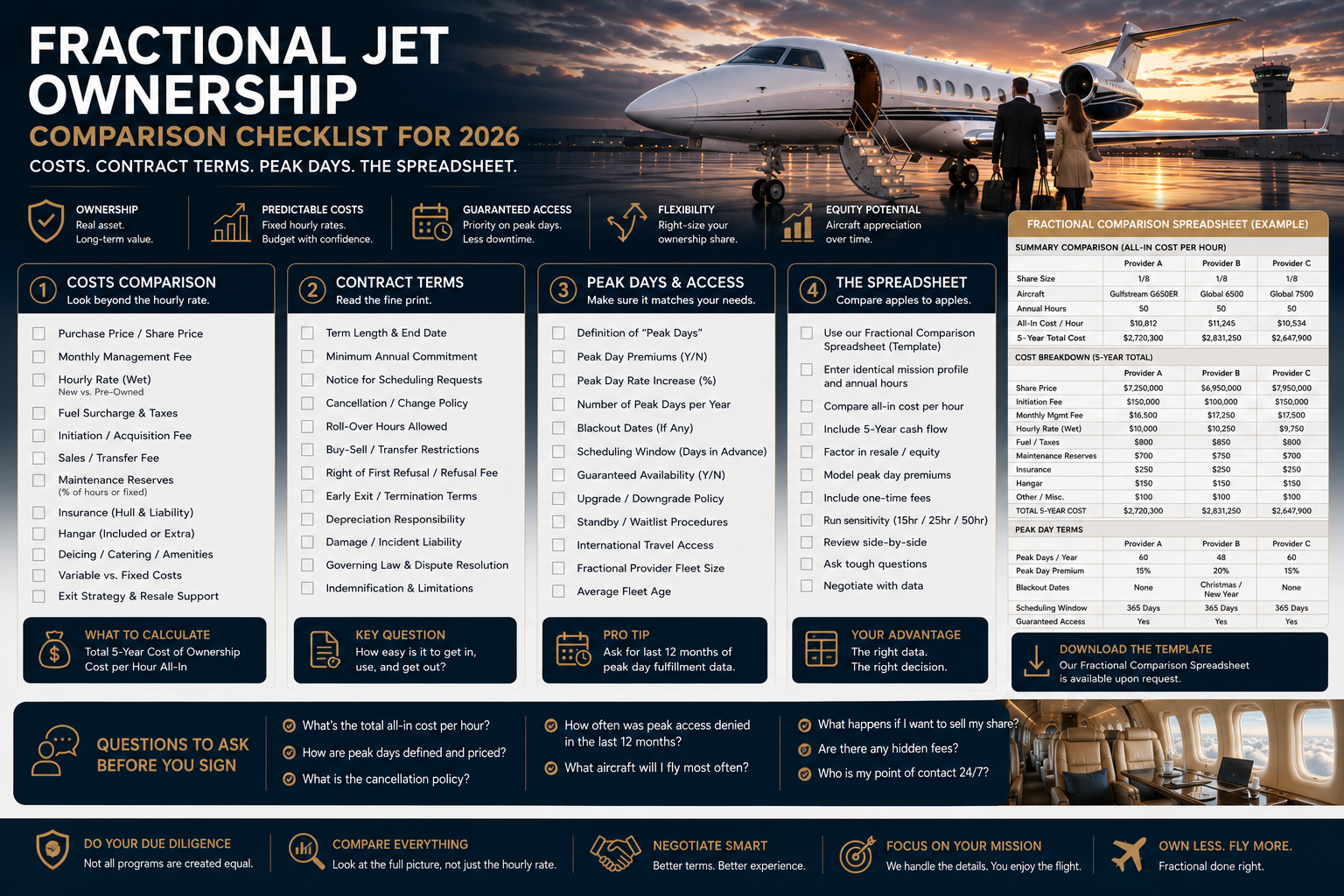
Two proposals can quote the same hourly rate and still differ by thousands of dollars per hour once the contract runs its course. That gap is where buyers lose money. This fractional jet ownership comparison checklist for 2026 closes it by converting every quote into one number, effective cost per occupied hour, and by treating peak-day reliability as a contract clause you can read rather than a promise you have to trust.
Here is the whole decision in four lines. Fractional ownership is a multi-year commitment tied to capital and fixed monthly fees. Peak days are where most programs quietly fail their owners. Contract language beats brochure language every time. A standardized checklist plus a spreadsheet solves all three problems.
Fractional tends to make sense when you fly steady hours on a predictable mission and you value contract-backed availability enough to accept depreciation and a five-year term. Alternatives often win when your usage is variable, when you want to avoid resale exposure, or when you need to move across multiple cabin categories without penalty. Our full comparison checklist lays out the same framework used to normalize competing proposals.
Effective cost per occupied hour is your total lifecycle cost, meaning buy-in minus exit value, plus monthly fees, plus hourly charges and surcharges, divided by the hours you realistically fly.
Fractional ownership is only comparable when you convert every fee and exit term into an effective cost per occupied hour. A 2026 fractional jet ownership comparison checklist should standardize every proposal into one number, effective cost per occupied hour, by combining acquisition cost minus expected residual value, monthly management fees, hourly flight charges, peak-day surcharges, taxes, and exit fees, then dividing by the hours you will actually fly.
On this page you get a downloadable spreadsheet, a clause-by-clause contract checklist, a broker-grade safety and compliance vetting checklist, and a sample scoring rubric. Here is how four access models compare at a glance.
|
Access model |
Capital at risk |
Fixed monthly fees |
Peak-day protections |
Exit friction |
|---|---|---|---|---|
|
Fractional share |
High (buy-in plus depreciation) |
Yes, management fee |
Contract-defined, peak calendars |
High (buyback plus remarketing fees) |
|
Jet Card |
Medium (prepaid hours) |
Usually none |
Contract-defined callout rules |
Low (fly remaining hours) |
|
On-demand charter |
None |
None |
Per-trip availability, no guarantee |
None |
|
Jettly Cloud Fraction |
Medium (license, no title) |
Yes, management fee |
10-hour callout, recovery sourcing |
Low (36-month term, no title) |
Fractional ownership is a structured framework built from several contracts and a managed operation, not a simple purchase of an airplane. You buy a share, you sign a management agreement for the operator to run and maintain the fleet, and you accept an owner agreement that governs how owners share aircraft. A fractional share is contract-defined and typically maps to a fixed annual hour allotment, but access is delivered through a managed fleet, not a promise that you will always fly one specific tail number.
Share sizes scale with the hours you plan to fly. According to the NBAA fractional ownership FAQ, programs sell shares as small as one-sixteenth and structure each aircraft around roughly 800 occupied hours per year, which is how one airplane serves many owners. A one-sixteenth share commonly lines up with about 50 hours a year, a one-eighth with about 100, and a one-quarter with about 200.
Three documents deserve your attention before anything else: the purchase agreement (what you buy and its resale terms), the management agreement (what you pay monthly and hourly), and the owner agreement (how sharing and substitution work). You may not fly the same aircraft or crew on every trip since the operator dispatches from a pooled fleet to meet demand across all owners. That is normal, and it makes callout time the number that governs real access.
Callout time is the minimum notice you must give for the program's availability guarantee to apply.
For a deeper look at line-item pricing, read our fractional cost breakdown. Understanding these mechanics matters for anyone weighing fractional jet ownership in the US, since the same share size can carry very different economics once fees and exit terms are layered in.
|
Share size |
Typical hours/year |
Who it tends to fit |
Key contract risks to review |
|---|---|---|---|
|
1/16 |
~50 |
Light, seasonal use |
Callout windows, peak-day caps |
|
1/8 |
~100 |
Regular regional travel |
Management fee escalation, taxi minimums |
|
1/4 |
~200 |
Heavy, near-weekly flying |
Residual methodology, remarketing fees |
|
1/2 or more |
400+ |
Near-dedicated aircraft needs |
Substitution rights, long commitment |
Pricing is not one number. The occupied hourly rate is not the all-in price; your all-in cost is driven by buy-in minus exit value plus fixed monthly fees. To compare fractional jet ownership costs across providers, you have to run each proposal through the same formula.
Effective $/occupied hour = ((Buy-in − Expected residual) + (Monthly fee × term months) + (Hourly rate × hours) + Fuel variable + Taxes + Peak surcharges + Exit/remarketing fees) ÷ Hours actually flown.
Break every quote into buckets. There is the acquisition or buy-in, the projected residual or buyback value, the monthly management fee, the occupied hourly rate, a separate fuel variable if the contract carries one, taxes and segment fees, peak-day surcharges, and exit or remarketing fees. The Flexjet fractional program illustrates these components, including the note that billed time can include a taxi-time add-on of around two-tenths of an hour per leg. Those small add-ons compound fast on short legs.
Occupied hourly rate is the per-hour charge for time the aircraft is in flight, plus any contract-defined taxi allowance.
Utilization changes everything. Run a sensitivity test. Fly 95% of your hours and your fixed costs spread across many hours, so effective cost drops. Fly only 70% and the same monthly fees and buy-in divide across fewer hours, so your true cost per hour climbs sharply. Do the same with residual value. If the buyback comes in 10% below the projection in your model, your effective cost per hour rises across the entire term. SherpaReport's economics analysis frames whole versus fractional costs on exactly this per-hour, lifecycle basis rather than a single sticker figure.
"The mistake many buyers make is comparing fractional ownership proposals by hourly rate alone. The real comparison begins when every proposal is converted into one standardized metric, your effective cost per occupied hour after accounting for acquisition cost, management fees, residual value, peak-day charges, and exit terms."
Justin Crabbe, CEO
Model three utilization levels for every quote: 70%, 85%, and 95% of contracted hours. That range shows you the all in costs under realistic use, not just the best case a sales deck assumes. It also reveals which programs punish light flyers. To connect fractional math to the broader picture, review the operating costs that shape hourly pricing across the industry.
|
Input field |
Where it appears |
Evidence to request |
Spreadsheet cell |
|---|---|---|---|
|
Acquisition / buy-in |
Proposal + purchase agreement |
Signed price schedule |
buy_in |
|
Residual / buyback |
Contract |
Buyback formula in writing |
residual_value |
|
Monthly management fee |
Proposal + management agreement |
Five-year escalation history |
mgmt_fee |
|
Occupied hourly rate |
Proposal |
Rate card + taxi allowance |
hourly_rate |
|
Fuel variable |
Contract addendum |
Index and adjustment method |
fuel_var |
|
Taxes and segment fees |
Sample invoice |
FET and segment fee detail |
taxes |
|
Peak-day surcharge |
Contract |
Peak calendar + method |
peak_surcharge |
|
Exit / remarketing fee |
Contract |
Remarketing fee schedule |
exit_fee |
The contract controls the experience. If a provider will not put peak-day rules, substitution rights, and buyback methodology in writing, you do not have a comparable quote. These are the clauses that decide reliability and true cost.
Term and renewal. NBAA notes a typical five-year commitment. Confirm the term, any auto-renewal, and the notice window to exit.
Fee escalation. Ask whether the management fee and fuel variable can rise, and whether increases are capped or tied to a published index.
Minimums. Taxi-time add-ons, per-leg minimums, and daily minimums inflate billed hours. Flexjet's taxi-time policy is a useful reference point for the questions to ask.
Cancellation and change windows. Penalties climb as departure nears, and terms vary by operator, so read the actual schedule rather than assuming an industry norm.
Buyback and remarketing. NBAA describes residual resale value as a defined concept; you want the formula, the timing, and any remarketing fees spelled out.
Substitution rights. Pin down what counts as an "equivalent aircraft," how downgrades are billed, and whether you get credit when you fly smaller.
Peak days are contract-defined high-demand dates that usually require longer lead times and may trigger surcharges or schedule constraints.
Exit economics deserve as much scrutiny as the purchase price, so read our resale and buyback guide before you sign. A discretionary "fair market value" buyback with no formula is a red flag. So is an uncapped annual fee increase.
"Fractional ownership is ultimately a contract decision as much as an aviation decision. Peak-day availability, substitution rights, interchange rules, buyback methodology, and fee escalation clauses will often have a greater impact on long-term value than the aircraft itself. Those terms deserve the same scrutiny as the purchase price."
Justin Crabbe, CEO
|
Clause |
Why it matters |
Request in writing |
Red flags |
|---|---|---|---|
|
Term and renewal |
Locks capital for years |
Term length, renewal notice |
Auto-renewal without notice |
|
Fee escalation |
Silent cost growth |
Cap or index |
Uncapped annual increases |
|
Minimums |
Inflates billed hours |
Taxi allowance, daily minimum |
Taxi add-ons with no cap |
|
Cancellation and change |
Costs on short notice |
Windows and penalties |
Non-refundable, no flexibility |
|
Buyback and residual |
Determines exit value |
Written formula and timing |
Discretionary value only |
|
Substitution |
Affects reliability and billing |
Definition of "equivalent" |
Downgrades billed at full rate |
Your busiest travel day is the day everyone wants a jet. Thanksgiving Sunday, the Friday before a holiday weekend, the morning after a championship game. Availability language matters more than the hourly rate on those dates, since a low rate is worthless if you cannot get a tail. Peak-day reliability is proven by written rules and historical performance, not by a sales promise.
Request the peak-day calendar and the peak-day callout rules in writing. Confirm whether the provider can shift your departure time on peak dates and under what conditions. Private Jet Card Comparisons documents how peak days, call-out windows, and primary versus extended service areas function as standard fractional concepts, and how extended areas can change fees.
Guaranteed availability means access to an equivalent aircraft category when you follow the program's callout and peak-day rules, not a guarantee of any specific tail number at any time. In fractional aviation, "guaranteed availability" is only guaranteed if you follow the contract's callout window and peak-day rules, so peak-day reliability is a contract clause, not a marketing claim.
Run three scenarios with every provider and record the answers.
Holiday outbound, Friday afternoon. Does the guaranteed callout window still apply, and what lead time do peak days require?
Short-notice return change. Can you move a return by a day inside the callout window, and what does that cost?
Simultaneous departures from two cities. Can the fleet cover two aircraft at once on a peak date, and is it guaranteed or best-effort?
Ask what happens if the assigned aircraft goes AOG (aircraft on ground). A recovery aircraft policy sources a replacement or alternate transport so your trip survives a mechanical issue. Jettly's Recovery Aircraft guarantee, for example, sources a replacement aircraft or alternate luxury transport when a booked aircraft becomes unavailable, though the operator retains control of the flight itself. Score reliability the same way you score cost, using our 50-question spreadsheet.
|
Test scenario |
Required evidence |
Pass / Fail |
Notes |
|---|---|---|---|
|
A. Holiday outbound, Friday PM |
Peak calendar + guaranteed callout window |
|
|
|
B. Short-notice return change |
Change policy + fee schedule |
|
|
|
C. Simultaneous departures, two cities |
Fleet availability confirmation |
|
|
Most buyers do not only fly one mission. A quick regional hop one week, a coast-to-coast trip with the full family the next. Flexibility is an economic feature, not just a comfort one, since the way you move between cabin classes changes how fast your hours burn.
Interchange ratio is the rate at which your hours are converted when you switch from your owned category to a larger or smaller cabin class.
Flexjet describes flexible share exchange into other aircraft types and even helicopters at certain ownership levels, which shows how upgrades and downgrades work in practice. Interchange usually runs one of three ways: hour multipliers, a published interchange table, or a cash price difference. Always ask for the interchange chart, since an upgrade can cost more by burning hours faster even when the hourly rate looks unchanged.
Upgrades usually work through interchange rules, where your hours are converted using a published ratio or multiplier when you fly a larger cabin class. Request the interchange chart, any blackout or peak restrictions on interchange, and how upgrades are billed on peak days before you compare shares and pricing.
Access models handle this differently. Jettly's membership programs include a complimentary aircraft upgrade that moves members into a larger available aircraft at no extra charge when one is open at departure, which sidesteps interchange math entirely. Compare that against the fractional approach using our list of top fractional providers.
|
Feature |
What it means |
Document to request |
Typical gotcha |
|---|---|---|---|
|
Interchange ratio |
Hour conversion across cabins |
Interchange chart |
Faster hour burn on upgrades |
|
Peak-day upgrade |
Larger cabin on high-demand dates |
Peak-day upgrade rules |
Blackouts and surcharges |
|
Downgrade credit |
Savings for smaller cabin |
Downgrade billing rule |
No credit for flying smaller |
|
Helicopter or other lift |
Connecting transport |
Availability terms |
Limited to a few markets |
Safety is the one criterion you cannot negotiate after the fact. Understand who does what first. The certified operator flies the aircraft and holds the certificate and insurance. A broker arranges the trip and, in Jettly's model, performs broker vetting and ongoing compliance monitoring, but never takes control of the flight.
Operational control is the legal responsibility for flight safety decisions (crew, maintenance status, dispatch), and it stays with the certified aircraft operator, not the broker.
Part 135 and Part 121 are the FAA operating rules that govern the carrier flying your trip, and buyers should confirm which certificate applies since it changes how flights are dispatched, staffed, and overseen, especially when comparing charter-style access versus airline operations. Part 135 covers on-demand charter and commuter flying, the category behind most private jet trips. Part 121 covers scheduled airline operations with the most demanding dispatch, crew, and maintenance program requirements. Some large fractional and airline-style operations touch Part 121 rules, so ask which certificate covers the specific flights you will take.
ARGUS and Wyvern are independent safety auditors. An ARGUS rating (Gold, Gold Plus, or Platinum) reflects historical safety data, crew background checks, and, at higher tiers, an on-site audit. A Wyvern rating applies similar operator, aircraft, and crew vetting. Request proof of current status and its scope, meaning the specific operator, aircraft, and base covered, not a generic logo. IS-BAO is a management standard built around a safety management system (SMS); some operators hold it as a complement to third-party audits, though it is not universal, so do not assume it.
Audit monitoring is a process, not a one-time checkbox. Treat it as initial vetting, then periodic re-checks (commonly annual), then event-based triggers such as an incident, an insurance lapse, a certificate change, or a major maintenance event. Good audit monitoring tracks a few plain KPIs: safety events per flight hours, on-time completion, maintenance deferral trends, crew experience minimums, and how quickly audit findings get closed. When a finding appears, a remediation plan with an owner and a deadline should follow, and re-audit should confirm the fix. That cadence is what separates real compliance monitoring from a marketing badge.
"Sophisticated buyers don't ask only whether an aircraft is available, they ask how that availability is delivered. Understanding who has operational control, how operators are vetted, what happens during disruptions, and how recovery is managed provides a far more accurate picture of program quality than any marketing brochure ever will."
Justin Crabbe, CEO
Red flags that should stop a contract: an expired or downgraded ARGUS or Wyvern status, refusal to share current audit documents, an insurance lapse, a recent certificate action, or opaque subcontracting where you cannot identify the actual operator. Jettly complies with DOT 295/298 broker rules, works exclusively with certified operators that are ARGUS- or Wyvern-rated (some also holding IS-BAO), and states it vets every operator and monitors every aircraft for compliance with independent safety auditors. A broker can vet and monitor operators, but operational control, and the insurance policy, belongs to the Part 135 or Part 121 carrier flying the trip. Passengers are covered by the operator's insurance; Jettly does not carry additional liability insurance. For the fundamentals, see our guide to private jet safety, and note that industry bodies such as the Air Charter Safety Foundation promote the audit standards these ratings build on.
|
Credential |
What it is |
What it typically covers |
What it does not guarantee |
Request in writing |
|---|---|---|---|---|
|
ARGUS |
Independent operator rating and audit |
Safety data, background checks, on-site audit at higher tiers |
Zero risk on any single flight |
Current rating and scope |
|
Wyvern |
Independent safety rating and audit |
Operator, aircraft, and crew vetting |
Condition of a specific tail today |
Current status, aircraft-specific report |
|
IS-BAO |
Management standard (safety management system) |
SMS structure and processes, staged registration |
Flight-by-flight third-party audit |
Registration stage and audit date |
Start broad, then narrow with evidence. The fastest way to compare fractional providers is to demand the same evidence pack from each and score only what is verified in writing. Private Jet Card Comparisons maintains a provider directory that shows how wide the market runs across aircraft categories, from light jets through large-cabin fleets, and names like NetJets and Flexjet anchor the category examples.
Comparisons have to be category-specific and mission-specific. A light-jet share and a large-cabin share are different economic animals, and your typical leg length and passenger count decide which one fits. Build the list first, then request an identical evidence pack from each provider so you are comparing the same things.
Your request pack should include a sample agreement, the pricing schedule, the peak-day calendar, the interchange chart, the buyback method, and written confirmation of safety credentials (Part 135 or Part 121, ARGUS or Wyvern, and IS-BAO where held). After you learn the scoring framework, narrative provider comparisons and a broader look at fractional providers help you sanity-check the shortlist.
|
Step |
Output |
Artifacts produced |
|---|---|---|
|
1. Build provider list |
Long list by category |
Directory tab |
|
2. Request identical evidence pack |
Comparable inputs |
Agreements, schedules, calendars |
|
3. Score against checklist |
Weighted scores |
Scored comparison |
|
4. Run peak-day stress test |
Reliability grade |
Stress-test scorecard |
|
5. Compute effective $/hour |
One comparable number |
Cost calculator tab |
This is the same structure used to normalize proposals into one apples-to-apples view. A fractional checklist is only as strong as the evidence behind each answer, so every field should have an attached document or written confirmation.
The spreadsheet runs on six tabs: Program Summary, Cost Calculator, Peak-Day Stress Test, Contract Clauses, Safety and Compliance, and an Evidence Library where every document lives. Minimum columns are non-negotiable. Capture share size, annual hours, buy-in, projected residual, monthly fees, hourly rate, fuel variable, taxi and leg minimums, peak-day count, peak surcharge method, interchange rules, cancellation terms, exit fees, callout, service areas, substitution rights, recovery policy, and safety credentials (Part 135 or Part 121, ARGUS or Wyvern, IS-BAO).
Monthly management fees typically cover fixed overhead like crew and administration, but many programs still add trip charges such as fuel variables, taxes, peak surcharges, and certain handling fees depending on the contract. Each of those belongs in its own column in your fractional jet ownership comparison checklist 2026 so nothing hides inside a single blended rate.
Default scoring weights cost at 40%, reliability at 30%, contract terms at 20%, and safety and audit monitoring at 10%, with a hard gate that any failed safety check disqualifies a provider outright. Shift more weight to reliability if your calendar is peak-day heavy. Keep the downloadable spreadsheet open as you collect evidence.
|
Provider |
Share |
Annual hrs |
Buy-in |
Projected residual |
Monthly fee |
Hourly rate |
Effective $/hr* |
|---|---|---|---|---|---|---|---|
|
Example Co (illustrative) |
1/8 |
100 |
$650,000 |
$390,000 |
$19,500 |
$6,800 |
$14,200* |
*Illustrative figure only, not a quote.
If your main goals are peak-day reliability and clear all in costs, you do not have to accept a five-year capital commitment to get them. Jettly offers structured private aviation access with fixed-rate options and broker-level safety vetting, without requiring you to take depreciation and resale risk on an aircraft share.
Jettly is a charter broker and does not own or operate aircraft. Flights are operated by third-party carriers holding FAA Part 135 or Part 121 certification (or a foreign equivalent). Jettly works exclusively with certified operators that are ARGUS- or Wyvern-rated, some also holding IS-BAO, and states it vets and monitors those operators through ongoing audit monitoring and compliance monitoring.
The cost clarity comes from a few concrete features. Membership programs use fixed hourly rates with no fuel surcharges and point-to-point billing, where the clock starts at takeoff and stops at landing. There are no positioning fees on the membership programs, so you pay only for your actual flight. Member deposits sit in an insured escrow account kept separate from operating funds. Reliability features include a minimum callout of just 10 hours, a Recovery Aircraft guarantee if a booked aircraft becomes unavailable, and a complimentary aircraft upgrade when a larger cabin is open at departure.
One honest note on coverage: Jettly does not carry additional liability insurance, and passengers are covered by the aircraft operator's insurance. That is standard for the broker model and consistent with operational control staying with the certified carrier.
|
Factor |
Fractional share |
Jettly Jet Card |
Jettly Cloud Fraction |
|---|---|---|---|
|
Capital required |
High buy-in plus depreciation |
Card from $50k–$160k plus $12,997 fee |
License $325k–$725k, no title |
|
Fixed monthly fees |
Yes |
None |
$12k–$22k per month |
|
Hourly billing |
Occupied plus taxi plus fuel variable |
From $3,528/hr, no fuel surcharge |
$5,250–$8,900/hr fixed |
|
Peak-day tools |
Peak calendar and callout |
10-hr callout, recovery aircraft |
10-hr callout, recovery aircraft |
|
Exit risk |
Buyback plus remarketing fees |
Hours do not expire |
36-month term, no title |
Which Jettly program fits? Pick on-demand charter for occasional trips with no commitment. Pick a Jet Card when you want prepaid hours that never expire and predictable rates. Pick Cloud Fraction when you want fractional-style access to a whole aircraft class on a 36-month term with 50 annual flight hours, fixed hourly rates, no tail-number restriction, and no title to sell later. For a plain overview of the ownership model this compares against, see our fractional ownership overview, or run numbers now with the cost calculator. These access options give you fractional jet ownership 2026 style reliability without the balance-sheet exposure.
Our methodology takes each proposal, subtracts expected residual value from the buy-in, adds the management fee across the full term, adds hourly charges and any fuel variable for the modeled hours, adds taxes, segment fees, and peak surcharges, then adds exit and remarketing fees. That total divides by the hours you realistically fly, tested at 70%, 85%, and 95% utilization. Every input requires a written source document before it enters the model. Estimates are labeled as estimates, and no figure is treated as binding unless it appears in a signed agreement.
Fractional jet ownership is a program where you buy a contract-defined share that entitles you to a set number of flight hours per year, then pay monthly management fees and an occupied hourly rate when you fly. It is delivered through a managed fleet, so you may not always fly the same tail number or crew on every trip, and access depends on following the program's callout and peak-day rules.
In 2026, a 1/16 share is commonly structured around about 50 occupied hours per year and a 1/8 share around about 100, but total cost depends on the aircraft category, monthly fees, fuel variables, and exit value, not just the buy-in. Run each quote through the effective cost per occupied hour model and the downloadable spreadsheet to see the real number.
Guaranteed availability usually means an equivalent aircraft category will be provided if you follow the callout window and peak-day rules in the contract. It is not a promise of a specific tail number at any time, and peak-day calendars, substitution rules, and primary versus extended service areas can all change your practical lead time and fees.
Monthly management fees typically cover fixed overhead like crew and administration, but many programs still add trip charges such as fuel variables, taxes, peak surcharges, and certain handling fees depending on the contract. Map each of these to its own line in your comparison checklist so a single blended rate cannot hide them.
Upgrades usually work through interchange rules, where your hours are converted using a published ratio or multiplier when you fly a larger cabin class. Request the interchange chart and the peak-day upgrade rules in writing, since an upgrade can raise your true cost by burning hours faster even when the stated hourly rate looks unchanged.
A jet card can be cheaper in total when you want access and predictability but do not want to tie up capital in a depreciating share, since fractional economics include buy-in and resale exposure plus fixed monthly fees. As JetLinx frames it, the choice comes down to a service model versus an ownership model, so for many travelers in the 25 to 75 hour range a card avoids resale risk entirely.
In private aviation, the certified aircraft operator provides the flight and carries the insurance, while the broker arranges the trip and does not hold operational control. Jettly operates as a broker and does not carry additional liability insurance, so passengers are covered by the aircraft operator's insurance, which is why verifying the operator's certification and safety credentials is part of due diligence.
Comparing fractional shares in 2026 comes down to discipline: convert every proposal into one effective cost per occupied hour, force peak-day rules and buyback methodology into writing, and verify safety through operating certificate type, ARGUS or Wyvern ratings, and a real audit monitoring cadence. Do that and the winner usually becomes obvious. If a lower-capital path with fixed rates and clear all-in costs fits better, Jettly arranges flights on certified Part 135 and Part 121 carriers and offers structured access through its Jet Card and Cloud Fraction programs. Request a Jettly Program Comparison and Peak-Day Reliability Review, or download the 2026 Fractional Comparison Spreadsheet, and reach the team any time at +1-866-448-2358 or departures@jettly.com.
NBAA Fractional Aircraft Ownership FAQ - share definitions, 800 occupied hours, five-year commitment, documents, and residual resale value.
Share this post:
Jay Franco Serevilla
Jul 25, 2026
|
5
min read
Discover tips and trends in the industry.

5
min read
Lunken Airport Private Charter: Jet Charters at Cincinnati Municipal Lunken Airport (LUK)
Cincinnati Municipal Lunken Airport (LUK) offers a convenient private charter service for travelers seeking quick access to downtown Cincinnati. Jettly connects clients to a wide range of aircraft options, ensuring a seamless booking experience with transparent pricing. With amenities designed for comfort and efficiency, Lunken Airport is the ideal choice for both business and leisure flights.
Read More
5
min read
Flight Charter: How Jettly Makes Private Charter Flights Simple, Flexible, and Transparent
Jettly revolutionizes private charter flights by offering travelers the flexibility to choose their schedule, aircraft, and route. With access to over 20,000 certified aircraft worldwide, Jettly ensures transparent pricing and no long-term commitments. This guide explores the benefits of charter flights, including cost-saving options like empty leg flights and the convenience of booking through a digital platform.
Read MoreStay updated with our latest insights and tips to elevate your journey with us.
MEMBERSHIPS AND ASSOCIATIONS



Disclaimer: Jettly operates as a charter broker, offering access to a global digital jet charter marketplace. Jettly is not a direct air carrier and does not own or operate aircraft. All advertised flights are conducted by third-party air carriers that are fully licensed and hold the appropriate Part 135 or Part 121 certifications issued by the Federal Aviation Administration (FAA) or equivalent regulatory authorities under U.S. or foreign law. Jettly complies fully with the U.S. Department of Transportation's Part 295 and Part 298 Charter Broker regulations. Jettly does not carry additional liability insurance. Passengers are covered by aircraft operator insurance. TICO: 50023770


