



Login
Get Instant Pricing On 23,000+ Aircraft

>
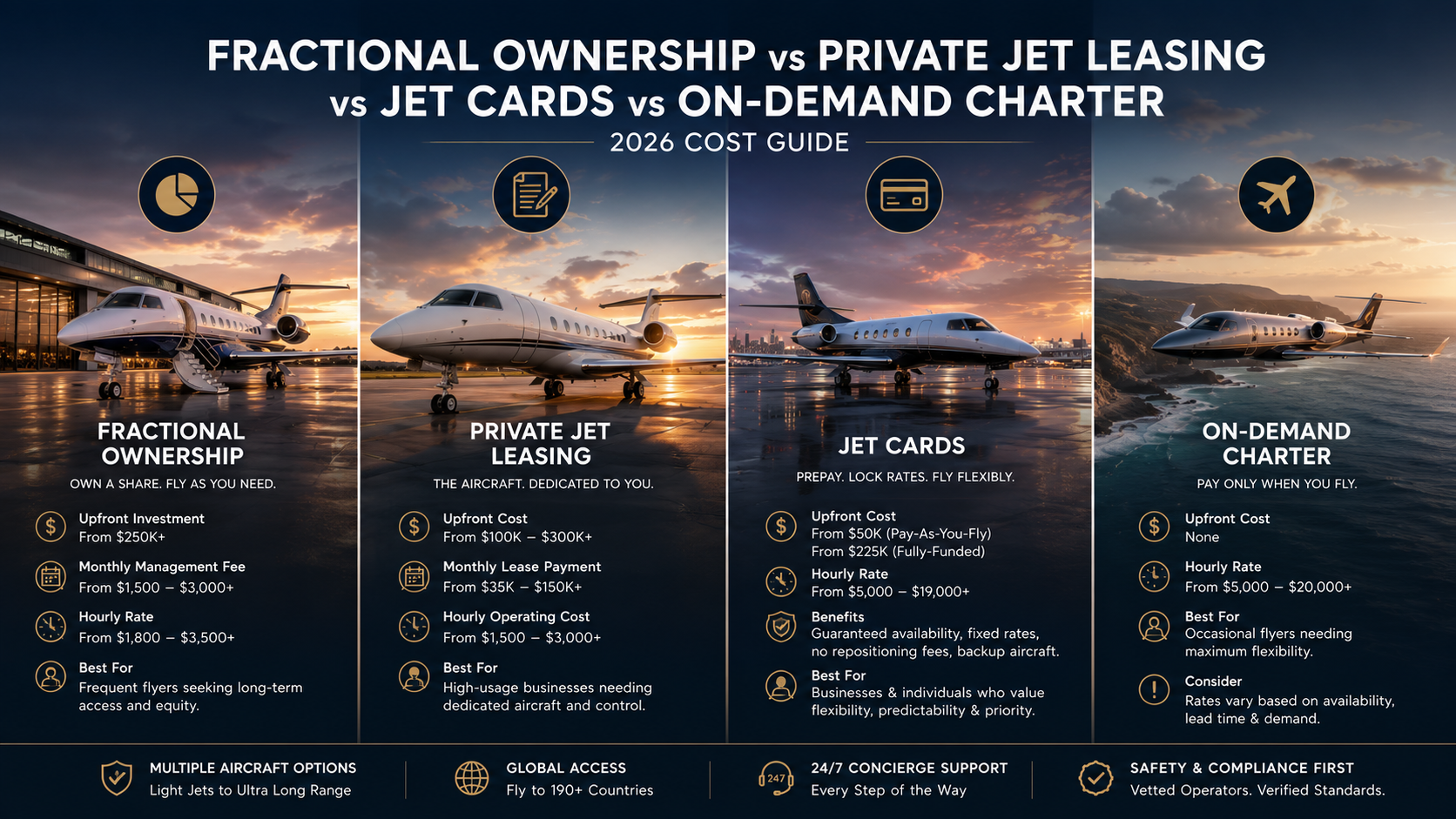
Private jet pricing looks complicated on purpose. Four access models compete for your money, and each one repackages the same underlying costs in a different wrapper. Fractional ownership, private jet leasing, jet cards, and on-demand charter all put you in a private cabin, yet the way each one bills can swing your five-year private jet cost by hundreds of thousands of dollars. The most useful thing to grasp before you compare a single quote is simple: you are not choosing a plane, you are choosing a pricing system. Pricing assumptions in this guide are current as of July 25, 2026.
Short on time? Route yourself with this quick guide, then read the sections that apply.
Fly 200+ hours a year on a steady schedule → price fractional ownership first.
Fly 50 to 150 hours and want fixed hourly pricing → compare jet cards and class-based access.
Hours are unpredictable or could drop next year → lean toward on-demand charter or a jet card.
Want a dedicated-aircraft feel without buying → look at leasing, then read the fixed-cost fine print.
Want zero capital tied up and maximum flexibility → on-demand charter fits best.
Here is each model in one sentence. Fractional ownership sells you a share of a specific aircraft plus guaranteed access for a multi-year term. Private jet leasing gives you contractual use of an aircraft for a set period and payment schedule. A jet card buys a block of flight hours at published rates and rules. On-demand charter is booking a private aircraft trip-by-trip with pricing based on the specific route, date, and aircraft, without buying hours or an ownership share.
The trade-off runs along two axes: predictability versus flexibility, and capital commitment versus pay-as-you-go. Fractional and leasing sit on the predictable, capital-heavy end. Jet cards land in the middle. On-demand charter gives the most flexibility with the least commitment. If your annual flying is uncertain or you may stop flying for a period, jet cards and on-demand charter reduce financial risk because you avoid multi-year commitments and resale exposure.
Flying about 60 hours a year with an unpredictable schedule? Compare a jet card against class-based access first, and hold on-demand charter as your flexible baseline. A full fractional share makes you carry fixed monthly fees whether you fly or not, which works against you at that utilization. Jettly advertises access to 23,000+ aircraft across more than 190 countries, so availability is rarely the constraint at 60 hours.
One line worth pinning up before you sign anything: fractional ownership is an access-and-availability contract dressed like ownership; the real question is whether the fixed fees and resale risk match how consistently you'll fly.
|
Model |
Typical commitment |
Cost predictability |
Best for |
|---|---|---|---|
|
Fractional ownership |
3 to 5 year share plus monthly fees |
High fixed, variable hourly on top |
Steady 200+ hours/year |
|
Private jet leasing |
1 to 5 year term |
High fixed monthly |
Dedicated feel, steady use |
|
Jet card |
Prepaid hours, often 12 to 24 months |
Fixed or capped hourly |
25 to 150 hours/year |
|
On-demand charter |
None, pay per trip |
Varies by trip and demand |
Unpredictable hours |
You are not choosing a plane. You are choosing a pricing system, and each system reacts differently when your flying changes.
Fractional ownership sells you a share of a specific aircraft, most commonly 1/16, 1/8, 1/4, or 1/2. Each share maps to an annual hour entitlement, and a 1/16 share is usually marketed near 50 hours a year. You sign a multi-year term, pay a monthly management fee, and pay an occupied hourly rate when you fly. At the end of the term the provider buys back or helps resell your share at a market-based residual, which is where a lot of the real cost hides.
Leasing gives you the right to use an aircraft for a defined term and payment schedule. Structures range from arrangements where you take on more operational control to ones where the operator handles crew and maintenance. Contract term, minimum payments, and return conditions define the deal. Leasing still behaves like a fixed-cost commitment: the monthly payment lands whether the aircraft flies or sits.
A jet card holds hours in a bank. You prepay a block, then draw it down at fixed or capped hourly pricing under published program rules covering notice time, peak days, minimum billed segments, and aircraft category caps. If the program has a monthly management fee, you're paying for readiness even in months you don't fly. Most jet cards skip that monthly charge, which is part of their appeal.
On-demand charter prices each trip on its own. Availability and rates move with demand, aircraft positioning, and crew schedules. Two roles matter here. The operator holds the air carrier certificate and flies the aircraft, and the broker arranges the trip across many operators. A charter broker arranges air transportation on certified third-party operators; the operator, not the broker, conducts the flight.
Jettly operates as a charter broker running a global digital marketplace. Every advertised flight is conducted by certified third-party air carriers holding FAA Part 135 or Part 121 certification (or the foreign equivalent), and Jettly complies with U.S. DOT Part 295 and Part 298 broker rules. Flexjet publishes a comparable occupied-hourly-plus-fixed-fee structure for its fractional program, a useful reference point when you read any proposal.
|
Model |
Upfront capital |
Fixed monthly |
Variable hourly |
Per-trip pricing |
|---|---|---|---|---|
|
Fractional ownership |
Yes (share) |
Yes (MMF) |
Yes (OHF) |
No |
|
Private jet leasing |
Sometimes |
Yes |
Sometimes |
No |
|
Jet card |
Prepaid block |
Usually none |
Yes (capped) |
No |
|
On-demand charter |
None |
None |
None |
Yes |
Read any proposal like a spreadsheet. Here are the 10 line items that make private jet pricing look mysteriously expensive.
Upfront capital: share purchase, deposit, or license fee.
Monthly management fee (MMF): the fixed overhead charge.
Occupied hourly rate (OHF): the per-hour flying charge.
Fuel: sometimes inside the hourly rate, sometimes a separate variable.
Taxes: U.S. Federal Excise Tax of 7.5% on domestic flight charges.
Repositioning or ferry time: moving the aircraft to you or to its next job.
Peak day surcharges: higher prices on designated high-demand dates.
De-icing: cold-weather charges that can surprise you.
International handling: permits, customs, and overnight crew costs.
Cancellation and change fees: heaviest on close-in trips.
Two of these drive most of the confusion, and they carry the definition worth memorizing. A monthly management fee pays for the aircraft's fixed overhead (crew, insurance, hangar, scheduling, and maintenance planning), while the occupied hourly rate is the per-hour charge you pay only when you fly. Learning the hourly occupied rate management fee relationship is the single most useful skill when reading a proposal. Every private jet cost comparison should map these line items side by side.
An occupied hourly rate is the per-hour charge applied when you're flying; it's typically calculated from takeoff to landing (and sometimes includes a taxi-time add-on or minimums, depending on the program). NetJets breaks its pricing into a monthly management fee, an occupied hourly rate, and a variable fuel component, a structure you can verify on the provider's own pricing page. Two proposals with the same hourly rate can have very different total cost if one adds fuel, ferry, peak, and taxi minimums as separate line items.
"Too many buyers compare private aviation programs using only the advertised hourly rate. In practice, the hourly figure is often the least important number. Fixed monthly fees, repositioning policies, peak-day rules, and exit obligations usually have a much greater impact on what you actually spend over the life of a program."
- Justin Crabbe, CEO
|
Line item |
What it is |
Who charges it most often |
What to ask |
|---|---|---|---|
|
Upfront capital |
Share, deposit, or license fee |
Fractional, some leases, jet cards |
Is it refundable? How is residual set? |
|
Monthly management fee |
Fixed overhead for crew, insurance, hangar |
Fractional, leasing |
Is there an annual escalation clause? |
|
Occupied hourly rate |
Per-hour flying charge |
All models |
Taxi time included? Minimum per leg? |
|
Fuel |
Variable energy cost |
Fractional (variable), charter (sometimes) |
Inside the rate or billed separately? |
|
Repositioning |
Moving the empty aircraft |
Charter, some cards |
Waived on membership? Capped? |
|
Peak day surcharge |
High-demand date premium |
Cards, fractional |
How many peak days per year? |
|
Taxes |
7.5% U.S. FET and segment fees |
All U.S. flights |
Shown as a line item? |
|
De-icing |
Cold-weather treatment |
Charter, cards |
Covered or passed through? |
For a deeper look at how the flying charge is set by category, our hourly rate guide breaks it down.
Fractional proposals are designed to make the hourly rate look like the main number. It is not.
Fractional jet ownership pricing usually has three core parts: an upfront share purchase (or lease-equivalent capital), a recurring monthly management fee, and a variable occupied hourly rate. Taxes and surcharges may be added on top. The acquisition cost buys your entry; the recurring fees decide your five-year total. Fractional ownership rewards steady, higher utilization, and the true private jet cost lands in those recurring fees rather than the sticker rate.
Share size sets your hours. A share size is the fraction of an aircraft program you purchase that determines your annual flight-hour entitlement (for example, 1/16 is commonly marketed as 50 hours per year). A 1/16 share is the smallest common position, mapping to roughly 50 hours, 1/8 to about 100, 1/4 to about 200, and 1/2 to about 400. Billing minimums and taxi rules can trim usable hours below the headline number.
|
Share |
Hours/year |
Typical commitment |
Best when |
Watch-outs |
|---|---|---|---|---|
|
1/16 |
~50 |
3 to 5 years |
Light, steady use |
Fixed fees dominate at low hours |
|
1/8 |
~100 |
3 to 5 years |
Regular regional travel |
MMF escalation clauses |
|
1/4 |
~200 |
3 to 5 years |
Frequent flyers |
Large capital tied up plus resale risk |
|
1/2 |
~400 |
3 to 5 years |
Near-daily travel |
Heaviest depreciation exposure |
In fractional ownership, the acquisition cost is only the entry ticket; the monthly management fee and occupied hourly rate usually drive most of the ongoing cash outlay. Typical fractional acquisition runs from about $500,000 for a small share to $1.5 million or more for larger shares, with monthly management fees commonly in the $8,000 to $25,000 range depending on aircraft. Share values fall over time, and a 30% to 50% drop over five years is a reasonable planning estimate.
"Guaranteed access" reads better than it lives. Access is conditional on notice time, peak-day limits, defined service areas, and the provider's right to substitute a different aircraft in your category. NetJets and Flexjet lead the fractional ownership market and both publish general program components; NetJets details its fee structure and Flexjet outlines its occupied-hourly and taxi-time approach. Our fractional cost breakdown works through the math with examples.
You want a dedicated-aircraft feel without buying an aircraft. Leasing is the model that promises that, and it delivers, up to a point.
Private jet leasing is a contractual right to use an aircraft for a defined term and payment schedule; it can lower upfront capital versus ownership, but it usually introduces fixed monthly obligations. Leasing solves for dedication and predictable access. It does not solve for utilization risk. Leasing can reduce upfront capital compared to ownership, but it can increase utilization risk because the monthly payment doesn't stop when you stop flying.
The variables that decide whether a lease is rational or a trap are minimum term, monthly lease cost, included hours (if any), overage rates, maintenance responsibility, and insurance responsibility. Depending on structure, maintenance and insurance sit with the operator or owner rather than you, or shift partly onto you. Our operating cost guide shows why these fixed costs exist whether the aircraft flies or not, which is exactly why a low-utilization lease can cost more per flown hour than charter.
Third-party economics back this up. SherpaReport's analysis of fractional versus whole ownership shows how fixed costs dominate the effective hourly cost once utilization drops. For roughly 50 to 150 hours a year, a jet card often matches or beats a lease without the fixed monthly obligation. Above that, where utilization is high and steady, a lease or fractional share starts to compete. Questions worth asking any lessor: Who controls scheduling? What happens during maintenance downtime? Which fees are fixed and which float with a monthly management fee or occupied hourly rate? Our guide to flexible leasing terms covers what to check before committing.
|
Factor |
Leasing |
Fractional |
Jet card |
Charter |
|---|---|---|---|---|
|
Upfront capital |
Low to moderate |
High |
Prepaid block |
None |
|
Monthly fixed cost |
Yes |
Yes |
Usually none |
None |
|
Flexibility |
Low |
Low to moderate |
Moderate |
High |
|
Exit friction |
Term lock-in |
Resale/residual risk |
Use remaining hours |
None |
A jet card is predictable pricing, until you hit the rule you didn't read.
A jet card is a private aviation program where you buy access (often as a block of flight hours) under published billing rules and pricing, instead of purchasing an ownership share. Blocks commonly start around 25 to 50 hours, though they vary by provider. A jet card is often the simplest way to fix your private jet cost per hour in advance, but the published hourly rate is only the starting point.
The rules that move the real price are aircraft category caps, peak-day definitions, minimum billed segment time, lead-time requirements, de-icing and fuel treatment, and cancellation windows. When comparing jet cards, treat the hourly rate as the starting point and the program rules as the real price. NetJets frames the share-versus-card choice on its own comparison page, a helpful look at how a major provider draws the line.
Jettly's Jet Card runs in tiers of 50, 100, 200, and Unlimited hours, priced at $50,000, $95,000, and $160,000 for the 50-, 100-, and 200-hour cards, each with a one-time enrollment fee of $12,997. Jettly uses an occupied hourly rate model with base rates from $3,630 per hour paid as you fly, plus an optional fully funded prepayment option ($225,000 for the 25-hour, $450,000 for the 50-hour, and $900,000 for the 100-hour card).
Three billing features separate Jettly membership from typical charter. Flights bill point to point, with the clock running from takeoff to landing. There are no fuel surcharges. There are no positioning fees on membership programs, so you pay for your flight, not the empty legs around it. Members book with a minimum 10-hour callout, and Jettly Jet Card hours do not expire, with no blackout dates or year-end use-by pressure. To see how programs stack up by use case, our jet card rankings compare terms side by side.
|
Rule |
Why it matters |
What to request in writing |
|---|---|---|
|
Peak days |
Higher rates and stricter notice |
Exact peak calendar and surcharge |
|
Minimum segment time |
Short legs bill more than flown |
Daily and per-leg minimums |
|
Lead time |
Guaranteed availability window |
Callout hours by aircraft category |
|
Fuel and de-icing |
Can add surprise cost |
Whether both are included |
|
Expiration |
Unused hours can lapse |
Confirm whether hours expire |
|
Refundability |
Exit and unused-hour value |
Refund terms in writing |
Charter is the most flexible model, but it's the least standardized.
On-demand charter is typically the best fit when you want maximum flexibility by trip, you don't want capital tied up, and your annual hours or aircraft needs vary. Pricing keys off aircraft category, route length, positioning, and demand for your dates. That is the core appeal of on-demand charter: you match spending to the trip in front of you.
Approximate 2026 charter rate bands, using Jettly's published figures, run like this: turboprops $1,800 to $2,800 per hour; very light jets $2,000 to $3,500; light jets $2,800 to $4,500; midsize and super-midsize $4,000 to $8,000; and heavy or ultra-long-range jets $8,000 to $15,000 and up. These are hourly ranges, not all-in trip prices, and your true private jet cost depends on more than the headline rate.
Several inputs push a charter quote higher: repositioning or ferry time, overnight crew stays, short-leg minimums, peak days, and international handling. Ferry or repositioning fees are charges for moving an aircraft to your departure airport or to its next assignment; they can materially change the effective hourly price on charter. If you don't know whether a quote includes repositioning time, you don't know the real charter price. Stratos Jets explains the same trade-off across fractional, card, and charter: flexibility rises as fixed commitment falls, and the cost of that flexibility shows up in per-trip variability.
Jettly runs this as a broker-led marketplace and issues a charter agreement for every booking that lists aircraft, itinerary, pricing, and terms. A trip is confirmed only after that agreement is signed and payment is secured. Many charters are non-refundable once confirmed, especially inside 72 hours of departure, with cancellation terms set by the operator. Jettly's instant quote tool returns route-specific estimates that factor flight distance, billable flight hours, the U.S. 7.5% Federal Excise Tax, and per-passenger segment fees; those results are estimates, not binding quotes. You can run numbers yourself with the charter calculator.
|
Provide this |
Why it changes the quote |
|---|---|
|
Route and dates |
Distance and demand set the base |
|
Time flexibility |
Flexible windows can lower price |
|
Passenger count |
Drives the aircraft category |
|
Baggage and pets |
May change aircraft or handling |
|
De-icing expectations |
Cold-weather cost exposure |
|
Cancellation window |
Sets your refund risk |
The right model is the one that still looks good if your hours drop by 30% next year.
Turn "it depends" into arithmetic. Here are the formulas, one per model.
Fractional 5-year cost = share purchase + (monthly management fee × 60) + (occupied hourly rate × hours flown) + taxes and surcharges − resale value at exit.
Lease 5-year cost = (monthly lease × term) + (hourly rate × hours) + overages + return costs.
Jet card 5-year cost = card purchases (capped rate × hours) + taxes + any peak upcharges.
Charter 5-year cost = sum of per-trip quotes (hourly × billable hours including repositioning) + taxes + fees.
Effective hourly cost is your total cost over a period (including fixed fees and capital losses) divided by the number of hours you actually flew. In any model with fixed monthly fees, your effective hourly cost rises sharply if you fly fewer hours than planned. That single sentence explains most buyer regret in fractional ownership.
Two variables swing fractional totals the most: depreciation and fee escalation. A share that loses 45% instead of 30% over five years can cost you six figures at exit, and our guide to resale and exit covers how buyback residuals get set. SherpaReport's math shows the same lever from another angle: lower utilization spreads fixed cost across fewer hours and lifts the effective rate.
Break-even is the number of hours at which one model's total cost equals another's. It moves with aircraft category and fee structure, so there is no universal figure. A heavy jet with a high monthly management fee has a higher break-even than a light jet on a card. Assumptions as of July 25, 2026 for the tables below: a midsize jet, a blended charter rate near $6,500 an hour, a jet card near $5,800, a fractional occupied hourly near $5,000 plus scaled management fees, and roughly 45% share depreciation over five years.
|
Illustrative 5-year cash outlay, midsize jet, excludes taxes. Figures are estimates for comparison only. |
||||
|
Hours/year |
Fractional |
Lease |
Jet card |
On-demand charter |
|---|---|---|---|---|
|
50 |
~$2.0M |
~$2.3M |
~$1.45M |
~$1.6M |
|
100 |
~$4.0M |
~$3.3M |
~$2.9M |
~$3.3M |
|
200 |
~$7.9M |
~$5.4M |
~$5.8M |
~$6.5M |
|
400 |
~$15.4M |
~$9.6M |
~$11.6M |
~$13.0M |
Fractional shows the highest cash cost in this illustration, and that reflects a real trade: the premium buys guaranteed availability, consistent aircraft, and, for businesses, potential depreciation benefits a cash table cannot capture. The point is not that fractional is bad. The point is that its fixed fees only pay off at steady, higher utilization.
|
Break-even sensitivity: which variable moves the 5-year result most. |
||
|
Variable |
Impact |
Why |
|---|---|---|
|
Share depreciation / residual |
High |
A 10-point resale swing shifts fractional by six figures |
|
Monthly management fee escalation |
High |
Paid 60 times; small increases compound |
|
Occupied hourly rate |
Medium to high |
Scales directly with hours flown |
|
Peak-day share |
Medium |
Surcharges cluster on popular dates |
|
Repositioning inclusion |
Medium |
Decides whether a charter rate reflects real cost |
Run the 60-hour case. At 60 occupied hours a year with an unpredictable schedule, a fractional share sized for that use carries roughly $9,000 to $17,000 a month in management fees whether you fly or not. Over five years, those fixed fees alone total $540,000 to more than $1 million before you buy a single hour. A jet card or on-demand charter lets you match spending to actual trips, which is why unpredictable flyers usually start there.
"We've found that sophisticated buyers approach private aviation the same way they evaluate any major business investment. They don't simply ask what a flight costs, they ask how the contract behaves over time, what happens if utilization changes, how easily they can exit, and which costs remain fixed regardless of whether the aircraft ever leaves the ground."
- Justin Crabbe, CEO
Use the same yardstick for every provider: costs, rules, and exit. The share size NetJets Flexjet overview below uses identical rows for each option, so you compare like with like, not marketing copy with marketing copy.
NetJets publishes a three-part framework of monthly management fee, occupied hourly rate, and a variable fuel component, and it offers both share and card programs. Flexjet publishes a comparable structure for fractional ownership, including occupied-hourly pricing with a taxi-time add-on. Jet cards vary most on peak days, minimums, fuel, and lead time, which is why two cards with the same headline rate can bill very differently. Our Flexjet vs NetJets comparison goes deeper on both fractional ownership programs.
Jettly plays a different position. Jettly provides capital-light access to private aviation through on-demand charter and membership programs that bill point-to-point (takeoff to landing) with no fuel surcharges and no repositioning fees on membership flights. The marketplace advertises access to 23,000+ aircraft across more than 190 countries, with instant quotes and iOS and Android apps. Membership runs in four tiers: Free, Personal, Business, and Unlimited. Paid tiers use dynamic flight pricing with no booking fee, carry no contract, and cancel online anytime; the Free tier adds a 10% booking fee. The Jet Card and Cloud Fraction programs use fixed hourly rates with point-to-point billing and no fuel surcharges, a 10-hour minimum callout, and Jet Card hours that do not expire, and member deposits sit in an insured escrow account kept separate from operating funds.
On safety, Jettly works only with certified operators that are ARGUS- or Wyvern-rated and monitors compliance with independent auditors. Flights are operated by the certified carrier, and passengers are covered by that operator's insurance rather than by the broker. Our overview of private jet safety standards explains how operator vetting works.
"The best private aviation program isn't necessarily the one with the lowest hourly price, it's the one whose financial structure matches how you actually travel. If your schedule changes frequently or your annual flight hours fluctuate, avoiding unnecessary fixed commitments can be just as valuable as negotiating a lower flight rate."
- Justin Crabbe, CEO
The most important comparison isn't NetJets vs Flexjet. It's fixed-fee commitments vs pay-as-you-go flexibility for your actual flying pattern.
|
Factor |
NetJets (fractional) |
Flexjet (fractional) |
Jet cards (general) |
Jettly |
|---|---|---|---|---|
|
Upfront capital |
Share purchase |
Share purchase |
Prepaid block |
None to license fee by program |
|
Monthly fixed fees |
Yes (MMF) |
Yes (MMF) |
Usually none |
None on charter; management fee on Cloud Fraction |
|
Hourly billing |
OHF plus fuel variable |
OHF plus taxi add-on |
Capped hourly |
Fixed hourly, point to point |
|
Repositioning |
Program-defined |
Program-defined |
Varies |
None on membership flights |
|
Notice time |
Program-defined |
Program-defined |
Varies |
10-hour callout |
|
Exit friction |
Resale/residual |
Resale/residual |
Use remaining hours |
No long-term lock-in beyond program term |
If it can be charged, it should be defined. The most expensive private jet fee is the one that wasn't defined in the contract. Hidden costs cluster in the fine print, and seven items deserve a written answer before you sign.
Peak-day definitions, surcharges, and different booking notice on those dates.
Minimum billable time per leg and any taxi add-ons.
Fuel treatment: included or variable, and whether any cap applies.
Repositioning: when it is waived and when it is charged.
Fee escalation clauses on the monthly management fee and the occupied hourly rate.
Early termination penalties and transfer restrictions.
Cancellation terms and close-in nonrefundability.
A peak day is a calendar date a provider designates as high-demand, often triggering higher prices, stricter notice requirements, or limited flexibility. Some programs list 10 peak days a year; others list 50. That difference alone can reshape your annual bill.
Get waivers in writing. NetJets discusses which charges its programs address on its cost page, a good model for the clarity to demand from anyone. On charter specifically, many flights are non-refundable once confirmed, especially within 72 hours of departure, with operator terms controlling. If you want lower-cost charter strategies, empty legs and flexible windows are the honest levers.
|
Red flag |
Why it matters |
What to negotiate or request |
|---|---|---|
|
Undefined peak days |
Open-ended surcharge exposure |
Fixed peak calendar in writing |
|
Vague fuel language |
Variable cost creep |
Cap or inclusion clause |
|
Silent repositioning policy |
Empty-leg charges add up |
Waiver or cap terms |
|
Uncapped fee escalation |
MMF rises yearly |
Annual escalation limit |
|
Harsh exit terms |
Costly to leave early |
Transfer and termination rights |
Don't start with a provider; start with your mission profile. A mission profile is the repeatable pattern of your flights (route length, passengers, booking notice, and frequency) that determines which pricing model is most efficient.
Quantify hours a year, with a best-case and a worst-case number.
List your top routes and typical passenger counts. Cross-border trips add permits and handling, so our international charter guide is worth a look here.
Decide your minimum notice tolerance, from same-day to 24 to 72 hours.
Choose the aircraft category you need 80% of the time, not the one for your single biggest trip.
Compare models using the same line items: MMF, OHF, fuel, peak, and repositioning.
Run the 5-year calculator, then stress-test it: drop your hours, raise fuel, add peak days.
Pick the aircraft you need most often, then buy flexibility for the exceptions, not the other way around. This decision guide, run honestly against your real private jet cost drivers and break-even math, points most variable-schedule flyers toward cards and charter, and steady high-hour flyers toward shares.
In 2026, fractional jet ownership cost is typically a combination of an upfront share purchase, a monthly management fee, and an occupied hourly rate, plus taxes and possible surcharges depending on the program. Totals vary most with aircraft class, share size, billing minimums, and the residual value you recover at exit. Acquisition commonly starts near $500,000 for a small share and climbs past $1.5 million for larger positions.
A monthly management fee covers fixed operating overhead, while an occupied hourly rate is the variable charge applied when you fly. The monthly fee pays for crew, insurance, hangar, and scheduling whether or not the aircraft moves; the hourly rate applies per flown hour, sometimes with taxi add-ons or minimums. Find both in the pricing schedule and the definitions section of any contract.
A jet card can be cheaper than fractional ownership when your annual flying is moderate or unpredictable, because you often avoid multi-year commitments and resale exposure. The reliable test is a five-year effective cost per occupied hour for both your expected and your downside scenarios. Run the calculator with a 30% drop in hours and see which model still looks reasonable.
The most common surprise fees are repositioning/ferry charges, peak day surcharges, minimum billable time per leg, fuel variables, and cancellation penalties. Ask for each in writing: the peak calendar, the per-leg minimum, whether fuel and de-icing are included, and the repositioning policy. A quote without those answers is not comparable to one that has them.
On-demand charter pricing is trip-based and depends on the aircraft category, route length, aircraft positioning, and demand for your dates. Always ask whether the quote includes repositioning time, since an empty ferry leg can change the effective hourly price. Estimates from a quote tool factor distance, billable hours, the 7.5% Federal Excise Tax, and segment fees, but the signed agreement sets the binding number.
Jettly recommends booking 24 to 72 hours in advance for best availability, but can often arrange same-day charters in as little as 3 to 6 hours depending on positioning and crew readiness. Membership flights use a 10-hour minimum callout. Actual availability depends on operator readiness at your departure point.
Jettly is a charter broker and marketplace, and flights are operated by certified third-party air carriers; passengers are covered by the operator's insurance. Every advertised flight runs under FAA Part 135 or Part 121 authority (or the foreign equivalent). Jettly does not carry additional liability insurance beyond the operator's coverage.
Match the pricing system to your flying, not the other way around. Steady, high-hour travelers with predictable schedules can justify the fixed fees inside fractional ownership or a lease. Anyone whose hours move around, which includes most people flying around 60 hours a year, usually keeps more money and more options with a jet card or on-demand charter. The math that settles it is a five-year effective cost per hour, stress-tested for a drop in usage.
Jettly provides capital-light access to private aviation through on-demand charter and membership programs that bill point to point with no fuel surcharges and no repositioning fees on membership flights. Run your numbers in the instant quote flow, then talk with a Personal Flight Coordinator for an apples-to-apples read across on-demand charter, the Jet Card, and Cloud Fraction. Call +1-866-448-2358 or email departures@jettly.com. Jettly arranges flights operated by certified third-party carriers, and cancellation terms depend on the operator and timing.
FAA PARC Steering Group - governance context for aviation data initiatives.
Share this post:
Jay Franco Serevilla
Jul 25, 2026
|
5
min read
Discover tips and trends in the industry.
5
min read
Stewardess: From Classic Airline Icon to Modern Flight Attendant
The term 'stewardess' has evolved into the more inclusive 'flight attendant,' reflecting the significant changes in the role from the mid-20th century to today. Modern flight attendants are trained safety professionals responsible for passenger safety, emergency response, and in-flight service, contrasting sharply with the outdated stereotypes of glamorous service. This article explores the history, training, and responsibilities of today's cabin crew across commercial and private aviation.
Read More
5
min read
DL 767: Delta Air Lines Flight DL767, Boeing 767‑300ER & Private Jet Alternatives
Delta Air Lines Flight DL 767 connects New York and Los Angeles using a Boeing 767-300ER, known for its reliability and comfort. This article explores the flight's features, the aircraft's specifications, and private jet alternatives for travelers seeking flexibility. With Delta planning to retire the 767-300ER by 2030, understanding your options is crucial for future travel.
Read MoreStay updated with our latest insights and tips to elevate your journey with us.
MEMBERSHIPS AND ASSOCIATIONS



Disclaimer: Jettly operates as a charter broker, offering access to a global digital jet charter marketplace. Jettly is not a direct air carrier and does not own or operate aircraft. All advertised flights are conducted by third-party air carriers that are fully licensed and hold the appropriate Part 135 or Part 121 certifications issued by the Federal Aviation Administration (FAA) or equivalent regulatory authorities under U.S. or foreign law. Jettly complies fully with the U.S. Department of Transportation's Part 295 and Part 298 Charter Broker regulations. Jettly does not carry additional liability insurance. Passengers are covered by aircraft operator insurance. TICO: 50023770


