


Login
Get Instant Pricing On 23,000+ Aircraft

>
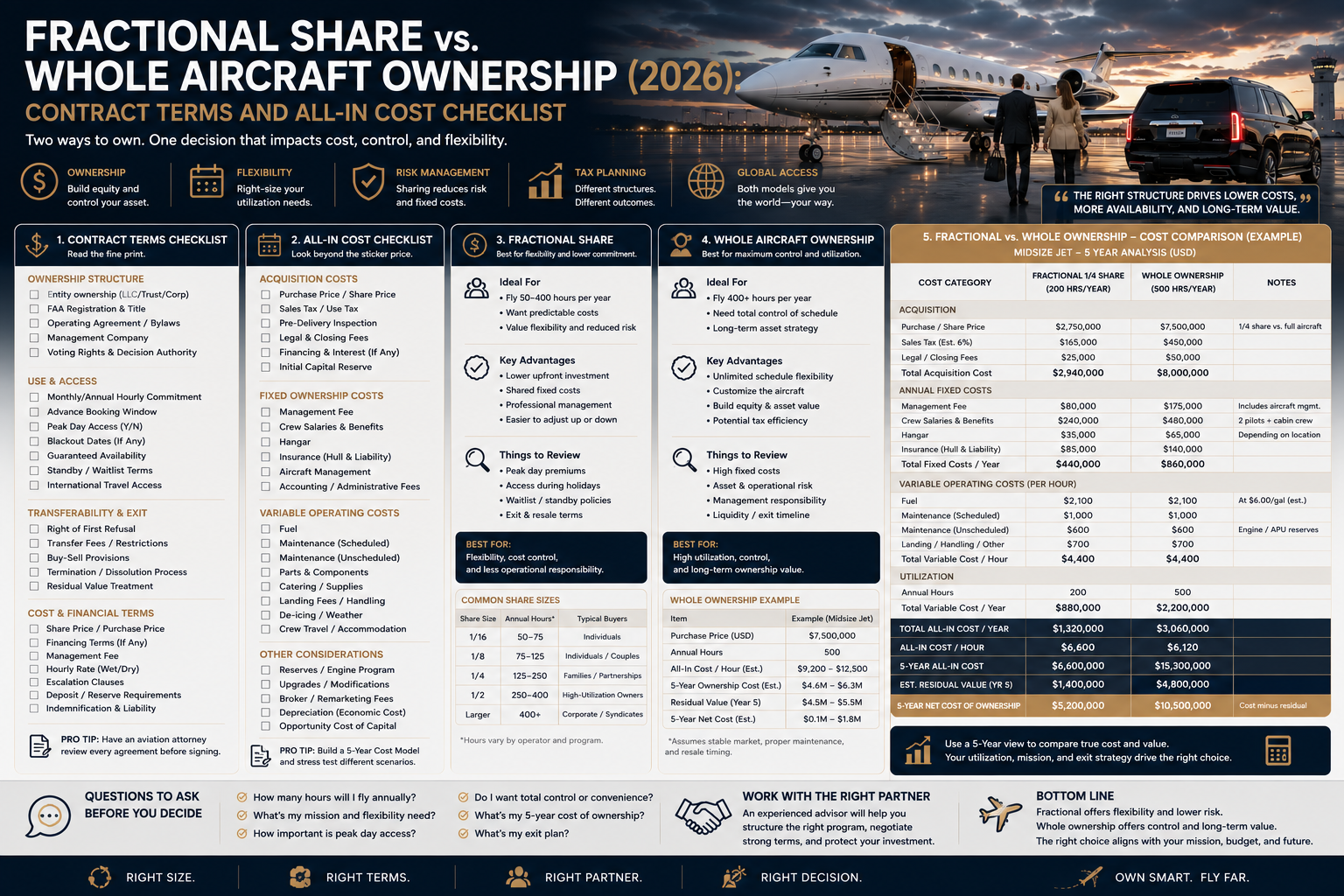
Buying private aviation access in 2026 comes down to one honest question: what are you actually trying to guarantee, an aircraft category, a departure day, or a total annual cost? This guide gives you a procurement-grade way to compare fractional jet ownership against whole aircraft ownership, starting with the contract and ending with one comparable number. The only apples-to-apples way to compare fractional share proposals is to convert buy-in (net of expected exit value), monthly fees, hourly charges, taxes, and surcharges into one metric: effective cost per occupied hour. Get that number right, read the peak-day clauses closely, and you sidestep the two most expensive mistakes buyers make.
Three drivers decide almost every private aviation access decision: your true all-in cost, your reliability on peak days, and your exit risk (how long it takes to get your capital back). Read the box below and find your line.
Fly under about 25 hours a year: on-demand charter or a small jet card usually wins, and ownership rarely pays off.
Fly 25 to 75 hours with unpredictable routes: a jet card or a fractional-style program keeps you flexible without capital lock-up.
Fly 75 to 150 hours on repeatable routes: compare a fractional 1/8 to 1/4 share against a jet card, weighing exit risk carefully.
Fly 150 to 300 hours and value an ownership structure: fractional jet ownership starts to compete, if you accept depreciation.
Fly 300+ hours or need a specialized mission: whole aircraft ownership can fit, with full downtime and backup-lift planning.
These ranges shift with cabin class and mission length. A short-leg operator burns fixed minimums faster, so a heavy-jet buyer flying long international legs behaves differently from a light-jet buyer hopping regional routes. Need multiple aircraft in different cities on the same day? Verify that capability in writing before anything else, because it changes the answer more than price does.
"The decision between fractional and whole aircraft ownership isn't really about buying an airplane, it's about choosing the most efficient way to guarantee access. Once you account for capital commitment, ongoing operating costs, peak-day reliability, and long-term exit risk, the ownership structure often matters more than the aircraft itself."
- Justin Crabbe, CEO, Jettly
Peak days are contract-defined high-demand dates when providers require more advance notice and may apply special scheduling rules or surcharges. If you can't get the schedule you need on peak days, the cheapest hourly rate is irrelevant. The FAA Aerospace Forecast projects sustained growth in U.S. business aviation activity through 2045, which tightens capacity on the busiest travel dates and makes those clauses worth reading twice.
Many buyers land on a portfolio approach: a primary model for regular flying plus a secondary option for peak weeks. Use the grid below as a starting point, then pressure-test it with the deeper comparison checklist later in this article.
|
Annual hours |
Likely best model(s) |
What to verify |
Common traps |
|---|---|---|---|
|
Under 25 |
On-demand charter, small jet card |
All-in hourly, cancellation terms |
Paying for a structure you barely use |
|
25 to 75 |
Jet card, fractional-style access |
Callout time, peak surcharges |
Buying hours you won't fly |
|
75 to 150 |
Fractional share or jet card |
Exit terms, guaranteed availability |
Ignoring resale and remarketing fees |
|
150 to 300 |
Fractional jet ownership |
Fee escalation caps, substitution |
Underestimating depreciation |
|
300+ |
Whole aircraft ownership |
Downtime coverage, backup lift |
Budgeting the best case only |
This is the core of fractional share vs whole ownership thinking: match the structure to your hours, your peak-day needs, and your appetite for capital risk before you look at any single hourly rate.
Pricing in private aviation is layered, never a single number. Any provider who quotes you "one rate" is hiding at least four other cost buckets that decide your real total.
Fractional jet ownership stacks five buckets: acquisition cost (your buy-in), a monthly management fee, an occupied hourly rate, taxes and surcharges, and exit economics when you leave. Whole aircraft ownership stacks differently: purchase or financing, fixed annual costs, variable hourly costs, and downtime or backup-lift costs. Named fractional providers such as NetJets and Flexjet package these into branded programs. A charter broker like Jettly reframes the same access as a jet card or a fractional-style license, which removes the aircraft title and most of the exit friction.
The occupied hourly rate is the contract-defined hourly charge for flight time (and any included taxi allowance), separate from monthly management fees and most taxes and surcharges. A low occupied hourly rate can still be expensive if the monthly fee is high and the exit value is uncertain. Independent analysis from SherpaReport makes the same point: whole ownership and fractional costs both stack far beyond the number on the first page of a brochure.
|
Model |
Upfront |
Monthly fixed |
Per hour |
Typical term |
Exit risk |
|---|---|---|---|---|---|
|
Fractional ownership |
Buy-in (six to seven figures by cabin) |
$10k to $30k+ |
~$3,500 to $13,000 |
Multi-year |
High (resale + remarketing) |
|
Whole aircraft ownership |
Full purchase / financing |
$60k to $170k+ equivalent |
~$1,500 to $5,000 variable |
Open-ended |
High (depreciation + market) |
|
Jettly Jet Card |
$12,997 one-time enrollment |
None |
From $3,528, paid as you fly |
Hours don't expire |
Low |
|
Jettly Cloud Fraction |
$325k to $725k license |
$12k to $22k |
$5,250 to $8,900 fixed |
36 months |
Low (no title) |
|
On-demand charter |
None |
None |
Market rate by trip |
Per flight |
None |
Two buckets are fixed (buy-in, monthly fee), one is variable (occupied hours), and one is lifecycle (depreciation and exit). Fractional jet ownership 2026 shoppers who skip the lifecycle bucket almost always overpay. For a line-by-line view, see this fractional ownership cost breakdown, which separates acquisition cost from monthly fees and hourly charges.
Fractional jet ownership means you buy an allocation of flight hours plus a set of contractual access rules, not a specific airplane you can walk out to whenever you like. You purchase a share, that share maps to annual hours, and the program guarantees access under defined conditions.
Share sizes follow a simple pattern. Providers such as Flexjet publish shares commencing at 1/16, and the ladder usually runs 1/16 (about 50 hours), 1/8 (about 100 hours), 1/4 (about 200 hours), and 1/2 (about 400 hours). Contract terms often run several years, and at the end you exit through a buyback or remarketing mechanism whose value depends on aircraft type, market conditions, and fees. No honest provider promises a fixed resale percentage, so treat exit value as a range you must model, not a guarantee.
Callout time is the minimum notice you must give for the program's availability guarantee to apply. In most fractional programs, "guaranteed availability" means an aircraft in the same category within a defined notice window, not a guaranteed specific tail number on demand. "Fleet access" means you may fly an equivalent aircraft in your category rather than your own airplane, which is fine for most missions but matters if you value a consistent cabin or crew.
|
Share |
~Annual hours |
Typically fits |
What to verify |
|---|---|---|---|
|
1/16 |
50 |
Light regional flyers |
Peak calendar, supplemental hours pricing |
|
1/8 |
100 |
Growing business travel |
Interchange ratios, guaranteed access window |
|
1/4 |
200 |
Frequent multi-city travel |
Fee escalation caps, substitution rights |
|
1/2 |
400 |
Heavy corporate use |
Exit timeline, fair market value method |
Before you commit to any share, model the numbers behind exit and resale, because liquidity and remarketing fees quietly reshape your all-in cost.
Owning the whole airplane means running a small aviation operation. You hold the title, and every operational responsibility that comes with it lands on your budget and your calendar.
Fixed costs run whether you fly or not: crew salaries, recurrent training, hangar and parking, insurance, a management company, subscriptions, and compliance oversight. Variable costs track your flying: fuel, maintenance reserves, landing and handling fees. Then comes downtime. Scheduled inspections and unexpected maintenance create days or weeks when the aircraft sits, you still pay the fixed costs, and you cannot fly it. Whole aircraft ownership can look cheaper per hour only if you fly enough hours to spread the fixed costs, and you budget for downtime and depreciation.
"Whole aircraft ownership provides the highest degree of control, but it also transfers every operational responsibility to the owner. Crew staffing, maintenance, insurance, regulatory compliance, downtime planning, and replacement lift all become part of the total cost of ownership, not optional considerations after the purchase."
- Justin Crabbe, CEO, Jettly
Total cost of ownership (TCO) is the sum of purchase or financing, fixed annual costs, variable flight costs, and resale or depreciation outcomes over the period you hold the aircraft. SherpaReport's cost comparisons use a light jet such as the Phenom 300 to show how a purchase price is only the opening line, with operating and lifecycle costs stacking on top over five years. Whole aircraft ownership tends to win in three cases: very high utilization, a specialized mission, or a genuine need for full customization and control, always weighed against the opportunity cost of the capital you tie up.
|
5-year line item |
Illustrative range |
Who owns this risk? |
|---|---|---|
|
Purchase / financing |
$5M to $75M+ |
Owner |
|
Crew (salary + benefits) |
$1.5M to $2.5M |
Owner |
|
Recurrent training |
$150k to $400k |
Owner |
|
Hangar and parking |
$300k to $700k |
Owner |
|
Insurance (hull + liability) |
$300k to $600k |
Owner / insurer |
|
Management company |
$500k to $900k |
Owner / manager |
|
Maintenance program + reserves |
$1M to $3M |
Owner / program |
|
Unscheduled downtime |
Variable |
Owner |
|
Backup lift for down days |
Variable |
Owner |
|
Depreciation / resale |
33% to 50% of value |
Owner / market |
These figures are illustrative, not quotes. For a deeper view of the middle rows, this operating cost breakdown walks through crew, maintenance, and hangar economics in detail.
Anyone comparing offers, whether a household or a corporate finance team, needs a single number that survives marketing spin. That number is effective cost per occupied hour, and it is the fairest way to line up two very different proposals.
Effective cost per occupied hour is your total program cost over the term (including buy-in net of exit value, monthly fees, hourly charges, and expected surcharges and taxes) divided by the number of hours you expect to fly. In plain math:
Effective cost per hour = ( buy-in − expected exit value + (monthly fee × months) + (occupied hourly rate × hours) + surcharges + taxes ) ÷ hours flown.
The inputs people forget are the ones that hurt: peak-day surcharges, taxi-time rules, daily minimums, the fuel variable, de-icing, international handling, and exit or remarketing fees. Utilization mismatch is the silent killer here. Buy 100 hours and fly 60, and your acquisition cost and monthly management fees spread across far fewer hours, so your effective rate spikes. If two programs can't be converted into effective cost per occupied hour using written inputs, they can't be compared responsibly.
"The strongest procurement decisions begin with the contract, not the brochure. Buyers who standardize every proposal into an effective cost per occupied hour while carefully reviewing peak-day clauses, substitution rights, and exit terms consistently make better long-term decisions than those focused solely on headline hourly pricing."
- Justin Crabbe, CEO, Jettly
|
Input |
Where it appears |
Why it matters |
Evidence to request |
|---|---|---|---|
|
Acquisition cost / buy-in |
Proposal |
Largest fixed sum |
Signed pricing schedule |
|
Monthly management fees |
Contract |
Runs whether you fly or not |
Fee schedule + escalation cap |
|
Occupied hourly rate |
Contract |
Scales with flying |
Rate table by aircraft |
|
Peak surcharges |
Peak calendar |
Hits your busiest dates |
Written peak-day list |
|
Taxi / minimum time |
Billing terms |
Inflates short legs |
Sample invoice |
|
Exit value |
Exit clause |
Determines net cost |
Buyback / remarketing terms |
Model the alternatives the same way with a route-based cost calculator so charter and card options sit on the same scale as ownership.
Request these documents before sending money: the pricing schedule, the peak-day calendar, the full sample agreement set, the cancellation schedule, and written confirmation of the operator's or program's insurance. In 2026, a good fractional vs whole-ownership checklist starts with the contract: callout time, peak-day calendar, substitution/recovery rights, billing definitions, fee escalation caps, and exit/remarketing terms.
Work through these eight clause areas with counsel:
Term and renewal: length, and any auto-renew language that locks you in silently.
Fee escalation: monthly fee increase caps, CPI language, and how the fuel variable is calculated.
Billing definitions: taxi time, leg minimums, daily minimums, and exactly when the clock starts and stops.
Service area and positioning: primary versus extended areas, and when repositioning charges apply.
Peak-day rules: how many peak days, notice windows, departure-time flexibility, and surcharge type.
Substitution and recovery: what counts as an equivalent aircraft, and how pricing adjusts on a downgrade or upgrade.
Supplemental hours: rate differentials, availability priority, and rollover rules.
Exit terms: buyback timeline, fair market value method, remarketing fees, early termination penalties, and transferability.
Substitution is the provider's right (and sometimes obligation) to provide a different aircraft than requested; the contract should define what qualifies as "equivalent" and how pricing changes. Billing conventions vary by provider, so read them literally. Flexjet, as one example, describes an occupied hourly rate with a taxi-time convention, and small differences in that definition change your invoice on every short leg. Peak-day rules, substitution rights, and exit terms are the three contract areas most likely to change your "headline" fractional price.
|
Clause |
Why it matters |
Acceptable language |
Red flag |
Evidence |
|---|---|---|---|---|
|
Fee escalation |
Protects your budget |
Capped annual increase |
Uncapped or "at provider discretion" |
Fee schedule |
|
Peak days |
Decides busy-date access |
Defined list + notice window |
Open-ended peak count |
Peak calendar |
|
Substitution |
Controls what you fly |
Equivalent category, no upcharge |
Downgrade with no adjustment |
Sample agreement |
|
Exit terms |
Sets your net cost |
Clear timeline + FMV method |
Vague valuation, high fees |
Remarketing clause |
Give the exit clause the most attention, since buyback and remarketing mechanics decide how much of your acquisition cost you ever see again.
Whole ownership is multiple contracts, not one. You sign a stack of agreements, and each one controls a different slice of your total cost. Whole aircraft ownership is rarely "just the purchase price", your checklist must include crew staffing, maintenance programs, hangar/parking, insurance, management, and downtime coverage.
The typical document stack looks like this:
Purchase agreement with a defined pre-buy inspection scope and clear acceptance and delivery conditions.
Aircraft management agreement covering budgeting, vendor selection, cost transparency, and conflict-of-interest disclosure.
Crew model setting the staffing plan, training cadence, duty-time coverage, and vacation backup.
Maintenance programs and reserves, including how major events get funded when they land.
Hangar and base strategy, with the repositioning implications spelled out.
Insurance procurement and claims process, where coverage depends on the operator and insurer in each context.
Downtime and backup lift plan, whether a charter policy, interchange rights, or a secondary access program.
Backup lift is a pre-arranged plan to source a replacement aircraft when your owned aircraft is down for maintenance or crew constraints. If your whole-ownership plan doesn't include backup lift, you're budgeting for the best-case scenario, not the real one. SherpaReport's ownership analysis reinforces the same warning: the ongoing expenses beyond the purchase price are large, recurring, and easy to underestimate.
One disclosure worth stating plainly here. Jettly is a charter broker and does not provide additional liability insurance; whichever access model you choose, passenger coverage comes from the certificated operator's policy, so confirm those certificates directly.
|
Document |
Costs it controls |
Questions to ask |
|---|---|---|
|
Purchase agreement |
Acquisition cost, pre-buy repairs |
Who pays for discrepancies found? |
|
Management agreement |
Fees, vendor markups |
Are vendor rebates passed through? |
|
Crew contracts |
Salaries, training, coverage |
How is vacation and sick coverage funded? |
|
Maintenance program |
Reserves, major events |
What triggers a reserve call? |
|
Insurance |
Hull, liability, claims |
Who holds the policy and the limits? |
If you lean toward ownership, this practical guide to buying a jet covers the deal sequence in more depth.
Picture a holiday week. You call on short notice, one aircraft in the fleet is grounded for maintenance, and every operator in the region is stretched. What happens next is written in your contract, not in the brochure.
Peak-day reliability is determined less by brochure promises and more by four clauses: peak-day notice window, guaranteed availability definition, substitution rights, and recovery aircraft procedures. Callout windows stretch on peak days, sometimes far beyond the standard notice, and peak calendars can be long. Departure-time flexibility clauses let some providers shift your time within a window, so a "confirmed" morning flight can slide to the afternoon. Substitution and recovery clauses answer the money question: who pays if the replacement aircraft costs more, and what happens if nothing is available at all.
A recovery aircraft policy explains how a provider sources a replacement aircraft (or other transport) if the scheduled aircraft becomes unavailable. Peak-day reliability is a contract outcome: the peak calendar, notice windows, substitution rights, and recovery procedures decide what you actually get. If you ever need simultaneous departures, multiple aircraft leaving different cities on the same day, ask for that guarantee in writing before you sign anything.
|
Stress-test question |
What good looks like |
Evidence |
|---|---|---|
|
How many peak days per year? |
Defined, capped list |
Peak calendar |
|
Peak callout window? |
Reasonable, stated in hours |
Contract clause |
|
Can departure times shift? |
Narrow, defined window |
Scheduling terms |
|
Who pays for a pricier substitute? |
Provider absorbs it |
Substitution clause |
|
What if no aircraft is available? |
Recovery plan + compensation |
Recovery clause |
|
Multiple aircraft same day? |
Confirmed capability |
Written confirmation |
Reliability planning connects directly to real-world disruption, so review the cancellation terms alongside these peak-day clauses.
The operator holds operational control; brokers arrange flights. That single distinction decides accountability, so anchor your safety review on it.
Operational control is the authority over the safety and conduct of a flight; it sits with the certificated air carrier or operator, not the broker. Fractional programs typically run under FAA Part 91K, charter flies under Part 135, and scheduled airline operations fall under Part 121. Whichever model you pick, request three things: the operator certificate, the insurance certificate, and the third-party safety ratings (ARGUS, Wyvern, or IS-BAO where applicable). Always confirm who holds operational control and whose insurance covers the flight, those two facts determine accountability.
Jettly is a charter broker, and its advertised flights are operated by third-party carriers certified under FAA Part 135 or Part 121 (or foreign equivalents). Jettly works with ARGUS- or Wyvern-rated operators, some also holding IS-BAO certification, and passenger coverage comes from the operator's insurance rather than the broker.
|
Verify |
Why it matters |
How to confirm |
|---|---|---|
|
Operator certificate |
Confirms who flies you |
Request the certificate number |
|
Insurance certificate |
Shows coverage and limits |
Ask for a current COI |
|
Safety rating |
Independent audit signal |
Check ARGUS / Wyvern / IS-BAO |
For a fuller picture of vetting standards, see this guide to private jet safety.
These are illustrative models, not quotes; your routes, cabin class, and peak days change the result. Each scenario uses a midsize-class reference and holds assumptions steady so you can see how utilization moves the answer.
Utilization is how many hours you actually fly; it determines how effectively you spread fixed costs and whether pre-purchased hours go unused. Three levers swing every number: monthly management fees, exit value, and how often you hit peak days. Short average leg length adds a fourth, because minimum-time billing punishes brief hops.
|
Scenario (5-yr total, effective/hr) |
Fractional |
Whole ownership |
Jet card |
On-demand charter |
|---|---|---|---|---|
|
50 hrs/yr (250 hrs) |
$2.36M ($9,440) |
$9.0M ($36,000) |
$1.46M ($5,852) |
$1.63M ($6,500) |
|
100 hrs/yr (500 hrs) |
$4.07M ($8,130) |
$9.65M ($19,300) |
$2.91M ($5,826) |
$3.25M ($6,500) |
|
200 hrs/yr (1,000 hrs) |
$7.42M ($7,420) |
$10.95M ($10,950) |
$5.81M ($5,813) |
$6.50M ($6,500) |
Scenario A (50 hours) shows why low-utilization ownership rarely pays: the buy-in and fixed costs spread over too few hours, so both fractional and whole ownership post punishing per-hour rates. Scenario B (100 hours) is where fractional programs look attractive on paper, yet unused hours and peak surcharges can erase the advantage fast. Scenario C (200 hours) narrows the gap, with fractional pulling within reach of the card and charter rates, and whole ownership finally becoming defensible for buyers who add downtime and backup-lift costs and value full control.
The sensitivity story is the real lesson. At 50 to 100 hours per year, small differences in monthly fees and exit value often matter more than the advertised hourly rate. Raise the monthly fee 20%, drop the exit value 15%, or add a dozen peak days, and the fractional column moves more than the hourly rate ever could. Non-ownership options hold a flat effective cost per occupied hour because they carry no fixed capital, which is why they win at lower and mid utilization.
Methodology and assumptions: midsize class; charter at $6,500/hr; jet card at $5,800/hr plus one-time enrollment; fractional occupied at $4,900/hr with buy-in scaled to share and exit recovery near 50%; whole ownership at a $9M purchase, roughly 40% depreciation over five years, about $950k fixed per year, and $2,600/hr variable. Numbers are rounded and illustrative. Benchmark the charter column against live charter pricing for your own routes.
Ownership isn't the only way to buy reliability. The question is what you need to guarantee: aircraft category, departure day, or total annual cost. Match the tool to that answer, and the decision gets simple.
Use Jettly (often) when you want flexibility without capital lock-up, your hours fluctuate year to year, you want simple billing, you need global lift across categories, or you want recovery options built in. Consider fractional ownership when you fly consistently at higher hours and genuinely value an ownership-style structure with contractual access rules, and you accept the exit and depreciation risk that comes with it. Consider whole aircraft ownership when you need full control, deep customization, or specialized missions, and you can carry the fixed costs plus a real downtime plan.
Capital risk is the money you may not recover when you exit an ownership position due to depreciation, market value swings, and fees. If you want reliability without owning an aircraft share, Jettly's Jet Card or Cloud Fraction can provide structured access with fewer exit and depreciation risks than fractional ownership. Jettly is a charter broker and does not own or operate aircraft; flights are flown by third-party certified carriers.
The Jettly programs worth comparing directly:
Jet Card in tiers of 25, 50, 100, and 200 hours, with a one-time $12,997 enrollment fee, an occupied hourly rate model from $3,528/hr paid as you fly, and optional fully funded prepay options. Hours do not expire, with no blackout dates or year-end pressure.
Cloud Fraction, a fractional-style license to an aircraft class rather than a single tail number: Light ($325,000 license + $5,250/hr + $12,000/mo), Midsize ($495,000 + $6,950/hr + $16,500/mo), and Super-Mid ($725,000 + $8,900/hr + $22,000/mo), each on a 36-month term with 50 annual flight hours and no tail-number restrictions.
Membership highlights across programs: no fuel surcharges, point-to-point billing where the clock starts at takeoff and stops at landing, no positioning fees on membership programs, a 10-hour minimum callout, deposits held in insured escrow kept separate from operating funds, a recovery aircraft guarantee, an optional flexible departure discount on a 72-hour window, a complimentary upgrade to a larger available aircraft when one is free at departure, and catering plus executive car service included on membership flights. Empty leg preferred pricing adds discounted repositioning fares on top.
Where Jettly may not fit: if you require a dedicated aircraft and a specific tail number, extensive custom interiors, or a fully owned asset on your balance sheet, an ownership model serves those goals better. For access without a purchase, the broader set of leasing alternatives widens the menu further.
|
Constraint |
Fractional |
Whole ownership |
Jettly Jet Card |
Cloud Fraction |
On-demand charter |
|---|---|---|---|---|---|
|
Peak-day certainty |
Strong (by contract) |
Strong (you control) |
Good |
Good |
Varies |
|
Variable schedule |
Weak |
Weak |
Strong |
Strong |
Strong |
|
Capital preservation |
Weak |
Weak |
Strong |
Strong |
Strong |
|
Multiple aircraft same day |
Limited |
No |
Good |
Good |
Good |
|
International reach |
Program-limited |
You arrange |
Broad network |
Broad network |
Broad network |
If it isn't in writing, score it as unknown. That single rule keeps verbal promises from inflating a proposal that can't back them up.
An evidence log is a record of where each claim is proven in writing (contract clause, pricing schedule, or written confirmation). A provider's answer only counts if you can attach written evidence, contract language beats verbal assurances every time. Copy the questions below into a spreadsheet, add columns for your answer and a link to the proof, and weight four categories to fit your priorities: Cost, Availability, Contract Risk, and Safety and Compliance.
|
Question |
Why it matters |
Acceptable proof |
|---|---|---|
|
What is the buy-in or acquisition cost? |
Largest fixed sum |
Pricing schedule |
|
What are the monthly management fees? |
Runs regardless of flying |
Fee schedule |
|
What is the occupied hourly rate? |
Scales with hours |
Rate table |
|
Is there a fee escalation cap? |
Budget protection |
Contract clause |
|
How is the fuel variable calculated? |
Hidden cost driver |
Billing terms |
|
How many peak days, and what notice? |
Busy-date access |
Peak calendar |
|
How is guaranteed availability defined? |
Sets real access |
Availability clause |
|
What are the substitution rules? |
Controls what you fly |
Sample agreement |
|
What is the recovery aircraft policy? |
Disruption backstop |
Recovery clause |
|
When does the billing clock start and stop? |
Short-leg cost |
Sample invoice |
|
Are there daily or leg minimums? |
Inflates light use |
Billing terms |
|
What is the service area? |
Positioning charges |
Service area map |
|
What is the cancellation schedule? |
Change-day cost |
Cancellation policy |
|
Who holds operational control? |
Accountability |
Operator certificate |
|
Whose insurance covers the flight? |
Liability clarity |
Insurance certificate |
|
What safety ratings apply? |
Audit signal |
ARGUS / Wyvern / IS-BAO |
|
What is the exit timeline? |
Time-to-capital-back |
Exit clause |
|
How is fair market value set at exit? |
Net cost driver |
Valuation method |
|
What are the remarketing or exit fees? |
Reduces recovery |
Remarketing terms |
|
Is the position transferable? |
Flexibility |
Transfer clause |
For a deeper template, this 50-question 50-question spreadsheet extends the same evidence-first method across every access model.
In 2026, fractional jet ownership typically includes (1) an upfront buy-in, (2) monthly management fees, and (3) an occupied hourly rate, plus taxes, surcharges, and exit economics that can materially change the all-in cost. Illustrative ranges run from several hundred thousand dollars of acquisition cost for a light-jet 1/16 share to multi-million-dollar buy-ins for large-cabin quarter shares, with occupied hourly rates roughly $3,500 to $13,000 by cabin. Model the exit value and peak-day rules before you trust any headline figure.
Acquisition cost varies by aircraft class and provider, but share size generally maps to annual hours: 1/16 is about 50 hours, 1/8 about 100, and 1/4 about 200. Any acquisition figure should be modeled net of expected exit value and remarketing fees, so you can compare it fairly against a jet card or on-demand charter that ties up no capital.
Fractional can be cheaper than whole ownership when you don't fly enough hours to spread fixed costs, or when you value outsourced management and guaranteed access more than total control. Whole ownership improves per hour as utilization climbs, but only if you also budget for downtime, backup lift, and depreciation. At 50 to 100 hours a year, most buyers find fractional or a jet card easier to justify than a full purchase.
Guaranteed availability usually means access to an equivalent aircraft category within a defined callout window and service area, not guaranteed access to a specific tail number at any time. Confirm the peak-day calendar and the substitution clause in writing, because those two documents decide what "guaranteed" delivers on your busiest travel dates.
The most common "hidden" costs are peak-day surcharges, fuel variables, de-icing, minimum billable time rules, international handling, and exit or remarketing fees. Surface them by requesting the pricing schedule, the peak-day calendar, and a sample invoice before you sign, then fold each one into your effective cost per occupied hour.
Before signing, verify callout windows (peak versus non-peak), billing definitions, substitution and recovery clauses, fee escalation caps, and the exact exit timeline and valuation method. Get every answer in writing, since a verbal promise you cannot attach to a contract clause should be scored as unknown.
A jet card often fits better than fractional ownership when your hours fluctuate, you want predictable billing without resale risk, or you want the option to walk away without a multi-year exit process. Jettly's Jet Card holds hours that do not expire and offers a 10-hour minimum callout on its membership programs, which suits travelers who value flexibility over an ownership title.
No, Jettly is a charter broker that arranges flights operated by third-party certified air carriers (FAA Part 135 or Part 121, or foreign equivalents). Operational control sits with the operator, and passenger coverage comes from the operator's insurance, so Jettly arranges and coordinates the flight rather than flying it or insuring it directly.
The winning method in 2026 is boring and repeatable: read the contract first, convert every proposal into effective cost per occupied hour using written inputs, score the peak-day clauses on their own, and attach evidence to every claim. Do that, and fractional share vs whole ownership stops being a marketing contest and becomes a math problem you can actually solve. For many buyers, the honest answer is that a jet card or a fractional-style license delivers the reliability they need with far less capital risk than owning a share or a whole airplane.
Want reliability without buying a share? Ask Jettly to model Jet Card vs Cloud Fraction vs charter for your top 10 routes, including a peak-day reliability review. Call +1-866-448-2358, email departures@jettly.com, or run an instant quote in the Jettly app. Jettly is a broker; all flights are operated by certificated air carriers, and coverage is provided by the operator's insurance.
FAA Aerospace Forecast Fiscal Years 2025 to 2045 - U.S. business aviation demand and utilization context for peak-day availability.
IRS Publication 946, How To Depreciate Property - baseline reference for how depreciation recovers the cost of business property (not tax advice).
Share this post:
Jay Franco Serevilla
Jul 25, 2026
|
5
min read
Discover tips and trends in the industry.

5
min read
Airline Charter: How Private Charter Flights Work with Jettly
Airline charters provide travelers with the flexibility to choose their departure times, destinations, and aircraft, making them ideal for business and leisure travel. Jettly's platform connects users to over 20,000 aircraft globally, simplifying the booking process with instant pricing and no long-term commitments. This guide explores how private charter flights work and the advantages they offer over traditional scheduled flights.
Read More
5
min read
Ontario, CA to Carson, CA by Private Jet: Route Guide, Airports, and Travel Options
Traveling from Ontario, CA to Carson, CA offers various options, including driving, public transit, and private aviation. While driving is the most common method, private jets can significantly reduce travel time when combined with ground transfers. This guide provides insights into travel times, costs, and the best airports for a seamless journey.
Read MoreStay updated with our latest insights and tips to elevate your journey with us.
MEMBERSHIPS AND ASSOCIATIONS



Disclaimer: Jettly operates as a charter broker, offering access to a global digital jet charter marketplace. Jettly is not a direct air carrier and does not own or operate aircraft. All advertised flights are conducted by third-party air carriers that are fully licensed and hold the appropriate Part 135 or Part 121 certifications issued by the Federal Aviation Administration (FAA) or equivalent regulatory authorities under U.S. or foreign law. Jettly complies fully with the U.S. Department of Transportation's Part 295 and Part 298 Charter Broker regulations. Jettly does not carry additional liability insurance. Passengers are covered by aircraft operator insurance. TICO: 50023770


