



Login
Get Instant Pricing On 23,000+ Aircraft

>

The GE Honda HF120 engine sits at the heart of one of the most talked-about aircraft in private aviation. As a turbofan engine in the 2,000-pound thrust class, it powers the HondaJet family and sets a high bar for what light business jets can achieve. This article breaks down how the HF120 works, what makes it efficient, and why it matters for charter travelers.
The GE Honda HF120 engine is a 2,000-lbf class turbofan developed by GE Honda Aero Engines, a joint venture between GE and Honda. It received FAA type certification in 2013 and powers the HondaJet aircraft family.
The HF120 produces 2,095 lbf of thrust, delivers high performance with efficient fuel burn, low noise below Stage 4 requirements, and demonstrated compatibility with 100% Sustainable Aviation Fuel.
Core technical features include a compact two-spool design, wide-chord titanium blisk fan, dual-channel FADEC control, effusion-cooled combustor, and a 5,000-hour target TBO.
Fleet milestones include more than 500 engines produced, over 250 HondaJets delivered, and the engine fleet surpassing 240,000 flight hours.
Through Jettly's digital charter marketplace, travelers can access HondaJets and similar light business jets powered by the HF120 for flexible, efficient private flights.
GE Honda Aero Engines is a 50/50 joint venture. GE Aviation and Honda formed this partnership in 2004, combining two industry leaders and two respected names in engine technology, while drawing on advanced manufacturing and significant research and development investment. The GE Honda HF120 grew out of Honda's earlier HF118 research engine and became the venture's first commercial product, targeting very light jets and light business jets.
The HF120 engine was developed as a joint venture between GE and Honda to fill a gap for efficient small turbofan engines while delivering high performance and reliability for this segment. Its primary application is the Honda HA-420 HondaJet, designed for 4–6 passenger aircraft that balance increased aircraft speed, climb performance, and reduced aircraft operating costs. The engine program launched around 2006, with intensive testing from 2009 onward. For charter customers booking through Jettly private charter aircraft, this powerplant sits behind the scenes but strongly influences trip performance, comfort, and cost.
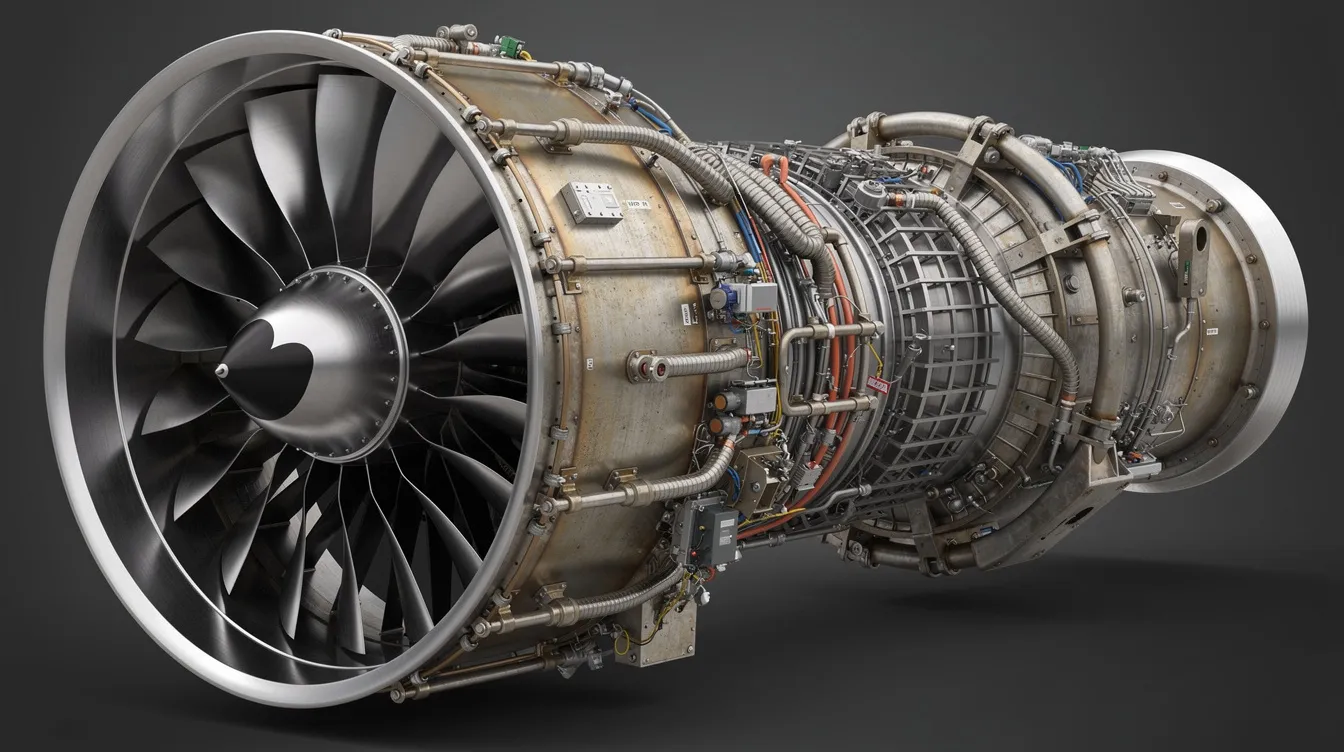
The HF120 turbofan engine uses a two-spool architecture with an axial-centrifugal compressor combination. A centrifugal impeller designed for maximum airflow efficiency pairs with a single-stage high-pressure turbine. The result is a compact design with a dry weight of approximately 466 lbs, delivering outstanding power from a small package.
Key specifications at a glance:
|
Specification |
Value |
|---|---|
|
Static thrust (sea level) |
2,095 lbf |
|
Thrust-to-weight ratio |
~4.5 |
|
Overall pressure ratio |
24:1 |
|
Bypass ratio |
2.9 |
|
Dry weight |
~466 lbs |
|
Target TBO |
5,000 hours |
The wide-chord swept titanium blisk fan and composite fan guide vanes improve aerodynamics while reducing weight and part count. HF120 components optimize operability through innovative 3D aerodynamic designs, contributing to smooth airflow and reduced vibration. The engine has a high thrust-to-weight ratio, allowing for rapid climbs and enabling a climb rate of over 4,000 feet per minute to altitudes around FL450. It incorporates advanced materials to withstand high temperatures in the turbine, and the innovative turbine blade geometry supports greater efficiency across the flight envelope.
The dual-channel FADEC system automatically manages thrust, fuel flow, and engine limits. This aids pilots, improves engine protection, and supports consistent high performance over the engine's life. Designed for frequent-cycle business aviation use, the HF120 handles multiple legs per day—exactly what charter operations demand.
The HF120 was built to deliver unparalleled performance not just in speed, but in environmental performance. Its optimized bypass ratio, advanced compressor aerodynamics, and airblast fuel nozzles produce better fuel atomization and more complete combustion. The HF120 helps reduce fuel burn by 15–20% compared to older engines in its class, and HondaJet achieves up to 20% less fuel consumption than competitors, a significant efficiency benefit.
The HF120 incorporates a unique effusion-cooled combustor design that lowers turbine inlet temperatures while reducing NOx, CO, and HC emissions. These combustor materials and variable geometry features bring this next-generation small turbofan closer to standards previously associated with larger transport engines.
Noise reduction is just one of the engine's unique features. Rotor dynamics keep resonant frequencies away from common taxi and flight RPM ranges. Tight manufacturing tolerances cut vibration. The HF120 operates with noise levels below FAA Stage 4 requirements, and the engine's design allows for a quieter cabin experience during flight.
GE Honda Aero Engines completed ground testing using 100% Sustainable Aviation Fuel, proving the HF120 can operate fully on SAF blends. This strong commitment to environmental performance supports reduced community noise footprints near smaller airports and lower fuel burn that can translate to more cost-efficient charter pricing when using Jettly's airport locator tool to access smaller regional fields.
Durability was a central goal. The HF120 uses superalloys in the hot section, high-temperature coatings, and optimized cooling passages. The differential bearing architecture and simplified part counts—like the blisk fan—extend component life. The HF120 engine achieves a target TBO of 5,000 hours, and predictive maintenance is supported by advanced monitoring systems, providing predictable utilization profiles that align well with Jettly's jet card flight cost estimator.
The HF120 underwent endurance and icing testing for certification. GE Honda tested tens of thousands of cycles, including simulations of over 5,000 flight cycles on a single engine.
Major certification milestones:
FAA type certification of the HF120 in December 2013
HA-420 FAA type certification in December 2015
EASA validation in April 2016
Brazil's ANAC approval in 2017
Production certificate for Burlington, North Carolina facility
By the mid-2020s, the HF120 had surpassed 240,000 flight hours in operation. Industry leaders recognized the engine's technology leadership and dispatch reliability across the growing HondaJet fleet.
The HondaJet family—HA-420 and Elite derivatives—is the primary platform. HondaJet features an over-the-wing engine mount design, and this over-the-wing engine placement improves aerodynamic performance. Engine placement increases cabin volume by 20% compared to competitors, and HondaJet's design reduces cabin noise by isolating vibrations from the fuselage.
The HF120's compact, lightweight build makes OTWEM feasible: reduced nacelle size, an efficient thrust-to-weight ratio, and low vibration that together support high cruise altitudes around FL430–FL450. The HondaJet has a maximum cruising speed of 422 knots—meaning the HondaJet can fly faster than similarly sized aircraft, with reduced climb time to cruise altitude.
The HF120 has been proposed as a retrofit option for older light jets such as the Cessna CitationJet CJ1, aiming to deliver better fuel burn and lower maintenance costs. The HondaJet Elite II features Emergency Autoland certification, adding another layer of safety. Operators benefit from the HF120's reduced direct operating costs and maintenance downtime—critical for charter profiles involving 2–5 passengers, stage lengths of 500–1,200 nm, and frequent cycles, which can be analyzed using Jettly's private jet charter cost estimator.

Recent press release highlights from GE Honda confirm strong momentum. The company reached production of the 500th HF120 engine at Honda Aero Inc. in Burlington, North Carolina. The installed base now spans more than 250 HondaJet aircraft worldwide.
The HF120-powered fleet surpassed 240,000 flight hours, underlining a maturing service record. Service network expansions include agreements with providers like Signature TECHNICAir as Authorized Service Providers, plus expanded MRO capabilities, helping ensure predictable uptime that supports fixed-hour pricing in world-class corporate jet card programs. GE Honda also announced successful HF120 testing with 100% SAF in October 2022, reinforcing the engine's best-in-class environmental credentials. These updates from the leading provider of small aviation engines reassure charter users and fleet operators that the HF120 remains fully supported.
Most travelers book aircraft, not engines. But the GE Honda HF120 plays a key role in the value proposition when chartering light business jets through Jettly or enrolling in Jettly's private jet memberships.
Operating costs for a HondaJet total approximately $1,019,567 annually, with variable hourly costs estimated at $1,561.60 and fixed costs about $202,488 yearly, figures that fit into broader benchmarks discussed in Jettly's guide on how much a private jet costs. The HF120's efficient fuel burn and long maintenance intervals help keep these numbers competitive, which can translate into favorable hourly charter rates—especially on short- to mid-range trips, as outlined in Jettly's guide on how much to rent a private jet.
Cabin comfort advantages are real: lower noise and vibration mean easier conversations and a more relaxed environment. HF120-powered HondaJets can use shorter runways at regional airports, allowing Jettly users to arrive closer to final destinations and apply many of the tips for booking the cheapest private jet flights by leveraging secondary airports and efficient light jets. High dispatch reliability limits last-minute aircraft substitutions, keeping schedules on track and maximizing seat availability for crowdsourced private jet flights and shared empty seats.
The HF120 generally offers fuel efficiency improvements of 15–20% versus older engines in the same thrust class. HF120 uses up to 20% less fuel than similar aircraft, though exact savings vary by routing, payload, and flight levels, contributing directly to more affordable private jet charter options. The optimized operability of its compressor and combustor designs drives this advantage.
Yes. GE Honda completed ground testing on 100% SAF (HEFA-SPK), confirming the HF120 is compatible with 100% Sustainable Aviation Fuel. Current operations typically follow approved SAF blend ratios. As regulations and fuel availability expand, broader use is expected for both domestic and international private jet flights.
The HF120 targets around 5,000 hours between major overhauls, supporting consistent operations across a wide range of operators featured in the ultimate list of charter airlines. Scheduled inspections and hot-section checks occur at defined intervals. Many operators participate in GE Honda maintenance programs to stabilize engine-related costs and manufacture engine components to specification across the aircraft's life.
The HondaJet family—including the original HA-420, Elite, Elite S, and Elite II—is the primary production platform powered by the Honda HF120. Retrofit concepts have been proposed for other small jets like the CitationJet CJ1, though widespread adoption outside the HondaJet remains limited, especially when many travelers evaluate HF120-powered aircraft as a NetJets alternative with Jettly.
Jettly lets customers filter by aircraft model rather than engine type. Choosing a HondaJet or HondaJet Elite effectively means selecting an aircraft powered by GE Honda HF120 engines, while some travelers may simply buy a seat on a private jet instead of chartering the entire aircraft. This gives customers the speed, efficiency, and quiet operation outlined above, while a variety of booking strategies make it easy to get a seat on a private jet. Explore options at jettly.com.
The GE Honda HF120 engine combines outstanding design, high performance, strong environmental performance, and long maintenance intervals. It stands as a cornerstone powerplant in the light business jet category. Its proven track record, extensive type certification history, and successful SAF testing position the HF120 as a modern, future-ready engine for business aviation. Travelers who book HondaJet and similar light jets through Jettly benefit directly from the HF120's efficiency, speed, and quiet operation on regional missions, whether flying popular domestic routes or arranging private jet charter in Kolkata, West Bengal.
Ready to experience private travel on your terms? Explore flight options or request a quote at jettly.com for everything from regional hops to private jet charter in New Delhi.
Share this post:
Jay Franco Serevilla
Oct 19, 2026
|
5
min read
Discover tips and trends in the industry.
5
min read
Aircraft Charter Guide: How to Choose, Book, and Fly with Confidence
This comprehensive aircraft charter guide provides essential insights on how to choose, book, and fly with confidence using Jettly's digital platform. It covers various jet categories, the charter process, and highlights the benefits of private aviation for both personal and business travel. With access to over 20,000 aircraft and transparent pricing, Jettly simplifies the charter experience for travelers.
Read More
5
min read
Who Owns a Jet? A Guide to Private Jet Owners, Boeing BBJ Operators, and Smarter Ways to Fly
This guide explores the landscape of private jet ownership, highlighting famous owners like Oprah Winfrey and Prince Al Waleed bin Talal. It also discusses the advantages of private jet charter services, such as Jettly, which provide flexible access to a wide range of aircraft without the burdens of ownership. Understanding the different models of private jet access can help travelers make informed decisions about their flying needs.
Read MoreStay updated with our latest insights and tips to elevate your journey with us.
MEMBERSHIPS AND ASSOCIATIONS



Disclaimer: Jettly operates as a charter broker, offering access to a global digital jet charter marketplace. Jettly is not a direct air carrier and does not own or operate aircraft. All advertised flights are conducted by third-party air carriers that are fully licensed and hold the appropriate Part 135 or Part 121 certifications issued by the Federal Aviation Administration (FAA) or equivalent regulatory authorities under U.S. or foreign law. Jettly complies fully with the U.S. Department of Transportation's Part 295 and Part 298 Charter Broker regulations. Jettly does not carry additional liability insurance. Passengers are covered by aircraft operator insurance. TICO: 50023770


