


Login
Get Instant Pricing On 23,000+ Aircraft

>

The General Dynamics F-16 Fighting Falcon is a single-engine, highly maneuverable, supersonic, multirole air combat fighter first delivered to the United States Air Force in January 1979. Best known for its agility, fly-by-wire flight controls, and ability to switch between air superiority and ground-attack missions, the F-16 features a frameless bubble canopy providing 360° visibility, a side-mounted control stick for pilot comfort, and a pilot seat reclined at a 30° angle to reduce g-force effects during high-G maneuvers. Its cockpit includes a head-up display and HOTAS (Hands On Throttle-And-Stick) controls to enhance pilot situational awareness and control during complex combat operations.
Originally designed by General Dynamics (now Lockheed Martin after acquiring General Dynamics' aircraft division), the F-16 became one of the defining combat aircraft of the late 20th century and remains one of the most widely operated Western fighters, flying with about 25 air forces worldwide.
For aviation enthusiasts, defense analysts, military personnel, and private travelers curious about how a frontline fighter compares with civilian aircraft, the F-16 offers a clear window into modern military aviation. This guide examines the aircraft’s design and development, technical specifications, avionics, weapons systems, variants, combat history, operational roles, modernization programs, global operators, and broader economic impact.
Its key technical breakthroughs were radical for the 1970s: the first production fly-by-wire combat aircraft with relaxed static stability for improved maneuverability, a frameless bubble canopy offering near-360-degree visibility, a side-mounted control stick, and 9-g maneuver capability at speeds over Mach 2. These features made the F-16 the first fighter aircraft purpose-built around pilot-centric ergonomics and electronic flight management, and they continue to influence how readers understand both advanced combat jet design and the evolution of high-performance flight.
The scale of the program is staggering. Around 4,604 F-16s have been built since 1976, with operations spanning the Middle East, Balkans, South Asia, East Asia, and most recently Ukraine, which began receiving donated F-16s in mid-2024. While the F-16 is a military counterpart to high-performance civilian aircraft, it remains exclusively a defense asset; private travelers seeking speed and flexibility instead rely on business jets, available through charter services like Jettly, for point-to-point convenience without the combat systems or military restrictions.
The General Dynamics F-16 Fighting Falcon is a single-engine, multirole air combat fighter that debuted in 1978 and remains in active service with roughly 25 air forces worldwide, making it one of the most widely operated Western fighters ever built.
The F-16 was the first production fly-by-wire fighter with relaxed static stability, a frameless bubble canopy offering 360° visibility, side-stick controls for pilot comfort, and HOTAS controls for enhanced maneuverability, establishing a benchmark for modern air combat design that influenced every Western fighter built after it.
About 4,604 F-16s have been built since 1976 across multiple variants, from the early F-16A/B through the latest Block 70/72 "Viper," with extensive combat history stretching from Operation Opera and the Bekaa Valley to the 1991 Gulf War, the Balkans, and 21st-century conflicts.
The F-16 is strictly a military combat aircraft and not available for private jet charter. Travelers looking for high-performance, point-to-point air travel instead use civilian-certified business jets accessible through platforms like Jettly.
Late 1960s–Early 1970s: USAF seeks a lightweight, agile fighter to complement the F-15 Eagle.
1972: Lightweight Fighter (LWF) program is launched.
1974: YF-16 prototype accidentally becomes airborne during taxi tests; official first flight follows.
1974–1975: YF-16 and YF-17 compete in air combat fighter competition.
January 1975: YF-16 declared winner; NATO partners join through co-production agreements.
1993–1995: General Dynamics' aircraft division acquired by Lockheed, forming Lockheed Martin.
The LWF requirements called for a small airframe with a high thrust-to-weight ratio greater than one, excellent maneuver performance at Mach 0.6 to 1.6 and altitudes around 30,000 to 40,000 feet, and unit costs significantly lower than heavyweight fighters. The F-16 was conceived under this program as a direct response to these priorities.
General Dynamics submitted the Model 401, designated YF-16, while Northrop entered the YF-17. The YF-16 used a single Pratt & Whitney F100 engine with a ventral underslung air intake and a cropped-delta wing, while the YF-17 featured twin engines and a different aerodynamic layout. The YF-17 later evolved into the Navy's F/A-18 Hornet family.
On 20 January 1974, during high-speed taxi tests at Edwards AFB, the YF-16 prototype accidentally became airborne when roll oscillations and control sensitivity forced test pilot Phil Oestricher to choose flight over risking damage on the ground. The official first flight followed on 2 February 1974. Subsequent flight testing revealed the jet's exceptional agility and handling qualities.
Over 1974 and 1975, both prototypes competed under the renamed air combat fighter competition. Evaluation criteria included cost per flight hour, turn rate, acceleration, range, and maintainability. In January 1975, the YF-16 was declared the winner. NATO partners, including Belgium, the Netherlands, Denmark, and Norway, joined early through co-production agreements that enabled final assembly in their countries.
In 1993, General Dynamics sold its Fort Worth aircraft division to Lockheed, which merged with Martin Marietta to form Lockheed Martin by 1995. The F-16 is now produced by Lockheed Martin after acquiring General Dynamics' aircraft division, though early aircraft are still commonly referred to under the General Dynamics F designation.
The F-16's core design goal was straightforward: deliver high agility and advanced avionics while keeping procurement and operating costs dramatically lower than heavyweight fighters. This made it the first fighter aircraft purpose-designed to balance cutting-edge capability with affordability at scale.
The concept rested on the "hi-lo mix" doctrine. The F-15 Eagle served as the high-end air superiority day fighter, while the F-16 filled the role of a more numerous, cheaper, and versatile combat aircraft that could also conduct ground attack. This mix allowed the USAF to field larger fleets across more bases.
Design trade-offs were deliberate:
A single engine replaced the twin-engine redundancy of heavier fighters, cutting purchase price and maintenance burden.
The airframe was smaller and lighter, with composites used selectively in non-critical areas to save weight.
Modular systems simplified servicing.
Early F-16A unit cost sat around US$8 to $10 million in late-1970s dollars, a fraction of the F-15's price, and far less than what the F-35 would later cost.
Innovations like relaxed static stability, fly-by-wire controls conducting thousands of measurements per second, and modular avionics allowed designers to achieve enhanced maneuver performance without needing a massively powerful twin-engine platform. The result was a jet that could sustain 9-g turns and exceed Mach 2 at altitude using a single powerplant.
This affordability drove exports. Medium-sized air forces needing both air defense and strike capability from the same platform found the F-16 irresistible. Co-production and license assembly agreements further reduced costs for partner nations.
A similar "high capability at controlled cost" philosophy appears in modern business aviation. Rather than purchasing an aircraft outright, travelers can access a range of business jets through charter platforms like Jettly, gaining performance and flexibility without ownership overhead while weighing how much a private jet costs across ownership, leasing, and charter options.
The F-16 uses a cropped-delta wing with approximately 40 degrees of leading-edge sweep, blended smoothly into the fuselage. Prominent leading-edge root extensions, or LERXs, extend forward of the wing roots, and a single vertical tail and all-moving stabilators complete the layout. The air intake sits beneath the forward fuselage in a chin position, feeding engine airflow cleanly at high angles of attack.
Relaxed static stability is what makes the F-16 so agile. The center of gravity sits aft of the aerodynamic center, making the airframe slightly unstable in pitch. This instability dramatically improves instantaneous turn rate and roll response, much like a racing car tuned for sharp steering at the cost of needing constant electronic correction. The quad-redundant fly-by-wire flight control system adjusts various flight control surfaces hundreds of times per second, commanding stabilators, flaperons, and rudder to maintain the aircraft's flight attitude across the flight envelope.
The blended wing-body and LERXs generate powerful vortex lift at high angles of attack, enabling sustained 9-g turns without early stall. This aerodynamic advantage allows tight dogfighting performance and makes the design well suited to high-G combat maneuvers. Combined with the F-16's thrust-to-weight ratio greater than one, the result is an aircraft that can outmaneuver most opponents in close air combat.
Structurally, the airframe uses:
Aluminum-lithium alloys for primary construction
Steel in high-load components like landing gear and engine mounts
Selective composites in control surfaces and panels
The F-16's airframe life is designed for 8,000 flight hours in its original specification. Later structural strengthening under programs such as Falcon UP and Falcon STAR reinforced wing structure, tails, and fuselage load paths, extending design life toward 12,000 hours for newer builds and modernized airframes.
The landing gear includes a steerable nose gear deploying forward, designed for operations from austere runways and taxiways, reflecting the F-16's emphasis on operational flexibility at dispersed bases.
The F-16 cockpit was radical for its time, designed from the ground up around pilot visibility, g-tolerance, and workload reduction in high-intensity air combat. Every element was engineered to keep the pilot focused on the fight rather than on managing the aircraft.
Frameless bubble canopy for 360° all-round visibility
Unobstructed forward vision and superior rearward visibility compared to earlier fighters
Pilot's seat reclined at a 30° angle to reduce g-forces
ACES II zero-zero ejection seat with backward tilt, reducing blood pooling during high-g maneuvers
Rocket firing system for zero-zero ejection capability
Side-mounted control stick for pilot comfort, positioned on the right console
Force-sensing sidestick translating hand pressure into electrical signals
HOTAS controls for enhanced pilot control during maneuvers
Head-up display for situational awareness, projecting flight and targeting data onto a transparent combiner glass
Displays evolved from early analog instruments and simple multi-function displays in the F-16A/B to modern glass cockpits in the F-16C and F-16V with color moving maps, digital flight instruments, and helmet-mounted cueing systems.
Automatic Ground Collision Avoidance System (Auto-GCAS) introduced in the 2010s
Prevents controlled flight into terrain by automatically pulling the aircraft away from the ground
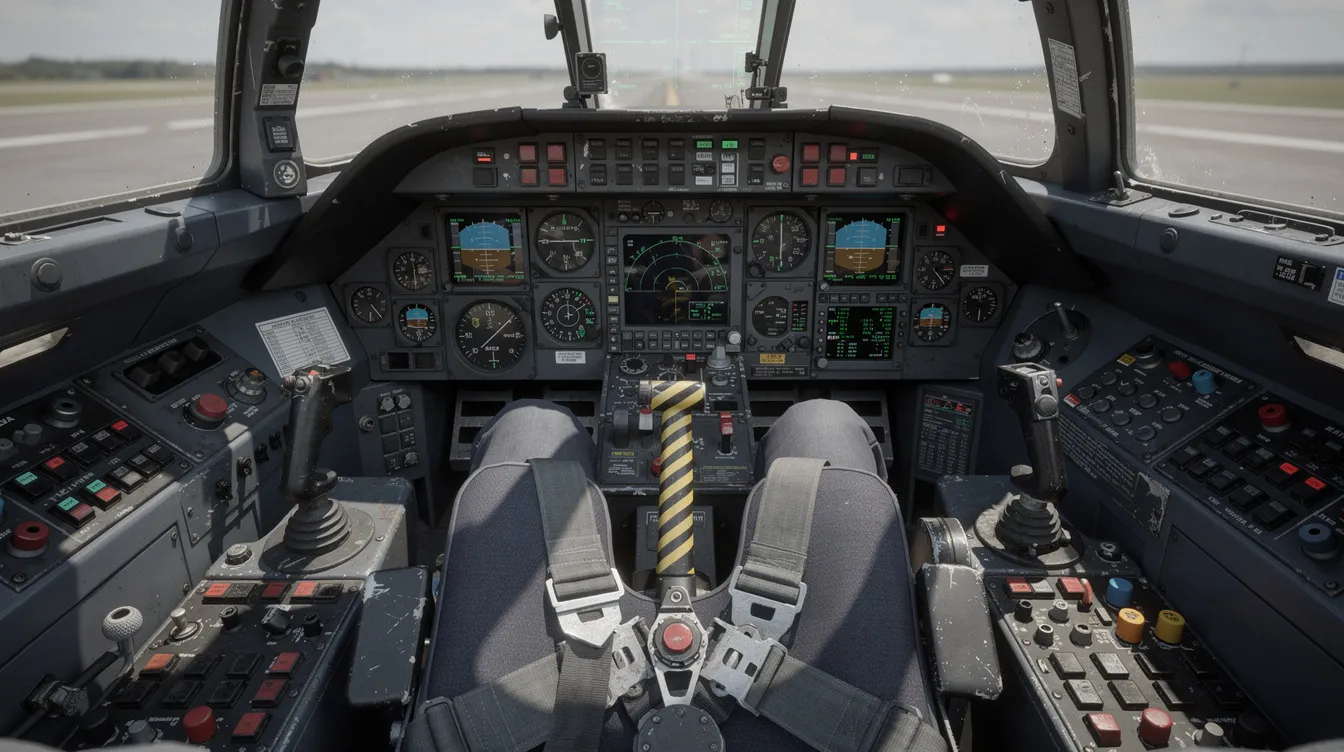
Fly by wire means that pilot inputs on the sidestick are converted into electrical signals, processed by a flight control computer, and sent as commands to hydraulic actuators that move control surfaces. There are no direct mechanical linkages between the control stick and the flight control surfaces. Instead, both the controllers and sensors work through electronic channels to relay flight commands to the aircraft's actuators.
Quadruplex redundancy: four independent channels with fault-tolerant logic
Automatic reversion modes to maintain control after failures or battle damage
Built-in flight envelope protections limit g-forces, angle of attack, and prevent stalls
Early F-16A/B blocks used analog-based systems, but the digital computer system beginning with Block 25 F-16C/D models introduced fully digital flight control computers with improved reliability, diagnostics, and maintainability.
The F-16's fly-by-wire success directly influenced later fighters like the F/A-18, F-22, and F-35. Even modern business jets now adopt fly-by-wire for smoother handling and enhanced safety.
Two engine families have powered the F-16 throughout its production life:
Pratt & Whitney F100 series (F100-PW-200, F100-PW-220, F100-PW-229)
General Electric F110 series (F110-GE-100, F110-GE-129, F110-GE-132)
Thrust-to-weight ratio greater than one in a clean configuration
Maximum speed over Mach 2 at altitude
Climb rates exceeding 50,000 feet per minute
Service ceiling above 50,000 feet
Typical combat radius: 300 to 400 nautical miles (air-to-ground configuration)
Ferry range: over 2,000 miles with three drop tanks
External fuel tanks on wing and fuselage hardpoints
Conformal fuel tanks (CFTs) on select export variants (e.g., Block 60 for UAE)
Forward fuselage fuel tank for additional endurance
Westinghouse AN/APG-66 radar: basic air-to-air search and track, rudimentary ground mapping
AN/APG-68: increased detection range, track-while-scan, enhanced ground modes, AIM-120 AMRAAM compatibility
AESA radars: Northrop Grumman APG-80 (Block 60), APG-83 (F-16V and Block 70/72)
LANTIRN for low-altitude night attack (Block 40/42)
Sniper Advanced Targeting Pod for precision strike
Reconnaissance pods: TARS, Orpheus
Infrared search and track systems: Legion-ES
Link 16 for networked tactical data sharing
Improved Identification Friend or Foe systems
Helmet-mounted cueing systems
Large color center pedestal displays in modernized cockpits
AIM-9 Sidewinder heat-seeking missiles (wingtip rails)
AIM-7 Sparrow (Air Defense Fighter variants)
AIM-120 AMRAAM (Block 25 onward)
Unguided bombs
Laser-guided munitions
JDAM GPS-guided bombs
AGM-65 Maverick
AGM-88 HARM (SEAD missions)
20 mm M61 Vulcan cannon (left wing root, ~500 rounds, up to 6,000 rounds/minute)
Nine hardpoints: wingtip stations, underwing pylons, fuselage centerline and cheek positions
|
Variant |
Seats |
Radar |
Engine |
Notable Features |
|---|---|---|---|---|
|
F-16A |
1 |
AN/APG-66 |
F100-PW-200 |
Early production, day-fighter focus |
|
F-16B |
2 |
AN/APG-66 |
F100-PW-200 |
Two-seat trainer/operational |
|
F-16C |
1 |
AN/APG-68 |
F100-PW-220/229, F110-GE-100/129 |
Improved radar, engines, night/all-weather |
|
F-16D |
2 |
AN/APG-68 |
F100-PW-220/229, F110-GE-100/129 |
Two-seat, operational/training |
Block 15: Larger horizontal stabilizers, improved undercarriage, additional wing hardpoints
Block 25: Improved radar, more powerful engines, structural changes, night/all-weather capability
Block 30/32: Alternate engine introduction
Block 40/42: Night attack with LANTIRN pods
Block 50/52: SEAD specialization as the CJ/DJ "Wild Weasel"
Developed for UAE
Conformal fuel tanks
APG-80 AESA radar
F110-GE-132 engine (~32,500 lbf thrust)
Enhanced avionics and internal fuel
APG-83 scalable agile beam radar
Large color center pedestal display
Upgraded mission computer architecture
Advanced electronic warfare suite
Structural life extended to ~12,000 flight hours
Block 70: F110-GE-129 engine; Block 72: F100-PW-229 engine
Last F-16 produced in Fort Worth in 2017; production moved to Greenville, South Carolina
Many existing F-16C/D fleets upgraded to F-16V standard via retrofit kits
A-16/F/A-16: Modified for close air support (program canceled)
Reconnaissance pods: Orpheus (Netherlands), TARS (US ANG)
F-16XL: Cranked-arrow delta wing, more internal fuel
Multiaxis Thrust Vectoring (MATV): Extreme angle-of-attack flight
VISTA: Variable-stability In-flight Simulator
Control-Configured Vehicle prototypes
F-16N/TF-16N: US Navy aggressor aircraft
Vought Model 1600: Navalized carrier variant (unbuilt)
F-16IN "Super Viper" (India), F-16BR (Brazil): Export proposals
United States (USAF, Air Force Reserve, Air National Guard)
Israel
Turkey (co-production with Turkish Aerospace Industries)
Greece, Belgium, Netherlands, Norway, Denmark, Portugal (Europe)
Egypt, UAE, Bahrain, Jordan, Chile, Pakistan, South Korea (Asia/Middle East)
Ukraine: Receiving donated F-16s from Denmark and other allies (2024)
USAF Thunderbirds: Aerobatic demonstration team with F-16C aircraft
Israel: Barak 2020
Turkey: Özgür and Özgür-II
Europe: Mid-Life Update (MLU) for A/B blocks

1981: Israeli Air Force F-16s destroy Osirak nuclear reactor in Iraq
1982: Lebanon War, Bekaa Valley air combat (Israeli F-16s vs. Syrian aircraft)
1991: Gulf War (Operation Desert Storm): 249 U.S. F-16s fly over 13,000 sorties
1990s: Balkans (Bosnia, Kosovo): Air-to-ground strikes, NATO's first air-to-air kill with AIM-120 AMRAAM
2011: Libya (Operation Unified Protector): No-fly zone enforcement, precision strikes
2019: India-Pakistan aerial engagements (F-16 involvement debated)
2024: Ukraine receives F-16s for air defense and strike roles
Despite being designed in the 1970s, the F-16 remains heavily used in 21st-century operations, a testament to continuous modernization and inherent airframe versatility.
High thrust-to-weight ratio, bubble canopy, and responsive handling
Effective in both visual-range and beyond-visual-range engagements
Precision attacks using laser-guided bombs, JDAMs, and standoff weapons
Night and all-weather capability via LANTIRN pods and enhanced avionics
F-16CJ/DJ variants with AGM-88 HARM anti-radiation missiles
Specialized targeting pods for enemy radar and SAM site suppression
Maritime strike (anti-ship missiles in some export configurations)
Close air support (when dedicated CAS platforms unavailable)
Battlefield air interdiction
Adversary aircraft for training
Multinational Staged Improvement Program (MSIP): Added provisions for advanced HUDs, multi-function displays, new radar, and BVR missiles
Pacer Loft: Upgraded Block 1/5 to Block 10 standard
Falcon UP: Repaired wing and fuselage cracks
Falcon STAR: Reinforced critical structural components
Europe: Mid-Life Update (MLU) for A/B fleets (F-16 AM/BM)
Israel: Barak 2020 (radar and avionics upgrades)
Turkey: Özgür and Özgür-II (domestic mission computers, radios, AESA radar)
USA: Common Configuration Implementation Program (CCIP), Post Block Integration Team (PoBIT) for Block 40/50 jets
These upgrades are projected to keep many F-16 fleets flying into the 2040s and 2050s, with the best-maintained and most recently built airframes potentially operational out to around 2060.
Over 500 suppliers across dozens of U.S. states
Tens of thousands of direct and indirect jobs
License production and co-assembly in allied countries (Fokker, SABCA, Turkish Aerospace Industries, South Korea's KF-16 program)
New F-16 production moved from Fort Worth, Texas, to Greenville, South Carolina
Offset agreements benefit purchasing countries' domestic industries
Global supply chains and industrial partnerships
Charter platforms like Jettly connect travelers with a global network of aircraft and operators
No civil airworthiness certificate
Ejection seats, military avionics, extreme noise, and fuel consumption
Designed for live weapons systems
Regulatory frameworks and export control treaties prohibit civilian operation
Only trained military/test pilots or selected officials fly in F-16s
Civilian military jet experiences available in trainer/ex-military aircraft (e.g., L-39 Albatros)
Civilian-certified business jets offer speed, flexibility, and comfort via platforms like Jettly
Fly-by-wire controls, advanced avionics, composite materials, and human-machine interface design now appear in business jets
Fighters and private jets both exploit smaller airports and flexible scheduling
Networked mission systems in F-16 squadrons
App-driven and web-based platforms in private aviation (e.g., Jettly)
While individuals will never book an F-16, understanding its design and engineering deepens appreciation for the technology that also underpins the fast personal planes and business jets available to civilians today.
|
Specification |
F-16C Block 50/52 |
|---|---|
|
Crew |
1 |
|
Length |
49 ft 5 in (15.06 m) |
|
Wingspan |
32 ft 8 in (9.96 m) |
|
Height |
16 ft 8 in (5.09 m) |
|
Empty Weight |
19,000–22,000 lbs (varies by equipment) |
|
Max Takeoff Weight |
~48,000 lbs |
|
Engine |
F110-GE-129 or F100-PW-229 (~29,000 lbf) |
|
Internal Fuel |
Supplemented by up to 3 external tanks |
|
Conformal Fuel Tanks |
Select export variants |
|
Max Speed |
> Mach 2 at altitude |
|
Combat Radius |
~340 miles (550 km) (air-to-ground config) |
|
Ferry Range |
>2,000 miles (with external tanks) |
|
Service Ceiling |
>50,000 ft |
|
Climb Rate |
>50,000 ft/min (clean configuration) |
|
Armament |
1 × M61A1 20 mm Vulcan cannon (500+ rounds) |
|
External Hardpoints |
9 (AIM-9, AIM-120, bombs, missiles, pods) |
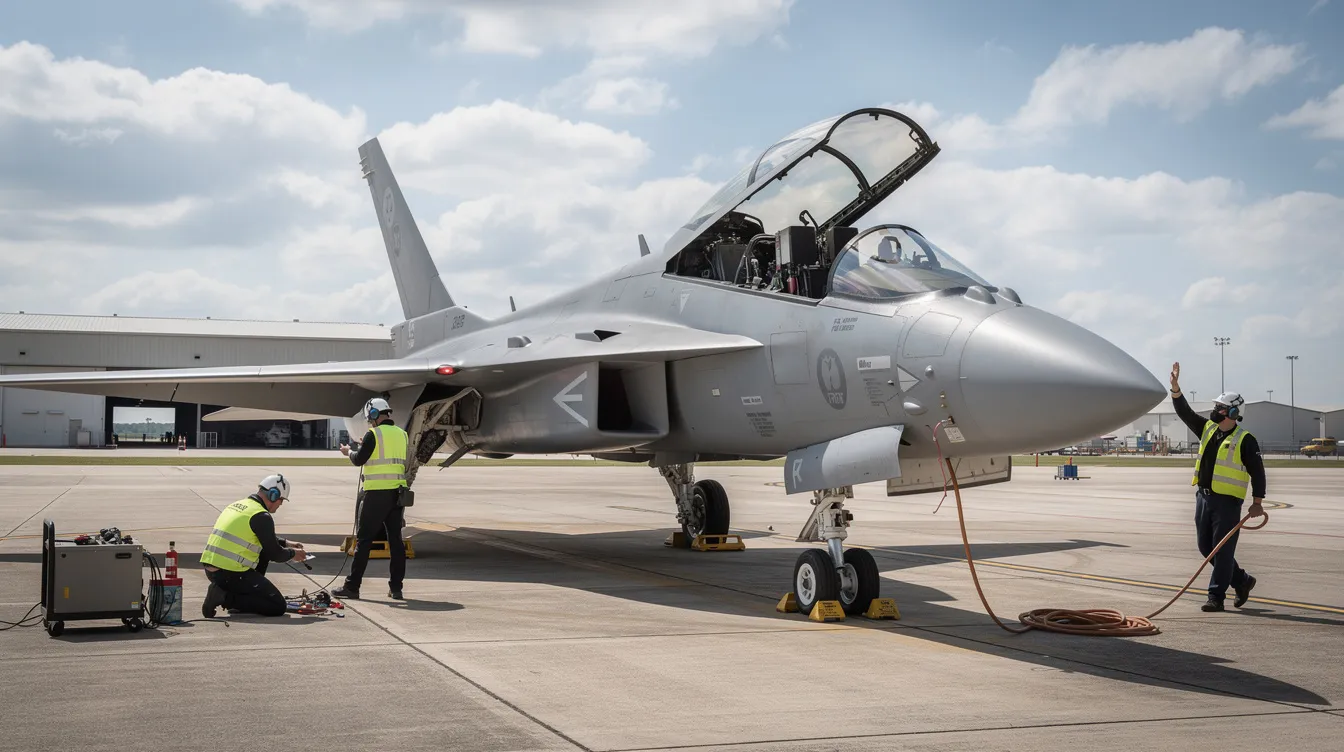
Bubble canopies, relaxed static stability, and side-stick controls became standard on subsequent Western fighters and advanced trainers
Taiwan: AIDC F-CK-1 Ching Kuo (inspired by F-16)
Japan: Mitsubishi F-2 (enlarged derivative)
South Korea: KF-16 and FA-50 (design DNA and production partnerships)
Nicknamed "Viper" (inspired by Battlestar Galactica)
Prominent in air shows, films, documentaries
Avionics integration, human-machine interface optimization, and performance/affordability balance influence modern business jet cockpits
This FAQ addresses common questions not fully covered in the main article, aimed at aviation enthusiasts and travelers curious about the F-16, as well as readers exploring options like crowdsourced private jet flights and shared empty seats in the civilian world.
While original F-16A/B production ended decades ago, Lockheed Martin continues to build new F-16 Block 70/72 aircraft at its Greenville, South Carolina facility, with active orders from several countries as of the mid-2020s. Current modernization plans and structural life extensions are expected to keep many F-16s in frontline service into the 2040s and potentially to around 2060 for the most recently built or upgraded airframes.
The F-16 is a fourth-generation multirole fighter optimized for high agility and cost-effective operations. The F-35 is a fifth-generation stealth aircraft focused on low observability, sensor fusion, and network-centric warfare. Many air forces operate both types, using F-16s for a wide range of day-to-day missions and reserving F-35s for high-end contested scenarios, which is more economical than flying stealth jets for every task.
The F-16A/B are the earliest single- and two-seat variants with older AN/APG-66 radar and analog avionics. The F-16C/D models introduced improved AN/APG-68 radar, modernized cockpits, more powerful engines, stronger structures, and expanded night and all-weather capabilities starting with Block 25 in the mid-1980s. Many F-16A/B jets have undergone Mid-Life Upgrades to bring avionics roughly in line with C/D capabilities, receiving new designations like F-16 AM/BM.
Genuine F-16 flights are restricted to military training and test operations. Civilians very rarely ride in two-seat fighters under tightly controlled government programs, and this cannot be booked commercially. Some companies in certain countries offer flights in demilitarized trainer jets like the L-39 Albatros, but these are entirely separate from F-16 operations and must comply with local civil aviation regulations.
While no civilian jet matches an F-16's 9-g maneuvering or Mach 2 speed, modern business jets cruise near Mach 0.90 to 0.92 and cover long distances quickly in comfortable cabins. Travelers should focus on mission profile, including distance, group size, and airport access, rather than raw speed. Platforms like Jettly help match travelers with suitable light, midsize, or long-range jets through on-demand charter and transparent pricing, and also provide guidance on how to get a seat on a private jet easily via memberships, brokers, and shared flights.
The F-16 Fighting Falcon began as a 1970s Lightweight Fighter concept and became one of the most numerous and combat-proven air combat fighters in history. About 4,604 airframes built for over 25 nations across five decades is a record few military programs will ever match.
Its enduring strengths remain clear: agility from relaxed static stability and fly-by-wire controls, a pilot-centric cockpit with its iconic bubble canopy and sidestick, multirole flexibility from nine hardpoints and continuously updated weapons integration, and a modernization pathway through AESA radar and advanced avionics that keeps 1980s-built airframes relevant against 21st-century threats.
New-build Block 70/72 aircraft and extensive structural life-extension programs mean the F-16 Fighting Falcon will likely remain in service with various air forces into the 2050s and 2060s, even as fifth-generation jets proliferate. The F-16's story is far from over.
While the F-16 is not accessible to civilians, understanding its technology helps travelers appreciate the engineering behind today's high-performance private jets and why platforms like Jettly focus on safe, efficient, civilian-certified aircraft, whether arranged as shared charter flights or full private charters. Ready to experience private travel on your terms? Explore flight options or request a quote at https://www.jettly.com or consider instant-book solutions like Zenflight’s private jet marketplace.
Share this post:
Jay Franco Serevilla
Jul 29, 2026
|
5
min read
Discover tips and trends in the industry.

5
min read
Plane Tickets NYC to Miami: Your Complete Guide (Commercial & Private)
This comprehensive guide covers everything you need to know about booking plane tickets from NYC to Miami, including commercial and private flight options. It highlights key airports, airlines, pricing strategies, and tips for finding the best deals. Whether you're traveling for business or leisure, understanding your options can enhance your travel experience.
Read More
5
min read
Medical Air Insurance: How Air Ambulance Coverage Works and When You Need It
Medical air insurance is essential for covering the high costs of emergency air ambulance transport, which can range from $10,000 to over $100,000. It supplements traditional health insurance, providing coverage in situations where ground transport is inadequate. Understanding the differences between medical air insurance, air ambulance memberships, and travel insurance is crucial for comprehensive protection during medical emergencies.
Read MoreStay updated with our latest insights and tips to elevate your journey with us.
MEMBERSHIPS AND ASSOCIATIONS



Disclaimer: Jettly operates as a charter broker, offering access to a global digital jet charter marketplace. Jettly is not a direct air carrier and does not own or operate aircraft. All advertised flights are conducted by third-party air carriers that are fully licensed and hold the appropriate Part 135 or Part 121 certifications issued by the Federal Aviation Administration (FAA) or equivalent regulatory authorities under U.S. or foreign law. Jettly complies fully with the U.S. Department of Transportation's Part 295 and Part 298 Charter Broker regulations. Jettly does not carry additional liability insurance. Passengers are covered by aircraft operator insurance. TICO: 50023770


