



Login
Get Instant Pricing On 23,000+ Aircraft

>

Between June 11 and July 19, 2026, the Western world will be busy celebrating football (referred to as soccer in the United States). Held every four years, the 2026 FIFA World Cup will take place across three countries: the U.S., Canada, and Mexico.
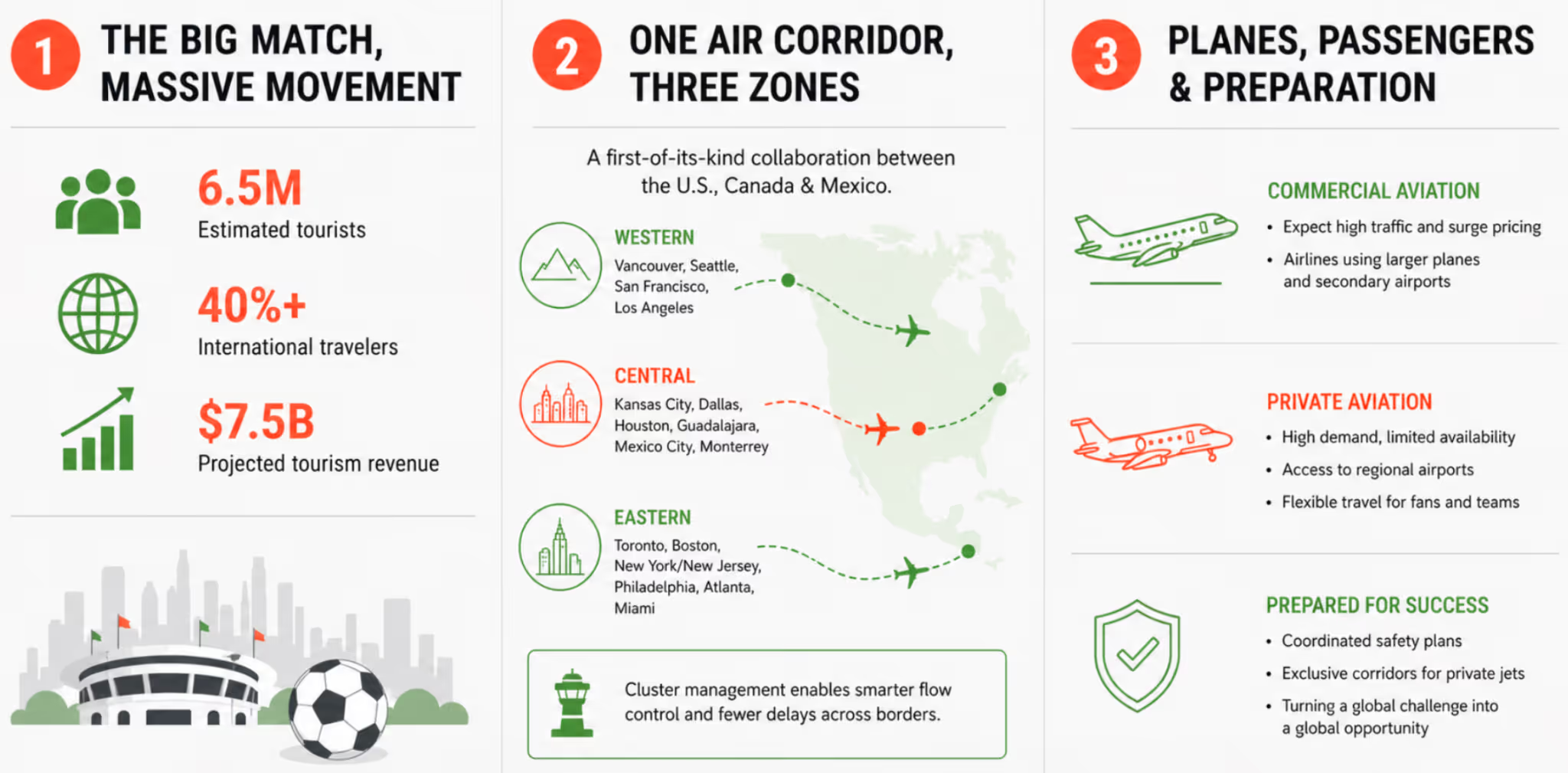
According to FIFA estimates, the event will draw around 6.5 million tourists, out of which at least 40% will be international travelers. The 16 host cities (11 of which are in the U.S.) are expected to generate around $7.5 billion in tourism revenue alone.
But it’s not all fun and games. Managing such a massive influx of tourists all at once is not going to be easy. And the issues start with the main means of transportation: airplanes. International airports are bracing for unprecedented operational volume, and both commercial and private aviation sectors will be all hands on deck, Jettly reports.
During the event, air traffic in all three host countries is expected to be busier. But, since the United States is the primary host nation, air traffic here will be at full capacity. Some fans will travel between countries and cities to catch as many games as possible, but many stay put in the U.S. and move between domestic airports.
The FIFA Air Corridor
For a smooth air experience and to avoid the complete gridlock of North American airspace, the three countries’ national aviation authorities (FAA, NAV CANADA, and AFAC) have joined efforts and operational playbooks for the first time in history.
Instead of managing 16 individual cities, the air corridor operates through a cluster management model divided into three zones:
By grouping these cities, air traffic controllers can treat the corridor as a single moving system, enabling flow control in which planes are held on the ground in one country to prevent a bottleneck in another.
The FAA also has a safety plan to avoid disruptions and intends to use secondary airports to prevent tier-one commercial hubs from becoming overwhelmed by concurrent arrival volumes.
The geographic distribution of the 2026 matches inherently favors private aviation frameworks. Even within the U.S., matches are spread thousands of miles apart, leaving fans with only a brief one- or two-day window to move from point A to point B.
The most important matches are concentrated around several big cities, with the semi-finals in Dallas and Atlanta, and the final in New York. Traveling through a commercial airport at this time will be beyond chaotic and uncomfortable.
On top of that, airlines are using dynamic pricing to manage demand on specific travel corridors between match days, so tickets could be more expensive. They are also planning to use larger planes to carry more passengers per flight.
Besides the usual inconveniences of commercial flying, passengers will also face surge pricing and crowded planes.
Industry forecasts indicate an unprecedented surge in charter velocity for the tournament duration, with fleet availability approaching total capacity weeks ahead of the opening match.
This supply squeeze is driven by a shift in consumer behavior: Groups of 8 to 14 passengers are increasingly pooling capital to leverage regional infrastructure and travel together in comfort, following their favorite teams across the air corridor. The itinerary is flexible, so if a group moves up too quickly, the fans can still see the most important matches.
Since private operators use regional airports, travelers get to avoid the congestion of an international hub like LAX or George Bush Intercontinental Airport in Houston. Regional hubs are also closer to cities, so it’s easier to get to the stadium on time and avoid crowds.
The influx of corporate sponsors, high-net-worth individuals (HNWIs), and international dignitaries is expected to push private air traffic to historic thresholds.
To avoid crowding regional airports, the FAA has created exclusive air corridors and strict drop-and-go mandates for private jet hubs expected to see the most traffic.
For instance, airports like Teterboro (NJ) and Van Nuys (LA) don’t allow private jets to park. Upon landing, they have to deplane their high-profile passengers and immediately depart for overflow parking in places like Stewart International or regional fields.
Once at the airport, the VIPs might opt for taking a helicopter or be permitted to follow special ground corridors to bypass traffic in major cities.
The traffic generated by the FIFA World Cup will likely be a massive headache for the aviation industry. Both the commercial and private sectors will operate at full capacity, as even the slightest delay can cause widespread dissatisfaction among passengers.
But it’s also an opportunity. Airports and airlines in the three nations can demonstrate what they can do, even with the whole world watching. With solid planning and coordination, paired with modern technology and innovation, the industry can turn what looks like a Gordian knot into a smooth, disruption-free operation.
Share this post:
Jay Franco Serevilla
May 22, 2026
|
5
min read
Discover tips and trends in the industry.

5
min read
Business Aviation: How Modern Private Air Travel Powers Business Growth
Business aviation revolutionizes corporate travel by providing unmatched flexibility, privacy, and efficiency. With access to over 5,000 airports and the ability to book on-demand, it enhances productivity and reduces travel time significantly. Platforms like Jettly simplify the process, making private jet travel accessible and cost-effective for businesses.
Read More
5
min read
Private Jet from Chicago to Las Vegas: Flight Time, Cost & Best Charter Options
Chartering a private jet from Chicago to Las Vegas offers a swift and convenient travel option, covering approximately 1,500 miles in about 3.5 hours. With various aircraft options available, travelers can enjoy significant time savings and avoid crowded commercial airports. Jettly's platform provides transparent pricing and access to over 20,000 private jets, making it easy to find the right charter for your needs.
Read MoreStay updated with our latest insights and tips to elevate your journey with us.
MEMBERSHIPS AND ASSOCIATIONS



Disclaimer: Jettly operates as a charter broker, offering access to a global digital jet charter marketplace. Jettly is not a direct air carrier and does not own or operate aircraft. All advertised flights are conducted by third-party air carriers that are fully licensed and hold the appropriate Part 135 or Part 121 certifications issued by the Federal Aviation Administration (FAA) or equivalent regulatory authorities under U.S. or foreign law. Jettly complies fully with the U.S. Department of Transportation's Part 295 and Part 298 Charter Broker regulations. Jettly does not carry additional liability insurance. Passengers are covered by aircraft operator insurance. TICO: 50023770


