



Login
Get Instant Pricing On 23,000+ Aircraft

>

Every private jet flying today carries a unique jet number - a short alphanumeric code that acts as the aircraft's fingerprint in the sky. If you've ever spotted a sleek Gulfstream on the tarmac and noticed something like N236MJ painted on its tail, you've already seen one in action. But what does that code actually mean, and why should it matter to anyone booking a private flight?
A jet number is the common name for an aircraft's registration identifier - the visible code displayed on the fuselage or tail, often referred to as a tail number, that uniquely identifies a specific aircraft. Think of it as a vehicle's license plate, but for planes. An aircraft registration number uniquely identifies a specific aircraft in every system that matters: air traffic control, legal records, insurance, and flight tracking.
Air traffic controllers use registration numbers for aircraft identification during every phase of flight. The flight number identifies the scheduled airline service on commercial routes, while fleet or ship numbers are internal identifiers used by airlines. For private jets, the tail number is the primary way to confirm aircraft identity, though aircraft can also be identified by serial number, making it central to private jet charter vetting and live tracking.
Jettly uses verified jet numbers and serial numbers behind the scenes to match travelers with compliant private aircraft across its global network of over 20,000 planes.
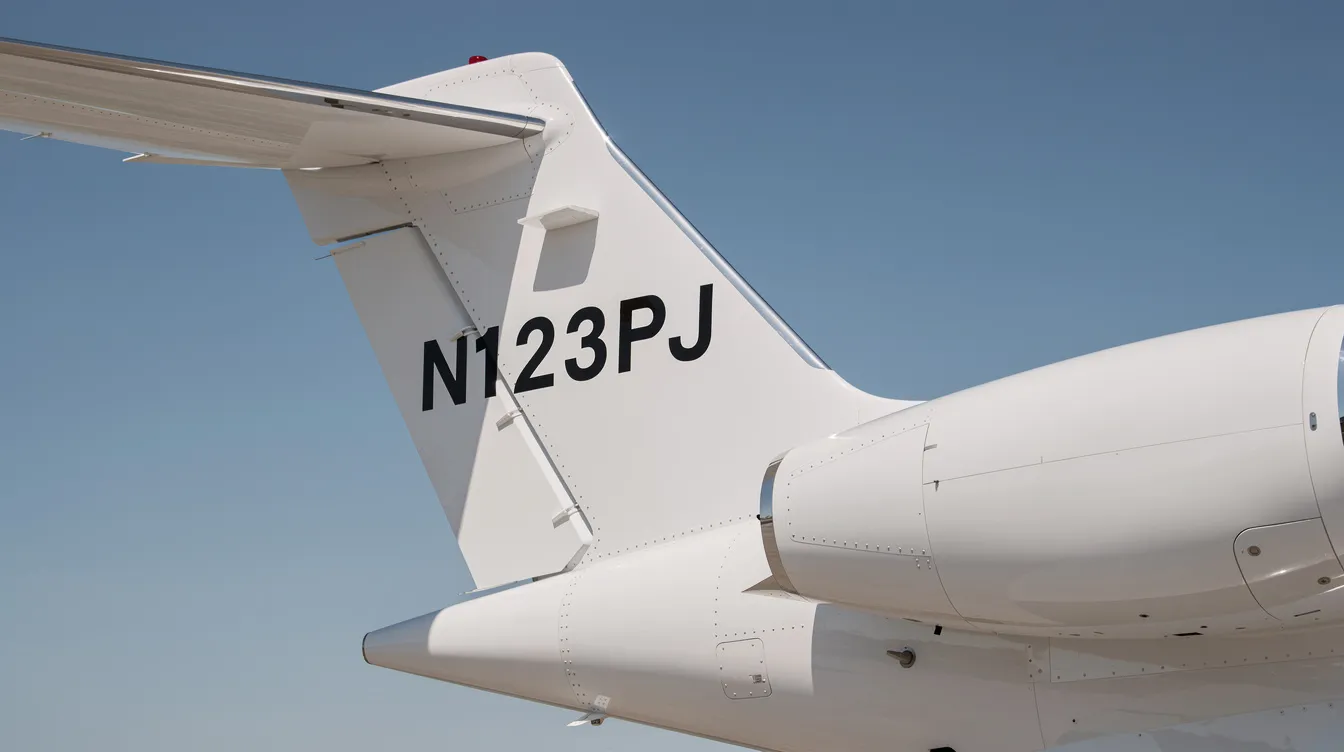
Every civil aircraft must be registered with its country's aviation authority. This aircraft registration - the jet number - follows international standards set by ICAO's Annex 7, which defines how nationality and registration marks are structured and displayed worldwide.
The jet number combines a country prefix with a unique suffix. In the USA, U.S. tail numbers begin with "N" followed by up to five characters - a mix of digits and letters, excluding the letters I and O to avoid confusion with 1 and 0. So a registration like N236MJ is valid, but N0123I would not be. The aircraft's tail number is typically displayed on the tail or rear fuselage and must be visibly displayed on the aircraft's exterior in permanent, readable form - Roman capital letters and Arabic numerals per FAA formatting rules.
Owners choose a registration country based on several factors: where the aircraft is primarily based, tax rules, maintenance regimes, and operational needs, and whether the registered owner is an individual or a company. Popular private jet registration choices include the U.S. (N-), Isle of Man (M-), and Cayman Islands (VP-C). Private jet registration rules are updated regularly by authorities such as the FAA, Transport Canada, and EASA member states, with digital registries now offering 24/7 online access to registration status and aircraft details.
The jet number (tail number) is a legal registration identifier that can change over an aircraft's life. The serial number is the manufacturer's permanent ID for the airframe - assigned once at the factory and never reused.
Manufacturers like Gulfstream, Bombardier, Dassault, Cessna, and Embraer each assign a unique serial number to every airframe they build. Tail numbers can change throughout an aircraft's life - when the plane is sold, relocated, or moved to a different registry - but the serial number stays with it from rollout to retirement. For example, the registration N236MJ has been assigned to three distinct airframes over time: a 1991 Gulfstream G-IV, a 2005 G550, and most recently a 2024 G650ER (serial 6579).
Aircraft maintenance is tracked via tail numbers to ensure compliance, and both serial numbers and tail numbers are linked in regulatory databases to confirm aircraft identity, airworthiness, and modification history. Jettly and reputable charter brokers cross-check both identifiers when pre-screening private jets for charter. For an in-depth look at how serial numbers work, see this guide on airplane serial number search.
Each country uses its own registration prefix as defined by ICAO. Countries use different prefixes for aircraft registrations, and recognizing these prefixes helps travelers interpret a private plane's origin. Country prefixes denote the registration's origin at a glance.
Key examples: N for the United States, C-F or C-G for Canada, G- for the UK, F- for France, D- for Germany, HB- for Switzerland, OE- for Austria, M- for Isle of Man, VP-C for Cayman Islands, VQ-B for Bermuda, and P4- for Aruba. Tail numbers identify aircraft and their country of registration - so when you see a jet marked G-SUGA at a London airport, you know it's registered in the United Kingdom.
The terms "tail number" and "jet number" are informal. In regulations and charter contracts, the formal phrase is aircraft registration. Some owners select offshore registration jurisdictions based on tax rules, privacy considerations, or bilateral agreements that affect private jet charter operations in regions like Europe. Certain offshore markings - such as M- or VP-C - can be restricted for commercial charter in the EU unless the operator holds appropriate EASA certification. This is one factor Jettly checks when sourcing aircraft for clients flying into or within Europe.
Many high-profile individuals personalize their private jet registrations, turning jet numbers into subtle signatures. Personalized or vanity tail numbers can be purchased by private jet owners who want their registration to reflect something personal. Customised tail numbers reflect personal branding for celebrities across industries.
Michael Jordan’s Gulfstream G550 has the tail number N236MJ. The code may suggest a nod to his Chicago Bulls jersey number (23), his six NBA championships (6), and his initials (MJ), but that alone does not prove current ownership. The aircraft is publicly registered to MJ AIR LLC, and the listed owner may be an LLC or other entity rather than showing whether the jet belongs directly to the celebrity.
Other interesting examples: Taylor Swift's Dassault Falcon 900 is registered as N898TS, where 89 refers to her birth year and TS to her initials. Bill Gates' private jet is registered as N887WM. John Travolta's jet has the tail number N707JT - a fitting choice for a pilot who once owned a Boeing 707. In the UK, Lord Alan Sugar flies under G-SUGA, a registration that doubles as a vanity plate.
Celebrity associations with specific tail numbers can change over time as jets are sold, re-registered, or replaced. The serial number must be checked for accurate historical tracking. U.S. aircraft registration information is publicly available, but the registered owner often appears as an LLC or trust rather than an individual name - a common privacy and liability strategy.
Anyone can perform a tail number lookup to see basic registration details and, in many cases, track private jet flights in near-real time. The process is straightforward.
Start by visiting an official registry with the complete registration. The FAA Aircraft Inquiry system allows searches by N-number for U.S.-registered aircraft. U.S. tail numbers start with "N" and link to FAA data including the registered owner, aircraft type, serial number, date of certificate, and registration status. For Canadian registrations, use Transport Canada's online database. For British aircraft, the UK CAA G-INFO tool provides similar search capabilities. A tail number lookup reveals aircraft identity and registration status, while FAA results can help confirm aircraft age and model but cannot by themselves establish a person's identity, travel history, or every operator detail.
Tail number lookups reveal aircraft ownership and registration status - but for live flight details, platforms like FlightAware and Flightradar24 let users input a tail number to see departure airport, destination, altitude, speed, and estimated arrival time. Some owners use privacy programs like the FAA's LADD or third-party blocking lists to limit public tracking, so a valid jet number may not always show live movements. Aviation experts can explain ambiguous lookup results when registration data, operator data, and flight activity do not fully match. Tail numbers are critical tools for safety, legal compliance, and tracking. Jettly prioritizes regulatory compliance over public tracking and can confirm aircraft status and operator credentials even when live tracking is restricted.
For private jet charter customers, knowing the jet number helps travelers support their due diligence before accepting a quote. Tail number lookups help verify aircraft details before chartering - confirming the aircraft type (light jet, midsize, heavy, turboprop), seating capacity, range, age, and current registration status.
Consider a business trip: a corporate team booking a flight from New York to Florida can request the proposed tail number, run a quick search, and confirm they're getting the right aircraft for the mission. A family booking a private flight from Los Angeles to Las Vegas might do the same, especially if they rent rather than own and want extra peace of mind before departure. Operators often confirm the final jet number closer to departure because maintenance or scheduling changes may require substitutions within the same category.
While tail number research supports transparency, deeper safety checks - maintenance oversight, operator certifications like FAA Part 135, and pilot experience - are typically handled by charter platforms. Jettly manages this vetting so travelers can focus on their journey. For guidance on choosing the right jet or learning how to book a private jet, the platform offers practical resources.
Jettly is a digital private jet charter marketplace that connects travelers to over 20,000 aircraft globally - from light jets and turboprops to large cabin jets and helicopters. The platform works only with vetted operators, confirming each aircraft's registration, tail number, insurance, and regulatory approvals before presenting options to users.
Internally, Jettly uses jet numbers and serial numbers to track fleet data, monitor compliance under FAA Part 135 and international equivalents, and ensure accurate aircraft selection for each mission and location. Customers typically see aircraft type, configuration, and estimated pricing upfront. A specific registration number can be confirmed as the departure date approaches, with any substitutions meeting or exceeding the original safety and comfort standards.
Jettly's on-demand booking and membership options deliver instant pricing, transparent cost breakdowns, and access to empty leg flights - all without long-term ownership commitments. Whether travelers are curious about famous jet numbers or focused purely on speed, range, and value, the platform steers every decision toward safety and mission fit. To explore charter options or request a quote, contact Jettly at jettly.com.
A jet number and a tail number refer to the same thing: the unique aircraft registration code displayed on the plane's tail or fuselage. It identifies the aircraft legally and operationally.
Yes, you can perform a tail number lookup through official registries like the FAA for U.S.-registered aircraft or equivalent authorities in other countries. This reveals details like the aircraft’s model, age, owner, and registration status.
Owners sometimes choose customized registrations to reflect personal branding, initials, or significant numbers. Celebrities like Michael Jordan (N236MJ) and Taylor Swift (N898TS) use these to make their jets recognizable.
The jet number shows registration and identity but does not directly indicate safety or maintenance status. Safety depends on operator compliance, maintenance records, and certifications, which platforms like Jettly verify.
Yes, tail numbers can change if the aircraft is sold, relocated, or re-registered in a different country. The manufacturer's serial number remains constant throughout the aircraft's life.
Knowing the jet number allows travelers to verify aircraft details, confirm registration status, and ensure the aircraft suits their mission before chartering. It adds transparency and confidence to the booking process.
No, each country uses a unique prefix for registrations (e.g., N for the U.S., G for the UK). This prefix helps identify the aircraft’s country of registration.
Many flight tracking services allow users to input a tail number to see recent flight activity, though some owners use privacy programs to limit public tracking visibility.
Learn more about Jettly’s charter options at https://www.jettly.com.
A jet number is more than a painted code - it is the core of aircraft identity, linking registration, serial numbers, flight tracking data, and the aircraft's history into a single searchable subject. Understanding jet numbers helps travelers verify private jet registrations, explore interesting celebrity examples like N236MJ, and make more accurate, informed choices when booking a private jet charter.
Jettly integrates jet number data with rigorous operator vetting, instant pricing, and digital booking tools to deliver safer, more transparent private travel for partners and clients worldwide.
Ready to experience private travel on your terms? Explore flight options or request a quote at jettly.com.
Share this post:
Jeff Ryan Serevilla
Oct 22, 2026
|
5
min read
Discover tips and trends in the industry.

5
min read
Chesapeake Regional Airport (KCPK) Private Jet & Traveler Guide
Chesapeake Regional Airport (KCPK) is a premier destination for private and charter aviation in coastal Virginia, offering a 5,500-foot runway and dedicated facilities. This guide provides essential information for pilots and travelers, including booking options through Jettly, making it an ideal choice for efficient and private travel.
Read More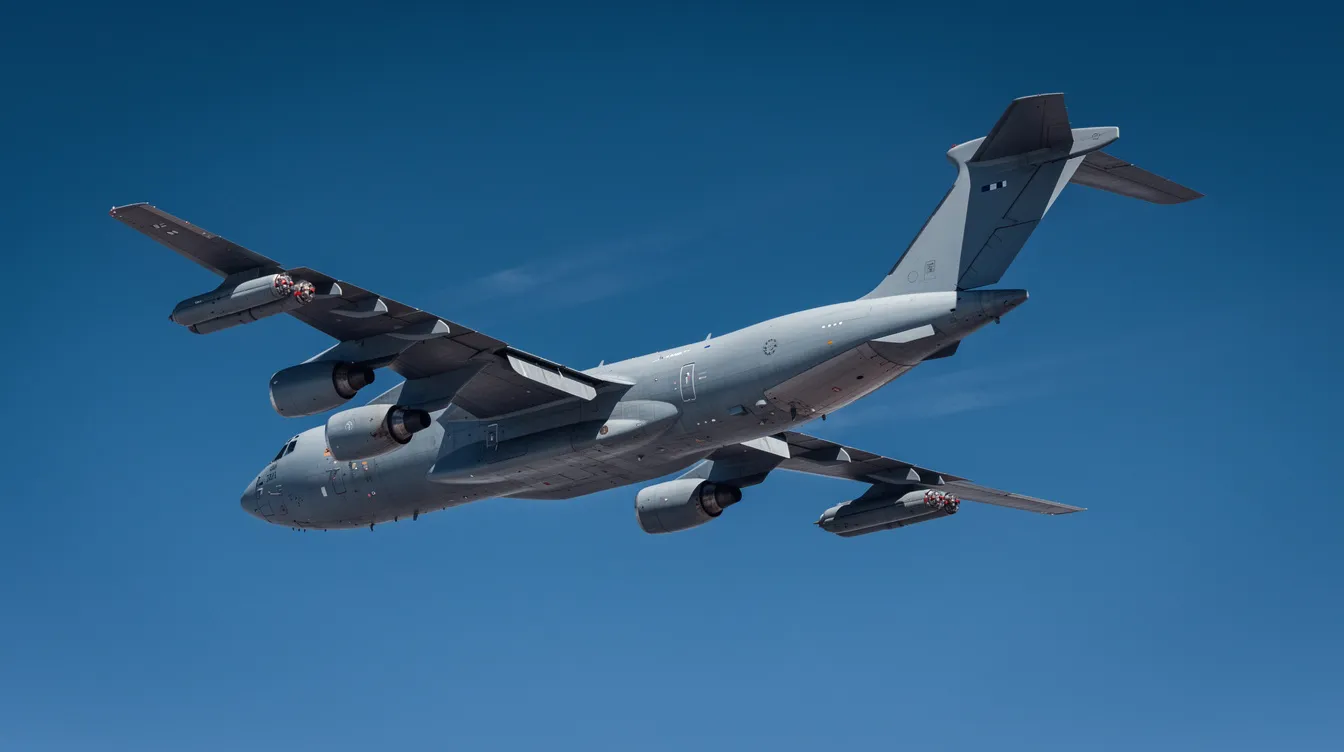
5
min read
KC-135 Accidents: History, Recent Crashes, and Safety Lessons
The KC-135 Stratotanker has a long history of accidents, with over 50 fatal crashes since its introduction in the 1950s. Recent incidents, including a crash in March 2026 that killed six crew members, highlight ongoing safety challenges in military aviation. Lessons learned from these accidents have led to significant improvements in training and operational procedures, benefiting both military and civilian aviation.
Read MoreStay updated with our latest insights and tips to elevate your journey with us.
MEMBERSHIPS AND ASSOCIATIONS



Disclaimer: Jettly operates as a charter broker, offering access to a global digital jet charter marketplace. Jettly is not a direct air carrier and does not own or operate aircraft. All advertised flights are conducted by third-party air carriers that are fully licensed and hold the appropriate Part 135 or Part 121 certifications issued by the Federal Aviation Administration (FAA) or equivalent regulatory authorities under U.S. or foreign law. Jettly complies fully with the U.S. Department of Transportation's Part 295 and Part 298 Charter Broker regulations. Jettly does not carry additional liability insurance. Passengers are covered by aircraft operator insurance. TICO: 50023770


