


Login
Get Instant Pricing On 23,000+ Aircraft

>
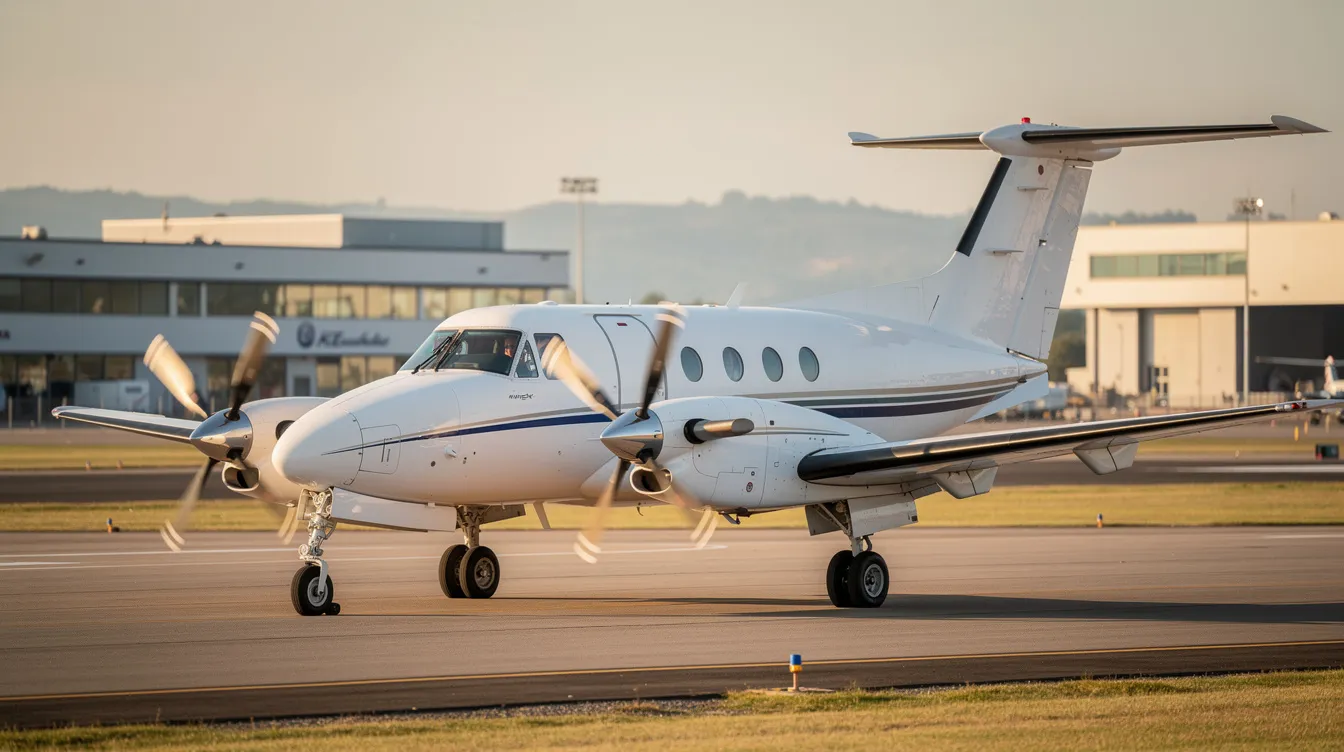
The King Air 350 landing distance is one of the most important performance figures for anyone planning a private charter into a shorter or regional runway. At roughly 2,692 feet under standard conditions, the Beechcraft King Air 350 can reach airports that many light jets simply cannot. But that published number only tells part of the story. Weight, weather, elevation, and runway surface all shift the actual distance a pilot needs on any given flight. This guide breaks down what those numbers really mean, how they compare to takeoff performance, and how Jettly's platform uses this data to match travelers with the right aircraft and the right runways.
The King Air 350 has a published landing distance of approximately 2,692 ft over a 50-foot obstacle at sea level, standard conditions, and maximum landing weight on a dry runway.
Takeoff distance is about 3,300 ft under similar conditions, meaning takeoff requirements typically drive runway selection more than landing.
Real-world landing distance varies with aircraft weight, airport elevation, temperature, runway condition, and wind - operators always add safety margins beyond the published figure.
The Beechcraft King Air 350's short-field performance makes it a strong fit for regional charter, remote strips, and smaller municipal airports that jets often cannot use.
Jettly factors landing distance, takeoff distance, and environmental data into its platform when presenting aircraft options, instant pricing, and routing for charter travelers, and tools like its airport locator platform help match specific runways to the right aircraft.

The King Air 350 is a twin-turboprop business aircraft and one of the most recognized models in the Beechcraft King Air family. First introduced in the early 1990s as part of the long-running King Air series, it remains a workhorse for private charters, corporate shuttles, and special missions worldwide.
In a typical executive layout, the aircraft seats 8 to 9 passengers, though some configurations stretch to 11. The spacious cabin measures roughly 19 ft in cabin length, about 4 ft 6 in in cabin width, and approximately 4 ft 9 in in cabin height - dimensions that offer more headroom and shoulder space than many turboprops in the same class. Overall cabin volume comes in around 303 cu ft, and the aircraft features both internal baggage space and external baggage capacity in wing lockers beneath the fuselage. The door width allows reasonably easy boarding even with bulky luggage or equipment.
On the performance side, the King Air 350 is powered by two Pratt & Whitney Canada PT6A-60A engines, each producing 1,050 shp. Maximum cruise speed reaches 312 knots, with a service ceiling of 35,000 ft and a maximum range of approximately 1,806 nautical miles with full fuel. The aircraft's climb rate is competitive for a turboprop of this size, and it features constant speed propellers with auto feathering capability - critical for safe handling in an engine inop scenario on one engine, especially when compared with larger narrowbody types like the Boeing 737-800.
The airframe itself spans a wing span of 57 ft 11 in, with an overall length 46 ft 8 in and a height 14 ft 4 in (sometimes listed as 14 ft 4). Maximum takeoff weight sits around 15,000–16,500 lbs depending on variant, and basic empty weight is typically in the 9,000–9,500 lb range, leaving a useful load that accommodates passengers, cargo, and fuel for most regional missions.
The aircraft's Pro Line avionics suite with advanced navigation capabilities is standard on current production models, equipped to handle IFR operations and reduce pilot workload in complex airspace. This combination of cruise speed, range, and short-field capability is why the King Air 350 appears frequently on Jettly's charter platform for regional and medium-haul flights alongside other private charter aircraft. For a look at the closely related King Air 360, see Jettly's King Air 360 guide.
Landing distance, as defined in aircraft performance manuals, is the horizontal distance required to descend from 50 feet above the runway threshold, touch down, and come to a complete stop. This "over a 50-foot obstacle" measurement is the standard used for airport planning, certification, and charter dispatch.
The landing distance for King Air 350 is 2,692 feet at maximum certified landing weight, at sea level, under ISA (International Standard Atmosphere) conditions, and on a dry, paved runway. This figure comes directly from the manufacturer's performance data. Landing distance is measured at sea level under standard conditions, which means any deviation from those baseline assumptions - higher altitude, warmer air, heavier aircraft - will change the number.
Some industry sources list slightly different figures, typically in the range of 2,484 to 2,692 ft. The variation reflects differences in testing assumptions, variant (350 vs 350i vs 350C), and whether the figure accounts for ground roll alone or the full over-obstacle distance. The King Air 350C, for instance, also has a landing distance of 2,692 feet under the same standard conditions.
A few points worth noting about these published numbers:
Published landing distances assume a stabilized approach and proper landing technique. Exceeding the target landing speed increases landing distance significantly, which is why operators train pilots to fly precise approach profiles.
Maximum certified landing weight impacts approach speeds and stopping distance. Landing distance is affected by aircraft weight - a lighter aircraft on arrival (less fuel, fewer passengers) will stop shorter.
Operators often apply safety margins to the calculated landing distance for planning. Regulations and company procedures often require additional safety margins beyond raw landing distance. For many regulatory frameworks, using 60% of the available landing distance is often required for dispatch planning.
In practice, charter flights frequently land well below maximum weight, so actual stopping distances tend to be shorter than the published maximum. But operators still plan conservatively, because the consequences of underestimating are severe.
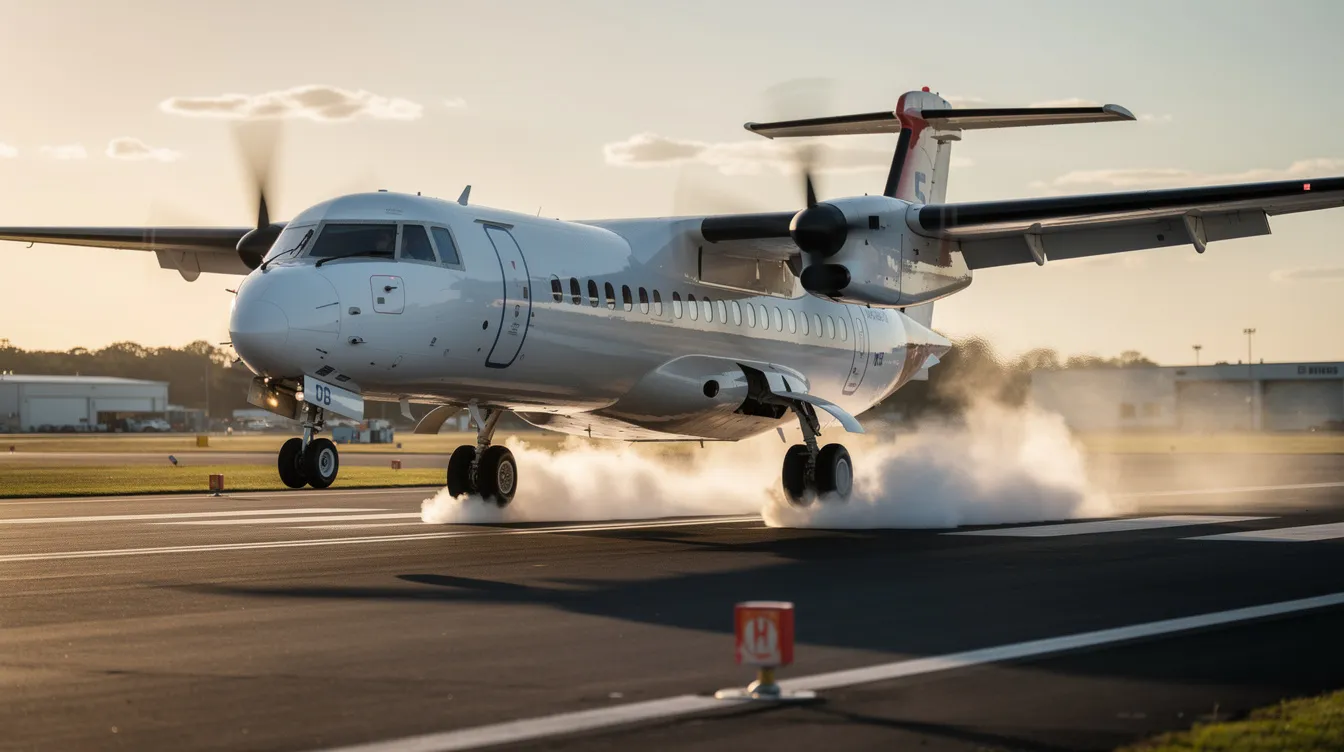
Landing performance is not fixed. It changes from flight to flight based on a set of variables that pilots and dispatchers must evaluate before every approach.
Weight: The heavier the aircraft at touchdown, the more energy the brakes and reverse thrust must absorb. Flying with full fuel versus reduced fuel can noticeably change landing distance. A King Air 350 arriving with minimal fuel after a long leg will stop in a meaningfully shorter distance than one that just departed with tanks topped off.
Airport elevation and temperature: High airport elevation increases landing distance due to higher true airspeed and groundspeed at touchdown - even though indicated airspeed stays the same. Higher temperatures and contaminated runway surfaces can increase the actual landing distance further. Together, these factors define "density altitude," and they can add 10–20% or more to the published sea-level figures at airports like Aspen or Telluride.
Runway surface and contamination: Dry runways provide optimal braking efficiency. From there, every degree of contamination makes things worse:
Wet runways can multiply landing distances by 1.3 to 1.4 times.
Water or slush on the runway can increase landing distance by 2.0 to 2.3 times.
Compacted snow can increase landing distance by 1.6 to 1.7 times.
Ice can increase landing distance by 3.5 to 4.5 times.
These multipliers come from regulatory and industry guidance that operators use when planning approaches to contaminated surfaces.
Wind and slope: Headwinds reduce landing distance while tailwinds increase it. Even a 10-knot tailwind can add hundreds of feet to the rollout. Runway gradient matters too - a 1% downhill slope can increase landing distance by approximately 10%. Conversely, an uphill slope helps, but pilots must weigh visibility and control trade-offs.
Pilot technique and systems: Landing further down the runway reduces available landing distance, which is why a stabilized, on-speed approach matters so much. Reverse thrust can reduce landing distance by up to 50%, but this requires properly maintained propeller systems and timely application. Brake condition, tire pressure, and anti-skid system health all play a role as well.
Professional charter operators use official performance charts and regulatory margins - not simple rule-of-thumb numbers - to determine whether a specific runway works on a given day, and travelers can pair this with a clear understanding of private jet charter costs when evaluating different aircraft options.
Pilots must consider both takeoff distance and landing distance when choosing airports for any charter mission. In many cases, it is the takeoff requirement - not landing - that limits which runways are usable.
The King Air 350's takeoff distance is 3,300 feet over a 50-foot obstacle at maximum takeoff weight, sea level, ISA, on a dry paved runway. Compare that with the landing distance of 2,692 feet under similar conditions. Takeoff requires roughly 20–30% more runway.
The reason is straightforward. During takeoff, the aircraft must accelerate from a standstill, reach rotation speed, lift off, and climb to clear a 50-foot obstacle - all while maintaining a balanced field length that accounts for engine-out scenarios. If one engine fails during the takeoff roll, the pilot needs enough remaining runway to either stop safely (accelerate-stop distance) or continue the takeoff on one engine. This engine inop consideration is a major factor in the longer takeoff requirement.
What this means in practice for charter missions:
A runway that works perfectly for landing a King Air 350 may not support takeoff at maximum takeoff weight, especially at higher elevations or in warm conditions.
Operators may need to reduce fuel load or passenger count to meet takeoff weight limits on shorter strips, which could mean a fuel stop en route.
For round-trip charters into short fields, the takeoff constraint usually drives the mission planning, not the landing distance.
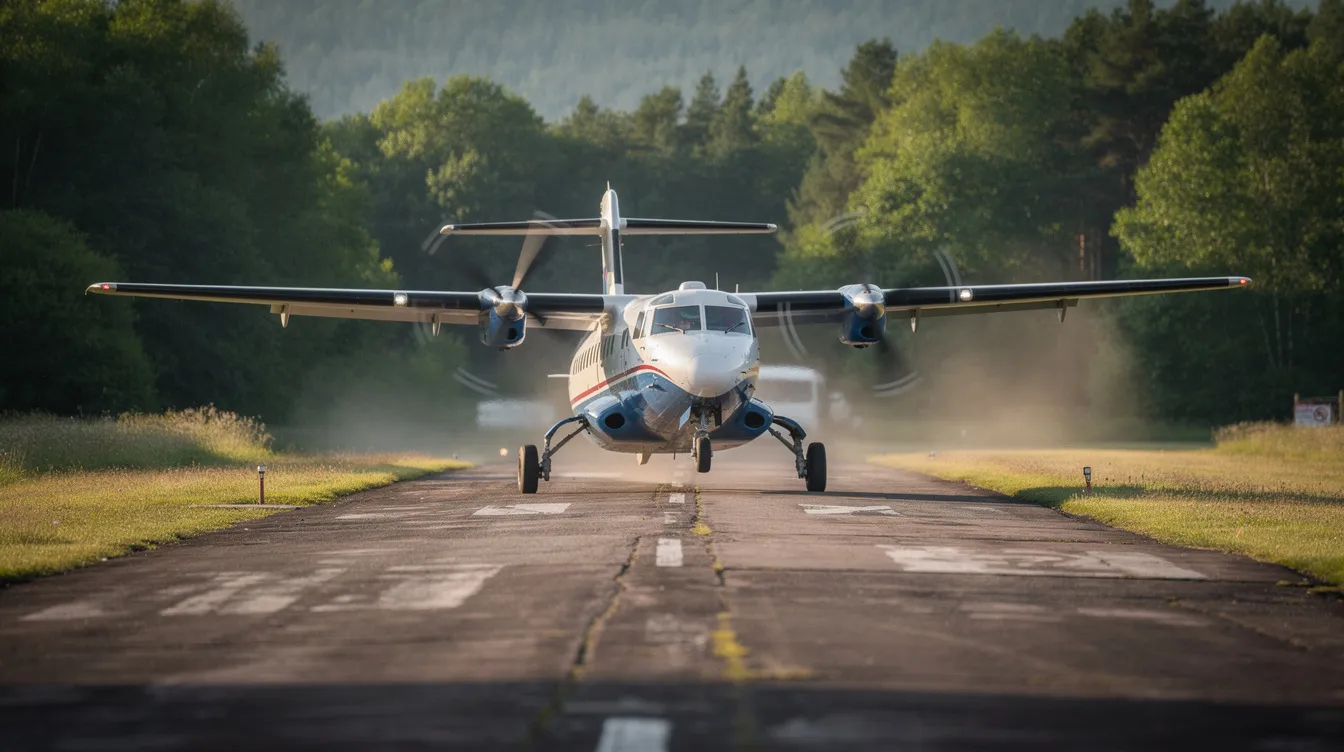
Performance numbers only matter when connected to what a traveler actually experiences - how many passengers can fly, how much baggage fits, and whether the aircraft can reach the intended airport without compromise.
Cabin layout: The King Air 350's cabin stretches roughly 19 ft in length with seating for 8 to 9 passengers in a standard executive configuration. Cabin width of about 4 ft 6 in and cabin height of 4 ft 9 in provide enough room for adults to move comfortably, and the aircraft offers both internal baggage compartments and external baggage space in wing lockers - roughly 71 cu ft of total cargo room. This compares favorably with many light jets that sacrifice baggage for speed.
Fuel capacity: The Air 350 carries approximately 539 US gallons (over 3,600 lb) of usable fuel. That fuel capacity is what enables the aircraft's 1,806 nm maximum range, but it comes with a weight penalty. At full fuel, available payload drops significantly. On shorter legs, operators often carry less fuel, which lowers takeoff weight and landing weight, shortens required runway distances, and frees up useful load for more passengers or cargo.
Cruise and ceiling: A cruise speed of roughly 300–312 knots and a service ceiling of 35,000 ft let the King Air 350 fly above most weather and complete regional legs efficiently. The top speed makes it competitive with entry-level light jets on sectors under 600 nm, where the speed difference is measured in minutes, not hours.
The trade-off equation: Every charter flight involves a combination of comfort, payload, fuel, and runway length. More passengers and bags mean higher weight, longer required runways, and potentially shorter range. Jettly's platform helps operators and travelers see which runways a specific King Air 350 can safely use given the planned payload, fuel load, and routing constraints - so there are no surprises at the airport, especially for members using Jettly's private jet membership programs.
|
Specification |
Value |
|---|---|
|
Maximum Takeoff Weight |
15,000 lbs (6,804 kg) |
|
Maximum Landing Weight |
15,000 lbs (6,804 kg) |
|
Basic Empty Weight |
~9,955 lbs (4,516 kg) |
|
Maximum Cruise Speed |
312 knots (359 mph, 578 km/h) |
|
Service Ceiling |
35,000 feet (10,668 meters) |
|
Maximum Range |
1,806 nautical miles (3,345 km) |
|
Takeoff Distance (50 ft obstacle) |
3,300 feet (1,006 meters) |
|
Landing Distance (50 ft obstacle) |
2,692 feet (821 meters) |
|
Cabin Length |
19 feet 6 inches (5.94 meters) |
|
Cabin Width |
4 feet 6 inches (1.37 meters) |
|
Cabin Height |
4 feet 9 inches (1.45 meters) |
|
Fuel Capacity |
539 US gallons (2,040 liters) |
|
Passenger Capacity |
8-9 (standard), up to 11 (some configs) |
One of the biggest advantages of chartering a Beechcraft King 350 is access to airports that most jets simply cannot use. Smaller municipal fields, remote resource-site strips, and coastal or mountain runways become viable options, cutting ground travel time and putting travelers closer to their final destination. For more on where private jets land, Jettly's airport access guide covers the broader picture.
Many operators prefer a practical minimum runway length of 3,000 to 3,500 feet for King Air 350 operations, which provides comfortable safety margins above the published landing and takeoff distances after accounting for elevation, temperature, and surface conditions.
Common use cases include regional business trips into short municipal airports (think county seats or small industrial towns), access to remote mining or energy sites in northern Canada or Alaska, and family trips to smaller coastal strips near vacation destinations, whether that's a major metro like Atlanta for private jet charter or a nearby smaller field that better matches the King Air 350's strengths.
Jettly's digital platform factors in runway length, elevation, and landing distance data when presenting aircraft options and instant pricing. Travelers see only airports and routes that work for the selected aircraft under real conditions - not theoretical best-case scenarios, whether they're planning flights in North America or looking at private jet charter in Kolkata, West Bengal and other international gateways.
Travelers with a specific short runway or challenging airport in mind should discuss constraints with Jettly's team before booking. That way, the right King Air 350 variant or a comparable turboprop is selected from the start.

When runway length is the deciding factor, turboprops and jets land in very different categories. The King Air 350 fills a niche that most light and midsize jets cannot touch - and that niche is exactly where many travelers need to go.
Short-field capability: Turboprops like the King Air 350 generally perform better on shorter or rougher runways than jets of similar passenger capacity. The combination of propeller thrust at low speeds, robust landing gear, and favorable wing design gives the King Air a genuine advantage at airports with 3,000 to 4,000 ft of pavement. For travelers heading to prop-plane-friendly destinations, this opens dozens of additional airport options per region.
Cost efficiency: Operating costs and hourly charter rates for a King Air 350 often undercut similar-capacity jets, particularly on short sectors where the jet's speed advantage is minimal. On a 200 nm leg, the time difference might be 15 minutes - but the cost difference can be substantial. Jettly's charter cost calculator can help travelers compare.
Cabin comfort: Despite being a turboprop, passenger comfort on the King Air 350 remains solidly business-class. The seating layout, enclosed lavatory, and generous baggage space (enough for skis, golf clubs, or sample cases) make it a comfortable aircraft for flights up to three or four hours.
Mission flexibility: The King Air 350 serves in roles from executive charter to cargo hauling to air ambulance operations. This versatility is valuable for Jettly customers who need mixed-use flights - say, carrying both passengers and equipment - or who require special missions like medical transport, and it fits neatly into the broader landscape of charter airlines and private operators available through the platform.
This makes the King Air 350 a reliable choice and a frequent recommendation on Jettly for regional travel where landing distance and airport choice are critical factors in the decision.
Jettly is a global digital private jet and turboprop charter platform with access to King Air 350 aircraft and thousands of other aircraft worldwide. The platform is built to simplify the complexity behind performance planning, aircraft selection, and pricing, whether you're booking a specific private jet for rent or comparing multiple turboprop options.
Jettly uses aircraft performance data - including landing distance, takeoff distance, range, and payload limits - when generating instant pricing and routing options. Travelers do not need to calculate density altitude or runway margins themselves; the platform and its operator network handle that.
Every operator on Jettly's network follows strict performance and safety standards. For short or challenging runways, pilots use official performance charts, regulatory safety factors, and conservative dispatch procedures to confirm that a given runway works for the planned flight.
Travelers can charter a King Air on-demand or through membership plans, without long-term ownership commitments. Both options provide access to the same fleet and the same safety standards, and frequent flyers may benefit from structured jet card programs that lock in predictable hourly rates.
Integration goes beyond the flight itself. Jettly can arrange ground transportation, in-flight catering, and multi-leg itineraries that take advantage of smaller regional airports - exactly the kind of missions where the King Air 350's short-field performance pays off. Travelers looking for value may also find empty-leg flights on King Air routes.
Ready to fly into a shorter runway closer to your destination? Explore flight options or request a quote at https://www.jettly.com.
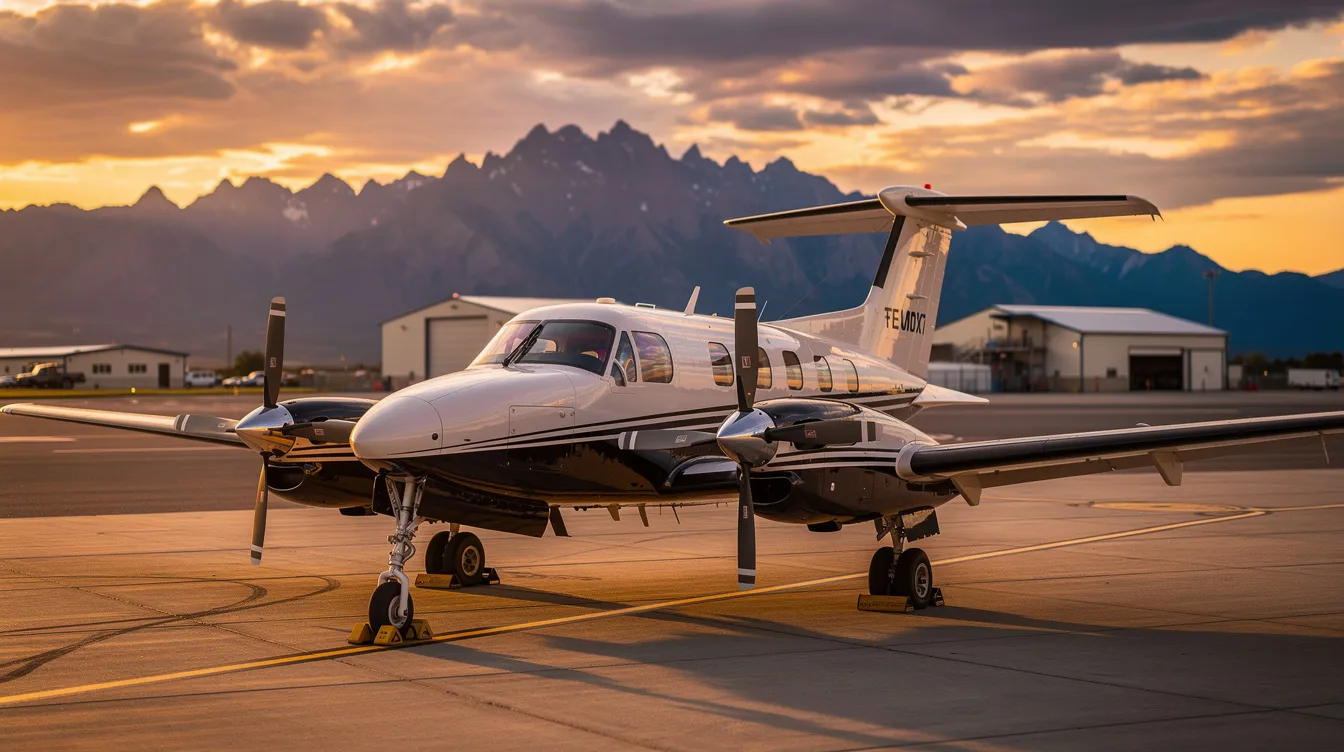
These FAQs address common questions about King Air 350 landing distance and charter planning that go beyond what is covered in the main sections above.
Under favorable conditions - lower-than-maximum landing weight, sea-level elevation, cool temperatures, dry pavement, and a headwind component - many operators can safely use runways around 3,000 ft. However, each flight requires a specific performance calculation based on that day's conditions, aircraft weight, and the operator's regulatory framework. No blanket "yes" applies to every 3,000 ft strip. Travelers should confirm any specific short runway requirement with Jettly before booking to ensure the planned airport and aircraft combination works.
The King Air 350 typically requires less runway on landing than many comparable light jets, particularly from shorter or rougher strips. Propeller thrust and the wing design of the Beechcraft King turboprop family provide better low-speed aerodynamic performance and more effective deceleration through reverse thrust. This difference makes turboprops especially attractive on routes where airport choice is limited by runway length - opening up dozens of fields that a Citation or Phenom might not be able to use safely.
Yes. More fuel means higher landing weight, which increases approach speed and requires more runway to stop. At maximum fuel capacity, the King Air 350 carries over 3,600 lb of fuel, which significantly affects its weight at touchdown. Many charter flights do not land at the absolute maximum landing weight because operators plan fuel loads to match the mission distance. Jettly and the operating carrier can adjust fuel and payload to balance range, performance, and airport options for each specific trip.
The core performance across these variants is similar because they share the same engines and basic airframe. However, small differences in equipment weight, cabin configuration, cargo door (on "C" variants), and avionics can shift published landing distance figures by a few hundred feet in either direction. The 350i, for example, added cabin noise reduction and updated avionics but did not materially change the POH landing distance. When booking, travelers should focus on the specific variant and year being offered, and Jettly's team can clarify performance expectations for the precise King Air model on a given itinerary.
Travelers should provide origin and destination airports (or nearest city), preferred travel dates, passenger count, and any special baggage or cargo needs. With this data, Jettly and its operators can check runway length, elevation, and expected conditions against King Air 350 landing and takeoff distance requirements. Sharing any must-use airfields, time constraints, or unusual load requirements (such as heavy equipment or oversized luggage) upfront allows the team to optimize aircraft selection and pricing from the start.
The King Air 350's landing distance of approximately 2,692 ft under standard sea-level conditions, paired with a takeoff distance of 3,300 ft, makes it one of the most capable turboprops for regional and remote charter operations.
Real-world King Air 350 landing distance depends on weight, fuel load, weather, elevation, and runway surface - so travelers should always rely on professional performance planning by experienced charter operators rather than published minimums alone.
Choosing between a turboprop and a jet often comes down to which airports a given aircraft can safely use. The King Air 350's success in reaching shorter fields gives it a clear edge for missions where airport access matters most.
Explore King Air and other aircraft options or request a quote through Jettly at https://www.jettly.com.
Share this post:
Jay Franco Serevilla
Jul 1, 2026
|
5
min read
Discover tips and trends in the industry.
5
min read
Planet 9 Aviation: Ultra Long Range Private Air Travel & How Jettly Helps You Charter It
Planet 9 Aviation specializes in ultra-long-range private jet travel, offering a managed fleet for intercontinental charters. Through Jettly, travelers can easily access these services without the need for ownership or jet cards, ensuring flexibility and convenience in booking private flights.
Read More
5
min read
Guide to Aviation Blogs: From Student Pilots to Private Jet Travelers
Aviation blogs have evolved into essential resources for student pilots, aviation businesses, and private jet travelers. They provide valuable insights on flight training, market trends, and charter options, helping readers make informed decisions. With contributions from industry professionals, these blogs serve as a bridge between education and practical application in aviation.
Read MoreStay updated with our latest insights and tips to elevate your journey with us.
MEMBERSHIPS AND ASSOCIATIONS



Disclaimer: Jettly operates as a charter broker, offering access to a global digital jet charter marketplace. Jettly is not a direct air carrier and does not own or operate aircraft. All advertised flights are conducted by third-party air carriers that are fully licensed and hold the appropriate Part 135 or Part 121 certifications issued by the Federal Aviation Administration (FAA) or equivalent regulatory authorities under U.S. or foreign law. Jettly complies fully with the U.S. Department of Transportation's Part 295 and Part 298 Charter Broker regulations. Jettly does not carry additional liability insurance. Passengers are covered by aircraft operator insurance. TICO: 50023770


