



Login
Get Instant Pricing On 23,000+ Aircraft

>
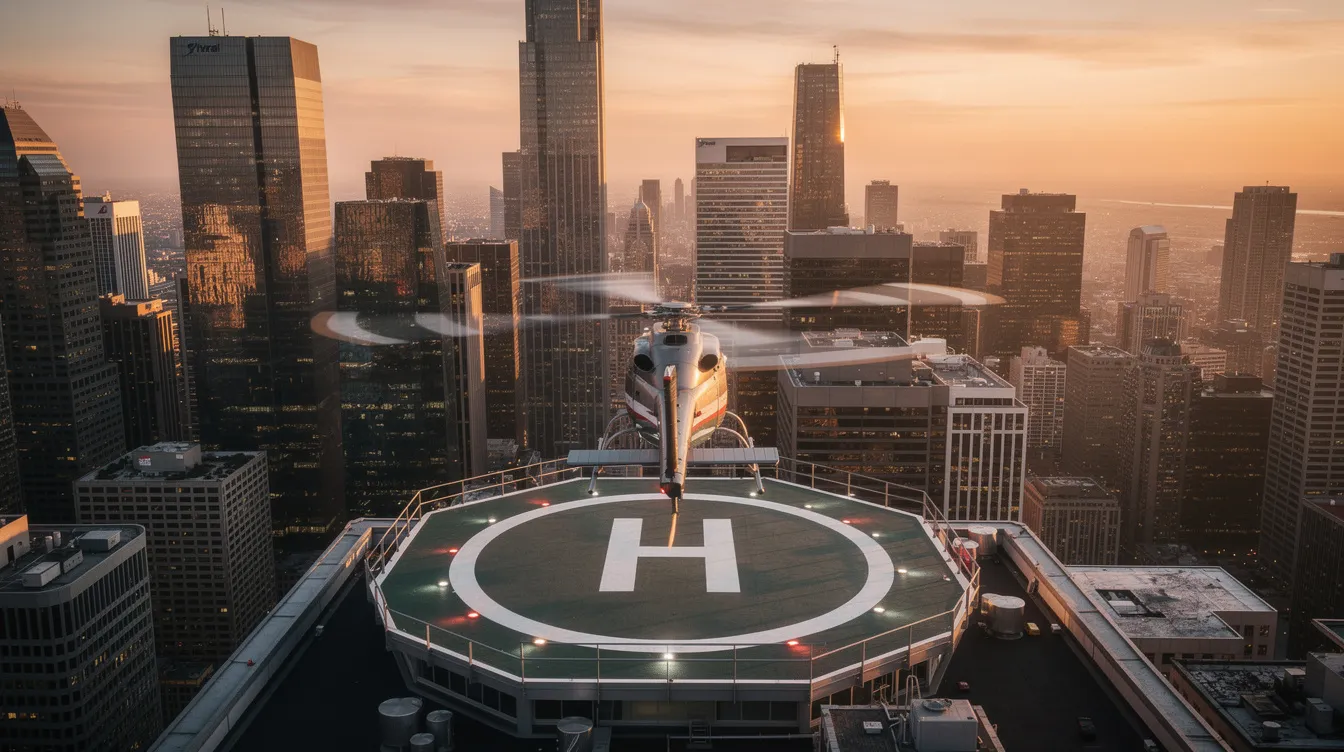
Helicopter landing is one of the most safety-critical phases of flight, and a normal approach typically begins at a 10-degree angle before ending in a controlled hover a few feet above the ground.
Aerodynamic effects like ground effect, vortex ring state, and ground resonance all influence how a pilot manages the final moments before touchdown.
Wind direction and strength are critical factors in helicopter landing safety, and passengers may notice one skid touching down before the other—this is normal.
Advanced techniques such as steep, shallow, running, slope, and confined area landings exist for specific terrain and power conditions, and each requires specialized training.
Charter travelers using platforms like Jettly benefit from operators who meet strict certification standards, including emergency procedure training and rigorous site assessment protocols.
The landing of helicopter flights is a controlled approach that typically begins at about a 10-degree angle, transitions into a hover a few feet above the ground, and ends with a vertical touchdown, with the pilot managing wind, terrain, and other aerodynamic factors for a safe arrival. Unlike fixed wing aircraft that rely on long runways and gradual roll-outs, helicopters can touch down on small helipads, hotel grounds, or remote mountain clearings. That flexibility is exactly what makes helicopter landing so relevant to private charter operations, especially for business and leisure travelers who want direct access with less ground transfer time.
Jettly, a digital private aviation platform, arranges helicopter charters alongside fixed-wing options, working exclusively with certified operators trained in safe landing procedures. Whether the destination is a downtown rooftop helipad in New York, a yacht deck in the Mediterranean, or a ski lodge near Whistler, passengers and ground staff should be aware that precision in the final seconds matters most.
This guide explains how helicopter landing techniques work, how pilots handle different surfaces and environments, and what safety measures and emergency procedures support reliable charter operations.
A normal approach is the baseline technique for touching down on prepared helipads, airfield landing zones, and hospital roofs. Passengers on Jettly-arranged helicopter flights will most often experience some version of this maneuver.
Helicopter landings typically begin with a 10-degree approach angle, with the pilot flying a straight-in line toward the helipad. Here is what happens step by step:
The pilot begins reducing altitude and groundspeed from roughly 300–500 feet above ground level.
The collective, which controls lift, is slowly lowered to initiate descent, while aft cyclic is applied to reduce forward airspeed.
Pedals keep the nose pointed in the correct direction toward the landing zone.
Normal landings end in a steady hover several feet above ground—typically 3 to 5 feet—and this is where the final landing sequence can start before the vertical descent.
A successful helicopter landing involves coordinated control inputs and stability management, with the pilot lowering the helicopter to the surface in a smooth, controlled motion.
The entire sequence feels like a gradual, deliberate slowing and settling. For a deeper look at how helicopters work mechanically, Jettly's platform covers rotorcraft technology in detail.
Wind direction and strength are critical factors in helicopter landing safety. Environmental factors like wind and surface conditions affect how every approach is flown.
Headwind preference: Helicopters generally prefer to land into the wind. A headwind increases effective airflow through the rotor disk, which improves lift and reduces power demand. This also lowers the possibility of entering vortex ring state near the ground.
Speed management: Pilots slowly reduce forward airspeed throughout the approach, reaching very low airspeed or nearly zero by hover height. There is no way to simply slam on the brakes—deceleration must be gradual and coordinated.
One-skid touchdown: Passengers often notice that one skid lands first. On many U.S.-built helicopters, the left skid touches down slightly before the right due to a small roll caused by tail rotor thrust compensation. This tilt is normal and falls well within certified limits.
Rollover awareness: Lateral velocity during landing can lead to helicopter rollover, which is why pilots are trained to keep the skid alignment flat and stable on contact.
As a helicopter nears the surface, several aerodynamic phenomena become critical. Understanding them helps explain what passengers feel and why pilots perform specific actions.
Ground effect is the cushion-like increase in rotor efficiency that occurs when flying within roughly one rotor diameter of the surface. The rotor downwash is disrupted by the ground, reducing the power needed to maintain hover. Passengers may feel the aircraft "floating" just before touchdown.
Vortex ring state is a hazardous condition that occurs with low airspeed and high descent rate. The helicopter descends into its own downwash, and the recirculating air causes a rapid, uncontrolled sink. Vortex ring state can cause descent rates over 2,500 feet per minute. Steep approaches, which range from 13 to 15 degrees, increase the risk of vortex ring state. Pilots avoid it by maintaining adequate forward airspeed and managing descent rate carefully; if the helicopter falls below the normal approach line, recovery depends on correcting airspeed, power, and pitch rather than simply adding collective.
Ground resonance can occur when landing gear oscillates on contact with the surface while the main rotor is spinning. It is a self-feeding vibration specific to helicopters with articulated rotor systems. Recovery requires immediate lift-off or engine shutdown. Modern maintenance and inspection standards make this occurrence rare.
Charter operators in Jettly's network train specifically to recognize and avoid these states, reinforcing the safety standards that govern commercial aviation.
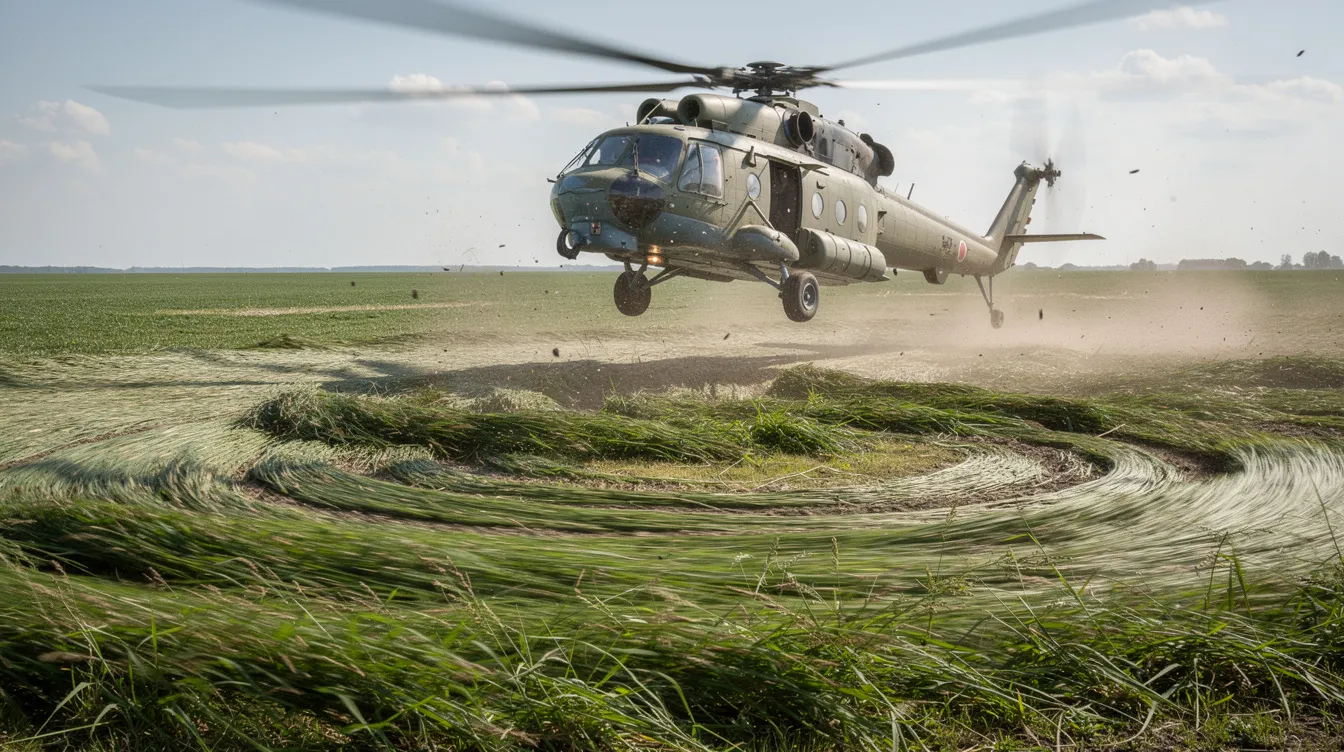
Not every helicopter landing follows a standard profile. Terrain, other obstacles, and available power can require different techniques.
Steep approach: A steep approach ranges from 13 to 15 degrees, used to clear tall buildings, trees, or antenna structures—common for hospital helipads and city rooftop pads. Steep approaches increase the risk of vortex ring state, so pilots must manage power and wind awareness carefully. There is little room for error at these angles.
Shallow approach: Shallow approaches use an angle typically between 3 to 5 degrees. The helicopter maintains more forward speed and stays closer to level flight. This technique is common at high-density-altitude locations where reduced air density limits engine power and rotor lift.
Running landing: Running landings require over 15 knots of airspeed at touchdown. The helicopter lands with forward speed and rolls or slides to a stop on a smooth runway or large grass strip. This avoids hovering when there is not enough available power to sustain it.
These techniques require significant training and are part of commercial pilot syllabi—one reason charter passengers should use platforms like Jettly that work only with licensed operators and provide access to a wide range of private charter aircraft.
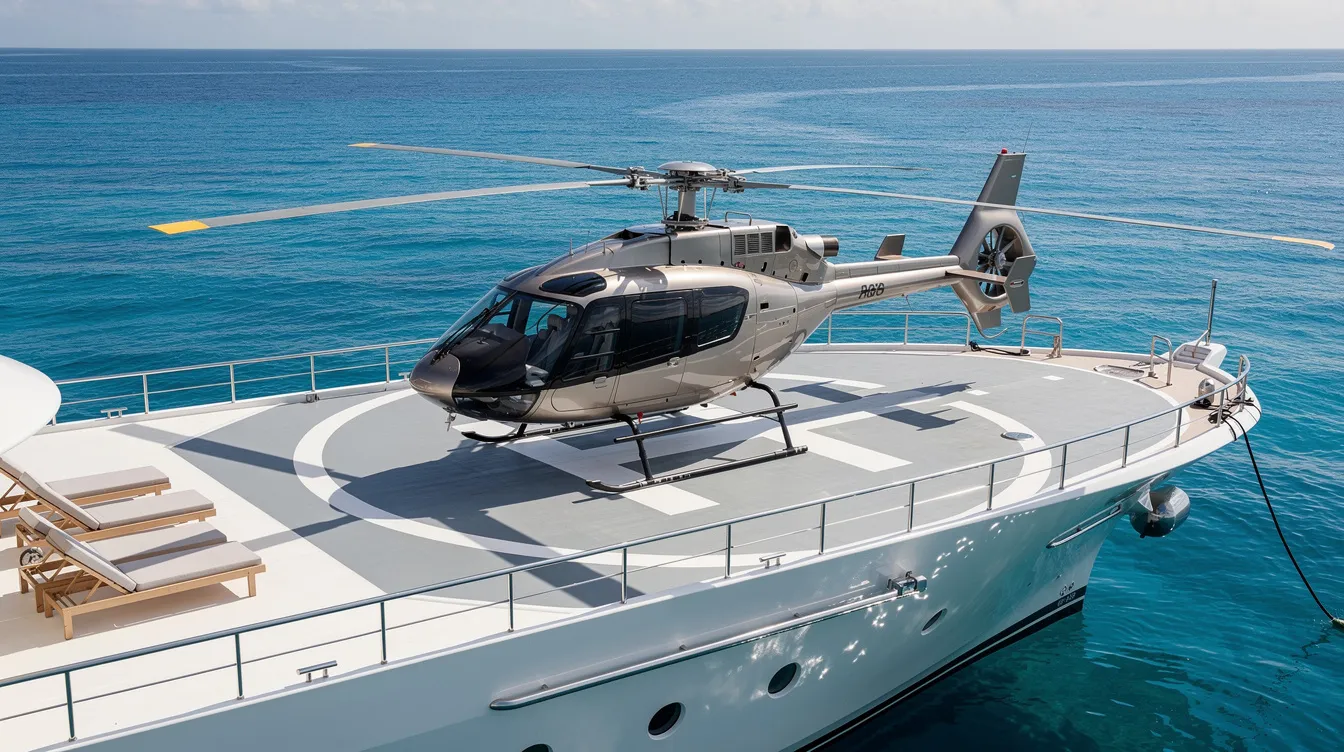
One major advantage of helicopters is the ability to land on sloping ground and in confined areas such as mountain lodges, private estates, or yacht decks, many of which are near smaller airports easily identified with Jettly's airport locator tool. These landings are among the most technically demanding.
The maximum slope for helicopter landings is typically around 6 degrees for most light helicopters.
Pilots prefer landing across the slope, placing the downhill skid first.
Collective is reduced smoothly after secure contact to avoid dynamic rollover.
The ground should be firm, flat, and free of obstacles to prevent tail rotor strikes.
Confined areas may have obstacles like trees or power lines.
A helicopter must fly a circuit at 500 feet before landing to assess the site.
A minimum clearance area of 100 feet by 100 feet is generally required, with a clear area at least double the rotor diameter for safe landings.
The landing zone must be secured and carefully scouted before helicopter arrival. Debris management is critical to maintaining helicopter landing zone safety—loose items must be secured to avoid becoming airborne during rotor wash.
Vortex ring state can occur during vertical landings in confined areas due to restricted airflow.
Clear paths for approach and departure reduce risks in emergency situations.
Pilots should approach the helicopter only from the front to maintain visibility.
The main rotor and tail rotor pose extreme hazards during helicopter operations.
Helicopter landing safety relies on site selection, communication, and hazard management. Communication protocols are vital for managing the landing zone, with clear radio communication maintained between the landing zone commander and flight crew.
Obstacles within the landing zone can create dangerous conditions for landing. Pilots assess suitability of the landing site based on multiple criteria before committing.
Safe helicopter landings require rigorous preparation and strict adherence to protocols.

Modern turbine helicopters are highly reliable, but pilots train extensively for loss-of-power scenarios. The key technique is the autorotation landing.
In an autorotation, the main rotor continues to spin—powered by upward airflow rather than the engine. This allows the helicopter to glide to a controlled landing, somewhat like a fixed wing aircraft gliding without thrust. The sequence involves:
Immediate lowering of the collective to maintain rotor RPM.
Establishing an appropriate glide speed and selecting a suitable landing field, road, or beach.
Using a flare near the ground to reduce descent rate and forward speed before touchdown.
Autorotation is a core part of commercial pilot checkrides and recurrent training. Many people first encounter the maneuver in training because it is practiced repeatedly as an emergency procedure. In U.S. instructional flights between 2010 and 2022, roughly 27% of training accidents involved autorotation practice—underscoring how seriously this skill is drilled.
Charter-certified operators in Jettly's network must comply with regulations such as FAA Part 135 or EASA Air Operator Certificate standards, including regular emergency procedure training and strict maintenance schedules. Frequent flyers may benefit from Jettly's private jet memberships, which pair these safety commitments with predictable access and pricing. Safe helicopter landings require rigorous preparation and strict adherence to protocols.
The ability to land close to a final destination is a major benefit of booking helicopter charters through a platform like Jettly. Several real-world scenarios show how landing techniques connect directly to passenger convenience, especially when combined with strategies for booking the cheapest private jet flights:
Business travelers landing on corporate helipads in London or São Paulo to skip ground traffic, often after using a private jet charter cost estimator to budget their full itinerary.
Leisure travelers flying from Nice to a hotel helipad in Monaco in under ten minutes, planning door-to-door journeys with an understanding of how much it costs to rent a private jet.
Ski groups landing near Whistler or Courchevel, where altitude and slope conditions demand skilled operators and careful planning for international private jet flights.
Yacht transfers in the Caribbean using approved deck helipads—a confined area landing that requires precision and practice, sometimes paired with crowdsourced private jet flights and shared empty seats on the fixed-wing legs of the trip.
Jettly's digital platform offers instant pricing, visibility into different helicopter types, and coordination with operators who hold local approvals for specific helipads and off-airport sites, alongside tools that explain how Jettly offers affordable private jet charter for connecting flights. Every operator in the network carries the certifications needed for the conditions they fly in—whether that means rooftop landings, night operations, or high-altitude approaches.
Explore helicopter charter options or request a quote at jettly.com.
Many first-time helicopter passengers have similar questions about how landings work. These answers are informational, and this FAQ works like a short reference article; actual procedures vary by aircraft type, operator, and local regulation, and broader questions such as how much a private jet costs overall depend on many additional factors. Always follow crew instructions.
Both take-off and landing carry higher risk than cruise flight. For helicopters, the landing phase can be more complex because of low-speed aerodynamics, obstacle clearance, and surface conditions. Canadian data shows that 53% of helicopter accidents occur during landing. However, commercial pilots train extensively for landing scenarios, and charter operators must meet strict regulatory standards for weather, pilot currency, and maintenance—key criteria when comparing the best private jet charter companies.
A brief hover lets the pilot verify wind conditions, confirm the landing spot is clear, and fine-tune position over a small helipad or yacht deck. This is also when the pilot adjusts for ground effect and small gusts, giving passengers a smooth, controlled descent.
While helicopters can technically land in many places, actual options are limited by local regulations, noise rules, obstacle clearance, and operator policies. Charter flights arranged through Jettly typically use approved helipads, private sites with permits, or pre-evaluated landing areas, while fixed-wing segments may involve booking a seat on a private jet as part of a combined itinerary. Travelers should assume that landing site options need advance coordination with the charter team.
Keep seatbelts fastened, follow crew instructions, avoid sudden movements, and secure loose items like phones or bags. Many travelers now pair these basic safety habits with smarter booking strategies for getting a seat on a private jet easily when planning multi-leg journeys. Wait for the crew's signal before unbuckling or exiting—especially on sites with uneven ground or nearby obstacles such as fences or parked vehicles.
Low visibility, strong gusty winds, heavy rain, or icing conditions can restrict operations and make landings unsafe. Professional charter operators follow conservative weather minima and may propose alternate helipads with better lighting or more open surroundings when conditions deteriorate, just as they do when selecting fixed-wing partners from the ultimate list of charter airlines. The fact that a good operator will delay or reroute rather than attempt a risky landing is an important point for passenger safety.
Ready to experience private travel on your terms? In addition to on-demand helicopter and jet charters, Jettly offers jet cards with world-class corporate programs and a cost-effective alternative to NetJets; explore flight options or request a quote at jettly.com.
Helicopter landings are a complex blend of precise control, environmental awareness, and rigorous safety protocols. Whether executing a standard 10-degree approach or navigating challenging confined or slope landings, pilots rely on extensive training and careful planning to ensure passenger safety and comfort. For private charter travelers, platforms like Jettly provide access to certified operators skilled in these techniques, offering seamless, efficient, and secure helicopter travel to diverse destinations.
Understanding the nuances of helicopter landing enhances appreciation for this flexible mode of transport and highlights the value of choosing experienced operators for your private aviation needs. Learn more about Jettly’s helicopter charter options at https://www.jettly.com/helicopter-charter and explore how private jet charters complement helicopter travel at https://jettly.com/private-jets.
Share this post:
Jay Franco Serevilla
Jul 25, 2026
|
5
min read
Discover tips and trends in the industry.
5
min read
cessna sales
The Cessna sales landscape in 2026 showcases a diverse range of aircraft, from vintage models to modern jets, with buyers increasingly utilizing digital tools and charter services for informed decisions. This guide provides insights into popular models, market trends, and practical steps for evaluating and purchasing Cessna aircraft, ensuring buyers navigate the process confidently.
Read More
5
min read
Are Pilots Rich? Airline & Commercial Pilot Pay, Wealth Potential, and Lifestyle in 2026
In 2026, airline and commercial pilots earn substantial incomes, with median salaries of $232,140 and $123,220, respectively. However, only senior captains at major airlines typically reach what is considered 'rich' status, with earnings exceeding $350,000. Factors such as high training costs and delayed income accumulation impact pilots' net worth, making wealth-building a long-term endeavor.
Read MoreStay updated with our latest insights and tips to elevate your journey with us.
MEMBERSHIPS AND ASSOCIATIONS



Disclaimer: Jettly operates as a charter broker, offering access to a global digital jet charter marketplace. Jettly is not a direct air carrier and does not own or operate aircraft. All advertised flights are conducted by third-party air carriers that are fully licensed and hold the appropriate Part 135 or Part 121 certifications issued by the Federal Aviation Administration (FAA) or equivalent regulatory authorities under U.S. or foreign law. Jettly complies fully with the U.S. Department of Transportation's Part 295 and Part 298 Charter Broker regulations. Jettly does not carry additional liability insurance. Passengers are covered by aircraft operator insurance. TICO: 50023770


