


Login
Get Instant Pricing On 23,000+ Aircraft

>

Pinal Airpark in Marana, Arizona is one of the most distinctive aviation facilities in the American Southwest. Known as both a sprawling jet yard for retired airliners and an active military training base, this county-owned airfield combines aircraft storage, maintenance, and defense operations on a single property in the Sonoran Desert.
Pinal Airpark (MZJ), also called Pinal County Airpark, is a county-owned public-use airport in Marana, Arizona, covering 2,080 acres and best known for large-scale commercial aircraft storage, dismantling, and maintenance.
The airpark originated during World War II as Marana Army Air Field, where over 10,000 military pilots received basic flight training and instrument flying instruction before the property transitioned to Pinal County ownership in 1948.
Current facilities include a single 6,849-by-150-foot asphalt surface runway, co-located Silverbell Army Heliport supporting Arizona Army National Guard operations, and a U.S. Special Operations parachute training and testing facility.
Ascent Aviation Services, the main tenant, operates a 500-acre secure storage area and provides heavy maintenance, painting, modifications, and part-out services for civilian commercial aircraft.
Travelers needing access to Pinal County or the Tucson–Marana corridor can use private jet charter platforms like Jettly and its airport locator tool to compare airports, including Pinal Airpark, San Manuel Airport, and Tucson International.
Pinal Airpark in Marana, Arizona, is a county-owned public-use airport in Pinal County, about 30 miles northwest of downtown Tucson along Interstate 10, best known for large-scale commercial aircraft storage, maintenance, and military training in the Sonoran Desert. Often called Pinal County Airpark and widely recognized as an airplane boneyard, it serves aviation professionals, aircraft leasing and maintenance teams, private jet travelers, business executives, and anyone evaluating aircraft storage or private flight access in the Marana-Tucson area.
The surrounding Sonoran Desert environment is central to the airpark’s role. Low humidity, minimal rainfall, and abundant sunshine help limit aircraft corrosion, which makes the site especially well suited for long-term preservation and storage. Across 2,080 acres, Pinal Airpark supports commercial aircraft parking, MRO and parts recovery, military helicopter and parachute training, limited general aviation activity, and a broader regional airport function that matters to operators and travelers who need to understand where private jets can land and access different types of airports in southern Arizona.
Pinal Airpark was originally Marana Army Air Field in 1942, constructed by Del Webb construction companies and Sundt as part of the U.S. Army Air Forces pilot-training network during World War II. The airfield opened in March 1943 and quickly became a major training base for basic flight training, instrument flying, and multi-engine instruction. Over 10,000 pilots were trained at Marana during WWII, including transport pilots who went on to serve across multiple theaters of the world war.
After World War II ended, the Army closed the field in 1945. Pinal County took ownership of the airfield in 1948 and leased the property to multiple tenants over the following years. The Darr Aeronautical Technical Company reconstructed runways, roads, and buildings during the early 1950s. Through the Cold War era and the Vietnam War period, the airpark saw intelligence-related and defense aviation activity, including operations linked to Intermountain Aviation. Commercial aircraft storage began around 1972.
Evergreen Air Center opened in 1982 for aircraft maintenance, establishing large-scale MRO service at the facility. Pinal County leased portions of the property to Evergreen until 2011, when the maintenance center was sold and renamed Marana Aerospace Solutions. Figures like Jim Petty contributed to the airpark's development and management over the decades. Today, the historic Marana Army Air Field name still appears in local history discussions, though the official designation remains Pinal County Airpark.
Pinal Airpark covers approximately 2,080 acres and has a single primary runway suitable for transport-category aircraft. Key facility details include:
Runway 12/30: 6,849 feet long by 150 feet wide, asphalt surface, capable of handling narrow-body and some wide-body commercial aircraft under typical conditions
Aircraft parking: Extensive aprons and storage pads where Boeing 737, 747, 757, 767, and Airbus A319/A320/A321 airplanes are stored nose-to-tail
Secure storage: Pinal Airpark has nearly 500 acres of secure aircraft storage managed by on-site operators
Infrastructure: Maintenance hangars with doors offering maintenance access, parts reclamation areas, fuel facilities, offices, and buildings connected to Interstate 10 via local access roads
Heliport: Four helipads at the co-located Silverbell Army Heliport (three approximately 100 × 100 feet, one approximately 165 × 165 feet)
Pinal Airpark had 58,200 aircraft operations in 2020, averaging about 159 per day. Roughly 86% were military and 14% general aviation. There is no scheduled commercial passenger service. Pinal County departments are responsible for airport oversight, management, and ongoing development at Pinal County Airpark.
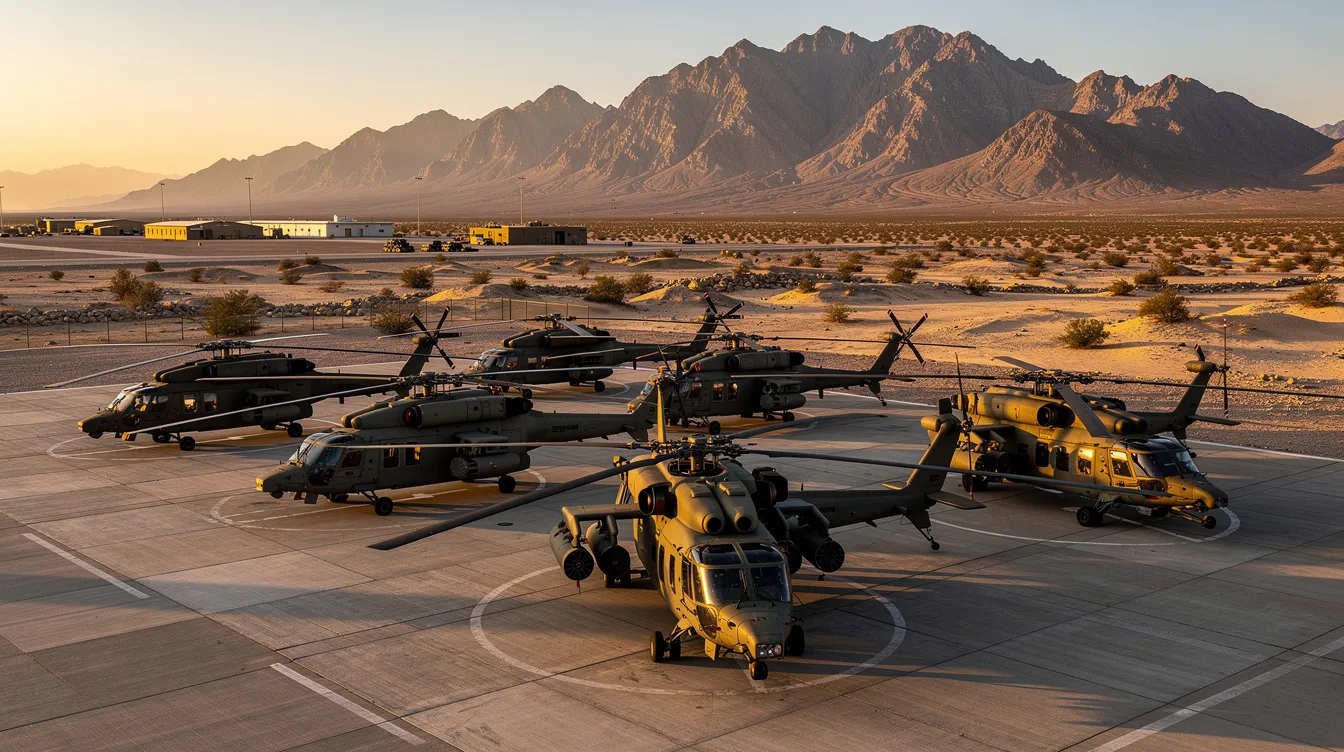
Pinal Airpark is co-located with the Silverbell Army Heliport, which supports Army National Guard units and serves as the home of the Western Army National Guard Aviation Training Site (WAATS), established in 1986. The airpark supports various military aviation activities through the adjacent heliport.
WAATS training: WAATS provides training for the UH-72A Lakota helicopter and previously operated AH-64 Apache flight and maintenance courses. WAATS discontinued AH-64 Apache training in 2012 as Army aviation requirements evolved.
Units: The Arizona Army National Guard's 1-285th Aviation Regiment ("Desert Hawks") and related units have operated from Silverbell, along with international partner programs such as Singapore's Peace Vanguard initiative.
USSOCOM facility: The U.S. Special Operations Command acquired 480 acres in 1992 to establish a parachute training and testing facility west of the runway. Pinal Airpark hosts this facility, which is used for advanced parachute operations, equipment testing, and evaluation in Arizona's stable weather conditions.
Pinal Airpark serves as a boneyard for civilian commercial aircraft and is one of the most recognizable aircraft storage sites in the country, with parked airliners visible from nearby Interstate 10. It also serves as a global lifecycle hub for managing aircraft at the end of their service.
The dry climate of the Sonoran desert is ideal for aircraft storage. The desert climate significantly reduces aircraft corrosion, which preserves resale value and keeps reactivation costs lower than at humid coastal locations.
Ascent Aviation Services is the main tenant, operating a 500-acre facility at the airpark. Ascent Aviation provides:
Heavy aircraft maintenance, painting, and modifications
Long-term storage and preservation (fuel draining, protective coverings, periodic engine runs)
Aircraft dismantling and parts reclamation (typically 70–100 aircraft per year)
Boeing 777 passenger-to-freighter conversion work
The airpark has hosted fleets from major U.S. and international airlines. About 38 Delta airliners are parked at Pinal Airpark, alongside aircraft from other carriers. Pinal Airpark experienced significant storage activity during 2020–2021 when the COVID-19 pandemic forced airlines to ground large portions of their fleets. While the facility is sometimes called an abandoned jet yard, many stored airplanes are temporarily parked rather than scrapped, with a portion returning to active service after market conditions improve.
Pinal Airpark sits near the Pinal–Pima county line, close to the growing town of Marana and the greater Tucson metropolitan area in southern Arizona. Ground access is straightforward via Interstate 10, with downtown Tucson roughly 30 miles to the southeast and Phoenix Sky Harbor approximately 100 miles north, fitting the broader pattern described in resources on where private jets typically land and operate.
San Manuel Airport (E77): A smaller public-use general aviation airport located in the town of San Manuel, north of Pinal Airpark, with a single paved runway serving light aircraft and local traffic. It functions as a reliever airport for the region.
Two airports, different roles: San Manuel Airport serves as a local GA field, while Pinal Airpark is a specialized facility for storage, maintenance, and military training. The distance between them reinforces the diversity of aviation infrastructure across the county.
Economic impact: The airpark drives employment in maintenance, logistics, security, and aviation support throughout Pinal County. These jobs help diversify the local economy beyond mining, agriculture, and residential development. Marana Air Park's operations support local suppliers, ground service companies, and fuel providers across the region.
Pinal Airpark is open to public use but does not host scheduled airline service. Most civilian access comes via general aviation, charter flights, or corporate aircraft landing on the single runway using private charter aircraft suited to the field’s runway and operational profile.
Private jet charter platforms like Jettly and partners such as Zenflight instant-book private jet charter allow travelers to arrange flights directly into Pinal Airpark (MZJ) or nearby airports, depending on aircraft performance and operational requirements. Common use cases include:
Aviation executives visiting Ascent Aviation for fleet inspections
Leasing teams surveying stored aircraft for acquisition or management decisions
Business travelers headed to Marana or Tucson who prefer less congested airports
Jettly's digital platform offers instant pricing, access to thousands of aircraft types, and tools like a private jet charter cost estimator, plus the ability to compare Pinal Airpark with alternatives like Tucson International Airport or Scottsdale Airport based on convenience and charter costs. Operating into a specialized facility like Pinal County Airpark typically requires coordination with on-site operators and local authorities-details a charter platform can help manage.
Ready to explore private travel to Marana, San Manuel, or anywhere in Pinal County? Request a quote at jettly.com.
Pinal Airpark is a secure operational facility with both commercial and military activity, so access beyond the entrance gate is restricted. There are no regular public tours. Organized visits may occasionally be arranged through airport management or tenants like Ascent Aviation Services, subject to security rules. Casual visitors can sometimes view stored aircraft from public roads outside the fenced perimeter.
Arizona's arid climate-low humidity, minimal rainfall, and constant sunshine-greatly slows corrosion on parked aircraft. Large, flat land areas in regions like Pinal County allow airports to build extensive storage aprons at lower cost than coastal or urbanized locations. The state's established aviation ecosystem, including MRO providers and a trained workforce, makes it efficient for airlines to consolidate stored fleets here and complements broader considerations outlined in guides to affordable aeroplane rental costs and options.
No. Davis-Monthan's AMARG stores primarily military aircraft under Department of Defense management. Pinal County Airpark focuses on civilian commercial aircraft storage, maintenance, and some military training support. The two sites are often confused because both feature large numbers of parked aircraft in a desert setting, but they are separate facilities operated by different entities.
Pinal Airpark is listed in the FAA's directory as a public-use airport, but pilots must review current NOTAMs and any local restrictions before flight planning. Military activity and storage operations may require coordination with the airport manager. Pilots seeking simpler access to the area might also consider San Manuel Airport or regional airports around Tucson and Phoenix, keeping in mind the general guidance on how renting a plane works and what to expect from different providers.
Travelers can use an on-demand charter marketplace such as Jettly to search for available aircraft, compare pricing across different airports, and book a suitable jet or turboprop from a global inventory of private charter aircraft. The process involves selecting departure and arrival points, dates, passenger count, and preferred aircraft category, then reviewing instant quotes online. For direct access to Pinal Airpark or efficient travel to Pinal County, explore flight options at jettly.com.
Pinal Airpark in Marana, Arizona, stands out as a multifaceted aviation hub in the arizona desert, blending extensive commercial aircraft storage, maintenance services, and vital military training operations. Its strategic location, vast secure facilities, and ideal climate make it a preferred site for preserving and managing aircraft at the end of their lifecycle. For travelers and aviation professionals alike, private jet access through platforms like Jettly offers convenient, flexible entry to this unique airpark and the surrounding region. Whether for business, maintenance inspections, or specialized military activities, Pinal Airpark remains integral to Arizona's aviation landscape.
Ready to experience private travel on your terms? Explore flight options or request a quote at https://www.jettly.com.
Share this post:
Jay Franco Serevilla
Aug 15, 2026
|
5
min read
Discover tips and trends in the industry.

5
min read
What Days Are the Best Days to Buy Plane Tickets?
Tuesday and Wednesday are typically the best days to buy plane tickets, with Sunday evenings also showing competitive prices. However, dynamic pricing means that the best day can vary based on demand and route. Booking in advance and being flexible with travel dates are key strategies for securing lower fares.
Read More
5
min read
Plane Landings: Phases, Techniques, and What Matters Most
Plane landings involve distinct phases that are crucial for safety and passenger comfort. Factors such as wind direction and runway conditions influence landing techniques, particularly in private aviation where shorter runways are common. Understanding these phases and techniques enhances the flying experience, especially for travelers using charter services like Jettly.
Read MoreStay updated with our latest insights and tips to elevate your journey with us.
MEMBERSHIPS AND ASSOCIATIONS



Disclaimer: Jettly operates as a charter broker, offering access to a global digital jet charter marketplace. Jettly is not a direct air carrier and does not own or operate aircraft. All advertised flights are conducted by third-party air carriers that are fully licensed and hold the appropriate Part 135 or Part 121 certifications issued by the Federal Aviation Administration (FAA) or equivalent regulatory authorities under U.S. or foreign law. Jettly complies fully with the U.S. Department of Transportation's Part 295 and Part 298 Charter Broker regulations. Jettly does not carry additional liability insurance. Passengers are covered by aircraft operator insurance. TICO: 50023770


