


Login
Get Instant Pricing On 23,000+ Aircraft

>
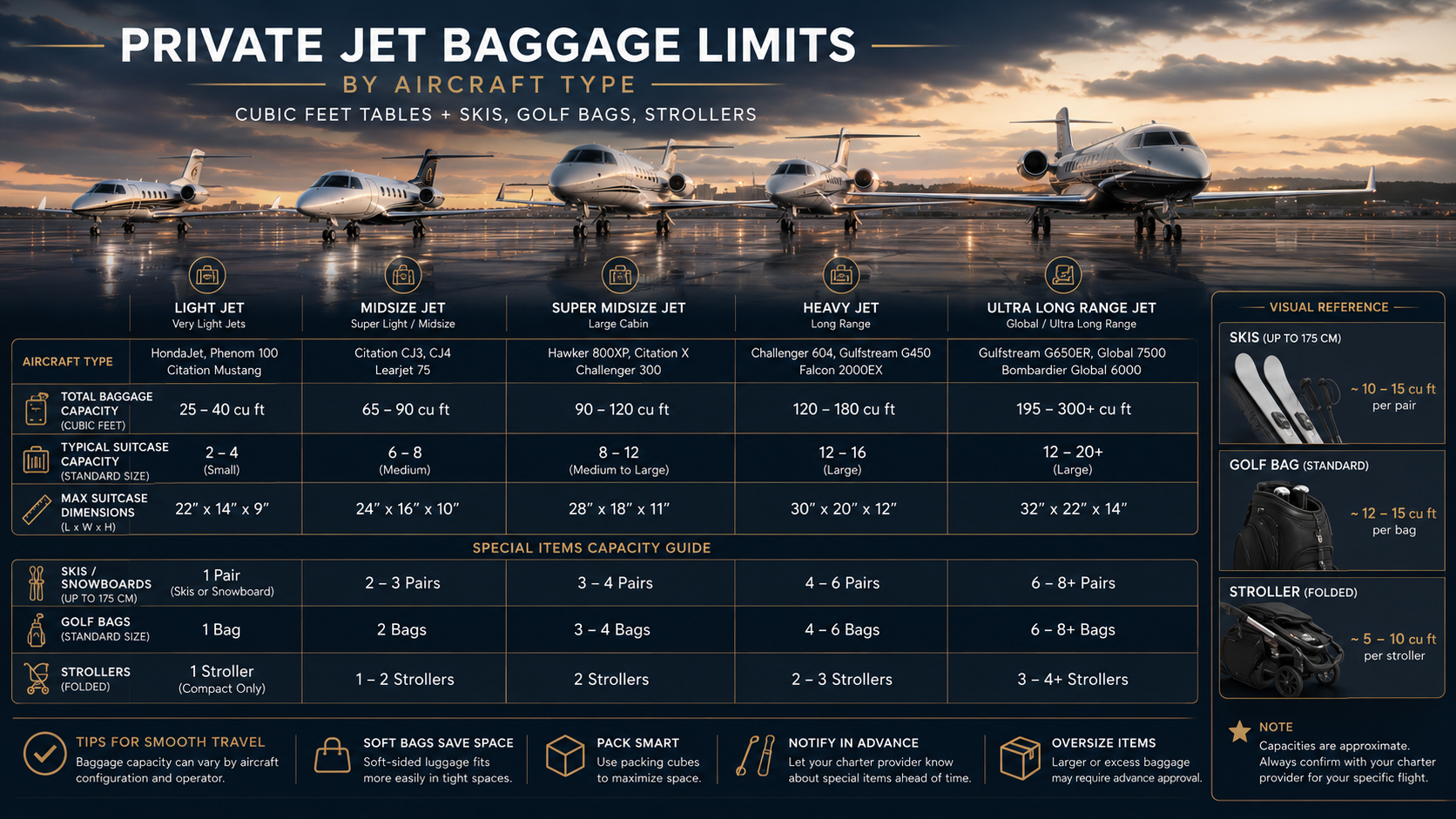
Private jet luggage capacity does not follow the airline playbook you already know. There is no printed "one carry-on plus one checked bag" allowance stamped on a ticket. Three factors decide what actually flies with you: the baggage volume of the specific aircraft (measured in cubic feet), the payload the flight can safely carry, and whether your items physically fit through the baggage door. This guide turns those numbers into real packing decisions, model by model, and it shows how bulky gear like skis, golf bags, and strollers can fail the fit test even when the cubic feet look fine.
Private jet baggage limits are set by two things: baggage volume (usually listed in cubic feet) and aircraft payload (the combined weight of passengers, fuel, and luggage). There isn't one universal "bags per person" rule, and capacity changes by aircraft model and by trip.
A third practical constraint sits next to those two: the shape of the baggage door and compartment. A jet can list plenty of volume on paper and still turn away a long ski bag if the opening is narrow or angled.
Cubic feet (cu ft) is the volume of a jet's baggage compartment. It describes space, not weight, and it does not guarantee that long or rigid items will fit through the compartment door.
Airline baggage policies are contractual. Private jet luggage limits are operational. The flight crew runs a weight-and-balance calculation before every departure to confirm the aircraft sits within safe loading limits. Published baggage volume is a planning number. Final approval comes from the operator for your specific flight.
The reason for this discipline is safety. The IATA safety overview describes how aviation runs on standardized procedures and defined limits that protect every flight, which is why load planning and stowage rules are non-negotiable.
Private jet baggage limits are determined by baggage volume (cubic feet), payload weight, and whether your items physically fit through the baggage door and compartment shape.
If you are flying private for the first time, our primer on first time flying private covers the ground rules before you book.
|
Private jet luggage capacity at a glance. Planning guidance only; final acceptance is operator-specific. |
||
|
Jet category |
Typical baggage volume (cu ft) |
Planning bag guidance (per passenger) |
|---|---|---|
|
Turboprops / very light jets |
25–55 |
1 small bag + 1 personal item |
|
Light jets |
45–75 |
1 small bag + 1 personal item |
|
Midsize jets |
70–135 |
1 medium bag + 1 personal item |
|
Super-midsize jets |
100–160 |
1–2 medium bags + 1 personal item |
|
Heavy / large-cabin jets |
150–225 |
2 large bags + 1 personal item |
Categories are a fast starting point, yet model-level differences inside a single category can be large enough to change what you can bring.
Jettly's network spans six categories: turboprops, very light and light jets, midsize jets, super-midsize jets, heavy or large-cabin jets, and ultra-long-range jets. Our overview of private jet basics breaks down how these classes differ in cabin size and range. Baggage volume tends to climb with each step up, but geometry does not always follow. A small jet can post "enough" cubic feet and still lack the door width or compartment length for skis and golf bags.
Access matters too. Many smaller jets load luggage into a compartment outside the cabin. An external baggage compartment is a storage area outside the cabin; once the aircraft is closed for departure, you typically cannot reach those bags until landing.
Use jet category ranges for planning, but confirm your specific aircraft model, because two jets in the same category can have very different baggage volume and door geometry.
|
Luggage capacity by aircraft category. Fit likelihood reflects door and compartment shape, not just volume. Planning guidance only. |
||||
|
Aircraft type |
Baggage volume (cu ft) |
Planning bags (soft-sided) |
Bulky items (skis/golf/stroller) |
In-flight access |
|---|---|---|---|---|
|
Turboprops |
25–55 |
3–5 |
Low |
Rarely |
|
Very light / light jets |
45–75 |
4–7 |
Low to Medium |
Rarely |
|
Midsize jets |
70–135 |
6–9 |
Medium to High |
Sometimes |
|
Super-midsize jets |
100–160 |
8–11 |
High |
Sometimes |
|
Heavy / large-cabin jets |
150–225 |
10–14 |
High |
Often |
|
Ultra-long-range jets |
170–225+ |
12–16 |
High |
Often |
Category ranges here draw on operator baggage pages published by XO and the practical guidance from Charter Wind, which stresses that soft-sided bags fill compartments more efficiently than hard-shell rollers that leave dead space in the corners.
Here is how to read the table below. First, find your model. Second, check the cubic feet figure. Third, read the bulky-item note if you are carrying skis, golf clubs, or a stroller. Fourth, confirm the plan with your Jettly coordinator before you sign anything.
Model-level variation is the whole point. A Citation XLS carries roughly 90 cubic feet, and a Hawker 800 carries closer to 50. Two midsize jets, same passenger count, very different luggage capacity. A bag equivalent is a planning estimate that converts baggage volume (cubic feet) into a practical number of typical suitcases; it is an estimate, not a guarantee, since bag shape and compartment geometry vary.
"One of the most common misconceptions we see is that passenger seating determines luggage capacity. In reality, baggage planning is driven by three factors working together: available baggage volume, payload limits, and whether the items physically fit through the baggage door. Two aircraft that seat the same number of passengers can have dramatically different luggage capabilities."
- Justin Crabbe, CEO, Jettly
Data last verified: July 25, 2026. Figures below are published planning numbers gathered from manufacturer specs and top industry baggage guides. Real fit depends on bag shapes and door dimensions. If you are close to the limit, send dimensions and photos to your coordinator.
|
Cubic feet by popular charter model. Confidence Score reflects door and compartment geometry plus typical use cases. Planning guidance only; the operator confirms final acceptance. |
|||||||
|
Aircraft model |
Type |
Baggage volume (cu ft) |
Bag equivalents (soft-sided) |
Bulky items notes |
In-flight access |
Fit confidence |
Source |
|---|---|---|---|---|---|---|---|
|
Citation Mustang |
Very light jet |
~37 |
2–3 |
Skis and golf bags risky; confirm door before booking |
No |
Low |
|
|
Embraer Phenom 100 |
Very light jet |
~53 (external) |
3–4 |
Golf tight; full-length skis often declined |
No |
Low–Medium |
|
|
Hawker 800 |
Midsize jet |
~50 |
3–4 |
Limited for its class; confirm skis and golf counts |
Varies |
Low–Medium |
|
|
Citation XLS / XLS+ |
Midsize jet |
~90 |
5–7 |
Good for golf; skis usually fine with notice |
Varies |
Medium–High |
|
|
Challenger 350 |
Super-midsize jet |
~106 |
6–8 |
Strong all-around for bulky gear |
Varies |
High |
|
|
Citation Sovereign |
Midsize jet |
~135 |
7–9 |
Golf and skis usually accepted |
Varies |
High |
|
|
Embraer Legacy 450 |
Midsize jet |
~150 |
8–10 |
Comfortable with skis, golf, and strollers |
Varies |
High |
|
|
Gulfstream G650 |
Ultra-long-range |
~195 |
10–12 |
Excellent; skis and multiple golf bags fit with notice |
Yes |
High |
|
|
Global 7500 |
Ultra-long-range |
~195 |
12+ |
Top-tier capacity for large groups plus bulky gear |
Yes |
High |
The Confidence Score is a Jettly planning signal, not an operator guarantee; a "High" score can still require notice for long items, and a "Low" score does not mean skis are impossible, only that geometry deserves a closer look. For deeper reads on the two biggest names here, see our G650 baggage details and the Global 7500 cargo space overview.
At the far end of the scale, VIP airliners such as converted Airbus and Boeing business jets can carry 60 to 80 pieces of luggage, far beyond even ultra-long-range business jets. Industry baggage guides from operators like Global Charter, Charter-A, and Flightworx echo the same rule that runs through every row above: check the model, not the class. Prefer a spreadsheet? Ask your Jettly coordinator for the CSV version of this dataset.
Cubic feet is a volume number. Here is how to translate it into packing decisions you can trust.
We use three bag archetypes, and you should measure your own gear against them rather than assume. A personal item is a tote or backpack. A carry-on is a standard cabin roller. A medium checked suitcase is the piece most travelers pack for a week. Measure length, width, and height on your actual bags, since real dimensions beat labels.
|
Bag archetypes for planning. Measure your own bags; these are estimates. |
|||
|
Bag type |
Typical dimensions (measure yours) |
Planning cubic feet |
Soft vs hard shell notes |
|---|---|---|---|
|
Personal item / tote |
~16 x 12 x 7 in |
~0.8 cu ft |
Squishes into gaps; great filler |
|
Carry-on / cabin bag |
~22 x 14 x 9 in |
~1.6 cu ft |
Soft flexes; hard shell holds fixed volume |
|
Medium checked suitcase |
~26 x 18 x 11 in |
~3.0 cu ft |
Soft packs tighter against curved walls |
Every compartment charges a geometry tax. Curved walls and sloped ceilings waste space around rigid rectangles, so a hard-shell roller that measures 3 cubic feet can eat 4 cubic feet of real storage space. Soft-sided luggage compresses into those gaps. Charter Wind and other operator guides recommend soft bags on small aircraft for exactly this reason, and switching from hard shells to duffels can free up roughly 30 percent more usable capacity.
Weight can override volume. Payload is the total weight the aircraft can carry beyond the empty aircraft, mainly passengers, baggage, and cargo, within safe limits. As FlyUSA explains, pilots trade fuel, passengers, and bags against a fixed ceiling; a longer leg needs more fuel, which leaves less payload for luggage. Our flight planning guide walks through how these trade-offs get calculated before departure.
Treat bag counts as planning estimates, since payload (weight) and compartment geometry can reduce what "should" fit by cubic feet alone. Safety-driven procedures, described in the IATA report cited above, are the reason a crew will hold firm on these limits.
For bulky gear, length and door geometry often matter more than cubic feet. Three things cause most last-minute problems: long items that exceed the compartment length, rigid frames that will not flex around a corner, and awkward wheel bases that block the door.
A door/compartment constraint is a fit limitation caused by the shape of the baggage door or compartment, even when total cubic feet looks sufficient on paper.
"When travelers ask whether skis, golf clubs, or strollers will fit, the answer usually isn't about cubic feet, it's about geometry. Long or bulky equipment often encounters the baggage door or compartment shape before it ever reaches the aircraft's published volume limit, which is why sharing dimensions before departure is so valuable."
- Justin Crabbe, CEO, Jettly
Skis and snowboards are more likely to be limited by length and cargo-door shape than by cubic feet; a jet can have "enough volume" and still not accept long items unless the compartment is designed for them. Ski bags run long and stiff. Notify your broker or operator before booking and favor aircraft with practical baggage doors, which usually means midsize and up depending on the model. Planning a mountain trip? Our Aspen airport guide covers the realities of flying gear into ski country.
Golf bags are bulky and often exceed the volume of a single suitcase. Remove the driver head or use a stiff-arm travel support, pack shoes and balls into other bags, and choose a soft travel cover that flexes into the compartment. Several full-size golf bags plus a full passenger load push most light jets past their comfortable limit.
Strollers vary widely once folded. Fold to the most compact setting, remove the wheels if the design allows, and measure the folded footprint. Send those folded dimensions rather than the open size, since the open size is meaningless for stowage.
Here is a simple upgrade rule. If you have multiple bulky items plus a near-maximum passenger count, move up a class or pick a model with larger baggage volume, such as a Citation XLS for a small group or a super-midsize and heavy jet for larger parties.
|
Bulky-item fit guide. Measure before you book. |
|||
|
Item |
What to measure |
Packing tips |
Fit likelihood by category |
|---|---|---|---|
|
Skis / snowboard |
Total bag length; number of pairs |
Use a padded soft bag; group pairs into one bag |
Low on light jets; Medium to High midsize and up |
|
Golf bags |
Bag length; number of bags |
Soft travel cover; consolidate shoes and balls |
Low to Medium light; High midsize and up |
|
Stroller |
Folded length, width, height; wheel base |
Fold fully; remove wheels if possible; use a travel bag |
Medium light; High midsize and up |
Two quick scenarios. Four passengers with four golf bags fit comfortably in a super-midsize jet and often in a roomy midsize like the Sovereign or Legacy 450; a very light jet would struggle. Six passengers with full ski gear and winter coats point toward a heavy or large-cabin jet, where both volume and door width work in your favor.
For skis, golf bags, and strollers, the safest planning approach is to share dimensions and a photo of the packed items before you book, because fit can fail at the baggage door even when cubic feet looks adequate.
On many light jets, baggage is loaded externally, so plan as if you will not see it again until landing.
Larger jets often have an internal baggage area or a cabin closet you can reach during the flight. Smaller jets usually rely on an external hold that seals before pushback. Access varies by model, which is why PrivateFly's baggage guide flags accessibility as a booking-time question, not an afterthought.
An FBO (fixed-base operator) is the private terminal used for many charter departures and arrivals, where baggage is typically loaded directly onto the aircraft. Bags stay stowed for takeoff and landing for the same safety reason the IATA report describes: loose items are a hazard during those phases.
If the baggage compartment is external, plan on zero in-flight access, and keep essentials in a small cabin bag.
|
What to carry in the cabin versus what can go in the hold. |
|
|
Pack in the cabin |
Okay to stow in baggage |
|---|---|
|
Medications and prescriptions |
Clothing and shoes |
|
Passports and ID |
Toiletries in sealed kits |
|
Phone, laptop, chargers |
Golf clubs and skis |
|
Keys and wallet |
Stroller (if folded and stowed) |
|
One change of clothes; valuables |
Bulk gifts and non-fragile gear |
International trips still involve customs and immigration on arrival, so keep travel documents on you rather than in a sealed hold. Our international charter tips cover how those steps work across borders.
Two trips on the same model can have different luggage limits. The tail number does not change; the mission does.
Weight and balance is the calculation the flight crew uses to confirm the aircraft is within safe limits for takeoff and landing, based on passengers, fuel, and baggage. That single calculation ties every factor below together.
Passenger count comes first. More people means less payload left for bags, so if you want maximum luggage, fly with fewer passengers or step up in size. Fuel and range come next; a long leg demands more fuel, which shrinks the margin for baggage. Runway and conditions play a part too, since a short runway or a hot, high-altitude airport can cap allowable takeoff weight and, with it, your baggage allowance. Operator discretion has the final word, because the crew is responsible for safe loading on the day.
Your allowed luggage can shrink on longer flights, since extra fuel reduces the payload available for bags. Manufacturer specs describe an aircraft's maximum on a good day; operator rules translate that into what is safe for your exact trip, which is how published numbers and real allowances end up different.
|
What changes your allowance and what to do about it. |
||
|
Factor |
Why it matters |
What to do |
|---|---|---|
|
Passenger count |
More people use up payload |
Share exact headcount; consider a size up |
|
Fuel / range |
Long legs cut baggage margin |
Flag long trips early for the right aircraft |
|
Runway / weather |
Short or hot-and-high fields cap weight |
Ask your coordinator about airport limits |
|
Operator policy |
The crew makes the final call |
Confirm the approved plan in writing |
When you keep hitting weight restrictions, the cleanest answer is often more cabin. Our heavy jets guide shows which large-cabin options carry the most and fly the farthest.
On smaller private jets, bag shape matters as much as bag count.
Soft-sided luggage beats hard shells in curved compartments. Rigid rollers hold their volume no matter what, so they strand space in the corners; duffels and soft bags flex into the gaps. Label every bag with your name and destination so ground crews load fast at the FBO. Photograph the full luggage pile once, then photograph your largest item next to a tape measure. Those two images answer most fit questions in seconds.
Pack essentials in a separate cabin bag so you never need access to an external hold mid-flight. Communicate bulky items early, before the charter agreement is finalized, so the right aircraft gets selected from the start.
Pre-flight coordination is the planning step before departure where passenger count, baggage details, catering, ground transportation, and timing are confirmed with the operator.
If you are close to the limit, switching from hard-shell rollers to soft duffels is often the simplest way to improve real-world fit.
Measure your three largest bags (length, width, height).
Weigh anything unusually heavy and note the estimate.
Swap hard shells for soft-sided luggage where you can.
Consolidate loose items into fewer, fuller bags.
Photograph the full pile in one frame.
Photograph the biggest item with a tape measure.
Fold strollers fully; remove wheels if possible.
Use soft covers for golf bags and ski bags.
Label each bag with name and destination.
Send counts, dimensions, and photos before you sign.
This is common, and it is fixable. Three moves solve almost every case.
Reduce and repack first. A hard-shell-to-soft swap plus tighter consolidation often recovers the last few cubic feet you need. Ship bulky items separately when the timeline allows, which can make sense for golf clubs or gear you do not need on arrival day. Switch aircraft class or model when you have skis or multiple golf bags plus a full passenger load, since a larger jet fixes both volume and door geometry at once. The operator has the final call on safe loading, so build in time to adjust.
An operator is the licensed air carrier responsible for the aircraft and flight crew; they make the final safety decision on baggage acceptance.
If baggage doesn't fit, the most reliable fix is switching to a larger aircraft, since it solves both volume and door-geometry constraints. Worried about cost when you size up? Our tips to save on charter cover empty legs and other levers that soften the difference.
|
If it doesn't fit, pick the fix that matches your priority. |
|||
|
Problem |
Fastest fix |
Lowest-cost fix |
Most reliable fix |
|---|---|---|---|
|
Slightly over on volume |
Repack into soft bags |
Repack / consolidate |
Repack into soft bags |
|
Oversized luggage (long items) |
Ship the item |
Ship the item |
Move up an aircraft class |
|
Full passengers plus bulky gear |
Size up the aircraft |
Split gear / ship some |
Size up the aircraft |
The simplest way to avoid baggage surprises is to confirm your luggage list before you sign the charter agreement.
Jettly is a charter broker and digital marketplace. Jettly does not own or operate aircraft. Every flight is operated by properly licensed third-party air carriers holding FAA Part 135 or Part 121 certifications, or the equivalent foreign authority. A charter broker arranges flights with licensed air carriers; the broker is not the aircraft operator and does not control the aircraft.
The booking flow is straightforward: request a flight, receive aircraft options, select your aircraft, sign the charter agreement with payment secured, complete pre-flight coordination, and depart from the FBO. Our full walk-through of renting a private jet covers each step in detail.
"The easiest way to avoid baggage surprises is to treat luggage planning as part of the flight planning process rather than something discussed the day before departure. Providing accurate passenger counts, luggage dimensions, and photos early allows the right aircraft to be selected from the beginning instead of solving avoidable problems at the FBO."
- Justin Crabbe, CEO, Jettly
What to send your Jettly coordinator, at minimum:
Passenger count and expected weight of heavy passengers or gear, if known.
Total number of bags.
Dimensions of your largest bag.
Weight estimates for any unusually heavy items.
A list of bulky items (skis, golf bags, strollers) with folded or bagged sizes.
One photo of everything packed together.
Your route and dates, so payload and runway limits are factored in.
Copy and paste template: "Booking for [route] on [date], [X] passengers. Bringing [X] bags total. Largest bag is [L x W x H]. Bulky items: [skis / golf bags / stroller] measuring [dimensions]. Photo attached. Please confirm which aircraft fits everything and note the approved baggage plan in writing."
To confirm baggage fit, share bag counts, the dimensions of the largest items, and a photo, then confirm the approved baggage plan in writing before departure. Use Jettly's instant quote tool or the app to start, and contact 24/7 member services for edge cases.
How much luggage you can take on a private jet depends on the aircraft model's baggage volume (cubic feet), the flight's payload limits, and whether your items fit through the baggage door. Start with the category table, move to the model table for your aircraft, then use the "what to send your coordinator" template to confirm.
Ultra-long-range and heavy jets carry the most, with the Gulfstream G650 and Global 7500 near 195 cubic feet each. Super-midsize jets like the Challenger 350 and roomy midsize jets like the Legacy 450 follow close behind for most trips.
Private jets don't follow a universal airline-style "50-pound per bag" rule, but every flight has a strict total weight-and-balance limit that includes passengers, fuel, and luggage. The operator and pilot decide safe loading, so share estimated bag weights for anything unusually heavy.
Operators account for baggage weight as part of the aircraft's weight-and-balance calculation, even when they do not enforce a fixed per-bag rule. Sharing an estimate for heavy items early lets the right aircraft get selected the first time.
Yes, skis and snowboards are often allowed, but they can be limited by baggage-door size and compartment shape even when the jet has enough cubic feet. Measure the length of your ski bag, send a photo, and plan on midsize or larger aircraft when you have multiple long items.
Golf bags are usually possible on many private jets, but multiple full-size bags can quickly consume baggage space, so confirm counts and dimensions before booking. Use soft travel covers and pack shoes and balls into other bags to save room.
Most strollers can be brought on a private jet if they fold compactly, but the folded size and wheelbase determine whether they fit on smaller aircraft. Provide folded dimensions, note whether the wheels come off, and use a travel bag.
Sometimes. If luggage is in an internal baggage area or cabin closet you may reach it, but external baggage holds are typically inaccessible until landing. Keep medications, documents, and chargers in a small cabin bag.
Many private flights are not subject to the carry-on liquid limits associated with commercial security screening, but you should still follow operator instructions and meet customs requirements for international travel. Confirm anything unusual during pre-flight coordination.
If your bags don't fit or exceed weight-and-balance limits, the operator can require items to be removed, shipped separately, or moved to a larger aircraft. The best prevention is sharing dimensions and a photo of all luggage before you finalize the booking.
Private jet luggage capacity is a three-part equation: cubic feet, payload, and door geometry. Category ranges give you a starting point, the model table gives you real numbers, and bulky items like skis, golf bags, and strollers still need a fit check at the door. Get the aircraft right the first time and the day of departure stays calm. Tell us what you are bringing, especially skis, golf bags, and strollers, and Jettly will match you to an aircraft that fits and confirm the baggage details during pre-flight coordination. Start with the instant quote tool or the Jettly app, or reach 24/7 member services at +1-866-448-2358 or departures@jettly.com. Final baggage acceptance always rests with the licensed operator's safety requirements, and getting your details in early is how you make that a formality rather than a surprise.
IATA Annual Safety Report 2025 (Executive Summary and Safety Overview) - safety-driven procedures and load-planning principles.
Share this post:
Jay Franco Serevilla
Jul 25, 2026
|
5
min read
Discover tips and trends in the industry.
5
min read
Southwest 737-800 vs MAX 8: What Flyers Should Know (and How It Compares to Private Jet Travel)
This article compares Southwest Airlines' Boeing 737-800 and MAX 8, focusing on passenger experience, comfort, and features. While both aircraft offer similar seating and service, the MAX 8 boasts quieter engines, modern interiors, and consistent USB charging. For travelers seeking privacy and flexibility, private jet charter options through Jettly present a compelling alternative to commercial flights.
Read More
5
min read
Flight Length: How To Estimate Flight Time Accurately (Especially For Private Jets)
Estimating flight length accurately is crucial for effective travel planning, whether for private jets or commercial flights. Factors such as distance, aircraft type, and wind conditions can significantly impact flight duration. This guide provides insights into estimating flight times and highlights the advantages of private jet travel through platforms like Jettly.
Read MoreStay updated with our latest insights and tips to elevate your journey with us.
MEMBERSHIPS AND ASSOCIATIONS



Disclaimer: Jettly operates as a charter broker, offering access to a global digital jet charter marketplace. Jettly is not a direct air carrier and does not own or operate aircraft. All advertised flights are conducted by third-party air carriers that are fully licensed and hold the appropriate Part 135 or Part 121 certifications issued by the Federal Aviation Administration (FAA) or equivalent regulatory authorities under U.S. or foreign law. Jettly complies fully with the U.S. Department of Transportation's Part 295 and Part 298 Charter Broker regulations. Jettly does not carry additional liability insurance. Passengers are covered by aircraft operator insurance. TICO: 50023770


