


Login
Get Instant Pricing On 23,000+ Aircraft

>
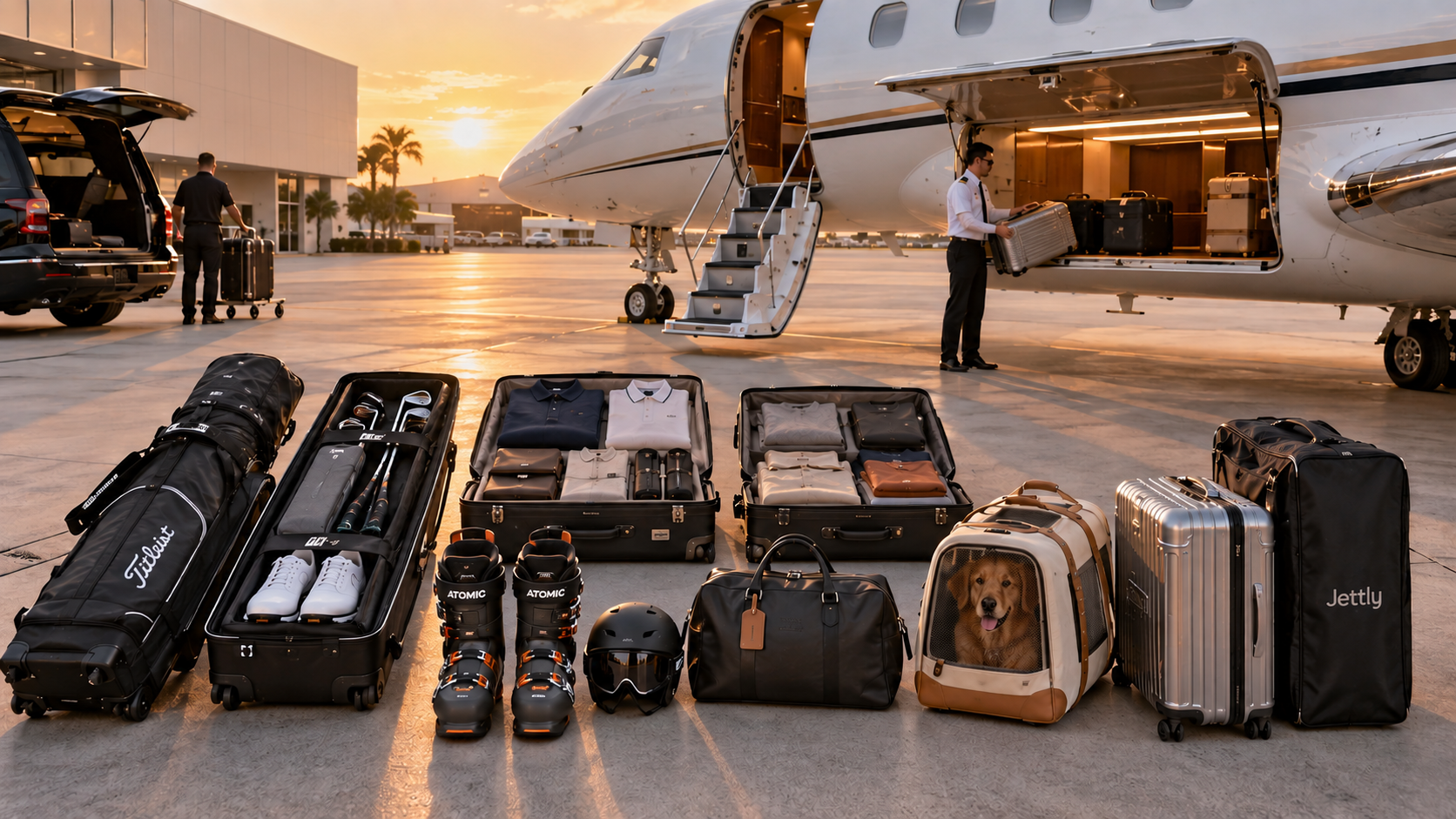
Private jet luggage rules trip up a lot of first-time charter travelers, and for good reason. No single "two bags per passenger" policy exists the way commercial carriers publish one. Private jet baggage limits aren't set by a flat "bags per person" rule. They're determined by (1) baggage volume (cubic feet), (2) payload and weight-and-balance for your route, and (3) whether your items fit through the baggage door. This guide is for first-time and experienced private jet travelers who want to understand how baggage limits work. Understanding private jet baggage limits helps avoid surprises and ensures a smooth travel experience. This guide shows what actually fits by aircraft class, gives you a model-by-model table in cubic feet, and walks through how to confirm your bags before you sign.
Most travelers can plan for roughly one to two bags per passenger on a private jet, though the true number depends on the aircraft, not a printed policy. A light jet carrying four people to a weekend event handles bags very differently from a heavy jet crossing an ocean with nine passengers aboard. Use aircraft class for a first estimate, then let the operator confirm the final load.
As a planning baseline in 2026, turboprops and VLJs usually fit about 1 small bag per person, light jets about 1 small-to-medium bag per person, midsize jets about 1 medium bag per person, super-mids about 1 to 2 medium bags per person, and heavy or large-cabin jets about 2 large bags per person. The operator then confirms the final load for your specific flight.
Planning baseline (operator confirms final allowance)
|
Aircraft class |
Typical baggage volume (cu ft) |
Planning bags per person |
Bulky items (skis/golf/stroller) |
In-flight access |
|---|---|---|---|---|
|
Turboprop / VLJ |
15-55 |
~1 small bag |
Often tight, measure first |
Usually external, none |
|
Light |
25-76 |
~1 small to medium bag |
Fits sometimes, varies by model |
Usually external, none |
|
Midsize |
70-140 |
~1 medium bag |
Usually fine with soft covers |
Often external, limited |
|
Super-mid |
100-195 |
~1 to 2 medium bags |
Good for golf and skis |
Sometimes internal |
|
Heavy / large-cabin |
195-525 |
~2 large bags |
Most forgiving |
Often internal |
|
For a deeper reference, see our full table of baggage limits by aircraft type, which lists more models and cubic feet figures. |
Commercial airlines publish fixed baggage policies to standardize thousands of identical flights. Unlike commercial travel, private jet baggage policies are specific to each aircraft type and operator. Each private aircraft carries a certified weight ceiling and a fixed compartment shape, and the operator recalculates what fits for every trip. That is why private jet luggage planning starts with the aircraft, not a rulebook of generic luggage restrictions.
Three things control your true allowance. Baggage limits on private jets depend on aircraft size and total payload. In private aviation, both volume and weight limits govern baggage allowances for your exact route. Baggage door geometry is the size and angle of the opening your items must pass through. The dimensions of baggage doors affect whether larger items can fit.
Baggage capacity (cubic feet) is the volume of the luggage compartment. Baggage capacity is measured in cubic feet of volume. It describes space, not a guaranteed number of suitcases.
Use aircraft class ranges for a first estimate, but the operator's weight-and-balance calculation for your exact route is what determines the final luggage allowance. Published references show how wide the spread runs: a Gulfstream G650 holds about 195 cubic feet, and an Embraer Lineage 1000E reaches roughly 443 cubic feet. Jettly can help confirm fit before you sign, though the operator always holds final authority over what boards the aircraft.
Private jet luggage isn't "allowed," it's "approved for that flight." Two trips on the same tail number can carry different bags, and the reason comes down to three separate constraints: volume, weight, and fit through the door.
Volume rarely changes. A hold is the size it is. Weight is where things move. A longer leg needs more fuel, and baggage capacity can change based on passenger load and fuel requirements because fuel and bags draw from the same budget. Load the tanks for a coast-to-coast run and the payload left for luggage shrinks, so it pays to confirm the aircraft-specific luggage requirements in advance.
Payload is the combined weight of passengers, baggage, cargo, and usable fuel an aircraft can carry, and weight limits are determined by the aircraft's maximum payload, not just bin space. The maximum payload limit includes all passengers, luggage, and usable fuel. That maximum payload limit includes all passengers, luggage, and usable fuel, so the total weight available for bags often competes with fuel on longer routes. Useful load, the weight left after the empty aircraft, splits between people, fuel, and bags.
Airport performance matters too. Hot temperatures, high elevation, and short runways all cut the allowable takeoff weight, so a "heat-and-high" field can quietly reduce your luggage capacity. Aspen is the classic example, where thin mountain air trims what a jet can lift. You can see the fuel and runway logic laid out in our flight planning basics.
Door shape is the third trap. A jet can have plenty of cubic feet on paper and still reject skis or golf bags if the baggage door opening is too small or angled. The dimensions of baggage doors affect whether larger items can fit. Two midsize jets with similar seating can differ sharply on baggage: a Cessna Citation XLS sits near 90 cubic feet, and a Hawker 800 is closer to 50.
|
Constraint |
What it affects |
What to do |
|---|---|---|
|
Fuel for a longer leg |
Cuts payload available for bags |
Share bag weights, consider a fuel stop |
|
Hot or high-altitude airport |
Lowers allowable takeoff weight |
Reduce bags or size up a class |
|
Small or angled baggage door |
Blocks long rigid items |
Send item length, pick a bigger cabin |
|
Full passenger count |
Leaves less weight for luggage |
Redistribute or upgrade aircraft |
Class ranges are planning baselines. The operator confirms the final baggage for your itinerary. Aircraft class gives you a private jet luggage allowance you can plan around, but the model sets the ceiling.
Turboprops and very light jets work best for short hops and smaller groups, and these smaller aircraft usually offer about 30 to 50 cubic feet of baggage volume, though some models run a bit higher. Bags often ride in an external hold you cannot reach in flight, so soft duffels that squeeze into odd corners beat rigid cases here. A Beechcraft King Air 350 offers around 55 cubic feet, and an Embraer Phenom 100 sits near 53 cubic feet, so even on a small jet the rule of thumb is at least one piece of luggage for one passenger, with enough room for a small bag each across four to six travelers. Long rigid items like skis are the usual sticking point. Choose this class when the trip is short, the group is small, and the bags are soft.
Light jets are a separate option from VLJs within the different categories of private aircraft, typically seating four to seven passengers and usually offering about 45 to 75 cubic feet of baggage space depending on the specific model. An Embraer Phenom 300 carries roughly 76 cubic feet, one of the better numbers in the light jet field, per compiled capacity data. As a general rule, planning assumes one suitcase per passenger, though some lighter configurations land closer to 30-60 cubic feet in practice. A light jet suits day trips and short business runs, so luggage per person is the best way to judge fit in this class. Multiple golf bags or several hard-shell suitcases are where a light jet starts to feel tight. Move up a class when two or more passengers bring full-size sports gear.
Midsize jets fit six to nine passengers and typically span about 70 to 160 cubic feet of baggage capacity across different aircraft models. They handle multi-day luggage far more comfortably, and many can accommodate about 7 to 10 pieces of luggage for a typical passenger load depending on available storage space. A Cessna Citation XLS+ sits in the mid size category, and midsize jets like the Citation XLS usually offer around 70 to 90 cubic feet of luggage space, while some tighter midsize options are closer to 60 cubic feet; a Citation Sovereign+ climbs near 100 cubic feet. Step up to a midsize jet when a family needs a week of luggage or a small executive team travels together. Some midsize models still route bags through an external door, so measure long items on a midsize jet before you commit.
Super-midsize jets balance passenger space with real luggage room, which makes them a strong pick for golf and ski trips. A Bombardier Challenger 350 carries around 106 cubic feet, and certain super midsize models allow limited in-flight baggage access. Choose super midsize when you want range, a stand-up cabin, and space for bulky gear without jumping to a heavy jet.
Heavy and large-cabin jets are the most forgiving for luggage plus bulky equipment, and large jets and other larger aircraft in this class commonly offer about 150 to 225+ cubic feet of space, with some layouts starting around 125 cubic feet for 10 to 12 passengers. A Gulfstream G650 or G650ER is among the ultra long range jets in this segment and offers about 195 cubic feet, while a Bombardier Global 7500 matches that near 195 cubic feet; on top of that, heavy jets can often carry about 12 to 20+ bags depending on the specific aircraft. The Embraer Lineage 1000E, a VIP-style option in the boeing business jet tier, reaches roughly 443 cubic feet, and VIP-converted airliners can transport roughly 60 to 80 pieces of luggage. Our heavy jet guide covers this category in more depth. Pick a heavy jet for ultra long range travel, large groups, or trips where luggage volume is the deciding factor.
External baggage compartment means the hold sits outside the cabin and typically cannot be accessed during flight once the doors are closed.
In private aviation, aircraft class is a helpful starting point, but model-to-model differences can be large enough to change whether special items like skis fit.
|
Class |
Typical trip fit |
What usually causes problems |
Upgrade trigger |
|---|---|---|---|
|
Turboprop / VLJ |
Short hop, soft bags for 4-6 |
Skis, hard cases, extra passengers |
Any long rigid item |
|
Light jet |
Day trip, one bag each |
Multiple golf bags, hard shells |
Two or more sets of sports gear |
|
Midsize jet |
A week of bags for a family |
Long items through an external door |
Skis plus full luggage |
|
Super midsize |
Golf or ski trip with gear |
Very large groups |
9-plus passengers with bags |
|
Heavy jet |
Long-range trip, big group |
Rarely volume, usually weight on long legs |
Ultra-long leg near max range |
If you're close to the limit, send dimensions and a photo to your Jettly coordinator before confirming the aircraft. The most reliable way to compare private jet luggage capacity is by aircraft model and cubic feet, because luggage capacity varies significantly by private jet model and by aircraft category, so comparing different aircraft matters more than seat count alone. The table below draws baggage volume in cubic feet from a compiled capacity reference and pairs each model with an estimated bag equivalent, a bulky-items flag, and whether you can reach your bags in flight.
Bag equivalent is a planning estimate that converts cubic feet into an approximate number of typical suitcases. It is not a guarantee, since bag shapes and compartment geometry vary.
|
Aircraft model |
Class |
Typical seats |
Baggage volume (cu ft) |
Est. bag equivalents (soft-sided) |
Bulky items note |
In-flight access |
Source |
|---|---|---|---|---|---|---|---|
|
Beechcraft King Air 350 |
Turboprop |
8-9 |
~55 |
~5-7 |
Soft bags help, skis tight |
No |
Flycraft |
|
Embraer Phenom 100 |
Very light |
4-6 |
~53 |
~4-5 |
Limited for long items |
No |
Flycraft |
|
Cessna Citation CJ3 |
Light |
6-7 |
~65 |
~6-8 |
Golf in soft covers only |
No |
Flycraft |
|
Embraer Phenom 300 |
Light |
6-8 |
~76 |
~6-8 |
Ski fit varies by loading |
No |
Flycraft / PrivateFly |
|
Learjet 75 |
Light |
6-8 |
~50 |
~4-6 |
Long items risky |
No |
Flycraft |
|
Hawker 800XP |
Midsize |
7-8 |
~50 |
~5-7 |
Tight for multiple golf bags |
Limited |
PrivateFly / XO |
|
Cessna Citation XLS+ |
Midsize |
8-9 |
~90 |
~7-9 |
Good with soft covers |
Limited |
Flycraft |
|
Cessna Citation Sovereign+ |
Midsize |
8-9 |
~100 |
~8-10 |
Handles skis and golf |
Limited |
Flycraft |
|
Bombardier Challenger 350 |
Super-mid |
8-10 |
~106 |
~9-11 |
Good for golf and skis |
Sometimes |
Flycraft / XO |
|
Dassault Falcon 2000 |
Super-mid |
8-10 |
~131 |
~10-13 |
Roomy for the class |
Sometimes |
Flycraft |
|
Gulfstream G650 / G650ER |
Heavy |
11-14 |
~195 |
~14-18 |
Very forgiving |
Yes |
Flycraft |
|
Bombardier Global 7500 |
Heavy |
14-17 |
~195 |
~14-18 |
Very forgiving |
Yes |
Flycraft |
|
Embraer Lineage 1000E |
VIP airliner |
13-19 |
~443 |
~30-40 |
Handles nearly anything |
Yes, walk-in |
Flycraft / PrivateFly |
Planning guidance only. Values compiled from published operator and manufacturer references and cross-checked across guides; the operator confirms for your itinerary.
Read the cubic feet column as a ceiling on space, then discount it for shape. A number near 90 cubic feet on a midsize jet does not mean 30 suitcases will slide in. Curved walls and mixed bag sizes eat into that figure, and the size of the baggage compartment varies significantly between aircraft types even when cabin size looks similar, which is why the bag equivalents run lower than raw cubic feet would suggest. Geometry risk climbs with long rigid items, so a jet with generous cubic feet can still turn away skis.
Among specific aircraft, the Gulfstream G650 offers 195 cubic feet of luggage space and serves as a useful benchmark when comparing aircraft models. Compare our G650 baggage details against the Global 7500 cargo space to see how two 195 cubic feet jets treat luggage in practice.
Cubic feet is space, not a suitcase count. Here's a practical way to estimate. Start with three bag archetypes drawn from Jettly's own baggage guidance: a personal item, a carry-on, and a medium checked suitcase.
|
Bag type |
Example dimensions |
Approx. volume (cu ft) |
Notes |
|---|---|---|---|
|
Personal item |
18 x 14 x 8 in |
~1 |
Stays in the cabin under a seat |
|
Carry-on |
22 x 14 x 9 in |
~1.6 |
Soft-sided packs tighter |
|
Medium checked bag |
26 x 18 x 11 in |
~3 |
The standard planning unit |
|
Large checked bag |
30 x 20 x 12 in |
~4.2 |
Often hits weight before volume |
A medium soft-sided checked bag takes up about 3 cubic feet. Divide a compartment's published volume by that figure and you get a theoretical ceiling: a 90 cubic feet midsize hold could, on paper, swallow around 30 soft bags. Real holds never pack that cleanly. Plan on filling only 60 to 75 percent of the published number for rigid or awkward loads, which drops that 30 to roughly 18 to 22.
Weight then finishes the job. Dense cases and a full cabin usually hit the payload ceiling before volume runs out, so the realistic plan for that same 90 cubic feet midsize lands near 7 to 9 medium checked bags for a full load. Soft-sided bags usually fit better than hard-shell suitcases on smaller jets because curved baggage compartments create wasted space around rigid rectangles.
Weight and balance is the pre-flight calculation that confirms passengers, fuel, and baggage keep the aircraft within its certified weight limits and center-of-gravity limits.
New to charter and want the plain-English version of how all this fits together? Our private jet basics primer covers the terms in one place.
If you remember one thing: cubic feet tells you space, not suitcase count. Send your bag dimensions to a coordinator, then let the operator confirm the load for your exact route.
If your route needs more fuel or your airport needs more performance margin, luggage capacity can shrink. The physics is simple: an aircraft can only lift so much, and everything you add competes for the same weight budget.
MTOW, or maximum takeoff weight, is the highest certified weight an aircraft can have at the start of takeoff, including passengers, fuel, and baggage. A separate maximum landing weight caps what the jet can weigh on touchdown, which matters on short flights that burn little fuel.
Longer flights can reduce baggage allowance because extra fuel uses payload that could otherwise be allocated to luggage. Even a heavy jet with big baggage capacity feels this on a max-range leg, so payload planning stays relevant on a Gulfstream G650 or a Bombardier Global 7500 flying near its limit.
Airport constraints stack on top of fuel. Private jet baggage limits depend on the aircraft, the route, the runway, the weather, and the payload math for that day, as Amalfi Jets details in its Aspen breakdown. High-elevation fields with short runways and warm afternoons cut the weight a jet can lift, so bags are sometimes the first thing to give. See our Aspen Airport guide for how that plays out at one of the trickiest fields in North America.
|
Factor |
What it changes |
How to prevent a surprise |
|---|---|---|
|
Passenger count |
More bodies, less weight for bags |
Confirm the final headcount early |
|
Fuel and range |
Long legs burn into payload |
Discuss a tech stop on ultra-long routes |
|
Runway, altitude, temperature |
Hot or high fields cut takeoff weight |
Flag mountain or short-runway airports |
|
Compartment geometry |
Blocks long or rigid items |
Send dimensions before confirming |
The operator runs a weight and balance check for every departure, and that check, not a brochure number, sets the day-of allowance.
For bulky items, length and door shape can matter more than cubic feet, so oversized luggage should always be declared before the flight because fit depends on compartment shape and door dimensions. A single measurement often decides the whole booking.
Baggage door geometry is the size and shape of the baggage door opening, which can stop long or rigid items from fitting even when the compartment volume looks sufficient. The dimensions of baggage doors affect whether larger items can fit.
Share the total bag length, not just the count. Smaller jets struggle with long rigid gear, and item fit varies by model and compartment design across guides from PrivateFly and XO. Super midsize and heavy cabins are the safe bet for sports equipment.
Soft travel covers pack far better than hard cases, and removing driver heads shaves length. One bag on a light jet is often fine; two or more can push a light jet past its comfortable limit.
Send folded dimensions and note removable wheels or parts. Disclosure up front keeps a stroller from eating your one medium-bag allowance on a smaller cabin.
A guitar or cello can sometimes ride in the cabin or on a strapped seat where the operator allows it. Ask early, since stowage and safety rules apply for musical instruments. Communicate any musical equipment that is bulky to the charter provider in advance.
Every private jet pet policy is set by the operator, so confirm early. Jettly can often arrange pet-friendly operators, and our guide to flying with pets covers empty-leg options for four-legged travelers. Pets are often allowed on private jet charters, but your pet carrier and supplies count toward the aircraft's baggage volume and payload, so you should share pet size and carrier dimensions before the aircraft is confirmed. International trips add health certificates and country rules that change by destination.
If you're traveling with skis, golf bags, a stroller, or a pet carrier, share the item dimensions before the aircraft is confirmed, because "cubic feet" alone doesn't guarantee it will fit. Filling the luggage compartments with the wrong-shaped items wastes space you paid for. Firearms can sometimes be transported if declared and securely stored. Explosives and other hazardous materials are prohibited on private jets.
|
Item |
Turboprop/VLJ |
Light |
Midsize |
Super-mid |
Heavy |
What to measure |
|---|---|---|---|---|---|---|
|
Skis / snowboard |
Low |
Low-Medium |
Medium |
High |
High |
Total bag length |
|
Golf bags |
Low |
Medium |
Medium-High |
High |
High |
Number and cover type |
|
Stroller |
Medium |
Medium |
High |
High |
High |
Folded dimensions |
|
Instrument |
Low |
Medium |
Medium |
High |
High |
Case size, cabin-stow option |
|
Pet carrier |
Medium |
Medium |
High |
High |
High |
Carrier L x W x H and pet weight |
On many light jets, assume you won't see checked luggage again until landing. Smaller cabins send bags to an external hold that seals before departure. If the baggage compartment is external, plan for zero in-flight access and keep essentials in a small cabin bag.
Larger cabins change the picture. Internal baggage areas and closets appear more often on super midsize and heavy jets, and access varies by model, a caveat XO and NovaJet both stress in their luggage guidance. The luggage compartments on a heavy cabin sometimes let a passenger grab a jacket mid-flight; the luggage compartments on a very light jet almost never do.
FBO, or fixed-base operator, is the private terminal where charter passengers usually arrive on a private plane, with its own security protocols; for private jet travelers flying privately, passengers typically arrive 15 to 30 minutes before departure. Baggage check is quicker than on commercial flights because bags are loaded directly into the aircraft by ground staff.
Private jet baggage handling skips the commercial belt, yet an international arrival still routes you through customs and immigration. Our overview of international private jet charter walks through those added steps.
|
Keep in the cabin |
Can go in the baggage compartment |
|---|---|
|
Medications and prescriptions |
Clothing and shoes |
|
Passports and IDs |
Toiletries in sealed bags |
|
Phones, laptops, chargers |
Sports gear and hard cases |
|
One change of clothes |
Non-fragile bulk items |
|
Valuables and documents |
Checked suitcases |
The fastest way to avoid a day-of-flight baggage surprise is to share details early, before you sign. A five-minute inventory beats a stressful morning at the FBO.
Inventory your bags and measure each one, length by width by height.
Choose a class baseline from the tables above.
Shortlist two or three aircraft options, including one a size larger for safety.
Confirm with your Jettly coordinator and the operator before finalizing.
Jettly is a charter broker and digital marketplace, not an aircraft operator. Flights come from third-party carriers holding FAA Part 135 or Part 121 certificates, or the foreign equivalent, and each carrier's own insurance covers the flight. Your Personal Flight Coordinator relays your bag details to the operator and confirms the load before you sign the charter agreement.
Charter agreement is the contract you sign to confirm a private jet charter. It outlines the aircraft, itinerary, pricing, and operational terms.
Before booking, provide bag counts, dimensions, and any bulky items, then confirm baggage approval with the operator for your exact itinerary. Send these details:
Number of passengers, including children
Number of bags and their type (hard or soft)
Bag dimensions, listed length by width by height
Any heavy bags near 50 pounds or more
Sports gear dimensions, especially ski and golf bag length
Stroller folded size
Pet weight and carrier dimensions
Special cargo like instruments or medical gear
Whether you need to reach a bag in flight
|
Item to send |
Example |
Why it matters |
|---|---|---|
|
Passenger count |
6 adults, 1 child |
Sets the weight left for bags |
|
Bag count and type |
6 soft checked, 4 carry-on |
Drives the volume estimate |
|
Bag dimensions |
26 x 18 x 11 in each |
Confirms fit through the door |
|
Heavy items |
2 bags near 50 lb |
Flags payload pressure |
|
Sports gear |
2 ski bags, 190 cm |
Checks door geometry |
|
Stroller |
Folded 32 x 18 x 12 in |
Confirms compartment fit |
|
Pet and carrier |
15 lb dog, 21 x 14 x 10 in |
Counts toward baggage and payload |
|
In-flight access need |
Yes or no |
Rules out external-only holds |
Request options through the instant-quote tool or the Jettly iOS and Android apps, then review aircraft choices with your coordinator. Frequent flyers on a Jettly Jet Card can lock recurring luggage needs with the same coordinator across trips. Pair your planning with our charter cost calculator to line up budget and cabin size at once. Operator discretion is final, so this pre-check confirms private jet charter baggage limits before money changes hands.
If baggage exceeds limits on departure day, it's usually solvable, though it may change cost or timing. Ranked options run from fastest to most involved.
Operator discretion means the licensed air carrier holds final authority to accept or decline baggage based on safety limits for the specific flight.
If your bags don't fit, the most common solutions are:
Upgrade to a larger class: Fastest solution, but usually higher cost. Works best when volume or weight is just short.
Redistribute or drop bags: Immediate and no cost, ideal if you are just over the line.
Ship overflow separately: Takes 1-3 days, low to moderate cost, best for non-essential items.
Add a fuel stop: Adds flight time and moderate cost, useful for long legs limited by payload.
The right aircraft restores both luggage capacity and baggage capacity in one move.
|
Fix |
Speed |
Cost impact |
When it works best |
|---|---|---|---|
|
Upgrade to a larger class |
Fast |
Higher |
Volume or weight is short |
|
Redistribute or drop bags |
Immediate |
None |
You are just over the line |
|
Ship overflow separately |
1-3 days |
Low to moderate |
Non-essential items |
|
Add a fuel stop |
Adds flight time |
Moderate |
Long legs limited by payload |
Most private jet luggage limits come down to cubic feet of baggage volume, payload for your route, and whether your items physically fit through the baggage door. Start with the aircraft class table above, narrow it with the model-by-model cubic feet table, and let the operator confirm the final load for your flight.
Private jets usually don't enforce a universal "50-pound per bag" rule like airlines, but the aircraft still has a strict total payload and weight-and-balance limit for your specific flight. A few dense bags can hit that payload ceiling even when the compartment still has open space, which is why weight matters as much as volume.
Often yes, but skis and snowboards are frequently limited by baggage door geometry, so you should share ski bag length before the aircraft is confirmed. Larger super midsize and heavy jets handle long rigid gear best, and model differences within a class can decide whether your skis fit.
Sometimes, but multiple full-size golf bags can quickly exceed a light jet's practical space, so soft covers and early disclosure make the biggest difference. One bag is often fine; two or more sets usually point you toward a midsize jet or super midsize cabin.
Depending on the aircraft, luggage is stored either in an external baggage compartment, usually not accessible in flight, or in an internal baggage area or closet that is sometimes reachable. Access varies by model, so keep medications, documents, and one change of clothes in a small cabin bag.
Private jet departures typically don't use standard commercial TSA checkpoints, so the familiar 3.4 ounce liquid rule usually doesn't apply, though security screening and local rules still can. International customs and agriculture rules remain in force, so declare restricted items and check destination requirements.
Pets are often allowed on private jet charters, but pet carriers and supplies count toward baggage volume and payload, and operator policies vary. Share your pet's weight and carrier dimensions early, and gather health certificates and documentation for any international trip.
Private jet luggage planning comes down to three numbers you can gather in ten minutes: how many passengers, how many bags, and the dimensions of anything long or bulky. Match those against the class and model tables above, then let the operator confirm the load for your route. Aircraft class gives you the estimate; model, payload, and door geometry give you the answer.
Jettly can size the aircraft to your bags, not the other way around, and the Complimentary Aircraft Upgrade benefit means an available larger cabin can move you up at no extra charge when one is free at departure. Share your passenger count and bag dimensions, and Jettly will match you with aircraft options from certified operators and help confirm baggage capacity before you sign.
Call +1-866-448-2358, email departures@jettly.com, or explore a Jettly Jet Card for recurring travel. Get an instant quote to start.
Share this post:
Jeff Ryan Serevilla
Sep 17, 2026
|
5
min read
Discover tips and trends in the industry.
5
min read
Aircraft Services Group: How Jettly Simplifies Modern Private Aviation
Jettly revolutionizes private aviation by connecting travelers to over 20,000 aircraft worldwide through a digital platform. With instant pricing and seamless booking, it offers flexibility and transparency without the need for jet card commitments. Safety is paramount, as all flights are operated by certified carriers, ensuring a reliable travel experience.
Read More
5
min read
Executive Jet Management Pilot Pay: What Pilots Really Earn in Part 135 Operations
Executive jet management pilot pay in U.S. Part 135 operations ranges from $100,000 to over $300,000 annually, influenced by factors like experience and aircraft type. Understanding these compensation structures is vital for pilots and industry professionals, as it aids in career planning and negotiation. Jettly connects travelers with vetted operators, enhancing transparency in pilot compensation.
Read MoreStay updated with our latest insights and tips to elevate your journey with us.
MEMBERSHIPS AND ASSOCIATIONS



Disclaimer: Jettly operates as a charter broker, offering access to a global digital jet charter marketplace. Jettly is not a direct air carrier and does not own or operate aircraft. All advertised flights are conducted by third-party air carriers that are fully licensed and hold the appropriate Part 135 or Part 121 certifications issued by the Federal Aviation Administration (FAA) or equivalent regulatory authorities under U.S. or foreign law. Jettly complies fully with the U.S. Department of Transportation's Part 295 and Part 298 Charter Broker regulations. Jettly does not carry additional liability insurance. Passengers are covered by aircraft operator insurance. TICO: 50023770


