



Login
Get Instant Pricing On 23,000+ Aircraft

>
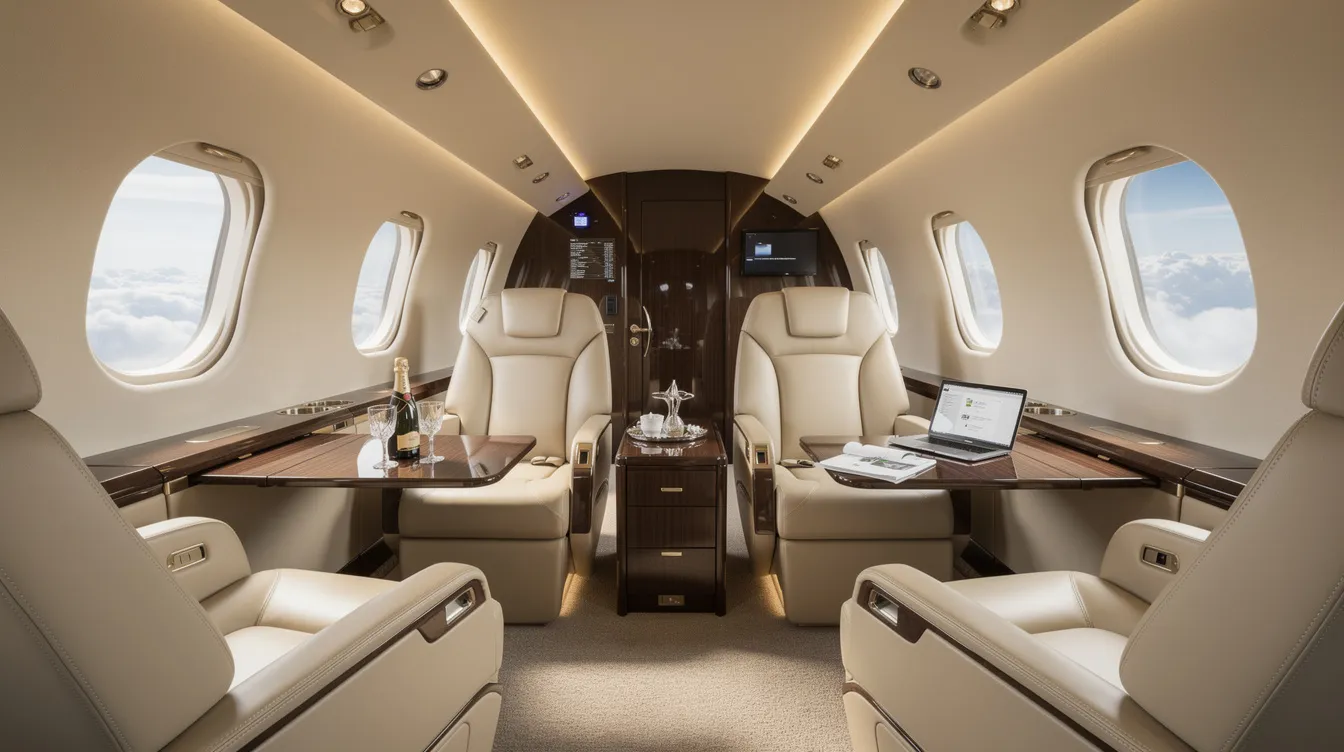
Booking a private jet for 6 passengers looks simple until luggage enters the picture. Six seats on paper do not always mean six travelers plus their bags, and that gap is where most charter surprises start. This guide covers what actually works for a group of six in 2026: the right aircraft class, real baggage limits, smart airport and FBO choices, and route-level cost examples you can plan around. Private jet charter is booking the entire aircraft with crew for your trip, priced primarily by flight time and aircraft type, rather than buying individual seats. Jettly is a charter broker, so the flights described here are operated by third-party carriers holding the proper FAA Part 135 or Part 121 certifications (or foreign equivalent).
For six passengers, a light jet is the most common match on regional routes, giving you a strong balance of cost, speed, and cabin comfort. Step up to a midsize jet when heavy or bulky baggage, longer nonstop legs, or a roomier cabin push past light-jet limits. Plan for roughly $2,800 to $8,000+ per flight hour in 2026, with cost per flight hour rising by aircraft class. Any online figure is an estimate, not a binding price; the signed charter agreement is your final confirmation.
Six seats and six comfortable seats with bags are not the same thing. A very light jet might list six seats on paper, then run out of hold space the moment your group arrives with six roller bags and a set of golf clubs. That is the real planning problem for a private jet for 6 passengers: seat count is easy, but payload and baggage volume decide what actually flies.
Charter is priced per aircraft, not per seat. Private jet charter pricing is usually for the entire aircraft, not per passenger, so the total price is generally the same whether you fly with two people or six. That model is why filling all six seats often delivers the best value per traveler, and it is covered in our guide to charter priced per aircraft.
For six passengers, luggage volume is often the deciding factor that moves you from a light jet to a midsize jet. Run your exact route through Jettly to see real aircraft availability and pricing across a network of more than 23,000 aircraft in over 190 countries, then treat any preview number as an estimate until the charter agreement confirms it.
|
Category |
Typical seats |
Best for six passengers |
Indicative hourly range (2026) |
|---|---|---|---|
|
Turboprop |
6–9 |
Short hops, smaller runways, value trips |
$1,800–$2,800 |
|
Light jet |
6–7 |
Default six-passenger regional missions |
$2,800–$4,500 |
|
Midsize jet |
7–9 |
Six travelers with heavy bags or longer legs |
$4,000–$8,000 |
|
Super-mid / heavy |
8–16 |
Coast-to-coast or international nonstop |
$8,000–$15,000+ |
For six passengers, the most efficient aircraft is usually the smallest one that clears three tests at once: range, baggage, and airport access. Get those three right, and you avoid paying for cabin you do not need. Miss one and you either swap aircraft late or leave bags behind.
Turboprops such as the King Air 350 or the Pilatus PC-12 make sense for short hops, smaller or unpaved runways, and value-focused trips. The cabin feel differs from a jet, and cruise speed is lower, yet baggage room can be excellent for the class. A PC-12 in particular carries a large cargo door that swallows gear other small aircraft cannot.
Very light jets like the Phenom 100 or Citation Mustang can seat six on paper, but comfort and bags usually push a full group of six up a size. Treat these as strong picks for two to four travelers with light luggage rather than the default for six.
Light jets are the standard six-passenger private jet category. The Embraer Phenom 300 is the flagship example, popular for its speed, range near 2,000 nautical miles, and cabin that seats six to seven comfortably. Market references put typical light jet seating at six to seven passengers, which lines up with real-world use, as noted in this light jet overview. The Cessna Citation line covers many of the same missions, and you can compare models across the Citation jet families.
The light-jet wild card is the Pilatus PC-24. It seats six with room to spare, adds a large cargo door and flat floor, and handles short runways that many jets cannot. When baggage or runway flexibility matters, the PC-24 often solves the six-passenger puzzle without moving to a bigger cabin.
Midsize jets like the Citation XLS+ or Hawker 900XP earn the upgrade when you carry more luggage, fly longer legs, want a taller cabin, and value real lavatory privacy. A six passenger private jet is usually a light jet mission, but six passengers with bulky luggage is often a midsize-jet mission.
Super-midsize and heavy jets, including Gulfstream and Challenger models, come into play only when range demands it: coast-to-coast nonstop comfort, international legs, or a working cabin. Book them for the distance, not simply because you have six people to seat.
Practical seating is the passenger count that keeps the cabin comfortable and leaves payload for luggage, which is often lower than the aircraft's maximum seat count.
|
Upgrade trigger |
Move from |
Move to |
|---|---|---|
|
More or bulky baggage (golf, skis, gear) |
VLJ or light jet |
PC-24 or midsize jet |
|
Longer nonstop range |
Light jet |
Midsize or super-midsize |
|
Short or high-altitude runway |
Light jet |
Turboprop or PC-24 |
|
Stand-up cabin and lavatory privacy |
Light jet |
Midsize jet |
Use this table to pick the smallest aircraft class that meets your route and luggage needs. Models vary by configuration, so read the range band as planning guidance and confirm the exact tail with the operator. When you are booking a private jet for six, baggage volume is often more limiting than seat count.
A range band is a planning estimate for how far an aircraft can fly in typical charter conditions; real-world range depends on passengers, bags, winds, and required reserves.
|
Category |
Example models |
Comfortable seats |
Range band |
Baggage practicality for 6 |
Airport flexibility |
Typical best-for |
|---|---|---|---|---|---|---|
|
Turboprop |
King Air 350, Pilatus PC-12 |
6–8 |
~1,000–1,700 nm |
Very good for the class; large door on PC-12 |
Excellent (short strips) |
Short regional hops, remote fields |
|
Very light jet |
Phenom 100, Citation Mustang, HondaJet |
4–6 |
~1,000–1,400 nm |
Tight with six; carry-on focus |
Good |
Two to four travelers, light bags |
|
Light jet |
Phenom 300, Citation CJ3, Learjet 75 |
6–7 |
~1,700–2,200 nm |
Good for weekend bags; limited oversize |
Good |
Default six-passenger regional trips |
|
Light jet (wild card) |
Pilatus PC-24 |
6–8 |
~1,800–2,000 nm |
Excellent; large cargo door, flat floor |
Excellent (short runways) |
Six with bulky gear |
|
Midsize jet |
Citation XLS+, Hawker 900XP, Learjet 60 |
7–8 |
~2,000–2,800 nm |
Very good; more hold volume |
Good |
Six with heavy bags or longer legs |
|
Super-midsize |
Challenger 350, Citation Longitude, Gulfstream G280 |
8–9 |
~3,000–3,600 nm |
Excellent; walk-in baggage |
Good |
Coast-to-coast, transatlantic |
One caution before you lock a choice: payload and baggage capacity shift with route length, fuel load, and weather. A jet that carries six with full bags on a short hop may need to trade weight on a long leg. For a real example of how compartment size limits certain items, see these light jet baggage limits, then confirm the specific tail with the operator.
There is no universal baggage allowance. Capacity depends on the specific aircraft, the fuel required for your route, and the shape and size of your bags. Two identical trips can carry different loads simply from wind and required reserves.
Payload is the combined weight of passengers, baggage, and cargo the aircraft can carry after accounting for fuel and safety reserves.
Match the aircraft to your luggage profile before you accept a quote. These four profiles cover most six-passenger trips.
|
Profile |
Examples |
Common problem on light jets |
Recommended fix |
Best aircraft category |
|---|---|---|---|---|
|
A. Carry-on only |
Overnight bags, laptops |
Rarely an issue |
None needed |
Light jet |
|
B. Weekend + 1 checked each |
Six roller bags plus extras |
Fills the hold fast |
Soft bags or size up |
Light jet or midsize jet |
|
C. Business + equipment |
Cases, displays, samples |
Odd shapes crowd the hold |
Larger hold or PC-24 |
Midsize jet or PC-24 |
|
D. Sports / oversize |
Golf, skis, strollers, pet crates |
Length exceeds compartment |
PC-24 or midsize |
PC-24, midsize jet |
Soft-sided bags are often easier than hard-sided rollers in smaller baggage compartments. They flex into odd corners, so six duffels frequently fit where six rigid cases will not. When space is tight on a light jet, this single swap can save an aircraft upgrade.
Pet rules vary operator by operator, so share the species, weight, and carrier size early. Jettly can accommodate pets on many operators' aircraft, and handling is usually smoother at an FBO than at a crowded airline terminal. Some operators add a cleaning fee, so ask upfront. For dedicated tips, read our guide to flying with pets.
For six passengers and baggage, the safest way to avoid a last-minute aircraft swap is to declare bag counts and oversize items before you accept a quote. Confirm these six items with special cargo:
Golf clubs (number of bags and travel-case length)
Skis or snowboards (length and quantity)
Musical instruments (size and whether a seat is needed)
Medical gear (power needs and securing method)
Pet crates (dimensions and pet weight)
Lithium batteries (many have quantity and watt-hour limits)
Once your bags are declared, arrive at the private terminal roughly 15 to 30 minutes before departure and your crew handles the rest.
An FBO (Fixed-Base Operator) is a private terminal where most charter flights depart, letting you arrive about 15–30 minutes before takeoff and board without the main airline terminal process. That single feature is the biggest time saving in private travel.
A reliever airport is a smaller airport near a major city designed to reduce congestion at the primary airport, and it is often where many private charters operate.
Private aviation reaches thousands of U.S. airports, far more than scheduled airlines serve, according to NBAA. That access is why airport choice changes your outcome. Relievers usually cut ground time, offer quieter FBOs, and can sit closer to where aircraft are parked, which shapes positioning cost and timing.
Operational limits still apply. Check FBO operating hours, local curfews, runway length for your chosen jet, slot programs at busy fields, and after-hours fees. A perfect aircraft is useless at an airport that closes before your arrival.
International trips add a layer: not every airport has customs and immigration on site, so your convenient local field may not be a legal entry point. Plan the border crossing first, then the ground logistics, as covered in our guide to international charter.
Choosing a nearby reliever airport with a good FBO can save time on the ground and can change which aircraft are realistically available for a same-day departure. Airport-specific planning matters too; mountain fields like Aspen carry their own rules, as shown in our Aspen airport guide.
|
Factor |
Primary airport |
Reliever airport |
Why it matters for six-passenger charter |
|---|---|---|---|
|
Ground congestion |
Higher |
Lower |
Faster ramp access, quicker boarding |
|
FBO options |
Multiple, busy |
Often dedicated, quieter |
Smoother arrival 15–30 min before |
|
Runway length |
Long |
Varies |
Confirms which jets can operate |
|
Customs (intl) |
Usually available |
Not always |
Affects legal entry points |
|
Aircraft positioning |
Depends |
Sometimes closer |
Can lower repositioning cost and time |
Use a simple price model: Total = billable flight time × aircraft hourly rate + trip logistics + taxes and fees. Every private jet charter cost estimate builds from those four pieces.
In 2026, a private jet for 6 passengers typically costs about $2,800–$8,000+ per flight hour depending on aircraft class, but your total trip price depends on billable flight time, aircraft positioning, taxes, and airport fees. Turboprops sit lowest, light jets fall in the mid band, and midsize through super-midsize aircraft climb toward the top, with market references confirming similar bands in this 2026 cost guide.
The occupied hourly rate is the time your group is actually on board, billed point to point. Repositioning is the separate cost of flying an empty aircraft to your departure city. On Jettly membership programs, billing runs wheels up to wheels down with no positioning fees; on-demand quotes may fold repositioning into the total, which is a frequent reason two quotes differ.
An all-in charter quote is the complete trip price that includes the aircraft, crew, and expected trip costs, plus taxes and airport fees that apply to your itinerary.
Taxes belong in every plan. A 7.5% U.S. Federal Excise Tax applies to domestic air transportation, as outlined in the IRS air transportation guidance, and quotes commonly itemize small per-passenger domestic segment fees that adjust over time. For six-passenger charter trips, repositioning distance and minimum billable hours are often the biggest reasons two quotes for the same route can differ.
One-way pricing is rarely half of a round trip. If the aircraft must fly home empty or reposition for its next job, that cost lands somewhere in your quote. To model your own numbers, run figures through the charter cost calculator before you request a live quote.
|
Component |
What it is |
When it applies |
How to reduce it |
|---|---|---|---|
|
Billable flight time |
Hours used to price the trip |
Every trip |
Nonstop routing, efficient aircraft |
|
Aircraft hourly rate |
Rate set by class |
Every trip |
Right-size the aircraft |
|
Repositioning |
Flying the jet to you |
One-way, remote starts |
Well-positioned aircraft, empty legs |
|
U.S. Federal Excise Tax |
7.5% on domestic transport |
Domestic legs |
Fixed; plan for it |
|
Segment fees |
Per-passenger domestic fee |
Each domestic segment |
Fewer stops |
|
Airport / FBO fees |
Landing, ramp, handling |
Varies by airport |
Relievers, off-peak timing |
Use date: September 28, 2026. Assumptions: passenger count of six, typical baggage for each profile, daytime departures, and standard FBO handling. Ranges reflect market hourly bands plus taxes and expected logistics. Final prices depend on aircraft availability and positioning, and every figure below is a planning estimate, not a guaranteed rate. For a deeper look at what drives total cost, review our operating cost breakdown.
Billable flight time is the time used to price the trip; depending on the quote, it may include only your occupied flight legs or may also reflect required repositioning and minimums.
Real-world private jet pricing is route-specific: the same six-passenger trip can price very differently based on where the aircraft is positioned and whether your itinerary is one-way or round-trip.
|
Route type |
Distance / time band |
Aircraft class (2 options) |
Estimated total range |
Notes |
Best way to save |
|---|---|---|---|---|---|
|
Short regional one-way |
~300–500 nm, ~1.0–1.5 hr |
Turboprop or light jet |
~$4,500–$11,000 |
One-way positioning can add cost |
Match to a nearby empty leg |
|
Domestic round-trip with overnight |
~900–1,200 nm each way, ~2.5–3.0 hr |
Light or midsize jet |
~$22,000–$45,000 |
Crew overnight plus round-trip minimums |
Same-day return avoids overnight |
|
Longer-range / international |
~2,500–3,500 nm, ~5.5–7.0 hr |
Super-mid or heavy |
~$55,000–$110,000+ |
International fees, customs, repositioning |
Flexible dates, well-positioned aircraft |
The short regional charter flight cost swings most on positioning. Book a turboprop or light jet already parked near you and the one-way total drops toward the low end. Force an aircraft to ferry in and the same charter flight cost climbs.
The domestic round-trip shows why a crew overnight matters. Keep the aircraft and crew waiting and you pay for their stay plus daily minimums; complete a same-day turn and you often avoid both. For the international example, taxes shift, customs handling appears, and a heavy jet's hourly rate drives the private jet charter cost far above domestic trips.
Consider one anonymized case. A group of six requested a one-way to a metro region with two airport choices. Routing into the busy primary field added ramp and handling charges, and the closest suitable jet sat two hours away, adding repositioning. Shifting to a reliever airport 20 minutes further by car placed the group next to an available light jet with a lower FBO fee. Same passengers, same day, materially lower total. That is aircraft availability and positioning in action.
Most quotes include the aircraft, crew, and fuel assumptions, then add taxes and trip-specific airport and logistics costs. Read the line items before you compare two offers.
As-incurred charges are costs that can't be finalized until the day of flight, such as de-icing or certain airport services billed based on actual conditions.
Common add-ons include landing and ramp fees, handling, crew overnight, de-icing in winter, after-hours operations, premium catering, Wi-Fi where fitted, and pet cleaning fees. These vary by operator, airport, and season, so no single list is universal. Jettly membership flights include complimentary de-icing coverage, and member deposits sit in an insured escrow account separate from operating funds; on-demand de-icing is priced by the day's conditions. For the mechanics behind rates, see our hourly rate guide.
The safest way to compare quotes is to compare total trip price and billable time assumptions, not just the headline hourly rate. Work through this checklist before you accept a quote:
Confirm the total price and the currency
Ask what billable time the quote assumes
Check whether repositioning is included or separate
Confirm taxes and per-passenger segment fees are listed
Ask about crew overnight and after-hours charges
Verify de-icing and weather-related handling
Confirm catering, Wi-Fi, and ground transport terms
Read the cancellation and change policy before signing
|
Usually included |
Commonly added |
Optional upgrades |
|---|---|---|
|
Aircraft and crew |
Landing and ramp fees |
Premium catering |
|
Standard fuel |
Taxes and segment fees |
Extra ground transport |
|
Basic catering (varies) |
Crew overnight |
Wi-Fi where fitted |
|
Standard handling |
De-icing (weather) |
Pet cleaning, special requests |
A broker and an operator play different roles. The broker arranges the trip; the operator flies it. Jettly is a charter broker, and every advertised flight is conducted by a third-party air carrier holding FAA Part 135 or Part 121 certification (or a foreign equivalent). Jettly also complies with the U.S. Department of Transportation's Part 295 and Part 298 charter broker rules.
A charter broker arranges air transportation by matching a trip request to a properly licensed air carrier; the broker does not operate the aircraft.
FAA Part 135 is the U.S. operating rule set for on-demand charter, covering crew duty limits, maintenance, and operational control. Some flights run under Part 121 depending on the aircraft and operation type. When you book through a charter broker like Jettly, the broker arranges the trip, but the FAA-certified operator is the company that actually operates the flight.
Jettly works exclusively with certified operators that are ARGUS- or Wyvern-rated and meet or exceed FAA, Transport Canada, and EASA standards, with some also holding IS-BAO certification. These ratings signal independent safety auditing and a working safety management system. They confirm a strong process; they do not replace confirming the specific tail and crew for your flight.
Run this quick safety checklist for any charter:
Operator air carrier certificate on file
Specific aircraft tail number and details
Crew qualifications and currency
Proof of the operator's insurance
Current maintenance status
Third-party ratings (ARGUS, Wyvern, IS-BAO) where applicable
One point of accuracy on coverage: Jettly does not carry additional liability insurance, and passengers are covered by the aircraft operator's insurance. For a fuller explanation, read our private jet safety guide.
|
Responsibility |
Broker (Jettly) |
Operator (Part 135/121 carrier) |
|---|---|---|
|
Arranging the trip |
Yes |
No |
|
Aircraft options and quote |
Yes |
Provides availability |
|
Charter agreement |
Facilitates |
Party to flight terms |
|
Flying the aircraft |
No |
Yes |
|
Crew and maintenance |
No |
Yes |
|
Insurance |
Covered by operator |
Carries operator insurance |
Savings run on a ladder from easiest to hardest: airport flexibility first, then time flexibility, then empty legs, then membership programs. Each rung trades a little control for a lower price.
An empty leg is a discounted one-way charter flight that exists because an aircraft must reposition, so the route and departure window are usually fixed.
Empty leg pricing can undercut standard charter by a wide margin, with advertised savings commonly in the 30% to 75% range depending on the route. Jettly lists thousands of empty leg flights on-site with fares that start low, and members get priority access. For six passengers, empty legs can deliver major savings, but they work best when your schedule is flexible and you do not need a guaranteed return on the same tail.
Time flexibility helps even without an empty leg. Jettly's Flexible Departure Discount unlocks lower rates when you opt into a 72-hour departure window, which suits groups that can move a few hours either way. Cost splitting is a separate convenience: Jettly can split one flight's cost so each passenger receives an individual invoice, handy for business teams settling separate accounts.
You do not need a jet card to get a quote. Memberships and jet cards can still trim certain costs, since Jettly's membership programs charge no positioning fees and bill point to point. Compare your options against the tradeoffs below, and see more tactics in our guide to how to find cheaper charters.
|
Option |
Best for |
Tradeoffs |
Works well for six when… |
|---|---|---|---|
|
On-demand charter |
Fixed schedule, guaranteed return |
Full price |
You need certainty and a set return |
|
Empty leg |
Flexible dates, one-way |
Fixed route and window |
Your dates flex and you skip a guaranteed return |
|
Shuttle / per-seat |
Small groups or splits |
Set routes, shared cabin |
Not the whole group needs a private aircraft |
No membership is required to start. You can request an instant quote, compare aircraft options, and only then confirm with a charter agreement and secured payment. With Jettly, you request a trip online, compare aircraft options, then confirm the flight by signing a charter agreement and securing payment; the operator flies the trip under FAA Part 135 or Part 121 (or foreign equivalent).
A charter agreement is the contract that lists the aircraft, itinerary, pricing, and operating terms, and the flight is confirmed only after it is signed and payment is secured.
Jettly's booking flow runs in six steps:
Search or request a flight (multi-city, round trip, or one way)
Receive aircraft options for your route and group
Select the aircraft that fits your range and bags
Confirm with a signed charter agreement and secured payment
Complete pre-flight coordination with your Personal Flight Coordinator
Depart from the FBO
Send complete information and your quote comes back faster. Include:
Departure and arrival airports, plus one or two alternates
Dates and time windows
Passenger count (six) and any children
Baggage profile and oversize items
Pets, with species, weight, and carrier
Catering preferences
Ground transport needs
International documents where relevant, and a decision-maker contact
If you want the fastest quote for a private jet for 6 passengers, provide your baggage details and one or two alternate airports upfront. Jettly recommends booking 24 to 72 hours ahead for the best availability, and same-day charters can sometimes be arranged in as little as 3 to 6 hours when aircraft and crew are positioned nearby. See our same-day booking guide for how a tight timeline works. You can get instant pricing through the Jettly instant-quote tool, the iOS and Android apps, and 24/7 support, which makes private jet charter booking same day realistic when conditions line up.
|
Missing info |
What happens |
How to fix |
|---|---|---|
|
No baggage details |
Risk of a late aircraft swap |
List bag counts and oversize items |
|
One airport only |
Fewer aircraft options |
Add one or two alternates |
|
Vague timing |
Harder to position aircraft |
Give a clear time window |
|
Unconfirmed passenger count |
Quote delays |
Confirm six and any pets |
For six passengers, a light jet is usually the best balance of cost and comfort, but heavy luggage or longer legs often justify a midsize jet. The Embraer Phenom 300 is the common light-jet pick, and the Pilatus PC-24 shines when baggage or short runways matter. Upgrade triggers are simple: more bags, more range, or a taller cabin.
In 2026, expect roughly $2,800–$8,000+ per flight hour for most six-passenger missions, with total trip cost driven by billable time, positioning, taxes, and airport fees. A short light-jet hop can total a few thousand dollars, and an international heavy-jet trip can run well into six figures. Use the scenario table above as a planning anchor, then confirm with a live quote.
Private jet charter is typically priced for the entire aircraft, not per passenger. Filling all six seats spreads that fixed price across more travelers, which is why groups get strong value. Jettly's cost-splitting feature can issue separate invoices, but that is an admin convenience, not a per-seat pricing method.
Baggage capacity depends on the specific aircraft and route, so the right rule is to match the aircraft to your luggage profile before you confirm the quote. Carry-on-only groups fit almost any light jet; golf, ski, and equipment loads often call for a PC-24 or midsize jet. Soft-sided bags help when space runs tight.
Often yes, but pet policies vary by operator, so you should share the pet's type, weight, and carrier details before booking. Many Jettly operators allow pets, and FBO handling is usually calm and quick. Some operators charge a cleaning fee, so ask when you request the quote.
Most six-passenger charters can use major airports and many reliever airports, typically departing from an FBO private terminal. Runway length and FBO operating hours are the main limits to check. Relievers often cut ground time and can place you closer to available aircraft.
A one-way charter is not automatically half the cost of a round trip because repositioning and aircraft availability can drive the price. If the jet must ferry in empty or return to base, that cost appears in your quote. Matching your one-way to an existing empty leg is the reliable way to save.
For best aircraft choice and pricing, booking 24–72 hours in advance is a strong rule of thumb, but same-day departures can sometimes work when aircraft are positioned nearby. Same-day trips can come together in 3 to 6 hours with the right positioning. Alternate airports and complete passenger info speed everything up. New flyers can review our guide for the first time flying private.
A private jet for 6 passengers usually starts as a light jet mission and moves up only when bags, range, or airport constraints demand it. Get the aircraft class, baggage plan, and airport choice right, and the private jet charter cost falls into a predictable range you can budget around. Treat every online figure as an estimate until the charter agreement locks it in.
Ready to see real numbers for your exact route? Get instant pricing and live aircraft availability through Jettly, with no aircraft ownership and no tail-number lock-in, and clear broker and operator disclosure on every trip. Use the online quote tool or the Jettly app, call +1-866-448-2358, or email departures@jettly.com to start a six-passenger private jet charter today.
NBAA, Aircraft Charter Overview - airport access and charter framing.
IRS, Air Transportation Excise Taxes - U.S. Federal Excise Tax concept.
Argus, Jet Fuel Market Reference - fuel market context.
WYVERN - independent safety and risk rating context.
ARGUS International - third-party safety rating context.
IS-BAO (IBAC) - safety management standard context.
Jettly - marketplace scale, programs, and broker disclosures.
Jettly Same-Day Charter Guide - same-day timelines and workflow.
Paramount Business Jets, Rental Cost Guide - market hourly rate context.
evoJets, Light Jet Overview - light jet seating and range framing.
Share this post:
Jay Franco Serevilla
Nov 2, 2026
|
5
min read
Discover tips and trends in the industry.
5
min read
Private Jet for 6 Passengers in 2026 (Aircraft, Baggage, Airports, and Real Costs)
Booking a private jet for six passengers in 2026 involves careful planning around aircraft choice, baggage limits, and airport logistics. Light jets are typically the best option, but bulky luggage or longer flights may necessitate a midsize jet. Understanding the real costs and requirements can help avoid surprises and ensure a smooth travel experience.
Read More
5
min read
Plane Car for Sale: How Flying Cars Are Moving from Concept to Reality
Flying cars, once a sci-fi dream, are becoming a reality with several models available for sale or reservation in 2026. These vehicles, like the Jetson ONE and Pivotal Helix, offer unique features but come with high ownership costs and regulatory challenges. For those seeking flexible air travel without the commitment of ownership, platforms like Jettly provide an appealing alternative.
Read MoreStay updated with our latest insights and tips to elevate your journey with us.
MEMBERSHIPS AND ASSOCIATIONS



Disclaimer: Jettly operates as a charter broker, offering access to a global digital jet charter marketplace. Jettly is not a direct air carrier and does not own or operate aircraft. All advertised flights are conducted by third-party air carriers that are fully licensed and hold the appropriate Part 135 or Part 121 certifications issued by the Federal Aviation Administration (FAA) or equivalent regulatory authorities under U.S. or foreign law. Jettly complies fully with the U.S. Department of Transportation's Part 295 and Part 298 Charter Broker regulations. Jettly does not carry additional liability insurance. Passengers are covered by aircraft operator insurance. TICO: 50023770


