


Login
Get Instant Pricing On 23,000+ Aircraft

>

A private jet program is a structured way to access private aircraft without buying one outright. These programs include jet cards, fractional ownership, jet membership options, and on-demand charter as forms of private air travel; each offers a different balance of cost, flexibility, and commitment for flying private. Various private jet programs exist to meet the needs of business and leisure travelers, and the options have expanded fast since 2020.
The private aviation world is growing. The private jet market is projected to reach $67 billion by 2032. The global market for jet card memberships was valued at $10.2 billion in 2024, and jet card memberships are expected to grow at 8.7% annually until 2033. The charter flights industry is expected to generate $40.3 billion in revenue by 2025. Subscription and membership model revenue is expanding at roughly 9.63% CAGR through 2031, according to the Haute Jets Wealth Migration Report.
Private jet programs include jet cards, fractional ownership, and membership programs. Jettly focuses on digital, on-demand access and optional membership programs rather than long-term commitment structures. This guide covers every major model: on-demand charter, jet card programs, fractional programs, full ownership, and tech-enabled membership models like Jettly's.
Private aviation programs fall into four core models. On-demand charter means booking and paying per flight with no deposit or fixed obligation. Jet cards are prepaid blocks of flight hours (often 25 to 50 hours) with fixed or capped hourly rates. Fractional ownership requires purchasing an equity share in a specific jet, giving owners a certain number of flight hours per year plus ongoing management fees, and it is often best for travelers who need reliable access to a specific type of aircraft; for a deeper look at options, see this overview of the best fractional jet ownership companies and costs. Membership programs charge annual or monthly dues for preferred access, reduced fees, or concierge service, without requiring equity or large prepaid balances.
Here is how each handles commitment:
On-demand charter: Pay per trip. No deposit. Book with as much or as little notice as you need. On-demand charters can have fluctuating costs based on market demand.
Jet cards: Prepaid hours at a locked rate. Guaranteed access windows. Notice periods and possible blackout days apply.
Fractional ownership: Large upfront capital. Monthly fixed costs. Scheduled access to a specific aircraft type. Shared depreciation risk.
Membership programs: Monthly or annual fees. Benefits like reduced surcharges or priority scheduling. Still pay per flight, but at preferred rates.
Private jet programs offer flexibility without the burdens of full aircraft ownership. Individuals can access private aircraft without purchasing an entire plane themselves. Private jet programs reduce the need for management responsibilities associated with ownership. Jettly's platform gives instant pricing and booking across more than 20,000 private charter aircraft without requiring fractional ownership or large jet card deposits.
All legitimate private aviation programs operate through licensed operators. In the U.S., that means FAA Part 135 certification, which governs pilot qualifications, aircraft maintenance, and operations oversight. European operators fall under EASA equivalents.
Each private jet access model solves a different problem. The right program depends on how often you fly, how far in advance you plan, and how much capital you want to commit.
On-demand charter: Best for infrequent flyers or variable routing. No upfront fees. You choose the aircraft type per trip and pay only for what you use. Chartering aircraft is usually best for infrequent flyers.
Jet cards and jet card programs: Jet cards allow members to pre-purchase a block of flight hours at set rates, typically 25 to 50 hours valid for 12 to 24 months. A 25-hour light jet card in 2026 runs approximately $210,000 to $260,000 depending on the provider. Jet cards usually require a hefty upfront deposit, often around $150,000. Jet card memberships require upfront deposits starting around $150,000.
Fractional ownership and fractional programs: Fractional ownership involves buying a share of a specific aircraft for shared use. A 1/16 share gives roughly 50 flight hours per year. Fractional ownership typically starts at 50 flight hours per year. Share prices start around $300,000 for light jets and exceed $1.2 million for large cabin aircraft. Fractional ownership requires a capital outlay exceeding $1 million for midsize and larger classes. Comparatively, fractional ownership is suitable for those flying regularly without needing a full plane.
Full ownership: Outright ownership provides maximum control over scheduling and aircraft management. It suits flyers logging 200 to 300+ hours annually who are ready to manage crew, aircraft maintenance, and depreciation. Private jet ownership involves high fixed costs and operational responsibilities. Potential tax advantages can be realized through private jet ownership, and major providers like NetJets’ fractional and ownership programs dominate this segment.
Private jet programs offer access to a variety of aircraft types depending on needs. Jettly can serve as a flexible alternative or supplement to these programs, especially for travelers who want to avoid long commitments but still enjoy reliable private flight access. For a deeper comparison, see Jettly's breakdown of jet card programs vs. fractional ownership.
Choosing between these three models comes down to cost structure, access certainty, and how much flexibility you need.
Upfront cost: On-demand charter requires none. Jet cards require large prepaid deposits. Private jet membership programs charge annual or monthly membership fees plus per-flight payment. There is no need for large upfront investment when using certain private jet program structures like on-demand or lightweight memberships.
Guaranteed access: Guaranteed availability is a significant advantage of private jet programs during busy travel periods. Private jet programs typically guarantee aircraft availability with short notice. Jet cards offer guaranteed access windows (often 24 to 96 hours' notice). On-demand charter does not guarantee availability until booked. Membership programs offer preferred access to aircraft for an annual fee. Private jet memberships offer unlimited on-demand access to jets through their fleet networks.
Aircraft flexibility: On-demand lets you pick any class per trip. Jet cards often lock you into a cabin category or charge interchange fees. Membership programs often include access to a fleet of jets across types.
Peak restrictions: Peak-day restrictions may apply to some private jet programs, particularly jet cards. Availability guarantees and restrictions are important factors to assess before joining a program.
Cancellation policies: Vary across all models. Read the fine print on notice windows, blackout dates, and fees.
Savings: Private jet memberships can save up to 30% compared to chartering on a per-hour basis when usage is consistent. Membership programs often require minimum flight hours to avoid extra fees.
For travelers flying under roughly 25 hours per year, on-demand charter or a lightweight jet membership is typically more cost-efficient. Between 25 and 75 hours per year, a jet card or structured membership program can justify its cost for access certainty during demand peaks. Review the best jet card programs ranked by use case for more detail, including how top jet card programs compare on pricing and access.
Jettly offers transparent per-leg pricing, plus optional memberships that reduce service fees and provide personalized service without locking travelers into a single aircraft type or region.
Headline hourly rates rarely reflect full cost. The gap between advertised rates and actual spend catches many first-time buyers off guard, especially if they do not understand how much a private jet really costs. Cost predictability is a key feature of many private jet programs, but only if you understand all the line items.
Here are the cost components to check:
Base hourly rate: Private jet rental prices range from $5,000 to $15,000 per hour depending on aircraft category.
U.S. Federal Excise Tax: 7.5% on all private charter flights.
Fuel surcharges: Often billed separately, fluctuating with fuel markets.
Repositioning (ferry) costs: If the aircraft must fly empty to your departure airport, you may pay for that leg.
Airport handling, landing, and de-icing fees.
Catering, crew overnight stays, and ground transportation.
Peak surcharges and minimum flight time requirements. AVNET's Q2 2026 data shows a 92.9-minute average daily minimum billed across jet card programs.
Chartering a private jet typically costs tens of thousands of dollars per trip. Potential for higher per-flight costs exists in private jet programs compared to ownership at high utilization levels. Proper financial planning is essential when considering jet ownership versus programs.
A concrete comparison: for a traveler flying 50 hours per year on a midsize jet, a jet card costs roughly $362,000 in year one (enrollment plus hourly rate plus taxes). For more detail on pricing structures, see this breakdown of jet card costs and price drivers. Fractional ownership for the same usage runs approximately $881,750 when you include share purchase, monthly management fees, and occupied hourly rates. On popular routes like New York to Miami or Los Angeles to Las Vegas, Jettly's on-demand pricing often undercuts jet card rates for travelers below 50 annual hours because there is no prepaid block to fund. Use the jet card flight cost estimator alongside the private jet cost calculator to estimate pricing for specific routes.
Jettly's instant pricing tool displays all taxes and surcharges upfront, reducing surprises compared to opaque programs where fees surface after booking.
Choosing the right aircraft category matters as much as choosing the right program. Overspending on a heavy jet for a 90-minute hop wastes money; squeezing eight passengers into a light jet sacrifices comfort and range.
Turboprops (King Air 350, Pilatus PC-12): Best for short regional flights of 1 to 3 hours with 2 to 6 passengers. Jet card averages in 2026 for turboprops run about $6,271 per hour, the lowest among powered fixed-wing options.
Light jets (Phenom 300, Citation CJ3): Ideal for 2 to 6 passengers on short to medium hops. Think Boston to Washington or LA to San Diego. A light jet is often the most cost-effective choice in many jet membership and jet card offerings. For recommendations, see best small jet aircraft.
Midsize jets (Hawker 900XP, Citation XLS): Seat 6 to 8 passengers with range for 4- to 5-hour nonstop legs across the U.S. Jet card averages run approximately $9,500 per hour in 2026.
Super-midsize jets (Bombardier Challenger 350, Gulfstream G280): Coast-to-coast capability, more cabin space, and range for longer missions. Super-midsize jets accounted for nearly 575,000 departures in 2025. Hourly charter cost ranges from $12,000 to $15,000.
Large cabin and ultra-long-range jets (Gulfstream G650, Global 7500): Built for transcontinental and international flights with 7 to 14 passengers. Jet card rates for large cabin jets average about $15,236 per hour; ultra-long-range jets reach $19,202 per hour.
Some fractional programs and jet card programs focus on a single category (often super-midsize), while platforms like Jettly provide access across all categories globally. Choose based on passenger count, range, and mission; for broader context on affordable aeroplane rental options and costs, see the full guide on choosing the right jet.
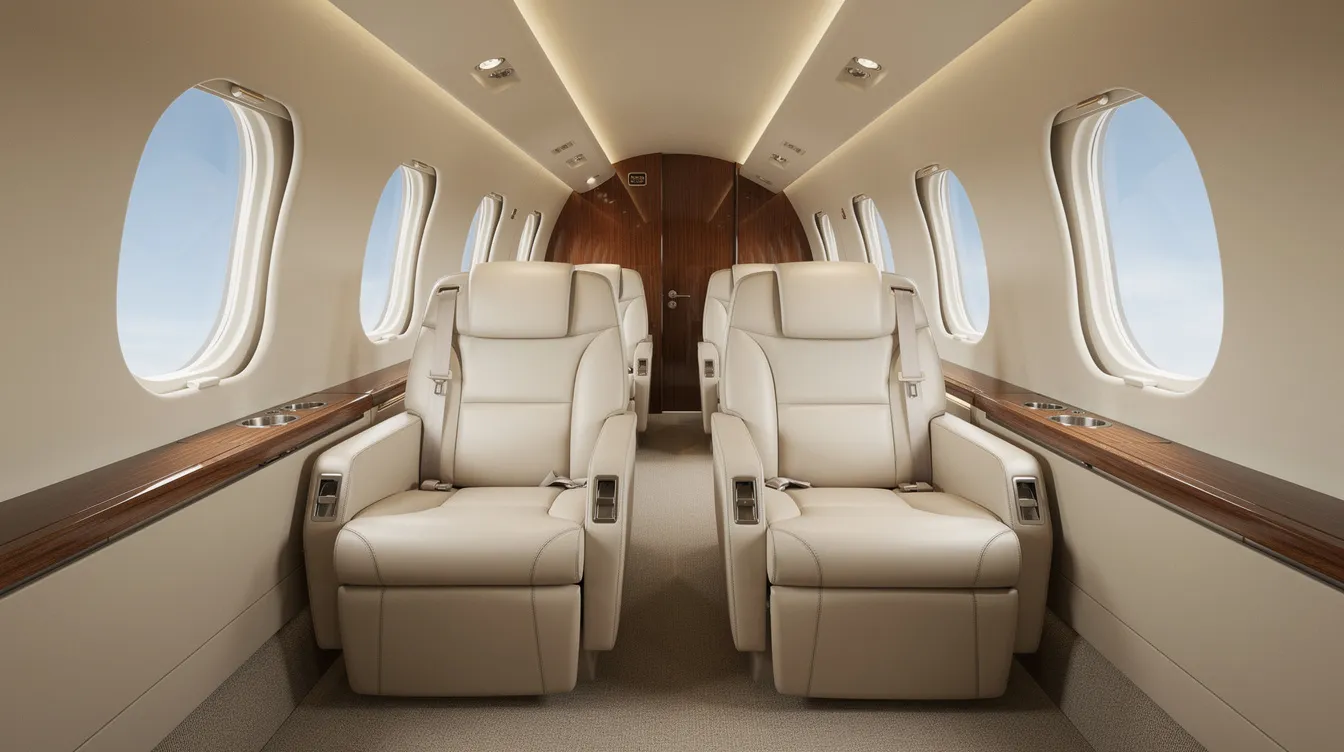
An empty leg refers to a repositioning flight during which the aircraft travels without passengers, either en route to pick up a booked charter or returning to its base after completing one. Operators sometimes sell these legs at a discount rather than fly empty.
Empty legs typically offer 30% to 75% off standard charter rates, depending on route, season, and flexibility.
Some membership programs and jet cards offer discounted empty legs as perks or early alerts, and shared-flight tools that crowdsource private jet flights and empty seats. Digital platforms like Jettly list empty legs openly alongside full-price charters.
Schedule flexibility is required. Empty leg timing and routing can change if the original booking shifts.
For leisure trips, empty legs can cut costs to near business-class levels on routes like Florida, the Bahamas, or Las Vegas weekend getaways.
Jettly customers can search and book empty legs through the platform, with the same safety and operator standards as full-price flights.
Empty legs are best for flexible travelers. For time-critical business travel, guaranteed access through a jet card or membership is safer. Travelers focused on single-seat options can also explore how to buy a seat on a private jet. Learn more about what empty leg flights are and how they work.

Safety and regulatory compliance matter more than price alone when choosing any private aviation program.
FAA Part 135: Safety oversight typically falls under FAA Part 135 regulations in the U.S. This governs pilot certification, maintenance schedules, and operations standards. International equivalents include EASA in Europe and Transport Canada.
Pilot standards: Pilot minimum flight hours are a common safety benchmark. Part 135 operators must ensure pilots meet recurrent training requirements and type ratings for each aircraft.
Aircraft maintenance: Maintenance programs are essential for business jets' safety. Certified maintenance facilities conduct scheduled inspections per manufacturer and regulatory requirements.
Crew rest: Crew duty-time compliance is critical for safety management. Operators must follow strict rest rules to prevent fatigue-related incidents.
Third-party audits: Operator audits and third-party ratings ensure safety compliance. Rating bodies like ARGUS, Wyvern, and IS-BAO audit detailed maintenance records, crew operations, and insurance coverage.
Jettly is a company that vets all charter operators for FAA Part 135 certification (or foreign equivalent), requires safety rating thresholds, and conducts continuous operator evaluation across its global network.
On the service side, reputable programs offer dedicated account managers, in-flight catering customization through services like Jettly Eats, and ground transportation coordination. These details separate a good private flight experience from a mediocre one.
Your "flight profile" is defined by annual flight hours, typical route lengths, passenger count, flexibility requirements, and how far in advance you plan. Private jet travel saves time compared to commercial flights. Private jets allow you to skip long security lines. Private jet programs allow users to avoid busy commercial terminals and security lines. Members avoid baggage restrictions common in commercial flights, whether they’re flying major hubs or regional markets like private jet charter in Kolkata, West Bengal.
Here are four traveler archetypes and the program that fits each:
Light occasional traveler (10 to 25 hours per year, mostly leisure). On-demand charter or a lightweight jet membership works best. No prepaid hours to burn. Jettly excels here with per-leg live pricing and no minimum commitment.
Frequent regional executive (30 to 75 hours per year). A jet card or structured membership program provides guaranteed availability and cost predictability. Members can quickly schedule flights on short notice. Private jet memberships can save time by skipping long airport lines. A 25-hour jet card at midsize rates runs roughly $250,000 to $350,000 per year, so it pays to understand what a jet card is, its costs and benefits.
Heavy corporate traveler (100 to 200 hours per year, consistent routes). Fractional ownership begins to make economic sense. Fixed costs amortize across more hours. Family offices and corporate flight departments often operate in this range, but many still consider Jettly as a flexible NetJets alternative to reduce costs and commitments.
Ultra-high usage global traveler (200 to 400+ hours per year). Full ownership or fractional in large cabin aircraft is likely the most cost-efficient model. Capital is a strategic investment at this volume.
Example: a corporate executive flying New York to Miami 12 times a year logs roughly 50 to 60 flight hours. A jet card handles that well. But if the same person adds Toronto to Vancouver, LA to Denver, and occasional international trips, Jettly's on-demand model fills the gaps without buying more prepaid hours. For additional strategies on access, see this overview of how to get a seat on a private jet easily. Learn more about how to fly private for practical booking steps.
Since the mid-2010s, cloud-based booking, mobile apps, and real-time inventory systems have reshaped private aviation. Traditional brokers required sales calls, multi-day proposal cycles, and manual contracts. Users can book flights using digital platforms for greater convenience, as outlined in this guide to charter airlines and modern private flight options.
Platforms like Jettly differ from legacy providers in several ways, particularly when it comes to offering affordable private jet charter pricing and strategies:
Real-time pricing across aircraft types and routes, not manual quote requests.
Filtering by cabin class, range, and cost on a single interface.
Digital payment and booking confirmation in minutes, not days.
Asset-light membership models require no equity, no fractional programs, and no large jet card deposits. Members pay dues for benefits like reduced surcharges, concierge services, and priority scheduling. Many private jet programs allow users to choose the perfect private jet membership based on their travel needs and flexibility requirements, and Jettly's membership model supports those evolving needs without tying members to one aircraft or region.
Integration with extras like catering, ground transportation, and multi-leg trip planning is handled through a single digital interface. Travel and aviation creators can even monetize their audiences by joining Jettly’s ULTRA high-ticket affiliate program, earning commissions when clients book or join memberships.
Environmental awareness in private aviation has grown since 2020. Programs are responding with carbon offset options, sustainable aviation fuel (SAF) initiatives, and efficiency-focused routing.
Some jet membership programs include carbon offsets by default. Others let clients purchase offsets per flight.
Choosing right-sized aircraft cuts fuel burn. A turboprop or light jet for a 90-minute hop uses a fraction of what a heavy jet would consume on the same route.
Reducing repositioning flights lowers empty miles. Empty legs, when filled, improve aircraft utilization and reduce per-passenger footprint compared to flying empty repositioning segments.
Jettly's tools help travelers compare aircraft types and routing for more efficient missions. Where SAF or offset programs are available through operators, travelers can opt in at booking.
What is the difference between a jet card and a jet membership? Jet cards require purchasing prepaid flight hours (typically 25 hours) at fixed hourly rates, with guaranteed access windows and stricter scheduling rules. Jet card memberships require upfront deposits starting around $150,000. A jet membership charges annual or monthly membership fees and offers benefits like reduced service fees, priority access, or concierge service, but does not require prepaid hours or equity. The membership model is lighter on capital and more flexible.
How many hours per year justify a jet card, fractional ownership, or full ownership? Under roughly 25 hours per year, on-demand charter or a lightweight membership is most cost-efficient. Between 25 and 75 hours, a jet card or structured membership program pays for itself in access certainty. Above 100 hours, fractional ownership starts making economic sense. Above 200 to 300 hours, full ownership may justify its fixed costs if routes, aircraft type, and asset utilization align.
Can I mix on-demand charter with a private jet program? Yes. Many travelers hold a jet card or fractional share for core domestic travel, then use on-demand charter for overflow, international legs, or trips outside the program's typical footprint. Jettly is well suited for that mix because it offers both charter and membership tools in one platform.
Are empty legs reliable enough for business travel? Generally not for time-critical trips. Empty leg schedules can change or be canceled because the original booking shifts. For leisure travel where you have flexibility on dates and airports, empty legs offer savings of 30% to 75%. For business trips with fixed schedules, guaranteed access through a jet card or membership is safer.
How quickly can I book a private jet through Jettly? On many domestic routes, bookings can be confirmed within a few hours if the aircraft and crew are available. International or ultra-long-range missions may require 24 to 72 hours due to overflight permits, customs clearance, and crew positioning. For more on same-day options, see the guide to same-day private jet charter.

No single private jet program fits every traveler. The right program depends on hours flown, typical routes, passenger count, and appetite for financial commitment. A corporate executive flying 60 hours per year on fixed routes has different needs than a family using 15 hours for leisure trips and delayed flights they want to avoid.
Modern private jet travel allows you to combine on-demand charter, jet cards, fractional ownership, and digital jet membership to match different stages of life or business growth. The private aviation industry continues to expand, and the range of options has never been broader. The global market for jet card memberships was valued at $10.2 billion in 2024 and keeps climbing.
Jettly offers a flexible, transparent alternative to traditional jet cards and fractional programs. Its marketplace delivers global private jet access across 20,000+ aircraft, instant pricing including all taxes and surcharges, and optional memberships for service enhancements. No prepaid cards, no equity, no long-term commitment required.
Ready to experience private travel on your terms? Explore flight options or request a quote at https://www.jettly.com.
Share this post:
Jeff Ryan Serevilla
Oct 10, 2026
|
5
min read
Discover tips and trends in the industry.
5
min read
Private Flight Club Membership Cost: What You Really Pay For
Private flight club memberships offer a range of costs influenced by initiation fees, monthly dues, and hourly rates. Understanding these components helps travelers make informed decisions between membership and on-demand charter options. With costs varying significantly based on aircraft type and usage, it's essential to evaluate personal travel needs and frequency before committing.
Read More
5
min read
Taneja Aerospace Share Price: Live Updates, Fundamentals & Investor Guide
Taneja Aerospace & Aviation Ltd's current share price is ₹344.20, reflecting a 1.7% decrease. With a P/E ratio of approximately 47, the stock indicates strong growth expectations in the aerospace sector, making it an intriguing option for investors. This guide provides essential trading data, valuation metrics, and insights into the company's fundamentals and market trends.
Read MoreStay updated with our latest insights and tips to elevate your journey with us.
MEMBERSHIPS AND ASSOCIATIONS



Disclaimer: Jettly operates as a charter broker, offering access to a global digital jet charter marketplace. Jettly is not a direct air carrier and does not own or operate aircraft. All advertised flights are conducted by third-party air carriers that are fully licensed and hold the appropriate Part 135 or Part 121 certifications issued by the Federal Aviation Administration (FAA) or equivalent regulatory authorities under U.S. or foreign law. Jettly complies fully with the U.S. Department of Transportation's Part 295 and Part 298 Charter Broker regulations. Jettly does not carry additional liability insurance. Passengers are covered by aircraft operator insurance. TICO: 50023770


