


Login
Get Instant Pricing On 23,000+ Aircraft

>
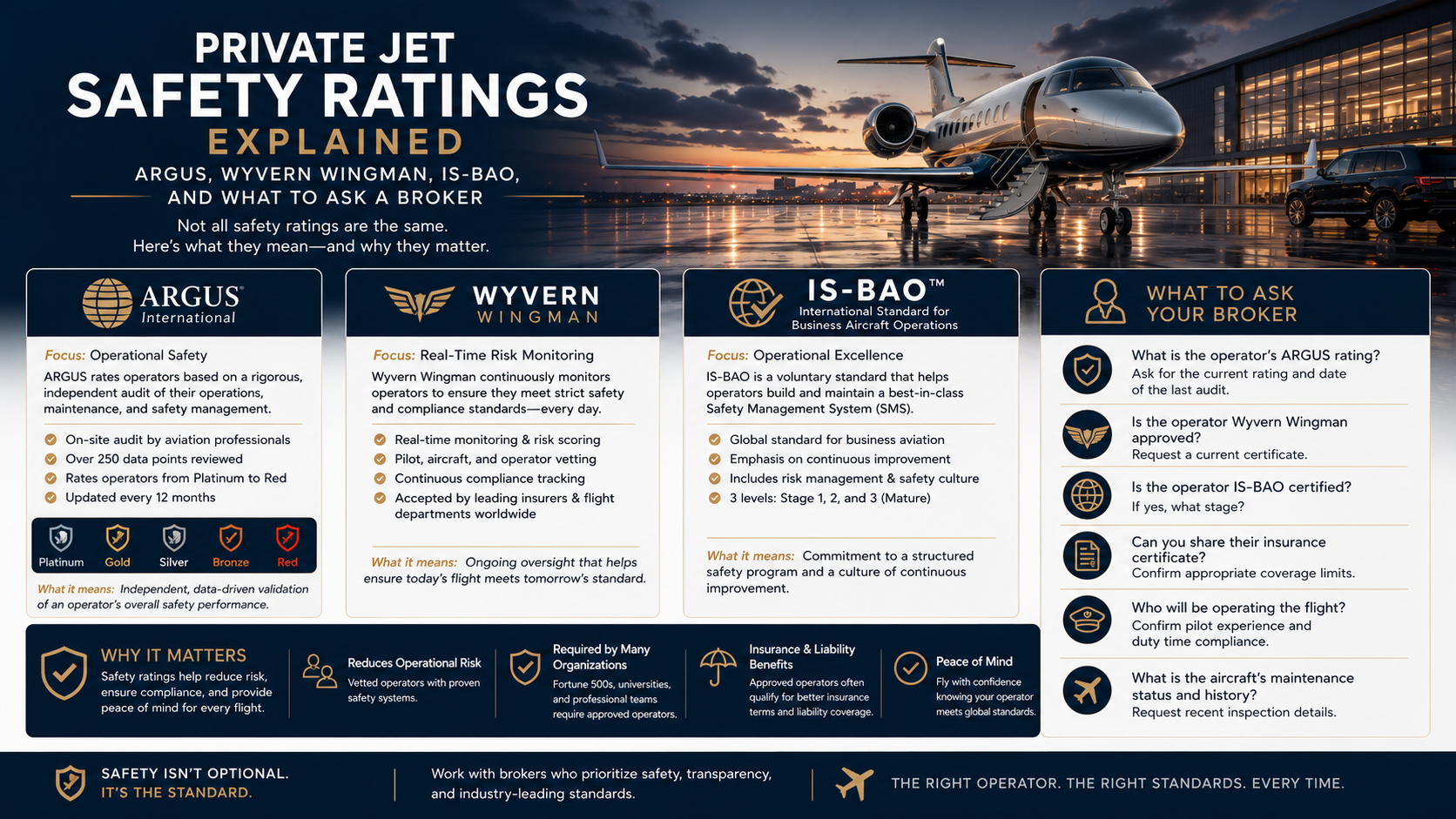
Every charter flight is only as safe as the company operating it. Private jet safety ratings help you judge that company before you sign anything. ARGUS, WYVERN, and IS-BAO are the three names you will see most often, and each one measures how an operator trains crews, maintains aircraft, and manages risk. None of them replaces the legal foundation underneath: an operator's authority to fly for hire. This guide explains what each rating means, what it does not guarantee, and the exact documents to request for your specific trip.
Private jet safety ratings are voluntary, third-party audit programs that evaluate an operator's safety practices beyond basic regulatory compliance. They add an independent read on top of the license an operator already needs to sell charter flights.
If you only remember one thing, remember this order of operations:
Baseline (non-negotiable): the flight must be operated by a properly certificated air carrier, meaning FAA Part 135 or Part 121 in the U.S., or an equivalent foreign authority.
Preferred layer: third-party audits such as ARGUS, WYVERN Wingman or Wingman PRO, and IS-BAO Stages 1 through 3.
Proof layer: documents for this trip, including the operator named in your charter contract, pilot currency, an insurance certificate, and current audit dates.
Start with the operator's legal authority to fly charter (Part 135/121), then use ARGUS, WYVERN, and IS-BAO to compare how proactively that operator manages risk. For broader context on the topic, our guide on are private jets safe covers accident data and how professional charter differs from general flying. The FAA's own general aviation numbers, which we quote later, sit under one fatal accident per 100,000 flight hours, though that category is broad and mixes many kinds of flying.
A safety rating is helpful, but it is not a license to sell charter. That distinction trips up more buyers than any other part of private jet safety.
Part 135 covers on-demand charter operations in the U.S. It sets baseline rules for pilot training, aircraft maintenance, and operational oversight that a company must meet to carry paying passengers. According to the FAA's Part 135 overview, these certificate requirements are what separate a legitimate charter carrier from casual private flying.
Part 91 covers private, non-commercial operations. A Part 91 flight is not a charter-for-hire, and a company selling seats or aircraft time under Part 91 rules may be running an illegal "gray charter." That is the single biggest legality risk in the market, and it is why the certificate check matters more than any logo.
Part 121 applies to larger scheduled and airline-style operations. Some bigger charter aircraft or shuttle-style segments may operate under Part 121 depending on the carrier and the operation model.
Where does a broker fit? Jettly is a charter broker and marketplace. It arranges flights, and the flights are operated by third-party air carriers that hold FAA Part 135 or Part 121 certificates (or equivalent foreign authority). A broker does not hold operational control of the aircraft, which is why the operating carrier is the name that must appear on your contract. Our overview of how the booking process works shows how documentation flows between broker, operator, and traveler.
The operating carrier is the air operator that has operational control of the flight and holds the certificate (such as Part 135) that legally allows the trip to be flown for hire. You can confirm a carrier's status using the FAA's published legal Part 135 holders list and matching the name to your charter agreement.
For safety and legality, the single most important check is that your trip is operated by a Part 135 (or Part 121) air carrier, and that the carrier name on your charter agreement matches that certificate.
|
Question |
Part 135 charter |
Part 91 private |
|---|---|---|
|
Can it be sold to the public? |
Yes, this is charter-for-hire |
No, it is private and non-commercial |
|
Baseline regulatory oversight |
Higher: training, maintenance, and dispatch rules |
Lower: owner-directed operations |
|
What to verify before booking |
Certificate holder name matches contract |
Confirm you are not being sold an unauthorized charter |
ARGUS is an independent aviation safety evaluation organization, and its CHEQ system is the framework used to rate charter operators. The ratings signal how deeply an operator's history, procedures, and safety systems have been reviewed.
"One of the biggest misconceptions in private aviation is that safety ratings apply to an aircraft. In reality, certifications such as ARGUS, WYVERN, and IS-BAO evaluate the operator's safety systems, procedures, and oversight. That's why every charter should begin by confirming who the operating carrier actually is, not simply which aircraft you'll be flying on."
- Justin Crabbe, CEO, Jettly
ARGUS CHEQ ratings move up in scrutiny across four tiers. Gold reflects a review of certificate status, operating history, and background checks. Gold Plus adds a validated safety system layer. Platinum and Platinum Elite involve deeper review, including an on-site audit of the operator's real-world practices.
ARGUS Platinum is a top-tier operator designation that typically indicates a more rigorous review that includes an on-site audit of the operator's safety and operational systems. The ARGUS audit standards outline what these reviews look at, which commonly includes:
Pilot qualifications and training records
Operational and accident/incident history
Maintenance programs and aircraft records
Manuals and standard operating procedures
Safety Management System maturity
An on-site audit for the higher tiers
Equinox Charter estimates that only around 5% of operators reach the top ARGUS tier, so treat it as an estimate rather than a hard figure. An "ARGUS-rated" logo is not enough. Ask what level the operator holds (Gold vs Platinum), confirm the rating is current, and make sure it applies to the operating carrier on your charter contract, not just an affiliated brand.
|
ARGUS level |
What it generally indicates |
What to ask for |
Common buyer mistake |
|---|---|---|---|
|
Gold |
Certificate, history, and background review |
Current status confirmation |
Assuming Gold means an on-site audit |
|
Gold Plus |
Adds a validated safety system layer |
Date of validation |
Treating it as identical to Platinum |
|
Platinum |
Deeper review with on-site audit |
Last on-site audit date |
Not checking recency |
|
Platinum Elite |
Highest scrutiny tier |
Scope and operator name on the audit |
Confusing marketing logos with current status |
Ratings apply to the operator, not a single airplane, and status can change between audits. That is why smart buyers verify per trip and cross-check against broader charter company options when comparing providers.
WYVERN works on a simple logic once you break it into parts. WYVERN is the auditor, Wingman is the certification tier, and PASS is the trip-level report concept.
WYVERN Wingman is a third-party operator safety certification that indicates an operator has undergone independent review and meets WYVERN's safety and risk-management criteria. The WYVERN program background describes its long history collecting operator and flight data to support that review.
At a high level, "Registered" reflects an operator that has submitted data and meets baseline participation, and Wingman reflects a certified standard backed by an independent audit. Wingman PRO is described as an enhanced tier with deeper review and ongoing validation of the operator's safety performance.
PASS reports are where WYVERN becomes trip-specific. A PASS-style report is often used to confirm operator, aircraft, and crew data points for a particular mission, meaning the exact tail number and date you plan to fly. That makes PASS a practical piece of evidence rather than a general badge.
To validate a WYVERN claim, request documentation, a status confirmation, or a copy of the current certification through your broker's compliance process. WYVERN status is meaningful, and it works best paired with Part 135/121 verification and a contract name match. WYVERN Wingman is most useful when it is tied to trip-specific proof, so ask your broker to confirm Wingman status and provide documentation for the operator flying your exact itinerary. Travelers new to this vetting language may find our guide to flying first time flying private a helpful primer.
|
WYVERN tier |
What it is |
What it suggests |
What to request |
|---|---|---|---|
|
Registered |
Data submission and baseline participation |
Operator engages with WYVERN |
Confirmation of current standing |
|
Wingman |
Certified standard with independent audit |
Meets defined safety criteria |
Certificate and audit date |
|
Wingman PRO |
Enhanced tier with deeper validation |
Higher, ongoing scrutiny |
Documentation plus a PASS report for your trip |
IS-BAO is different from a simple badge. It is a management system standard, not a one-time inspection sticker.
IS-BAO is a global safety standard built around a Safety Management System that operators implement and prove through staged audits. It is maintained by IBAC, the International Business Aviation Council, and it is used by operators worldwide as a benchmark for professional practice.
A Safety Management System (SMS) is a formal process an operator uses to identify hazards, assess risk, and continuously improve safety performance. In plain terms, it is how a company catches problems before they cause an accident.
IS-BAO uses three stages that act as maturity steps. Stage 1 means the SMS is built and in place. Stage 2 means it is functioning and producing real safety data. Stage 3 means it is mature and embedded in daily culture. IS-BAO Stage 3 generally signals a mature safety culture because the operator has proven its SMS is not just written down, it is working consistently.
When an operator claims IS-BAO, ask four questions: What stage are you at? When was the last audit? Do you run documented pre-flight risk assessments? How is safety reporting handled? IS-BAO does not replace legal authority to fly charter. It complements it. For teams building travel policy, our corporate aircraft guide connects this kind of due diligence to broader duty-of-care planning.
|
Stage |
What it means in plain English |
What proof to request |
|---|---|---|
|
Stage 1 |
SMS is implemented and documented |
Registration date and audit summary |
|
Stage 2 |
SMS is functioning and generating data |
Evidence of active hazard reporting |
|
Stage 3 |
SMS is mature and embedded in culture |
Most recent audit date and stage certificate |
These programs overlap, but they are not interchangeable. ARGUS and WYVERN are independent third-party safety auditors. IS-BAO is a global safety standard built around an SMS that operators implement and prove through staged audits.
A third-party audit is an independent review by an external organization that evaluates an operator's safety practices against a defined standard. Holding more than one credential can give you broader independent scrutiny, though no credential removes the need to verify operator legality and match the name on the contract.
An operator that stacks a top-tier ARGUS rating, WYVERN Wingman PRO, and IS-BAO Stage 3 is often treated as a strong signal, since three different bodies have reviewed the operation from different angles. Use the table below to translate a badge into a request: what level is it, when was it audited, and does it apply to the operator flying your trip?
|
Program |
What it is |
What it evaluates |
Common levels |
What to request from your broker |
|---|---|---|---|---|
|
ARGUS (CHEQ) |
Independent auditor and rating system |
History, training, maintenance, SMS, on-site practices |
Gold, Gold Plus, Platinum, Platinum Elite |
Level, current status, last on-site audit date |
|
WYVERN |
Independent auditor and certification |
Safety criteria, risk management, trip data via PASS |
Registered, Wingman, Wingman PRO |
Wingman status plus a PASS report for your tail and date |
|
IS-BAO |
Global safety standard (SMS-based) |
Safety Management System maturity |
Stage 1, Stage 2, Stage 3 |
Current stage and most recent audit date |
|
Must-have baseline |
Legal authority to fly charter |
Certificate and operational control |
Part 135 or Part 121 |
Carrier name matched to the FAA legal holders list |
For trips crossing borders, credentials interact with foreign oversight, which we cover in our guide to international private charter.
Verification is not rude. It is standard duty of care, and good operators expect the questions.
"No single safety badge should ever be the reason you book a flight. The strongest safety decision comes from combining three layers of verification: confirming the operator is legally authorized to conduct charter operations, reviewing independent third-party safety audits, and validating that the documentation applies to the exact aircraft and crew assigned to your trip."
- Justin Crabbe, CEO, Jettly
Trip-level verification means confirming safety, legality, and documentation for the exact operator, aircraft, and crew assigned to your specific flight, not just the broker's general standards. Run these steps before every booking:
Get the operator's full legal name. Ask for the operating carrier, not just the aircraft type or a marketing brand.
Confirm the certificate. Check the carrier against the FAA's legal Part 135 holders list (or the Part 121 equivalent).
Match the name on the contract. The operating carrier name must match the name on your charter agreement before you sign. A name mismatch is a major red flag.
Request current audit evidence. Ask for the ARGUS level, WYVERN status, or IS-BAO stage, plus the last audit date and scope, and keep a copy in your trip file.
Request trip-level proof. Ask for crew currency confirmation, an insurance certificate for the operator, and a PASS-style trip summary where relevant.
Handle international legs. Confirm which authority's certificate applies and who is responsible for permits and operational control, using AOC and TCO concepts covered below.
Escalate if answers are vague. Ask for written confirmation, switch operators, or work with a broker that documents safety diligence for you.
The safest way to use ratings is to verify them against the operator named on your charter agreement, for the exact date and tail assigned to your trip. The FAA's general aviation fact sheet reports a fatal accident rate of roughly 0.6 per 100,000 flight hours, but general aviation is a broad category that includes training and personal flying, so it does not equal professional charter safety.
|
Document |
Who provides it |
What it proves |
Red flag if missing |
|---|---|---|---|
|
Charter agreement with operator name |
Broker |
Who holds operational control |
No named carrier before signing |
|
Part 135/121 certificate reference |
Operator |
Legal authority to fly for hire |
Refusal or vague answer |
|
ARGUS/WYVERN/IS-BAO status |
Operator or broker |
Independent safety review |
Only a logo, no level or date |
|
Insurance certificate |
Operator |
Coverage carried on the flight |
Unwilling to share a certificate |
|
Crew currency confirmation |
Operator |
Qualified pilots for the aircraft |
No confirmation available |
If your assigned aircraft or crew changes at the last minute, re-verify the replacement. Our overview of recovery options explains how aircraft swaps work and why the same checks apply to a substitute operator.
Great brokers welcome these questions. The best ones produce documents, not marketing.
"The most valuable question a client can ask isn't 'Is this operator ARGUS Platinum?' It's 'Can you provide documentation showing the operating carrier, its current certification, and the safety credentials that apply to my specific flight?' Safety verification should always be trip-specific, not based solely on general marketing materials or company logos."
- Justin Crabbe, CEO, Jettly
Duty of care is the practice of documenting reasonable steps to identify and reduce travel risk, especially important for organizations booking flights for others. The questions below force specific answers.
|
Question to ask |
What a good answer looks like |
|---|---|
|
Who is the operating carrier for this trip? |
A full legal company name, not just an aircraft type |
|
Is that carrier a Part 135 or Part 121 holder? |
Yes, with a certificate reference you can verify |
|
What ARGUS level does the operator hold, and when was the last audit? |
A named level (for example ARGUS Platinum) plus a recent date |
|
Is the operator WYVERN Wingman or Wingman PRO, with documentation? |
A stated tier and a shareable certificate |
|
What IS-BAO stage applies, and when was it audited? |
A stage (for example IS-BAO Stage 3) with a current date |
|
Will the charter agreement list the same operating carrier you are quoting? |
Yes, with names that match exactly |
|
Can you share an insurance certificate for the operator? |
A certificate naming coverage amounts |
|
Will the crew be two qualified pilots current in this aircraft? |
Confirmation of a qualified two-pilot crew |
|
If the aircraft becomes unavailable, what is the replacement process? |
A clear plan that re-verifies the new operator |
|
Does PCSSP security screening apply to this aircraft? |
A direct yes or no based on aircraft size |
The best broker questions are the ones that produce documents: operator name, Part 135/121 proof, audit level and date, crew currency confirmation, and an insurance certificate. Some brokers apply approved-vendor insurance minimums as a screening tool, and Stratos Jets publishes example thresholds such as 25 million dollars for turboprops and higher figures for jets. Treat those as examples, not universal rules. Pair this diligence with pricing homework using our charter cost calculator so safety and budget move together.
Here is a short email script you can copy, paste, and send:
Subject: Safety documentation request for [route, date]
Hello [Broker], before we sign, please send the following for my [date] trip: the operating carrier's full legal name and Part 135/121 certificate reference; current ARGUS, WYVERN, or IS-BAO status with the last audit date; an insurance certificate for the operator; and confirmation that the charter agreement will name the same carrier. Please reply within 48 hours so we can finalize. Thank you.
Ratings evaluate the operator. Your trip also depends on the specific crew assigned that day.
Time-in-type means how many flight hours a pilot has in the specific aircraft model (or a closely related variant), not just total flight hours. A captain with thousands of total hours but little time in your jet type is a different risk profile than one who flies it every week.
Recurrent training and simulator programs are a common best practice, though operators run them at different intervals. Worldwide Jet and Paramount Business Jets both discuss pilot experience benchmarks, with captain totals often cited in the 3,000 to 5,000 hour range as a comfort marker. Read those as examples rather than fixed rules, since the right number varies by aircraft and mission.
Fatigue is a real risk factor, so ask a plain question: what duty and rest policy do you follow, and how do you manage fatigue risk? Many jets in charter are flown by two pilots, and confirming a qualified two-pilot crew is a reasonable request. Ask for confirmation of pilot qualifications, currency, and the relevant ratings for the aircraft category, without demanding private personal data.
|
Pilot question |
Why it matters |
Acceptable proof |
|---|---|---|
|
How much time-in-type does the crew have? |
Proficiency in your exact aircraft |
Written confirmation from the operator |
|
How often do pilots complete recurrent simulator training? |
Skills stay sharp for rare events |
Training provider letter or schedule |
|
What is your duty and rest policy? |
Fatigue lowers the safety margin |
A stated policy you can review |
Ask about time-in-type, recurrent simulator training, and fatigue management, because those factors affect the safety margin on the specific day you fly. Strong training and maintenance programs cost money, which is one reason the cheapest quote is not always the safest. Our operating cost breakdown explains where those expenses show up.
International trips add layers. Permits and oversight do not automatically transfer from a domestic flight.
An Air Operator Certificate (AOC) is the authority a company needs to run commercial flights in a given jurisdiction. EASA's AOC overview explains the concept for European operations. For non-EU operators flying into Europe, a separate Third-Country Operator authorization applies.
The Private Charter Standard Security Program (PCSSP) is a TSA security program framework that requires passenger and accessible baggage screening for certain private charter operations, based on aircraft size and seating thresholds. According to NBAA's PCSSP overview, the program applies to operations using aircraft with a maximum certificated takeoff weight above 45,500 kg (about 100,309 pounds), or a passenger seating configuration of 61 or more seats. PCSSP is primarily security screening. It complements operator safety audits and ratings rather than replacing them.
For international or large-aircraft charters, ask not only "Is it Part 135?" but also which operator's AOC or TCO authority is being used and whether PCSSP security screening applies. Three quick questions cover most international legs: Who obtains the permits? Who holds operational control? Which authority's certificate applies?
|
Topic |
Applies when |
Who is responsible |
What the buyer should ask |
|---|---|---|---|
|
AOC |
Commercial flights in a jurisdiction |
The operating carrier |
Which authority issued the certificate? |
|
TCO |
Non-EU operator flying into Europe |
The operating carrier |
Is TCO authorization in place? |
|
PCSSP |
Large aircraft above weight/seat thresholds |
Operator and TSA framework |
Does screening apply to this aircraft? |
Safety starts with who operates the flight. Jettly is a charter broker and does not own or operate aircraft. All advertised flights are performed by third-party air carriers holding FAA Part 135 or Part 121 certificates, or the equivalent foreign authority.
Jettly complies with the U.S. Department of Transportation's Part 295 and Part 298 charter broker regulations, and it issues a charter agreement for every booking. That agreement outlines the aircraft, itinerary, pricing, and operational terms, and the flight is confirmed only after the agreement is signed and payment secured. That paper trail is exactly what duty of care requires.
A charter broker arranges air transportation with licensed air carriers; the broker is not the operator and does not control the aircraft's day-to-day flight operations. Jettly works exclusively with certified operators that are ARGUS- or WYVERN-rated and meet or exceed FAA, Transport Canada, and EASA standards, and some operators also hold IS-BAO certification. As part of its Safety and Compliance Monitoring, Jettly states that it vets every operator, monitors aircraft for compliance, and works with independent safety auditors.
Jettly arranges flights only with properly certificated carriers and prioritizes third-party-audited operators (ARGUS and WYVERN, and when available IS-BAO) so clients can verify safety credentials before they fly. If a booked aircraft becomes unavailable, Jettly's Recovery Aircraft guarantee sources a replacement aircraft or alternate luxury transport, and the same verification should be applied to any substitute operator.
One clear note on coverage: Jettly does not carry additional liability insurance. Passengers are covered by the aircraft operator's insurance, which is why requesting that operator's insurance certificate is part of the verification steps above.
|
Role |
Who signs what |
Who holds operational control |
|---|---|---|
|
Charter broker (Jettly) |
Arranges the flight and issues the charter agreement |
None over the aircraft |
|
Operating carrier |
Holds the Part 135/121 certificate |
Full operational control |
|
Aircraft owner or manager |
Owns or manages the tail |
Depends on the operating agreement |
How we verify operators: Jettly confirms each flight is arranged with a certificated carrier, issues a signed charter agreement naming the operator, and points clients toward the third-party audit documentation (ARGUS, WYVERN, and where available IS-BAO) that applies to their specific trip.
A corporate jet charter should be operated by an FAA Part 135 (or Part 121) air carrier, and the strongest operators often add third-party audits like ARGUS, WYVERN Wingman, and IS-BAO. At minimum, a legitimate U.S. jet charter must be operated by an FAA-certificated air carrier under Part 135 (on-demand charter) or Part 121 (scheduled airline); top operators also maintain third-party safety audits such as ARGUS, WYVERN Wingman, and IS-BAO. The key is verifying that those credentials apply to the operating carrier named on your charter agreement for your specific trip.
ARGUS and WYVERN are not interchangeable, and each is a respected third-party auditor, so having either or both is generally more informative than having neither. Ask for the level, the last audit date, and confirmation that the credential applies to the operating carrier for your trip.
IS-BAO Stage 3 generally indicates the operator has demonstrated a mature, embedded Safety Management System (SMS) that consistently drives continuous safety improvement. The stages progress from Stage 1 (implemented) to Stage 2 (functioning) to Stage 3 (mature culture), so request the current stage and the most recent audit date as evidence.
Ask for the operating carrier's full legal name and confirm it against the FAA's list of legal Part 135 holders, then match that name to your charter agreement before signing. Brokers arrange flights, and the operator holds the certificate, so the operator's name is the one that must line up across every document.
Safety ratings like ARGUS, WYVERN Wingman, and IS-BAO primarily apply to the operator's systems and oversight, not just a specific aircraft. That is why trip-level checks matter: confirm the crew, insurance, and assigned tail for your exact flight in addition to the operator's rating.
PCSSP is a TSA security screening program framework that applies to certain private charter operations based on aircraft size or seating thresholds, so it is most relevant for larger aircraft missions. It is a security program, not a safety audit, so it complements rather than replaces operator safety verification.
It is not a simple comparison, since commercial airlines are highly standardized and private charter safety depends heavily on the specific operator, crew, and oversight standards in place. FAA general aviation data offers broad context, with a fatal accident rate under one per 100,000 flight hours, but that category mixes training and personal flying with professional operations, so the useful comparison is operator to operator using Part 135/121 authority plus independent audits.
Private jet safety comes down to three layers you can verify yourself: legal authority first (Part 135 or Part 121), then third-party audits (ARGUS, WYVERN, IS-BAO), then trip-level proof for your exact operator, aircraft, and crew. Ratings are a shortcut for judging how an operator manages risk, not a substitute for confirming who is actually flying your trip.
Ready to compare options with the paperwork in hand? Get flight options from third-party certificated carriers through the Jettly platform or the Jettly Private Jet Charter app, and ask your Jettly coordinator for the operator's Part 135/121 proof and current ARGUS, WYVERN, or IS-BAO documentation before you sign. Request an instant quote online, or reach the team at +1-866-448-2358 or departures@jettly.com to build a documented safety verification pack for your itinerary.
Disclaimer: Jettly is a charter broker and does not own or operate aircraft. Air transportation is provided by third-party operating carriers that hold the applicable certificates, and passenger insurance coverage is carried by the operating carrier.
FAA, Part 135 Certification - baseline definition of Part 135 and why it is required for U.S. on-demand charter.
FAA, General Aviation Safety Fact Sheet - general aviation fatal accident rate used as broad context.
FAA, Legal Part 135 Holders - how to confirm an operator is legally certificated.
EASA, Air Operator Certificate - AOC concept for European commercial operations.
EASA, Third-Country Operators - TCO authorization for non-EU operators flying in Europe.
IBAC, IS-BAO - IS-BAO definition, SMS focus, and the staged approach.
WYVERN, About - WYVERN's role as an audit and standards organization.
NBAA, PCSSP - PCSSP applicability thresholds and screening requirements.
ARGUS, Auditing Services - ARGUS audit standards and what evaluations cover.
Share this post:
Jay Franco Serevilla
Jul 25, 2026
|
5
min read
Discover tips and trends in the industry.

5
min read
Airline Charter: How Private Charter Flights Work with Jettly
Airline charters provide travelers with the flexibility to choose their departure times, destinations, and aircraft, making them ideal for business and leisure travel. Jettly's platform connects users to over 20,000 aircraft globally, simplifying the booking process with instant pricing and no long-term commitments. This guide explores how private charter flights work and the advantages they offer over traditional scheduled flights.
Read More
5
min read
Ontario, CA to Carson, CA by Private Jet: Route Guide, Airports, and Travel Options
Traveling from Ontario, CA to Carson, CA offers various options, including driving, public transit, and private aviation. While driving is the most common method, private jets can significantly reduce travel time when combined with ground transfers. This guide provides insights into travel times, costs, and the best airports for a seamless journey.
Read MoreStay updated with our latest insights and tips to elevate your journey with us.
MEMBERSHIPS AND ASSOCIATIONS



Disclaimer: Jettly operates as a charter broker, offering access to a global digital jet charter marketplace. Jettly is not a direct air carrier and does not own or operate aircraft. All advertised flights are conducted by third-party air carriers that are fully licensed and hold the appropriate Part 135 or Part 121 certifications issued by the Federal Aviation Administration (FAA) or equivalent regulatory authorities under U.S. or foreign law. Jettly complies fully with the U.S. Department of Transportation's Part 295 and Part 298 Charter Broker regulations. Jettly does not carry additional liability insurance. Passengers are covered by aircraft operator insurance. TICO: 50023770


