


Login
Get Instant Pricing On 23,000+ Aircraft

>
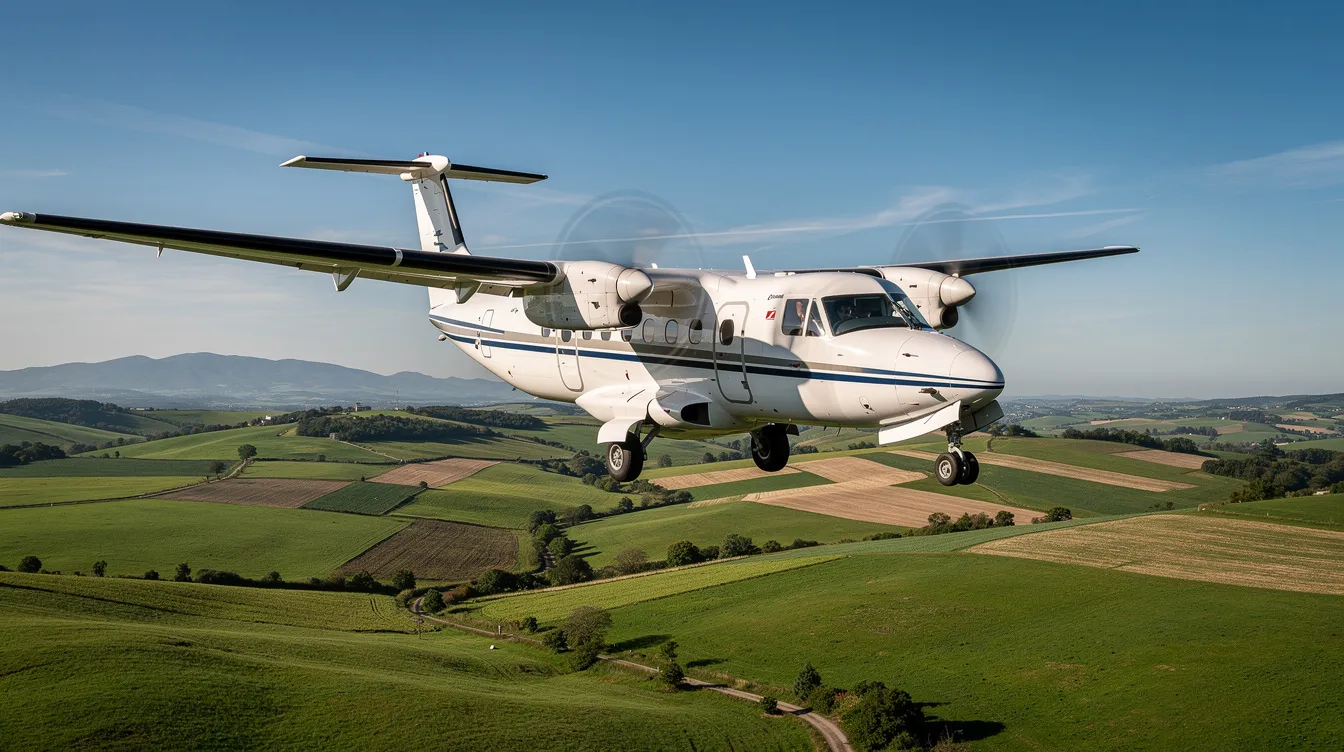
Propeller planes have never been more relevant to private aviation than they are right now. While jet aircraft dominate headlines, propeller-driven aircraft quietly handle thousands of charter missions each year — connecting remote communities, slashing costs on regional routes, and landing at airports that jets simply cannot reach. This guide breaks down how propeller planes work, when they outperform jets, and how to choose the right aircraft category for any given trip.
Propeller planes include both piston aircraft and modern turboprop aircraft. Piston aircraft use reciprocating internal combustion engines to spin their blades, while turboprops pair a gas turbine engine with a reduction gearbox to drive larger, more powerful propellers. Both fall under the umbrella of propeller propulsion — and both serve different roles from the jet engines found on light jets and larger jet aircraft.
The terms prop planes, propeller aircraft, and propeller driven aircraft all describe airplanes where a spinning propeller generates most of the thrust, rather than high-velocity exhaust from a turbofan.
Turboprop aircraft typically cruise at around 300 knots (550 km/h), with the broader category spanning roughly 180–330 knots depending on model. Cruise altitudes reach up to FL300 (around 30,000 feet), though most turboprop planes operate efficiently between FL200 and FL300. Propeller planes typically operate at lower speeds under 400 mph and lower altitudes compared to jets.
They are often used in regional aviation for short-haul flights. Turboprops are ideal for regional routes under 1,500 km, where the speed advantage of a jet shrinks and cost differences widen.
Jettly's charter marketplace includes both propeller driven aircraft and jets, matching each aircraft-powered option to the mission at hand - whether that means a turboprop to a mountain strip or a midsize jet across the continent.
Propeller planes generate thrust by using rotating airfoils that push air backward, which moves the aircraft forward. The blades of a propeller are shaped like airplane wings to create aerodynamic lift - except that lift is oriented forward, pulling the aircraft through the air. As the engine spins the propeller, it creates a pressure difference that pulls air and accelerates it backward, much like spinning wings generating force along the direction of flight.
Each propeller blade is twisted along its length. Because the blade tips move faster than sections near the hub, the twist ensures the correct propeller blade angle of attack from root to tip. This concept dates back to the Wright brothers' hand-carved wooden propellers in 1903.
Propeller blades often feature variable pitch to optimize efficiency across different flight phases. Variable pitch propellers adjust the blade pitch — the angle at which each blade meets oncoming air - to match conditions. Constant speed propellers take this further by automatically maintaining a set RPM: fine pitch for takeoff, coarser pitch for cruise. This propeller control system maximizes the power generated across the flight envelope.
Propeller thrust responds almost instantaneously to throttle adjustments at low speeds, giving pilots precise control during takeoff and approach. Propellers provide superior low-end responsiveness useful in agricultural aviation and short-field operations alike.
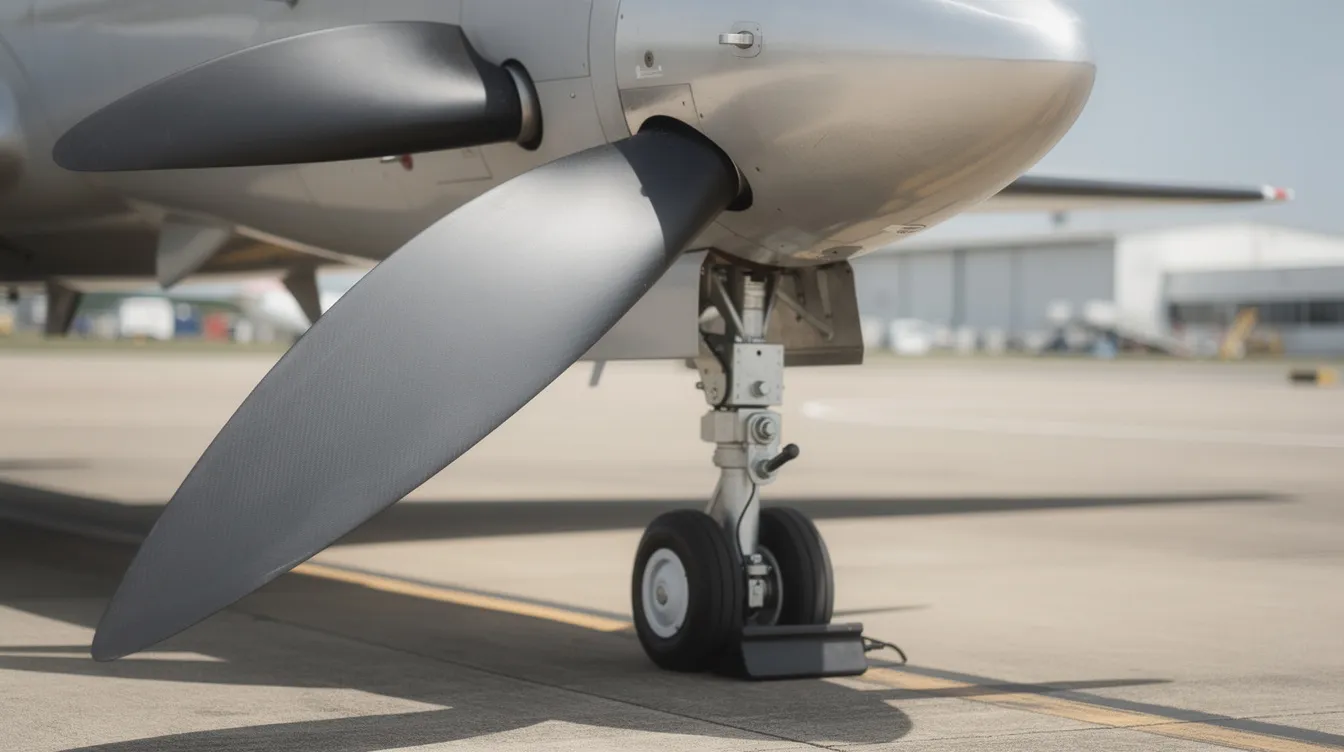
Modern prop planes often use scimitar-shaped composite blades to lower noise and improve fuel efficiency. Hartzell's carbon fiber composite scimitar blades, for example, feature nickel leading edges and erosion protection while cutting weight. Research published in 2026 showed scimitar blade tips can reduce tonal noise by roughly 55% at the fundamental frequency compared to conventional designs.
Propeller planes typically need less runway than jets because of strong low-speed thrust and lower approach speeds. The Pilatus PC-12 NG, for instance, can take off from about 2,485 feet under standard conditions — well within the limits of many remote airports.
There are two main categories of propeller aircraft in private and regional charter: piston aircraft powered by internal combustion engines, and turboprop aircraft driven by turbine engines. Each serves different mission profiles, budgets, and performance needs.
Piston aircraft use reciprocating internal combustion engines - mechanically simpler powerplants that drive smaller propellers. Piston engines typically cruise at speeds under 200 mph, at altitudes between 10,000 and 13,500 feet. Piston engines are standard for smaller training aircraft like the Cessna 172, and common uses for propeller planes in this category include flight training and agricultural aviation. Models like the Cirrus SR22 and Cessna 206 seat 4–6 passengers and handle short air taxi or budget-friendly charter missions.
Turboprop aircraft pair a gas turbine (essentially a jet engine core) with a reduction gearbox that spins a large propeller, with hot gases driving a power turbine that turns the shaft and propeller through the reduction gearbox. Modern turboprop engines deliver cruise speeds of roughly 260–320 knots and service ceilings up to 30,000–35,000 feet. Leading examples include the Pilatus PC-12 (single engine, cruising around 285–290 knots), the Beechcraft King Air 350 (twin-engine, cruising 300–312 knots), and the Cessna Caravan for utility and cargo roles.
Performance gap: Piston cruise at approximately 120–140 knots vs. turboprop cruise at 260–320 knots. Piston aircraft operate at lower altitudes without pressurization, while turboprops offer pressurized cabins and much greater payload and range.
Piston-engine propeller aircraft generally feature lower acquisition and operating costs. Mechanically, piston-powered propeller aircraft are simpler and cheaper to maintain than jet engines or turboprop engines. But turboprops close much of the gap between piston props and light jets in speed, range, and comfort - making them the dominant propeller system in executive and regional charter.
Propeller planes use internal combustion or turboprop engines to generate thrust, depending on the aircraft category. Piston engines have lower acquisition and operating costs, but turboprops deliver far more mission capability per hour.
Both single-engine turboprops and twin engine turboprops are widely used in charter and regional operations. The choice between them comes down to mission requirements: payload, terrain, redundancy, and budget.
Single-engine turboprops such as the Pilatus PC-12 and Daher TBM 960 offer lower operating costs, impressive range (around 1,500–1,800 NM with reserves), and typical seating for 6–8 passengers. The PC-12 NGX needs only about 2,485 feet of runway at maximum takeoff weight, making it a strong fit for remote strips.
Twin engine turboprops such as the Beechcraft King Air 250/350 and De Havilland Dash 8 provide engine redundancy — critical over water, mountains, or inhospitable terrain. The King Air 350 carries a useful payload exceeding 1,500 lbs with full fuel, reaches a service ceiling of approximately 35,000 feet, and performs well in hot-and-high conditions where single engines may be limited.
Mission fit: single-engine models work well for small groups (up to 6–8 passengers) accessing remote airstrips with modest payloads. Twin-engine models are better suited for executive shuttles, cargo transport, and routes requiring greater weather capability or higher payload.
Turboprop aircraft maintain strong safety records comparable to jets. Single-engine turboprops have accident rates comparable to twin-engine models when operated under strict Part 135 or equivalent regulations, with powerplants like the Pratt & Whitney PT6 family offering proven reliability.
Jettly presents both single and twin turboprop options in search results, displaying seat count, range, and runway requirements so travelers can match the right configuration to their itinerary.
Jets and light jets cruise at roughly 430–470 knots at FL350–FL450, while modern turboprops cover ground at 280–320 knots at FL200–FL300. That speed gap is real — but it tells only part of the story, especially on shorter routes.
On short legs under 500–700 NM, door-to-door time between a turboprop and a light jet often differs by only 15–30 minutes. Climb and descent phases, airport taxi, and ground transfers eat into the jet's cruise-speed advantage. Propeller planes are extremely fuel-efficient on short flights and at lower speeds, and high efficiency is a key advantage of propeller planes at lower speeds and short-to-medium ranges.
Prop planes can use many more airports, including short and unpaved runways, often cutting ground transfer times dramatically. Jet planes require longer, paved runways for safe takeoff and landing, which can force passengers to land farther from their final destination. Propeller planes can take off and land on short, unpaved, or rough airstrips.
Jet planes use jet engines that expel high-velocity gas exhaust to generate thrust, and jet planes are built for high-speed cruising at 500 to 600+ mph and higher altitudes. Jet planes consume fuel much faster at low altitudes but become efficient at high altitudes. Propeller planes are less suitable for high-speed, high-altitude flight, but on sectors where that performance isn't needed, they win on cost and access.
Comfort: jets generally offer quieter cabins and smoother rides at altitude, but modern turboprop aircraft with advanced blade design and improved cabin insulation are comfortable for flights under roughly 90 minutes. The gap has narrowed considerably with scimitar composite blades and better soundproofing.
Jettly's platform compares costs, flight duration, and airport options between propeller aircraft and jets, letting clients choose the best mix per trip rather than defaulting to the fastest or most expensive option.
Propeller aircraft open access to thousands of remote airports that many jets and light jets simply cannot use. This is one of the strongest practical advantages of the aircraft category.
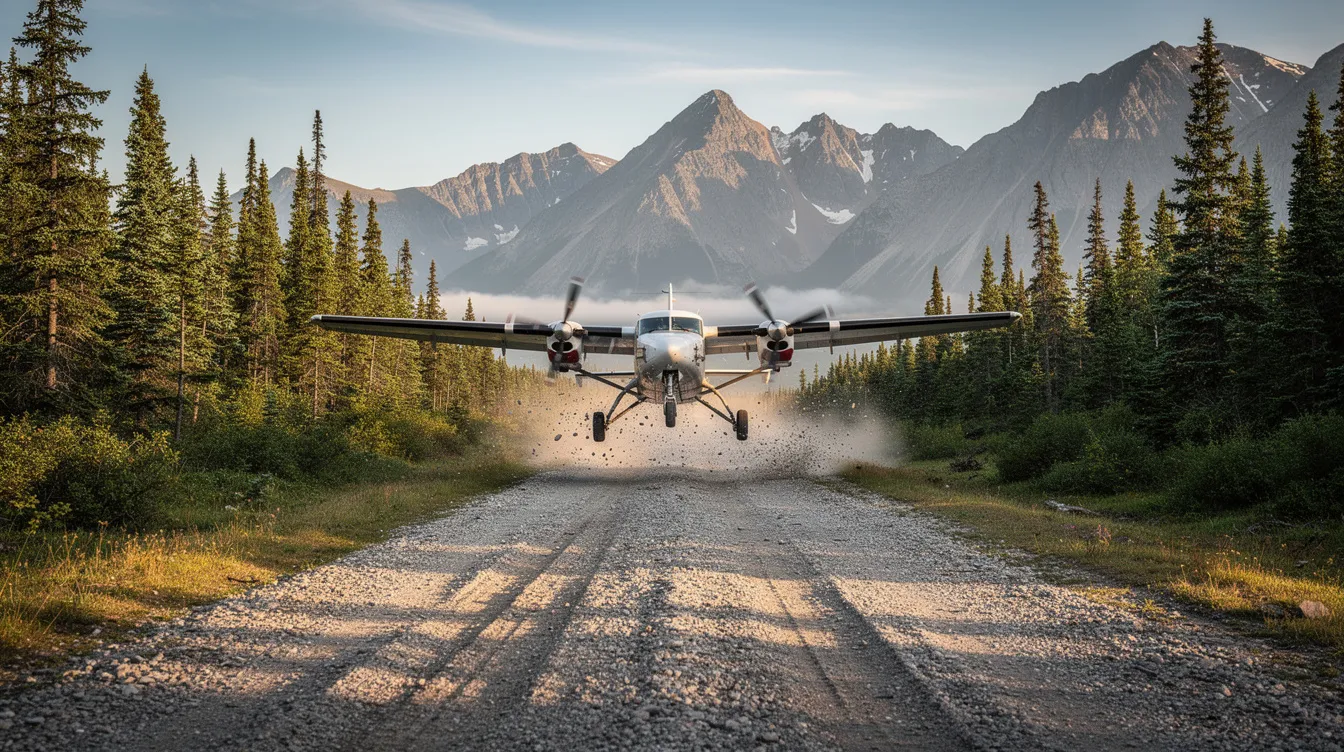
Turboprop aircraft can operate from runways as short as 1,100 meters. Turboprop aircraft can operate on grass, gravel, or compacted earth - surfaces that would ground most jet aircraft. Propeller planes can access unpaved runways that jets cannot.
Aircraft known for rough-field work include the Cessna Caravan, Quest Kodiak 100, and De Havilland Twin Otter—all frequently deployed for island, bush, mining, or remote industrial site operations.
Propeller planes excel in roles that require short takeoff and landing capabilities. Strong low-speed thrust from large-diameter propellers, robust landing gear, optional gravel kits, and lower approach speeds all contribute to their short-field performance.
Approximately 34% of airports globally rely exclusively on turboprop and propeller aircraft for scheduled or charter access — particularly in developing regions, island nations, and remote communities where runways are short and infrastructure is minimal.
Jettly uses runway length, surface type, and elevation data when suggesting suitable propeller-driven aircraft for remote-airport missions, ensuring the right propeller aircraft is matched to each destination's constraints.
Propeller aircraft often provide the most cost-effective solution for regional routes under 1,500 km. On these missions, lower fuel burn, simpler maintenance, and reduced airport fees add up fast.
Typical hourly charter cost ranges: piston aircraft often fall under $1,500 per hour for small payloads and short legs. Executive turboprops like the King Air 350 typically charter in the range of $2,600–$3,400 per hour, while comparable light jets may run $3,500–$6,000 per hour depending on model and region. That puts turboprops roughly 20–40% below light jets on an hourly basis. For detailed breakdowns, see Jettly's turboprop charter rates guide.
Turboprops can use up to 50% less fuel than jets on comparable short-haul missions, giving them lower fuel consumption than many light jets in this category and improving the overall economics discussed in depth in Jettly's guide on how much a private jet really costs. The King Air 350 burns approximately 95 gallons per hour at high cruise and can drop to around 60 gallons per hour at economy settings, whereas light jets commonly burn 120–150 gallons per hour. Maintenance costs are also lower due to simpler propulsion system architecture and fewer high-temperature components.
Cost per seat-mile advantages become significant on shorter sectors or where lower passenger demand keeps loads modest. For a group of 6–8 passengers on a 400 NM hop, a turboprop frequently delivers the lowest total trip cost — including landing fees, fuel, and crew.
Jettly's instant pricing tool shows side-by-side costs for propeller aircraft versus light jets on the same route, helping clients weigh cost efficiency against speed when it matters.
Propeller-driven aircraft, especially modern turboprops, are often more fuel-efficient than regional jets on short-haul routes. That efficiency translates directly into lower emissions per passenger.
Turboprops consume up to 50% less fuel than regional jets on sectors under 1,500 km. Turboprops emit fewer CO₂ emissions than regional jets as a direct result. On routes where both aircraft types are viable, the environmental case for a turboprop is straightforward.
Turboprops are less likely to produce contrails than jets. Because prop planes cruise at lower altitudes, they avoid the cold, humid upper atmosphere where persistent contrails form — contrails that contribute to radiative forcing and additional warming.
Modern turboprop engines improve fuel efficiency by 3% over previous generation engines, driven by refined thermodynamic cycles, improved compressor designs, and digital engine control systems that optimize fuel-air mixtures across all flight phases. Synthetic aviation fuels and sustainable aviation fuel (SAF) blends are increasingly available for turboprop engines, further reducing lifecycle carbon.
Advances in propeller blade design — including scimitar-shaped composite blades and swept blade tips - reduce external noise footprints. Composite materials now account for over 54% of the U.S. propeller system market, reflecting demand for lighter, quieter, and more aerodynamically efficient blades.
Jettly can support clients interested in more efficient aircraft choices by highlighting propeller aircraft where the mission profile and alternative fuels lower environmental impact without sacrificing convenience.
The propeller plane's story stretches back more than a century, from hand-carved wooden blades to advanced composite designs. Each era brought breakthroughs in blade technology, engine power, and mission capability.
The Wright brothers' 1903 Flyer used simple wooden propellers - essentially spinning wings with no variable pitch. Subsequent pioneers, including Alberto Santos-Dumont and early European engineers, advanced toward metal blades and more refined airfoil sections by the 1910s. These were the first human powered aircraft to evolve into engine-driven flight.
By the 1930s, constant-speed propellers and variable pitch propellers entered service (notably Hamilton Standard designs in the U.S.), letting pilots optimize blade pitch for takeoff, climb, and cruise - a major leap in efficiency.
World War II saw piston-driven aircraft like the DC-3 and P-51 push propeller technology to its limits with multi-blade metal designs. The post-war era introduced the first practical turboprop engines: the Rolls-Royce Dart engines powered aircraft like the Vickers Viscount, which first flew in 1948 and proved that turboprop technology could serve regional airline roles effectively.
The 1960s–1980s brought high-bypass jet engines that took over longer routes, but turboprops held firm on regional and short-haul missions. ATR turboprop aircraft (ATR 42/72, first delivered in the mid-1980s) and the De Havilland Dash 8 became workhorses. For business aviation, the Beechcraft King Air series (launched in the 1960s, continuously upgraded) and the Pilatus PC-12 (first delivery 1994) came to dominate.
Modern turboprop models now feature scimitar composite propellers, winglets, advanced avionics, and pressurized cabins - closing much of the comfort gap with light jets while preserving cost and runway advantages that practical turboprop engines have always offered.
Regional airlines and cargo carriers rely heavily on prop planes to connect smaller communities and serve industries in places with limited infrastructure.
Modern turboprops like the ATR 72, Dash 8 Q400, and Cessna Caravan handle scheduled regional routes and feeder networks worldwide. Passenger turboprops on these routes prioritize low cost per available seat-mile, high frequency, and access to smaller airports - often on segments of 200–400 NM.
Propeller aircraft are suited for routes with lower passenger demand: smaller cabins, lower trip costs, and the ability to serve short sectors economically. Regional airlines use them to feed passengers from secondary cities into major hubs, where travelers connect to longer jet routes.
Turboprop aircraft are commonly used for cargo transport and medevac missions. Express parcel flights, medical supply runs, and freight to islands or remote mining airstrips without jet-capable infrastructure depend on aircraft like the Cessna Caravan and King Air freighter variants.
Airlines looking to replace aging fleets on thin regional routes often choose modern turboprop aircraft over regional jets, driven by significantly less fuel burned per seat and better short-runway performance.
The same aircraft types appear on Jettly's marketplace for ad hoc charter — commuter shuttles, urgent cargo, and time-sensitive medevac missions that need the flexibility of on-demand booking.
Private travelers use propeller aircraft for a surprisingly wide range of missions - from executive commuting to family adventures and complex multi-leg trips.
Executive commuting: A turboprop connecting Toronto and Ottawa (roughly 300 km) can use smaller airports closer to each city center, avoiding the congestion and ground travel that eats into the speed advantage of a jet. The same logic applies to routes like London–Paris (~340 NM), where turboprop planes land at secondary airfields with faster curb-to-cabin times.
Family travel to islands or ski destinations: Many Caribbean out-islands and alpine ski strips have short or unpaved runways where jets cannot operate. Propeller aircraft like the PC-12, Caravan, or Kodiak handle these approaches routinely, getting families closer to their destination without a connecting ground leg.
Multi-leg itineraries: A client might fly New York to Dallas on a midsize jet, then hop a turboprop for the final 200 NM to a remote regional airport that lacks jet-capable infrastructure. This combination of jet aircraft for long sectors and prop planes for feeder legs often saves both time and money.
Cargo and expedition missions: Groups traveling with bulky equipment — dive gear, film production kits, scientific instruments - benefit from the cargo flexibility of turboprop cabins and large cargo doors.
Jettly's booking flow lets users filter for turboprops, piston aircraft, or light jets and compare price, time, and airport options for each scenario, making it easy to build the right itinerary.

Modern commercial and charter propeller aircraft follow the same regulatory standards as jets. There is no separate, lower safety tier for prop planes — the rules are the same.
Turboprops and piston aircraft used on Jettly are operated by certified air carriers under FAA Part 135 (or equivalent international frameworks) with rigorous maintenance programs, scheduled inspections, and documented crew proficiency. For more on how charter safety works, see Jettly's guide to private jet charter safety.
Pilot training for turboprops emphasizes propeller control techniques, including engine-out procedures for twin engine turboprops, operations into short and unpaved runways, and handling at low speeds where propeller dynamics differ from jets. Counter-rotating propellers on some twin engine models further reduce asymmetric thrust risks.
Modern safety technologies installed on charter turboprops include advanced avionics (GPS, ADS-B, synthetic vision), terrain awareness and warning systems (TAWS), digital engine control systems, weather radar, and ice protection on leading edges and blades, while compressed air also powers pneumatic systems such as de-icing boots on some aircraft.
Powerplants like the Pratt & Whitney PT6 family have decades of proven reliability across hundreds of thousands of flight hours worldwide. Composite blades require strict inspection routines - particularly in rough-field operations — but deliver excellent durability when properly maintained.
Jettly vets operators for safety audits, regulatory compliance, insurance, and crew experience before listing propeller aircraft on its platform. Aircraft registration and operator credentials are verified as part of the onboarding process.
The right aircraft depends on a handful of practical variables: route length, passenger count, luggage, runway conditions, schedule flexibility, and budget.
For routes under 500–700 NM, turboprop planes generally make the strongest case - especially when secondary or remote airports are involved. On a 400 NM hop, a turboprop might take about 1.5 hours versus 1.1 hours for a light jet, but at 20–40% lower cost and with access to more airports.
When non-stop range beyond roughly 700–1,000 NM matters, or when speed is the top priority, a light jet or midsize jet usually justifies the premium. On a 900 NM mission, a turboprop may take approximately 3.0–3.3 hours compared to about 2.0 hours for a midsize jet.
Jettly's interface displays estimated flight time (including climb, descent, and ground handling), available airports at origin and destination given runway requirements, and hourly or trip-based pricing for prop planes, light jets, and larger jets — all on one screen.
Travelers can combine aircraft types on multi-leg trips: a jet for the trunk route and a prop plane for the feeder leg, booked through a single itinerary.
Consider environmental and cost factors alongside speed. Choosing a turboprop that burns significantly less fuel and lands closer to your destination may reduce both the bill and the carbon footprint. For an instant estimate, try Jettly's charter cost estimator.
Are turboprops really much slower than jets? On cruise speed alone, yes - light jets cruise around 400–500 knots versus turboprops at 260–330 knots. But on routes under 500–700 NM, door-to-door time differences often shrink to just 15–30 minutes once airport access, ground transfers, and climb/descent phases are factored in. The crossover point where jets clearly save meaningful time is roughly 700 NM and beyond.
How noisy are modern propeller cabins? Modern turboprop aircraft with scimitar composite blades and improved cabin insulation are significantly quieter than older props. Industry commentary on models like the King Air 350 and PC-12 NGX describes cabin noise levels as competitive with light jets. On flights under 90 minutes, most passengers notice little practical difference.
Can charter prop planes fly in bad weather and at night? Yes. Charter propeller aircraft are IFR-certified and equipped for poor weather, including icing protection on blades and airframes, required lighting, and weather radar. Twin engine models offer added engine redundancy. Operators and crews maintain instrument ratings and night currency under Part 135 or equivalent regulations.
What range can business turboprops cover non-stop? Popular models like the King Air 350 and PC-12 NGX offer non-stop IFR ranges of approximately 1,800 NM with a few passengers and reserves. That covers cross-country U.S. segments, Caribbean island-hopping from the mainland, and many European city pairs comfortably.
When does Jettly recommend a propeller aircraft over a jet? When the route is under roughly 500–700 NM, when the destination or origin runway is only usable by props, when the passenger count is modest, or when the client prioritizes lower operating costs and environmental impact over raw cruise speed. The platform's comparison tools make these trade-offs visible at the quote stage.
Jettly is a digital private aviation marketplace with access to thousands of aircraft, including piston aircraft, propeller-driven turboprops, light jets, and larger jets across its global network.
The online search and instant pricing process is straightforward: enter route, dates, and passenger count to receive real-time quotes for suitable prop planes and jet aircraft. Results show price, estimated flight time, aircraft type, and airport options side by side.
Membership and on-demand options are both available. Travelers can use the platform without long-term jet card commitments - booking a turboprop for one trip and a midsize jet for the next, with no lock-in.
Support advisors help interpret differences between propeller aircraft and jets for specific missions, including runway and weather considerations, so travelers can make informed choices rather than guessing.
Jettly integrates services such as ground transportation and catering, regardless of whether the flight uses a prop plane or a jet - keeping the experience consistent across aircraft categories.
The air intake of quote requests, from piston charters to heavy jets, all flows through a single booking platform designed for transparency and speed.
Propeller planes - especially modern turboprops — remain vital for regional, remote, and cost-sensitive private flights alongside jet aircraft. They are not a compromise; they are a strategic match for thousands of routes where jets offer diminishing returns.
Prop planes deliver strong fuel efficiency, access to remote airports and short runways, and attractive pricing for trips under about 1,500 km. Turboprops can use up to 50% less fuel than comparable jets on these missions.
Approximately 34% of airports globally rely on turboprop aircraft for access, and modern turboprop engines improve fuel efficiency by 3% over previous models - meaning the case for propeller aircraft is getting stronger, not weaker.
Jettly's platform makes it easy to compare propeller driven aircraft with light jets and other jet categories on one screen, so travelers can see the real trade-offs before booking.
Ready to see how propeller planes stack up against jets for your next trip? Explore traditional charters, experiment with crowdsourced private jet flights and shared empty seats, compare leading private jet operators like NetJets with alternatives, dive deeper into choosing the best personal plane, or even browse top luxury private jets and affordable charter options and specific operators such as Dexter Air Taxi before you request a quote at https://www.jettly.com.
Share this post:
Jeff Ryan Serevilla
Sep 22, 2026
|
5
min read
Discover tips and trends in the industry.

5
min read
Very Light Jets for Sale: Smart Alternatives to Ownership and Jet Cards
The market for very light jets (VLJs) is rapidly expanding, offering a cost-effective entry into business aviation. This guide explores the benefits of ownership versus chartering, highlighting the efficiency and flexibility of VLJs for business and leisure travel. With options like Jettly, travelers can access these jets without the burdens of ownership, making private aviation more accessible than ever.
Read More
5
min read
Gulfstream G700 Price: Ownership Costs vs. Charter with Jettly
The Gulfstream G700 is a premier ultra-long-range private jet with a list price ranging from $75 million to $81 million, often exceeding $90 million due to customization and demand. For high-net-worth individuals and corporations, understanding the ownership costs versus chartering options through Jettly is crucial for making informed decisions about private aviation.
Read MoreStay updated with our latest insights and tips to elevate your journey with us.
MEMBERSHIPS AND ASSOCIATIONS



Disclaimer: Jettly operates as a charter broker, offering access to a global digital jet charter marketplace. Jettly is not a direct air carrier and does not own or operate aircraft. All advertised flights are conducted by third-party air carriers that are fully licensed and hold the appropriate Part 135 or Part 121 certifications issued by the Federal Aviation Administration (FAA) or equivalent regulatory authorities under U.S. or foreign law. Jettly complies fully with the U.S. Department of Transportation's Part 295 and Part 298 Charter Broker regulations. Jettly does not carry additional liability insurance. Passengers are covered by aircraft operator insurance. TICO: 50023770


