


Login
Get Instant Pricing On 23,000+ Aircraft

>
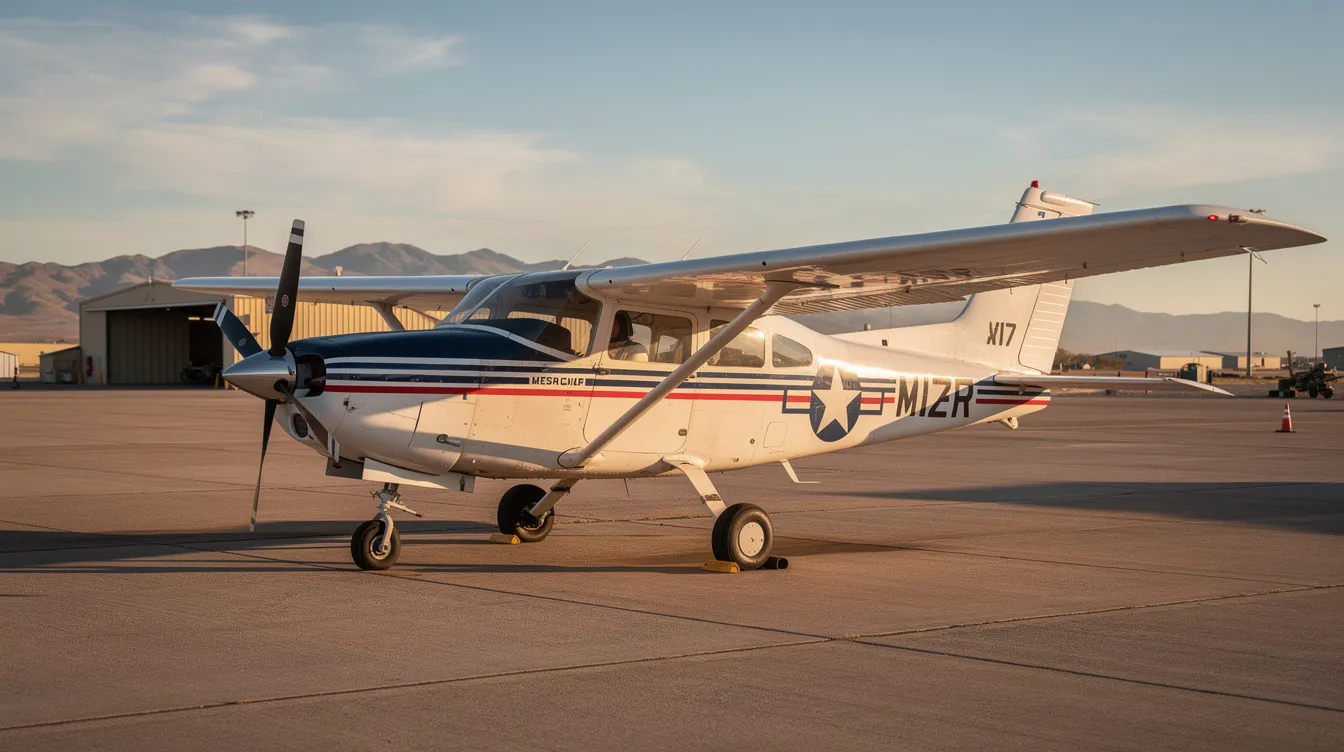
The Cessna T-41 Mescalero is the military version of the Cessna 172, introduced in 1964 as a primary trainer for the U.S. Air Force and U.S. Army before pilots moved on to more advanced aircraft. For aviation enthusiasts, military and civilian pilot trainees, and private aviation customers—including Jettly users comparing aircraft heritage and training roots—it offers a clear link between civilian general aviation and military flight instruction. This guide looks at the T 41’s design, development, operational history, technical specifications, and its transition into museum and private ownership, while showing why the aircraft still matters in modern private aviation through the training standards, safety culture, and aircraft familiarity that continue to influence pilot development and charter decisions today.
The Cessna T-41 Mescalero is the military version of the Cessna 172, introduced in 1964 as a primary trainer for the United States Air Force and U.S. Army. It was flown by pilot candidates as their first step toward advanced aircraft.
Later variants received more powerful engines (210 hp vs. 145 hp), a constant-speed propeller, and upgraded avionics, setting the T-41 apart from a standard Cessna 172 in climb performance and design capabilities.
Over 300 T-41s served with the US Air Force and Army, while the aircraft was exported to approximately 30 countries for military training. Some remain airworthy in museum and heritage roles today.
Lessons from the T-41's flight screening role carry straight into modern private pilot training and aircraft selection on platforms like Jettly.
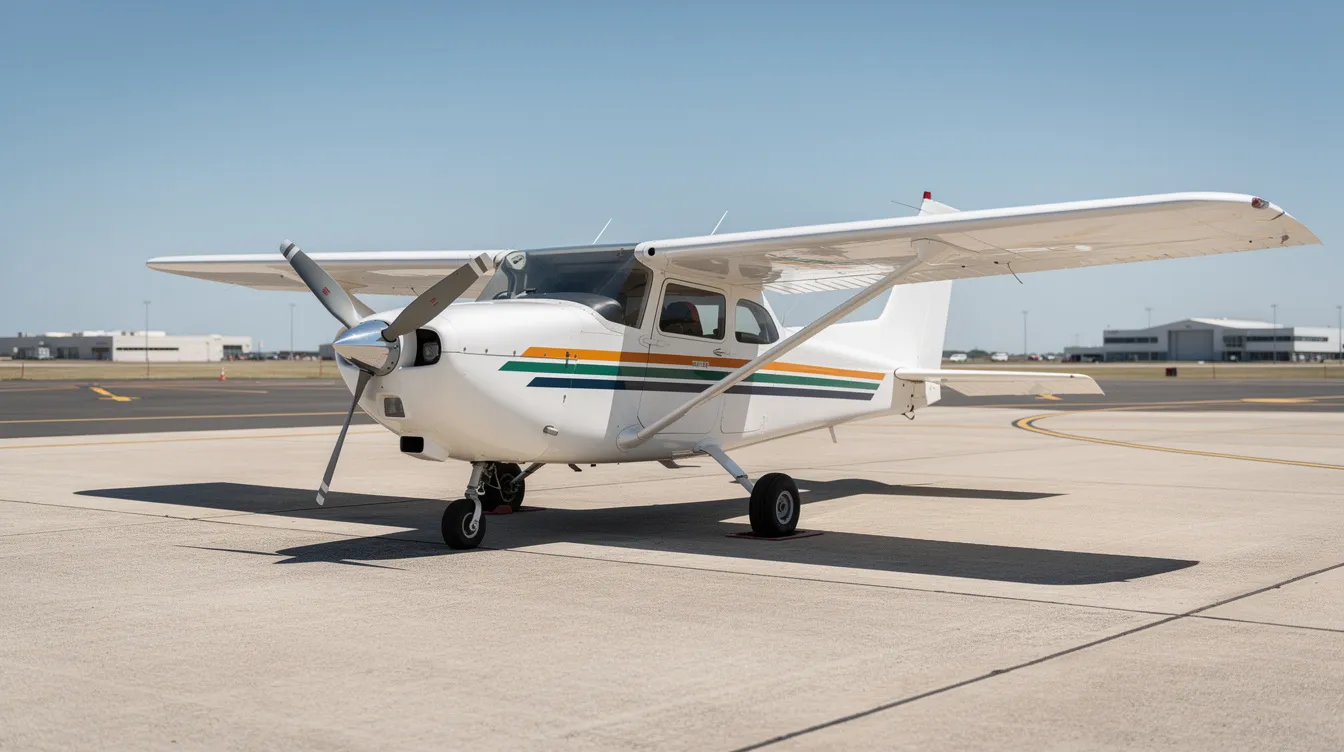
The T-41 Mescalero is basically a Cessna 172 built for military service. The USAF and the US Army adopted it in the mid-1960s to provide an affordable, reliable way to screen students before they moved on to jets.
The base airframe is the Cessna 172F-one of the most widely produced four-seat aircraft in history, with over 43,000 built since 1956. Its high-wing configuration, tricycle landing gear, and forgiving flight characteristics made it a natural fit for the armed forces. In its early T-41A form, the aircraft was powered by a 145 hp Continental O-300 engine, cruising around 120–130 mph.
The "T" designation indicates a trainer in U.S. military nomenclature, and 41 Mescalero became the official name. The T-41 Mescalero was widely exported to international air forces, with countries like Greece, Turkey, Iran, South Korea, and various other countries operating the type for basic flight training. In total, the aircraft served approximately 30 countries for military training worldwide.
In 1964, the US Air Force sought a cost-effective lead-in trainer and turned to the proven Cessna 172F airframe rather than developing something new, a more conservative path compared with today’s civilian military jet experience flights. The effect was immediate: a large order placed at a fraction of the cost of purpose-built military aircraft.
Key changes from the civilian model to the T-41A included military radios, safety harnesses, and instrumentation suited for training. The engine remained the 145 hp Continental O-300 with a fixed-pitch propeller. The USAF ordered 237 T-41As in 1964, making it one of the largest single purchases of a civilian-derived trainer.
The Army version came next. The T-41B, developed for the US Army in the late 1960s, featured a 210 hp Continental IO-360 engine and a variable-pitch propeller (constant speed), which significantly improved short-field and climb performance. The us army version also included jettisonable doors, a 28-volt electrical system, and a removed baggage door to reduce weight.
In 1968, the USAF acquired 52 T-41Cs for the Air Force Academy near Colorado Springs. These used the same 210 hp engine but fitted a fixed-pitch climb propeller optimized for high-altitude operations. The T-41C model was used primarily by the U.S. Air Force Academy for cadet training and certain academic classes.
The T-41D, an export military variant, brought the configuration to allied nations. The T-41D included an upgrade in avionics in 1996 with more modern radios and navigation equipment, keeping the aircraft relevant. These more powerful engines and propeller options are what distinguish the T-41 from most standard Cessna 172 trainers at civilian flight schools.
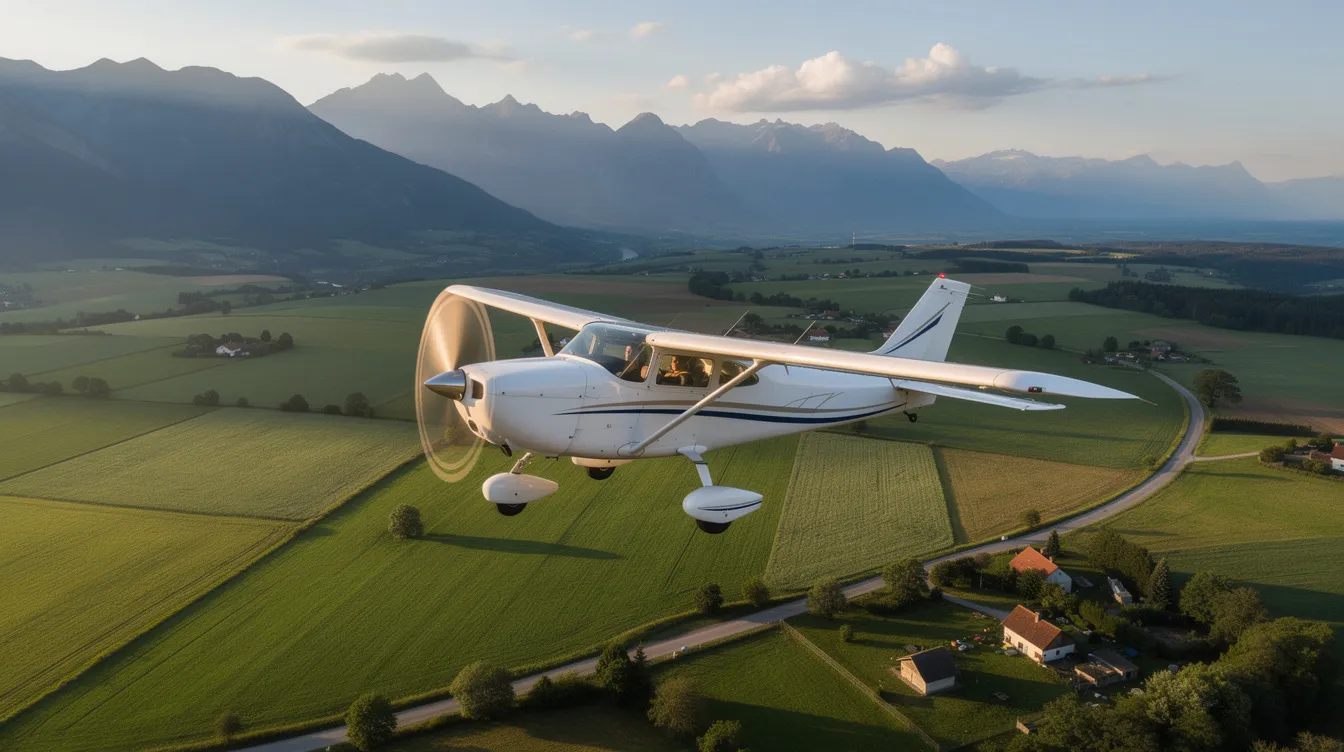
The T-41's main mission was straightforward: a flight screening role for pilot candidates before they advanced to more complex aircraft. Introduced in 1964, the T-41 Mescalero was used for pilot training across multiple branches of the U.S. armed forces.
The United States Air Force ordered 170 T-41As in the first batch, followed by 34 more in 1967. These were operated primarily at civilian contract flight schools located near Air Training Command bases. The T-41 was crucial for training pilots due to its forgiving flight characteristics-students could learn basic maneuvers in a stable, predictable aircraft.
The T-41 was also used for pilot training by the US Army, which employed the T-41B as both a primary trainer and liaison aircraft. Army roles included personnel transport, light utility missions, and observation flights from the late 1960s onward.
At the Air Force Academy, the USAFA flying team and academic classes relied on the T-41C fleet from 1968 onward. Cadets received flight training at the airfield near Colorado Springs, and the aircraft supported ongoing flying team and academic roles into the 1990s.
By 1993, the Air Force began replacing most T-41s with the Slingsby T-3A Firefly for aerobatic screening. Some T-41s remained in service for non-aerobatic training, and several airworthy examples are now on display at the National Museum of the U.S. Air Force in Ohio as a display site, as well as at other sites. Allied air forces across Europe, the Middle East, and Asia-including Peru, the UK, and South Korea-also operated T-41s in similar training roles.
This section provides a focused, data-driven view of the T-41C's specifications and how they compare with a typical Cessna 172 used in civilian flying.
|
Specification |
T-41A |
T-41B |
T-41C |
Civilian Cessna 172 |
|---|---|---|---|---|
|
Engine |
145 hp Continental O-300 |
210 hp Continental IO-360 |
210 hp Continental IO-360 |
145-180 hp Lycoming or Continental |
|
Propeller |
Fixed-pitch |
Constant-speed (variable pitch) |
Fixed-pitch climb propeller |
Fixed-pitch or constant-speed |
|
Max Speed |
~125 knots (144 mph) |
~125 knots (approx.) |
~125 knots (139 mph) |
~122 knots (140 mph) |
|
Cruise Speed |
~110 knots |
~110-120 knots |
~110-120 knots |
~110 knots |
|
Service Ceiling |
~13,000 ft |
~13,000 ft |
~14,000 ft |
~13,000 ft |
|
Range |
~626 miles |
~500 miles (due to engine) |
~626-720 miles |
~640 miles |
|
Seating Capacity |
1 pilot + 3 passengers |
1 pilot + 3 passengers |
1 pilot + 3 passengers |
1 pilot + 3 passengers |
|
Role |
Basic flight screening |
Primary trainer & liaison |
Cadet training & academic |
General aviation training |
General characteristics include a high-wing configuration, loaded weight around 2,300 lb, a length of roughly 26 ft 11 in, and a height of about 8 ft 10 in. The 210 hp engine-whether driving a fixed-pitch or constant-speed propeller- delivers a climb rate near 910 ft/min, a significant upgrade over the 145 hp Cessna 172.
Avionics on late-service T-41D models included dual radios, VOR/ILS navigation, and basic transponder equipment, with later GPS retrofits. This contrasts with the glass-cockpit setups found in modern Cessna 172S aircraft and other small Cessna planes used for training today.
For pilots, handling remained similar to a civil Cessna 172. That familiarity helped students pull skills straight from military training into general aviation, airline, or multi-engine careers.
After leaving active duty, many T-41 aircraft entered civil registries, museums, and historical wings across North America and overseas. People can view examples at locations like Maxwell AFB in Alabama, Vance AFB in Oklahoma, and the National Museum of the U.S. Air Force in Ohio.
A typical history looks like this: a 1967 Cessna 172E converted to T-41 configuration, flown as a primary trainer and liaison aircraft for the Army, and today maintained as an airworthy model in a living-history collection. Former T-41s are often restored close to their original military schemes, retaining dual controls, training instrumentation, and sometimes the 210 hp engine.
These aircraft serve an educational purpose in organizations such as Commemorative Air Force wings, where they teach visitors about Cold War-era pilot training and the transition from piston trainers to jets. In civilian operation, a T-41 is treated much like a high-performance Cessna 172-suitable for personal travel, advanced training, or air experience flights under normal general aviation regulations, and many of the same cost and access considerations apply as with other affordable aeroplane rental options.
Some private owners and flight schools still purchase ex-military T-41s for their robust build quality and strong climb performance, even though they are no longer typical in commercial charter fleets. Argentina, for example, still reports T-41Ds active in training roles with its Army Aviation School.
The T-41 Mescalero's heritage connects directly to the broader evolution of light training and touring aircraft-and that matters for today's private aviation customers.
While the T-41 itself is rarely offered as a charter aircraft, its civil counterpart, the Cessna 172, remains one of the most common training and personal travel aircraft in the world. Many charter pilots start their careers in Cessna 172-type aircraft before moving into turboprops, light jets, and heavy jets, including high-performance piston twins like the Piper Aerostar 600.
Modern private flyers who book through Jettly typically move beyond piston singles. A business traveler who once trained in a Cessna 172 might now charter a light jet for a Toronto–New York trip, perhaps comparing top private jet charter companies before booking. A family might choose a King Air turboprop for a multi-city vacation instead of a single-engine trainer, browsing Jettly’s global selection of private charter aircraft. Learn more about these options in Jettly's aircraft charter guide.
Jettly provides immediate access to a global inventory of 20,000+ aircraft, transparent pricing, and tools like a private jet charter cost estimator to help plan trips, plus the ability to compare different aircraft types. All of these aircraft trace their design philosophy back to reliable trainers like the Cessna 172 and T-41-prioritizing safety, predictable handling, and sound engineering.
Understanding trainers like the T-41 helps travelers appreciate the safety culture, pilot experience, and performance capabilities behind the aircraft offered through Jettly's platform.
Below are answers to common questions about the T-41 Mescalero and its connection to modern private flying.
Most T-41s were phased out of primary screening in the 1990s, replaced by aircraft like the Slingsby T-3A Firefly and later platforms. A small number continued in limited training, academic, or heritage roles at the U.S. Air Force Academy. Remaining examples are generally preserved in museums, used by historical wings, or registered as civilian aircraft rather than frontline military trainers.
Many T-41 variants-especially the T-41B, T-41C, and T-41D-use a 210 hp fuel-injected Continental IO-360 engine instead of the 145–180 hp engines common in older Cessna 172 trainers. Some models feature a constant speed propeller, ruggedized equipment, and military-grade radios, delivering better climb performance and flexibility while maintaining similar overall handling to the civilian 172.
Ex-military T-41s typically operate in the private general aviation and museum world rather than in commercial charter fleets, so they are not common options on charter marketplaces. Customers using Jettly typically choose certified charter aircraft such as turboprops, light jets, and midsize jets that offer higher cruise speeds, greater comfort, and full commercial certification-even though many charter pilots originally trained on Cessna 172-type aircraft-and may also opt to book a single seat on a private jet through shared and semi-private options.
Many charter pilots progress from piston trainers like the Cessna 172 and T-41 to aircraft families such as King Air turboprops, Citation and Learjet light jets, and larger Gulfstream or Global business jets, the same kinds of models highlighted when choosing the best cross-country plane for private travel. These charter aircraft share core design priorities-reliability, predictable handling, and safety systems-that echo the simplicity and robustness of the T-41, and they make up a significant share of the global private jet fleet.
The T-41 provides a tangible link between everyday general aviation through the Cessna 172 and professional military flying, much like the aircraft profiled in guides to choosing the best personal plane for your needs. Visiting or flying in a preserved T-41 helps learners understand basic aerodynamics, cockpit layouts, and training practices that continue to influence both commercial and private aviation today. Comment sections on aviation forums regularly highlight the T-41 as a favorite subject among historians and pilots.
The T-41 Mescalero bridged civilian general aviation and military pilot training for decades. Its enhanced engines, propellers, and avionics set it apart from the standard Cessna 172 while keeping the same dependable airframe at its core.
From its introduction in 1964 through extensive service with the US Air Force and Army, upgrades across T-41A/B/C/D variants, and continued presence in museums and private ownership, the aircraft earned its place in aviation history. The T-41 remains a notable military version of the Cessna 172-proof that simple, reliable airframes can support both armed forces and civilian aviation alike.
Ready to explore modern private air travel beyond trainers like the T-41? Browse aircraft options, use Jettly’s resources on affordable private jet charter, and get instant pricing at https://www.jettly.com.
Share this post:
Jay Franco Serevilla
Aug 2, 2026
|
5
min read
Discover tips and trends in the industry.

5
min read
Jettly Cloud Fractional Jet Ownership Pricing Guide
The Jettly Cloud Fraction program offers a unique fractional jet ownership model, allowing access to entire aircraft classes with fixed pricing over a 36-month term. This guide details the costs, fees, and inclusions for Light, Midsize, and Super-Mid jets, helping buyers make informed decisions without hidden fees. Understanding the full cost structure is essential for comparing Cloud Fraction with traditional ownership and jet card options.
Read More
5
min read
When Is the Best Time to Buy Airfare? (And When to Book Private Jets Instead)
Knowing the best time to buy airfare can save you money on flights. For domestic trips, booking 1 to 3 months in advance is ideal, while international flights are best booked 2 to 8 months ahead. This guide also explores when private jet charters may be a more convenient option, especially when commercial flights become costly or inconvenient.
Read MoreStay updated with our latest insights and tips to elevate your journey with us.
MEMBERSHIPS AND ASSOCIATIONS



Disclaimer: Jettly operates as a charter broker, offering access to a global digital jet charter marketplace. Jettly is not a direct air carrier and does not own or operate aircraft. All advertised flights are conducted by third-party air carriers that are fully licensed and hold the appropriate Part 135 or Part 121 certifications issued by the Federal Aviation Administration (FAA) or equivalent regulatory authorities under U.S. or foreign law. Jettly complies fully with the U.S. Department of Transportation's Part 295 and Part 298 Charter Broker regulations. Jettly does not carry additional liability insurance. Passengers are covered by aircraft operator insurance. TICO: 50023770


