


Login
Get Instant Pricing On 23,000+ Aircraft

>

Tom Brady’s career is one of the most lauded and scrutinized in NFL history, not least because it extended well beyond the typical span of a professional football player’s time in the spotlight. While he’s now retired from competitive play, his new career as a sports commentator for Fox, which will earn him $375 million in a decade, means he’s still a high earner, with a raft of associated responsibilities and travel needs to meet in his latest broadcast role.
The upshot of his retirement choice, combined with his other business interests, including an ownership stake in the Las Vegas Raiders, is that Brady's aviation habits align more with C-suite executives than with typical former sports celebrities. In turn, the financial physics of private aviation mean that time in the air dictates ownership structure. For ultra-high-net-worth individuals with lower annual utilization, outright title holding quickly exposes capital to depreciation loss. As Jettly, a private jet rental service, explains below, Brady’s modern travel cadence likely points to an operational shift toward strategic asset access over single-tail maintenance obligations, although hard reporting on the specifics of his ownership status is scarce, reflecting his prioritization of privacy.
What’s known about Tom Brady’s aviation habits is neatly summarized by Simple Flying, with coverage from multiple media sources confirming that he regularly uses a Gulfstream G550 valued at around $20 million and equipped with space onboard for up to 19 passengers. The article also cites speculation that he owns a separate $50 million jet in conjunction with ex-wife Gisele Bündchen, although there’s no legitimate source confirming this rumor.
What is clear is that operating a dedicated airframe of this scale creates substantial annual fixed expenditures, including hangar leases, crew retainers, and specialized insurance premiums. When a jet remains parked on an apron, those fixed costs continue unabated regardless of total flight hours. This might explain the uncertainty around ownership status, even though Brady is confirmed to have placed an order for a G550 back in 2008.
Fixed maintenance overhead combined with market value erosion creates a high effective cost per hour for low-volume flyers. Mid- to large-cabin airframes experience early-life valuation declines much like luxury vehicles, which can drop by 60% over five years. If an asset is valued at $20 million, the depreciation hurts significantly more than a car costing $100,000.
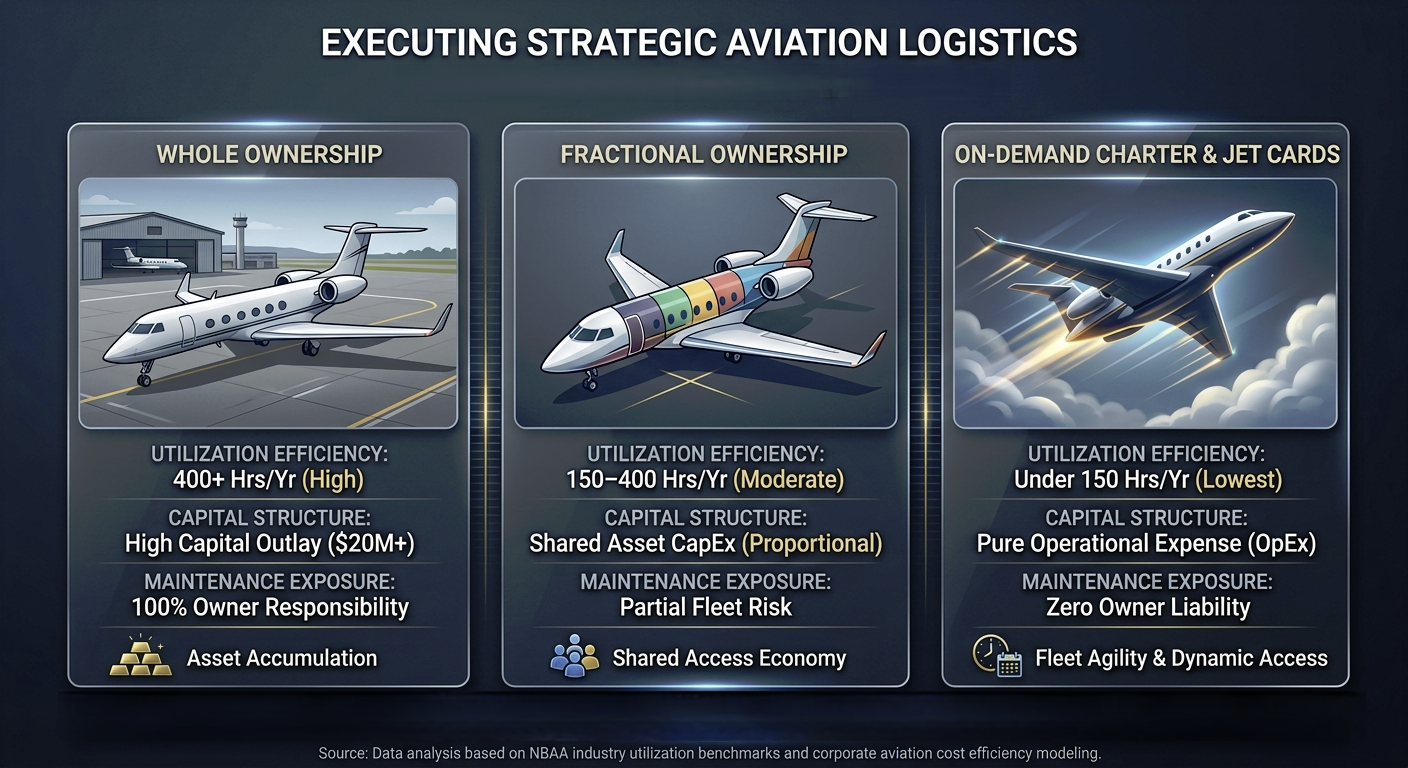
The math shifts dramatically when annual flight time hits a specific inflection threshold. According to Jettly, whole-aircraft ownership typically becomes cost-effective only when annual utilization approaches 300 to 400 flight hours. Elite athletes and C-suite executives logging under 200 hours per year, as is likely the case for Tom Brady, will find that sole ownership introduces structural operational inefficiency. The capital tied up in a sitting airframe can be far more effectively deployed into active growth investments.
Because Tom Brady’s private jet ownership status isn’t confirmed, and the tail number of the G550 he’s known to use regularly is also not a matter of public record, it’s hard to know how much he flies each year. That’s in contrast to other celebrities whose private jets are known, and whose aviation habits are much easier to track as a result.
High-profile executives and sports broadcasters, of which Brady is both, see private air travel as a mobile command center rather than a simple luxury. Extended flight windows can provide uninterrupted time for strategic work and game preparation, while during Brady’s playing career, he likely used this time for physical recovery as much as psychological rest.
Even standard configurations are engineered specifically to maximize onboard utility. Modern heavy-cabin jets routinely feature high-speed satellite connectivity, dedicated meeting zones, and custom quiet suites for recuperation mid-flight.
Meanwhile, eliminating commercial terminal delays saves hours during weekly travel rotations. Arriving at fixed-base operator terminals allows direct tarmac access, cutting transit times down to minutes. That saved time can be converted into increased preparation time for weekend broadcasts.
The broader business aviation industry continues shifting away from sole-owner models toward access-based solutions, and it’s likely that Brady is following this trend. Capital preservation, tax optimization, and fleet agility drive decision-making across corporate boards and family offices alike. Prioritizing on-demand flexibility lets high-frequency travelers maintain full control over their schedules and gain maximum mobility with zero long-term asset liability.
Share this post:
Jeff Ryan Serevilla
Sep 29, 2026
|
5
min read
Discover tips and trends in the industry.

5
min read
How Far Is Las Vegas to Arizona? Distance, Driving Times, and Scenic Private Jet Options
Traveling from Las Vegas to Arizona varies significantly based on your destination, with distances ranging from 35 miles to over 420 miles. Popular spots like the Grand Canyon and Hoover Dam are easily accessible, making for memorable day trips. Whether you choose to drive, take a guided tour, or fly privately, each option offers unique experiences and scenic views along the way.
Read More
5
min read
Jet It: What Happened, What It Means for Private Aviation, and Smarter Alternatives
Jet It, a fractional jet ownership company, ceased operations in mid-2023 due to financial and operational challenges, highlighting the risks of low-cost models in private aviation. Its collapse serves as a cautionary tale for potential buyers, emphasizing the importance of understanding costs and flexibility in private flight options. As a result, many customers are now turning to platforms like Jettly for more reliable and adaptable private aviation solutions.
Read MoreStay updated with our latest insights and tips to elevate your journey with us.
MEMBERSHIPS AND ASSOCIATIONS



Disclaimer: Jettly operates as a charter broker, offering access to a global digital jet charter marketplace. Jettly is not a direct air carrier and does not own or operate aircraft. All advertised flights are conducted by third-party air carriers that are fully licensed and hold the appropriate Part 135 or Part 121 certifications issued by the Federal Aviation Administration (FAA) or equivalent regulatory authorities under U.S. or foreign law. Jettly complies fully with the U.S. Department of Transportation's Part 295 and Part 298 Charter Broker regulations. Jettly does not carry additional liability insurance. Passengers are covered by aircraft operator insurance. TICO: 50023770


