


Login
Get Instant Pricing On 23,000+ Aircraft

>
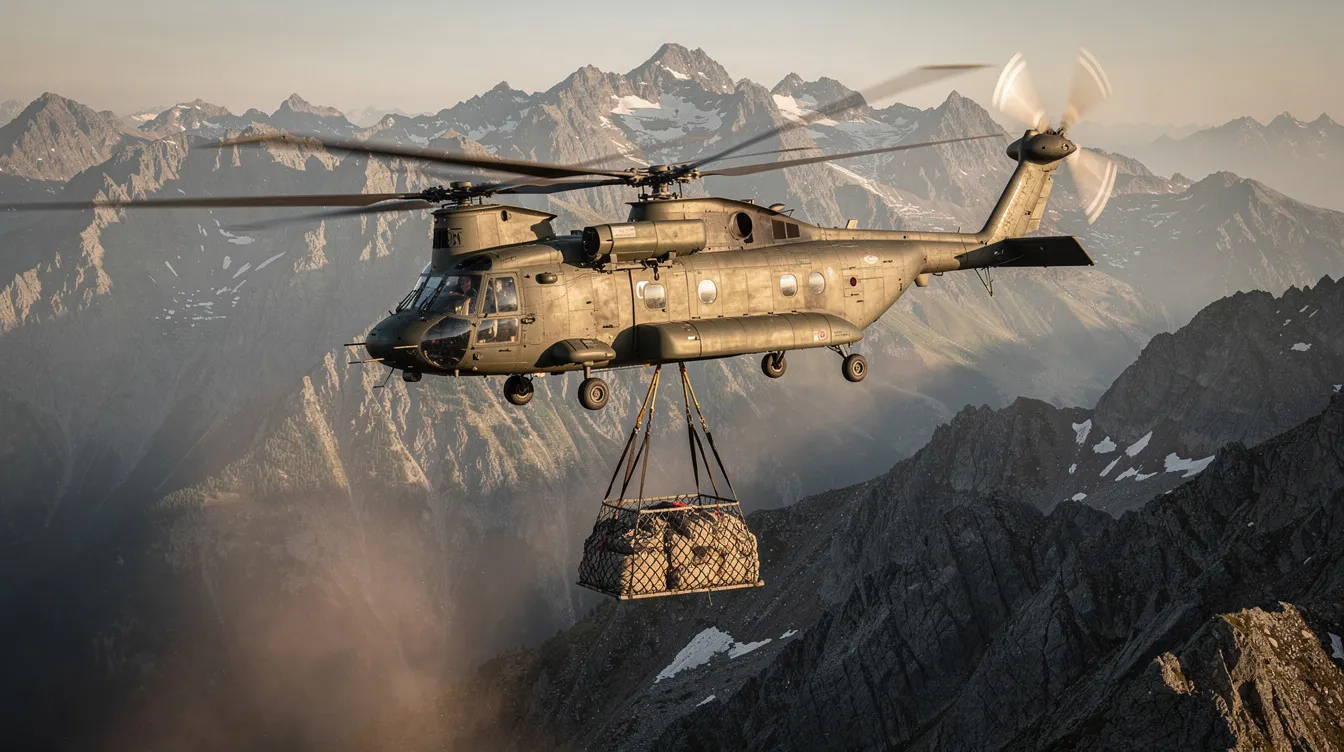
A transport helicopter bridges the gap between fixed-wing aircraft that need runways and ground vehicles stuck in traffic or blocked by terrain. From combat zones to offshore platforms and alpine resorts, these rotorcraft move people, cargo, and equipment to places that would otherwise be unreachable. This guide is intended for travelers, aviation enthusiasts, and professionals seeking to understand the roles and capabilities of transport helicopters. This guide breaks down the roles, types, and performance benchmarks of transport helicopters across military, humanitarian, and private aviation - and explains how charter travelers can put them to practical use.
Transport helicopters and utility helicopters give military forces, governments, and private operators the ability to move people and cargo directly to locations where runways do not exist, from combat zones to offshore platforms and mountain sites.
Iconic models such as the CH-47 Chinook, Mil Mi-26, Sikorsky CH-53K, and Sikorsky S-92 illustrate how different transport helicopters specialize in heavy lift, tactical deployment, or long-range crew transport.
Tiltrotor aircraft like the Bell Boeing V-22 Osprey and Leonardo AW609 offer higher cruise speeds than conventional rotorcraft, but at greater acquisition and operating cost and with more complex handling and infrastructure demands.
For private charter, transport-capable utility helicopters are often the most efficient way to access short hops, remote resorts, city centers, and yachts, and can be booked on-demand through a digital platform like Jettly.
When choosing between a military transport helicopter–derived platform, a civil utility helicopter, or a tiltrotor, mission profile, payload, range, landing environment, and budget should drive the decision - not just aircraft size or maximum speed.
Transport helicopters are rotorcraft featuring large cabins designed for carrying troops and cargo. Their high maneuverability allows them to operate in confined spaces, and they can take off and land vertically without the need for runways—capabilities that fixed-wing transports like the C-130 Hercules simply cannot match in confined or unprepared areas. This vertical takeoff and landing ability enables access to locations unreachable by traditional transportation methods, such as mountains, islands, dense urban rooftops, and remote areas.
In military operations, these aircraft transport troops and supplies to remote locations, perform casualty evacuation, and resupply forward bases in active combat zones. Military transport helicopters are essential for moving infantry and heavy equipment, with iconic models like the Boeing CH-47 Chinook excelling in cargo and troop transport. The history of air mobility stretches back to Vietnam, where the CH-47 Chinook and other platforms proved that helicopters could save lives and reshape battlefield logistics.
Civilian transport helicopters are used extensively for emergency medical services and disaster relief. During the 2010 Haiti earthquake, roughly 36 helicopters delivered food, water, medical aid, and personnel to communities cut off by destroyed roads. Transport helicopters also deliver humanitarian aid in disaster zones like the 2004 Indian Ocean tsunami and support search and rescue operations by extracting individuals from hazardous environments. They are vital for offshore oil crew transport in regions such as the North Sea and Gulf of Mexico. These helicopters can be reconfigured for multiple missions, including cargo transport and medical evacuations, making them versatile assets for civil operators.
For private aviation, many civil helicopters share DNA with military transport helicopter platforms. Charter platforms like Jettly connect travelers with rotorcraft for point-to-point access where jets cannot land, turning a rugged landing zone into a convenient stop, and private jet memberships extend that flexibility to fixed-wing segments of the trip.
Lift capacity alone does not make a great transport helicopter. Performance across varying conditions, reliability, and mission flexibility matter just as much.
Payload and cabin volume vary widely. Light helicopters carry 4–6 passengers. Medium platforms seat 10–15. Heavy lift helicopter models like the Boeing CH-47F Chinook handle around 7,250 kg internally in hot conditions, while the Sikorsky CH-53K King Stallion can carry a payload of around 16,300 kg (36,000 lb). The Mil Mi-26, the largest transport helicopter ever built, can lift up to 20 tonnes (44,000 lb) externally, with a cargo hold spacious enough to carry vehicles or generators. Transport helicopters feature large cabins designed for carrying troops and cargo, with cargo hold space that can accept palletized freight or stretcher configurations. The rotor configuration of transport helicopters contributes directly to their lifting power.
Range and endurance define how far an aircraft can fly on a single fuel load. The Boeing CH-47 Chinook has a maximum operational range of approximately 400 nautical miles, while the Airbus H225 Super Puma has a range of approximately 857 km. Lighter civil models like the H145 reach roughly 350 nautical miles, with endurance around 3.5 hours.
Hot and high performance is where many aircraft struggle. At altitude and in heat, air density drops and engines produce less power. The CH-53K was developed to sustain roughly 27,000 lb external loads at 3,000 ft and 95°F over a 110 nautical mile radius. The H145 has demonstrated safe operations above 20,000 ft in the Andes, retaining sufficient power even in one-engine-inoperative scenarios.
Avionics and safety systems on modern platforms include digital glass cockpits, 4-axis autopilots, IFR capability, de-icing systems, and health and usage monitoring systems (HUMS). These features improve safety during night flight and bad weather - demands that any serious operation must meet.
Transport helicopters span light, medium, and heavy categories. Each serves different tasks, and many platforms can be reconfigured for multiple missions such as cargo transport and medical evacuations.
Light utility helicopters (e.g., Airbus H125/AS350 B3, Bell 407, AW109): typically 4–7 seats, operated for air taxi, sightseeing, law enforcement, and light internal cargo to rooftops or remote pads.
Medium transport helicopters (e.g., Bell 412, Leonardo AW139, Airbus H175): 10–15 passengers, popular for offshore energy crew transport, corporate shuttle service, and SAR missions. They balance comfort, range, and cost. The Airbus H225 Super Puma, with a range of approximately 857 km, is a leading model in this category.
Heavy lift and military transport helicopter platforms (e.g., Boeing CH-47F Chinook, Sikorsky CH-53E/CH-53K, Mil Mi-17): 20–50 troop capacity, underslung load capability, and the ability to support armored vehicles and heavy equipment. The Boeing CH-47 Chinook can carry up to 26,000 lb externally. Military transport helicopters like the Sikorsky UH-60 Black Hawk, which can carry approximately 4,000 kg internally, are widely used globally for transport.
Multirole utility helicopters (UH-60 Black Hawk, AW149): the Sikorsky UH-60 Black Hawk can be rapidly reconfigured for troop transport, medevac, or VIP missions.
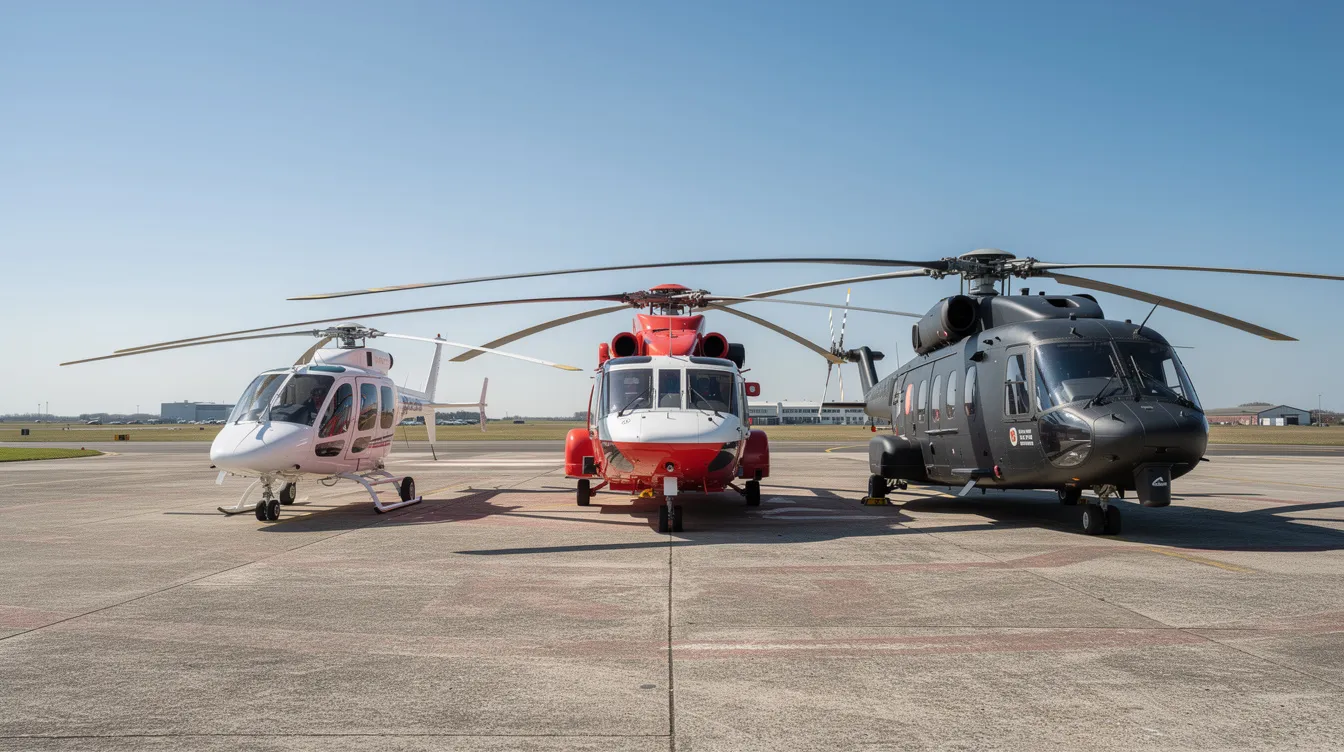
Civil operators adapt these platforms with executive interiors, noise-reduction kits, and enhanced safety equipment for private charter. For helicopter passenger capacity guidance on matching a model to your group size, Jettly's platform lists cabin layouts so travelers know what to expect on board and resources like helicopter passenger capacity types and limits can help frame expectations.
Many of today's transport helicopter designs were proven in military service before influencing civil aviation fleets. There are 136 transport helicopter entries listed in the Military Factory database, reflecting the versatility and global demand for these machines throughout history.
Boeing CH-47 Chinook. First flown in 1961, this Boeing-built model from the American manufacturer entered U.S. Army service in 1962. Its tandem-rotor design, powered by a pair of engines, gives it exceptional lift and stability. The CH-47F variant carries a payload of roughly 10–12 tons and has served in Vietnam, Afghanistan, Iraq, and dozens of humanitarian missions worldwide. Boeing continues production of the platform, and it remains a backbone of NATO and allied air mobility doctrine.
Sikorsky CH-53 family. The CH-53E Super Stallion was introduced in 1981. Its successor, the CH-53K King Stallion, reached initial operational capability with the USMC in the mid-2020s. The Sikorsky CH-53K King Stallion can carry 36,000 pounds on its center hook, making it the most capable heavy lift helicopter in the Western world. Its engines produce roughly 57% more power than the CH-53E with fewer parts, a leap in development and efficiency.
Mil Mi-26. Introduced in 1983 by the Soviet Union, the Mil Mi-26 was developed by the Mil design bureau, the original manufacturer behind the largest series-production helicopter ever built. The Mil Mi-26 can lift up to 20 tonnes (44,000 lb) externally, and its cargo hold can accept vehicles, generators, and even downed aircraft. It has been operated by military forces in Russia, China, India, and several UN missions. Its fuselage length exceeds 33 meters.
Legacy models like the Boeing Vertol CH-46 Sea Knight and the Aérospatiale SA 321 Super Frelon served in naval operations and early offshore work across Europe and Asia, proving that rotorcraft could support infrastructure development and combat logistics simultaneously.
Rather than naming a single "best" military transport helicopter, the table below groups ten standout models by what they do best.
|
Model |
Category |
Payload / Capacity |
Range |
Key Strength |
|---|---|---|---|---|
|
Mil Mi-26 |
Heavy lift |
20,000 kg external |
~430 NM |
Record payload for any production helicopter |
|
Sikorsky CH-53K |
Heavy lift |
16,300 kg / 36,000 lb external |
110 NM tactical radius |
Modern Western heavy lifter with fly-by-wire |
|
Boeing CH-47F |
Heavy lift |
~7,250 kg internal (hot/high) |
400 NM |
Balanced lift, range, and proven global service |
|
Mil Mi-6 |
Heavy lift (legacy) |
~12,000 kg |
~300 NM |
First Soviet heavy transport, paved the way for Mi-26 |
|
Sikorsky S-92 |
Offshore / SAR |
19 pax |
~450 NM |
Gold standard for offshore crew change |
|
Airbus H225 Super Puma |
Offshore / SAR |
19–24 pax |
~857 km |
All-weather, de-icing certified, 1M+ fleet flight hours |
|
Leonardo AW189 |
Medium multirole |
16–19 pax |
~460 NM |
Long range for offshore and SAR |
|
Bell 412EPI |
Medium utility |
13 pax |
~350 NM |
Versatility across military and civil roles |
|
Airbus H145 |
Light transport |
8–10 pax |
~350 NM |
HEMS, police, VIP shuttle; capable at extreme altitude |
|
Bell 407GXi |
Light utility |
6 pax |
~330 NM |
Light tactical, air taxi, low operating cost |
Selection criteria include real-world operational record, safety statistics, versatility across passenger/cargo/SAR missions, maintainability, and fleet adoption by multiple nations or large corporate operators.
When browsing helicopter charter options on Jettly, think in similar terms: focus on mission fit - distance, landing site, headcount - rather than brand name alone, and consult a detailed overview of helicopter rental costs and pricing so budget aligns with your mission profile.
Aircraft choice should start with mission requirements, not a particular model. Key planning questions include:
How many personnel and how much baggage or equipment?
What is the route distance?
Is the landing zone paved, unpaved, a rooftop, or a ship deck?
What are the expected weather and altitude conditions?
Trade-offs matter. Executive interiors add comfort but reduce usable space compared to high-density or cargo-ready cabins with tie-down points and large sliding doors. Offshore platforms demand strict safety standards met by models like the S-92 and H225. Mountainous terrain needs strong power margins - an area where the H125 and UH-60 class excel.
On helicopter rental cost, hourly rates scale sharply from light to heavy. Repositioning and stand-by time affect totals, and booking more capacity than needed can be inefficient for short hops. A digital marketplace like Jettly simplifies this selection with filters for range, seats, and instant charter cost estimates from safety-vetted operators.
Tiltrotor aircraft feature rotors that pivot from vertical (helicopter mode) to horizontal (fixed-wing mode) for higher cruise speed. The Bell Boeing V-22 Osprey cruises at around 250 knots, and the Leonardo AW609 - a civil project nearing certification - targets about 275 knots with a range exceeding 750 NM. Conventional transport helicopters typically cruise at 120–160 knots, and pairing them with tools like an airport locator for remote and city fields helps plan realistic routes and connections.
The trade-off is cost and complexity. Tiltrotors require more involved pilot training, higher acquisition prices, and different support infrastructure. Traditional transport helicopters still dominate most military and civil missions because of simpler logistics, proven safety records, load-handling flexibility with slung loads, and lower cost per flying hour.
Looking ahead, the U.S. Army's Future Long-Range Assault Aircraft program and other development efforts may bring more tiltrotor and compound helicopter designs into service by the early 2030s. As these categories enter the market, digital platforms will be key to comparing them with conventional helicopters and jets on price, speed, and routing flexibility, much like existing guides that explain affordable aeroplane rental costs and options do for fixed-wing aircraft today.
Transport helicopters routinely operate at low altitude, in variable weather, and at confined landing sites. Structured safety practices are not optional - they are the baseline.
Modern avionics mitigate weather risks like low visibility, icing, and brownout from rotor wash. Certified military and civil transport helicopters must meet stringent standards from authorities such as the FAA and EASA, including capability to manage lightning strikes and turbulence.
For passengers boarding a charter flight, basic ground procedures matter: approach from the front or side, secure loose items, stay clear of the tail rotor, and listen to crew briefings. Behind the scenes, crew training through Crew Resource Management (CRM) and scheduled maintenance based on flight hours and cycles keep operations safe, whether flying dedicated rotorcraft or private charter aircraft across Jettly's fleet.
Jettly works with licensed operators that comply with national regulations (e.g., Part 135 in the U.S., Part 703/704 in Canada). Customers can ask for operator certifications and safety records before booking any helicopter ride, just as they would when choosing a private jet operator through Jettly.
Jettly's inventory includes both fixed-wing aircraft and helicopters, letting travelers match the right aircraft to each leg of a trip. Typical charter use cases include short city-to-city hops (Manhattan to the Hamptons), airport-to-resort transfers (Geneva to Alpine ski resorts), and last-mile connections from major airports to yachts or private estates. Transport helicopters can deliver supplies, medical aid, and personnel in remote areas - and the same capability serves leisure travelers heading to places without airstrips, fitting into the broader landscape of private and charter airlines for bespoke flights.
Helicopters often complement private jets rather than replace them. Jets handle longer segments (Toronto to New York), while a utility helicopter covers the final 50–150 km over congested roads or water. The result: time savings, predictable pricing via instant quotes, and access to thousands of vetted aircraft and operators globally, supported by resources that explain how Jettly offers affordable private jet charter.
Jettly offers both membership and on-demand access, with cost transparency and no traditional jet card liabilities - flexibility that works for occasional or frequent helicopter users alike, and readers curious about structured solutions can explore world-class jet card programs and learn what a jet card is, its costs, and benefits.
Ready to experience private travel on your terms? Explore flight options or request a quote at https://www.jettly.com, compare Jettly as a NetJets alternative for private flying, or dive deeper into how much a private jet really costs when pairing jets with helicopter segments.
These FAQs address practical questions that travelers and aviation enthusiasts often ask but that the main sections above did not cover in depth, complementing more specialized resources such as detailed guides to jet card costs and pricing structures.
Typical civil utility helicopters have ranges between 200 and 400 nautical miles, while larger models like the S-92 or Airbus H225 Super Puma can exceed 450 nautical miles with standard fuel. The Airbus H225 Super Puma has a range of around 857 km. Actual usable range depends on payload, reserve fuel requirements, wind, and routing, so charter operators calculate conservative planning distances for each mission, much as they do when explaining one private jet flight cost and its components.
Many modern transport helicopters are certified for instrument flight rules (IFR) and night operations, using advanced avionics, autopilots, and published approach procedures. Whether a specific flight can depart at night or in poor visibility depends on the aircraft's equipment, crew qualifications, and the regulations governing the operator's certificate.
The underlying airframe can be identical. A utility helicopter is configured for flexible cargo or high-density seating, while a VIP helicopter has upgraded interiors, soundproofing, and amenities such as club seating and worktables. Many platforms can be reconfigured between roles, and charter brokers like Jettly list cabin layouts so customers know what to expect on board.
Light helicopters usually seat 4–6 passengers, medium platforms 8–12, and larger transport-derived helicopters 15 or more - though charter demand above 12 seats is relatively rare in the private market. Maximum seating may be reduced for comfort, baggage needs, or range requirements, and actual limits are set by the operator's configuration and weight-and-balance calculations. For a deeper look, see Jettly's guide on how many seats are in a helicopter, and compare this with strategies for getting a seat on a private jet easily if your trip combines rotorcraft and fixed-wing legs.
Helicopters generally burn more fuel per passenger-mile than modern airliners but can be more efficient than long car journeys when they avoid traffic and follow direct routes over short distances. Some operators and platforms available via Jettly offer carbon offset programs, crowdsourced private jet flights and shared empty seats, and route optimization to reduce total environmental impact for multi-leg trips.
Transport helicopters play a crucial role in modern aviation by providing versatile, reliable access to locations unreachable by fixed-wing aircraft or ground vehicles. From heavy-lift military operations and emergency disaster relief to offshore crew transport and private charter, these rotorcraft offer unique capabilities that save time and expand travel options. Models like the Mil Mi-26, Boeing CH-47 Chinook, and Sikorsky CH-53K demonstrate the range of performance and mission adaptability available today. For travelers seeking flexible, efficient point-to-point access, chartering transport-capable helicopters through platforms like Jettly offers a practical solution. Whether for business, leisure, or emergency needs, transport helicopters remain a crucial asset in connecting people and cargo to the places that matter most.
Ready to experience private travel on your terms? Explore flight options or request a quote at https://www.jettly.com.
Share this post:
Jay Franco Serevilla
Jul 25, 2026
|
5
min read
Discover tips and trends in the industry.
5
min read
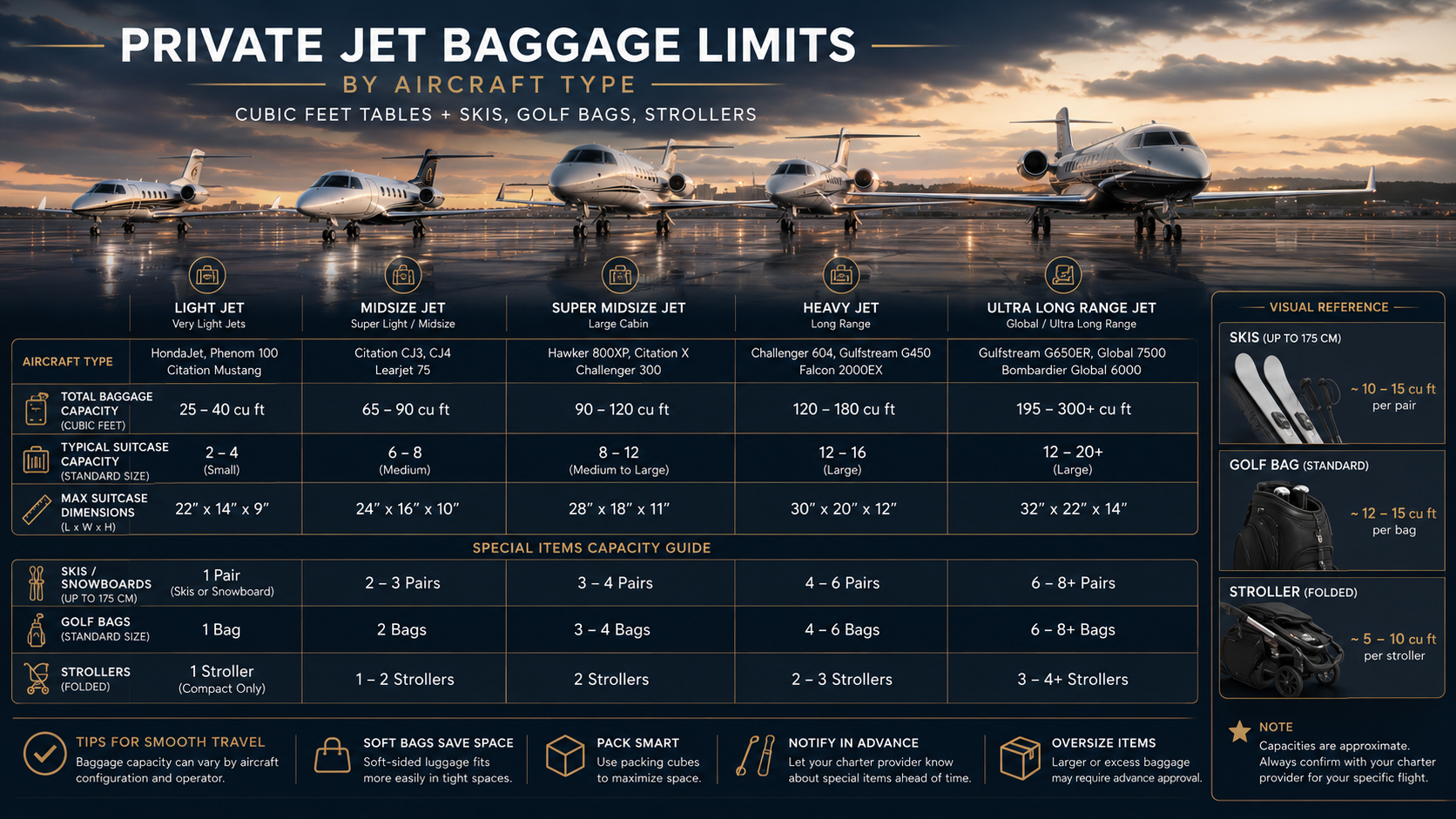
Private Jet Baggage Limits by Aircraft Type (Cubic Feet Tables + Skis, Golf Bags, Strollers)
Understanding private jet baggage limits is crucial for travelers. Unlike commercial airlines, private jets have unique restrictions based on aircraft type, baggage volume, and door geometry. This guide provides essential insights into luggage capacity, especially for bulky items like skis and golf bags, ensuring a smooth travel experience.
Read More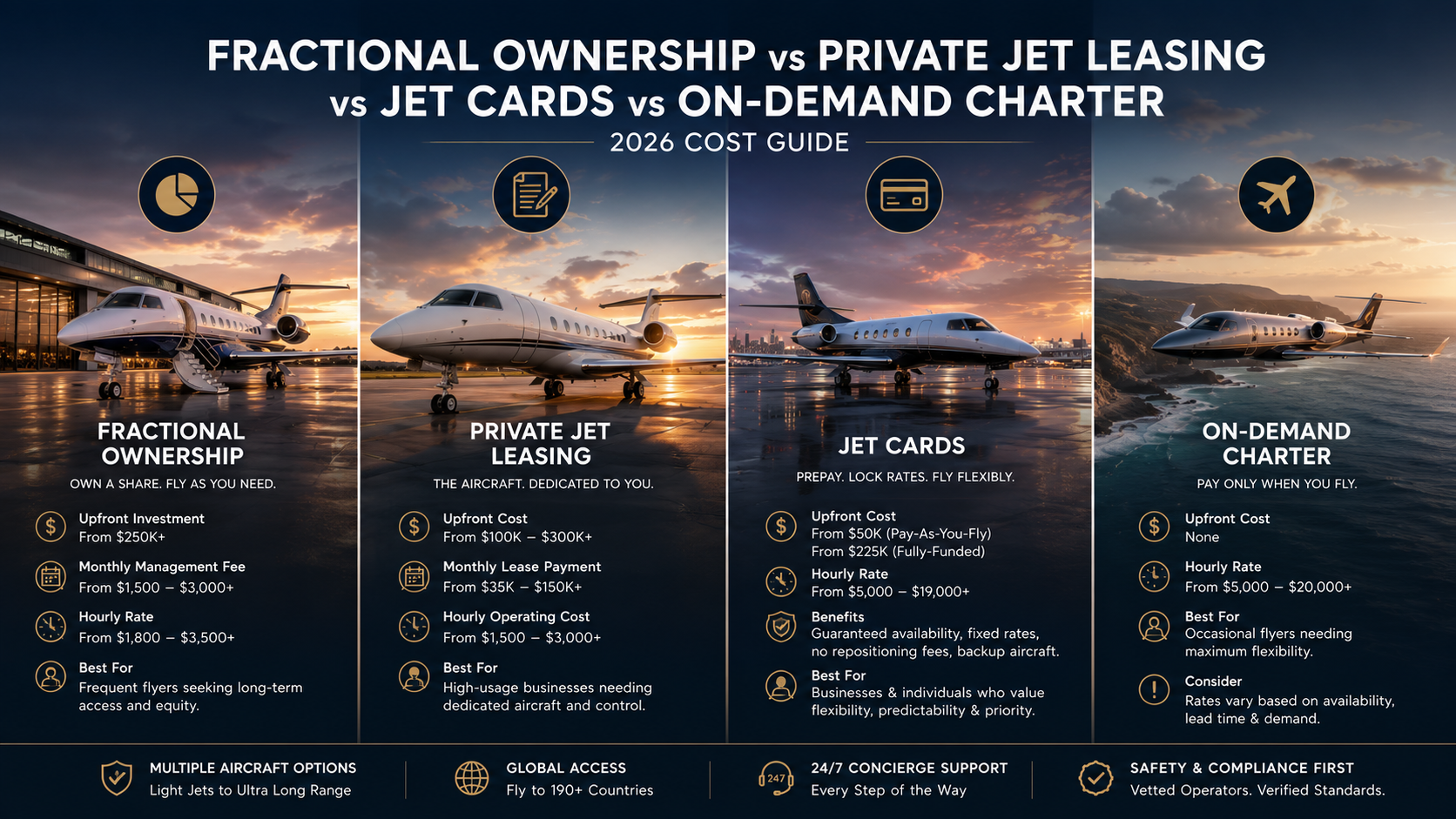
5
min read
Fractional Ownership vs Private Jet Leasing vs Jet Cards vs On-Demand Charter (2026 Cost Guide)
Navigating private jet access models can be complex, with options like fractional ownership, leasing, jet cards, and on-demand charter each offering unique pricing structures. Understanding these models is crucial for making informed decisions based on your flying habits and financial commitments. This guide breaks down the costs and benefits of each option, helping you choose the best fit for your travel needs.
Read MoreStay updated with our latest insights and tips to elevate your journey with us.
MEMBERSHIPS AND ASSOCIATIONS



Disclaimer: Jettly operates as a charter broker, offering access to a global digital jet charter marketplace. Jettly is not a direct air carrier and does not own or operate aircraft. All advertised flights are conducted by third-party air carriers that are fully licensed and hold the appropriate Part 135 or Part 121 certifications issued by the Federal Aviation Administration (FAA) or equivalent regulatory authorities under U.S. or foreign law. Jettly complies fully with the U.S. Department of Transportation's Part 295 and Part 298 Charter Broker regulations. Jettly does not carry additional liability insurance. Passengers are covered by aircraft operator insurance. TICO: 50023770


