



Login
Get Instant Pricing On 23,000+ Aircraft

>
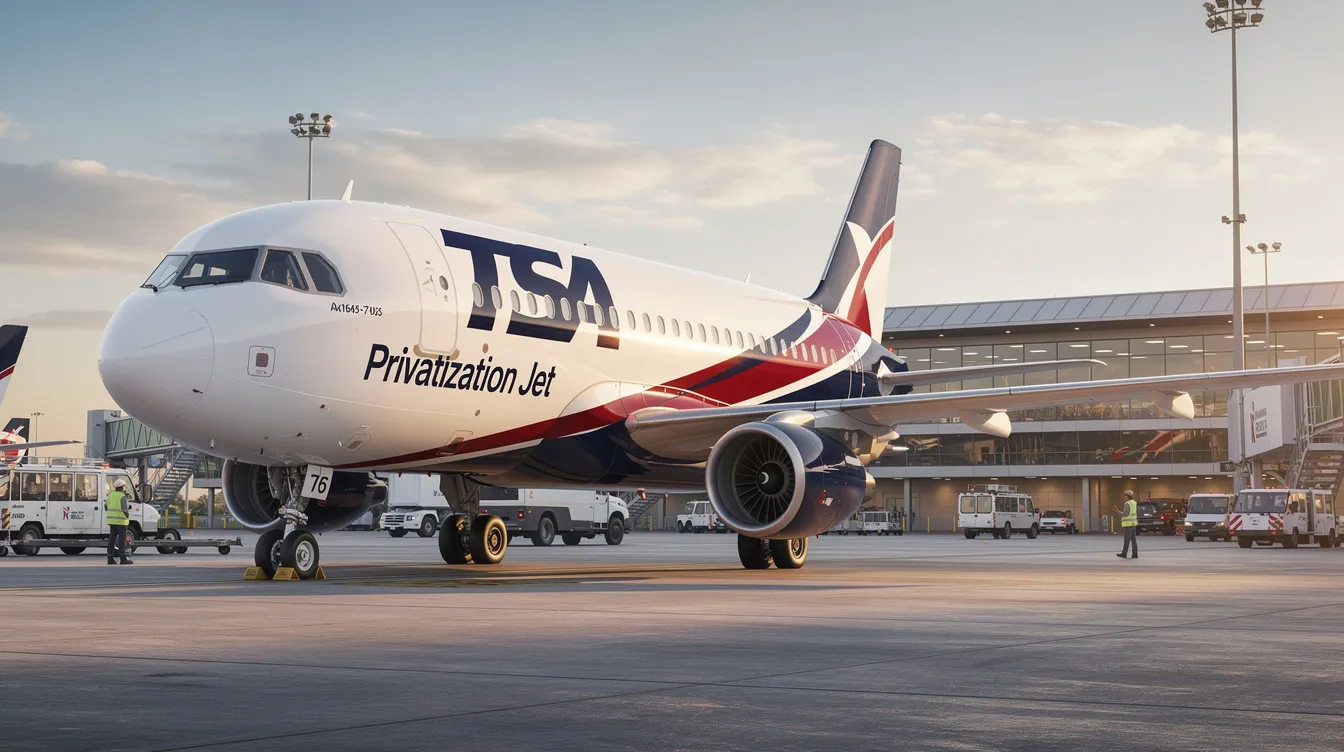
The debate around TSA privatization is heating up again. As the federal government weighs expanding contractor-run checkpoints to hundreds of airports, the implications for travelers, TSA employees, and the broader aviation screening security system are significant.
This guide is for travelers, airport employees, and private flyers who want to understand how TSA privatization could affect their airport experience, job security, or travel choices. Whether you’re a frequent flyer frustrated by long lines, an airport worker concerned about job stability, or a private flyer seeking alternatives, understanding the changes in airport security is crucial. Here is what you need to know about the Screening Partnership Program, the newer TSA Gold and Gold+ proposals, and why some flyers are skipping the conversation entirely by going private.
TSA privatization does not remove federal oversight. Private contractors must follow TSA security standards and training, use approved equipment, and submit to regular audits. The TSA oversees private contractors to ensure security standards remain consistent.
The Trump administration's privatization push includes budget proposals to expand contractor-run screening at roughly 220 non-hub airports, potentially cutting more than 4,000 TSA agent positions.
Privatized airport screening at SPP airports like San Francisco International Airport has shown shorter wait times, but critics warn of inconsistent quality and labor impacts on TSA workers.
Private aviation offers an alternative that bypasses traditional airport security altogether. Platforms like Jettly let travelers depart from private terminals with streamlined security processes.
Growing frustration with unpredictable checkpoint experiences is driving interest in private jet charter as a practical workaround, regardless of whether screeners are government employees or private staff.
The Transportation Security Administration, commonly known as the TSA, runs airport security at roughly 430 commercial airports across the United States. But a subset of those airports have opted to privatize airport security under federal oversight through TSA's Screening Partnership Program (SPP).
TSA privatization refers to the process where private companies, rather than federal employees, staff airport security checkpoints under TSA oversight. TSA privatization means private companies staff the checkpoints instead of federal government employees. However, these private contractors still follow the same screening process, use the same scanning equipment, and operate under the same security standards set by TSA. Privatization allows airports to hire contractors for security screenings while TSA retains regulatory control.
At major hubs like Atlanta, Los Angeles, and Chicago O'Hare, government employees handle security screening at every lane. About 20 airports, including San Francisco International Airport and Kansas City International Airport, already use private screening firms. These programs coexist with a broader trend of travelers seeking alternatives to traditional checkpoint congestion, including private jet charter platforms like Jettly.
Before the September 11 attacks, airlines hired low-bid private companies to handle airport screening. Training was inconsistent, oversight was minimal, and the system had well-documented gaps. The deadly consequences of that era, including vulnerabilities exploited in the Pan Am Flight 103 bombing and the 9/11 hijackings, exposed how the pre-existing model failed the flying public.
In November 2001, Congress created the TSA through the Aviation and Transportation Security Act. By 2003, most airport screening roles shifted to government employees under the new agency, which also fell under the Department of Homeland Security. The Bush administration oversaw this federalization, but the same law preserved a path for select contractors to operate under federal supervision, laying the groundwork for today's Screening Partnership Program.
Since then, rising security complexity, longer queues, and frequent disruptions have pushed many time-sensitive travelers toward private aviation, where airport security is handled in smaller, controlled facilities managed by fixed-base operators and a wider range of smaller regional and private airports.
The Screening Partnership Program lets local airport authorities apply to replace TSA officers at checkpoints with private screening companies. TSA evaluates each application based on cost, security effectiveness, and impact on the traveling public before approving an SPP contract, similar to how Part 135 charter companies operate under dedicated regulatory frameworks.
Current SPP airports include San Francisco (SFO), Kansas City (MCI), Orlando Sanford International Airport (SFB), Jackson Hole (JAC), and Key West (EYW), among others. At these locations, private contractors must use TSA-approved screening procedures, background checks, and training programs. Many contractors recruit existing TSA workers to join their teams, easing the transition.
Benefits reported at SPP airports include:
Private contractors can adjust staffing levels dynamically based on passenger volume.
Competition among contractors could encourage efficiency and better customer service.
Private screening firms compete on performance and can drive efficiency improvements.
Privatization may enhance flexibility in airport operations and management.
At Punta Gorda Airport, peak wait times dropped from 45 minutes to under 10 minutes after adopting private screening. Expectations of privatization include improved checkpoint throughput and customer experience. However, concerns remain about oversight during contract changes, profit motives, and the risk that underperformance by private contractors complicates accountability in security operations.

TSA Gold and Gold+ refer to newer privatization concepts that go beyond the standard Screening Partnership Program. The Gold+ program aims to increase airport security efficiency by giving airports control over both personnel and screening technology.
Under Gold+, private contractors would not only staff checkpoints but also select, purchase, and maintain screening technology. This is a major departure from SPP, where TSA generally controls equipment and software. The Gold+ contract solicitation carries a $12.9 billion ceiling over ten years, covering new technology deployment, cybersecurity, and operations management.
Three airports are slated as early adopters: Des Moines (January 2027), Charleston (February 2027), and Tampa International Airport targets May 2027 for Gold+ program implementation. However, Tampa has reportedly expressed reservations about finalizing participation, and timelines may shift.
Key criticisms include:
Concerns exist that profit-driven motives may compromise security through cost-cutting.
Privatization raises concerns regarding accountability and oversight in airport security.
Critics argue privatizing airport security may introduce inconsistent standards across airports.
Outsourcing technology decisions to for-profit firms could create conflicts between vendor relationships and national security priorities.
The Federal Aviation Administration continues to regulate airspace and aircraft safety separately, but the overlap between aviation security and new contractor responsibilities under Gold+ has drawn scrutiny from Congress and the American Federation of Government Employees.
The privatization push intensified under the Trump administration, which favored outsourcing across multiple federal agencies. TSA plans to privatize security at 220 out of 440 commercial airports, focusing primarily on small and non-hub airports. TSA requested $477 million to expand privatization efforts in fiscal year 2027.
Budget documents project that privatization could save TSA $52 million by cutting 4,000 positions. The White House framed these moves as a way to gain operational flexibility, reduce the federal payroll, and redirect funds toward new technology and data systems.
The American Federation of Government Employees, led by national president Everett Kelley, pushed back forcefully. AFGE represents roughly 47,000 TSA agents across 400-plus airports and warned that the privatization push represents a step backward for aviation security. Union leaders argued behind closed doors and in public hearings that the program could have devastating and deadly consequences if contractors underinvest in staff or training. Some lawmakers echoed these concerns, citing the New York Times and other outlets reporting on potential labor and safety risks.
While privatization debates follow political cycles, the underlying drivers—budget pressures, growing passenger volumes, and evolving threats—continue regardless of which party controls Congress or the agency.
At SPP airports like San Francisco International Airport, most passengers report little visible difference at the checkpoint. Uniforms, signs, and the screening process look similar because contractors follow TSA standards.
However, privatization may lead to varied security processes across airports. Inconsistent quality in service might result from varying levels of oversight among private contractors. Practical differences can emerge in staffing levels, customer service culture, and queue management from one privatized international airport to another.
For TSA workers, the transition from federal to private screening can disrupt existing staffing structures. Private security contractors often offer lower wages and fewer benefits than federal employees. High employee turnover rates can result from privatization in airport security operations. Privatization could negatively impact labor rights and employee morale in security roles, according to the federation of government employees.
One clear advantage: airports using private contractors saw shorter wait times during government shutdowns. During a partial shutdown, federally employed TSA agents at non-SPP airports faced unpaid work and higher absenteeism, while contractor-run checkpoints maintained normal operations.
For the private sector alternative, charter customers using platforms like Jettly depart from FBOs or private terminals where security involves manifest checks, ID verification, and controlled facility access. As detailed in Jettly's guide explaining whether private jets go through TSA, this process is faster and more discreet than any commercial checkpoint. While TSA privatization tweaks the commercial experience, private aviation effectively bypasses standard TSA lines entirely—a major reason time-sensitive executives and families choose charter.
|
Aspect |
Federal TSA Screening |
Screening Partnership Program (SPP) |
TSA Gold+ Program |
|---|---|---|---|
|
Staffing |
Federal government employees |
Private contractors under TSA oversight |
Private contractors with control over tech |
|
Equipment |
TSA-provided and controlled |
TSA-provided and controlled |
Airport-selected and maintained by contractor |
|
Oversight |
TSA direct oversight |
TSA oversight with contractor accountability |
TSA oversight with expanded contractor responsibilities |
|
Training |
TSA standard training |
Same TSA training for contractors |
Same TSA training for contractors |
|
Customer Experience |
Standardized across airports |
May vary by contractor and airport |
Potentially more variation due to tech choices |
|
Wait Times |
Variable, sometimes longer |
Often shorter, especially during shutdowns |
Expected improvement with new tech and staffing |
|
Cost to TSA |
Salaries and benefits for TSA staff |
Contract payments to private firms |
Larger contracts, including tech investments |

Debates over whether to privatize airport security reflect broader questions about how to balance safety, cost, passenger experience, and workforce stability. Even with expanded privatization—whether via SPP or new TSA Gold+ models—commercial airport screening will still involve queues, random checks, and standardized rules for millions of passengers daily.
Private jet charter offers a fundamentally different model. Platforms like Jettly allow travelers to arrive closer to departure time, avoid checkpoint congestion, and move through smaller airport environments while still complying with security regulations, and tools like Jettly’s private jet charter cost estimator help travelers budget those trips. The TSA administrator may reshape how the flying public experiences commercial airports, but private aviation sidesteps that equation.
Typical use cases where private aviation outperforms any version of TSA-run or privatized airport screening include:
Last-minute business meetings between New York and Toronto, or other international private jet itineraries.
Family trips from Los Angeles to Cabo via multi-city itineraries, where a mix of shared charter flights and full charters can balance comfort and cost.
Medical or emergency travel where every minute at the airport matters, especially when weighing jet rentals versus first-class tickets for urgent corporate trips.
Dallas Fort Worth to destinations with limited commercial options, where understanding the best private jet charter companies and their service models helps travelers compare options.
Ready to skip the checkpoint debate? Explore instant pricing and flight options at Jettly, and consult a broader guide to private and charter airlines to understand how charter fits into the aviation landscape.
Yes. Under the Screening Partnership Program and proposed Gold+ concepts, all contractors must follow TSA security directives, training standards, and screening protocols. TSA conducts regular audits and oversight at every privatized checkpoint. Private screeners cannot relax federal rules on prohibited items, identity checks, or random screenings, even if their employer badges differ from standard TSA officers.
For most passengers, the experience at a privatized checkpoint looks nearly identical—same lanes, scanners, and general procedures. Possible differences include customer service style, staffing levels, and wait-time management. Signage might reference the contractor, but boarding passes, ID checks, and baggage rules remain aligned with TSA standards set for airlines and passengers nationwide.
Most private jet departures from FBOs do not use standard TSA lanes. Security requirements still apply, including passenger manifest checks, ID verification, and controlled access to aircraft. For the vast majority of charter trips booked through platforms like Jettly, travelers benefit from a faster, more discreet security process, even as they weigh how much a private jet really costs. Learn more in Jettly's guide on how to book a private jet.
Available public studies and government audits generally show comparable security performance when contractors are closely overseen by TSA. Safety depends more on the strength of federal rules, technology investment, and ongoing oversight than on whether screeners are government employees or private staff.
Private jet charter makes the most sense for time-critical business trips, multi-city itineraries, routes with limited commercial options, or when travelers want to avoid unpredictable TSA or privatized airport screening lines. Compare total door-to-door time, schedule flexibility, and privacy needs, and use resources that explain how to find affordable private jet charter options. Explore instant pricing on Jettly when commercial airport security becomes a bottleneck.

TSA privatization represents a significant shift in how airport security is managed across the United States. While private contractors bring flexibility, potential efficiency improvements, and shorter wait times—especially during government disruptions—concerns about accountability, consistent security standards, and labor impacts remain. For travelers, the difference at checkpoints may be subtle, but the broader implications affect workforce stability and the overall passenger experience.
For those seeking to bypass the uncertainties of TSA screening—whether federal or privatized—private aviation offers a compelling alternative. Platforms like Jettly provide seamless access to private jet charters, enabling travelers to avoid traditional airport security lines altogether. By departing from private terminals with streamlined security processes, flyers save time and enjoy greater convenience on business or leisure trips. Learn more about how to book a private jet and explore private jet charter costs to plan your trip.
As the TSA continues to explore new privatization programs like Gold+, the future of airport security will likely involve a mix of federal oversight and private sector innovation. Meanwhile, private jet charter remains a reliable option for travelers prioritizing flexibility, speed, and comfort. Discover the best private jet charter companies and understand how private jets handle international flights to maximize your travel experience.
Ready to experience private travel on your terms? Explore flight options or request a quote at https://jettly.com/.
Share this post:
Jay Franco Serevilla
Sep 6, 2026
|
5
min read
Discover tips and trends in the industry.

5
min read
Delta Food Menu: What to Expect on Delta Flights vs. Private Jet Dining
Delta's food menu varies by cabin class, route, and season, offering everything from snacks on short domestic flights to gourmet meals in Delta One. In contrast, private jet dining through Jettly provides fully customized meal options tailored to individual preferences and dietary needs. This guide compares the dining experiences on Delta flights with the flexibility of private jet catering.
Read More
5
min read
Private Jet Manchester: Charter Guide to MAN & Liverpool John Lennon
This guide provides essential information for chartering private jets from Manchester and Liverpool John Lennon airports. It covers airport details, costs, aircraft options, and the convenience of using Jettly's platform for seamless booking. Whether for business or leisure, private jet travel offers unmatched flexibility and luxury.
Read MoreStay updated with our latest insights and tips to elevate your journey with us.
MEMBERSHIPS AND ASSOCIATIONS



Disclaimer: Jettly operates as a charter broker, offering access to a global digital jet charter marketplace. Jettly is not a direct air carrier and does not own or operate aircraft. All advertised flights are conducted by third-party air carriers that are fully licensed and hold the appropriate Part 135 or Part 121 certifications issued by the Federal Aviation Administration (FAA) or equivalent regulatory authorities under U.S. or foreign law. Jettly complies fully with the U.S. Department of Transportation's Part 295 and Part 298 Charter Broker regulations. Jettly does not carry additional liability insurance. Passengers are covered by aircraft operator insurance. TICO: 50023770


