



Login
Get Instant Pricing On 23,000+ Aircraft

>
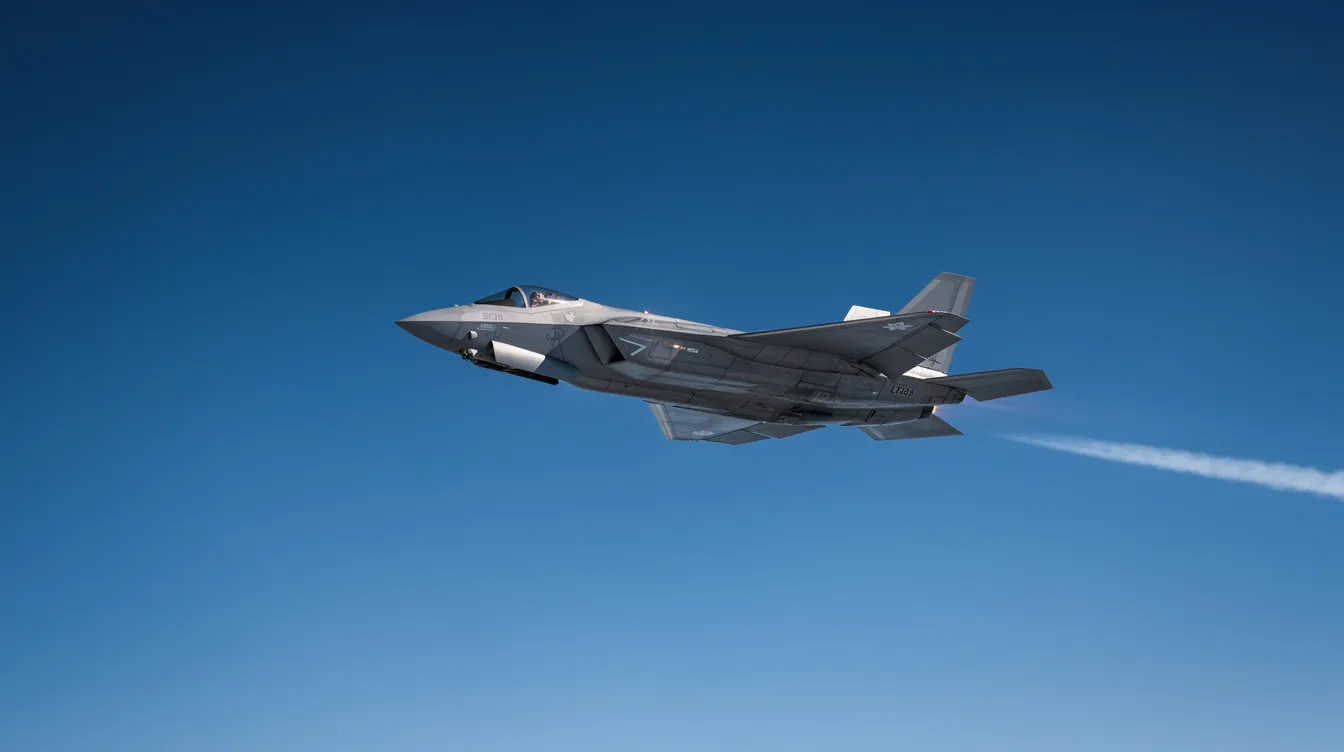
US fighter aircraft have evolved through five distinct generations since 1945, progressing from subsonic early jets to today's F-35 stealth fighter and upcoming sixth-generation concepts like NGAD and F/A-XX.
The F-22 and F-35 (including the F-35B and F-35C variants) serve as current front-line platforms for the Air Force, Navy, and Marine Corps, combining stealth, electronic warfare, sensor fusion, and networked data-sharing capabilities to underpin air superiority and global security.
More than 1,150 F-35 aircraft are currently in service, with twenty nations expected to operate the type, making it one of the most significant defense programs in history.
Fighter jet programs drive economic growth across dozens of US states, supporting hundreds of thousands of high-tech jobs and generating spin-off technologies that benefit civilian aviation and platforms like Jettly.
Next-generation programs emphasize manned-unmanned teaming and advanced electronic warfare, aiming to field new air dominance systems by the early-to-mid 2030s.
The US fighter jet has been central to American military strategy for over eight decades. From Cold War standoffs to operations in the Indo-Pacific, fighter aircraft provide the air superiority, deterrence, and rapid-response capability that underpin global security. The United States military operates a specialized fleet of fighter jets designed for air superiority across every branch-the Air Force, Navy, and Marine Corps each rely on these platforms to project power around the world.
Modern fighters do far more than dogfight. They combine stealth, advanced sensors, electronic warfare suites, and secure networking to control the battlespace across air, land, sea, space, and cyber domains, just as modern charter platforms rely on precise airport locator tools to optimize routes and operations. Advanced aircraft like the F-35 operate as high-tech information nodes sharing tactical data with allies in real time.
These capabilities don't exist in a vacuum. Military aviation accelerates innovation in civil flight-safety systems, avionics, composite materials, and operational concepts developed for fighters eventually reach commercial and private aircraft. Platforms like Jettly, which connects travelers with modern charter aircraft, benefit indirectly from decades of defense-driven research. The sections below trace how US fighters evolved, what they can do today, and where the technology is headed next.
U.S. military fighter jets are categorized by generation, design philosophy, and core operational roles. Since 1945, the US has operated 47 major fighter types, each reflecting the threats and technologies of its era. Fighter designations generally follow specific roles indicated by letter modifiers-"F" for fighter, "A" for attack, "B" for bomber-a system that helps track how designs have shifted over the decades. Here's a condensed timeline:
Late 1940s–1950s (1st and 2nd generation): The P-80/F-80 Shooting Star and F-86 Sabre introduced jet-powered combat during the Korean War. These aircraft were initially designed for speed and climb rate, with early radar and gun-based armament. The war over Korea proved that jet-versus-jet combat demanded constant improvement.
1960s–1970s (3rd generation): The F-4 Phantom II became a workhorse fighter-bomber flown by the Air Force, Navy, and Marine Corps in Vietnam. McDonnell Douglas built 2,294 units of the Phantom II before its retirement, making it one of the most produced Western fighters in operational history. The F-105 Thunderchief served as a supersonic penetration fighter carrying heavy bomb loads deep into North Vietnam.
1970s–1980s (4th generation): The F-14 Tomcat brought variable-sweep wings and long-range guided missile ability to carrier operations. The F-15 Eagle and F-16 Fighting Falcon gave the Air Force dedicated air superiority fighters and multirole platforms with fly-by-wire controls. The F/A-18 Hornet added carrier-based fighter flexibility for the Navy and Marine Corps.
1990s–2000s (5th generation): Stealth arrived with the F-117 (technically an attack aircraft) and then the F-22 Raptor, which redefined air dominance. Fifth-generation fighters are defined by extreme stealth, sensor fusion, and networked operations capabilities-a generational leap over everything before them.
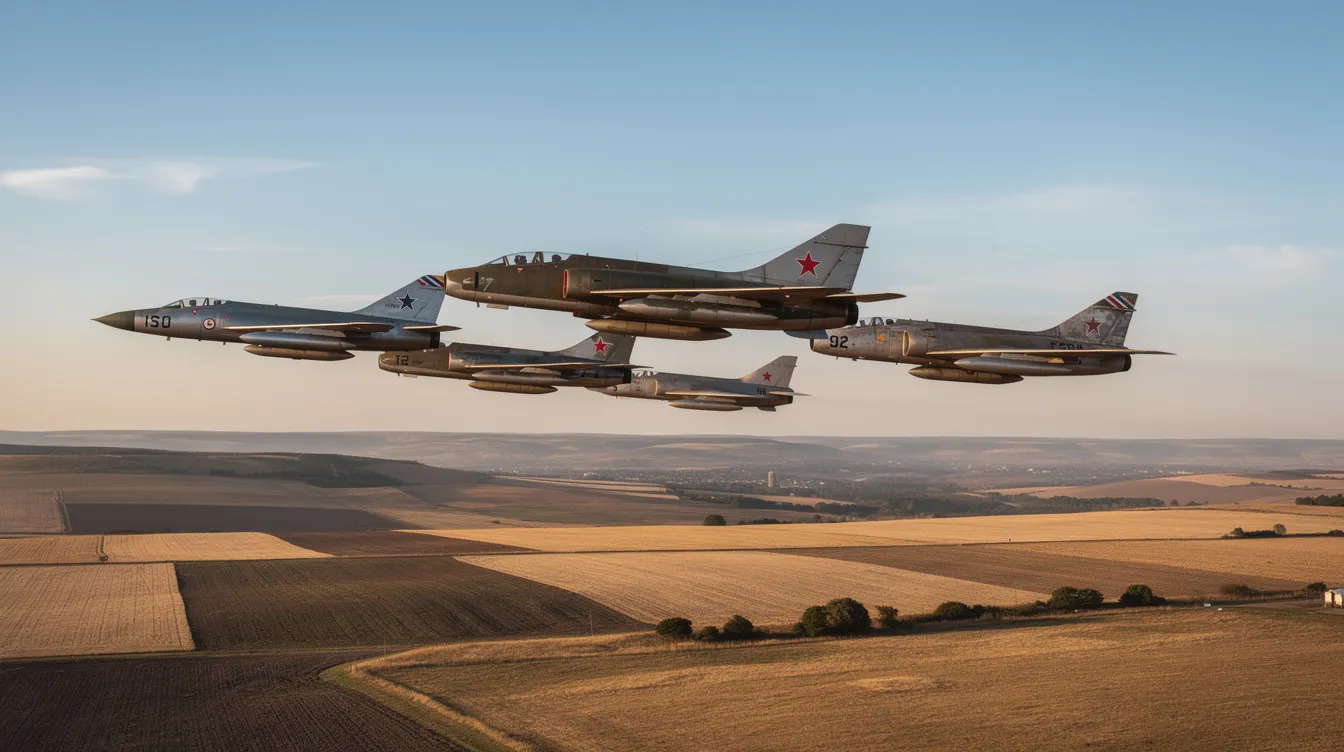
US fighter jets are built around mission roles. Different aircraft types serve specific roles such as air superiority, multirole combat, and strike missions, and many modern designs combine several of these functions in a single airframe. Fighters are optimized for roles including air superiority, close air support, and electronic attacks. Here are the major categories:
Air superiority: Air superiority fighters are designed primarily to gain and maintain air dominance-clearing the skies of enemy aircraft so friendly forces can operate freely. The F-22 and F-15C are prime examples of this role.
Multirole / strike: Multi-role / strike fighters are versatile aircraft capable of performing various combat roles, switching between air-to-air and ground attack missions on a single sortie. The F-16, F/A-18, and F-35 all fill this category. Multirole capabilities allow fighter jets to perform various missions including air-to-air and air-to-ground combat without needing separate airframes for each task.
Interceptor: Fast-response platforms scramble to counter incoming threats like strategic bombers or cruise missiles. Earlier aircraft like the F-106 Delta Dart were purpose-built interceptors; today, multirole fighters handle this job.
Electronic warfare and SEAD: Electronic warfare derivatives like the EA-18G Growler are designed to jam enemy radar and protect strike packages. These aircraft suppress enemy air defenses so that other fighters and bombers can carry out their missions with reduced risk.
Sensor fusion combines data from multiple sensors-radar, infrared search-and-track, electronic support measures, and off-board feeds-into a comprehensive display for pilots. This lets modern fighters act as "quarterbacks," coordinating other aircraft, ground forces, and naval units during complex operations. Many fighters can also perform photo reconnaissance aircraft duties and signals intelligence collection, underlining their flexibility across modern conflicts.
The F-35 Lightning II, built by Lockheed Martin, is the cornerstone fifth-generation stealth fighter in service with the US Air Force, Navy, and Marine Corps-as well as allied nations worldwide. The F-35 is designed for air superiority and strike missions, and it integrates air, land, sea, space, and cyber operations into a single platform. Modern military fighters integrate advanced technologies for enhanced operational capabilities, and the F-35 represents that principle at scale, just as modern charter platforms help explain affordable private jet charter costs and make advanced aviation more accessible.
Key capabilities include:
Stealth fighter design with low-observable shaping and internal weapons bays that dramatically reduce radar cross-section in contested airspace. Stealth / 5th-generation fighters utilize low-observable technology and sensor fusion to survive where older aircraft cannot.
Sensor fusion that combines radar, infrared, electronic support measures, and off-board data into one coherent picture for the pilot.
An advanced electronic warfare suite capable of detecting, jamming, and deceiving enemy systems.
Secure networking and data-sharing that support joint and allied operations, reinforcing global security. The F-35 is capable of carrying both U.S. and non-U.S. weapons, enhancing interoperability with coalition partners.
Real numbers tell the story of this program's scale:
The prototype completed its first flight on December 15, 2006. The Marine Corps declared IOC in July 2015, the USAF followed in August 2016, and the US Navy achieved IOC with the F-35C in 2019.
The F-35 has accumulated over 1 million flight hours across the global fleet.
More than 1,150 F-35 aircraft are currently in service, with over 1,000 F-35s delivered to the U.S. military specifically.
F-35 production continues at an annual rate of 156 aircraft.
Twelve nations operate the F-35 globally today, and the F-35 is the aircraft of choice for 19 allied nations. Twenty nations are expected to operate the type as the program expands, with 10 foreign military sales customers already under contract.
F-35 Block 4 upgrades enhance its advanced capabilities with new weapons, sensors, and processing power.
The F-35 enhances global security and deters threats worldwide through these global partnerships. Three variants serve different service branches, each detailed below.
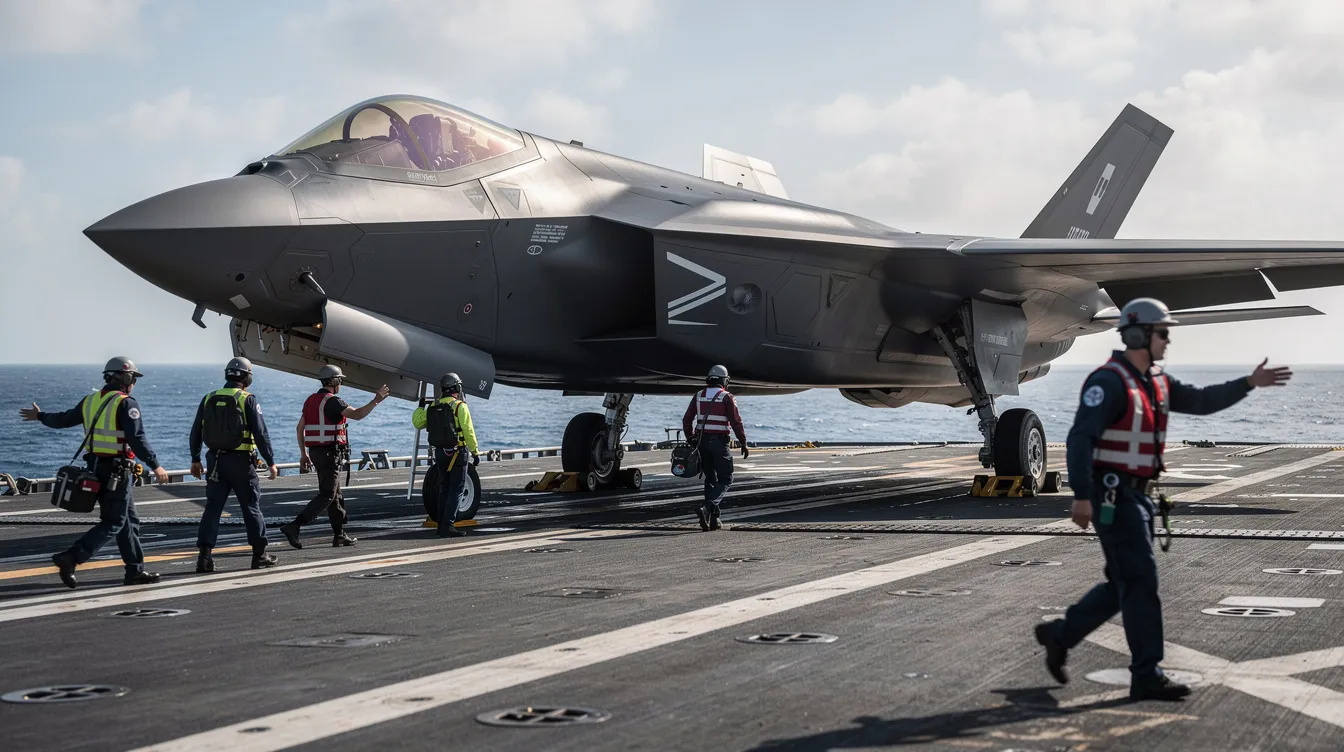
The US Navy and Marine Corps depend on carrier-based and expeditionary fighters to project a powerful force from the sea. Both the F-35B and F-35C extend fifth-generation capabilities to maritime and amphibious operations, which no legacy platform could match.
F-35B details:
The F-35B features a STOVL design with a lift fan and swiveling exhaust nozzle, allowing it to operate from amphibious assault ships and austere forward bases without full-length runways.
Its first flight occurred in 2008, and the US Marine Corps declared IOC around July 2015, making it the first F-35 variant to enter squadron service.
This ability to land vertically expands Marine Corps flexibility, allowing engineers and planners to deploy air power close to front lines from dispersed locations.
F-35C details:
The F-35C is the carrier-based fighter variant, with larger wings for better low-speed handling, stronger landing gear, and a tailhook for catapult launches and arrested carrier landings on US Navy supercarriers.
The F-35C variant entered service in 2019 after its first flight in 2010.
It operates alongside the F/A-18E/F Super Hornet as a stealth strike and air superiority asset within carrier air wings, giving the Navy a long-range, survivable platform for contested environments.
Both variants share core stealth, sensor fusion, and electronic warfare capabilities with the F-35A, ensuring interoperability across US services and allies. This commonality simplifies training, logistics, and follow-on software upgrades across the fleet.
Before the F-35 dominated headlines, several iconic US fighters defined air superiority across different eras. Each model pushed the boundaries of speed, avionics, and weapons integration.
F-22 Raptor:
The F-22 Raptor is recognized as the premier air superiority stealth fighter, a twin-engine platform that entered USAF service in 2005 after its first flight in 1997.
It can supercruise above Mach 1.5 without afterburners, drastically reducing fuel consumption and heat signature during supersonic flight. Its performance in air-to-air combat remains unmatched, and it carries advanced radar, electronic warfare systems, and limited ground attack capabilities.
Only 195 were built, with the last delivered in 2012. The small fleet means every airframe matters for maintaining US air dominance until NGAD arrives.
Other key fighters:
F-14 Tomcat: A carrier-based fleet defense fighter developed by Grumman, famous for its variable-sweep wings and the ability to carry long-range Phoenix missiles. The F-14 had 522 units built before retirement from US Navy service in 2006. It was flown extensively in carrier operations and became a cultural icon.
F-4 Phantom II: A long-range, twin-engine fighter-bomber used by the Air Force, Navy, and Marine Corps from the 1960s through the 1990s. The F-4 Phantom II had 2,294 units built before retirement, serving in roles from air superiority to ground attack and photo reconnaissance aircraft missions. McDonnell Douglas designed it as a fleet interceptor, but the crew eventually employed it across nearly every combat role imaginable.
F-105 Thunderchief, F-100 Super Sabre, and F-8 Crusader: Each was a supersonic fighter or fighter-bomber with notable service during the Cold War and Vietnam. The F-105 functioned as a deep penetration fighter-bomber over North Vietnam; the F-8 Crusader earned its reputation as a pure air superiority fighter equipped with cannons and early missiles; and the F-100 was the first production supersonic fighter in USAF inventory.
Many of these airframes transitioned through multiple roles-from pure air superiority to multirole strike and electronic warfare variants-demonstrating the adaptability that has defined US fighter design philosophy for decades.
The US is already investing in sixth-generation fighter aircraft intended to replace or complement the F-22 and F-35 around and after 2030. The U.S. Air Force actively develops next-generation platforms emphasizing stealth and advanced sensor fusion, and the USAF relies on a mix of fifth-generation fighters and next-generation programs for air dominance into the future.
USAF Next Generation Air Dominance (NGAD):
NGAD aims to field an air superiority family of systems-including a manned fighter sometimes referred to as the F-47 in open-source discussions-along with uncrewed "loyal wingman" drones that can operate alongside the pilot.
Flight demonstrators began flying in the early 2020s, with operational fielding targeted for the early-to-mid 2030s.
US Navy F/A-XX:
This program intends to replace or complement the Super Hornet and operate alongside the F-35C aboard carriers.
Carrier-specific challenges include extended range, heavy payload capacity, and survivability in maritime environments. A contractor decision between Boeing and Northrop Grumman is expected by mid-2026.
Next-generation systems emphasize manned-unmanned teaming and advanced electronic warfare. Anticipated sixth-generation features include:
Adaptive cycle engines offering greater thrust and fuel efficiency
Even lower radar and infrared signatures
AI-enabled mission assistance and autonomous wingman capabilities
Expanded electronic warfare and cross-domain integration with space and cyber assets
These programs represent the next step in ensuring US and allied air superiority and global security well into the 2040s.
Fighter jet programs are among the largest drivers of economic growth, technology development, and skilled employment across the United States.
The F-35 program alone supports nearly 300,000 jobs across 49 states and Puerto Rico, spanning engineering, production, maintenance, and software development, much like Jettly’s own high-ticket affiliate program creates incentives for partners to expand access to advanced aviation services.
Global supply chains involve partner nations that manufacture components and subsystems, strengthening alliances and shared industrial capabilities. The F-35 program includes 10 foreign military sales customers, deepening these global partnerships.
Technology spillovers reach civilian aviation through new materials, avionics architectures, safety systems, and operational concepts later adopted by airlines and private aviation operators, influencing the aircraft portfolios offered by top private plane manufacturers.
Modern fighters require extensive sustainment over decades-software updates, structural inspections, engine overhauls, and crew training-creating stable, high-skill employment long after initial production lines wind down. International sales of US fighter aircraft, from the F-16 to the F-35, contribute to trade balances and deepen defense relationships with allied nations.
These advances raise safety and efficiency standards across the entire aviation ecosystem, including private jet operators, charter marketplaces, and flight-sharing platforms for empty seats.
Innovations first developed for military fighter jets regularly find their way into civil aircraft. Composite materials, fly-by-wire flight controls, and advanced navigation systems were all pioneered in military programs before becoming standard in business and commercial aviation.
Avionics and situational awareness: Head-up displays, synthetic vision, and enhanced navigation systems reduce pilot workload and improve safety in business jets. These technologies trace directly back to fighter cockpit development and now support flexible charter models such as NetJets alternatives like Jettly.
Materials and aerodynamics: Lightweight composites and aerodynamic shaping techniques-refined through decades of fighter airframe research-improve fuel efficiency and performance in modern jet engines and airframes, while cabin-focused services such as in-flight catering for private jets enhance the passenger experience.
Data and connectivity: Secure communications, real-time data feeds, and predictive maintenance concepts adapted from fighter operations now support civil flight tracking, maintenance planning, and passenger connectivity, and underpin tools like Jettly’s jet card flight cost estimator.
Operational concepts like mission planning efficiency, high-reliability dispatch rates, and rigorous safety culture in fighter fleets influence best practices across private and commercial aviation. Platforms such as Jettly benefit indirectly from these advances by offering access to modern, efficient aircraft types and structured jet card programs whose design lineage is shaped by decades of military R&D.

Jettly is a private jet charter marketplace-not a military operator-but it sits within the same broader aviation ecosystem shaped by fighter jet innovation. The same emphasis on safety, operational discipline, and technology that defines military aviation echoes in how Jettly connects travelers with capable aircraft.
Jettly's digital platform provides on-demand access to over 20,000 aircraft worldwide, from turboprops to long-range business jets.
The platform offers instant pricing and transparent cost structures, with no need for traditional jet cards or fractional ownership commitments.
It focuses on time savings, flexible scheduling, and route customization for both business and leisure travelers.
Concepts from high-end military aviation-mission planning efficiency, safety culture, and robust operator vetting-echo in Jettly's emphasis on working only with licensed, regulated charter operators. Real-world use cases include:
Executives flying point-to-point between secondary airports to shorten travel days.
Families using private charters for direct access to remote vacation destinations, including city-specific options such as private jet charter in Chennai.
Time-critical trips-medical evacuations, legal teams, or emergency business meetings-that benefit from precise scheduling and quick turnarounds, supported by regional offerings like private jet charter in Kolkata.
Learn more about how private jet charter works and explore Jettly's full range of options.
The military selects fighter aircraft to match specific mission profiles. Private travelers face a similar-if less dramatic-decision when choosing which charter aircraft best suits their trip requirements.
Military mission-driven selection:
Air superiority fighters like the F-22 for contested airspace and escort missions
Multirole fighters like the F-35 for strike, interdiction, and close air support
Carrier-capable jets for naval operations and power projection from the sea
Private aviation equivalents:
Light jets and turboprops for short regional trips to smaller airports, drawing on a broad range of private charter aircraft types
Midsize and super-midsize jets for cross-country business travel, while budget-conscious travelers may explore affordable private aircraft options
Heavy jets and long-range business aircraft for intercontinental private jet flights with larger groups
Jettly's platform simplifies this choice by presenting aircraft categories, performance ranges, and pricing so travelers can match aircraft to their own "mission profile." For a detailed comparison of aircraft sizes and capabilities, explore this private jets comparison guide alongside a broader overview of choosing the best personal plane.
|
Aircraft |
Role |
Service Branches |
First Flight |
Units Built |
Key Features |
|---|---|---|---|---|---|
|
F-22 Raptor |
Air Superiority |
USAF |
1997 |
195 |
Stealth, supercruise, advanced avionics |
|
F-35 Lightning II |
Multirole/Strike |
USAF, USN, USMC |
2006 |
1150+ |
Stealth, sensor fusion, electronic warfare |
|
F-14 Tomcat |
Fleet Defense |
USN |
1970 |
522 |
Variable-sweep wings, long-range missiles |
|
F-4 Phantom II |
Multirole |
USAF, USN, USMC |
1958 |
2294 |
Versatile, long-range, all-weather |
|
F-15 Eagle |
Air Superiority |
USAF |
1972 |
1000+ |
High speed, maneuverability, radar |
These FAQs address common questions not fully covered in the main sections above.
For civilians interested in the experience of private flying rather than military aviation, there are many ways to buy a seat on a private jet without owning an aircraft.
Operational US fighter aircraft are strictly military assets. Safety, security, and legal restrictions prevent them from being chartered for civilian use. Civilians may occasionally fly in two-seat trainer or heritage fighter aircraft under tightly controlled programs, but this is entirely separate from standard private jet charter.
While the platforms differ radically in purpose, today’s market offers multiple ways to get a seat on a private jet easily, giving travelers access to business-jet capabilities without the complexity of ownership.
Fighter jets prioritize speed, maneuverability, weapons integration, and survivability-often at the expense of comfort, fuel efficiency, and range. Business jets focus on cabin comfort, range, noise reduction, and operating economics, making them well suited for charter platforms like Jettly. The design trade-offs are fundamentally different even when both types share underlying technologies.
Avionics, fly-by-wire controls, safety systems, and structural materials originally developed for fighter aircraft gradually migrate into business jets and airliners. For example, synthetic vision systems now common in Gulfstream and Bombardier cockpits trace back to military heads-up display technology. Improved structural composites reduce cabin noise and boost fuel efficiency in new business jet models.
Some demilitarized, retired fighters are flown by private owners under strict regulatory oversight, usually classified as experimental or limited category aircraft. Operating costs, maintenance complexity, and training requirements are significantly higher than for typical general aviation or business jets. A crew certified on a retired fighter typically needs specialized type-specific training beyond standard pilot ratings.
Part of Jettly’s safety focus comes from the structure of its private jet membership programs, which prioritize vetted operators and consistent service standards across trips.
Jettly works with licensed, regulated charter operators that comply with civil aviation authority standards, such as FAA Part 135 in the US or equivalent frameworks abroad. While civil and military standards differ in scope, both emphasize rigorous maintenance, crew training, and operational discipline to manage risk effectively within their respective domains.
US fighter jets remain a cornerstone of national defense and global security, embodying decades of technological innovation and strategic evolution. From early jet fighters to today's advanced F-35 and next-generation programs, these aircraft combine stealth, sensor fusion, and networked connectivity to maintain air superiority in increasingly complex environments. The F-35's widespread adoption among US forces and allied nations underscores its role as a force multiplier and a key element in allied interoperability.
Beyond their military significance, fighter jet technologies have profoundly influenced civil and private aviation, driving advances that improve safety, efficiency, and passenger experience in business jets and charter platforms like Jettly. As the aviation landscape evolves, the integration of new technologies and connected fighter aircraft concepts ensures that US air dominance will continue well into the future.
For travelers seeking flexibility, convenience, and advanced aviation capabilities, understanding the legacy and innovation behind US fighter jets provides valuable context for the private jet charter industry. Ready to experience private travel on your terms? Explore flight options or request a quote at https://www.jettly.com.Learn more about how private jet charter works and compare private jets to find the ideal aircraft for your next trip.
Share this post:
Jay Franco Serevilla
Aug 30, 2026
|
5
min read
Discover tips and trends in the industry.

5
min read
Private Plane Maintenance: A Practical Guide for Owners and Charter Flyers
Private plane maintenance is essential for ensuring safety, reliability, and the long-term value of aircraft. Owners and charter clients must understand maintenance costs and processes to make informed decisions. Platforms like Jettly provide access to well-maintained jets without the burdens of ownership.
Read More
5
min read
Best Single-Engine Airplane for Cross-Country in 2026
Choosing the best single-engine airplane for cross-country flying in 2026 involves evaluating speed, range, comfort, and cost based on your flying needs. This guide highlights top piston aircraft and high-performance singles, comparing ownership with charter options to help you make an informed decision. Whether for business or leisure, the right aircraft can enhance your travel experience significantly.
Read MoreStay updated with our latest insights and tips to elevate your journey with us.
MEMBERSHIPS AND ASSOCIATIONS



Disclaimer: Jettly operates as a charter broker, offering access to a global digital jet charter marketplace. Jettly is not a direct air carrier and does not own or operate aircraft. All advertised flights are conducted by third-party air carriers that are fully licensed and hold the appropriate Part 135 or Part 121 certifications issued by the Federal Aviation Administration (FAA) or equivalent regulatory authorities under U.S. or foreign law. Jettly complies fully with the U.S. Department of Transportation's Part 295 and Part 298 Charter Broker regulations. Jettly does not carry additional liability insurance. Passengers are covered by aircraft operator insurance. TICO: 50023770


