



Login
Get Instant Pricing On 23,000+ Aircraft

>
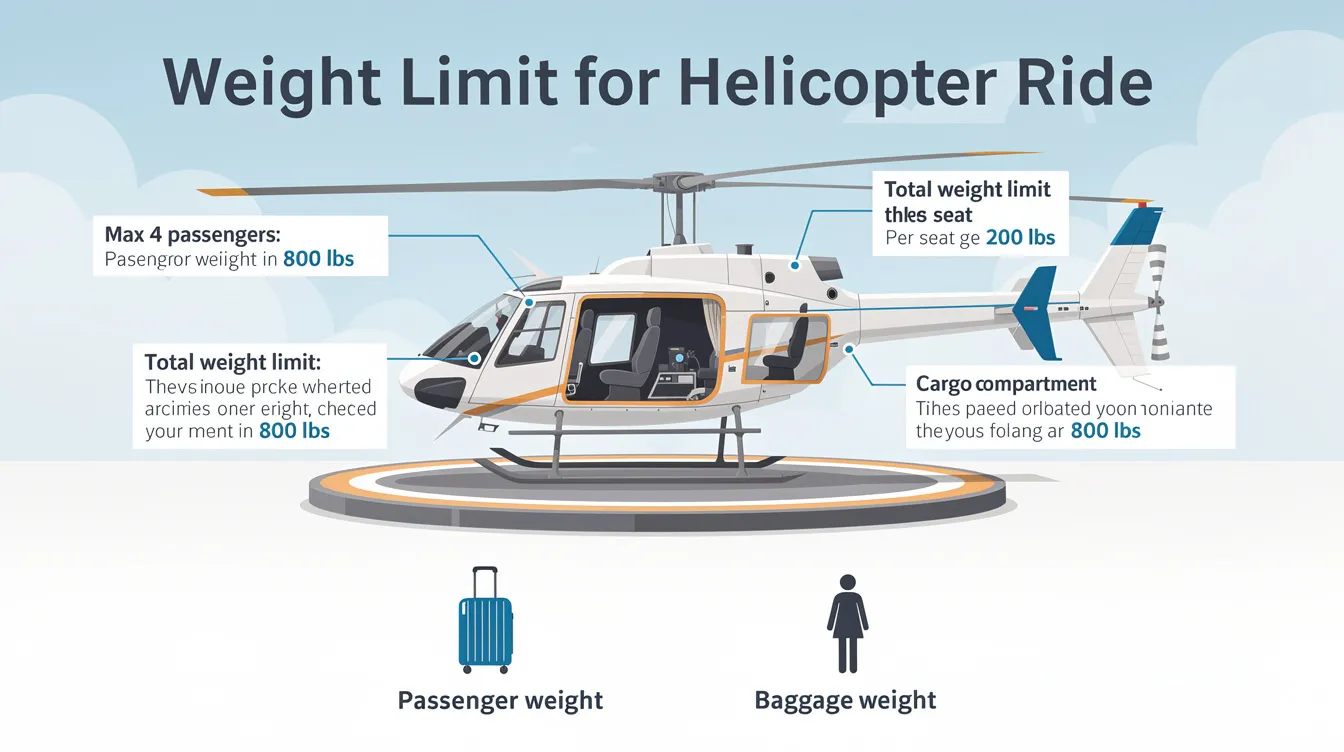
Understanding the weight limit for helicopter ride bookings is one of the most practical steps a traveler can take before boarding. Whether it is a scenic helicopter tour over the beach or a private charter to an event, every aircraft has strict weight restrictions that affect who can fly, how seating arrangements work, and what the trip will cost.
Many helicopter companies set individual passenger weight limits around 250 to 300 pounds, with combined cabin weight caps that vary by aircraft.
Weight restrictions exist for safety reasons: seat crash protection, overall weight and balance, and rotorcraft performance under varying weather conditions.
Passengers close to or over the stated limit may need to pay for an extra seat or incur a fuel surcharge, depending on the operator's policy.
Passengers are typically weighed at check-in on a calibrated scale, and the pilot assigns seating to keep the helicopter balanced.
Jettly helps travelers choose the right helicopter tour or charter based on group size, individual weights, and comfort. Learn more at https://www.jettly.com.

Helicopters typically have a maximum weight limit per passenger seat ranging from 240 to 350 pounds, with many operators setting limits between 250 and 300 pounds to ensure safety and comfort. For example, Robinson R44 helicopters have a seat weight limit of 300 pounds, with a combined weight limit of about 580 pounds for three passengers. Smaller models like the Robinson R22 have limits capped around 240 to 300 pounds per seat. Larger helicopters, such as the Bell Long Ranger, can carry up to 1,100 pounds total across six passengers, sometimes without a strict per-seat cap.
Combined weight limits for all passengers on tours often range from 550 to 700 pounds, depending on the helicopter type, fuel load, and weather conditions. Understanding how helicopter passenger capacity varies by model and configuration helps explain why these limits can differ between operators and routes. Operators enforce these limits to comply with safety regulations and to maintain proper helicopter balance, which is crucial for safe flight operations.
Passengers are typically weighed at check-in to provide accurate data for the pilot, who uses this information to distribute weight evenly across the cabin. This balance affects pilot control during flight and helps prevent dangerous situations like excessive banking or tail heaviness.
Weight limits are essential for ensuring proper crash protection for passengers. Helicopter seats are designed with crash attenuation systems tested to protect occupants up to a certain weight—usually around 250 to 300 pounds. Exceeding this limit may reduce the effectiveness of these safety features.
Beyond crash safety, helicopter weight limits are critical for maintaining the aircraft’s overall balance and performance. Every helicopter has a maximum gross takeoff weight, including the airframe, pilot, passengers, baggage, and fuel, and this same combination of factors also drives helicopter rental costs on scenic tours and charters. Exceeding this weight can impair the helicopter's ability to hover or climb safely.
Weight distribution also influences pilot control. Uneven passenger weight can cause the helicopter to bank dangerously, requiring the pilot to compensate within limited control ranges. Proper seating arrangements based on passenger weights help maintain the center of gravity within safe limits.
Weight restrictions are also influenced by external factors such as weather and fuel load. For instance, hot and high-altitude conditions reduce air density and lift capacity, leading operators to lower passenger weight limits or adjust fuel and routing to maintain safety.
Operators often require passengers exceeding weight limits to purchase an additional seat or pay surcharges to cover increased fuel consumption. For example, a passenger over 250 pounds might incur a fuel surcharge between $50 and $150 per flight. Some tours also charge extra if a passenger’s width requires more than one seat, while others may invite guests to offset costs by using platforms that crowdsource private flights and share empty seats.
To avoid surprises, travelers should weigh themselves realistically within 24 to 48 hours of their flight and disclose any heavy gear or mobility aids. Groups can optimize seating by distributing heavier and lighter passengers evenly or opt for larger helicopters or private charter aircraft when combined weights approach limits.
Different helicopter types have varying weight and seating capacities. Light single-engine helicopters like the Robinson R44 or R22 are suitable for short scenic tours with moderate weight limits. Intermediate models such as the Bell 407, AS350, or Eurocopter EC30 can carry more passengers with higher combined weight limits, ideal for city transfers. Larger twin-engine VIP helicopters provide more space and comfort for passengers near seat weight limits and those traveling with luggage, making them appealing to frequent flyers who may benefit from flexible private jet memberships or similar subscription models.
Private helicopter charters booked through platforms like Jettly offer flexibility in aircraft choice, timing, and seating arrangements, accommodating groups with diverse weight profiles and special needs, and can be coordinated efficiently using an airport locator tool to find convenient departure and arrival points.
Explore helicopter and fixed-wing charter options with transparent pricing and access to a wide global fleet at https://www.jettly.com.
Below are answers to common questions that go beyond the main article, covering edge cases and practical booking concerns travelers often hope to have addressed.
Most tour operators either weigh passengers individually on a calibrated scale at check-in or request actual weights in advance and may randomly verify them. Accurate figures are critical for weight and balance purposes. Some regions allow standard weights for small variances, but significant under- or over-estimation can lead to delays, reseating, or off-loading baggage. Treat weight questions as a safety requirement and answer honestly to avoid last-minute complications.
Being over 300 lbs does not automatically prevent a person from taking a ride in a helicopter, but it may rule out certain small models or shared tours with strict per-seat limits. Heavier passengers should contact a charter broker like Jettly early, especially if they’re already familiar with how top private jet charter companies structure their safety standards and cabin configurations. The solution is often to book a larger helicopter, purchase an extra seat, or choose between shared charter flights and full charters with more flexible seating. The final decision always rests with the operating carrier and the pilot in command.
On short scenic tours, operators typically restrict hand baggage to small personal items—phone, camera, wallet—with larger bags left at the heliport, a common practice at busy hubs such as those serving private jet charter in Houston, Texas. For point-to-point transfers and private charters, luggage allowances are calculated alongside passenger weights, and overall trip pricing follows many of the same principles outlined in guides to affordable private jet charter costs. Soft-sided bags are preferred in smaller cargo bays. If you’re comparing options for air travel more broadly, a guide to affordable aeroplane rent costs and options can help frame how aircraft type and trip profile affect both baggage and budget. Ask for exact baggage allowances when booking, especially if carrying bulky items like skis or photography gear, and consider broader insights from a guide to charter airlines and private flights if you’re comparing multiple operators or aircraft types.
Most helicopters do not have strict height limits, but very tall passengers (around 6 ft 6 in and above) may find cabins cramped. Pilots may seat taller passengers near sliding doors or in the front seat to improve legroom. Passengers with limited mobility should disclose this to allow for appropriate boarding and seating arrangements, and those with specific dietary needs can often request tailored in-flight catering services on longer charter itineraries.
Yes. Hot and high conditions reduce helicopter lift, lowering allowable combined weight compared to cooler, lower-altitude departures. Similar to choosing the best cross-country plane for long journeys, range, performance, and environmental conditions all influence which helicopter is appropriate for a given route. Operators may reduce passenger numbers, limit baggage, or adjust fuel and routing. In rare cases, parties may need to split flights, connect to a dedicated air-taxi or private jet operator, or take alternative transport to lower-altitude heliports. Operators typically offer refunds or rescheduling if conditions make flights unsafe.
Ready to book a helicopter ride that fits your group? Explore flight options or request a quote at https://www.jettly.com.
Understanding the weight limit for helicopter rides is essential for a safe, comfortable, and smooth flight experience. These limits ensure proper crash protection, maintain helicopter balance, and comply with safety regulations. Travelers should plan ahead by knowing their weight, considering potential extra costs like additional seat fees, and selecting the right helicopter type for their group’s size and needs. Weather and operational factors may also impact weight restrictions and scheduling, so flexibility is key. Platforms like Jettly simplify the booking process by offering transparent pricing, a wide range of aircraft options, and expert assistance to help travelers find the best fit. Ready to book a helicopter ride that fits your group? Explore flight options or request a quote at https://www.jettly.com.
Share this post:
Jay Franco Serevilla
Jul 25, 2026
|
5
min read
Discover tips and trends in the industry.
5
min read
Mexico Jet Travel: Private Jet Charters, Routes, and Mexico City Airports with Jettly
Flying private to Mexico in 2026 offers unparalleled convenience and flexibility, allowing travelers to bypass crowded terminals and customize their itineraries. With Jettly's digital marketplace, you can access thousands of aircraft for on-demand flights to popular destinations like Cabo San Lucas and Mexico City. Understanding the latest regulations and airport options is crucial for a seamless travel experience.
Read More
5
min read
Private Jet Membership: How Jet Memberships Work and When They Make Sense
Private jet memberships offer travelers convenient access to private flights without the burdens of ownership. With various membership models available, including prepaid jet cards and subscription services, it's essential to choose one that aligns with your travel frequency and needs. Jettly stands out by providing flexible options and access to a vast fleet of aircraft worldwide.
Read MoreStay updated with our latest insights and tips to elevate your journey with us.
MEMBERSHIPS AND ASSOCIATIONS



Disclaimer: Jettly operates as a charter broker, offering access to a global digital jet charter marketplace. Jettly is not a direct air carrier and does not own or operate aircraft. All advertised flights are conducted by third-party air carriers that are fully licensed and hold the appropriate Part 135 or Part 121 certifications issued by the Federal Aviation Administration (FAA) or equivalent regulatory authorities under U.S. or foreign law. Jettly complies fully with the U.S. Department of Transportation's Part 295 and Part 298 Charter Broker regulations. Jettly does not carry additional liability insurance. Passengers are covered by aircraft operator insurance. TICO: 50023770


