


Login
Get Instant Pricing On 23,000+ Aircraft

>
Last updated: July 25, 2026. Written by the Jettly Editorial Team, reviewed for pricing accuracy by our private aviation specialists.
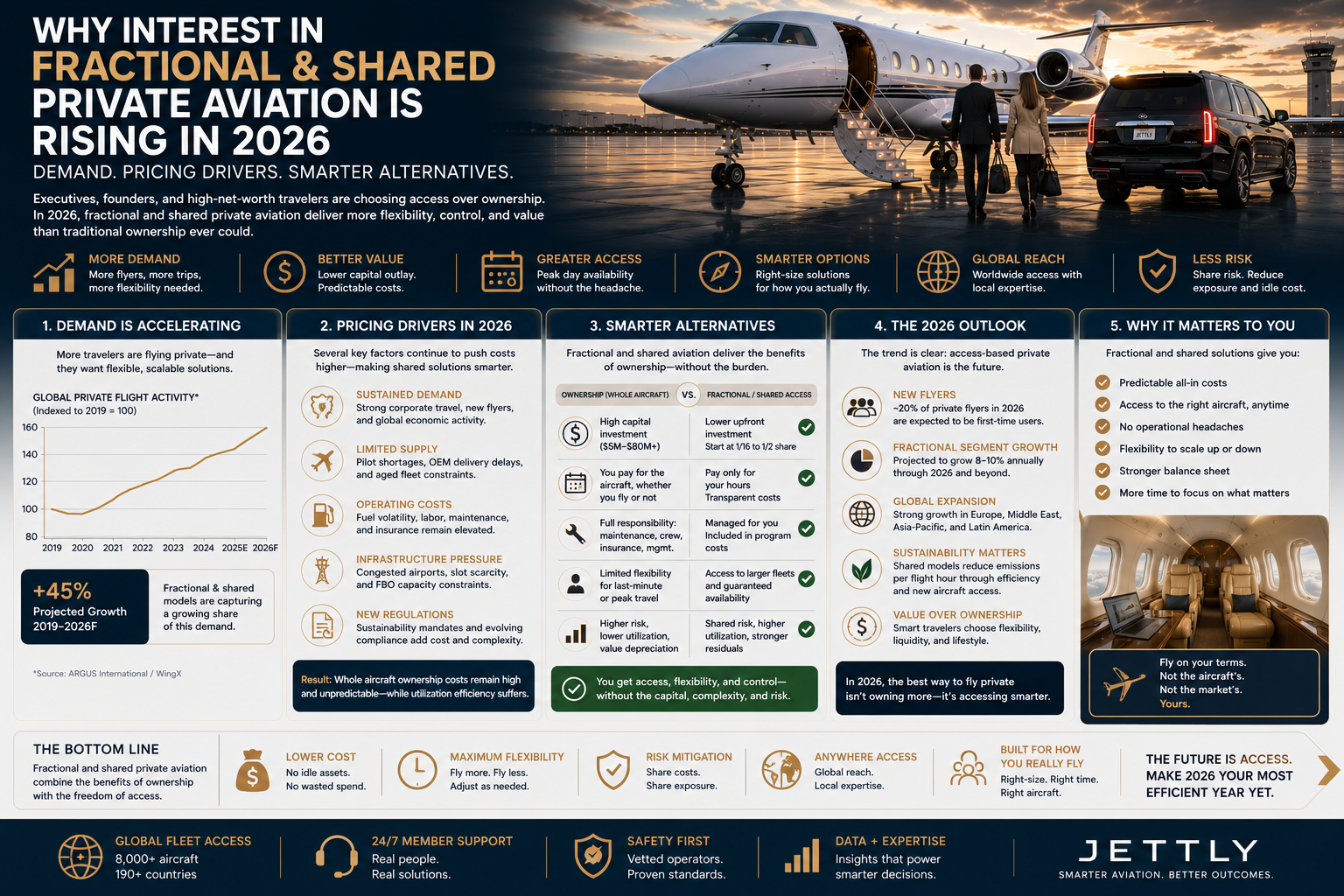
Private aviation is flying more hours than it has in years, and that one fact explains most of why interest in fractional and shared flying keeps rising. Travelers want guaranteed access without the price swings of the spot charter market, and they want to understand fractional jet ownership pricing before committing to a multi-year contract. This 2026 guide quantifies the demand behind the trend, breaks the cost into three plain-English layers, and maps every pain point to a capital-light alternative you can book today.
Global business aviation flew 8.4 million hours in 2025, up 4% from 2024, according to Aviation Week's market analysis. Momentum carried into this year, and lift has stayed tight as a result.
Business aviation demand is still growing in 2026. Global activity was up 6.5% year over year in March 2026, with North America up 6.6% and Europe up 4.9%, which keeps pressure on availability and pushes more travelers toward predictable-access programs like fractional and shared flights, per AIN figures from Argus TraqPak. Small-cabin jets grew fastest at 11.5% year over year.
Rising demand tightens availability, and tight availability makes guaranteed access worth paying for. That one pattern explains why fractional jet ownership cost 2026 searches keep climbing, and why shared private aviation options from NetJets, Flexjet, and marketplaces like Jettly draw more interest every quarter.
Shared private aviation is any model that lets multiple unrelated travelers share aircraft access or costs, such as fractional programs, jet cards that access a fleet, and per-seat shuttle or shared flights, so the cost of private flying is not carried by a single full-aircraft owner. When business aviation activity rises, availability tightens, and that's when programs that promise predictable access (fractional, jet cards, and shared flights) tend to attract more interest. Technology is speeding this shift too, and you can see how private aviation is changing across booking and access.
Fractional ownership is priced like a membership with an asset attached. You buy a share that entitles you to a set block of hours, a management company runs the aircraft, and you pay ongoing fees for access and flight time. The share is real equity, yet the day-to-day value you buy is guaranteed availability and managed operations.
Fractional jet ownership is a program where you purchase a share that entitles you to a set number of flight hours each year, and a management company runs the aircraft operations and charges ongoing fees for access and flight time. Shares commonly start at 1/16, often marketed at about 50 hours a year, and scale upward from there. Providers highlight guaranteed access and predictable operations as the core benefit, as Flexjet's program page describes.
This is not on-demand charter, which is priced per trip at market rates with no ongoing fixed fees. It is not a per-seat shared flight, where you buy a single seat rather than the whole aircraft. Your share size sets your annual hours, but your contract sets your real cost: response-time guarantees, taxi-time billing, fuel adjustments, interchange rules between aircraft types, leg minimums, and exit mechanics all move the number, which is why fractional jet ownership pricing is best understood as a contract, not a rate.
Fractional ownership is "guaranteed access with fixed fees," not "owning a whole aircraft," and your real cost depends on how the contract bills time, fuel, and exit value. Before signing, it helps to weigh the pros and cons of fractional ownership.
|
Access model |
What you are buying |
Ongoing fixed fees |
|---|---|---|
|
Fractional |
Share + MMF + OHF (+ fuel and taxes) + exit value |
Yes |
|
Jet card |
Prepaid or structured hours under program terms |
Usually none |
|
On-demand charter |
Trip-based pricing, one flight at a time |
None |
Five forces explain why interest is rising now, and each one ties to a specific line on your invoice. A pricing driver is a cost pressure, like utilization, fuel, crew, maintenance, or airport constraints, that pushes private jet prices up or makes them less predictable.
Higher utilization and scheduling competition. With 2025 utilization at 8.4 million hours and March 2026 activity up 6.5% year over year, more travelers compete for the same lift. Guaranteed access is worth more when a last-minute charter might not be available at any price.
Labor and operations complexity. Crew hiring, recurrent training, and dispatch overhead do not disappear when you park the jet. Fractional programs fold that standing cost into monthly management fees you owe every month.
Fuel volatility. Fuel prices move week to week, so many programs quote an occupied hourly rate and then add a separate fuel variable that adjusts up or down. NetJets and Flexjet both structure fuel this way.
Demand for budget certainty. Buyers want fewer surprise charges for de-icing, repositioning, and catering. Different programs bundle these differently, and the bundling is often where the real price hides.
Acceptance of shared access. Shared flights, shuttles, and membership platforms like Wheels Up have normalized access over ownership, lowering the psychological barrier to non-ownership solutions.
As utilization rises, travelers prioritize guaranteed access and predictable terms, even if the headline hourly rate isn't the lowest. These pricing drivers rarely show up as one clean number, which is why standardizing your comparison matters.
"The growing interest in fractional and shared private aviation isn't simply about luxury, it's a response to a market where availability has become increasingly valuable. As demand rises, travelers are looking for predictable access, transparent pricing, and contractual certainty rather than relying solely on the volatility of the on-demand charter market."
Justin Crabbe, CEO
|
Driver |
Where it shows up in pricing |
|---|---|
|
Utilization and scheduling competition |
Peak-day rules, availability windows, short-notice surcharges |
|
Crew training and dispatch overhead |
Monthly management fee (MMF) |
|
Fuel volatility |
Fuel variable added to the occupied hourly fee (OHF) |
|
Budget certainty |
Bundled vs unbundled extras (de-icing, catering, repositioning) |
|
Shared-access acceptance |
Per-seat fares and cost-splitting |
To see why these fees exist in the first place, review a full operating cost breakdown.
Fractional jet ownership pricing has three moving parts plus a lifecycle cost: a fixed piece, a variable piece, and the money you recover (or lose) at exit. Here is the one-sentence version for quick reference.
In 2026, fractional jet ownership is usually priced in three layers: an upfront acquisition cost for the share, a monthly management fee (MMF) you pay whether you fly or not, and an occupied hourly fee (OHF) you pay when you fly, plus fuel variables, taxes, and depreciation when you exit.
Acquisition cost. The acquisition cost is the upfront price of your share. Share sizes commonly run 1/16, 1/8, and 1/4, and cabin class drives the number: a light private jet like the Phenom 300 costs far less to buy into than a large-cabin aircraft. Bigger cabins and newer models raise both the acquisition cost and every fee that follows.
Monthly management fee. A monthly management fee is the fixed monthly charge in a fractional program that covers indirect operating costs, like crew, training, insurance, hangar, and scheduling, whether you fly that month or not. You owe it in months you never leave the ground. NetJets and Flexjet both describe this fixed overhead as the backbone of the program.
Occupied hourly fee. The hourly occupied rate applies only to the time your aircraft is flying with you aboard. It covers direct operating costs such as maintenance and cleaning, and some providers bundle a portion of fuel here. The occupied hourly rate management fee relationship matters: two programs with the same OHF can cost very differently once the management fee and fuel variable are added.
Fuel variable and taxes. Many programs adjust fuel separately from the hourly occupied rate, so a published rate can rise with a monthly fuel component. U.S. domestic flights carry the 7.5% Federal Excise Tax plus per-segment fees, which a BlackJet cost breakdown and other pricing guides both flag.
If you only compare the occupied hourly fee, you're not comparing fractional programs. You're comparing one line item.
"Too many buyers focus on a single hourly number when comparing private aviation programs. The more meaningful comparison is understanding how acquisition costs, monthly management fees, occupied hourly charges, fuel adjustments, and long-term exit value interact over the life of the program. That's where the true economics are revealed."
Justin Crabbe, CEO
|
Cost layer |
How it's billed |
What it covers |
What can still be extra |
Question to ask |
|---|---|---|---|---|
|
Acquisition |
One-time, upfront or financed |
Your equity share of the aircraft |
Depreciation and exit costs later |
What is the buyback formula? |
|
Monthly management fee |
Fixed, every month |
Crew, training, insurance, hangar, scheduling |
Annual escalation clauses |
How much can the MMF rise per year? |
|
Occupied hourly fee |
Per flight hour flown |
Maintenance, cleaning, direct operating costs |
Fuel variable, taxi time |
What does the OHF exclude? |
|
Fuel and taxes |
Variable, per trip or per month |
Fuel adjustment, FET, segment fees |
International permits and handling |
How is fuel indexed and adjusted? |
For a deeper drill-down with worked numbers, see our full fractional cost breakdown.
MMF is the fixed overhead. OHF is the per-flight operating bucket. One rule overrides every brochure: your contract's definition wins.
NetJets groups indirect costs (pilot salaries, training, insurance, hangar) into the monthly management fee, and direct costs (maintenance, landing fees, cleaning) into the occupied hourly fee. Flexjet uses a similar split and treats fuel as a separate, monthly-adjusted component on top of the hourly occupied rate. An occupied hourly fee is the variable, per-flight-hour charge in a fractional program that covers direct operating costs when the aircraft is in flight, but may not include fuel adjustments, taxes, or trip-specific extras.
Monthly management fees usually pay for the standing costs of keeping crew and aircraft ready. The hourly operating fees what's included question has a shorter answer: the direct costs of the flight itself, and rarely much more. Read the exclusions closely, since international handling, special catering, Wi-Fi, de-icing, and peak or holiday rules often sit outside both buckets.
In most fractional programs, MMF pays for the "standing army" (crew, insurance, hangar, scheduling), and OHF pays for the "mission," which is the flight itself.
|
Usually in the MMF |
Usually in the OHF |
Often extra or varies |
|---|---|---|
|
Pilot salaries and training |
Maintenance and reserves |
Fuel variable |
|
Insurance |
Landing and handling fees |
Federal Excise Tax and segment fees |
|
Hangar and storage |
Cabin cleaning |
International permits and handling |
|
Scheduling, dispatch, admin |
Base catering |
Special catering, Wi-Fi, de-icing |
|
Peak-day and holiday surcharges |
Hourly costs vary widely by cabin class, which our private jet hourly rates guide lays out by category.
A share size is the fraction of an aircraft's annual utilization you buy in a fractional program, which translates into a set number of flight hours per year (for example, 1/16 is commonly marketed as about 50 hours).
|
Share size |
Typical annual hours |
Who it fits |
What to watch |
|---|---|---|---|
|
1/16 |
~50 |
50+ hours, one primary region |
Overage rates and leg minimums |
|
1/8 |
~100 |
Frequent flyer near 100 hours |
Wasted capital if you fly less |
|
1/4 |
~200 |
Heavy users or a small team |
Large upfront plus monthly management fees |
|
1/2 |
~400 |
Near-daily corporate flying |
Approaches whole-aircraft economics |
Flexjet states that shares commence at 1/16, roughly 50 hours, and pairs that with a 10-hour response-time guarantee for scheduling. The catch is how hours get counted. Flexjet adds taxi time of about 0.2 hour per leg, so short hops burn a bigger share of each billed hour. Fly six 45-minute legs and your occupied total climbs faster than the map suggests.
Sixty hours a year sits in an awkward middle. It can look like a 1/16 share plus overage hours, or a 1/8 share you never fully use, depending on your average leg length and peak-day needs. The right share size is determined less by "hours per year" and more by your average mission length, peak-day needs, and how your program bills minimums and taxi time. A 1/8 share suits someone flying close to 100 hours; a 1/8 share bought by a 60-hour flyer wastes capital. Ask for the typical share hourly management fees in writing before you compare providers.
Average stage length (short legs favor smaller shares or cards)
Which days of the week you fly
Peak-day and holiday demand
International versus domestic patterns
Traveling with pets or heavy luggage
Need for aircraft interchange (light jet one day, large cabin the next)
Frequency of last-minute changes
How your occupied hourly rate and minimums treat sub-hour legs
If you are weighing the two biggest names, our Flexjet vs NetJets comparison breaks down the differences.
Hidden doesn't mean dishonest. It means "not in the headline number." The brochure rate is a starting point, and four categories tend to move your real cost the most. These hidden costs rarely appear on the first quote.
Effective all-in hourly cost is what you really pay per hour after you spread fixed fees (like the MMF) and lifecycle costs (like depreciation or exit fees) across the hours you actually fly.
Fuel component adjustments. Flexjet lists an hourly fuel variable, and NetJets applies a variable fuel rate, so a rate quoted in January can read differently in July.
Taxi time, rounding, and minimums. A 0.2 hour taxi charge per leg and per-leg minimums inflate the effective cost of short trips more than long ones.
Depreciation and buyback. Your share loses value over the contract, and the buyback price at exit reflects depreciation plus fees. Our own fractional resale and exit guide covers how depreciation and exit friction play out in practice.
Taxes and fees. The 7.5% Federal Excise Tax and per-segment fees apply to most U.S. flights, a point several pricing breakdowns flag.
In fractional programs, the biggest budget surprises usually come from fuel adjustments, billing minimums on short legs, and depreciation or exit economics, not from the occupied hourly fee itself.
|
Gotcha |
Where it shows up |
How to ask about it |
|---|---|---|
|
Fuel component adjustment |
Monthly fuel variable on top of OHF |
"How is the fuel index set and how often does it change?" |
|
Taxi-time add-on |
~0.2 hour billed per leg |
"Do you bill taxi time, and how much per leg?" |
|
Leg or daily minimums |
Minimum billed hours per flight |
"What is the minimum flight charge per leg?" |
|
Peak-day surcharges |
Named high-demand dates |
"How many peak days per year, and what is the surcharge?" |
|
Repositioning / ferry |
Aircraft moved to reach you |
"Am I billed for repositioning or only occupied time?" |
|
De-icing |
Winter operations |
"Is de-icing bundled or billed per event?" |
|
International handling |
Permits, customs, foreign fees |
"What international fees fall outside the OHF?" |
|
Federal Excise Tax |
7.5% on U.S. flight charges |
"Which taxes and segment fees apply to my routes?" |
|
Depreciation |
Share value at exit |
"What depreciation should I expect over the term?" |
|
Buyback / early exit |
Exit price and penalties |
"What is the buyback formula and any early-exit fee?" |
At about 60 hours a year, predictability matters, but fixed fees can dominate your cost if you are not careful. The math below shows how fractional ownership pricing behaves at this volume.
Start with the generic formula for effective cost per hour in a fractional program:
(Annual acquisition depreciation + MMF × 12 + OHF × hours + fuel, taxes, and fees) ÷ hours flown.
When your schedule is unpredictable, two things get harder. Short-notice trips lean on response-time guarantees (Flexjet cites a 10-hour window), and you must read peak-day rules and minimums that can bite when you fly the busiest dates. Fly fewer hours than planned, and your fixed MMF spreads across a smaller base, so your effective all-in cost per hour rises.
Point-to-point billing means you're billed for your actual flight segment time (takeoff to landing) rather than paying extra billable hours for repositioning. That distinction matters at 60 hours a year, since repositioning and minimums are exactly where fractional math gets expensive.
Jettly maps this same 60-hour need to several capital-light options, each using verified program terms.
Jettly Jet Card uses an occupied hourly rate model with a base rate from $3,528 per hour paid as you fly. Tiers run 25, 50, 100, and 200 hours, with a one-time enrollment fee of $12,997. Hours do not expire, and there are no blackout dates.
Jettly Cloud Fraction is a fractional-style program that licenses access to an entire aircraft class rather than one tail number, with no aircraft title. The Light tier is a $325,000 license plus $5,250 per hour and a $12,000 monthly management fee; Midsize runs $495,000 plus $6,950 per hour and $16,500 monthly; Super-Mid is $725,000 plus $8,900 per hour and $22,000 monthly. Each sits on a 36-month term with 50 annual flight hours, fixed hourly rates, and no fuel surcharges.
Jettly shared and shuttle flights let you buy a seat on popular routes when your schedule and route line up, with cost splitting available so each traveler gets a separate invoice.
Jettly on-demand charter is trip-based, with access to more than 23,000 aircraft through certified third-party operators, priced only when you fly. See how Jettly charter works for the booking flow.
|
Model |
Upfront |
Monthly |
When you fly |
Best for |
|---|---|---|---|---|
|
Traditional fractional (1/16) |
Six-figure share purchase |
Monthly management fee |
OHF + fuel variable + taxes |
Steady 50+ hours, brand fleet, guaranteed access |
|
Jettly Cloud Fraction (Light) |
$325,000 license |
$12,000 |
$5,250/hr fixed, no fuel surcharge |
Fractional-style access without aircraft title |
|
Jettly Jet Card (50-hr) |
$95,000 card + $12,997 enrollment |
None |
From $3,528/hr, hours never expire |
Structured hours, no monthly overhead |
|
On-demand charter |
None |
None |
Trip-based market rate |
Irregular volume, varied aircraft |
|
Shared / shuttle |
None |
None |
Per-seat fare or split cost |
Popular routes, lowest cost |
For 60 hours a year with an unpredictable schedule, the honest answer for most travelers is to skip whole-aircraft fractional ownership. Jettly Cloud Fraction gives you fractional-style predictability and fixed hourly rates without taking aircraft title or locking into a single tail number, and the Jet Card keeps your money variable with hours that never expire. For around 60 hours a year, the decision usually comes down to whether you want to pay fixed monthly overhead for guaranteed access (fractional or Cloud Fraction) or keep costs primarily variable with a jet card or on-demand charter. Traditional fractional ownership earns its keep at higher, steadier utilization or when you need a very specific aircraft on guaranteed terms.
Access runs on a spectrum, from buying a single seat up to owning a share outright: per-seat shared flights, on-demand charter, jet cards, fractional-style access, then traditional fractional ownership. Match the model to how you actually fly, not to a brochure. These smarter alternatives cover almost every real-world pattern.
Shared flights and shuttles work best on popular routes where buying a shared private jet seat, or splitting the cost, beats chartering the whole aircraft. Jettly offers both, with cost splitting built in.
Empty legs reward flexibility on route and timing. Jettly lists thousands of empty-leg flights with member preferred pricing, and fares can run well below standard charter.
On-demand charter fits irregular volume and changing aircraft needs. Jettly's instant-quote tool and iOS and Android apps price any trip across a global fleet.
Jet cards give structure without long-term ownership. Jettly's Jet Card bills by the occupied hour, and the hours do not expire.
Cloud Fraction gives fractional-style predictability without aircraft title and without being tied to a single tail number.
A fractional-style program is a structured access plan that mimics fractional predictability (fixed rates and managed operations) but does not require you to take aircraft title. If your flight hours are unpredictable, choosing an access model with minimal fixed overhead often reduces regret, since your costs fall when you fly less.
"Ownership is no longer the only path to predictable private aviation. Today's market offers a spectrum of access models, from on-demand charter and jet cards to fractional-style programs and shared flights, allowing travelers to match their flying habits with the level of financial commitment that actually makes sense for their business or lifestyle."
Justin Crabbe, CEO
|
Priority |
Fractional |
Jet card |
On-demand |
Shared / shuttle |
Empty legs |
Cloud Fraction |
|---|---|---|---|---|---|---|
|
Budget predictability |
Good |
Good |
Fair |
Fair |
Limited |
Best |
|
Schedule unpredictability |
Good |
Best |
Best |
Limited |
Limited |
Good |
|
Specific cabin class |
Best |
Good |
Best |
Limited |
Fair |
Good |
|
Peak-day flying |
Good |
Fair |
Fair |
Limited |
Limited |
Good |
|
International trips |
Good |
Good |
Best |
Limited |
Fair |
Good |
|
One-way patterns |
Fair |
Good |
Best |
Good |
Best |
Good |
Compare the numbers behind these in our jet sharing costs guide, our flight sharing guide, and a rundown of cheaper charter strategies.
Don't ask for a quote. Ask for a pricing model you can audit. A single hourly number tells you almost nothing until you know what surrounds it. The fastest way to compare fractional programs is to standardize the questions you ask, since every provider groups costs differently.
Group your questions into fees and inclusions, billing mechanics, availability and peak rules, fleet and interchange, safety and operations, and exit economics. A minimum flight charge is a rule that bills you for at least a set amount of time per leg, even if the actual airborne time is shorter. Some providers, NetJets among them, promote no minimum flight charges; treat that as a claim to verify and ask exactly where it applies, and confirm how your occupied hourly rate handles sub-hour legs.
|
Question |
Why it matters |
What to look for |
Red flag |
|---|---|---|---|
|
What does the MMF include? |
Sets your fixed monthly cost |
Itemized crew, insurance, hangar, scheduling |
Vague "operations" line |
|
What does the OHF exclude? |
Reveals add-ons |
A clear list of extras |
"Depends on the trip" |
|
How is fuel adjusted? |
Swings your real rate |
Published index and cadence |
Unexplained monthly changes |
|
What minimums and taxi time apply? |
Inflates short-leg cost |
Stated minimum flight charge |
Hidden per-leg billing |
|
How many peak days apply? |
Limits guaranteed access |
Named dates and surcharge |
Open-ended peak list |
|
Can I interchange aircraft? |
Fleet flexibility |
Clear interchange rates |
Locked to one type |
|
Who operates and audits the fleet? |
Safety and compliance |
ARGUS or Wyvern ratings |
No third-party audit |
|
What is the buyback formula? |
Your exit value |
Written depreciation method |
Discretionary pricing |
|
What are the early-exit terms? |
Flexibility if plans change |
Defined penalties |
No exit before term end |
|
What management charges escalate yearly? |
Long-term budget |
Capped annual increases |
Uncapped escalation |
Request these documents before you sign:
A sample invoice from a recent comparable trip
The full fee schedule and any escalation clauses
Buyback terms and early-exit penalties
The peak-day definition and calendar
Interchange rules between aircraft types
Short-leg and minimum-billing rules
Benchmark every proposal against a real trip price. Run your actual routes through our charter cost calculator before you commit to anything.
In 2026, fractional jet ownership typically includes an upfront share acquisition cost, a monthly management fee you pay whether you fly or not, and an occupied hourly fee you pay when you fly, plus fuel variables, taxes, and depreciation at exit. Providers define inclusions differently, so compare the all-in cost per hour rather than a single rate. Our fractional cost breakdown and provider pages from NetJets and Flexjet spell out the components.
An occupied hourly fee (known as an occupied hourly rate) is the per-flight-hour charge in a fractional program for the time the aircraft is flying; it typically covers direct operating costs like maintenance and crew-related operating expenses, but it may not include fuel variables, taxes, or all trip-specific charges. Some programs add taxi time of about 0.2 hour per leg, and fuel is often billed separately.
Monthly management fees usually cover fixed overhead like crew, training, insurance, hangar, and scheduling, but not every trip-specific cost. NetJets describes the MMF as indirect operating costs, so request a sample invoice to see how a real month bills out.
Many fractional programs market a 1/16 share as about 50 annual hours and a 1/8 share as about 100 annual hours, but billing rules can change how many effective hours you use. Taxi-time add-ons and leg minimums mean short trips consume hours faster than the distance implies.
Sometimes, but only if you consistently use your hours and the program's fixed fees and exit economics don't overwhelm your utilization. For variable schedules, a jet card or on-demand charter often delivers similar flexibility with less fixed overhead; Jettly's Jet Card and Cloud Fraction offer capital-light comparisons.
Shared flights and shuttles are growing because they let travelers buy access by the seat or split costs, capturing private-aviation time savings without paying for an entire aircraft. With 2025 utilization at 8.4 million hours and activity still rising in 2026, access over ownership keeps gaining appeal.
Compare billing mechanics (minimums, taxi time, fuel), availability rules, interchange and fleet access, and exit terms, not just the hourly rate. Provider definitions from NetJets and Flexjet vary enough that two similar rates can produce very different bills.
A jet card or a fractional-style access program can offer predictable access with less capital risk than traditional fractional ownership. Jettly's Jet Card gives you hours that never expire, and Cloud Fraction provides class-level access without aircraft title or a single tail-number restriction.
This guide is current as of July 25, 2026.
Demand and activity figures come from Aviation Week (2025 utilization of 8.4 million hours, up 4%) and AIN via Argus TraqPak (March 2026 activity up 6.5% year over year). Program component definitions, including how the monthly management fee, occupied hourly fee, and fuel variable are structured, draw on published pages from NetJets and Flexjet. Cost-structure concepts and typical ranges reference published pricing breakdowns from Jettly, BlackJet, and StratosJets, and are presented as ranges shown in those breakdowns, not as a quote for any specific customer.
The 60-hour worked example is illustrative. Actual quotes depend on aircraft category, routing, season, notice time, and contract terms, so treat the formula as a framework rather than a price.
Jettly is a charter broker operated by Jettly Inc. and does not own or operate aircraft. Every flight is operated by certified third-party carriers holding FAA Part 135 or Part 121 authority (or a foreign equivalent), and passengers are covered by the operating carrier's insurance. Jettly program figures (Jet Card tiers, Cloud Fraction tiers, and fees) reflect published program terms and may change.
Interest in fractional and shared private aviation is rising for a simple reason: demand is up, lift is tight, and predictable access has real value. Fractional ownership can deliver that access, yet its cost lives in three layers plus a lifecycle bill, and the headline hourly rate hides most of the story. Price the whole stack, ask the audit questions, and match the model to how you actually fly.
For 60 hours a year with an unpredictable schedule, you rarely need to own a whole plane. Get an instant estimate for your next trip and compare it against any fractional proposal using the MMF and OHF checklist above. If you want predictable access without aircraft title, look at Jettly's Jet Card, with hours that never expire, or Cloud Fraction for fractional-style class access. Book and manage every trip from the Jettly app, or reach the 24/7 team at +1-866-448-2358 or departures@jettly.com.
The Jettly Editorial Team covers private aviation pricing, aircraft, and access models, with fact-checking by Jettly's charter specialists and Personal Flight Coordinators. Jettly operates a global jet charter marketplace with access to more than 23,000 aircraft across 190-plus countries, working only with ARGUS- or Wyvern-rated operators.
Aviation Week (AWIN) - 2025 global business aviation utilization of 8.4 million hours, up 4% from 2024.
AIN via Argus TraqPak - March 2026 activity up 6.5% year over year; North America +6.6%, Europe +4.9%, small-cabin jets +11.5%.
BlackJet - full cost picture including Federal Excise Tax and depreciation.
Jettly - complete pricing breakdown of acquisition, management, and occupied hourly charges plus lifecycle costs.
Share this post:
Jay Franco Serevilla
Jul 25, 2026
|
5
min read
Discover tips and trends in the industry.

5
min read
Richmor Aviation, Inc.: Charter Services, Flight School, and How Jettly Helps You Compare Options
Richmor Aviation, Inc. has been a key player in New York's aviation sector since 1967, offering charter services and a renowned flight school. For those seeking to compare private jet options beyond Richmor, Jettly provides a digital marketplace to explore a vast network of aircraft and operators. This guide details Richmor's offerings and how Jettly enhances the travel experience.
Read More
5
min read
Plane Flying Height in km: How High Different Aircraft Fly and Why It Matters
Most commercial planes fly between 9 to 12 km, while private jets can reach up to 15.5 km. The chosen altitude balances fuel efficiency, safety, and passenger comfort. Understanding these heights helps travelers appreciate the dynamics of air travel and optimize their flight experience.
Read MoreStay updated with our latest insights and tips to elevate your journey with us.
MEMBERSHIPS AND ASSOCIATIONS



Disclaimer: Jettly operates as a charter broker, offering access to a global digital jet charter marketplace. Jettly is not a direct air carrier and does not own or operate aircraft. All advertised flights are conducted by third-party air carriers that are fully licensed and hold the appropriate Part 135 or Part 121 certifications issued by the Federal Aviation Administration (FAA) or equivalent regulatory authorities under U.S. or foreign law. Jettly complies fully with the U.S. Department of Transportation's Part 295 and Part 298 Charter Broker regulations. Jettly does not carry additional liability insurance. Passengers are covered by aircraft operator insurance. TICO: 50023770


