



Login
Get Instant Pricing On 23,000+ Aircraft

>
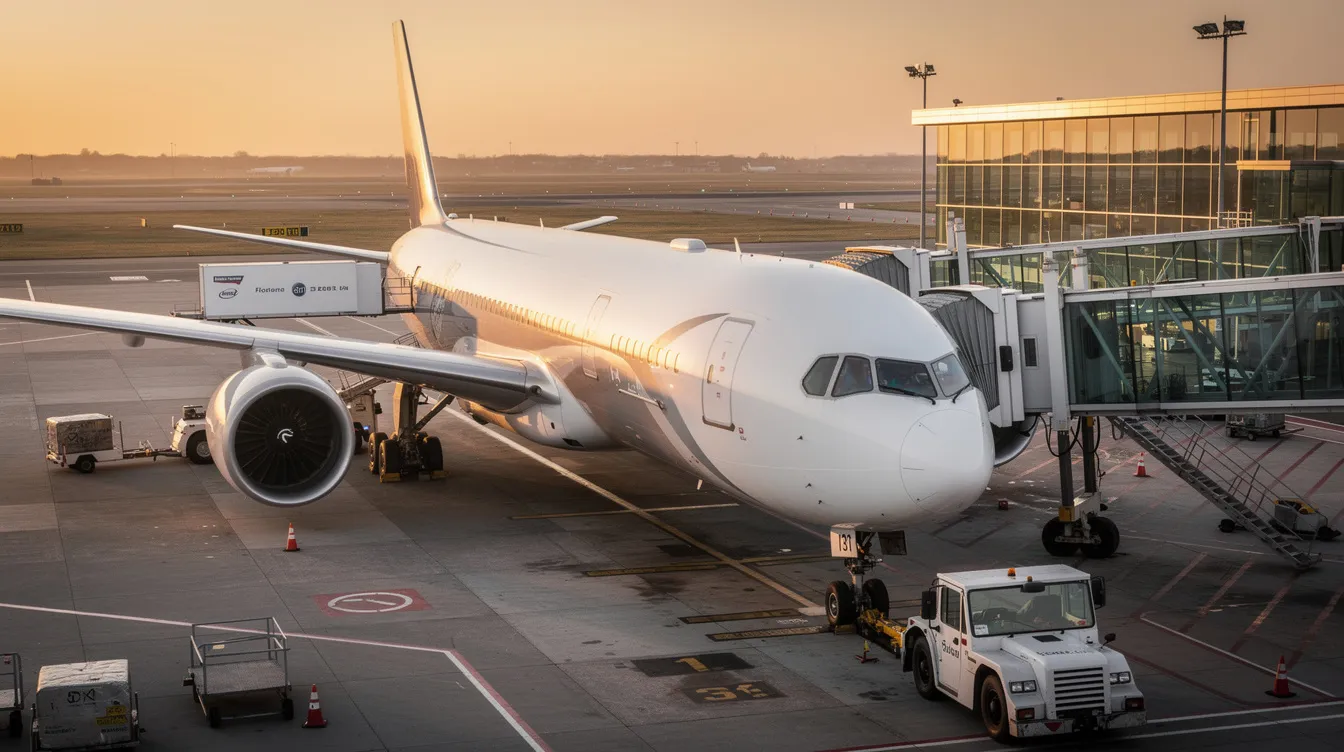
The Boeing 767‑300ER range is one of the most searched performance specs in commercial aviation, and for good reason. This wide-body airliner has connected cities across oceans for nearly four decades, and its extended range capability still shapes how airlines schedule long-haul routes today. Whether you fly commercially or consider private jet charter through platforms like Jettly, understanding what the 767‑300ER can and cannot do nonstop helps you plan smarter trips.
This guide is for travelers, aviation enthusiasts, and private charter clients seeking to understand the Boeing 767-300's range and performance.
We cover the 767-300ER's range, technical differences from the standard 767-300, typical routes, and how its capabilities compare to private jet charter options.
The Boeing 767‑300ER has an operational range of approximately 5,980 nautical miles (roughly 11,070 km), enough for most North America–Europe and many North America–South America routes.
"ER" stands for Extended Range. The 767‑300ER carries significantly more fuel and has a higher maximum takeoff weight than the standard 767‑300, which directly increases range.
Typical cruising speed sits around Mach 0.80–0.82, and combined with range, this shapes long‑haul schedules for airlines like United Airlines, Delta Air Lines, and American Airlines.
Cabin layouts on the 767‑300ER - including economy class, business, and premium cabins - are optimized for sectors in the 7–11 hour band, with features such as movable armrests and power outlets on many refurbished aircraft.
For travelers who want to customize range, routing, and schedule beyond commercial options, Jettly offers private jet charter alternatives across multiple aircraft categories with on‑demand pricing.
The Boeing 767 is a wide‑body twin‑engine jetliner that first entered service in 1982. The 767‑300ER is its most commercially successful long‑range passenger variant, certified in 1988 and designed specifically to fly farther than the original model. The Boeing 767 typically seats 181 to 375 passengers depending on configuration, making it versatile for both medium‑ and long‑haul missions.
When people search for "767 300 range," they usually mean the extended range version. The Boeing 767‑300ER has an operational range of approximately 5,980 nautical miles — roughly 11,070 km in a standard two‑class configuration. The 767 family as a whole has a range of up to 6,385 nautical miles across all variants, but it is the ER model that airlines rely on for intercontinental routes.
This range opened efficient transatlantic service and some thinner routes to South America and across the Pacific that previously required larger, more expensive aircraft. The Boeing 767‑300ER is recognized for its capability in long‑haul international operations, a reputation it earned by reliably linking major cities on both sides of the Atlantic for over three decades.
For Jettly's audience, comparing the 767‑300ER's commercial range to private jet capabilities and browsing private charter aircraft across multiple categories is often the starting point when planning complex or long-distance flights.
The 767‑300 came first as a stretched fuselage version of the 767‑200, sharing the same wing and cross‑section but adding length to carry more passengers. The 767‑300ER was then developed to fly farther using similar airframe dimensions but with targeted engineering upgrades.
Three main technical changes give the extended range version its advantage:
Increased fuel capacity. Additional center and wing tanks raise fuel capacity from roughly 16,700 US gallons on the standard 767‑300 to approximately 24,140 US gallons on the ER — an increase of over 40%.
Higher maximum takeoff weight (MTOW). The maximum takeoff weight of the 767‑300ER can reach up to 412,000 pounds (about 186,880 kg), compared to lower limits on non‑ER models. This allows the aircraft to carry more fuel and payload simultaneously.
Structural reinforcements. Strengthened wings, landing gear, and fuselage skin accommodate the higher weights and stresses of long flights with full fuel loads.
Here is how the ranges compare:
The standard Boeing 767‑300 has a range of approximately 3,900 nautical miles, falling in the low‑ to mid‑4,000 nm band depending on load.
The 767‑300ER reaches close to 5,980–5,990 nm in optimal conditions.
The Boeing 767‑300 has different performance characteristics depending on the specific aircraft variant, and the ER's extra fuel allows airlines to carry full passenger loads on longer city pairs without payload restrictions — especially on westbound or winter operations with strong headwinds.
Some visual cues, such as blended winglets, are common on 767‑300ER aircraft but are not a foolproof way to distinguish them. Winglets can be retrofitted on other carriers and variants, so external appearance alone does not confirm an ER airframe.
The 767‑300ER is optimized for medium‑ to long‑haul blocks in the 7–11 hour range. Its combination of range and cruising speed makes it a practical choice for overnight transatlantic crossings and daytime returns.
Key performance numbers:
|
Specification |
Value |
|---|---|
|
Typical cruising speed |
Mach 0.80–0.82 (~530–540 mph / 850–870 km/h) |
|
Published maximum range |
~5,980 nautical miles (two‑class config) |
|
Real‑world usable range |
~5,000–5,500 nm (with winds, reserves, routing) |
|
Service ceiling |
Up to 43,199 feet |
|
Approximate fuel burn |
~4,300 kg/h at typical payloads |
|
Cruising altitude |
35,000–39,000 ft |
The aircraft features a cruising speed of Mach 0.80, comparable to many other wide-body aircraft from the same era. Maximum advertised range assumes standard atmospheric conditions, no headwinds, and a typical two‑class cabin. Real‑world usable range is usually several hundred nautical miles less once winds, routing, and mandatory fuel reserves are factored in.
The 767's relatively modest fuel burn for its generation and twin‑engine ETOPS certification let airlines operate more efficiently than with older tri‑jets or four‑engine jets on similar legs. For private flyers, similar or longer ranges can be reached with large‑cabin business jets such as the Gulfstream G650 or Bombardier Global 7500, which trade seat count for additional comfort and flexibility.
The 767‑300ER earned its nickname as a "transatlantic workhorse" by connecting secondary and primary hubs efficiently across the Atlantic for decades.
Routes that sit comfortably within the 767‑300ER's range envelope include:
Newark (EWR)–London Heathrow: ~3,450 nm
Newark–Lisbon: ~3,350 nm
Chicago O'Hare–Frankfurt: ~4,130 nm
Toronto–Rome: ~4,000 nm
Longer missions that push closer to the aircraft's upper range include New York–Athens (~4,250 nm), Miami–Buenos Aires (~4,100 nm), and certain Pacific segments under favorable conditions.
Airlines deploy the 767‑300ER on "thin" long-haul routes where demand does not justify larger aircraft like the Boeing 777 or 787, but range requirements exceed narrow‑body capabilities. This aircraft type fills a mid-size gap in the fleet that few other widebodies match as efficiently.
The Boeing 767‑300 features substantial under‑floor hold space suitable for cargo, making it productive on both passenger and mixed operations. Freight carriers use the similar‑range 767‑300F and converted 767‑300ER freighters on express cargo routes, where payload‑range balancing is critical for overnight networks run by integrators and other carriers worldwide, while shorter routes may be better served by narrow‑body types such as the Boeing 737‑800.
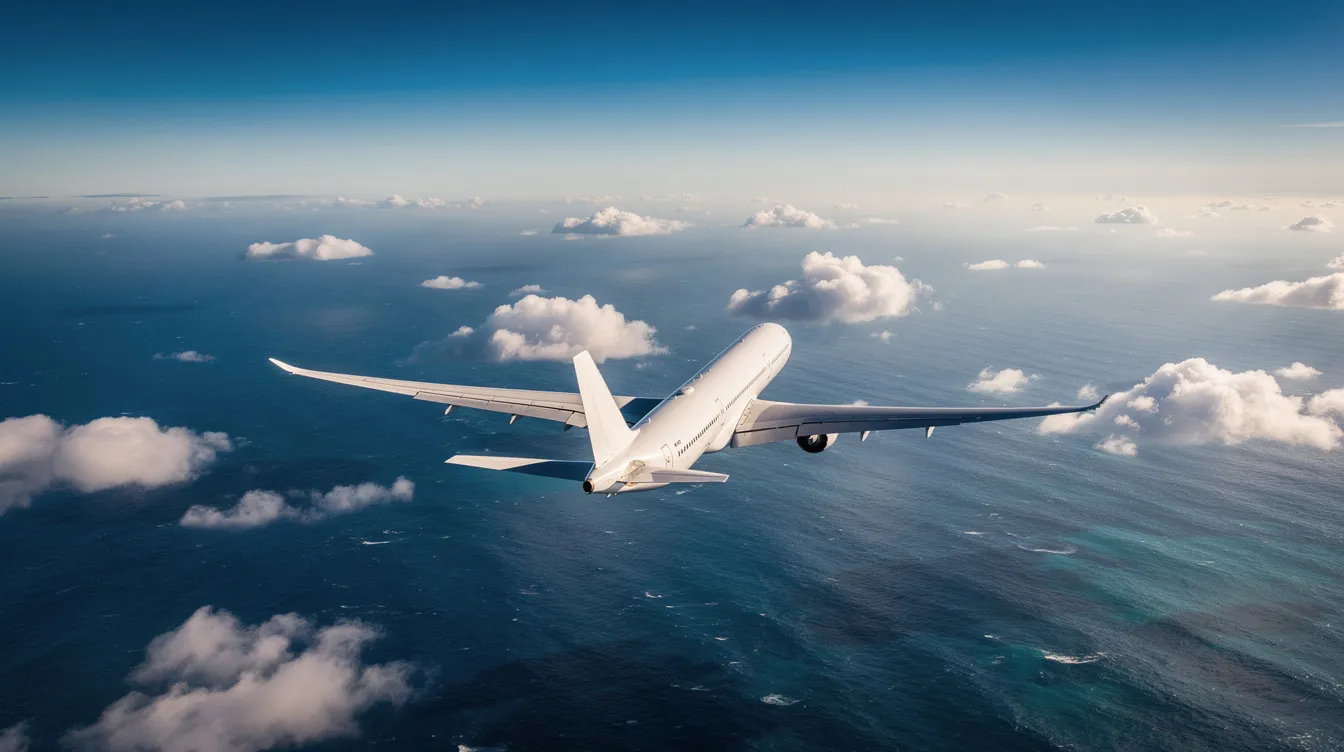
By the mid‑2010s and early 2020s, legacy carriers like United Airlines, Delta Air Lines, American Airlines, All Nippon Airways (Nippon Airways), and Japan Airlines were among the largest operators of the 767‑300ER. The aircraft's maiden flight for the ER variant led to rapid adoption among major airlines operating flights across the Atlantic.
United Airlines has used the 767‑300ER primarily on transatlantic flights from hubs like Newark, Washington Dulles, and Chicago O'Hare. As of mid‑2026, United's fleet included approximately 37 Boeing 767‑300ERs. The 767‑300ER typically seats 200 to 270 passengers in most airline configurations, but United Airlines operates a 167‑seat configuration on its premium‑heavy "High‑J" variant — intentionally operating well below maximum capacity to trade seat count for added comfort and premium revenue.
United's standard configuration carries about 203 seats with 30 Polaris business class seats, 24 Premium Plus seats, and 149 in United economy. These aircraft are deployed on thinner or leisure‑oriented routes where premium demand is lower.
Delta and American Airlines have also used 767‑300ER fleets extensively on North America–Europe and North America–South America routes. Production of new 767 passenger aircraft has wound down, and both carriers have been gradually retiring the type in favor of the 787 and A350.
Many retired passenger 767‑300ERs have found a second life as freighters. Their range and cargo volume match the needs of integrators like UPS Airlines, FedEx, and DHL, keeping the aircraft in service well beyond their original passenger career.
The 767‑300ER's range profile strongly influences cabin design. Airlines configure interiors for long‑haul comfort rather than maximum density, because most flights on this aircraft type last 7–11 hours.
Most airlines use a 2‑3‑2 layout in economy class, which reduces the number of middle seats per row. Only one seat in the center block is a true middle seat — a meaningful improvement over the 3‑3‑3 or 3‑4‑3 arrangements found on some newer wide-body aircraft. The Boeing 767 typically features a 2‑3‑2 economy layout for exactly this reason.
The Boeing 767‑300 typically accommodates around 269 to 290 passengers in a multi‑class configuration. The 767‑300ER can be configured with up to 351 seats in a high‑density arrangement, but most airlines choose lower counts to meet airline requirements for comfort on long sectors. In maximum capacity exit configurations, the maximum certified exit limit for the 767‑400ER variant is 375 passengers.
Premium cabins - business and premium economy - are prioritized on long sectors. Airlines like United Airlines operate premium‑heavy layouts on high‑yield routes across the Atlantic, dedicating a large share of the cabin to Polaris business and Premium Plus sections.
Some operators use high‑density layouts on mid‑range leisure routes within the aircraft's range envelope, sacrificing legroom and premium seating to lower unit costs while still staying comfortably within the 767‑300ER's endurance. Other differences between configurations come down to route demand and airline strategy.
For travelers booking through Jettly, private jets can be configured for specific passenger needs, matching the interior and passenger count to the specific trip rather than a generic long‑haul profile, and tools like Jettly's airport locator and booking platform help align aircraft choice with departure and arrival options.
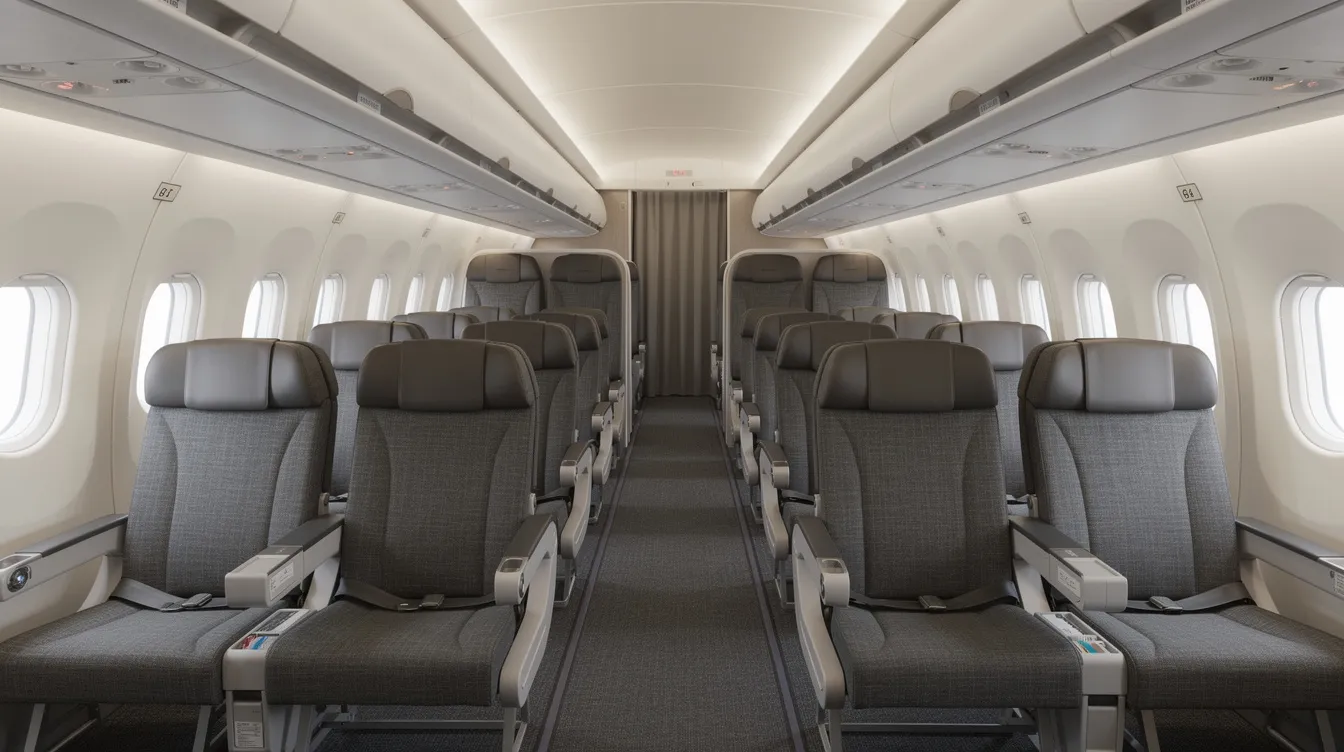
Economy class is where most passengers experience the 767‑300ER's long‑range capability, often on overnight sectors of eight hours or more.
Typical economy class seat characteristics include:
Pitch: Around 31–32 inches
Seat width: Close to 17.5–18 inches
Layout: 2‑3‑2, resulting in only one true middle seat per row in the center block
Common aircraft features that improve comfort on long flights include movable armrests on aisle and some window seats for easier access, adjustable headrests, and — on many refurbished aircraft — individual seatback screens with USB ports and AC power outlets. Many 767s are equipped with in‑seat power outlets, particularly those that have gone through recent cabin refreshes.
Older or unrefurbished 767‑300ER cabins may still rely on overhead monitors or early CRT screens and have limited power availability. On an 8–10 hour flight, this can be a drawback for travelers who depend on personal devices. The gap between refurbished and older interiors on this aircraft is significant.
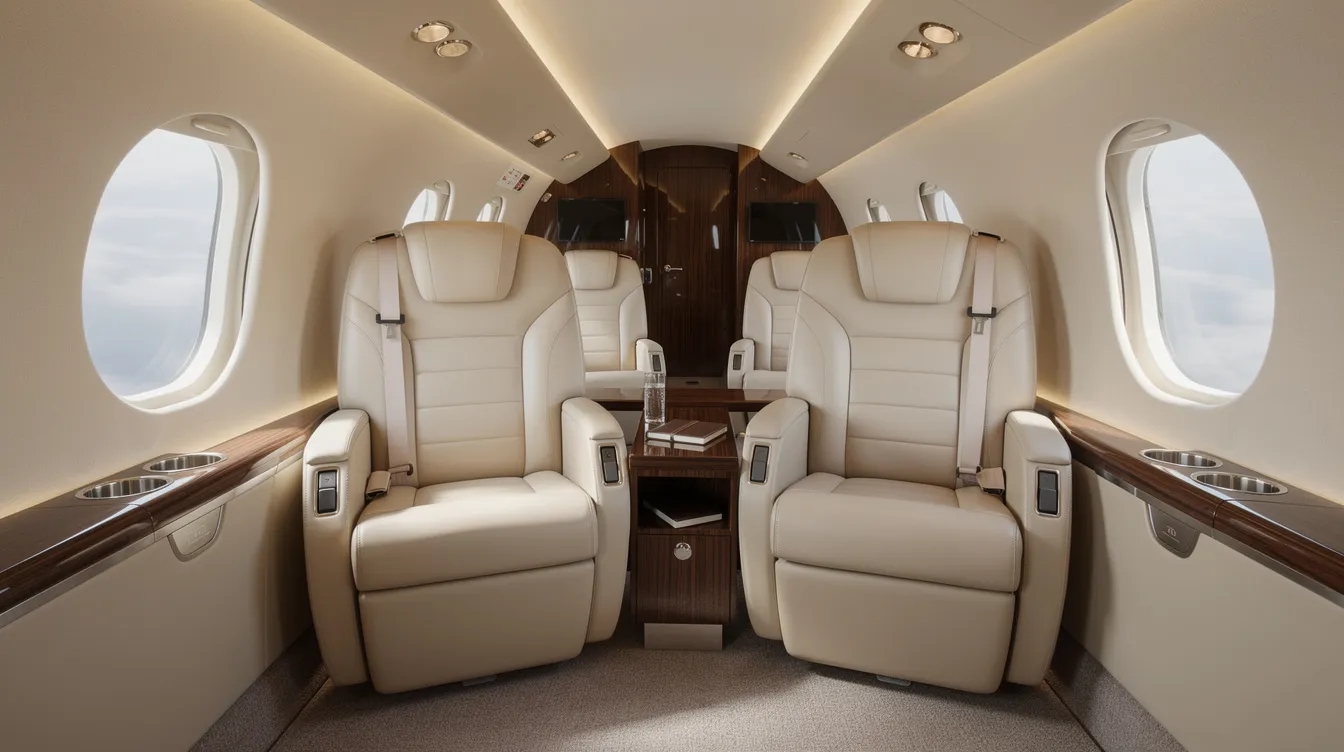
By contrast, typical private jet cabins accessible via Jettly cover ranges similar to shorter 767‑300ER sectors with far fewer seats and more generous personal space for each traveler. Private jets offer more personal space than commercial flights, which matters especially on red‑eye crossings.
Airlines upgraded business and premium cabins on 767‑300ER fleets specifically because the aircraft often flies overnight long‑range missions where passenger willingness to pay for comfort is highest.
Modern business class layouts on the 767‑300ER include:
Seating: 1‑2‑1 or staggered layout with direct aisle access for every seat
Pitch: Business class seats often have a pitch of 70–80 inches, with lie‑flat beds
Width: Approximately 20.6 inches in United's Polaris configuration
Screens: Up to 16 inches in Polaris
Premium economy seats usually offer 35–38 inches of pitch, enhanced recline, and sometimes legrests or footrests. United's Premium Plus section uses a 2‑2‑2 layout with 13‑inch screens and a seat width of about 18.5 inches — no middle seats at all in that cabin.
Key amenities valued on long‑range sectors include upgraded dining, amenity kits, noise‑canceling headphones, Wi‑Fi availability, and at‑seat power outlets to support work or rest at cruising altitude.
For comparison, large‑cabin private jets available through Jettly — such as Gulfstream or Dassault Falcon models — can handle similar ranges with fully flat beds, bespoke catering, and total cabin privacy for small groups, supported by dedicated services like Jettly Eats in‑flight catering. Rolls-Royce and other engine manufacturers power many of these long‑range private aircraft.
The 767‑300ER's success as a long‑range aircraft is not only about fuel capacity and engines. Several operational and cabin features make it viable for extended sectors.
The 767 was one of the first ETOPS-certified aircraft. ETOPS (Extended‑range Twin‑engine Operational Performance Standards) certification — initially 120 minutes, later expanded to 180 minutes on many airframes — enabled efficient transatlantic and remote‑ocean routes that previously required three or four engines for safety margins.
Over its service life, cockpit and avionics upgrades improved navigation and fuel efficiency on long sectors. Modern Flight Management System enhancements and satellite communications are now standard on the fleet, used by airlines and cargo operators alike.
In‑cabin features tied to range and passenger endurance include:
Pressurization levels consistent with its generation (cabin altitude around 8,000 ft)
Lighting schemes designed to reduce jet lag on overnight flights
Galleys sized for multiple meal services on flights over eight hours
Many 767‑300ERs also received winglets, which marginally improve fuel efficiency and can extend effective range or reduce fuel burn on standard long-haul routes. These were not part of the aircraft's first flight configuration but have been widely adopted.
Advertised maximum range assumes a specific passenger and cargo weight. The actual flight range of the Boeing 767‑300 depends on payload and other operational conditions, and airlines constantly balance these two variables.
The basic concept works like this:
At full passenger and cargo load, the maximum achievable range is lower than published specs.
At lower payloads (for example, premium‑heavy layouts with 167 seats instead of 260+), the aircraft can fly closer to its theoretical maximum range.
Payloads affect the range capability of the Boeing 767‑300 in every variant.
United Airlines' premium‑heavy 167‑seat configurations effectively trade payload for comfort. This also gives the carrier more margin for long winter westbound segments within the aircraft's range envelope, where headwinds can cut hundreds of miles off effective range.
Cargo operators sometimes restrict payload on particularly long routes to ensure sufficient fuel reserves. The same airframe is optimized very differently for freight versus passenger missions — freight carriers push payload heavy and accept shorter ranges on specific legs.
This concept applies equally to private jet charter through Jettly. Private operators similarly adjust passenger count, baggage, and fuel planning to reach specific long‑range destinations, often providing direct flights that bypass commercial hubs on international private jet routes.
The 767‑300ER's combination of range and cruising speed determines where it fits in an airline's route network and daily schedules.
At a typical cruising speed around Mach 0.80–0.82, an eight‑hour flight covers roughly 4,000–4,300 nautical miles. That matches most common transatlantic sectors this aircraft serves.
Airlines time 767‑300ER departures to enable overnight "red‑eye" eastbound transatlantic flights and daylight westbound returns. This scheduling pattern maximizes aircraft utilization — the plane can fly to London or Frankfurt overnight, turn around during the European morning, and arrive back in New York by early afternoon.
Flying at slightly lower speed can reduce fuel burn and extend range, while speed increases slightly raise operating costs but can improve schedule recovery after delays. Airlines set speed primarily to balance schedule commitments, fuel burn, and air traffic constraints rather than to stretch range to the absolute maximum.
Private jet scheduling through Jettly works differently. Private jet charters allow on‑demand departure times, so travelers can tailor departures around meetings or connections rather than being locked into fixed commercial timetables, especially when working with a private jet operator network like Dexter Air Taxi on Jettly.
The 767‑300ER entered service in the late 1980s and continued to operate extensively into the 2020s. During the same period, Boeing developed the 787 Dreamliner as its direct replacement for long‑range twin‑aisle operations.
Many passenger airlines have been gradually replacing the 767‑300ER on long-haul routes with more fuel-efficient aircraft like the Boeing 787 and Airbus A330neo/A350. These newer designs offer similar or better range with roughly 30–40% lower fuel consumption per seat. United Airlines has signaled full 767‑300ER passenger fleet retirement by approximately 2027.
Boeing and conversion specialists have converted large numbers of retired 767‑300ERs into freighters through programs like BCF (Boeing Converted Freighter) and BDSF. The type's range and cargo volume are a strong fit for express package networks, with typical freighter structural payloads around 52–57 tonnes.
The aircraft's continued freighter use means its range characteristics will keep influencing global cargo routing well into the 2030s, even as passenger fleets shrink. The production line for the 767 continues in freighter form for now.
For individual travelers planning long‑range private trips, shifting airline fleets have little impact. Jettly's marketplace focuses on business jet and charter operators rather than commercial widebodies, so availability remains consistent regardless of which carrier retires which fleet, and platforms like Jettly position themselves as a flexible NetJets alternative without long‑term fractional commitments.
While commercial widebodies carry hundreds of passengers, many private jets can cover similar ranges for smaller groups with greater flexibility.
|
Category |
Typical Range |
Passengers |
Example Aircraft |
|---|---|---|---|
|
Light jets |
1,200–2,000 nm |
4–8 |
Citation CJ4, Phenom 300 |
|
MMid-size/ super-mid-size jets |
2,000–3,500+ nm |
8–12 |
Citation Latitude, Challenger 350 |
|
Heavy / long‑range jets |
4,000–6,000 nm |
10–16 |
Gulfstream G550, Falcon 7X |
|
Ultra‑long‑range jets |
6,000–7,500+ nm |
12–19 |
Bombardier Global 6000, Gulfstream G650ER |
Some large‑cabin aircraft can match or exceed the 767‑300ER's range. For trips like New York–London or Los Angeles–Honolulu, private jets that can fly to Europe and beyond are available through Jettly, flying nonstop with fewer passengers and bypassing connections.
Private jet charters can access smaller airports than commercial flights, significantly reducing total door‑to‑door travel time even when cruising speed is similar to or slightly lower than that of a 767. Private aircraft lack distinct economy class or business class sections — the entire cabin is effectively a premium cabin, making long-distance flights more comfortable for small groups despite smaller airframes.
This comes down to practical trade‑offs: cost per person, schedule flexibility, and route availability.
Scenarios favoring a 767‑300ER commercial flight:
Solo or small‑group leisure travel on major transatlantic routes where commercial tickets are cost‑effective
Schedules that align with existing airline departures on domestic routes or intercontinental routes served from major hubs
Budget‑conscious travelers who do not need scheduling flexibility
Scenarios favoring private charter through Jettly:
Multi‑city business trips where commercial connections waste hours
Flights to secondary airports not served by long‑haul airlines
Time‑sensitive travel where same‑day return is essential
Groups traveling together — executive teams, sports squads, high‑net‑worth families — where splitting the cost of a private jet or using crowdsourced private jet flights to share empty seats becomes competitive with premium‑cabin tickets on long‑haul 767‑300ER service
Travelers exploring private options can use Jettly's charter cost estimator and aircraft filters by range to quickly see which private aircraft can handle their planned itinerary nonstop, then refine choices further with guides on affordable private jet charter costs.
Growing awareness of aviation's environmental impact makes aircraft efficiency a factor in travel decisions.
The 767‑300ER was more fuel efficient than earlier tri‑jets and quad‑jets, but it is generally less efficient on a per‑seat basis than newer designs like the Boeing 787 or Airbus A350 on the same long‑range missions. The difference can be 30–40% in fuel burn per seat under comparable conditions.
Winglet retrofits and operational improvements — optimized altitudes, continuous descent approaches, lighter cabin interiors — have helped reduce the 767‑300ER's fuel burn and emissions on long routes. These changes don't close the gap entirely, but they extend the aircraft's economic life.
Private jet flights, including those brokered through Jettly, typically involve fewer passengers per flight. Operators and travelers often look at carbon offset programs, modern aircraft selection, and efficient routing to mitigate environmental impact. Travelers concerned about emissions can consider newer, more fuel-efficient private aircraft, optimized passenger counts, and voluntary offset schemes when booking long‑range trips, alongside understanding aircraft rental costs and options that may influence which types of jets they choose.
Understanding aircraft range — whether for a Boeing 767‑300ER or a private jet — is essential for trip planning, connection choices, and budget decisions.
Jettly's digital platform allows users to input origin, destination, and dates to instantly see charter options filtered by range capability, aircraft size, and price. This simplifies complex route planning that would otherwise require comparing multiple commercial carriers, connection times, and aircraft types.
The platform offers access to a global inventory of more than 20,000 aircraft, enabling travelers to compare private jets whose range and cabin characteristics best match missions that might otherwise rely on long‑haul commercial flights. Whether the trip calls for a midsize jet to fly coast to coast or an ultra‑long‑range cabin to cross the Atlantic, Jettly's inventory covers it.
Jettly promotes transparent pricing and on‑demand booking, avoiding the long‑term financial commitments of traditional jet cards or fractional ownership, even though some travelers may still compare these options to jet card programs with fixed hourly rates or use tools like a jet card flight cost estimator when evaluating long‑term solutions; others may prefer flexible private jet memberships that balance commitment and convenience. This is particularly useful for occasional long‑range travelers who do not want to lock in recurring costs.
Learn more about charter options and aircraft range planning at https://www.jettly.com or explore a broader overview in this guide to charter airlines and private aviation options.
While the published maximum range is around 5,980 nautical miles in a standard two‑class configuration, real‑world usable range is often in the 5,000–5,500 nm band. Headwinds, routing restrictions, alternate airport requirements, and mandatory fuel reserves all reduce effective range. Westbound transatlantic flights in winter are where this gap is most noticeable. Launch customer airlines learned early to plan for these margins.
Small adjustments in cruising speed — for example, Mach 0.79 versus 0.82 — can marginally improve fuel efficiency and thus effective range. However, airlines set speed primarily to balance schedule commitments, fuel burn, and air traffic constraints rather than to stretch range to the absolute maximum. The speed difference rarely exceeds a few percent in fuel savings.
Some shorter North America–Asia city pairs within roughly 5,000–5,500 nm are technically within range under favorable conditions. However, airlines more commonly use newer long‑range aircraft like the 787 or 777 on those missions. The 767‑300ER is more frequently deployed across the Atlantic and to parts of South America, where its range and mid-size capacity match market demand. The type also lacks the per‑seat economics of newer aircraft on ultra‑long Pacific legs, and military variants of the 767 serve different operational needs entirely, though they share fuselage lengths with the commercial version.
Amenities like USB ports, AC power outlets, and personal seatback screens depend on the airline and whether the cabin has been refurbished. Newer interiors on carriers like United Airlines typically include these in premium cabins and increasingly in economy, while older airframes may still rely on limited or shared power and overhead screens. Risk-sharing agreements between Boeing and suppliers during the aircraft's development did not dictate cabin amenity standards — those evolved over each carrier's refurbishment cycles.
Many mid-size and large‑cabin private jets available through Jettly can comfortably cover 3,000–6,000+ nautical miles, allowing nonstop routes like New York–London or Los Angeles–Hawaii for small groups. Travelers can reduce per‑person costs by buying a seat on a private jet or leveraging platforms that show easy ways to get a seat on private flights. The added flexibility of choosing departure times and smaller airports not served by long‑haul commercial aircraft makes charter attractive even when a private jet's range matches or falls short of the 767‑300ER's. Every row of a private cabin is your row — there is no distinction between premium and economy, and each seat can be adapted to the traveler.
Ready to experience private travel on your terms? Explore flight options or request a quote at https://www.jettly.com.
The Boeing 767-300ER remains a vital aircraft in long-haul commercial aviation, offering a balanced combination of range, capacity, and efficiency that has served airlines and passengers well for decades. Its extended range of nearly 6,000 nautical miles enables nonstop flights across major transatlantic and transcontinental routes, while cabin configurations are tailored to optimize comfort on 7–11-hour sectors. However, as newer, more fuel-efficient aircraft enter service, the 767-300ER is gradually being phased out from passenger fleets but continues to thrive in cargo and freighter roles.
For travelers seeking greater flexibility, privacy, and personalized service, private jet charter platforms like Jettly provide compelling alternatives. These options offer similar or greater range capabilities for smaller groups, access to more airports, and on-demand scheduling that commercial flights cannot match. Whether choosing a 767-300ER commercial flight or a private charter, understanding the Boeing 767-300ER range, private jet charter options, airport access advantages, and charter cost estimator helps travelers make informed decisions that best fit their itinerary, budget, and comfort preferences.
Ready to experience private travel on your terms? Explore flight options or request a quote at https://www.jettly.com.aircraft’s range and operational characteristics helps travelers make informed decisions that best fit their itinerary, budget, and comfort preferences.
Ready to experience private travel on your terms? Explore flight options or request a quote at https://www.jettly.com.
Share this post:
Jay Franco Serevilla
Oct 17, 2026
|
5
min read
Discover tips and trends in the industry.
5
min read
Boeing 767-300 Range: Performance, Routes, and Private Charter Alternatives
The Boeing 767-300ER is a widely used long-haul aircraft known for its impressive range of approximately 5,980 nautical miles. This guide explores its performance, typical routes, and how it compares to private jet charter options, making it essential for travelers and aviation enthusiasts alike. Understanding the capabilities of the 767-300ER can help in planning smarter trips, whether flying commercially or considering private charter alternatives.
Read More
5
min read
Boeing 737-300: Second-Generation Classic Airliner for Airlines and Private Charter
The Boeing 737-300 is a pivotal second-generation airliner that transformed commercial aviation since its introduction in the mid-1980s. Although many airlines have retired this model, it remains in service for cargo, VIP, and private charter operations worldwide, showcasing its adaptability and enduring value. This article delves into the aircraft's legacy, specifications, and its relevance in today's aviation landscape.
Read MoreStay updated with our latest insights and tips to elevate your journey with us.
MEMBERSHIPS AND ASSOCIATIONS



Disclaimer: Jettly operates as a charter broker, offering access to a global digital jet charter marketplace. Jettly is not a direct air carrier and does not own or operate aircraft. All advertised flights are conducted by third-party air carriers that are fully licensed and hold the appropriate Part 135 or Part 121 certifications issued by the Federal Aviation Administration (FAA) or equivalent regulatory authorities under U.S. or foreign law. Jettly complies fully with the U.S. Department of Transportation's Part 295 and Part 298 Charter Broker regulations. Jettly does not carry additional liability insurance. Passengers are covered by aircraft operator insurance. TICO: 50023770


