



Login
Get Instant Pricing On 23,000+ Aircraft

>

Dan Jones International Airport (T51) is a small, privately owned public-use general aviation airport in Cypress, Texas, serving private pilots and charter operators across northwest Houston. For business travelers, corporate executives, high-net-worth individuals, and families looking to skip the congestion of major hubs, it offers a faster, lower-hassle departure point for light aircraft, turboprops, and very light jets. Here is what to know about the airport’s location and facilities, what kinds of private flights it can handle, how it compares with larger Houston airports, what ground transportation options to expect, and how to book a charter through Jettly’s digital marketplace. The airport primarily serves general aviation (general aviation refers to all civil aviation operations other than scheduled commercial airline service, including private pilots and recreational flying).
Dan Jones International Airport (T51) is a privately owned, public-use general aviation field covering 24 acres near Cypress and Tomball in unincorporated Harris County, TX.
The airport has a single runway (17/35) measuring 3,440 by 50 feet, primarily supporting light aircraft, turboprops, and select light jets.
Historical data shows roughly 7,800 annual aircraft operations, an average of about 21 daily movements, all general aviation with no scheduled commercial airline service.
Its location approximately 22 nautical miles northwest of downtown Houston makes it a time-saving alternative for business travelers and families in the area.
Jettly connects travelers with on-demand private charter flights that can use Jones International Airport when runway and aircraft performance allow. Explore options at jettly.com.
Dan Jones International Airport (FAA identifier T51), also called Jones International Airport, is a small public-use, general aviation airport in unincorporated Harris County, Texas. It sits approximately 5 nautical miles southwest of Tomball and about 22 nautical miles northwest of downtown Houston.
The airport is privately owned by Daniel Jones of Cypress, Texas, but it is designated for public use by general aviation pilots and charter operators. Despite the word "international" in the name, the field functions primarily as a general aviation facility. Customs and scheduled international airline service are handled at larger Houston-area airports like George Bush Intercontinental (IAH) or William P. Hobby (HOU).
There is no air traffic control tower at the airport. Pilots self-announce on the CTAF/UNICOM frequency of 122.8 MHz. Jettly arranges private charter flights that can use Dan Jones International when runway length, aircraft type, and conditions allow, and also invites partners to promote these services through its ULTRA high ticket affiliate program.
Next, let's look at the airport's ownership and its role in the region.
Dan Jones International is categorized as a public-use airport that is privately owned, distinguishing it from city- or county-owned municipal airports across the Houston region. Ownership by Dan Jones allows the field to serve the community while remaining outside direct municipal control, which often suits general aviation operators seeking flexible, low-congestion access.
Within northwest Houston's aviation ecosystem, T51 functions as a convenience airport for local pilots, flight training, recreational flying, and private flights. Pilots and operators who might otherwise navigate the heavier traffic at IAH, HOU, or David Wayne Hooks can use this field for quicker turnarounds. The airport supports non-scheduled operations, including on-demand charter services accessed through digital platforms like Jettly.
The facility is listed in FAA records as T51. It has been surveyed and reported on periodically, with data covering flight activity, based aircraft, and aerodrome details available through FAA and tracking sources as well as Jettly's airport locator tool.
Now, let's explore the airport's location, access, and the communities it serves.
The airport sits in unincorporated Harris County near Cypress, Texas, at an elevation of 166 feet above mean sea level. Driving from Tomball typically takes around 10 to 15 minutes. From downtown Houston, travelers can expect 35 to 45 minutes under normal traffic conditions.
Key business and residential communities served include Tomball, Cypress, and the northwest Houston suburbs along the US 290 and SH 249 corridors. Ground access is straightforward: most passengers arrive by private car, corporate car service, or pre-arranged chauffeured transportation. Jettly can coordinate ground transfers as part of a charter itinerary.
For business travelers heading to Austin, Dallas, or San Antonio, departing from this field saves significant drive time compared to heading into a major hub during the week.
Next, let's review the runway, facilities, and operational details at Dan Jones International Airport.
Runway designation: 17/35
Length: 3,440 ft (1,049 m)
Width: 50 ft (15 m)
Surface: Asphalt with runway turf shoulders
Elevation: 166 ft MSL
Lighting: Low intensity edge lights, single threshold light
Beacon: Present (nonstandard colors noted in FAA remarks)
Hours: Dawn (sunrise/sunset reference) to midnight; closed midnight to dawn
For the 12-month period ending May 2008, roughly 7,800 aircraft operations were recorded, averaging 21 operations per day. All were classified as general aviation, typically using private charter aircraft suited to a smaller field like T51. At that time, around 18 aircraft were based on the field, with 94% single-engine and 6% multi-engine. Current traffic levels can fluctuate, and operators should contact FAA sources for up-to-date figures.
The airport is operational all year round from dawn until midnight. Rotor wing aircraft operations are also permitted when conditions and surface allow.
Obstacles: Trees (approx. 35 ft) near runway end; deer and cattle reported in area
Displaced thresholds: Day displaced threshold on runway 17 is approximately 255 feet; portions of runway usable at night are reduced further due to displaced thresholds on the runway 35 end
Instrument procedures: No published instrument approach procedures; pilots should cancel IFR expectations
Runway condition: Reported in good condition with basic maintenance
To review the full page of details, users can zoom in on AirNav's T51 listing or click through FAA resources for the latest information.
Now, let's discuss general aviation and private jet use at Jones International.
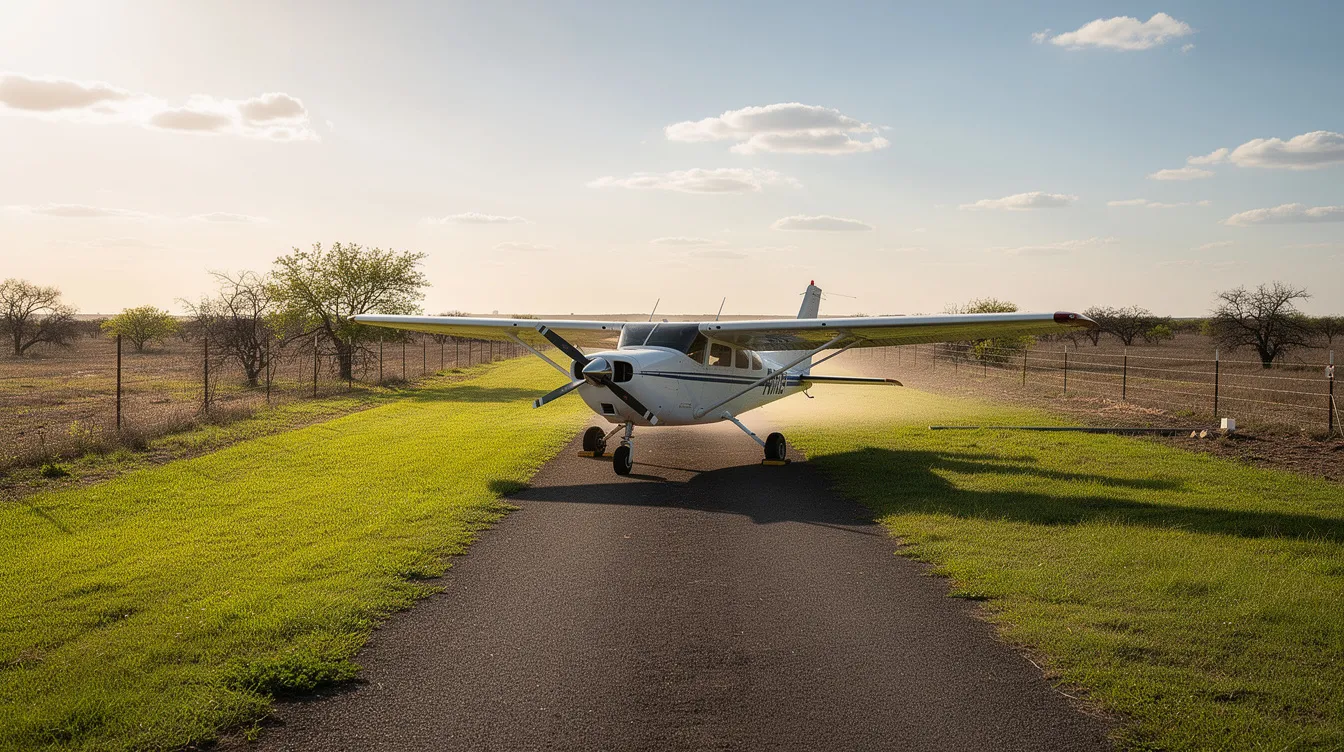
Dan Jones International Airport primarily serves general aviation aircraft. General aviation refers to all civil aviation operations other than scheduled commercial airline service, including private pilots and recreational flying. Light aircraft operations are the main focus of the airport, and the airport caters primarily to private pilots and recreational flying. Flight instruction and locally based aircraft round out the typical activity.
The 3,440-foot runway accommodates single-engine pistons, light twin-engine planes, some turboprops, and select very light jets with appropriate performance margins. Wildlife in the vicinity includes deer and occasionally cattle, which adds a layer of operational awareness for pilots.
For private jet charter, runway length constraints are a key factor. Hot Texas summers degrade aircraft performance and increase required takeoff distance, so charter brokers like Jettly evaluate aircraft weight, payload, and weather before confirming flights into T51. Compared to larger Houston airports, Jones International offers fewer crowds and quicker car-to-aircraft transitions, balanced against more limited aircraft class options and facilities.
Some charter customers prefer this field for short hops within Texas, booking turboprops or small aircraft through Jettly's platform and leveraging Jettly's focus on affordable private jet charter to keep trip costs under control.
Next, let's see how to charter a private flight to Dan Jones International with Jettly.
Jettly is a digital private jet charter marketplace connecting travelers with more than 20,000 aircraft worldwide. Suitable aircraft that can operate to and from Dan Jones International Airport are available when performance and conditions permit.
To search routes involving T51, travelers enter departure and arrival points, select dates and passenger count, and receive instant pricing estimates through Jettly's private jet charter platform. The charter cost estimator and Jettly's dedicated jet card flight cost estimator cover multiple aircraft categories relevant to this runway: turboprops like the King Air, very light jets, and light jets.
Jettly's model emphasizes transparent, up-front pricing and on-demand access, while optional jet card programs provide additional flexibility for frequent flyers without traditional fractional ownership commitments. This benefits travelers who only occasionally route via Jones International. Value-add services include coordinating in-flight catering through Jettly Eats, arranging ground transfers from homes or offices in Cypress and Tomball, and verifying that operators meet recognized safety standards.
Now, let's examine why travelers choose Jones International over larger Houston airports.
While Houston's major airports handle heavy airline traffic, smaller fields like Dan Jones International offer distinct advantages for private flyers:
Shorter drive times for residents of Cypress, Tomball, and northwest Houston suburbs
Quick boarding with minimal taxi and hold times on the ground
Schedule flexibility through on-demand flights that match business or family needs
Privacy and discretion preferred by executives and high-net-worth individuals
Trade-offs exist. Terminal facilities are minimal, fuel options are limited (primarily 100LL), and Jet A availability is inconsistent. Jettly helps clients decide whether Jones International or another nearby airport, such as those found through Houston private jet charter options, better suits a specific trip.

Next, let's see how Jettly can help you plan trips from the Houston–Cypress area.
Travelers in the Cypress or Tomball area can use Jettly to compare flights from Dan Jones International Airport against other nearby airports, weighing convenience, aircraft choice, and cost side by side.
Sample use cases:
A small team of four flying on a turboprop from Jones International to Dallas for a day of meetings
A family chartering a light jet to Destin or the Texas Hill Country for a long weekend
An executive needing a same-day round trip to San Antonio, departing and returning to T51
Jettly's platform shows multiple routing options. It marks Dan Jones International as available when aircraft performance permits, while also surfacing empty leg flights and alternate departures for broader flexibility. Both on-demand charter and private jet membership options are available for frequent flyers based near Cypress.
Ready to explore private charter options from T51? Visit jettly.com to get instant pricing or request a personalized quote for routes involving Jones International Airport.
Now, let's answer some frequently asked questions about Dan Jones International Airport.
Despite the name, Dan Jones International Airport does not host scheduled international airline service. The "international" title is aspirational rather than functional. International private flights typically require customs and immigration facilities found at larger Houston airports. Jettly can help clients select the right airport for cross-border trips, including options to crowdsource private jet flights and share empty seats when appropriate.
The 3,440-foot runway best accommodates:
Single-engine pistons
Light twins
Turboprops
Some very light jets
Midsize and heavy jets generally require longer runways and would use other Houston-area airports.
Jettly's team checks runway performance before confirming any charter into T51.
No. Dan Jones International Airport does not provide scheduled commercial airline service.
All recorded operations are general aviation.
Travelers seeking airline connections use George Bush Intercontinental (IAH) or William P. Hobby (HOU).
Yes. Jettly can coordinate chauffeured cars and premium ride services to pick up or drop off passengers at the airport or nearby locations in Cypress and Tomball.
Share your exact addresses during the quote process to optimize transfer logistics.
Visit jettly.com
Enter Dan Jones International Airport (T51) as your departure or arrival point
Set your dates and passenger count
Review instant pricing
Contact Jettly's support team through the platform if you need guidance on aircraft suitability for the T51 runway.
Dan Jones International Airport (T51) offers a convenient, low-traffic option for private pilots and charter travelers in the northwest Houston area. Its single 3,440-foot runway primarily supports light aircraft, turboprops, and select very light jets, making it ideal for short- to medium-range private flights. While lacking scheduled commercial service and extensive terminal facilities, the airport’s location near Cypress and Tomball saves valuable time compared to larger Houston airports. Jettly’s digital platform provides easy access to private charter options at T51, with transparent pricing and instant booking for travelers seeking flexibility and efficiency. Whether for business or leisure, Dan Jones International is a practical choice for private aviation in the region.
Ready to experience private travel on your terms? Explore flight options or request a quote at https://www.jettly.com
Share this post:
Jay Franco Serevilla
Jul 1, 2026
|
5
min read
Discover tips and trends in the industry.
5
min read
Business Class in Flight: Comfort, Cost, and Private Jet Alternatives with Jettly
Flying business class offers travelers enhanced comfort, priority services, and access to airport lounges, making long-haul flights more enjoyable. However, for those seeking ultimate privacy and flexibility, private jet charters through platforms like Jettly present a compelling alternative. This guide explores the benefits, costs, and comparisons between business class and private jet travel.
Read More
5
min read
Price of Helicopter Fuel: What It Really Costs to Fly
Understanding helicopter fuel prices is essential for charter flight customers, as fuel is the largest variable cost in helicopter operations. This article details current fuel prices, burn rates across various helicopter models, and regional price variations, helping customers make informed decisions. Jettly's transparent pricing model incorporates these factors, ensuring no surprises during booking.
Read MoreStay updated with our latest insights and tips to elevate your journey with us.
MEMBERSHIPS AND ASSOCIATIONS



Disclaimer: Jettly operates as a charter broker, offering access to a global digital jet charter marketplace. Jettly is not a direct air carrier and does not own or operate aircraft. All advertised flights are conducted by third-party air carriers that are fully licensed and hold the appropriate Part 135 or Part 121 certifications issued by the Federal Aviation Administration (FAA) or equivalent regulatory authorities under U.S. or foreign law. Jettly complies fully with the U.S. Department of Transportation's Part 295 and Part 298 Charter Broker regulations. Jettly does not carry additional liability insurance. Passengers are covered by aircraft operator insurance. TICO: 50023770


