



Login
Get Instant Pricing On 23,000+ Aircraft

>
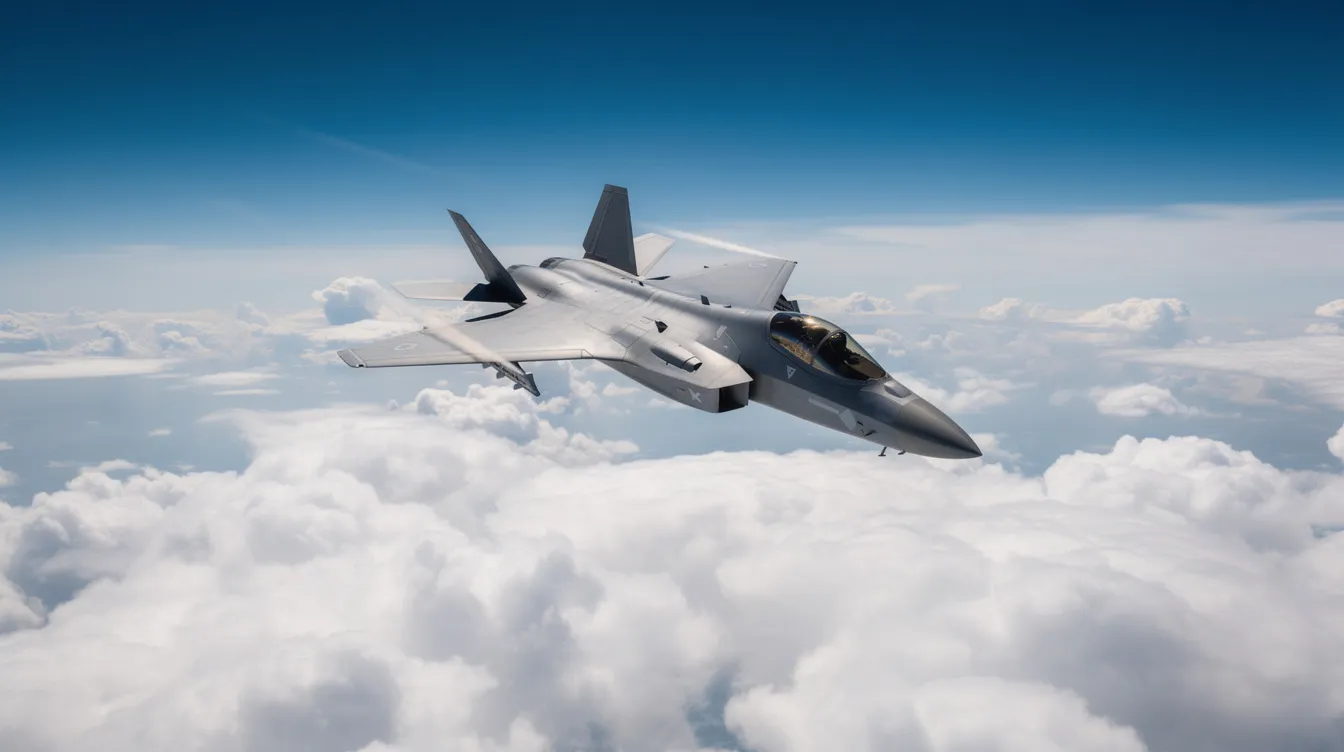
The f 35 stealth fighter jet is arguably the most talked-about military aircraft program of the last three decades. Designed to combine stealth, advanced sensors, and multi role flexibility into a single airframe, the F-35 Lightning II serves as the backbone of air power for the United States and a growing list of allied nations. This guide breaks down everything you need to know about the program, from its origins and technology to its global impact and future trajectory.
The f 35 lightning ii is a fifth-generation multirole stealth fighter jet that serves the U.S. Air Force, Navy, Marine Corps, and over a dozen allied nations, combining stealth, sensor fusion, and networked warfare to enhance global security.
The program includes three variants: the f 35a for conventional runways, the f 35b for short takeoff and vertical landing, and the f 35c for aircraft carrier operations. Each addresses distinct mission requirements for different service branches.
Lockheed Martin is the prime contractor, with Northrop Grumman providing the center fuselage and key mission systems, and BAE Systems building aft structures and flight controls. By mid-2025, the global fleet exceeded 1,340 delivered aircraft and surpassed one million flight hours.
The F-35 program supports economic growth and tens of thousands of skilled jobs across the U.S. and partner nations, while strengthening NATO and Indo-Pacific security through shared platforms, common training, and interoperable data links. In the civil sector, a similarly global network of operators and platforms underpins private flying, as outlined in comprehensive guides to charter airlines and private flights.
While the F-35 represents the cutting edge of military aviation, civilian business aircraft operate in a different regulatory world. Platforms like Jettly focus on safe, efficient private jet charter, connecting travelers with certified civil operators rather than combat systems.
The F-35 Lightning II is a single-seat, single-engine, fifth-generation multirole stealth fighter designed to conduct both air-to-air and air-to-ground missions. It is the most expensive weapons system in history and, increasingly, the most widely fielded stealth aircraft in the world.
The designations "f 35" and "f 35 lightning ii" refer to the same program. The aircraft emphasizes stealth shaping, supersonic speed of Mach 1.6, advanced sensors, and the ability to share data across a joint force in real time. The F-35 is designed for air superiority, ground attack, and ISR missions, and it can conduct various missions including electronic warfare and reconnaissance on a single sortie.
The program includes three variants. The f 35a is the conventional takeoff and landing model for land-based air forces. The f 35b uses short takeoff and vertical landing technology for operations from amphibious ships and austere airstrips. The f 35c is the carrier variant, equipped for catapult-assisted launches and arrested recoveries aboard full-sized aircraft carriers.
These aircraft support the U.S. air force, navy, marine corps, and allied air forces across roles ranging from air superiority and close air support to electronic warfare and intelligence, surveillance, and reconnaissance. The fighter jet is designed and produced primarily by lockheed martin, with critical contributions from northrop grumman and BAE Systems, forming one of the largest defense industrial collaborations in history.
The first F-35A flew on 15 December 2006, marking the beginning of a comprehensive flight test program. The US Marine Corps declared Initial Operational Capability (IOC) for the F-35B variant on 31 July 2015, with the first F-35B deployment following in 2017 at MCAS Iwakuni, Japan. The F-35C variant achieved operational status on 28 February 2019. Israel’s unique F-35I subvariant conducted its first combat operation in May 2018, while F-35As carried out their first combat mission on 27 April 2019.
The F-35 program traces its roots to the 1990s joint strike fighter competition run by the U.S. Department of Defense. The goal was straightforward but ambitious: develop a single family of stealth strike aircraft that could replace multiple aging platforms across three military services, all while keeping costs manageable through shared design and production.
In October 2001, after a concept demonstration phase, the Lockheed Martin X-35 beat Boeing's X-32 demonstrator. That decision launched the system development and Demonstration phase, formally known as the sdd phase, which would evolve into the F-35 Lightning II program over the following years.
The core design goals were clear. The aircraft needed to replace aging fleets of F-16s, AV-8B Harriers, and F/A-18s. It had to deliver stealth capabilities approaching those of the F-22 Raptor, share as much commonality as possible across services, and reduce long-term support costs compared with operating three separate fighter types.
The name "Lightning II" honors earlier Lockheed fighters like the P-38 Lightning from World War II and reflects the jet's planned role as a versatile strike aircraft across multiple domains, from air to surface to sea.
The program was multinational from the start. Partner countries including the UK, Italy, the Netherlands, Canada, Australia, Norway, and Denmark invested in development to gain industrial participation and early access to the fighter jet. This structure laid the groundwork for the global partnerships that define the program today.
Lockheed Martin serves as the prime contractor for the F-35, responsible for overall system integration and final assembly. The primary production facility is located in fort worth, Texas, where the majority of aircraft are built before delivery to U.S. and international customers.
Northrop Grumman builds the center fuselage and contributes key mission systems, including sensors and avionics that form the backbone of the aircraft's situational awareness capabilities. BAE Systems produces the aft fuselage, empennage, and flight control systems. Together, these three companies form the industrial core of the program.
Beyond this primary trio, hundreds of suppliers across Europe, North America, and the Asia-Pacific region produce components such as wings, landing gear, composite structures, and software modules. The UK, as the sole Tier 1 partner, contributes roughly 10% of F-35 development costs through over 100 British suppliers.
This globally distributed production model supports economic growth and skilled employment in partner countries. It also creates complex supply chains and export control requirements that differ sharply from the way civilian manufacturers of airplanes build business jets and commercial airliners.
For private and commercial aviation, the industrial ecosystem looks quite different. Platforms like Jettly work with certified civil operators who source aircraft from established business jet manufacturers. The regulatory, economic, and production frameworks are distinct from defense procurement, even though both sectors rely on precision engineering and global supplier networks.
The F-35's outer shape and materials are optimized to reduce radar cross-section and infrared signatures while maintaining the maneuverability needed for combat. The F-35's stealth design minimizes infrared and visual signatures across multiple threat bands.
Key stealth shaping features include canted tails, aligned panel edges, internal weapons bays, and the F-35's diverterless supersonic inlet, which reduces radar signature by eliminating the traditional boundary layer diverter found on older fighters. These design choices work together to deflect and absorb radar energy rather than reflecting it back to an adversary's receiver.
The aircraft uses radar-absorbent materials to enhance stealth, along with edge treatments and serrated access panels designed to minimize reflections across a broad frequency range. The result is striking: the F-35's radar cross-section is lower than a metal golf ball, making it extremely difficult for conventional radar systems to detect and track.
Compared with earlier stealth aircraft like the F-117 Nighthawk, the F-35 features more durable coatings and easier access to maintenance panels. This represents a significant step forward in stealth sustainability, since earlier stealth jets were notoriously difficult to maintain in the field.
Stealth effectiveness is greatest when weapons are carried internally. Adding external fuel tanks or pylons increases radar signature, but this configuration can be used in lower-threat environments where maximum payload takes priority over low observability. Notably, the F-35 can mount Luneburg lens reflectors to disguise its actual radar cross-section during peacetime flights and training, preventing adversaries from collecting accurate signature data.
The F-35 is distinguished by low observability and high-capacity data sharing, a combination that separates it from every fourth-generation fighter jet in service today.
The Pratt & Whitney F135 turbofan engine powers all three F-35 variants. Derived from the F119 engine used in the F-22 Raptor, the F135 produces approximately 43,000 pounds of thrust in the f 35a configuration, making it one of the most powerful fighter engines ever built.
The F-35 has a top speed of Mach 1.6, roughly 1,200 miles per hour, and the f 35a variant can perform 9 g maneuvers, the highest of all variants. The f 35a has a combat radius of over 1,350 miles depending on mission profile and loadout, with internal fuel capacity of approximately 18,498 pounds. High subsonic cruise efficiency allows the aircraft to cover long distances without external tanks, preserving its stealth profile in contested environments.
The f 35b adds a shaft-driven lift fan and roll posts to enable vertical lift and short takeoff, which increases mechanical complexity but allows operations from amphibious assault ships and short runways. The f 35b sacrifices some fuel volume for the lift fan system. The f 35c features enlarged wings and strengthened landing gear for carrier operations, all powered by variations of the same engine family. The f 35c's more robust tailhook supports repeated arrested landings on carriers.
Future propulsion upgrades are under development. The Engine Core Upgrade by Pratt & Whitney aims to boost power and thermal management to support Block 4 capabilities and beyond. Adaptive cycle engine technology is also being studied as a potential longer-term solution to improve range and cooling capacity for new technologies integrated into the airframe.
One of the F-35's defining features is its integrated sensor and avionics architecture. Rather than presenting pilots with separate displays for radar, infrared, and electronic warfare, the aircraft fuses data from multiple systems into a single tactical picture. The F-35 uses sensor fusion to enhance situational awareness across all domains.
The principal sensors include the AN/APG-81 AESA radar, built by Northrop Grumman, which provides advanced targeting capability and can track multiple targets over 80 nautical miles away. The F-35 features the AN/APG-81 AESA radar for advanced targeting, and it can track multiple targets over 80 nautical miles away. The Distributed Aperture System tracks targets using six infrared sensors mounted around the airframe, giving pilots 360-degree infrared coverage without needing to maneuver the aircraft. The Electro-Optical Targeting System combines forward-looking infrared with infrared search and track functions. The AN/ASQ-239 electronic warfare suite rounds out the sensor package, providing threat detection, identification, and geolocation.
The aircraft combines radar, infrared cameras, and electronic warfare sensors for combat effectiveness. Sensor fusion on the F-35 combines data from various systems into a single display, dramatically reducing pilot workload and enabling faster, more accurate decisions. This capability is what gives the F-35 its first-look, first-kill advantage by detecting threats at long range before adversaries even know the aircraft is present.
The F-35's avionics are designed for network-centric warfare. The aircraft functions as an information node, sharing target data with other aircraft, ships, and ground units. This connected fighter aircraft concept turns the F-35 into more than just a weapons platform. It becomes a sensor and communications hub for the entire joint force.
Ongoing upgrade paths include Technology Refresh 3 hardware and planned new sensors like the AN/APG-85 radar, designed to keep the fighter jet ahead of emerging threats through the 2030s and beyond. The F-35 offers unparalleled situational awareness and network connectivity.
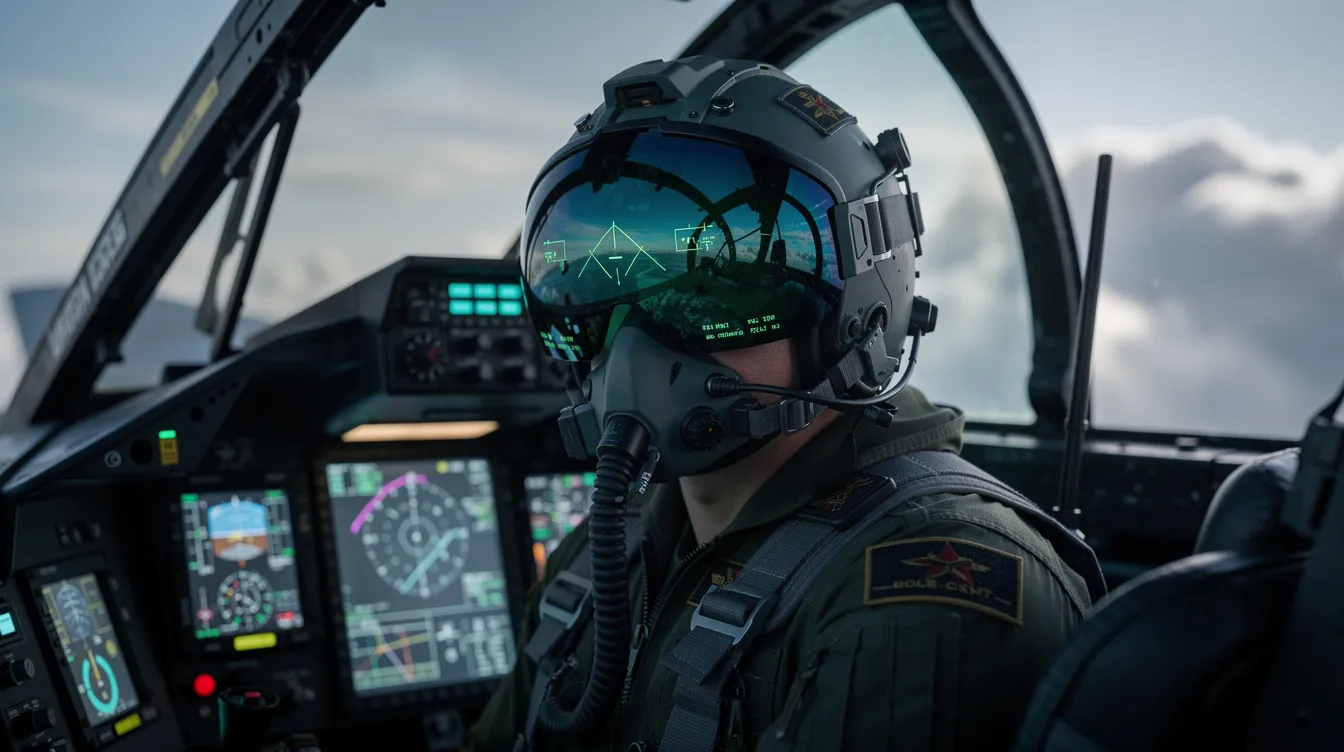
The F-35's cockpit is dominated by software and data visualization. Fewer traditional gauges and switches exist compared with fourth-generation fighters. Instead, pilots interact with a large panoramic cockpit display and touchscreen interface that lets them customize layouts for radar, weapons, flight data, and tactical information.
The F-35 features a helmet-mounted display for enhanced situational awareness. The Helmet-Mounted Display System projects symbology and sensor imagery directly onto the pilot's visor, enabling "look-and-shoot" targeting. Using imagery from the Distributed Aperture System, pilots can effectively see "through" the aircraft's structure, tracking targets below, behind, or to the sides without turning their heads to a separate display. This capability fundamentally changes how pilots interact with their environment during combat.
Software complexity is staggering. The F-35's Block 3F software includes 8.6 million lines of code, managing everything from sensor fusion and weapons release to flight controls and electronic warfare functions. The software baseline has evolved through incremental updates, starting with Blocks 2B and 3i, progressing to the current 3F standard, and now moving toward Block 4.
Each software increment adds new weapons, sensor modes, and electronic warfare functions. This approach allows the F-35 to grow its capabilities over time without requiring entirely new hardware, though it also introduces challenges in testing, integration, and cyber security.
Software delays have been one of the program's most persistent controversies. Agile development practices are now being used to push new capabilities to the fleet faster than traditional upgrade cycles allowed. However, balancing speed with reliability remains an ongoing tension for the Joint Program Office and the industrial team.
The F-35 can carry air-to-air and air-to-surface weapons internally for stealth, plus additional stores externally when low observability is less critical. The F-35 can carry up to 18,000 pounds of payload in its maximum external configuration, often referred to as "beast mode."
For air dominance missions, the standard internal load includes two AIM-120 AMRAAM medium-range air-to-air missiles. In some configurations, shorter-range missiles like the AIM-9X can be carried on special internal or semi-recessed stations. This internal weapons load preserves the aircraft's stealth profile while still providing effective air-to-air capability.
Air-to-ground options include JDAM precision bombs, Small Diameter Bombs, and various stand-off missiles. The F-35 can strike hardened, moving, or time-sensitive ground targets using precision guidance and sensor cueing from its onboard systems. Weapons integration efforts under Block 4 are expanding the range of munitions the aircraft can employ, including the Joint Air-to-Surface Standoff Missile.
The three variants differ in gun configuration. The f 35a has an internal 25 mm GAU-22/A cannon, while the f 35b and f 35c use a podded gun mounted under the fuselage when needed, preserving internal space for other mission systems.
The aircraft's main mission categories span air superiority, close air support, suppression and destruction of enemy air defenses, electronic attack, ISR, and maritime strike. The F-35 includes advanced electronic warfare capabilities for enhanced survivability, allowing it to operate in heavily defended airspace. This multi role flexibility means a single sortie can address several mission types, making the F-35 a powerful force multiplier for any formation it joins.
All three variants share a common stealth and sensor architecture, but each is tailored to different basing and mission requirements. This commonality keeps training, logistics, and software development costs lower than they would be for entirely separate aircraft programs.
The f 35a is the conventional takeoff and landing model used by the U.S. air force and the majority of international operators. Optimized for land bases, it carries an internal gun, offers the best payload and range performance among the three variants, and has the lowest operating cost per flight hour. It serves as the workhorse of the global fleet, performing everything from air superiority patrols to deep strike missions. The F-35A can perform 9 g maneuvers, the highest of all variants.
The f 35b is the short takeoff and vertical landing model. The U.S. marine corps, the UK's Royal Navy and Royal Air Force, and Italy operate this variant. Its lift fan, swiveling exhaust nozzle, and roll posts allow operations from amphibious assault ships and short runways. The mechanical complexity of the STOVL system adds weight and reduces internal fuel capacity compared with the A model, but the ability to operate from austere locations and smaller ships is invaluable for expeditionary operations. The F-35B sacrifices fuel volume for its lift fan system.
The f 35c is the carrier variant built for the U.S. navy. It features larger folding wings for greater lift and slower approach speeds, stronger landing gear, and a reinforced airframe designed to withstand catapult launches and arrested landings on aircraft carriers. While it sacrifices some range compared with the A model, its ability to operate from the sea gives carrier strike groups a stealth capability they previously lacked. The F-35C has a more robust tailhook for carrier landings.
The main trade-offs between the three variants come down to range, payload, and basing flexibility. Air forces choose the variant that best matches their operational needs. In joint and coalition air operations, all three contribute differently, with the combined force benefiting from shared data links and common tactics.

The F-35 is now in service with over a dozen nations, making it one of the most widely adopted fifth-generation fighters in the world. Twelve nations operate the F-35 globally, with additional countries in various stages of procurement.
Major operators include the United States, where the air force, navy, and marine corps all fly different variants. The United Kingdom operates the f 35b from HMS Queen Elizabeth-class carriers and RAF Marham. Italy flies both A and B models. The Netherlands, Norway, Denmark, and Belgium operate the f 35a from European bases, providing rapid response coverage across NATO's northern and central flanks. Poland has ordered the aircraft as well, further extending the European footprint.
In the Indo-Pacific, Japan fields a growing fleet of F-35As and plans for F-35Bs. Australia and South Korea operate the A variant from key regional bases. Israel operates a unique subvariant called F-35I, known as the "Adir," which integrates Israeli-developed mission systems and electronic warfare tools.
Finland and Switzerland have selected the F-35A for their future fighter needs. Canada has committed to acquiring the aircraft after years of deliberation. The F-35 program includes 12 partner nations and 8 Security Cooperative Participants.
Not every country's path to the F-35 has been smooth. Turkey was removed from the F-35 program in July 2019 after acquiring Russian S-400 air defense systems, a decision that highlighted how procurement choices interact with alliance politics and technology security concerns.
The global deployment footprint stretches from bases in Europe to the Middle East and across the Pacific, allowing allied nations to train together, share logistics, and coordinate operations using common platforms and data links.
The F-35 program is designed not only as a national capability but as a shared platform for allied nations. By fielding the same fighter jet across multiple countries, the program enhances collective defense and simplifies coalition operations.
Common training standards, interoperable data links, and identical or closely related mission systems allow joint air forces and navies to plan and execute complex multinational operations with minimal friction. When two aircraft from different nations fly together using the same sensor suite and tactics, the result is a combined force that operates far more effectively than separate national efforts would allow.
The F-35 supports NATO strategic concepts, including deterrence and defense of the Euro-Atlantic area. Its presence in the Indo-Pacific contributes to regional stability and deterrence against high-end threats. As air force magazine and other defense publications have noted, the aircraft's ability to integrate with existing force structures makes it a decisive advantage for allies facing sophisticated air defense networks.
The F-35 functions as a "quarterback" in modern warfare, collecting and distributing sensor data to fourth-generation fighters, surface ships, and ground forces. This role as a force multiplier means legacy platforms like the F-16 and F/A-18 become more effective when operating alongside an F-35, gaining access to a tactical picture they could not generate on their own. This approach to air power reflects a broader shift toward network-centric operations, where information dominance matters as much as raw firepower.
Debates exist about dependency on a single fighter family across so many countries. Concerns include supply chain vulnerability, software sovereignty, and the risk that a single technical problem could affect multiple operators simultaneously. Still, the benefits in training, logistics, and interoperability among allies remain compelling arguments for the program's multinational structure.
The F-35 program supports tens of thousands of jobs in the United States and partner nations through manufacturing, engineering, maintenance, and logistics roles. Lockheed Martin's Fast Facts page cites over 3,500 pilots and 21,240 maintainers supporting the fleet, with the broader industrial base employing far more.
Industrial participation agreements allow partner countries to produce components, perform maintenance, and host regional logistics hubs. This structure links the fighter jet directly to local economic growth. In the UK alone, over 100 suppliers contribute to production, with the economic ripple effects extending into engineering, materials science, and advanced manufacturing sectors.
The program's total costs are substantial. Publicly reported lifetime sustainment estimates exceed $1.6 trillion when accounting for decades of operations, maintenance, upgrades, and personnel costs. While those figures attract criticism, they also represent sustained investment in domestic and allied economies over a period spanning decades.
High-tech defense programs like the F-35 can drive innovation in materials, software, and manufacturing processes. Some of these innovations spill over into commercial aviation and other industries, including advances in composite structures, data management, and precision manufacturing, which in turn affect private jet operating costs and economics.
The defense-focused industrial base around the F-35 differs fundamentally from the civil aircraft market that powers business jets and charter services. Digital platforms such as Jettly draw on a different regulatory and economic ecosystem centered on private, non-military flying. Yet both sectors share a reliance on advanced engineering, skilled labor, and global supply networks.
The F-35 program has faced persistent criticism for schedule slips, cost overruns, and technical issues since early in development. Acknowledging these challenges is essential to understanding the program's trajectory.
Early hurdles included weight growth that forced structural redesigns, stealth coating durability problems, and software complexity that delayed the achievement of full combat capability. Reliability shortfalls affected availability rates, a problem that has proven difficult to solve even as the fleet has grown.
Cost debates have been prominent since the 2000s. The Congressional Research Service has documented how program estimates rose significantly during the development phase. Economies of scale, multiyear contracts, and learning curves have gradually reduced the unit flyaway cost for the f 35a to roughly $62-80 million per jet in recent lots, but total program costs remain a subject of political scrutiny. As of July 2024, the average cost per F-35A is approximately $82.5 million.
Readiness is another sore point. F-35 fleet readiness declined from 38% in 2021 to 25% in 2025, according to GAO reporting. The program chief has warned that the fleet has outgrown its support system, requiring a "Global Support Solution Reset" to address spares, depot capacity, and maintenance plans.
Political controversies in partner nations have centered on procurement decisions, industrial offsets, and debates between extending older aircraft versus transitioning to the F-35. Canada's long deliberation before committing to the purchase is one well-known example.
Despite these issues, the program has reached large-scale production. Operational fleets have logged over one million flight hours, with incremental upgrades planned for decades to come. The challenges are real, but so is the scale of what the program has delivered.
The F-35 is intended to be a continuously evolving platform. Hardware and software improvements delivered in blocks over its service life keep the aircraft relevant against developing threats and new technologies in adversary arsenals.
Block 3F serves as the baseline configuration providing full initial war-fighting capability. The ongoing Block 4 upgrade aims to add new weapons, enhance electronic warfare suites, improve sensor performance, and expand computing power. According to the GAO, Block 4 originally planned approximately 66 new capabilities, but technical and funding constraints have pared that list and pushed completion timelines toward 2031 or beyond.
Technology Refresh 3 hardware, including upgraded processors, memory, and thermal management capacity, serves as a prerequisite for many Block 4 functions. As of September 2025, 158 jets had been delivered in the TR-3 configuration. However, schedule and cost pressures around TR-3 have been significant, with the Block 4 cost baseline rising from roughly $10.6 billion to $16.5 billion.
Future enhancements under consideration include new stand-off missiles, advanced air-to-air weapons, improved radar systems, and cooperative engagement capabilities that let F-35s share targeting data seamlessly with other platforms. Manned-unmanned teaming is also on the roadmap. In May 2026, tests with the MQ-20 Avenger confirmed the ability to share data links and operate alongside uncrewed combat aircraft.
These incremental upgrades are designed to keep the F-35 ahead of evolving air defense networks, cyber threats, and adversary fighter developments through the 2030s and 2040s. The plans for continuous modernization reflect a program philosophy centered on long-term adaptability rather than static design.
Sustainment and lifecycle costs are among the most significant factors in the F-35 program. They drive the development of integrated logistics systems and global support networks that span multiple continents.
The original autonomic logistics information system, known as ALIS, was designed to handle maintenance tracking, mission planning, parts management, and supply chain coordination. In practice, ALIS drew criticism for excessive complexity, slow performance, and security vulnerabilities. ALIS was replaced due to reliability and security issues that undermined its effectiveness in the field.
The F-35's maintenance system is transitioning from ALIS to ODIN, the Operational Data Integrated Network. ODIN is designed as a more agile, cloud-based solution aimed at improving readiness and reducing the time technicians spend on data entry and troubleshooting. ODIN’s performance is double that of ALIS.
Physical design features also simplify maintenance compared with earlier stealth jets. Stealth coatings are more durable, and 95% of field-replaceable parts are accessible without removing other components. Modular avionics allow quicker swaps of faulty systems, a major improvement over earlier platforms.
The F-35 program's sustainment strategy costs $13.7 billion through 2031 under the Global Support Solution Reset initiative. This investment targets spares, depot capacity, and maintenance processes to address the shortfalls that have suppressed fleet readiness.
Global sustainment is shared among regional hubs, with depots on different continents performing heavy maintenance while front-line units handle routine servicing. This distributed approach keeps aircraft mission-ready while spreading the maintenance workload across the international operator community.
The F-35's operational history begins with key flight test milestones. The first F-35A flew on 15 December 2006, marking the start of a flight test program that would eventually encompass all three variants and thousands of sorties.
Initial operational capability came in stages. The USMC declared Initial Operational Capability for the F-35B on 31 July 2015, making the marine corps the first service to field the aircraft. The U.S. air force declared IOC for the f 35a in 2016, and the F-35C achieved operational status on 28 February 2019 with the navy.
Combat use followed quickly. F-35Is conducted their first combat operation in May 2018, with Israel employing its Adir variant against targets in the region. The first F-35B combat strike occurred on 27 September 2018 when U.S. marine corps aircraft struck ground targets in Afghanistan. F-35As first deployed to Al Dhafra Air Base on 15 April 2019, expanding the aircraft's operational footprint to the Middle East.
More recently, RAF F-35Bs shot down two hostile drones over Jordan in March 2026 using ASRAAM missiles, marking the first combat shoot-down for the UK's F-35 fleet. In another incident, a U.S. air force F-35A on a combat mission over Iran made an emergency landing after reportedly taking ground fire.
Joint exercises such as Red Flag and multinational training events in Europe and the Pacific have demonstrated the F-35's ability to coordinate with legacy jets and ground-based air defense systems. Real-world feedback from squadrons has driven software patches, tactics development, and hardware changes, reinforcing an iterative approach to mission success.

No high-performance fighter jet is accident-free, and the F-35 has experienced a limited number of crashes and serious incidents since entering service. As of 2025, roughly 11 crashes involving airframe loss have been documented, with only one known fatal accident. A Japanese F-35A was lost in 2019, attributed to spatial disorientation of the pilot.
Compared with legacy aircraft like the F-16, which accumulated hundreds of losses over decades of service, the F-35's safety record is relatively strong for its fleet size and flight hours. However, every incident draws significant public attention given the program's cost and visibility.
Investigations into incidents have led to modifications in training, procedures, and components. Non-fatal events, including emergency landings, engine-related mishaps, and ejection events, have informed further refinements to fleet operations and maintenance protocols.
Military aviation follows stringent maintenance and safety protocols. In some respects, this parallels the regulatory rigor of civil aviation that underpins private and business jet operations. Both domains prioritize systematic maintenance, pilot training, and continuous improvement based on incident analysis, even though their missions and operating environments differ dramatically.
Two F-35 variants are designed specifically for operations from ships. The f 35b operates from amphibious assault ships and short decks, while the f 35c flies from full-sized aircraft carriers with catapult and arresting gear systems.
Carrier aviation demands reinforced structures for catapult launches and arrested landings, corrosion resistance for the sea environment, and compact deck handling characteristics. The f 35c is built to meet these challenges with stronger landing gear, a tailhook, and larger folding wings that improve low-speed handling during approach.
The f 35b's short takeoff and vertical landing capabilities allow the marine corps and allies to project air power from smaller ships and austere shore bases without long runways. This ability to operate from dispersed locations complicates adversary targeting and extends the reach of naval strike groups.
Carrier air wings and amphibious ready groups integrate the F-35's stealth and sensor fusion into naval operations, improving early warning, targeting, and air defense against complex threats. The aircraft combines stealth with the networked data-sharing capability to extend the tactical picture for an entire fleet.
Ship-based operations require close coordination between air crews, deck crews, and planners. Specialized training and procedures are tailored to each navy's operational doctrine, ensuring safe and effective operations in the demanding sea environment.
As a cutting-edge combat aircraft, the F-35 is subject to strict U.S. export controls and complex political considerations in each potential buyer nation. The aircraft's advanced technology means that every export decision involves balancing defense cooperation against the risk of technology proliferation.
Partner nations and foreign military sales customers must meet security, interoperability, and political criteria. Countries like Japan, Israel, South Korea, Belgium, Finland, Switzerland, Germany, and others have been approved. Some remain in negotiation, and a few, like Turkey, have been removed.
High-profile debates and legal challenges have emerged around exports. In the Netherlands and UK, non-governmental organizations challenged the supply of F-35 components to regions involved in ongoing conflicts, arguing that exports violated humanitarian law obligations. The UK government estimated that it supplies about 10% of components to each jet, making these debates particularly significant for British industry and policy.
Export decisions interact with broader strategic goals: maintaining regional balances of power, strengthening alliances, and limiting advanced technology proliferation to potential adversaries. These considerations make every F-35 sale a geopolitical event, not just a commercial transaction.
These defense export issues are distinct from commercial aviation markets, where platforms such as Jettly operate under civil aviation authorities and focus on safe, legal private travel rather than arms transfers.
Fourth-generation fighters like the F-16, F/A-18, and Eurofighter Typhoon defined air combat for decades. They feature high maneuverability, proven weapons systems, and extensive operational records. What they lack is the integrated stealth, sensor fusion, and data-sharing architecture that defines fifth-generation platforms like the F-35.
The F-35's advantages in contested environments are substantial. Its stealth profile allows penetration of advanced integrated air defense systems that would challenge or deny access to older jets. Sensor fusion gives pilots a comprehensive tactical picture without toggling between separate displays. Electronic warfare capabilities provide additional survivability. These features, combined, deliver a decisive advantage in high-threat scenarios.
The trade-offs are real. Fifth-generation aircraft carry higher acquisition costs and greater software complexity. Many air forces operate mixed fleets as a result, using F-35s as information and strike nodes while legacy jets carry additional weapons or perform less demanding missions. When two aircraft fly a mission together, the F-35 can share its sensor picture with the fourth-generation wingman, dramatically increasing the effectiveness of the entire package.
Combined training and data links allow fourth-generation fighters to benefit from the F-35's situational awareness. This approach maximizes the value of existing fleets while gradually transitioning to newer platforms. As air force magazine and other defense outlets have reported, this mixed-fleet strategy is the operational reality for most operators.
Lessons from integrating fifth-generation jets are now shaping requirements for future sixth-generation air dominance programs. The emphasis on networking, autonomy, and information superiority that the F-35 pioneered will carry forward into whatever platforms follow it in service.
Aviation enthusiasts and frequent flyers often have a strong interest in advanced military aircraft like the F-35. That curiosity frequently overlaps with interest in business jets, modern avionics, and the broader technology landscape that connects military and civilian flying.
Technologies developed for programs like the F-35, including composite materials, avionics integration, data-driven maintenance, and advanced flight management, influence design philosophies that eventually appear in commercial and business aircraft. The push for more efficient engines, lighter structures, and better cockpit displays in civil aviation owes something to the research and development investment driven by military programs.
Civil and private jets focus on efficiency, reliability, and passenger comfort under strict safety regulations rather than stealth and weapons. But both domains share concerns about maintenance rigor, training standards, and operational readiness. A business jet may not carry missiles, but it demands the same commitment to safety and performance that defines military aviation, just as modern private charter aircraft are engineered for reliability and mission readiness in demanding operating environments.
Jettly operates within this context as a digital private jet charter platform that leverages technology for instant pricing, aircraft matching, and transparent booking across thousands of certified aircraft worldwide, including innovative options to crowdsource private jet flights and share empty seats that make premium aviation more accessible. For readers who appreciate high-performance aviation, the benefits of private jet travel may resonate, from flexible scheduling and time savings to the ability to reach destinations that commercial airlines cannot serve directly, especially when choosing among the best private jet charter companies that prioritize safety, reliability, and service quality.
While the F-35 is a front-line military platform, the broader aviation ecosystem also includes commercial airlines and private charter services that move people and goods every day. Both ends of the spectrum rely on advanced engineering, skilled operators, and careful regulation.
Jettly's role is as a technology-driven marketplace connecting travelers with a global inventory of more than 20,000 civil aircraft, including light jets, midsize jets, heavy jets, turboprops, and helicopters, supported by tools such as its airport locator platform to identify suitable departure and arrival fields worldwide. The platform emphasizes transparent, up-front pricing, on-demand and membership options, and digital booking tools that give business and leisure travelers control over their schedules.
The regulatory and safety framework around private jet charter is rigorous. Certified charter operators must meet strict maintenance, pilot experience, and operational standards set by civil aviation authorities, operating under rules that govern Part 135 charter companies and their safety requirements. Jettly prioritizes working within these established guidelines, ensuring that every flight booked through the platform meets recognized safety standards.
The mission profiles could not be more different. Fighter jets like the F-35 focus on global security and defense. Private jets focus on personal mobility, productivity, and convenience. Yet both rely on the same foundational principles: precision engineering, data-driven operations, and an uncompromising commitment to safety. Understanding how private jet charter works can help travelers see how these principles translate into a practical, accessible travel experience.
Both military and civil aviation face increasing scrutiny over emissions, fuel burn, and environmental impact, even though their missions differ greatly.
The F-35 program includes efforts to improve engine efficiency, reduce maintenance waste, and optimize mission planning. Fuel-efficient operations enhance range and endurance in combat scenarios, making environmental efficiency a performance consideration as well as a sustainability one.
Lessons from efficient routing, aerodynamics, and engine technology across military and commercial sectors contribute to broader research on sustainable aviation fuels, lighter materials, and improved flight management systems. These innovations benefit the entire aviation industry over time.
Private aviation providers and platforms like Jettly can factor environmental awareness into charter choices, even when focusing on affordable private jet charter solutions that help travelers manage budgets without sacrificing safety. Matching travelers with right-sized aircraft, encouraging efficient routing, and providing access to carbon offset programs where available are practical steps toward reducing the footprint of private travel, all while helping clients understand how much a private jet really costs over its lifecycle.
Technical innovation, data-driven operations, and smart mission planning are common tools used across the aviation industry to balance performance, cost, and environmental responsibility. Whether the mission involves defending airspace or flying a business executive to a meeting, efficiency matters.
This FAQ section addresses common questions that readers frequently ask about the F-35 program. Answers are written in plain English and are intended for general information, not official procurement or operational guidance.
The F-35 is among the most advanced fighter jets currently in operational service, particularly in terms of stealth, sensor fusion, and networked warfare. However, other aircraft also offer cutting-edge capabilities in specific areas. The F-22 Raptor, for example, is generally considered superior in pure air-to-air performance, while emerging international designs from China and Russia aim to match or challenge fifth-generation standards.
The term "most advanced" depends on the specific metric being measured. In avionics integration, data sharing, and multi role versatility, the F-35 is difficult to match. Air forces typically compare overall mission effectiveness rather than any single specification, and by that standard, the F-35 provides a decisive advantage for the operators who fly it.
Recent public estimates put the unit flyaway cost of the f 35a at roughly $62 to $80 million, depending on the production lot, configuration, and support package. The B and C variants tend to be more expensive due to their added mechanical complexity for vertical landing and carrier operations, respectively.
Cost per flight hour includes fuel, maintenance, and personnel. For the F-35A, this figure has been trending downward as the fleet matures and maintenance processes improve, though it remains higher than costs for legacy fighters like the F-16. These figures are far above those for civil business jets, which are optimized for efficient passenger transport. Private travelers typically pay charter rates rather than full ownership and sustainment costs. For a sense of what private jet travel costs, Jettly's charter cost estimator provides transparent pricing alongside detailed guidance on how much it costs to rent a private jet.
Civilians cannot charter an F-35. It is a front-line military aircraft restricted to trained military pilots and operated by national armed forces under strict security and safety rules. No civilian charter, tourism, or private transport flights are available.
Some civilians may see the F-35 at airshows or public demonstrations, but all flight operations remain under military control. Civilians interested in high-performance aviation experiences should look at certified private jet charter or aerobatic flights operated under civil aviation regulations. Jettly provides access to a wide range of private aircraft for practical travel needs through its on-demand charter platform, complemented by tools like a jet card flight cost estimator for travelers who prefer predictable hourly rates.
Current planning in the United States and many partner nations envisions the F-35 fleet operating well into the 2050s. Ongoing upgrades to sensors, weapons, and software are designed to extend its relevance across its full service life, which is currently projected at 8,000 or more flight hours per airframe depending on the variant.
Future sixth-generation fighter programs are under development, but these are expected to complement rather than instantly replace the F-35, leading to mixed fleets for decades. Service life is influenced by airframe fatigue limits, upgrade investment, and evolving threat environments, all factors that defense planners track continuously.
The F-117 Nighthawk was a pioneering stealth attack aircraft from the late Cold War era. It was designed solely for precision strikes against ground targets, with limited sensors, no radar, and no air-to-air combat role. It proved the concept of stealth in combat but was a specialized, single-mission platform.
The F-35 is a fundamentally different aircraft. It is a multi role fighter designed for air combat, strike, ISR, and electronic warfare simultaneously. It benefits from newer radar-absorbent materials, more refined stealth shaping, integrated advanced sensors, and sophisticated software that enables real-time data sharing with other platforms. Where the F-117 demonstrated the value of stealth, the F-35 integrates stealth into a broader system-of-systems approach that emphasizes information dominance as much as low observability.
The F-35 Lightning II stands as a cornerstone of modern air power. It combines stealth, sensor fusion, and multirole flexibility across the f 35a, f 35b, and f 35c variants in service with the U.S. and allied nations around the world.
Its influence on global security, industrial collaboration, and defense technology is substantial. The program has delivered transformative capabilities in stealth, networked warfare, and multi role combat, while simultaneously facing the cost and complexity challenges that accompany any system of this scale and ambition. Developing solutions to readiness and sustainment issues remains a priority for the Joint Program Office and its partners.
The aircraft's ongoing upgrades and international deployment patterns will continue to shape air combat tactics, alliance structures, and interoperability through the 2030s and beyond. With plans for continuous modernization across its service life, the F-35 is built to remain relevant for decades.
Many of the same themes, including advanced engineering, data-driven operations, and safety-focused regulation, also underpin business and charter flying. The f 35 stealth fighter jet may define the future of military aviation, but the principles it embodies apply across the entire aviation space.
Ready to experience private travel on your terms? Whether you need affordable private jet charter pricing for routine trips or dedicated private jet charter in Kolkata, West Bengal for regional missions, you can explore flight options or request a quote at https://www.jettly.com.
Share this post:
Jay Franco Serevilla
Jul 26, 2026
|
5
min read
Discover tips and trends in the industry.

5
min read
Flight Time: How Long Your Private Jet Trip Really Takes
Understanding flight time is essential for private jet travelers to ensure timely arrivals and efficient trip planning. This guide details how flight time is calculated, the factors that can affect it, and how to effectively use tools like flight time calculators to optimize your journey. With insights from Jettly's platform, travelers can streamline their experience and make informed decisions.
Read More
5
min read
Delta Boarding Zones: How Delta Air Lines Boarding Works (and What It Means for Private Flyers)
Delta Air Lines utilizes a structured boarding system with eight numbered zones plus pre-boarding, determining the order in which passengers board based on cabin class, fare type, and loyalty status. Understanding this system is crucial for travelers considering commercial flights versus private jet charters, as it impacts overhead bin space and wait times. For those seeking a more streamlined experience, private jet options like Jettly eliminate the complexities of boarding zones altogether.
Read MoreStay updated with our latest insights and tips to elevate your journey with us.
MEMBERSHIPS AND ASSOCIATIONS



Disclaimer: Jettly operates as a charter broker, offering access to a global digital jet charter marketplace. Jettly is not a direct air carrier and does not own or operate aircraft. All advertised flights are conducted by third-party air carriers that are fully licensed and hold the appropriate Part 135 or Part 121 certifications issued by the Federal Aviation Administration (FAA) or equivalent regulatory authorities under U.S. or foreign law. Jettly complies fully with the U.S. Department of Transportation's Part 295 and Part 298 Charter Broker regulations. Jettly does not carry additional liability insurance. Passengers are covered by aircraft operator insurance. TICO: 50023770


