


Login
Get Instant Pricing On 23,000+ Aircraft

>
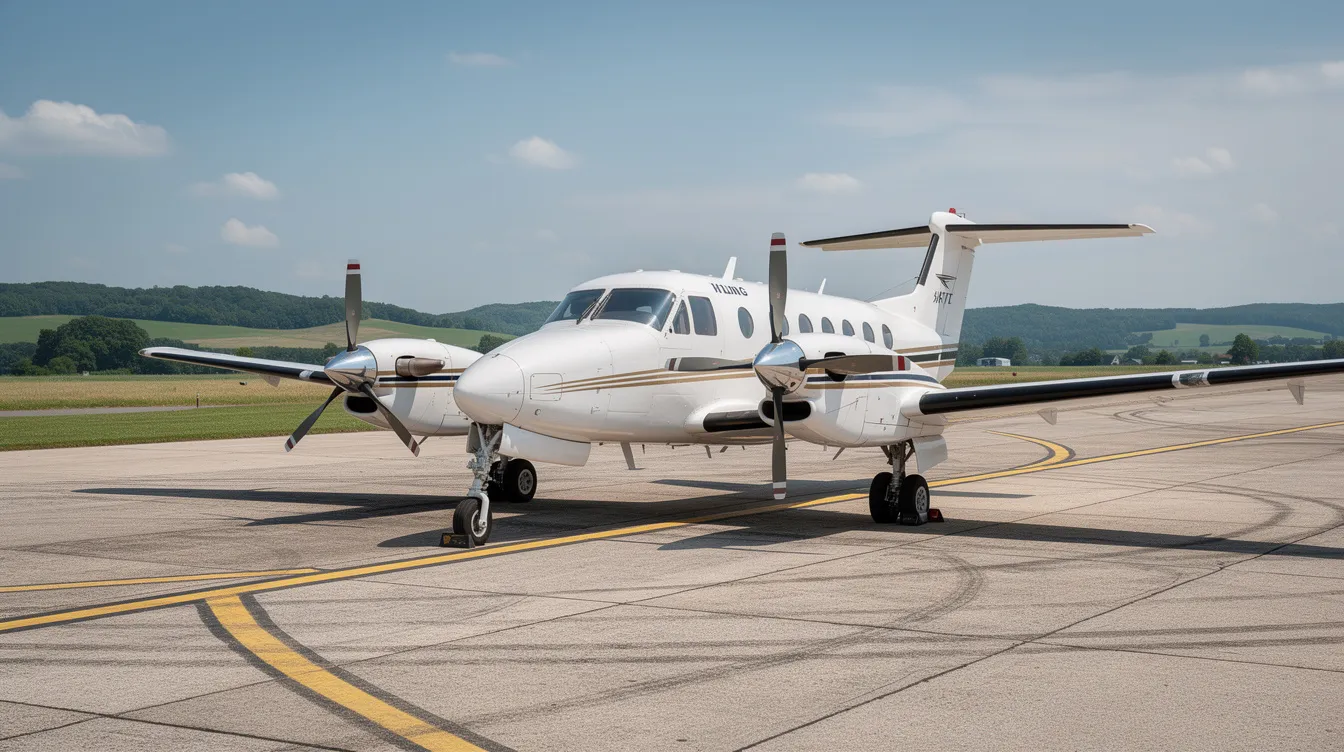
The Beechcraft King Air E90 remains one of the most recognized turboprop aircraft in private aviation. Produced between 1972 and 1981, the air e90 built its reputation on versatility—equally suited for corporate travel, family trips, and regional cargo operations. But understanding King Air E90 operating costs before buying or budgeting is where most prospective owners stumble.
This article breaks down the real-world annual budget for owning and flying a King Air E90, including per-hour and per-mile cost estimates across different utilization scenarios. It also examines how those numbers compare to on-demand charter through Jettly.
All figures referenced here are illustrative 2024–2026-era estimates, not formal quotes. Actual costs depend on location, fuel prices, aircraft condition, and operational profile. Readers will find concrete example scenarios for 200, 300, and 450 flight hours per year to help frame their own planning.
Typical King Air E90 operating costs can exceed $1.1M annually for owners flying around 450 hours per year, with a fully loaded operating cost of roughly $2,577 per hour.
Key cost drivers include fuel burn (about 84 US gallons per hour at a fuel cost of $5.47 per gal), maintenance reserves, crew salaries, insurance, and hangar expenses.
Flying more hours each year lowers the cost per hour and cost per mile because total fixed costs are spread across more flights, but the total annual budget increases.
Operating costs are split between variable and fixed expenses, and both must be modeled carefully before committing to aircraft ownership or acquisition.
Chartering a King Air through Jettly can deliver similar performance and cabin comfort without long-term ownership, depreciation, or upfront capital costs.
Aircraft performance and design directly influence fuel burn, maintenance loads, and overall operating costs. Before diving into dollar figures, it helps to understand what the King Air E90 brings to the table—and where its specs create cost implications.
Key specifications:
Production years: 1972–1981
Engines: Twin Pratt & Whitney Canada PT6A-28 turboprops, which require reserves for overhaul costs, are typically budgeted as part of maintenance planning
Typical seating: Up to 5 passengers plus 1–2 crew
Cabin dimensions: Approximately 4'10" high, 4'6" wide, and 12'5" long
Baggage volume: Around 48–54 cubic feet
Maximum operating altitude: 30,000 feet
Cruise performance:
The King Air E90 has a cruise speed of 250 knots (approximately 288 MPH).
It has a range of approximately 1,000 nautical miles under favorable conditions.
**Runway access:
The aircraft requires a balanced field length of 4,220 feet for takeoff and roughly 2,700 feet for landing, giving it access to thousands of smaller regional airports.
These performance metrics matter because speed and fuel consumption determine cost per mile, payload capacity affects how many trips are needed, and short-field access expands the airport network available—often cutting ground transportation time compared to flying into a major hub when paired with tools like Jettly's airport locator platform.
Operating costs for the King Air E90 fall into two broad categories: fixed costs (paid annually whether the aircraft flies or not) and variable costs (incurred per flight hour or per trip). Understanding this split is the foundation of accurate budget planning.
Total operating costs typically range from $1,300 to $1,800 per flight hour for this aircraft class, depending heavily on utilization, fuel price, and the condition of the airframe and engines. For a deeper look at how these figures compare across aircraft types, see this private jet operating cost breakdown.
At higher utilization levels—around 450 flight hours per year—total annual operating costs can exceed $1.1M, aligning with industry benchmarks for well-maintained King Air 90-series turboprops.
It's worth noting that depreciation, financing interest, and acquisition cost are usually treated separately from hourly operating cost. However, they still affect the true cost of ownership and should factor into any purchase decision. The sections below walk through estimated dollar ranges for each major cost category so readers can build their own annual budget.
Variable costs scale directly with flight hours and sectors flown. They drive most of the cost-per-hour figures that owners and operators focus on when comparing aircraft.
Fuel is the single largest variable expense. Variable costs depend on flight hours and include fuel and maintenance as the two biggest line items.
Fuel consumption for the King Air E90 is 84 gallons per hour of Jet-A during typical cruise and climb operations.
Fuel cost per gallon for the King Air E90 averages around $5.47 based on recent US airport pricing, though rates can swing between $5 and $7 per gal depending on location and market conditions.
At $5.47 per gallon, fuel cost runs approximately $460 per hour. At $6.50 per gal, that figure climbs to roughly $546 per hour.
Fuel prices significantly affect the overall operating costs of aircraft in this class. A $1-per-gallon swing translates to about $84 per hour in added or reduced expense—a meaningful shift over hundreds of annual flight hours. For more on what's driving jet fuel pricing, see this cost of aviation fuel overview.
Airframe maintenance covers routine inspections and mandatory replacements, including scheduled 100-hour, annual, and phase inspections, plus unscheduled repairs that arise from normal wear. Routine maintenance includes inspections and compliance with regulations such as airworthiness directives (ADs) and service bulletins (SBs).
When averaged across a year of flying, maintenance typically adds several hundred dollars per hour to the operating budget. For a King Air E90, a reasonable estimate is $200–$400 per hour depending on aircraft condition, with older or deferred-maintenance airframes trending toward the high end.
Budgets for engine and propeller reserves are essential for aircraft maintenance planning. The twin PT6A engines typically require a reserve for overhaul costs, with full engine overhauls running between $200,000 and $500,000 per engine depending on condition and variant. At a typical TBO (Time Between Overhaul) of 3,600 hours, this translates to an engine reserve of roughly $110–$280 per engine per flight hour.
Propeller reserves add another $15–$20 per hour. Combined engine and prop reserves often land in the $230–$280 per hour range for both engines.
Additional per-flight or per-hour costs include:
Navigation and overflight charges: $50–$200 per leg, depending on airspace and region
Landing and parking fees: Vary widely by airport, from minimal at small fields to several hundred dollars at busy metro airports
De-icing: Seasonal and weather-dependent, but can add $200–$500 per event
Catering and in-flight services: Typically $50–$150 per leg for light catering, especially when using dedicated solutions like Jettly Eats in-flight catering
Oil: Approximately $4 per hour
Fixed costs are incurred regardless of flight time and include insurance and hangar fees, crew salaries, and administrative overhead. These expenses hit the budget whether the King Air E90 flies 50 hours or 500 hours in a given year, which is why annual utilization affects fixed costs per flight hour exponentially.
Insurance costs vary based on pilot qualifications and aircraft value. For a legacy turboprop like the E90—typically valued in the $800,000–$900,000 range on today's market—hull and liability premiums generally fall between $25,000 and $50,000 per year. Operators with highly experienced crews and clean claims histories tend to land at the lower end.
Hangar storage protects the airframe from corrosion and weather damage but varies significantly by geography. The cost of annual fixed expenses for the hangar alone can range from $30,000 to $60,000 or more, depending on the airport location. Tie-down arrangements at smaller regional fields cost far less but increase long-term maintenance exposure. For a broader look at what storage and other ownership expenses look like, see this plane ownership cost guide.
A full-time captain for a King Air E90 typically earns $70,000–$150,000 per year, depending on experience and location. If a second pilot is required (common for Part 135 charter operations), total crew costs can reach $200,000–$300,000 annually, including benefits.
Recurrent simulator training, medical examinations, and travel for training events add another $15,000–$25,000 per year per pilot.
Ongoing administrative costs include:
Aircraft management or scheduling services
Avionics database and FMS updates ($2,000–$5,000 per year)
Accounting and regulatory compliance support
Onboard connectivity packages (where installed)
Combined, these items typically run $20,000–$50,000 per year.
|
Fixed Cost Category |
Estimated Annual Range |
|---|---|
|
Insurance |
$25,000–$50,000 |
|
Hangar / Parking |
$30,000–$60,000 |
|
Crew (1 captain + training) |
$85,000–$175,000 |
|
Administration & Subscriptions |
$20,000–$50,000 |
|
Total Fixed Costs |
$160,000–$335,000 |
In many owner-operated scenarios with a professional crew, total fixed costs for King Air E90 ownership come in around $354,568 annually when including management and regulatory overhead. This figure becomes the baseline that must be covered regardless of how many hours the aircraft actually flies.
Many owners and charter customers compare aircraft like the King Air E90 by looking at cost per hour and cost per mile. These metrics depend heavily on annual utilization—the more hours flown, the lower the per-hour burden of fixed costs, even as the total annual budget climbs.
At 200 flight hours per year, fixed costs are spread thin. Using approximate fixed costs of $354,568 and variable costs in the $1,200–$1,500 per hour range, the math looks like this:
|
Component |
Estimate |
|---|---|
|
Fixed costs |
~$354,568 |
|
Variable costs (200 hrs × ~$1,400/hr) |
~$280,000 |
|
Total annual budget |
~$634,568 |
|
Effective cost per hour |
~$3,173 |
|
Cost per mile (at ~250 knots / 288 MPH) |
~$11.02/statute mile |
At this utilization level, the per-hour figure is steep. Owners flying 200 hours or fewer per year often find that chartering delivers equivalent access at a lower effective rate, especially when they understand how private jet charter pricing works and what drives hourly and trip quotes.
Increasing to 300 hours per year reduces the fixed cost burden per hour noticeably:
|
Component |
Estimate |
|---|---|
|
Fixed costs |
~$354,568 |
|
Variable costs (300 hrs × ~$1,400/hr) |
~$420,000 |
|
Total annual budget |
~$774,568 |
|
Effective cost per hour |
~$2,582 |
|
Cost per mile |
~$8.96/statute mile |
The total annual spend rises, but the cost per hour drops by nearly $600 compared to the 200-hour scenario. This is the utilization sweet spot where ownership begins to compete with regular charter use.
At 450 hours per year, fixed costs are well-amortized. This is where the benchmark data from industry reports aligns:
|
Component |
Estimate |
|---|---|
|
Total variable costs |
$805,149 |
|
Total fixed costs |
$354,568 |
|
Annual operating budget |
$1,159,717 |
|
Operating cost per hour |
$2,577 |
|
Cost per mile (at 288 MPH) |
~$8.95/statute mile |
This scenario confirms that annual operating costs can exceed $1.1M, but the per-hour figure drops into a range that can be competitive for high-utilization operators.
Typical charter rates for King Air 90-series turboprops range from approximately $1,450 to $2,950 per hour, depending on aircraft age, amenities, and region. Charter users pay a higher published hourly rate but avoid acquisition cost, depreciation, and fixed cost exposure entirely. For owners flying fewer than 200 hours per year, the math frequently favors charter. To compare rates directly, Jettly's charter cost estimator provides instant pricing by route and aircraft type.
Annual utilization is the key factor in deciding between owning a King Air E90 and chartering on demand. The higher the hours, the more ownership costs per hour decrease—but only if the aircraft is genuinely needed that often.
Always-available aircraft: No scheduling conflicts or positioning delays, unlike on-demand or private jet membership programs, where availability can vary with demand
Customized interior and cabin configuration: Tailored to business or personal preferences
Consistent crew: Familiar pilots who know the owner's routes and preferences
Home-basing flexibility: Station the aircraft at a convenient airport near the company HQ or residence
Maintenance control: Direct oversight of maintenance standards and vendor selection
High annual budget: Even at moderate utilization, costs can run into six or seven figures per year
Market depreciation exposure: Legacy aircraft values can decline, particularly without avionics or engine upgrades—an issue some owners sidestep by using fixed-rate jet card programs instead of purchasing an aircraft outright
Regulatory and management complexity: Compliance with ADs, SBs, and operational requirements demands expertise or professional management, which is why some flyers choose predictable-cost options like Jettly's jet card flight cost estimator and membership products instead of owning.
Downtime risk: Scheduled inspections and unscheduled maintenance can ground the aircraft for several weeks per year
For a broader comparison of ownership models, this fractional ownership vs. charter guide covers the tradeoffs in more detail, and Jettly's overview of fractional private jet ownership pros and cons can help clarify where shared ownership fits between full ownership and on-demand charter.
Jettly's digital platform offers access to King Airs and similar turboprop private jet aircraft worldwide without acquisition costs. Customers get transparent pricing per trip, no need to manage fuel hedging, crew salaries, or hangar contracts, and no exposure to depreciation.
Charter also eliminates the operational burden. There's no annual inspection to schedule, no AD compliance to track, and no crew training budget to manage, and platforms like Jettly position themselves as a flexible NetJets alternative for private flying with fewer long-term commitments.
As a general threshold, travelers flying under 150–200 hours per year typically find on-demand charter more cost-effective than owning a King Air E90. Between 200 and 300 hours, the decision depends on how much the owner values guaranteed availability and control, or whether a fractional jet ownership structure might better balance commitment and flexibility. Above 300 hours, ownership starts to deliver meaningful per-hour savings—if the fixed cost structure is well managed.
Before committing capital, it's worth modeling both scenarios side by side using real route data and current fuel pricing. For those who want to compare without building a spreadsheet, this article, " How much is a plane to buy, " provides a useful framework, and Jettly's guide to affordable airplane rental options and costs offers another perspective on accessing aircraft without full ownership.
Jettly operates as a tech-driven private jet and turboprop charter marketplace—not an aircraft seller. The platform is built around flexibility and cost transparency, giving travelers access to turboprop and jet aircraft without the commitment of ownership, and is frequently listed among top private jet charter companies for its digital-first model.
Jettly's network includes turboprops comparable to the King Air E90, spanning the King Air 90/C90 series, King Air 250, and similar aircraft available on demand for business meetings, family travel, and regional hops, alongside a broad catalog of private charter aircraft across all major categories. For a full overview of King Air charter options, see this King Air charter guide.
What users can do on the platform:
View instant pricing estimates by route and aircraft type using tools such as Jettly's jet card flight cost estimator
Compare aircraft by cabin size, range, and operating cost per hour
Book directly without committing to jet cards or fractional shares, or even share empty seats on private jet flights to reduce per-passenger cost
Tailor flights by timing, airport selection (including small regional airports where turboprops have the best fit), and optional services like catering and ground transportation
Turboprops like the King Air E90 can also be more fuel-efficient on short sectors than comparable light jets. For cost- and emissions-conscious travelers, this makes turboprop charter a practical choice that balances performance with environmental responsibility and fits neatly into the broader private charter airline landscape.

The following FAQ answers common questions not fully covered in the main sections above. All responses align with 2024–2026 operating assumptions and are intended to provide added nuance for decision-making.
There is no single breakeven number, but many operators and financial advisors use a range of 200–300 flight hours per year as a rough threshold. Below 200 hours, the fixed costs of ownership—crew, hangar, insurance—push the effective cost per hour well above what charter customers pay on a per-trip basis. Travelers who report flying fewer than 200 hours annually should compare Jettly's on-demand charter costs with a detailed ownership budget model before purchasing an E90. Corporate users with complex multi-city schedules or time-sensitive missions may still favor ownership above certain utilization levels due to control, availability, and the ability to operate on short notice without positioning delays.
A $1-per-gallon change in Jet-A pricing multiplies across the E90's fuel burn of approximately 84 gallons per hour, adding or removing roughly $84 from the hourly fuel cost. At $5.47 per gal, fuel runs about $460 per hour. At $7.00 per gal, that same hour costs approximately $588 in fuel alone. While fuel is a major variable cost, many other items—maintenance, crew, insurance—are not directly tied to fuel price, so total per-hour cost does not move one-for-one with fuel. Charter customers often see fuel fluctuations reflected in quoted hourly rates or as separate fuel surcharges, while owners feel the impact directly at the pump every time they send the aircraft out.
The E90 is a legacy airframe, and older aircraft can see higher maintenance and parts costs, especially if prior operators deferred upgrades or major inspections. Corrosion, aging wiring, and obsolete avionics components are common cost drivers on E90S that haven't been well maintained over their long service lives. However, well-maintained E90S with recent avionics upgrades and engine work can still operate reliably. Buyers should budget conservatively for maintenance reserves and always invest in a thorough pre-purchase inspection. Modernizing avionics and interiors can improve both reliability and market appeal, but these improvements increase near-term capital expenditure rather than hourly operating costs.
Scheduled inspections (annual, phase, and periodic engine checks), occasional unscheduled maintenance, and any avionics or interior work can collectively ground the aircraft for several weeks per year. Older airframes tend to require more unscheduled maintenance, extending downtime beyond what operators of newer turboprops typically experience. Owners who need guaranteed availability sometimes supplement their own aircraft with charter during maintenance periods. Charter clients using Jettly can simply select another aircraft if one option is unavailable, eliminating downtime as a concern entirely, similar to how partner operators like Dexter Air Taxi private jet services provide additional lift. Factoring expected downtime into annual utilization planning and cost per hour calculations helps avoid budget surprises at year-end.
No. Jettly's charter customers pay per trip or per hour for the flight itself, not for the aircraft's underlying fixed costs like hangar, insurance, or crew salaries. Those fixed and variable costs are already embedded into the operator's charter rate, giving customers an all-inclusive price for each mission aside from optional extras like catering or ground transport. This is one of the primary financial advantages of chartering over ownership: there are no month-to-month obligations, no surprise maintenance invoices, and no depreciation exposure. Travelers comparing models can also review Jettly's guide on how renting a plane works to understand the end-to-end rental process. Learn more about Jettly's transparent pricing and charter options at https://www.jettly.com.
Annual King Air E90 operating costs can exceed $1.1M at higher utilization levels, with cost per hour typically landing in the low- to mid-$2,000s once all expenses—fuel, maintenance, engine reserves, crew, insurance, and hangar—are accounted for. The numbers are real, and they demand careful modeling before any acquisition decision.
Accurate budgeting requires separating fixed and variable operating costs, then understanding how flying more hours reduces cost per hour while raising the total annual budget. Owners who fly 450 hours per year can achieve effective hourly rates around $2,577, but those who fly fewer than 200 hours may pay well over $3,000 per hour for the same aircraft.
For travelers who want King Air-level performance and access to smaller airports without the purchase price, depreciation, or long-term commitment, on-demand charter through Jettly offers a practical alternative. The platform provides instant pricing, a wide selection of turboprops and jets, and the flexibility to fly only when needed, with optional private jet membership plans for frequent flyers who want additional benefits.
Ready to explore private charter options, compare aircraft, or request a quote? Visit https://www.jettly.com.
Share this post:
Jay Franco Serevilla
Jul 3, 2026
|
5
min read
Discover tips and trends in the industry.
5
min read
Who Flies a Plane: From Private Jet Captains to Celebrity Pilots
Flying a plane requires skilled, licensed pilots who undergo extensive training. This article explores the various types of pilots, their training processes, and the controls they manage during flights. It also highlights the role of private jet charter services like Jettly in connecting travelers with professional pilots and aircraft.
Read More
5
min read
Free Flight Tracker: How to Monitor Commercial and Private Flights in Real Time
Free flight trackers have revolutionized how we monitor aircraft in real-time, providing accessible tools for tracking both commercial and private flights. These platforms aggregate data from various sources to deliver live updates on flight status, routes, and estimated arrivals. While free versions offer essential features, premium options and services like Jettly enhance the experience by enabling booking and detailed trip management.
Read MoreStay updated with our latest insights and tips to elevate your journey with us.
MEMBERSHIPS AND ASSOCIATIONS



Disclaimer: Jettly operates as a charter broker, offering access to a global digital jet charter marketplace. Jettly is not a direct air carrier and does not own or operate aircraft. All advertised flights are conducted by third-party air carriers that are fully licensed and hold the appropriate Part 135 or Part 121 certifications issued by the Federal Aviation Administration (FAA) or equivalent regulatory authorities under U.S. or foreign law. Jettly complies fully with the U.S. Department of Transportation's Part 295 and Part 298 Charter Broker regulations. Jettly does not carry additional liability insurance. Passengers are covered by aircraft operator insurance. TICO: 50023770


