



Login
Get Instant Pricing On 23,000+ Aircraft

>
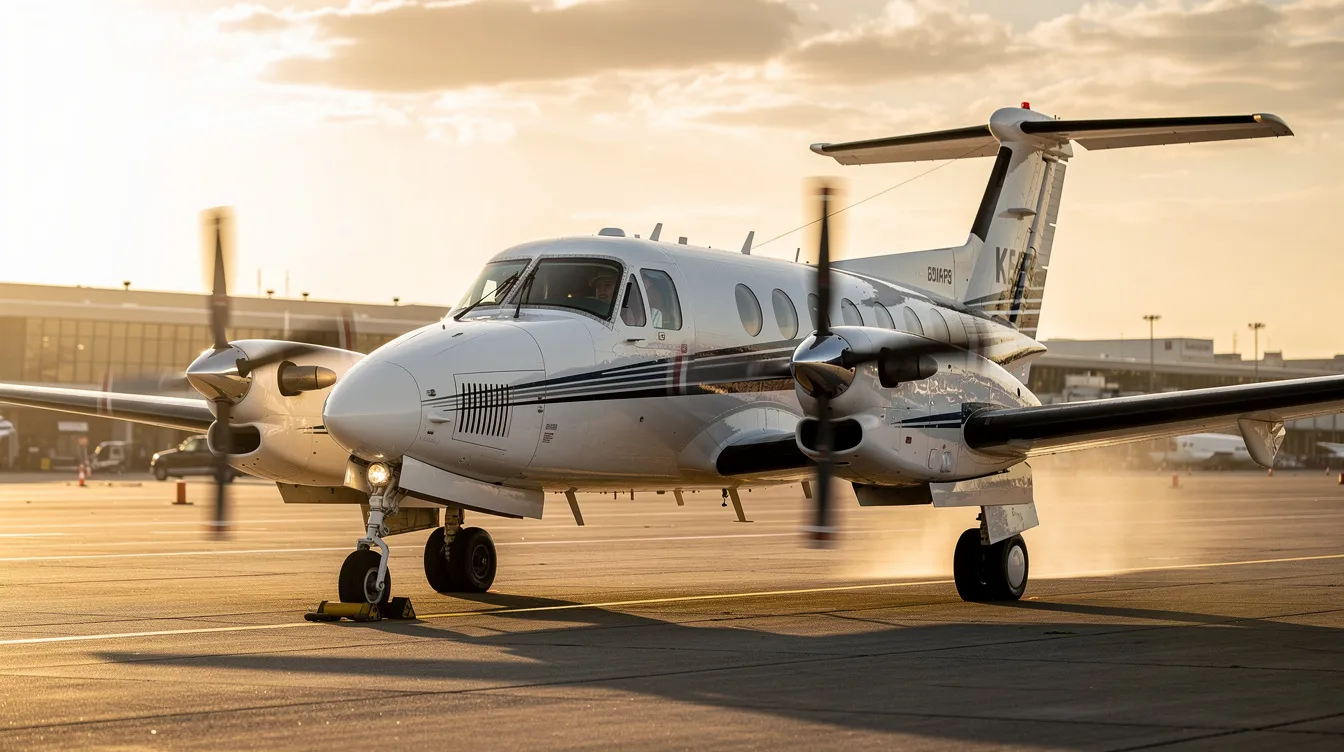
Understanding King Air 200 fuel burn is essential for anyone planning a charter, evaluating ownership, or comparing turboprop options against light jets. This guide breaks down realistic fuel consumption across every phase of flight, explains how burn rates drive operating cost, and shows how the numbers translate into charter pricing on platforms like Jettly.
The King Air 200 and King Air B200 deliver fuel burns typically around 100 to 115 gallons per hour at normal cruise power, making them efficient alternatives to light jets for regional missions under 1,000 nm.
Real-world cruise fuel burn for a standard King Air 200 or Super King Air 200 profile usually falls between 105 and 115 GPH, while taxi, climb, and descent add several gallons per leg. Most operators use an average of 107 to 115 gallons per hour for block time planning.
The King Air B200 fuel burn is very close to the older King Air 200. Block speeds around 270 to 290 KTAS are broadly interchangeable for most operators.
Operating cost per hour, including fuel, maintenance, and engine programs, often falls in the $1,700 to $2,100 range depending on fuel price and avionics upgrades.
Travelers can use Jettly's private jet charter cost estimator to compare King Air 200 vs light jet options on cost and range and get instant charter pricing.
The Beechcraft King Air 200 family - including the King Air 200, King Air B200, and several Super King Air variants - represents one of the most successful twin-engine turboprop lines in aviation history. Production spanned decades, with these airplane models serving corporate, charter, and government operations worldwide. The aircraft features a distinctive T-tail design and two Pratt & Whitney Canada PT6A engines, known for fuel efficiency and reliability across millions of flight hours.
The aircraft boasts a maximum certified ceiling of 35,000 feet, a cabin length of about 16 feet 8 inches, a width of roughly 4 feet 6 inches, and a height of 4 feet 9 inches. The cabin can accommodate 6 to 9 passengers in typical configurations, with seats arranged for passenger comfort on regional trips. Standard fuel capacity is around 544 US gallons, and the maximum payload capacity is 2,640 pounds. The King Air 200 requires just 2,579 feet of runway for takeoff at sea level, with a similarly short landing distance - a key advantage over jets that need longer strips.
The "King Air 200" label usually refers to earlier models equipped with PT6A-41 engines, while the King Air B200 uses PT6A-42 engines with minor aerodynamic refinements to the leading edges and other surfaces. Despite these differences, the 200 and B200 share very similar performance specifications in real-world operations. King Air 200 aircraft frequently appear in Jettly's turboprop charter inventory for short to medium regional missions where efficiency and short-field capability matter.
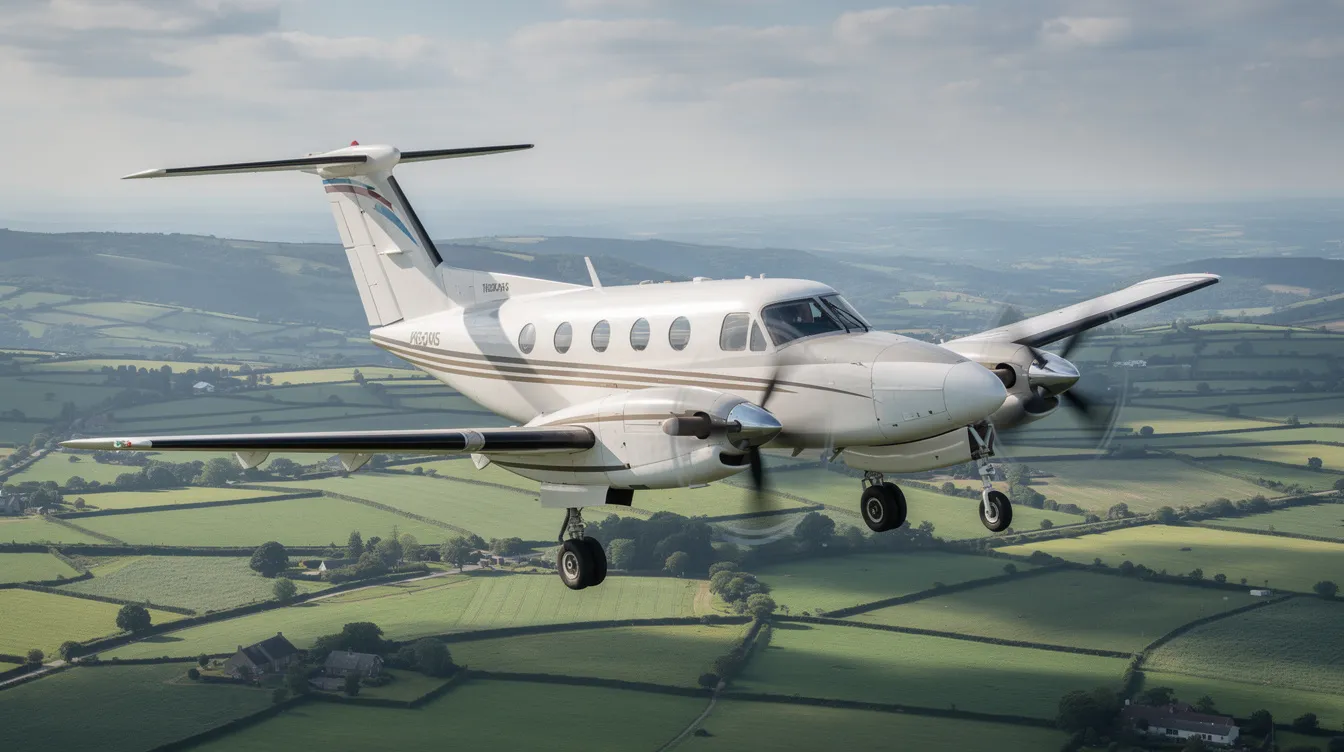
Published handbook figures and real-world charter data differ slightly due to atmospheric pressure, weight, and pilot technique. Here are realistic planning numbers for the King Air 200 and B200 across all flight phases.
Taxi and ground operations: Roughly 10 to 20 gallons total depending on delays, with each engine's gas generator section idling at relatively low fuel flow.
Takeoff and initial climb: Fuel flow is highest during takeoff and initial climb, burning upwards of 140 to 150+ gallons per hour temporarily as both engines operate at max power.
Cruise at typical altitudes (FL230 6FL270): About 105 to 115 GPH for the King Air 200; the B200 is often quoted around 107 to 113 GPH. Each individual engine can produce fuel flow rates of roughly 400 to 480 lb/hr at cruise power settings.
Descent and approach: Reduced power, averaging 60 to 80 GPH for that phase.
The Beechcraft King Air 200 burns approximately 100 to 120 gallons per hour total across a typical mission. Average burn rates can vary from 90 to 110 gallons per hour depending on power settings chosen by the cockpit crew. The average hourly fuel burn translates to roughly 700 to 800 pounds per hour total when measured in weight.
At high altitude cruise, fuel flow drops to roughly 95 to 105 gallons per hour. The aircraft can cruise at fuel flows of roughly 70 to 90 gallons per hour depending on the settings selected, and pulling back power in Long Range Cruise can decrease burn toward 90 gallons per hour total. Meanwhile, the King Air 200 typically operates around 70 to 85 gallons per hour in cruise for a balance of speed and cost. For easier mental math, pilots and dispatchers frequently round planning fuel burn for both models to about 110 GPH at normal cruise power. These figures assume jet A fuel at standard conditions; hot, high altitude departures or heavy payloads will increase actual burn.
Fuel burn directly drives variable expenses, and the King Air 200 family is often cheaper per flight hour than comparable light jets while still offering jet-like cruise speeds. Understanding the direct operating cost of aircraft helps charter customers and owners budget accurately, and Jettly's insights on private jet operating cost breakdowns provide additional context for long-term budgeting decisions.
The King Air 200 consumes 115 gallons per hour at a fuel cost per gallon of $5.47, yielding roughly $629 in fuel-only cost per hour. At lower fuel prices around $5.00 per gallon, that drops to about $550 per hour; at $7.00 per gallon, it climbs to approximately $770 per hour. The variable cost per hour for the King Air B200, including fuel, maintenance, and engine programs, is approximately $2,042 according to industry benchmarks.
Annual operating cost for the King Air 200 runs around $1,010,563 when factoring in depreciation, insurance, crew, hangar, and all variable expenses across a typical utilization year. The estimated annual budget for a King Air B200 is roughly $924,713. Total hourly cost in ownership scenarios often lands around $1,700 to $2,000+ when fixed and variable costs are divided across about 300 hours per year. By comparison, light jets frequently carry total variable costs well above $2,500 per hour, which is why many charter clients and operators favor the King Air 200 for regional hops, especially as private jet fuel costs continue to fluctuate across regions. For a deeper look at how fuel prices affect private aviation, Jettly's resource library covers the latest market trends, and aircraft profiles such as the Canadair CRJ-200 specs, range, and charter rates provide additional context when comparing regional jet efficiency to turboprops like the King Air 200.
Many pilots ask whether the King Air B200 is meaningfully more efficient than the earlier Air 200 model, especially when planning mixed fleets or selecting backup aircraft. The short answer: the difference is minimal.
The King Air 200 with PT6A-41 engines typically cruises at about 270 to 285 KTAS with about 110 to 115 GPH fuel burn. Cruise speed typically ranges from 270 to 286 knots across normal operating profiles.
The King Air B200 with PT6A-42 engines often achieves 277 to 291 KTAS with a similar 107 to 113 GPH cruise burn. Its maximum cruise speed is 291 knots at max cruise power settings.
Any small fuel savings from B200 engine improvements can be offset by equipment differences - icing conditions, protection systems, propeller type, and avionics packages all play a role. Three-blade vs four-blade propeller choices, for example, can change climb performance and create a slightly different feel during the landing flare, but the fuel consumption difference is often negligible. From a cost-per-mile perspective, choosing between a well-maintained King Air 200 and B200 on Jettly will usually come down more to cabin configuration, avionics, and availability than to fuel efficiency, and specific charter listings such as Jettly's King Air 200 private jet for rent illustrate how individual aircraft are positioned for different missions.
Fuel burn and usable fuel capacity determine the practical range of the King Air 200, and payload trade-offs become important on longer legs, just as they do with other affordable airplane rental options where weight and mission profile directly affect total cost. The ability to fly nonstop is directly tied to how much fuel you carry versus how many passengers and bags are on board.
The King Air 200 has a maximum range of 1,718 nautical miles under ideal conditions. With full fuel and light payload, it offers a maximum range of around 1,500 nautical miles with IFR reserves.
The King Air 200 has a normal range of 1,075 nautical miles with typical passenger loads.
The maximum practical range is roughly 930 to 1,350 nautical miles depending on payload and power management. Higher cruise power settings (targeting 285 to 291 KTAS) increase fuel burn and reduce range, while Long Range Cruise around 220 to 235 KTAS stretches range but trades speed - a slow but capable option for longer legs.
For charter planning, Jettly's private charter aircraft platform and operators usually build in conservative margins, planning King Air 200 trips in the 300 to 800 nm band for nonstop legs with full seats and luggage. Here are example missions:
Business trip - Toronto to New York (~300 350 nm): Plenty of reserve fuel, full passenger load, and under 1.5 hours block time.
Regional hop - Dallas to Denver (~550 600 nm): Normal cruise with standard payload, about 2 hours en route.
Edge-of-range - ~900 1,000 nm: One or two passengers or luggage items may need to be traded for extra fuel to operate safely with proper reserves.

Published numbers are averages. Actual fuel burn on a King Air 200 or Super King Air can shift substantially with aircraft configuration and operating conditions. Fuel burn significantly increases with heavier weight during all flight phases, and higher cruising altitudes improve fuel efficiency and lower total fuel flow, mirroring the broader trends seen in private jet fuel pricing and consumption.
Altitude and temperature: Flying at FL230 to FL270 improves true airspeed and reduces fuel per mile. Hot-and-high departures increase burn and may limit the ceiling the aircraft can reach. Atmospheric pressure changes at altitude are a key driver.
Weight and balance: Higher takeoff weight requires more power, especially in climb, and may limit cruise altitude. With full fuel, payload capacity shrinks - operators must manage this process carefully.
Propeller configuration: Three-blade vs four-blade props change climb performance and noise. Pilots report that three-blade props can cause more float on the landing flare, but major fuel differences are uncommon.
Avionics and modifications: Raisbeck performance kits, winglets, and modern avionics can slightly influence how efficiently pilots manage power. Upgrades to leading edges and other aerodynamic surfaces equipped on modified aircraft also help.
Flight profile: Frequent short legs at low altitudes increase per-hour and per-mile fuel consumption compared to long, high-altitude cruises. Icing conditions requiring anti-ice systems also raise fuel demand.
Jettly's instant-pricing engine and partner operators factor all of these variables into real-time quotes rather than relying on book-average fuel burn alone, and tools like the jet card flight cost estimator give frequent flyers an additional way to benchmark route pricing.
The King Air 200 and King Air B200 are efficient alternatives to popular light jets for flights under roughly 800 to 1,000 nm. On the market today, turboprop charter rates often reflect this cost advantage.
Typical light jet fuel burn can easily reach 150 to 200+ gallons per hour, compared to the King Air 200's approximately 110 GPH. Fuel economy metrics for the King Air show an efficiency of 30 to 33 passenger-miles per gallon - a strong line item in its favor.
Per-hour operating costs for jets are usually markedly higher once maintenance, engine programs, and depreciation are included.
Despite slightly slow cruise speeds (around 270 to 290 KTAS vs 380 to 430 KTAS for many light jets), the King Air's ability to fly into shorter runways and secondary airports can save door-to-door time for many regional itineraries, a point often highlighted when evaluating the best private jet charter companies and their fleet mixes. A turboprop private jet like the King Air makes the most economic sense for regional business routes, small groups, access to shorter runways, and budget-sensitive travelers, especially when you factor it into the broader picture of how much a private jet really costs to own or charter. Stepping up to a jet may be justified for longer segments beyond 1,000 nm, very tight schedules, or when higher cruise altitudes are needed for weather, and in those cases a detailed guide to how much it costs to rent a private jet can help frame the trade-offs against turboprops like the King Air 200. Jettly lets users compare charter quotes side by side, factoring fuel-driven hourly cost into transparent pricing, and its platform also specializes in affordable private jet charter options for travelers prioritizing value.
Many travelers care about fuel burn because it directly influences charter price. Jettly's on-demand model keeps these costs visible and easy to compare during the booking process, especially when paired with its private jet charter cost estimator for quick budget checks.
Access to a large global pool of King Air aircraft as part of a 20,000+ aircraft inventory.
Instant online quotes that incorporate estimated fuel burn, operator fees, and airport charges.
The ability to choose between ad-hoc on-demand charter and private jet membership options for frequent flyers seeking lower per-hour rates.
The King Air 200 offers specific advantages in a charter context: flexibility to fly into smaller regional airports closer to home or final destination, and efficiency for short-notice business trips, medical flights, or family getaways where private terminals and short runways are key. Travelers who want to reduce per-seat cost can also take advantage of Jettly's crowdsourced private jet flights and shared empty seats on compatible routes. Its lower fuel burn per seat-mile compared to many jets also supports more responsible private travel - something increasingly important in the market today.
Ready to explore King Air 200 charter options? Learn more and request a quote at jettly.com, or dive deeper into the ultimate list of charter airlines and private flight options to see how King Air operators fit into the wider market.
These FAQs address common practical questions for both aircraft shoppers and charter customers.
At roughly 110 GPH and a block time of about 2.0 to 2.2 hours, a 500 nm flight uses approximately 220 to 242 gallons of Jet A. At a fuel cost of $5.47 per gallon, that works out to roughly $1,200 to $1,325 in fuel alone. Add taxi and climb fuel, and total fuel for the leg is typically around 250 gallons.
The differences are small - usually just a few GPH. Real-world performance depends more on engine condition, maintenance history, propeller configuration, and pilot technique than on model designation. Both models share the same production lineage, and the King Air 200's engines are known for fuel efficiency across both variants.
Climbing to FL230 through FL270 improves true airspeed and reduces fuel per nautical mile, even though climb fuel is higher at the beginning. At high-altitude cruise, fuel flow drops to roughly 95 to 105 gallons per hour compared to lower-altitude operations.
For private owners and flight departments planning new routes, using 115 GPH plus taxi and climb reserves is a solid conservative figure. This accounts for weight, weather, and real-world deviations from book performance.
While Jettly doesn't display raw fuel gallons in quotes, its instant pricing fully embeds fuel costs and allows comparison between aircraft types, and its insights into jet card costs and pricing structures help frequent flyers evaluate alternative ways to pay for those hours. Use the charter cost estimator or explore Jettly's jet card programs to see how a King Air 200 stacks up against other options for your specific route.
Ready to experience private travel on your terms? Explore flight options or request a quote at https://www.jettly.com, compare Jettly as a NetJets alternative for flying private, or review how NetJets card costs stack up against on-demand King Air 200 charter.
|
Flight Phase |
Fuel Burn (Gallons Per Hour) |
Notes |
|---|---|---|
|
Taxi and Ground Ops |
10 - 20 |
Depends on delay and idle time |
|
Takeoff and Climb |
140 - 150+ |
Highest fuel flow during max power climb |
|
Cruise (FL230-FL270) |
105 - 115 |
Typical cruise burn for King Air 200 and B200 |
|
Descent and Approach |
60 - 80 |
Reduced power phase |
|
Average Mission Burn |
100 - 120 |
Total average burn across phases |
Understanding the King Air 200 fuel burn is crucial for making informed decisions about chartering or owning this versatile turboprop aircraft. With fuel consumption typically ranging from 100 to 115 gallons per hour during cruise, the King Air 200 offers an efficient and cost-effective option for regional travel under 1,000 nautical miles. Its ability to operate from shorter runways and access smaller airports adds to its flexibility, making it a practical choice for business trips, family travel, and special missions.
Jettly’s platform enhances this experience by providing transparent, instant pricing that reflects real-world fuel burn and operating costs. Travelers can easily compare King Air 200 charter rates against light jets and other aircraft types, ensuring the best fit for their itinerary and budget. With access to a global fleet and flexible membership options, Jettly simplifies private aviation, making it more accessible and convenient.
Ready to experience private travel on your terms? Explore King Air 200 flight options or request a personalized quote at https://www.jettly.com. Learn more about private jet charter cost estimator, King Air B200, private jet operating cost breakdowns, and private jet membership options to enhance your private flight planning.
Share this post:
Jay Franco Serevilla
Sep 6, 2026
|
5
min read
Discover tips and trends in the industry.

5
min read
Zimex Aviation: Specialist Missions, Fleet, and Career Opportunities
Zimex Aviation, established in 1969, specializes in flying to remote and challenging environments where conventional airlines often cannot operate. With a diverse fleet of turboprop aircraft, Zimex provides essential services such as oil and gas logistics, humanitarian airlift, and express cargo. The company emphasizes safety and operational excellence, making it a key player in the global logistics and humanitarian support sectors.
Read More
5
min read
Air X: Private Aviation, Diversified Fleets, and Jet Support Explained
Air X represents a category of private jet charter operators known for their diversified fleets and integrated jet support, ensuring flexibility and safety. With over 7,050 flights in 2023, AirX Charter exemplifies excellence in private aviation, catering to corporate executives and high-net-worth individuals. Digital platforms like Jettly enhance access to these services, allowing travelers to book tailored flights effortlessly.
Read MoreStay updated with our latest insights and tips to elevate your journey with us.
MEMBERSHIPS AND ASSOCIATIONS



Disclaimer: Jettly operates as a charter broker, offering access to a global digital jet charter marketplace. Jettly is not a direct air carrier and does not own or operate aircraft. All advertised flights are conducted by third-party air carriers that are fully licensed and hold the appropriate Part 135 or Part 121 certifications issued by the Federal Aviation Administration (FAA) or equivalent regulatory authorities under U.S. or foreign law. Jettly complies fully with the U.S. Department of Transportation's Part 295 and Part 298 Charter Broker regulations. Jettly does not carry additional liability insurance. Passengers are covered by aircraft operator insurance. TICO: 50023770


