



Login
Get Instant Pricing On 23,000+ Aircraft

>

The Embraer ERJ 145 started life as the largest member of the Embraer ERJ family, a 50-passenger short- to medium-haul airliner designed for commercial aviation. Today, it has found a second career as one of the most practical large-group private jet options on the market. Its spacious cabin, proven reliability, and relatively low acquisition cost make the Embraer ERJ 145 private jet a smart choice for organizations that need to move 25 to 50 people on a single aircraft.
The aircraft's first flight took place in 1995, and it entered commercial service in 1996. For decades, airlines like American Eagle and United Express used the ERJ 145 as a regional workhorse before fleet renewals freed up hundreds of airframes. Many operators now convert these aircraft into private charter and semi-private configurations, creating a dedicated "private shuttle" experience: your schedule, your passengers, no strangers onboard, and tailored services from boarding to arrival.
Jettly's marketplace can source ERJ 145 aircraft from vetted operators globally for corporate shuttles, events, and high-capacity group travel. The rest of this article covers performance, cabin comfort, operating economics, safety, and how to book through Jettly, and you can also review a dedicated Embraer ERJ 145 specs, range, and charter rates overview for additional technical context.
The Embraer ERJ 145 is a converted 50-seat Embraer regional jet now widely used as a large-group private jet for corporate shuttles, sports teams, and event travel. Jettly connects travelers with ERJ 145 operators for charters worldwide, acting as a broker with access to certified third-party carriers.
The Embraer ERJ 145 offers a maximum range of approximately 1,550 nautical miles (up to ~2,000 nm for the ERJ 145XR) at a maximum cruise speed of Mach 0.78, making it well suited for regional private flights and high-demand regional routes.
Compared to smaller business jets, the ERJ 145 is cost-effective on a per-seat basis for 25–50 passengers—especially for corporate shuttles, sports teams, and incentive travel. The average hourly rental rate is around $8,700.
Private configurations significantly upgrade cabin comfort and cabin experience versus legacy airline interiors, with leather seating, Wi Fi connectivity, catering, and flexible layouts accommodating 16 to 30 seats in VIP setups.
The ERJ 145 has zero passenger fatalities in scheduled service, has logged millions of flight hours since the 1990s, and meets FAA Part 25 certification standards.
Jettly acts as a charter broker, not an operator, using certified third-party carriers and instant online pricing to help clients compare the ERJ 145 with other aircraft options.
Embraer's path to the ERJ 145 began with turboprops like the EMB-120 Brasilia. By the late 1980s, the Brazilian manufacturer recognized that airlines wanted jet speed on regional routes. The ERJ 145 program launched in 1989, initially with over-wing engines before a redesign moved them to rear-mounted positions for better aerodynamics and cabin noise reduction.
The ERJ 145 first flew on August 11, 1995. Certification followed quickly, and the first delivery was made to ExpressJet Airlines in December 1996. Embraer invested approximately $300 million in the program, including contributions from risk-sharing partners, reflecting the scale and seriousness of the undertaking.
Over 1,200 ERJ 145 aircraft were delivered by 2020, logging more than 27 million flight hours and transporting nearly 730 million passengers. That massive production run created an affordable pool of airframes now being refurbished for private jet and corporate shuttle missions. The operational history of the ERJ 145 gives charter clients confidence: this is a mature platform with deep support infrastructure.
The Embraer ERJ family includes three main models that share a high degree of airframe, engine, and systems commonality. The ERJ 135 seats approximately 37 passengers, the ERJ 140 handles about 44, and the ERJ 145 accommodates up to 50 passengers in a standard airline layout. All three use variants of the same Rolls-Royce AE 3007 powerplant, and pilots hold a common type rating across the ERJ family, allowing pilots to transition between models with minimal additional training.
The ERJ 145 itself includes several sub-variants:
ERJ 145ER/EP - Standard range, roughly 1,200 nm
ERJ 145LR - Longer range with increased MTOW and higher fuel capacity, reaching approximately 1,550 nm
ERJ 145XR - Extended range variant with winglets and auxiliary fuel, capable of up to ~2,000 nm in favorable conditions
When booking a charter, group size and route length determine the best fit. Smaller groups on shorter routes might consider an ERJ 135 or 140 for fewer seats and lower cost, while the full-size ERJ 145 makes sense for 30–50 passengers. For guidance on mid-capacity aircraft, Jettly's 30-passenger plane guide covers similar-sized options. Use Jettly's instant quote tool to compare variants for your specific trip.
Performance specifications determine which routes an Embraer ERJ 145 can fly nonstop and how it stacks up against other regional jets and private jet categories.
Core figures at a glance:
Cruise speed: approximately 445–450 knots (Mach 0.78 maximum cruise speed)
Service ceiling: 37,000 feet for most operators
Maximum range: approximately 1,550 nautical miles with reserves (standard LR variant)
Maximum takeoff weight: 36,375 pounds
Wing span: approximately 65 feet
The ERJ 145XR pushes extended range up to around 2,000 nm, opening missions like New York–Dallas, London–Athens, or São Paulo–Lima as nonstop charters. With full fuel, the XR variant handles transcontinental segments that other regional aircraft and many midsize business jets cannot match without a fuel stop.
Runway performance is practical for private missions. Approximate takeoff distances start around 4,600 feet for lighter loads, meaning the ERJ 145 can operate from shorter runways than larger jets and access many smaller airports closer to corporate campuses or event venues; Jettly’s airport locator tool helps identify suitable fields along your route. Landing distance at maximum landing weight is roughly 4,600 feet. That said, at maximum takeoff weight, required runway lengths can stretch to 6,600–7,500 feet depending on weather conditions, elevation, and variant.
These numbers translate directly to real-world use: same-day multi-city corporate tours, conference shuttles, or sports team travel where block time and quick turns matter. The aircraft can access smaller regional airports effectively, bypassing congested hubs and saving ground time.
In commercial service, the ERJ 145 typically seats up to 50 passengers in a 2-1 seating configuration across a single aisle. That 2-1 layout already offers more personal space per passenger than the 2-2 configuration found on some other regional jets. For private charter, operators reduce seat count significantly to enhance cabin comfort.
Common private configurations include:
30–40 seats with increased pitch (legroom) and wider cushions
16–30 seats in full VIP transport layouts with business-class-style seating
Mixed zones: a forward VIP area with club-style facing seats, a mid-cabin meeting or briefing area, and a rear section with standard seating
Conference and lounge areas created by removing rows and installing tables or modular furniture
The cabin height of the ERJ 145 is approximately 6 feet, and the fuselage interior width is about 6 feet 11 inches. The aircraft's cabin allows for comfortable upright movement for most passengers, though taller passengers may find the ceiling height snug. Designers mitigate the compact dimensions with upgraded LED lighting, refined sidewall materials, and strategic seat placement.
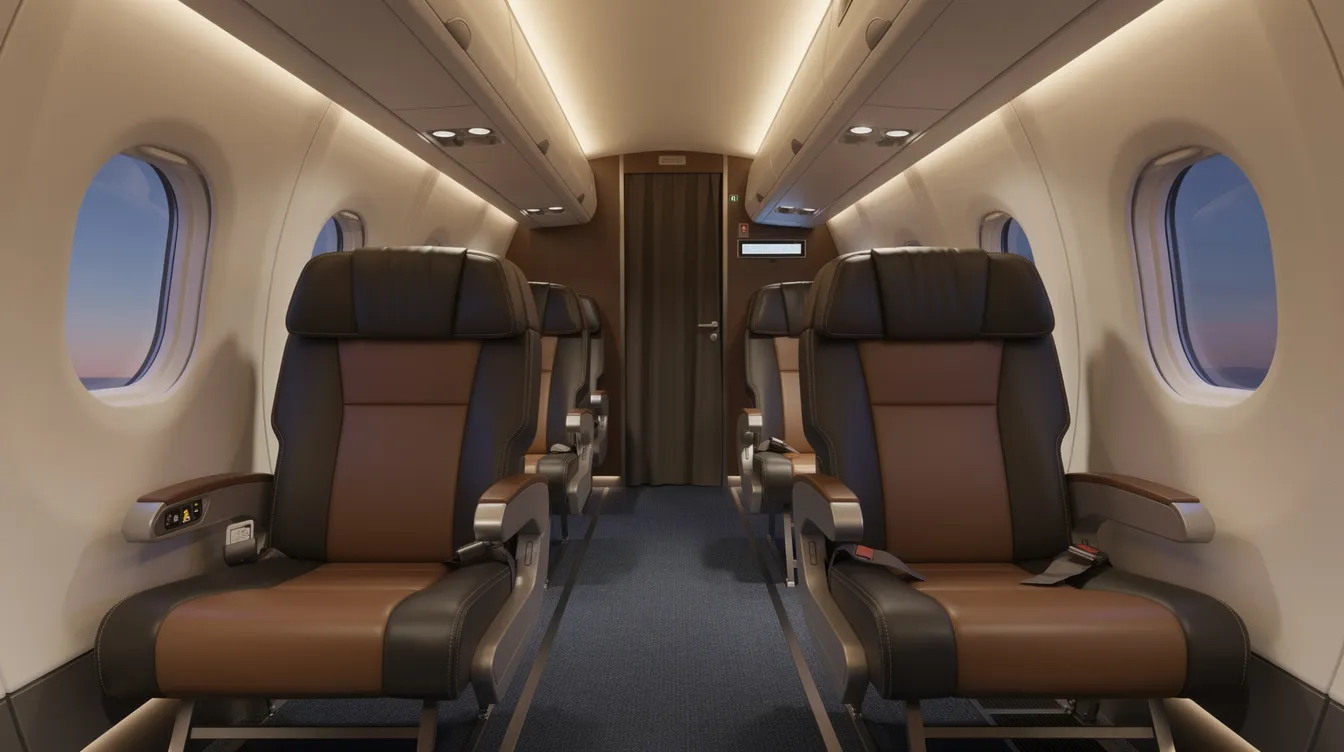
Typical amenities in private ERJ 145 conversions include:
Leather recliners or business-class seats
Upgraded carpeting and sidewall panels
Enhanced soundproofing over airline-standard levels
Wi Fi connectivity on many aircraft
Power outlets at each seat or row
Modern LED lighting systems
Refreshed overhead storage (many conversions remove small overhead bins to open up the cabin visually)
The cabin layout can vary with custom modifications for private use, and it features a spacious cabin suitable for group travel. The result is a cabin experience that sits between a traditional private jet and a premium airline cabin-practical, comfortable, and entirely dedicated to your group.
The difference between a legacy airline interior and a refurbished private-jet-style fit-out is significant when it comes to in-flight service. Cabin refurbishments can add leather seating and Wi Fi, transforming an aging regional airliner into a modern amenities-equipped charter aircraft.
Galley: Most ERJ 145 private jets feature a modular galley at the forward end of the cabin. Depending on the conversion, this may include hot and cold beverage stations, snack drawers, and a convection or microwave oven. Operators can load catering ranging from simple snack boxes to full meals based on client requests.
Lavatory: The aircraft includes a fully enclosed lavatory with a sink, typically located at the rear. VIP conversions often upgrade finishes, lighting, and privacy features.
Connectivity and entertainment: Wi Fi availability is common but not universal across the charter fleet. Some operators have installed Starlink high-speed internet, while others offer streaming via personal devices. For corporate flights, optional screens or presentation systems allow mid-flight briefings.
These features serve real use cases: pre-game meals for sports teams, business presentations during longer flights, or relaxed family service on vacation charters. Jettly can request specific catering, power outlets at every seat, and cabin setups from operators during the booking process, often leveraging Jettly Eats in-flight catering for private jets to coordinate menus across airports.
The ERJ 145 became a backbone of North American regional networks under the American Eagle and United Express brand names starting in the late 1990s. Envoy Air (operating as American Eagle) and ExpressJet Airlines (operating under the United Express brand) were among the largest operators. CommuteAir operates the largest fleet of 165 ERJ 145s as of August 2021.
The aircraft was popular on high-demand regional routes in the Americas, connecting smaller cities to hubs like Chicago O'Hare, Dallas–Fort Worth, Houston, and Charlotte. Routes were typically under two hours-exactly the mission profile the aircraft was designed for. It also found success in South America and the European market, though the American market remained its primary home.
As airlines shifted toward larger regional airliners and mainline narrowbodies, many operators retired their ERJ 145 fleets. This created an opportunity: affordable airframes with decades of remaining structural life became available for private conversion. The final delivery of new-build ERJ 145s marked the end of production, but the platform's second life was just beginning.
Beyond airline use, ERJ 145 airframes serve as government VIP shuttles, medevac platforms, and military surveillance aircraft (the R-99 variant). These roles, along with its joint venture partnerships and broad adoption, underscore the platform's versatility and mirror how other regional jets like the Canadair CRJ-200 have transitioned between commercial and charter markets.
For charter clients booking via Jettly, this operational maturity means abundant parts, experienced crews, and proven dispatch reliability. The ERJ 145's operational profile is built for high-cycle commercial use, which translates to robust airframe durability in charter service, and it sits within Jettly’s broader private charter aircraft network spanning thousands of jets worldwide.
The ERJ 145 holds a strong safety record that ranks it among the safest aircraft families ever produced. The ERJ 135/140/145 family has recorded approximately 24 million passenger flights with zero passenger fatalities in scheduled service as of late 2026. The aircraft has a low accident rate of 0.01 per thousand years. While the ERJ 145 family has experienced 26 accidents and incidents over its service life, none have resulted in passenger fatalities in scheduled airline operations.
Key safety design elements include:
Twin rear-mounted Rolls-Royce AE 3007 turbofan engines known for reliability and backed by a global support network
Redundant hydraulic and electrical systems meeting FAA/EASA Part 25 transport-category certification standards-the same regulatory framework applied to Boeing 737 and Airbus A320 aircraft
Honeywell Primus 1000 avionics suite with an all-digital cockpit, advanced avionics, crew alerting system (including engine indication), TAWS (terrain awareness), TCAS (traffic collision avoidance), and modern autopilot on the flight deck
Maintenance intervals are based on flight hours and cycles, and the global ERJ support network-with many operators and MROs worldwide-helps keep dispatch reliability high. Maintenance standards remain rigorous because most charter operations fall under FAA Part 135 or equivalent international regulations, and understanding how Part 135 charter companies work can give charter clients additional confidence in safety oversight.
Jettly works only with properly certified operators and recommends that safety-conscious clients review operator safety ratings during booking. For broader context on aircraft safety, Jettly's safest passenger planes guide provides additional perspective.
The ERJ 145 is not the cheapest aircraft to run per hour. But it can be remarkably cost-effective per passenger when flying 25–50 people together. It is a cost-effective option compared to traditional heavy business jets, and it is suitable for transporting larger groups economically.
Charter pricing ranges:
|
Cost Factor |
Typical Range |
|---|---|
|
Hourly charter rate |
$6,000–$16,000/hr (average ~$8,700) |
|
Operational costs |
$757–$1,338/hr |
|
Monthly lease |
$38,000–$55,000 |
|
Pre-owned purchase price |
~$2,500,000 |
Actual quotes depend on region, operator, aircraft configuration, and scheduling. A basic-configuration ERJ 145 on a favorable route may charter for $6,000–$9,000 per hour, while VIP-outfitted aircraft with repositioning and peak-demand surcharges can reach $12,000–$16,000 per hour.
The math becomes compelling for groups. On a two-hour leg with 50 passengers and a rate of $5,800 per hour, the per-seat cost drops to roughly $230-often less than a last-minute commercial ticket on the same route, with the added benefit of schedule flexibility and private boarding.
Chartering an ERJ 145 can be more economical than multiple smaller jets. Two midsize business jets carrying 8 passengers each at $5,000/hr each total $10,000/hr for 16 passengers. One ERJ 145 at $8,700/hr carries three times as many people. Jettly's private jet cost calculator and jet card flight cost estimator help clients model these scenarios directly.
The ERJ 145 effectively bridges commercial aviation and private jets, delivering an airline-style cabin entirely dedicated to a single group. The aircraft is often reconfigured for VIP or corporate shuttle operation, and some groups lower costs further by using Jettly’s platform to crowdsource private jet flights and share empty seats when schedules allow.
Corporate shuttles: Companies run regular weekday flights between offices-New York to Raleigh, Los Angeles to Silicon Valley, Houston to Chicago. Staff bypass busy terminals and fixed airline schedules. Learn more about this model in Jettly's corporate shuttle flights guide, including practical examples from markets such as private jet charter in Kolkata, West Bengal.
Sports teams and collegiate athletics: A full roster, coaching staff, and equipment fit on one aircraft. The ERJ 145 has a higher baggage capacity than many small business jets, with approximately 324.9 cubic feet of cargo hold space. Flexible departure times, tailored catering, and secure private boarding simplify game-day logistics and reduce logistical difficulties.
Leisure and event travel: Destination weddings, corporate retreats, incentive trips, and fan charters for 30–50 guests flying nonstop to resort destinations or smaller airports near venues.

Sample routes within ERJ 145 range:
New York (TEB) → Miami (OPF): ~950 nm
Dallas (DAL) → Denver (APA): ~660 nm
Chicago (MDW) → Charlotte (CLT): ~530 nm
Los Angeles (VNY) → Las Vegas (LAS): ~225 nm
São Paulo (GRU) → Buenos Aires (EZE): ~900 nm
For group private jet charter planning, Jettly can match the right ERJ 145 variant and operator to your specific itinerary.
Choosing between an ERJ 145 and a traditional light, midsize, or super-midsize jet comes down to trade-offs between group size, cabin comfort per passenger, and cost per seat.
Cabin configuration: The ERJ 145 offers a single large cabin with airline-style rows versus the club seating arrangement in smaller jets. You get more walking space and far greater capacity, but each individual seat may have less luxury than a heavy business jet's lie-flat configuration.
Airport access: The ERJ 145 can operate from shorter runways than larger aircraft but still needs more runway than light jets or turboprops. Many shorter routes to very small airstrips may require smaller aircraft. For more on how the ERJ 145 stacks up against similar conversions, see Jettly's CRJ private jet guide.
Cost comparison: Hourly rates for an ERJ 145 are typically higher than for a single midsize jet. But the cost per traveler drops sharply once the group grows beyond 20 passengers. The ERJ 145 can accommodate up to 50 passengers, and its 2-1 seating configuration offers more personal space than some other regional jets, making it well suited for groups that want comfort without paying for multiple aircraft.
Jettly's advisors can model different scenarios-two midsize jets versus one ERJ 145-to find the best balance of comfort, schedule, and budget. A private jet comparison tool helps visualize these trade-offs.
Jettly is a digital private aviation platform that connects clients with a broad inventory of aircraft, including Embraer ERJ 145 operators around the world. As a charter broker, Jettly handles the sourcing and coordination while flights are operated by certified third-party carriers.
The typical booking workflow:
Enter your route, dates, and passenger count on Jettly.com
The platform returns instant pricing options, which may include ERJ 145s alongside other aircraft types
Jettly coordinates with operators to confirm aircraft availability, safety credentials, and exact cabin configuration
Add-ons like catering, ground transfers, luggage handling, and onboard branding (headrest covers, signage) are arranged for corporate or team travel
For a step-by-step walkthrough, Jettly's how to charter a flight guide covers the full process.
Ready to explore ERJ 145 charter options? Request a quote at https://www.jettly.com or browse partners like Dexter Air Taxi’s private jet operator page within the Jettly network.
Large-group charters can be optimized through private jet memberships and smart scheduling, especially for recurring corporate shuttles or seasonal operations.
Jettly membership can offer more predictable pricing, service benefits, and reduced booking fees on high-frequency use of aircraft, including ERJ 145-class jets. Travelers and content creators can also benefit from Jettly’s ULTRA high-ticket affiliate program, earning commissions by referring new members and charter clients. For companies running regular shuttle programs, working with Jettly to design semi-fixed schedules that leverage the same operator and aircraft type improves both reliability and cost stability, and some organizations pair this with world-class corporate jet card programs to lock in hourly rates.
Empty leg opportunities also arise when ERJ 145s reposition between charter missions. These empty leg flights can be available at significant discounts-ideal for flexible groups that can adjust timing and routing. While ERJ 145 empty legs are less frequent than those on smaller jets, they do appear, particularly on high-demand regional routes.
Though ERJ 145 charters involve substantial total spend, thoughtful use of memberships, route planning, and operational efficiency can deliver strong value compared to buying or leasing an aircraft outright-especially when monthly lease costs for the ERJ 145 range from $38,000 to $55,000 and the average purchase price of a pre-owned ERJ 145 is $2,500,000.
Larger aircraft like the ERJ 145 consume more fuel per hour than light jets. But on a per-seat basis, a fully loaded ERJ 145 can be significantly more efficient than flying multiple smaller aircraft. Consolidating a large party on a single charter instead of multiple jets-or dozens of separate commercial tickets-streamlines logistics and can reduce overall trip emissions.
Efficient flight planning, modern avionics, and optimized cruising altitudes all play a role in minimizing fuel burn. Some operators offer sustainable aviation fuel (SAF) when available, along with carbon offset programs. Jettly can help identify operators providing these solutions and offers additional guidance on affordable private jet charter strategies that align budget and sustainability goals.
Environmentally conscious clients should ask Jettly about carbon offsetting, routing efficiencies, and aircraft selection tailored to their sustainability priorities. Regional travel on a single aircraft, rather than spreading passengers across multiple flights, often proves to be both the greener and more practical choice, and in some cases a Eurocopter EC30 charter or other helicopter solution may further reduce repositioning and ground-transport emissions for short hops.
These FAQs address practical questions about chartering an ERJ 145 that supplement the main article above and complement broader advice on how to get a seat on a private jet easily through memberships, empty legs, and shared flights.
The ERJ 145's cargo hold offers approximately 325 cubic feet of space-enough to handle checked-size bags for 30–40 passengers plus light sports equipment or trade show materials. For oversized items like golf bags or musical instruments, confirm capacity with the operator during booking. Unlike smaller business jets where you may need to gate check bags or limit carry-ons, the ERJ 145's hold handles volume similar to a small commercial flight.
Most Embraer ERJ 145 private charters operate from FBOs (fixed-base operators) or private terminals. Passengers enjoy dedicated security screening, private lounges, and direct tarmac boarding-eliminating the long walks, crowded gates, and TSA lines associated with commercial service. At some airports, ERJ 145s may use a remote stand with ground transport to the aircraft. This process typically saves 60–90 minutes compared to a commercial departure.
Wi Fi is common on many chartered ERJ 145s but is not guaranteed on every airframe. Some operators have installed Starlink or other broadband systems, while older aircraft may lack connectivity entirely. Confirm Wi Fi availability during the quoting process, and let Jettly know if connectivity is a priority-the platform can match clients with Wi-Fi-equipped operators.
Permanent seat reconfiguration requires a supplemental type certificate and significant downtime, so it is typically handled by the operator rather than per-trip. However, many operators can adjust seating zones, block specific rows, and add soft branding like custom headrest covers, welcome signage, or onboard printed materials. Jettly can coordinate these requests in advance. For more extensive customization-such as conference areas or lounge seating-look for operators with existing VIP-configured ERJ 145 airframes.
For routine travel on flexible dates, two to four weeks of lead time is usually sufficient. For peak seasons, major sporting events, or holiday periods, booking several months ahead improves aircraft selection, pricing, and access to preferred time slots. ERJ 145 availability is more limited than midsize jets simply because fewer aircraft are in the charter fleet, so earlier booking through Jettly significantly increases options-particularly during high-demand periods.
The Embraer ERJ 145 is a proven regional aircraft platform repurposed as a capable, cost-effective private jet for 25–50 passengers. With millions of flight hours, zero passenger fatalities in scheduled service, a deep global support network, and flexible cabin layouts, it fills a niche that few other aircraft can match.
The ERJ 145 is ideal for corporate shuttles, sports teams, events, and large family groups on regional legs. It has faced challenges common to aging airframes-older interiors, higher maintenance needs-but modern amenities upgrades and VIP conversions address these directly.
For very high-end, small-party luxury travel on shorter routes, a midsize or heavy business jet may be the better fit, such as chartering a Gulfstream G-IVSP private jet for rent when long-range comfort for a smaller group is the priority.
For groups that need capacity and schedule control, chartering an Embraer ERJ 145 private jet via Jettly is often the most practical solution for high-capacity regional missions. The platform's operational flexibility, combined with Jettly's broker network, makes it straightforward to compare options and lock in the right aircraft for your trip.
Ready to experience private travel on your terms? Explore flight options or request a quote at https://www.jettly.com.
Share this post:
Jay Franco Serevilla
Nov 8, 2026
|
5
min read
Discover tips and trends in the industry.

5
min read
How Many Plane Crashes in 2025? Global Air Safety, Statistics, and Context
In 2025, there were 51 commercial airline accidents worldwide, with 8 classified as fatal, resulting in 394 fatalities. Despite a rise in fatalities, the overall accident rate improved, highlighting the complexities of aviation safety. This article provides insights into the statistics and implications for travelers.
Read More
5
min read
Jet Airliners: From Early Jet Aircraft to Present-Day Commercial Airliners
Jet airliners have revolutionized global travel since the 1950s, transforming long journeys into hours-long flights. This article explores the evolution from early models like the de Havilland Comet to modern aircraft such as the Boeing 787, highlighting their impact on commercial aviation and the rise of private jet travel options.
Read MoreStay updated with our latest insights and tips to elevate your journey with us.
MEMBERSHIPS AND ASSOCIATIONS



© 2026 Jettly Inc. All rights reserved.
Disclaimer: Jettly operates as a charter broker, offering access to a global digital jet charter marketplace. Jettly is not a direct air carrier and does not own or operate aircraft. All advertised flights are conducted by third-party air carriers that are fully licensed and hold the appropriate Part 135 or Part 121 certifications issued by the Federal Aviation Administration (FAA) or equivalent regulatory authorities under U.S. or foreign law. Jettly complies fully with the U.S. Department of Transportation's Part 295 and Part 298 Charter Broker regulations. Jettly does not carry additional liability insurance. Passengers are covered by aircraft operator insurance. TICO: 50023770


